The Rupp Report: They Never Give Up

Recently, the annual figures of the national gross domestic products (GDPs) of various countries of
the European Union (EU) were published. Most of them are not very favorable compared to those for
Asian countries. Most of them show a negative growth. Many Western industrialized countries not
only are dealing with the aftermath of the financial crisis, but also with the long-term flattening
growth of their economies.

Group Of 30

Now, some financial newspapers have published the message that the Group of Thirty (G30), an
association of leading representatives of the global financial industry, warns urgently of the risk
that insufficient long-term investment will occur worldwide in the coming years. They claim that
this could weaken the growth sensitively. The G30 is a secretive panel of private bankers. Mario
Draghi, president of the European Central Bank (ECB), and Bank of England Governor Mervyn King are
among its members — but why is that so? The EU now wants some clarification: What is this group,
and what do they want?

From 2006 to 2011, Draghi, an Italian bank manager and economist, was governor of the Bank
of Italy, and since Nov. 1, 2011, has served as president of the ECB. He was also former vice
chairman of Goldman Sachs International, and is currently also a board member of the Bank for
International Settlements in Basel, Switzerland.

Who’s Who Of Global Finance

In 1978, Geoffrey Bell, an American banker and economist, founded the G30 on the initiative
of the Rockefeller Foundation. Bell is an extremely important and powerful advisor to private and
central banks. Johan Witteveen, former managing director of the International Monetary Fund, served
as the group’s first chairman. According to its website, the G30 currently has 32 active members,
which reflects a real Who’s Who in the banking sector: In addition to Draghi and King, other
members include JPMorgan Chase International Chairman Jacob A. Frenkel, chairman of the G30’s Board
of Trustees; and U.S. economist and Nobel Laureate Paul Krugman. Former ECB President Jean Claude
Trichet is the group’s chairman.

Conflicts Of Interest

Now, the Corporate Europe Observatory, an organization that fights against corruption, is
blaming Draghi for a conflict of interest: The organization raises questions about Draghi’s
independence as a member of the G30, which is mostly entangled with large bankers. The cornerstones
of the EU should be “impartiality, independence and objectivity” — factors that are obviously in
strong conflict with practices at the G30.

Lobbying

In a self-declaration, the Group of Thirty states that “it is dedicated to the study of
economic and financial phenomena.” For this, the members meet twice a year to gain “a deeper
understanding of international business and finance” and to understand “the impact of decisions in
the public and private sectors.” In it unclear to what extent the G30 is influencing the world
economy. Having these confidential gatherings and the composition of the group — that is, its
exclusive members — in mind, critics suspect unwritten and clandestine agreements.

According to a G30-commissioned study titled “Manufacturing the future: The next era of
global growth and innovation,” prepared by the consulting firm McKinsey Global Institute, the group
claims that the investment needs of the nine largest countries — which together are responsible for
60 percent of the GDP — will grow from 30 percent of the GDP in 2010 to 34 percent in 2020. This
would represent a real investment needs growth of US$7.1 trillion to US$18.8 trillion.

The authors believe that the global financial system will struggle to provide the necessary
capital to provide for the expected surge in investment. The main sources of investment, subject to
national differences, include self-financing by households and companies, which represents
approximately one-third; governments, which represent 25 to 30 percent; and bank loans and
mortgages, representing approximately one-third. The study claims that banks and governments, as a
result of the financial crisis, are not able to do their job. That’s why the “non-banking sector
and the capital market should step much more into the breach,” they state.

New Regulations (?)

Now, the G30 proposes to remedy “an array of especially regulatory measures to strengthen
the capacity and willingness to long-term investments.” That is strange.

On the other side, 11 EU countries — out of 27 member states — decided that from 2014, a
uniform minimum tax would apply to bank and stock market transactions. The fact that not all EU
member states want to participate should leave one wondering. The EU Taxation Commissioner in
Brussels has presented parts of a proposal to introduce a financial transaction tax. The tax is
expected to provide the Commission with annual revenues of 30 billion to 35 billion euros from the
11 countries. Financial experts say that this seems to be a fair and technically sound control,
which would strengthen the internal market and bridle irresponsible trade.

With this tax, banks and other institutions should contribute to the costs of the financial
crisis, which have been paid mostly by taxpayers. Liability for taxation should be placed only on
financial institutions. Ordinary banking activities, credit and savings services, and insurance are
not included.

The G30 says that portfolio managers of pensions and sovereign wealth funds should be more
powerful, and, for example, might receive bonus incentives (!). But also, the group supports
implementing accounting rules that “give the short-term market volatility of long-term investments
less weight.” And there is no limit -the “cooperation between the public and private investors
could be developed.”

The Purpose Of The Group Of Thirty

What is this Group of Thirty really doing, and what do they want? Board Chairman Frenkel
said in January 2012 that “the effectiveness of the G30 is directly related to the quality and the
status of its group members.” What is the effectiveness of a private lobbying organization
dedicated to directly influencing the world economy?

Many personalities from politics and business complain that bodies such as the G30 can
hardly distinguish between public duties and private interests; and also that all that relates to
politically relevant content and discussions and decisions can hardly be private. What do these
people really discuss and negotiate? No one knows. Social networks are already on call to stop the
G30. Now the European Ombudsman is trying to resolve the Draghi case and the question of whether
the G30 will have some influence on the fortunes of Europe. One thing is clear: The top leaders of
the financial world do not give up so quickly.

February 19, 2013
Textile Manufacturing: Global Cost Trends From A U.S. Perspective: Trends In Fiber And Yarn Prices

Introduction

There recently has been a noticeable increase in the U.S. public’s interest in domestic
manufacturing. This was a much-discussed topic in recent political elections for a variety of
reasons, including patriotism and concern for the U.S. economy. Co-author B.J. Hamilton sought to
examine trends in production costs to determine whether conditions are becoming more favorable for
textile manufacturing in the United States. This is the first installment of a four-part series of
papers created from part of that research.

The main source of secondary data utilized in this paper was the monthly “Yarn Market”
department of

Textile World
magazine from 1980 to 2012.

Fiber And Yarn Price Data

In subsequent parts of this series, it will be shown that due to the cost structure of yarn
manufacturing, the United States would benefit from an increase in fiber prices, such as the steep
increase in cotton prices in 2010-11. In order to show the overall influence of fiber prices on
yarn prices, which obviously impact the total costs of subsequent textile processes and products,
it was believed worthwhile to review historical trends. Figures 1-3 show the historical prices of
fibers and the yarns made from those fibers.

Figure 1 shows the prices of raw cotton fiber, 10/1 ring-spun yarn and 10/1 rotor-spun yarn
from 1990 to 2012. Figure 2 shows the prices of 1.5-denier polyester fiber and 8/1 ring-spun
polyester yarn from 1984 to 2012. Figure 3 shows the prices of 3-denier acrylic fiber and 12/1
rotor-spun acrylic yarn from 1984 to 2012. In each instance, any increase in fiber price is
reflected by a similar increase in yarn prices and these cost increases and decreases are quickly
passed down the textile supply chain. It is clear also that, particularly for cotton, there is the
expected slight lag between changes in fiber prices and changes in yarn prices.

Figure 4 compares the prices of the fibers found in the past three figures from 1990 to
2012. A relationship can be seen among the three fibers. The market dictates that if the price for
one goes up, the demand for others will increase, leading to the prices of the other fibers also
increasing. It is seen that in 2010-11, the sudden price increase in raw cotton was soon followed
by price increases for polyester and acrylic fibers.

Conclusions

This paper shows the close relationship between the price of raw fibers and the yarns made
from those fibers. It also shows the correlation between various fiber prices. This means that an
increase in any one fiber price should affect the costs for both spinners of other fibers and for
fabric makers.

References

Hamilton, B.J. (2012). “Short- and Long-Term Opportunities for US Textile Manufacturing.”
PhD Dissertation, North Carolina State University.

Textile World “Yarn Market” (1984-2012).


Editor’s note: Brian John Hamilton, Ph.D., is product developer – Domestic Lifestyle at New
Balance Athletic Shoe Inc., Boston. William Oxenham, Ph.D., is Associate Dean, and Kristin Thoney,
Ph.D., is Associate Professor at North Carolina State University’s College of Textiles, Raleigh,
N.C.


February 19, 2013

Starlinger & Co. GmbH Opens Office In Indonesia

VIENNA, Austria — February 2013 — As of December 2012, Starlinger has opened an independent
regional office in Surabaya to enhance sales and service support for customers in South East Asia.

“PT Starlinger SEA” has been founded in response to the growing woven packaging market in
South East Asia and is operating as an independent company. It handles sales and service activities
of both business areas of Starlinger, textile packaging machinery and plastics recycling lines, and
is headed by Mr. Hengky Senjaya. Four regional technicians are available for technical service and
support, with more technicians being hired and trained in the course of the year. “The aim is to
provide full technical service coverage and to establish Indonesia as the base for Starlinger’s
technical service activities in Asia. The new office will also facilitate the market development in
the region and help us to further strengthen our position in Asia”, says Starlinger Sales Director
Hermann Adrigan.

South East Asia: An Important Growth Market

The strong economic growth in the South East Asian countries during the past years have made
this region an important market on national as well as international level. This also means strong
potential in the packaging sector: For example, 95 % of all agricultural products destined for the
local markets are transported in woven plastic bags; Starlinger customers thus produce packaging
mainly for the agricultural sector. But also the cement and chemical industries are steadily
growing and, together with fast growing export rates, provide further markets for flexible woven
packaging.

Posted on February 19, 2013

Source: Starlinger & Co. GmbH

Rosink’s 10 Years Nonwoven Anniversary

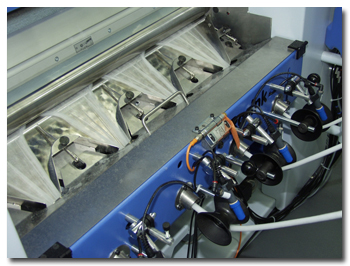
NORDHORN, Germany — February 2013 — 10 years ago Rosink successfully installed its first Air Quad
Web Splitting Unit, called RAQSU40 on to a Trützschler high production revolving flat card. This
started as a so called retrofitting project (textile machine modernization) and nowadays it is sold
as a working unit together with Rosink’s premium business partner Messrs. Trützschler, with sales
all over the world.

This development, from textile machinery specialist Rosink Maschinenfabrik, was, and still is
unique in the nonwoven hygienic industry.

The highly economical and short production process offers 4 ultra-light single slivers *
ranging between approx. 1,2 – 1,7 g/m each **; directly from the card without the need of a draw
frame. The 4 slivers are discharged by special ionization nozzles and coiled at high speeds up to
175 m/min! Various control systems ensure perfect sliver evenness.

The special Rosink Quad Can Coiler, coils all 4 slivers smooth and precise into round
spinning cans 24″ x 48″. An automatic can doffing system, easily & quickly changes all 4 cans
at the same time. These cans of sliver can now go directly to your cotton swabs machine(s).

The above equipment “Made in Germany” includes the latest technology for trouble free &
safe running. Totally 74 installations are performing an excellent job throughout the world.

Rosink

Rosink’s Web Splitting Unit


Besides this bleached cotton sliver production line, Rosink and Trützschler also mutually
sell, modern, high absorbent flat ribbon (tampon strip) production lines, for digital tampon
production.

Posted on February 19, 2013

Source: Rosink GmbH + Co. Machinenfabrik

Textile Exchange Introduces New Organic Content Standard

O’DONNELL, Texas — February 19, 2013 — The Organic Content Standard (OCS) is a new chain of custody
standard to track certified organically grown raw materials through the supply chain through the
use of scope certificate and transaction certificates, all verified by an independent third-party.
The OCS will replace the OE 100 and OE Blended standards, within an allowed transition time.

What is new?

  • The OCS will allow any kind of certified organically grown material; it is not limited to
    cotton.
  • The OCS combines the former OE 100 and OE Blended into one standard. There will continue to be
    two options for labeling, according to final organic material percentages and whether it has been
    blended with its conventional counterpart.


How can the OCS be used?

Because the OCS can be used with any raw material, it is relevant for industries
beyond textiles. The standard combines an organic farming certification requirement with the chain
of custody requirements of the Content Claim Standard (CCS).


How do I become certified?


There will be a transition period while Certification Bodies become accredited to the new
standard. As soon as the process is complete, we will post the list of Certification Bodies onto
the OCS webpage. Contact your Certification Body for more information.

What if my company is already certified to the OE standards?

Your company will transition to the OCS in your next annual renewal audit. Contact your
Certification Body for more information.


I have questions!


Register for the upcoming webinar “Integrity in Content Claims,” which will explain content
claims and how they are supported by the Content Claim Standard, the Organic Content Standard, and
the upcoming Recycled Content Standard.

Send your questions to Integrity@TextileExchange.org.

Posted on February 19, 2013

Source: Textile Exchange

Switzerland – An Enigma?

Switzerland is one of the smallest countries in Europe and has very high living costs compared to
other nations around the world. Yet, the country is not a member of the European Union (EU).
Switzerland has no direct access to the sea, and its main natural resource is water. However, the
country of some 8 million people enjoys a quite stable economy. This is also the case for the Swiss
textile machinery industry. Is there any secret for that ongoing success?

After ITMA 2011 and ITMA Asia + CITME 2012, the Swiss manufacturers of textile machinery and
auxiliaries expressed in many discussions their overall satisfaction with their recent economic
situation. In spite of the euro crisis and some problems in Asia, particularly in China, the Swiss
textile machinery manufacturers are well-prepared for the future.

StaubliSwiss

Stäubli reports that automatic drawing-in machines are very much in demand.

Stable Economy

As of

TextileWorld.com
‘s press time, there are no firm figures for the full year 2012 available for the Swiss
economy and the textile machinery industry. In November 2012, overall Swiss foreign trade grew
exceptionally well. According to the Swiss Federal Customs Administration, exports rose within a
year by 5.1 percent in spite of a very strong Swiss franc, while imports rose 5.4 percent. The
overall trade surplus for November alone was more than 2.9 billion Swiss francs — the
second-highest monthly surplus ever — and for January to November 2012, it was 23.5 billion Swiss
francs. Export sales increased in November, varying by industry.

For 2012, the gross domestic product (GDP) is estimated to have grown by some 0.9 to 1.0
percent. The Swiss economy is supported by robust domestic demand, especially in construction,
retail and insurance sectors. However, it is characterized by difficulties in almost all export
sectors, which are jeopardized by the strong Swiss franc.

Imports increased in all main groups except capital goods. Especially strong was the
25-percent increase for energy. Raw materials and semi-finished goods imports rose by 4.7 percent.
Consumer goods imports increased 5.2 percent on average, including pharmaceutical products, which
increased 25 percent.

Unbalanced Europe

The situation in Europe remains insecure for all Swiss companies, including those in the
textile machinery industry. Experts predict that the European debt crisis will last at least
another two or three years. According to economiesuisse, the eurozone will have negative growth in
2012 and 2013 of -0.4 percent and -0.5 percent, respectively. economiesuisse is the largest
umbrella lobby organization in the Swiss economy. It represents more than 100,000 companies that
employ a total of 2 million workers.

RieterSwiss

According to Rieter, markets will stay dynamic and volatile; flexibility and speed will
remain very important.

Where Are The Markets?

Based on statistics reported for January to November 2012, exports to EU countries decreased
slightly by 0.1 percent. Other regions present a very different picture: exports to Oceania and
Latin America grew by 7.4 percent and 12.1 percent, respectively; to North America, by 13.3
percent; and to Africa, by 5.1 percent. One may be surprised to learn that exports to Asia grew
only by 3.4 percent. For the month of November alone, exports to the EU increased 1.1 percent;
Oceania, 22.4 percent; Latin America, 18.4 percent; North America, 16.6 percent; Africa, 14.0
percent; and Asia, 8.7 percent.

The main reason for the relatively small increase in Asia is the fact that many Swiss
producers have opened their own companies in Asia. This is very much the case for the Swiss textile
machinery industry. Virtually all important Swiss textile machinery suppliers have their own
production sites in Asia, mostly in China or India.

Market Situation

As mentioned before, in general, the Swiss textile machinery industry is looking forward to a
promising future. All companies interviewed for this report declared that they are more or less
happy with the year 2012. The first six months were rather difficult, but the second half was much
better, itema reported. Remo Dähler, head of sales, Calorifer AG, mentioned that the company’s
Steinemann Central Vacuum Systems business enjoyed a very good year in 2012.

Top exporting countries and regions for the Swiss manufacturers are China, India, Brazil,
Southeast Asia and Turkey. Also important are Japan, Egypt, Bangladesh and the United States; and,
for itema, even Indonesia. However, mentioned Ralph von Arx, managing director of Retech AG, “for
us, as an OEM, the most important countries are Europe and the U.S.” Other countries he named were
Germany and Vietnam.

Some companies have top sellers. Others, like Crealet AG and Calorifer, offer custom-built
solutions. itema mentioned its new R9500 rapier weaving machine is very much in demand. In
addition, the Silver Dynaterry rapier weaving machine is claimed to be itema’s best-selling machine
for terry fabrics. Retech mentioned that thanks to the ever-increasing importance of technical
yarns, its heated godets for technical yarns are very much in demand. For Rieter, ring and, even
more, compact spinning are products that are in very high demand, as are air-jet machines and
complete installations. Reinhard Furrer from Stäubli AG mentioned that automatic drawing-in
machines are very much in demand because delivery times are getting shorter and these machines
support short production cycle times. Jacquard machines are also having great success, as the
demand for top-quality fabrics is still a trend.

To present the versatility of the Swiss textile machinery industry and its peripheral
sectors,

TW
invited the members of the Swiss Mechanical and Electrical Engineering Industries’
(SWISSMEM’s) Textile Machinery Division to take part in a country overview. The results are
published in Table 1 (a link to Table 1 can be found at the bottom of the webpage).

UsterSwiss

For Uster Technologies, China, India, Southeast Asia, Turkey, Bangladesh and the United
States are the most important markets at the moment.


The Future


For 2013, the experts, including economiesuisse, predict GDP growth of some 0.6 percent.
However, there are significant differences among the sectors: The watch industry, of course,
pharmaceuticals and aviation should be the winners. On the other hand, industry sectors like
mechanical, electrical and metal; but also other sectors such as textiles, paper and the plastics
industries will continue to suffer from the crisis in the eurozone.

The Swiss textile machinery manufacturers are confident about 2013, but they have certain
reservations; the same or even better results than they had in 2012 should be possible for most of
them. Rieter says that if the euro crisis ends, the European economy will generate further demand.

The promising markets for 2013 are more or less the same as in 2012: Asia in general but
particularly China and India; Brazil, Turkey; the United States; and the EU.

It seems quite clear for the Swiss that textile mass production will move further toward
Asia, but also to Latin America and North Africa. On the other hand, the demand for technical
fabrics will grow further in Western countries. As Rieter mentions: “Markets will stay dynamic and
volatile. Flexibility and speed will remain very important. Asia with its domestic growth has high
potential.”

The Secret

And what is the secret of success for Switzerland? For decades, the unemployment rate has
been between 2.5 and 3.0 percent. Swiss people tend to be very independent — this is probably one
of the reasons the country is still not part of the EU. As citizens of a country with limited
natural resources, the Swiss are hard workers. They know very well that success will only come with
hard work and top products. This is also the case for Swiss textile machinery. For 2013,
economiesuisse predicts an unemployment rate of 3.3 percent. This is still very good compared to
other nations. After all, there is no enigma: the recipe is very simple: Don’t talk — work!

February 19, 2013

Haiti Joins TAAT Alliance, Urges U.S. To Stand By Strong Textile Rules In TPP

WASHINGTON — February 19, 2013 — Haiti became the 31st country to join the TAAT alliance which is
seeking strong and fair textile rules in the TPP agreement.

Gregor Avril, the Executive Director of the Association of Industries of Haiti said, “We
stand with our free trade partners from around the world in urging the U.S. government to stand
firm for the strongest textile rules in the agreement. These include a yarn forward rule of origin,
long tariff phase-outs for sensitive products and strong and effective customs rules and
resources.”

Vietnam, the second largest apparel exporter to the United States, has proposed to eliminate
the textile rules that have been present in every FTA for the past 25 years. By changing the
textile rules, Vietnam would open up a loophole so that China could backdoor its subsidized textile
components through Vietnam and into the United States without paying duties.

Avril stated, “Apparel production in Haiti supports tens of thousands of desperately needed
job in Haiti. Since the devastating earthquake, we are proud to have opened new textile and apparel
plants and we believe this industry has a bright future in our country. Moreover, apparel accounts
for 90 percent of Haiti’s exports to the United States and earns badly needed foreign exchange for
our country. However, if Vietnam’s proposals are included in a final TPP agreement, our bright
future is ended and Haiti’s economy will be hit hard because our industry will be devastated.”

TAAT comprises trade groups from 31 countries that have free trade and preference trade
programs with the United States. These groups employ more than two million direct workers in the
textile and apparel trade and support more than $30 billion in two way trade with the United
States. They are made up of mostly small and medium sized family owned companies. Studies have
shown that Vietnam’s proposal would lead to the destruction of most of the textile and apparel
production in the Western Hemisphere, Africa and the Middle East. This production has been on the
upswing during the last several years.

Vietnam is the second largest apparel exporter to the United States. The largest apparel
company in Vietnam is Vinatex, a state-owned and subsidized company that employs more than 500,000
workers.


Posted on February 19, 2013

Source: Textile and Apparel Alliance for TPP

Positive 2012 Fourth Quarter For Italian Textile Machinery Orders

MILAN — February 2013 — Based on an industry study conducted by ACIMIT, the Association of Italian
Textile Machinery Manufacturers, during the fourth quarter of 2012, the orders index for textile
machinery rose by 22% compared to the previous quarter, for an absolute value of 130.4 points. Even
more significant was the increase with respect to the same period the previous year (+46%).

Overall orders also benefitted from a positive trend on the domestic market, for which a 47%
increase was actually recorded compared to the three previous months. The value stood at 83.5
points. Growth on foreign markets was slightly more contained at +20%.

“The fourth quarter data are comforting, comments ACIMIT President Sandro Salmoiraghi, and
are a good omen for 2013, but we still need to consider that overall the year 2012 closed with a
decrease compared to 2011.”

In fact, on an annual basis the orders index fell by 4%, for a value of 108.6 points. Abroad,
the comparison on the previous year recorded a slight drop (-1%), while the domestic market
totalized a 21% decrease.

 “In Italy, we’re registering the effects of an overall climate of scant
confidence in the future, a fact that is common to businesses and families alike,” observes
Salmoiraghi. “We need reforms capable of promoting growth, such as those recently proposed by
Confindustria, aimed at cutting business costs – starting from the cost of labour, while boosting
investments in capital goods. These issues must be prioritized in the industrial policies enacted
by the next government.”

ACIMIT’s president concludes “Abroad, where our manufacturers realize 80% of their turnover,
we need to work together in a structured manner. This is why we ask that Italian Trade Promotion
Agency (ICE) be provided with greater resources for promoting Made in Italy products in foreign
markets, avoiding that public funds for internationalization are wasted in many unstructured
projects.”


Posted on February 19, 2013


Source: ACIMIT

Lenzing Partners With NanoCarbons LLC To Develop New Activated Carbons For Energy Storage Systems

LENZING, Austria — January 10, 2013 — Lenzing AG and NanoCarbons LLC, Fort Lauderdale (Florida,
USA), will cooperate in the future to develop and explore the use of new activated carbons in
electrode technology. This technology is based on a combination of Lenzing’s TENCEL® fibers and the
technology provided by NanoCarbons LLC. After extensive research Lenzing constructed a new pilot
production facility to take the technology forward.

The jointly developed carbons should deliver optimal performance in the area of energy
storage. It is believed that these new carbons will accelerate the development of the already rapid
growth in uses of electrical devices such as double layer capacitors (also known as ultra
capacitors or super capacitors). These high performance capacitors are being increasingly used in
hybrid vehicles as well as with stop-start systems, uninterruptable power supplies and wind turbine
blade orientation.

“For Lenzing, the development of new, special applications in the technical segment comprises
an important extension of the use of our fibers”, says Peter Untersperger, Chief Executive Officer
of the Lenzing Group in commenting on the new partnership. “The strongly growing market for energy
storage devices is a promising market niche for us. With our TENCEL® fibers we will certainly
witness the development of a series of additional, highly interesting technical applications in the
coming years.”

Friedrich Weninger, COO of the Lenzing Group with management responsibility for research and
development, adds: “We are continuing to invest in new areas of research to increase the range and
reach of our product portfolio, both in-house and through external cooperation. The new carbons
optimally complement our existing business with separator materials for the energy storage devices.
We strongly believe in the future growth of this market. We are offering our customers a
sustainable product with consistent quality to allow the industry to develop further.”

Rud Istvan, CEO of NanoCarbons LLC, comments: “I strongly believe that this development will
allow the double layer capacitor market to make a significant advancement. With the combination of
Lenzing’s technical understanding and infrastructure and Nanocarbons’ technology, we can expect an
acceleration in the market uses and exploitation of double layer capacitors, from new automotive
stop-start systems to uninterruptable power supplies. This could be a breakthrough for electrode
technology that will reap dividends for the designers of electrical components and the drivers of
vehicles alike.”

Posted on February 19, 2013

Source: Lenzing

ACIMIT Attentive To New Training Initiatives

MILAN — February 2013 — ACIMIT, the Association of Italian Textile Machinery Manufacturers, has
always played a fundamental role in promoting awareness and knowledge of Italian technologies for
textile operators, as well as in lending its support to training initiatives and courses for
personnel in countless textile production facilities making use of Italian machinery around the
globe. This commitment bears witness to the various forms of partnership initiated by ACIMIT with
technical institutes and engineering faculties both in Italy and abroad. The latest of these
partnerships has been undertaken with the Textile & Engineering Institute of Ichalkaranji
(DKTE’S) for the implementation of a local training center.

Always attentive to new training initiatives, ACIMIT is therefore keeping a close watch on
the very first edition in English of the 1st Level University Master’s course in Management and
Textile Engineering, offered by LIUC-Università Carlo Cattaneo di Castellanza together with Città
Studi Biella. The Master’s course will be held from September 2013 to July 2014 in the city of
Biella, at the Città Studi university campus, and will be targeted at recent engineering graduates,
and managers or technicians who are already working and possess an engineering degree from Italy or
abroad. The aim is to provide participants with essential training that will allow them to qualify
for technical positions in the textile and garments sector, combining an assimilation of the latest
technology specific to the industry with fundamental managerial and behavioural skills.

ACIMIT President Sandro Salmoiraghi commented “With the entire textile and garments industry
currently being transformed, businesses are increasingly globalized and are required to compete
with a growing number of foreign competitors. We need to focus on production efficiency and
state-of-the-art innovation; this requires multicultural human resources in management positions
who possess a broad range of expertise, capable of managing increasingly complex processing cycles
from both a technical and economic/production standpoint, and this Master’s course is definitely a
step in the right direction”.

For more information, please visit www.masterMTE.cittastudi.org. For students in Italy and
the European Union the application deadline is 2 August 2013, whereas for students outside the EU
the deadline is 3 May 2013.

Posted on February 19, 2013

Source: ACIMIT

Sponsors