BASF Revamps Leather And Textile Chemicals Business

BASF SE, Germany, has announced plans to reorganize its Leather and Textile Chemicals business unit
(BU) to focus on the Asia-Pacific region and on high-value-adding applications.

Leather Chemicals will focus on core technologies for automotive and premium leather
applications. Textile Chemicals will focus on value-adding steps such as printing and finishing and
solutions for manufacturing premium textile items.

BASF will establish a global innovation center for its Leather and Textile Chemicals BU
within the BASF Innovation Campus in Shanghai.

The company will eliminate 65 positions, including 29 in Germany, to adjust to the BU’s new
setup, and will create approximately 23 positions to support anticipated growth in China, India and
Turkey.

The reorganization is expected to be completed by the end of 2014.

May/June 2013

Stork Prints Debuts NovaScreen®

Stork Prints BV, the Netherlands, now offers NovaScreen® 195-19% — a combination of the open-area
NovaScreen 165 (mesh) screen and the high-resolution NovaScreen 195 (mesh) screen — for the textile
printing market. For printers that require voluminous paste supply, the hybrid screen offers a
high-resolution option with improved paste flow and printability.

Stork reports primary benefits of the new screen include: high screen volume and high
printing resolution; improved surface printing; and benefits in geometric printing.

A unique electroforming process allows Stork to control nickel growth during screen
production and push the ratio among hole size, mesh count and thickness of the screen beyond
conventional boundaries. By keeping the nickel growth mostly toward the top of the screen, the dam
shape stays thin and streamlined.

Stork reports that a smaller, more streamlined dam shape increases the chance of paste
flowing beneath the dam with lower squeegee pressure, thus creating a more even spread of paste on
the textile substrate. This even paste flow makes the screen suitable for pigment printing and
penetrative printing. In addition, the look and straightness of geometric and engraved prints is
improved, and improved rasterizations with dot definition generate quality halftone impressions.

DPFnewsStork

Stork Prints’ NovaScreen® for textile printing offers improved geometrical (top), fine-line
(middle) and halftone (bottom) printing.

May/June 2013

M&S Approves SDL Atlas Pnuburst

SDL Atlas, Rock Hill, S.C., reports that United Kingdom-based fashion retailer Marks & Spencer
(M&S) has approved the SDL Atlas PnuBurst Pneumatic Bursting Strength Tester for use in M&S
P27 method tests.

May/June 2013

SDL Atlas Offers PowerTear™ Tester

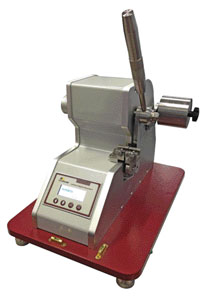
SDL Atlas, Rock Hill, S.C., has introduced the PowerTear™ High-Energy Elmendorf Tearing Tester for
testing the ballistic tear strength of both fine and heavyweight textiles.

The PowerTear’s microprocessor-controlled falling pendulum measures ballistic tear strength
by generating a single rip tear in a testing sample. The pendulum features a digital display, and
individual vertical and horizontal precision adjustors to determine the pendulum’s center of
gravity and make adjustments. An angular decoder is capable of measuring the pendulum’s swing
angles before and after testing to ensure a more direct and accurate determination of tearing
resistance.

The Tester has a maximum capacity of 12,800 centinewtons, and higher-capacity add-on weights
are split into separate pieces to simplify tester capacity changes. A large, heavy steel base plate
prevents the pendulum’s swing from affecting test accuracy; and an electrical clutch immediately
stops the pendulum after testing to increase test efficiency and operator safety.

The tester’s software is compatible with all Windows® operating systems and enables users to
input batch information, remarks and specimen descriptions; include or exclude particular test
results; and create customized reports.

NewProdsSDL

SDL Atlas’s PowerTear™ Elmendorf Tearing Tester

May/June 2013

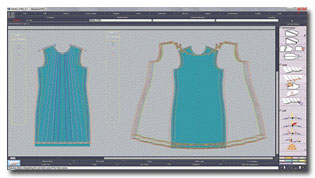
Lectra Debuts Modaris® V7R2

Lectra, Paris, has updated its Modaris® product development solution for pattern-making, grading
and 3-D prototyping. Modaris® V7R2 improvements streamline pattern development and enhance speed,
flexibility and control — including the ability to link grading to pattern pieces and modify
measurements on the piece itself; enrich patterns with technical details; apply notes directly to
pattern pieces; and combine elements from different patterns to create new styles. New and improved
pattern-drafting options include rounded edges and corners, mitered corners, folds and hems, new
geometry tools and notches. A new tool facilitates the creation and grading of pleats.

KAnewsLectra

Lectra’s Modaris® V7R2 product development solution

May/June 2013

Built In Seattle™ Promotes Seattle Garment District

Seattle-based fashion and apparel companies Built for Man, Tasty Tiger and Stigmare Couture
Marketing have established Built In Seattle™, a project that aims to present the city’s fashion
apparel resources and talent, and show that the city offers more than outerwear and technical
apparel, while also being able to provide manufacturing and design services as well as “living wage
jobs.”

Built for Man, led by Founder and Creative Director Francisco Hernandez, designs fashion
apparel made using natural fibers. The label has been using the manufacturing facilities of Tasty
Tiger, a producer of spandex and slinky knit products that provides its facility to Built for Man
during off-hours. Those two companies began their cooperation with help from Steven Paul Matsumoto,
founder of Stigmare Couture Marketing, Bellevue, Wash., who has been working to cultivate a
regional supply chain and manufacturing resources to support independent and global brands in a
Seattle-based garment district.

May/June 2013

Morrison Reports Sales In Turkey, Asia

Morrison Textile Machinery Co., Fort Lawn, S.C., has reported recent sales of machinery to
companies in Turkey, India and Thailand.

Matesa Tekstil, Turkey, has upgraded its Morrison Denim Finishing range with the addition of
wash boxes, a skying device and drive controls. The company also has purchased the MDS 550 Long
Chain ReBeamer featuring AC Drive and Controls, Beam Doffing, Yarn Sheet Strummer and elevated
Reverse Drive Yarn Accumulator.

DNM Textile, Turkey, has purchased another Morrison MDS 550 Long Chain ReBeamer.

ETCO Denim Pvt. Ltd., India, and Atlantic Mills (Thailand) Ltd. have purchased Morrison Denim
Finishing Ranges featuring S8 Compressive Shrinking Units with automatic rubber belt compression
control; GrindVAC for vacuuming belt byproducts when dressing the rubber belt; and the SanforTROL™
closed-loop shrinkage control system.

May/June 2013

Huntsman Unveils Phobotex® Fluorine-Free Finishes

Huntsman Textile Effects (HTE), Singapore, has introduced the Phobotex® range of fluorine-free
textile finishes designed for end-use applications including rainwear, activewear, pants,
careerwear, awnings, tarpaulins, boat covers, outdoor furnishings and shower curtains.

The Phobotex range – designed to complement HTE’s Phobol® CP short-chain C6 fluorocarbons
sold under the Teflon® trademark – comprises hydro polymer finishes that offer a soft hand and
durable water-based rain repellency and stain-management effects that last for up to 30 washes at
40°C and higher, the company reports. Some products also provide a stain-release effect after
washing, as well as moisture-wicking and quick-drying properties.

The finishes are compatible with other textile finishes and comply with Oeko-Tex® and
bluesign® standards; align with the Zero Discharge of Hazardous Chemicals joint roadmap; and are
free of chemicals on the American Apparel & Footwear Association’s Restricted Substances Lists.

May/June 2013

Oerlikon Neumag Delivers S+ BCF System To Chinese Firm

Germany-based Oerlikon Neumag reports that the first S+ three-end bulk continuous filament (BCF)
yarn system delivered to China is set to start up this spring at vertically integrated carpet
manufacturer Zhengzhou Yifa, which will use the system to produce polypropylene BCF carpet yarn.

According to Oerlikon Neumag, the S+ system enables increased productivity, with 99-percent
efficiency and low wastage, and also offers cost advantages. The system, which combines advantages
offered by the company’s S5 and Sytec One systems, has been available for processing polyester yarn
for the past year.

FWNeumag

Oerlikon Neumag’s S+ BCF yarn system

May/June 2013

Encouraging Signs

Revised government production estimates based on updated benchmark data confirm that the U.S.
textile and apparel industries are pretty much holding their own in today’s relatively modest
economic recovery. At last report, domestic output of basic textile products like yarns and fabrics
were running 12-percent above the low point hit during the 2009 recession. That’s the equivalent of
a nearly 4-percent annual rate of increase — and not much different from the rate reported for
aggregate U.S. manufacturing activity over the same three-year period. True, the comparable 2009-12
annual rate of advance noted for more highly fabricated textile products like carpets and home
furnishings was smaller. Nevertheless, this other key mill sector managed to rack up a
close-to-1-percent annual rate of gain. Domestic apparel production over this same three-year
period showed some fractional losses, but here, too, there have been signs of leveling off over the
past 12 months or so. In any case, all of the above marks a significant change from the 10-year
period ending in 2007, the last year before the recent downturn began. During that extended earlier
period, production of basic textiles, more highly fabricated textile products and apparel tumbled
40 percent, 21 percent and 65 percent, respectively — reflecting for the most part the huge import
influx from China and other low-cost producers. But, things are beginning to change, with the shift
over the past three years clearly suggesting that U.S. mills and factories are becoming
increasingly competitive in today’s cutthroat global marketplace.


Other Positive Signs


Uncle Sam’s revised data also provide other indications of an improving industry climate.
For one, they show that the big capacity cutbacks of the past few decades are beginning to slow
down. Thus, production potential for all mills has declined only about 4 percent annually over the
past two years. That’s a fair-sized slowdown from the 5- to 6-percent attrition noted over earlier
years. Moreover, given the outlook for relatively steady demand, this upbeat trend should continue.
Also pointing to smaller capacity declines: U.S. mills still seem willing to invest hefty sums on
new facilities. The National Council of Textile Organizations finds that mills spent nearly $17
billion on new plant and equipment over the past decade. This spending is clearly paying off in
terms of impressive productivity gains. Indeed, a comparison of mill equipment and output numbers
suggests mill efficiency is rising at nearly a 3.5-percent annual rate — not that different from
the pace noted for all U.S. manufacturing. And it’s pretty much the same for the U.S. apparel
industry. Capacity shrinkage has dropped down to only a 3-percent annual rate — again, well under
the huge declines of the previous two decades, when more than two-thirds of the U.S. apparel
industry disappeared. And here, too, there’s been continuing capital investment, for both
modernization and improved efficiency.


Operating Rates Up


Finally, a few words on how the new output and capacity numbers are affecting mill and
apparel utilization rates: Here, too, the news is basically positive. More to the point: The new
government statistics show production increasing relative to available capacity. These ratios are
still nowhere near the levels at which U.S. industries would prefer to operate. Nevertheless, any
increases are welcome, as they help dampen competitive pressures. As for the actual numbers:
Domestic textile mills are currently producing at nearly 70 percent of their potential — 13-percent
above their 2009 low, though still far under the 85- to 90-percent levels prevailing through most
of the 1990s. Similar improvement is noted for the apparel sector — with a 70-percent reading
running some 10 percentage points above the 2009 low, though well under the 85-percent levels of
two decades ago. As suggested earlier, all the above has to some extent helped reduce the cutthroat
price-cutting of recent years. Indeed, it may well be why textile and apparel profits have climbed
back into modest positive territory. Moreover, factor in the likelihood of steady demand and the
absence of any cost pressures, and industry earnings could well inch up a bit more in 2013 and
2014.

May/June 2013

Sponsors