FloorTek Expo 2013 Exhibitor Preview: Americhem

CUYAHOGA FALLS, Ohio — Aug. 22, 2013 — Beyond color and additive masterbatches, Americhem Inc.
takes a value engineering approach to product design, finding the best mix of properties and
services to boost speed-to-market, product quality, process efficiency and overall customer
satisfaction. The company will detail its holistic, value engineering capabilities at FloorTek Expo
(booth #141), Sept. 10-12, in Dalton, Ga.

“Value engineering means we are more than just a supplier-we are raising the bar on what
customers can and should expect from their masterbatch supplier,” said Mark Downey, sales director,
Americhem. “We design products that center on our customers’ needs, including their processes,
equipment, end-use requirements and desired physical properties, helping them create success with
their customers from the plant floor to the showroom floor.”

Americhem’s value engineering model is a comprehensive approach that expands beyond product
design to also include educational opportunities, trends reporting and process integration.
Combined with superior technical guidance and exceptional service, Americhem is committed to
helping its customers succeed.

“Education is a key component of our value engineering model,” said Downey. “That’s why
we’re excited to bring our popular Americhem U series to FloorTek.”

In conjunction with FloorTek, Americhem is offering a special Americhem U 
presentation, “Discover the World of Polymeric Additives,” presented by Dr. Vaman G. Kulkarni on
Sept. 12, at 11 a.m. Dr. Kulkarni is one of Americhem’s industry experts with extensive knowledge
of fibers, polyester and additives.  Seating will be limited, so interested attendees should
email Susan Ellis at sellis@americhem.com or call 706.279.3465 to RSVP.

For more on Americhem’s value-engineering model visit FloorTek booth #141 or browse
www.americhem.com.

Posted August 27, 2013

Source: Americhem

The Rupp Report: China Is Discovering Its Small And Medium-Sized Enterprises

Some people think that China is not only a country, but also a big factory. Especially in textile
production, China has the image of being a land of extremely large companies with tens of thousands
of employees in every factory. For the last two decades, this image has been nourished by the fact
that customers from the West could only order big or very big quantities of textile products; and
consequently, the exports from China flooded over the globe.

On the other hand, in Western countries, textiles are still a business of more small and
medium-sized enterprises (SMEs). An excellent example is Italy, particularly the Italian textile
machinery industry. According to information from the Association of Italian Textile Machinery
Manufacturers (ACIMIT), most of the 150 member companies are small and medium-sized, very
straight-thinking companies, working for many generations in the same business.

New View In Sight

This up-to-date orientation toward “only big is beautiful” could change soon: The recent
small dent in the textile industry and other business sectors of the Middle Kingdom shows also a
current trend to smaller lots and more flexible production. This was and is the chance for
neighboring countries to take some business away from China to other small tigers around the big
tiger nation. Some days ago, is was officially announced that China’s Cabinet is willing to provide
more support to small and even micro-sized businesses through increased financing innovation and
credit for the private sector.

Eight Targets

The State Council has released eight detailed targets and explains that the credit growth
rate for SMEs cannot be below the national average lending rate. At the same time, the gradual
amount shouldn’t be less than the amount that was borrowed last year. On this subject, Tan Yaling,
head of the China Foreign Exchange Investment Research Institute, made a remarkable comment: she
said that “policy makers have made a point of reiterating the policies to show the government’s
resolution in supporting small and micro-sized businesses.” She added that all eight targets, or
policies, have already been issued.

These targets include the recent doing away with the value-added tax for businesses whose
monthly revenues fall below 20,000 yuan, among other steps. However, Tan emphasized the most
important issue for small Chinese companies is credit access. Many Chinese banks do not want to
provide loans to companies if interest payments won’t provide a large return. However, this is not
only a problem for SMEs in China, but in Western countries as well.

Communication

In most businesses, communication is the key word. Of great importance, Tan said, is to
coordinate the interaction between small financial institutions and SMEs. As she pointed out:
“Financial institutions over the course of their developments have not addressed the SME financing
woes or just ignore their demands. This time the State Council has specifically cited small
financial institutions to tackle the problem faced by SMEs.” This is quite a clear statement.

And the next move, which is very well-known in the Western banking world, is to request that
private banks, financial leasing enterprises and consumer financial companies establish branches in
locations near concentrations of small businesses. In addition, policymakers have promised make
greater efforts to ensure that small businesses are not hit with “unreasonable charges.”

Reshuffling The Cards

Many of the above-mentioned details and problems could also be tackled in the West; for
example, “unreasonable charges” by the banks sounds very familiar. The recent economic slowdown has
led the Chinese government to turn its attention toward small business expansion as it tries to
increase domestic demand and employment. Chinese officials have probably realized that SMEs are
still the pillar and cornerstone of a healthy economy.

It may be surprising to Western people that 99 percent of Chinese companies are small or
medium-sized enterprises. And furthermore, they account for 80 percent of all jobs in cities and 60
percent of the country’s economic output.

The shift in Chinese financial policy is quite remarkable and could activate the business
environment in the Asia-Pacific Rim. It may reshuffle the cards of competitiveness among countries
in the region when it comes to entrepreneurship, flexibility and just-in-time delivery in the
Chinese textile industry.

August 20, 2013

Litzler To Supply Tire Cord Dipping Line To Rajashree Polyfil

India-based Rajashree Polyfil — a nylon and polyester filament yarn producer and a division of
Century Enka Ltd. — has commissioned C.A. Litzler Co. Inc. — a Cleveland-based manufacturer of
machinery including oven and drying equipment — to design and build a 80 mpm Tire Cord Dipping
Line.

Litzler reports the line offers benefits including multiple tension zones that provide
maximum flexibility for elongating or relaxing the material to meet specific processing criteria; a
line speed of 60 meters per minute (m/min) at maximum tension, with the ability to increase speed
to 80 m/min at reduced tension; speed and tension control accuracy of ±0.1 percent to achieve
control of critical material processes; and improved spreader design for better control of low
ends-per-inch fabric.

The line is the second Rajashree Polyfil has ordered from Litzler over the past three years.

August 20, 2013

Unifi Purchases DTY And Sample Machinery For Yadkinville Plant

Greensboro, N.C.-based textured yarn manufacturer Unifi Inc. has purchased nine draw textured yarn
(DTY) machines and a sample machine for its Yadkinville, N.C., facility, which houses its polyester
yarn twisting and beaming operations. The additional machinery will help Unifi to increase its
production capacity for value-added products in the regional market. The company reports that
synthetic apparel supply in the United States, North America Free Trade Agreement and Central
America-Dominican Republic Free Trade Agreement regions has steadily increased since 2009,
especially as brands and retailers continue their commitment to regional sourcing.

“The number of lot changes required to support the needs of our customers has grown
substantially over the years, which puts a premium on flexibility and the ability to provide
shorter production runs and quicker turnarounds within our manufacturing process,” said Unifi
President and COO Roger Berrier. “The investment in the nine DTY machines will increase our
capacity to support our overall volume growth, and will advance our objective of growing the volume
of our premier value-added yarns by 20 percent annually. The new sample machine will provide
additional product development capacity, which will allow Unifi to stay at the forefront of product
innovation.

“The continued growth of synthetic apparel production in the region will lead to ongoing
opportunities for the Company,” said Unifi Chairman and CEO Bill Jasper. “This investment adds to
our capacity and helps assure Unifi will be in a position to supply the increasing regional
demand.”

August 20, 2013

Alvanon Debuts Intimate/Swim Form Made Using Memory Foam

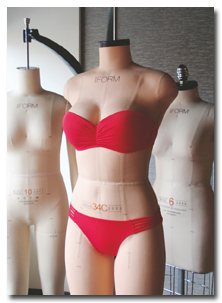
Technical fit form manufacturer Alvanon Inc., New York City, has introduced an Intimate/Swim Form
that is made using memory foam, making it 15-percent softer than the company’s standard soft
mannequin and thus enabling more realistic fitting of compression fabrics.

“Previous generations of mannequins were not as soft and did not accommodate the underwire
and bust fit very well,” said Ed Gribbin, president, Alvanon. “For that reason, designers could not
assess fit on a mannequin with a desired degree of accuracy.”

Gribbin noted that the new form may be used at every step along the supply chain to ensure
exact form fit measurements and lower production costs. Previously, manufacturers have used human
models at different points along the supply chain, which has made it difficult for designers to
realize a desired fit because of inconsistencies in the models’ shapes.

Alvanondummy

Alvanon’s newest Intimate/Swim Form

August 20, 2013

SYFA: Resurgence Of Textiles Back In The Region

CLOVER, S.C. — August 16, 2013 — Resurgence Of Textiles Back In The Region
Presented by SYFA

Keynote Address

Dr. Donald Sabbarese

Director of KSU Econometric Center

Kennesaw State University

“How Sustainable Is the U.S. Economy without the Federal Reserve’s Quantitative Easing?”

U.S. Economic growth remains steady, but uncharacteristically weak and inconsistent after
four years of expansion. Will important sectors such as the housing and automobile industries
continue to grow at the same pace as the Federal Reserve begins to remove its support for low
interest rates?

Dr. Donald Sabbarese specializes in the area of macroeconomics and financial institutions. He
is a professor of Economics and Director of the Kennesaw State University’s Econometric Center
where he directs the Georgia Purchasing Managers Survey, Southeast Regional Purchasing Managers
Survey, and the Georgia International Business Index. Other research includes studies of the local
and regional economy, industry surveys, economic impact studies, tax revenue forecasting, and
research on forecasting regional economic conditions. He serves as a member of the Board of
Directors, ISM-Atlanta. He served as Director of the Graduate School of Banking for Community
Bankers.

His work at the Econometric Center has been reported by local, regional and national media.

When

Thursday September 26, 2013 at 11:30 AM EDT

-to-

Friday September 27, 2013 at 12:30 PM EDT

Where

Sheraton Airport Hotel

3315 Scott Futrell Dr.

Charlotte, NC 28208

Posted August 20, 2013

Source: SYFA

Local Relationships Key To Successful Furniture Design

To impress home furnishing buyers twice a year at High Point Market with the freshest designs, a
growing number of successful upholstered furniture manufacturers are bucking a prior trend toward
offshore manufacturing.

Instead, even before shopping for the latest looks in fabric at Showtime textile trade
shows, more are opting to manufacture domestically and relying on key local supplier relationships
for greater fabric design flexibility as well as control of color, feel, fit, style, turnaround,
consistency, and shelf life.

“Some of the best furniture craftsmen, with generations of experience, are right here in
North Carolina,” said Holly Blalock, vice president of merchandising and marketing for CR Laine, a
Hickory, N.C.-based custom upholstered furniture manufacturer and style innovator that has built
locally since 1958. “To stay ahead of the design curve in fabric, we look to local collaborators
who can provide more design flexibility than overseas suppliers that have long lead times, complex
logistics, and different languages and time zones.”

Marlatexplaid


There is a big gap in quality between low-end and middle to high-end furniture fabrics. At
the middle to high-end are tightly woven, “honest weaves” that use enough yarn and fiber to provide
a soft, appealing texture.


While cut-rate overseas suppliers may offer the lowest prices, relying on them for fabric
innovation to complement showroom offerings can be problematic. Domestic furniture manufacturers
are finding that the best design collaboration is done not long-distance, but face-to-face, with
fabric in hand, in the context of a long-term relationship.

“If you’re a color innovator, you need the actual fabric, since color tone must be perfect
and you can’t set a color palette via computer monitor,” Blalock said. “The feel should be soft,
pliable and responsive, not coarse or abrasive — and you can’t tell that from a catalog. You’ll
also want to put the fabric up against your furniture frame to ensure it has the right fit and
style because there are many undertones represented in both wood finishes and textiles.”

According to Blalock, when she’s reaching for cutting-edge design, relying on a long-term
relationship with a local fabric collaborator is essential. “When you want a certain look that’s
not off-the-shelf, you need a relationship with a mill like Marlatex, where you can take an idea
and get help,” she said. “I may give them a sample of carpet or vintage fabric, then ask, ‘How
close can you get to this coloration?’ and they’re on it.”

Marlatex Corp., a Belmont, N.C.-based upholstery fabric manufacturer known for its plaids,
stripes, plains, and comfortable textures made from natural fibers, is close to many furniture
manufacturers in Hickory and High Point N.C., allowing easy arrangement of face-to-face meetings
between furniture and fabric designers.
Marlatexplaidroll


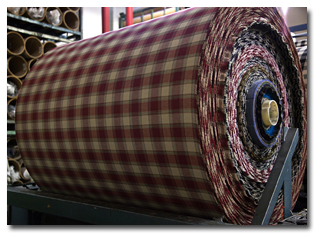
Color innovators need to see the actual fabric in person because the color tones must be
perfect, and a color palette can’t be set via computer monitor.


“We like to work one-on-one to create custom fabric designs with furniture
manufacturers,” said Gail Richard, a Marlatex fabric designer. “We pride ourselves on coming up
with new designs, new constructions, new color directions that work with whatever they’re running
to individualize their showrooms.”

Recently, for example, when Blalock needed a unique plaid for a High Point Market
upholstered furniture collection, she asked Richard for help. “Gail found an intriguing plaid in
her company’s historic archives, but I needed it opened up so it didn’t feel too dense, too
old-school,” Blalock said. “I told her the scale and colors I was looking for, and she had a
digital mock-up of the design as well as yarn samples for color to me within a week. It was
executed, delivered, and received so well by our retail base that we just did a second coloration.”

“The folks at Marlatex know us, our look, how we operate,” Blalock said. “Since they’re
close, they visit us and we visit them. They’re in our High Point showroom every six months, so I
can say, ‘Remember how we had this kind of look,’ and they remember. They consistently meet our
needs, price points, delivery windows and quality requirements.”

Regarding fabric quality today, there is a big gap in quality between low-end and middle to
high-end. Low-end fabrics, which are often threadbare to save cost and weight, are typically held
together by an unappealing, heavy latex backing. At the middle to high-end are tightly woven,
“honest weaves” that use enough yarn and fiber to provide a soft, appealing texture.

“Our fabrics hang on a display in our retail and designer stores, so when a customer pulls a
swatch, they often consider both the front and the back,” Blalock said. “We won’t buy any fabrics
so thin that they need 50-percent backing. Our relationship with local fabric partners is essential
to providing consumers with a total quality experience with CR Laine.”

Marlatexbluewarp

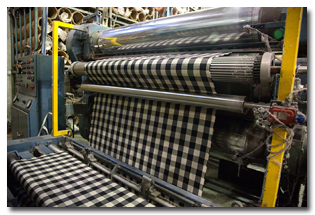
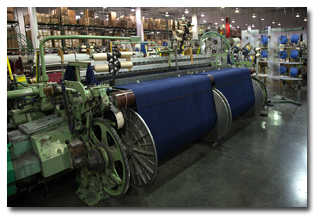
Marlatex has been weaving dobby and jacquard fabrics in Belmont, N.C., for more than 17
years.


According to Blalock, once a furniture manufacturer or retailer has chosen a fabric for its
collection, product shelf life becomes a critical issue.

After a potential buyer has spent hours in a retail showroom painstakingly picking out
furniture and fabric, the last thing she wants to hear is that the fabric is no longer in stock, or
has been discontinued altogether. Understandably, retailers want to avoid breaking that bad news to
residential consumers and potentially losing the sale. But it is not uncommon for some fabric
manufacturers, particularly those overseas, to drop certain fabrics every couple of years.

“Once we’ve invested the time and money to get a fabric on the shelf and swatched to all our
dealers, we need it to stay fully stocked for at least four years, our average cycle,” Blalock
said. “One of the things we appreciate about Marlatex is how they commit to their yarn bank. Some
of their fabrics have been with us for 15 years. Once we add a pattern, we know it’ll be available
when the homeowner chooses it.”

While overseas suppliers have had a good run recently, when it comes to furniture and fabric
design, it appears that local, domestic manufacturing relationships are due for a rebound.

“We value our local fabric collaborators like Marlatex,” Blalock said. “They’re an important
part of our business and help us stay on top of the latest trends, from mens- and womenswear looks
to eco-friendly cotton-linen blends.”


Del Williams is a technical writer based in Torrance, California.


August 20, 2013

An Improving Cost Climate

Credit the absence of any meaningful cost pressure for most of today’s stronger bottom lines. Zero
in on textile and apparel companies’ two major production expenses — raw materials and labor — and
cost increases over the current year have been either minimal or nonexistent. On the raw-material
front, for instance, cotton fiber prices, while above year-ago levels, are nowhere near the
sky-high $2-plus-per-pound peaks of just two years ago. And all indications would seem to indicate
that these quotes won’t be under any significant upward pressure for the remainder of the year —
and probably well into 2014. Thus, the U.S. Department of Agriculture’s latest global production
estimate for the 2013-14 global cotton crop shows totals continuing to run well above projected
consumption levels. Result: Another increase in year-ending inventories, with the marketing year’s
ending stock-usage ratio — a major cotton price determinant — expected to climb to near 86 percent.
That’s more than double the low 39-percent reading of just a few years ago.

Prices also seem a bit soft when it comes to wool, the other key natural fiber. Indeed,
quotes here are actually running under late-2012 levels. Zero in on man-made fibers, and again,
things remain pretty much under control. Uncle Sam’s producer price index for these fibers, for
example, remains fairly close to levels prevailing 12 months ago. And this reassuring man-made
fiber picture is confirmed by another price index, this one compiled by PCI Fibres, an
international consulting firm. This latter yardstick — a weighted average for acrylic, nylon,
polyester and polypropylene filament yarns and staple fiber — also indicates little near-term price
change both here in the United States and overseas.


No Labor Pressure Either


All signs point to an equally positive labor-cost scenario. To be sure, wage levels in mills
making both basic and more highly fabricated products at last report were running 2- to 2.5-percent
above year-ago levels. But the impact of this is being erased by continuing advances in worker
productivity – estimated to be rising by as much as a 3-percent annual rate. As such, costs per
unit of mill output won’t be advancing over the current year. Indeed, these unit labor costs could
well edge fractionally lower. And a similar pattern is seen in the apparel sector, where new
efficiency gains are also more than offsetting only fractional pay hikes. Moreover, this lack of
any meaningful upward wage pressure is likely to persist for some time. And it will be not only
because of continuing strong gains in productivity. More important here is the fact that today’s
still relatively high unemployment rate isn’t going to disappear anytime soon — a fact that pretty
much rules out any excessive new pay demands. If there’s any doubt about this, consider the
following: The U.S. economy is currently projected to continue adding some 200,000 new jobs a month
— or 2.4 million per year. While clearly a good sign, that still means it should take about five
years to bring down the jobless rate to levels prevailing just before the recent recession. Given
this scenario, it’s clear that textile, apparel and other production workers’ jobs will not succeed
in allowing for anything more than currently small pay hikes for at least another few years.


A Cost-Price Perspective


The improving overall cost picture can be best appreciated by comparing production expenses
to the industry’s sales dollar. True, the percentage of each dollar attributable to labor has not
changed, and is not expected to change, by all that much — remaining, as it has, in the 18- to
19-percent and 43- to 44-percent ranges for mills and apparel manufacturers, respectively. On the
other hand, with fiber costs way down vis-à-vis a few years ago, the raw material portion of a
mill’s sales dollar has tumbled — from 71 percent in 2011 to just 53 percent this year. And a
similarly sharp percentage drop is seen for apparel makers. More importantly, include labor costs
as well as raw materials, and the resulting decline in the overall apparel cost-sales ratio is
particularly noteworthy. In 2011, for example, these combined outlays by apparel manufacturers
actually topped the industry’s revenues, thereby precipitating an apparel industry slide into the
red. But 2011 should be considered an anomaly, with current 2013 cost-sales ratios — both for
textile mills, 72 percent, and apparel firms, 88 percent — representing more typical readings. In
any case, all signs suggest that today’s more normal ratios will continue for all sectors of the
U.S. industry, thus assuring modestly good profit outlooks for at least the next few years.

August 2013

Bulletin Board

DyStar, Singapore, has released its third Annual Greenhouse Gas Emissions
Assessment Report, also known as the Carbon Footprint Report. The report is available at
dystar.com.

Malvern, Pa.-based
Banom has received the Frost & Sullivan 2013 North American Product Leadership
Award for its cut-resistant gloves featuring MaxPly® with the Netherlands-based
DSM Dyneema LLC‘s Dyneema® and TriMax® with Dyneema.

iF International Forum Design GmbH, Germany, has presented a 2013 Outdoor Industry
Award in the Products of High Ecological and Sustainable Value category to Switzerland-based
Schoeller Technologies AG for its water- and mud-repellent ecorepel® textile
finish based on biodegradable paraffin.

Rieter Holding AG, Switzerland, has published its 2012 Sustainability Report,
which is available in both German and English at rieter.com.

The Industrial Fabrics Association International (IFAI), Roseville, Minn., has
launched Advanced Textiles Source, the official website and digital publication dedicated to the
Advanced Textiles Conference & Trade Show.

Fairfield, N.J.-based
PureCare by Fabrictech has signed a multi-year agreement with Ontario-based Zucora
Inc., under which Zucora will be the exclusive distributor of PureCare® and Fabrictech
International® products in Canada.

Pawtucket, R.I.-based
Cooley Group‘s environmental management system has earned ISO 14001:2004
Environmental Standard Certification from TÜV SUD America.

Steamboat Springs, Colo.-based
SmartWool has relocated its European headquarters to VF Corp.’s corporate office
in Switzerland, located at Via Senago 42/E, Pazallo, Lugano 6912.

PurThread Technologies Inc., Durham, N.C. has launched an online store, located at
purthread.com, for its medical scrubs and lab coats.

Bulletin

PurThread’s medical scrubs and lab coats.


Laconia, N.H.-based
Madeira USA has released its 2013 Source Guide, The Commercial Embroiderers’
Complete Catalog Of Suppliers. The guide is available at madeirausa.com.

Switzerland-based

Mettler Toledo
is offering its Good Titration Practice™ (GTP®) Sensor Use and Maintenance Webinar on-demand
at mt.com/gtp-sensor.

Los Angeles-based luxury furniture and textile manufacturer

J. Robert Scott Inc.
has signed a representation agreement with Allan Knight & Associates Inc. for the Texas
market, and now will occupy approximately 2,500 square feet in Allan Knight’s trade showroom.

Cincinnati-based
Cintas Corp.‘s Portsmouth, Va., uniform rental facility has received Voluntary
Protection Program (VPP) Star certification from the Virginia Occupational Safety and Health
Administration.

Outlast Technologies Inc. has relocated its headquarters to 831 Pine Ridge Rd.,
Golden, Colo., 80403. Phone numbers remain the same.


Ann Arbor, Mich.-based
CIMdata Inc. has published the 2013 Product Lifecycle Management (PLM) Executive
PLM Market Report.

Research and Markets Ltd., Ireland, has published “Survey of the European Fabric
Fairs for Spring/Summer 2014”; and “Cellulose Fibers Market — Global Industry Analysis, Size,
Share, Growth, Trends and Forecast, 2013-2018.”

New York City-based
Bloomsbury Publishing Inc. has published “A Cultural History of Fashion in the
20th and 21st Centuries: From Catwalk to Sidewalk,” 2nd Edition, by Bonnie English.

London-based
Laurence King Publishing Ltd. has published “Textile Visionaries: Innovation and
Sustainability in Textile Design,” by Bradley Quinn.

The War on Want, Students & Scholars Against Corporate Misbehavior (SACOM), Clean
Clothes Campaign
and the
IHLO (International Trade Union Confederation/Global Union Federation Hong Kong Liaison
Office)
have collaborated to produce the report “Breathless for Blue Jeans: Health hazards
in China’s denim factories,” by Dominique Muller.

August 2013

Grafica Launches Nano-prinTag – World’s Fastest And First All Electrical-Mechanical Direct-To-Garment Tagless Label Screen Printing Machine

India — August 7, 2013 — Grafica Flextronica, manufacturer and exporter of screen printing machines
and allied products for textile, graphics and industrial printing sectors, is launching the
nano-prinTag, world’s fastest and first all electrical-mechanical automatic direct-to-garment
tagless label screen printing machine. The machine is being launched at the forthcoming KnitShow
exhibition, which is scheduled for 11-13 August 2013 in Tirupur, Tamil Nadu.

Bhargav Mistry, managing director, Grafica, said, “This is yet another breakthrough product
from Grafica. The machine is designed, keeping in mind the minimum power consumption and minimum
maintenance requirement. It runs without a compressor because there is no pneumatics inside, which
makes the machine fastest and trouble free.”

Over the last three years, Grafica has been regularly introducing a range of Nano series
screen printing machines such as Nano-Print, Nano-Screen Maker 5-in-1, Nano-UV, Nano-Squeegee
Sharpener, Nano-Print plus, Nano-PrinTex, Nano-Texdryer, Nano-flashTex and allied products to meet
the global market demands.

“Each machine has found to be having tremendous potential and has been doing well with many
repeat orders within a year of their launch. And now, we are introducing Nano-PrinTag, which is
expected to be another revolutionary product,” concluded Mistry.

Nano-prinTag has user-friendly touch-screen control panel for easy operation. It is possible
to ‘print-flash-print-flash’ multiple times on same piece. Grafica will also offer customised
pallets in various sizes and shapes for different applications. 

Applications: Grafica’s nano-prinTag can be used to print tagless neck label, high density
labels & logos for t-shirts/shirts, pocket/shoulder logo printing, socks/handkerchief, hand
gloves, jeans pocket, vest/ underwear/ innerwear, caps, transfers & high density labels, all
types of hosiery, garments & apparels, and many more. 

Salient Features of nano-prinTag:

  • Speed: 2880 prints / hour
  • Index Accuracy: Below +/- 0.005 mm (5 microns)
  • No Pneumatics
  • No Compressor required
  • Available upto 4 colours/8 pallets
  • Single Phase
  • Plug N Play
  • Compact & space saving
  • Most competitive price

Technical specification:

  • Print area: 6″ x 6″ (15.25 cm x 15.25 cm)
  • Dimension: 3.75 feet (1.14 meter) for 3-colour machine
  • Minimum Power required: 220 V / 50 Hz – 5.2 kW, Single Phase (for 3 print heads & 3 flash
    curing)
  • Weight: 240 kg (530 lb Pounds US)

Other features:

  • Multiple squeegee strokes for same piece
  • Multiple Index rotation
  • Clockwise or anti clockwise index rotation
  • Adjustable print mode to set squeegee movement from front to back or back to front
  • Laser registration guides for accurate placement for any type of job.
Grafica

nano-prinTag


Posted August 13, 2013

Source: Grafica Flextronica

Sponsors