
The Rupp Report: (R)evolutionized Dobby And Jacquard Weaving

Up to now, a dobby or Jacquard machine has always been connected with the weaving machine. Every
weaver knows the problems with high-speed weaving. Stop-and-go is just one problem; marks in the
fabric after a stop or a restart contribute to inferior-quality products.

Any inconsistency in the process causes problems, and the higher the speed of the propeller
shaft during production, the higher the forces. Consequently, the wider the machine, and the
greater the distance between the harnesses of the Jacquard machine, the greater are the vibrations
on the entire system.

For decades, the weaving community around the world has asked for a system that would avoid
all these problems. A new development called SyncroDrive from Germany-based weaving machinery
producer Lindauer Dornier GmbH might be the solution.

For the first time, there is a possibility to separate the weaving machine from the dobby or
Jacquard machine. This means there is the possibility to have an independent shed. All limits are
eliminated in weaving, because the weft insertion is freely programmable.

Separate Drives

In conventional weaving systems, the weaving machine and the Jacquard machine have separate
drives with servo motors. In Dornier’s SyncroDrive system, there is no shaft drive, but there is a
connection via an electronic beam. Air-jet machines have a drive connected directly to the main
shaft.

Also, the rapier weaving machine with a nominal width up to 290 centimeters (cm), like the
air-jet machine, has a direct drive. Rapiers with a nominal width from 300 cm up have a direct
drive with a flywheel connected directly to the main shaft. The Jacquard machine has a direct drive
with a flywheel on the main shaft. For the shedding device, relatively small motors are needed — 6
to 8 kilowatts, depending on the number of boards.

Patented

The patented SyncroDrive is a low-maintenance drive system without clutch-brake unit, with a
separate motor for the shedding device. The inventor of the SyncroDrive was Valentin Krumm, the
former head of weaving technology at Dornier and predecessor of Gerhard Bögl, the current head of
the Technology Center for Weaving Technique in Lindau, Germany. Krumm is also the mastermind behind
Dornier’s positive rapier weaving machine. The intelligent drive design has extremely small speed
variations compared to conventional direct drives.

The SyncroDrive reads the desired weft insertion and stores it. The last weft insertion
remains memorized during the next startup. The Jacquard machine’s shed formation speeds up, for
example, over eight to TEN insertions to reach the specified speed. Similarly, the weaving machine
speeds up over one weft insertion to reach the specified speed. The synchronization of the two
machines starts when both have reached the specified speed. Then, the true weaving process — the
weft insertion — begins. If the job is completed or stopped, the last insertion is memorized while
the machines shut down. The shed formation shuts down over eight to ten insertions to a full stop.
The weaving machine shutdown is carried out over one weft insertion to a standstill.

Through the use of the SyncroDrive, the propeller shaft is eliminated, so problems such as
start and stop marks no longer exist, which has a very positive impact on the whole weaving system.
The SyncroDrive does not operate with cams, because a cam motion can’t be run independently.

Thanks to the machine’s soft start and stop, start and stop marks are avoided. Also, the last
reed beat-up is perfectly executed because the SyncroDrive memorizes the last weft insertion. The
Jacquard machine is separated from the weaving machine and can shut down smoothly.

Advantages

The propeller shaft used in conventional weft insertion is replaced by an electronic beam.
Therefore, vibrations in the Jacquard machine’s frame are minimized. The ground vibrations are
reduced, and speed variations are less than 3 percent. In a top-class weaving mill, using
SyncroDrive, the oscillations were reduced by more than 50 percent. When the author physically
tested the machine, the vibrations were very low.

Dynamic Warp Guide

Dornier mentions that the highly dynamic warp-yarn guide unit (DWG) enables weaving with the
lowest possible warp tension level, leading to a significant reduction in warp-end breaks. Through
its synchronous movement with the shed motion, this patented, roller-free unit guarantees an ideal
tension balance between the opening and closing shed motions even at maximum machine speeds.

More detailed information will be provided in an upcoming issue of

Textile World
.

July 30, 2013
Standard Textile To Expand Operations In Union, S.C., Add Jobs

Cincinnati-based Standard Textile Co. Inc. — a vertically integrated provider of total textile
solutions for healthcare, hospitality, industrial laundry and decorative products markets — will
invest more than $2.5 million to expand the terry towel manufacturing operations, including new
technology for terry towel finishing, at its Union, S.C., plant. The expansion will create 15 jobs,
and is expected to be completed by the end of September.

“We are excited about the opportunity to expand our existing operations in Union County,”
said Russ Ogle, plant manager, Standard Textile. “South Carolina has provided us with a skilled
workforce and an excellent environment in which to do business. We appreciate all the support we’ve
received from state and local officials.”

In addition to its Union plant, Standard Textile has manufacturing centers in Enterprise,
Ala., Augusta, Ga., and Thomaston, Ga.; and seven distribution centers throughout the United
States.

July 30, 2013

HanesBrands To Acquire Maidenform Brands

Winston-Salem, N.C.-based apparel manufacturer HanesBrands Inc. has agreed to acquire Iselin,
N.J.-based global intimate apparel marketer Maidenform Brands Inc. for approximately $575 million.

HanesBrands reports the acquisition will complement its Innovate-to-Elevate strategy, which
integrates its brands, low-cost supply chain and product innovation; create growth and cost-savings
opportunities; and increase its reach to serve retailers. The company plans to leverage its
low-cost supply chain, including its own global manufacturing operations supplemented by
third-party manufacturing, to enhance Maidenform’s value to retailers and consumers. Maidenform
currently sources all of its products from third-party manufacturers.

The acquisition also will combine the strengths and capabilities of the companies’
portfolios and allow for the cross-introduction of new products. Maidenform’s average-figure bra
business will complement HanesBrands’ full-figure bra business. In addition, Maidenform is known
for its shapewear, and HanesBrands is known for its panty business.

“We are looking forward to Maidenform joining the Hanes family,” said HanesBrands Chairman
and CEO Richard A. Noll. “Maidenform has great brands that consumers trust. Combining the
complementary strengths of both companies creates a lot of growth opportunities.”

The acquisition is expected to close in the fourth quarter of 2013.

July 30, 2013

Appleton Introduces Slabber XLA™ For Non-Wovens

Neenah, Wis.-based Appleton Mfg. Division has introduced the Slabber XLA™ for Non-Wovens, an
upgraded version of its Safe-Slab™ Core Recycler slabbing and core recycling unit.

The Slabber XLA was designed for a large consumer products company, and adds full automation
and process integration to the Safe-Slab concept. Features include a conveyor for loading and
moving rolls onto the slabbing arm; a laser mounted to the slabbing arm to guide roll positioning;
precise, programmed vertical lifting of the roll for each cutting pass; a fully guarded and
interlocked cutting area; a programmable cutting device mounted at the top of the enclosed cutting
area; an exit conveyor or elevator for moving waste material to downstream processes; and an
externally mounted operator control panel.

The Slabber XLA’s overall design parameters may be altered to fit a variety of installation
needs; and the cutting process may be adjusted to accommodate a variety of materials and
capacities.

July 30, 2013

Unifi, Palmetto Synthetics Sign REPREVE® Supply Agreement

Greensboro, N.C.-based textured yarn manufacturer Unifi Inc. and Kingstree, S.C.-based Palmetto
Synthetics LLC — a manufacturer of polyester, nylon, and other specialty man-made staple fibers —
have signed a manufacturing and distribution agreement under which Palmetto Synthetics will
purchase Unifi’s REPREVE® chip — produced at Unifi’s Repreve Recycling Center in Yadkinville, N.C.
— and process it into staple fiber to be sold under the Repreve name. The agreement was inked with
the intention of providing the textile industry with a U.S.-made staple fiber product option.
Repreve products produced by Palmetto will be available as either natural or solution-dyed
polyester staple fiber, and will be compliant with both the North American Free Trade Agreement and
the Berry Amendment.

“We have a shared vision with Unifi to provide the textile industry with high quality,
innovative products, which led us to this supply relationship,” said David Poston, vice president,
Palmetto Synthetics. “We have seen a big shift in inquiries for a domestically made recycled fiber,
and this initiative with Unifi allows us to amplify our domestic efforts.”


Unifi’s Repreve chip products have been certified for recycled content by Emeryville,
Calif.-based Scientific Certification Systems (SCS) Global Services and also have been certified to
SCS’s Responsible Source™ standard for responsible production and compliance with environmental and
social regulations.

Palmetto Synthetics will discontinue its NatureSpun® recycled fiber product and replace
production with Repreve recycled fiber.

July 30, 2013

Andritz Opens Competence Center, Delivers High-Speed Line In China

Austria-based Andritz Group recently opened a plastic film production competence center at its
Andritz Biax location in Foshan, China. At a recent customer day to mark the opening of the center,
guests were offered tours of the 8,000-square-meter facility, demonstrations of the biaxially
oriented polypropylene (BOPP) film production line, and presented with information from experts on
the latest advancements in BOPP film production. Andritz also introduced guests to its patented
stretching technology for special films — Mechanical Simulteneous Stretching System (MESIM) — and a
high-speed chain track system with patented clips. Andritz reports 170 people from more than 70
companies attended the opening event.

In other company news, Andritz has received an order from China-based Chuzhou Jinchun
Non-woven Fabric for a high-speed spunlace line. The line comprises a Jetlace 3000
hydroentanglement unit, dewatering system and Perfodry Advantage dryer. The
17,000-ton-annual-capacity line will be used to produce fabrics ranging from 30 grams per square
meter (g/m2) to 80 g/m2 for the hygiene industry. The new line will bring Chuzhou Jinchun’s total
spunlace capacity to 32,000 tons per year. The company produces spunlace fabric rolls for wipes,
hygiene, man-made leather and filtration applications.

July 30, 2013

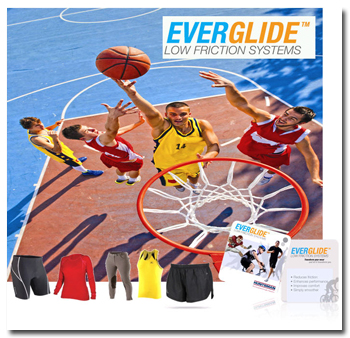
Huntsman Unveils EverGlide™ Low Friction Systems For Activewear

Huntsman Textile Effects (HTE), Singapore, has introduced EverGlide™ Low Friction Systems for
activewear including endurance sportswear, cycle shorts, base layer mountain-hiking wear,
equestrian trousers, sports underwear and training/gym wear.

The technology wicks perspiration from the skin, reducing the fabric-to-skin friction often
experienced when apparel becomes saturated with perspiration during sports performance. Combined
with HTE’s “cool comfort” moisture-management system that enhances body temperature regulation and
imparts quick drying properties, EverGlide can defend against blisters and skin reddening. Huntsman
reports that in relative friction tests based on friction coefficient values on both nylon/elastane
and polyester knits, EverGlide has been shown to be four times more effective than conventional
softeners. The finish also offers a soft, silky hand and enhances fabric resilience and durability.

Huntsman

Huntsman’s EverGlide™ Low Friction Systems for activewear reduces fabric-to-skin friction
.

EverGlide may be applied to all substrates using a simple and versatile application
technique; and its low yellowing properties do not affect thermomigration or degree of whiteness,
even under molding conditions, according to Huntsman.

July 30, 2013

US Labor Department Updates List Of Products Made By Forced Or Indentured Child Labor

WASHINGTON — July 22, 2103 — The U.S. Department of Labor’s Bureau of International Labor Affairs
today announced a revised “List of Products Produced by Forced or Indentured Child Labor,” adding
six new products from five countries. Federal contractors supplying products on the list must
certify the goods were not produced by forced or indentured child labor in accordance with
Executive Order 13126.

The Departments of Labor, State and Homeland Security published a Federal Register notice
updating the list that adds cattle from South Sudan, dried fish from Bangladesh, fish from Ghana,
garments from Vietnam, and gold and wolframite from the Democratic Republic of Congo. Public
comments were solicited, received, and considered in the agencies’ final determination.

ILAB published the first list in 2001 and revisions each year from 2010 through 2012. The
complete Executive Order 13126 list, a bibliography of sources cited, frequently asked questions,
procedural guidelines, and procurement compliance information are available online at
http://www.dol.gov/ILAB/regs/eo13126/main.htm.

Information about ILAB and its program activities is available at http://www.dol.gov/ilab/.
The notice is scheduled to be published in the July 23, 2013, Federal Register.

List of Products Produced by Forced or Indentured Child Labor:
http://www.dol.gov/opa/media/press/ilab/ILAB20131359.htm

Federal Register publication of the notice:
http://webapps.dol.gov/FederalRegister//PdfDisplay.aspx?DocId=26971

Posted July 30, 2013

Source: U.S. Department of Labor

Statement By The U.S. Government On Labor Rights And Factory Safety In Bangladesh

WASHINGTON — July 19, 2013 — The following is a joint statement by the Department of State, the
Department of Labor, and the Office of the United States Trade Representative:

Today, the United States is outlining next steps in a longstanding effort to address in a
meaningful way worker safety problems in Bangladesh – the severity of which were exemplified in the
tragedies of the November 2012 Tazreen Fashions factory fire and the April 2013 Rana Plaza building
collapse – and, more broadly, the ability of Bangladeshi workers to exercise their full range of
labor rights. 

On June 27, 2013, President Obama announced his decision to suspend Bangladesh’s trade
benefits under the Generalized System of Preferences (GSP) in view of insufficient progress by the
Government of Bangladesh in affording Bangladeshi workers internationally recognized worker
rights.  That decision followed an extensive, interagency review under the GSP program of
worker rights and worker safety in Bangladesh during which the U.S. Government encouraged the
Government of Bangladesh to implement needed reforms. At the time of the announcement, the
Administration provided the Government of Bangladesh with an action plan which, if implemented,
could provide a basis for the President to consider the reinstatement of GSP trade benefits. 

Today, the Administration is making this action plan public as a means to reinforce and
support the efforts of all international stakeholders to promote improved worker rights and worker
safety in Bangladesh. On the basis of this action plan, the United States looks forward to
continuing to work with Bangladesh on the actions it needs to take in relation to potential
reinstatement of GSP benefits.

The United States is also pleased to associate itself with the July 8, 2013 European Union
(EU)-Bangladesh-International Labor Organization (ILO) Sustainability Compact for Continuous
Improvements in Labour Rights and Factory Safety in the Ready-made Garment and Knitwear Industry in
Bangladesh (Compact). The United States looks forward to working as a full partner with the EU,
Bangladesh, and the ILO to implement the goals of the Compact, many of which are broadly consistent
with the GSP action plan we are releasing today.  At the same time, the United States will
pursue additional concrete actions required under the GSP action plan, such as increasing sanctions
for labor violations sufficient to deter future misconduct, publicly reporting on the outcome of
union registration applications, establishing an effective complaint mechanism for labor
violations, and ending violence and harassment of labor activists and unions. 

In addition to these complementary, government-to-government efforts, the Administration
recognizes the importance of efforts by retailers and brands to ensure that the factories from
which they source are compliant with all fire and safety standards in Bangladesh.  We urge the
retailers and brands to take steps needed to help advance changes in the Bangladeshi garment sector
and to work together and with other stakeholders to ensure that their efforts are coordinated and
sustained.

The Administration looks forward to continuing its engagement with the Government of
Bangladesh and all stakeholders in order to effect positive change for Bangladeshi workers and to
help ensure that the recent tragedies we have witnessed do not recur.


BANGLADESH ACTION PLAN 2013

The United States Government encourages the Government of Bangladesh (GOB) to take
significant actions to provide a basis for reinstating Bangladesh’s Generalized System of
Preferences (GSP) benefits, including by implementing commitments under the “National Tripartite
Plan of Action on Fire Safety and Structural Integrity” and taking the following actions:

 Government Inspections for Labor, Fire and Building Standards

    * Develop, in consultation with the International Labor Organization
(ILO), and implement in line with already agreed targets, a plan to increase the number of
government labor, fire and building inspectors, improve their training, establish clear procedures
for independent and credible inspections, and expand the resources at their disposal to conduct
effective inspections in the readymade garment (RMG), knitwear, and shrimp sectors, including
within Export Processing Zones (EPZs).

    * Increase fines and other sanctions, including loss of import and export
licenses, applied for failure to comply with labor, fire, or building standards to levels
sufficient to deter future violations.

    * Develop, in consultation with the ILO, and implement in line with
already agreed targets, a plan to assess the structural building and fire safety of all active
RMG/knitwear factories and initiate remedial actions, close or relocate inadequate factories, where
appropriate.

    * Create a publicly accessible database/matrix of all RMG/knitwear
factories as a platform for reporting labor, fire, and building inspections, including information
on the factories and locations, violations identified, fines and sanctions administered, factories
closed or relocated, violations remediated, and the names of the lead inspectors.

    * Establish directly or in consultation with civil society an effective
complaint mechanism, including a hotline, for workers to confidentially and anonymously report
fire, building safety, and worker rights violations.


Ready Made Garments (RMG)/Knitwear Sector

    * Enact and implement, in consultation with the ILO, labor law reforms to
address key concerns related to freedom of association and collective bargaining.

    * Continue to expeditiously register unions that present applications that
meet administrative requirements, and ensure protection of unions and their members from anti-union
discrimination and reprisal.

    * Publicly report information on the status and final outcomes of
individual union registration applications, including the time taken to process the applications
and the basis for denial if relevant, and information on collective bargaining agreements
concluded.


    * Register non-governmental labor organizations that meet administrative
requirements, including the Bangladesh Center for Worker Solidarity (BCWS) and Social Activities
for the Environment (SAFE). Drop or expeditiously resolve pending criminal charges against labor
activists to ensure workers and their supporters do not face harassment or intimidation. Advance a
transparent investigation into the murder of Aminul Islam and report on the findings of this
investigation.


    * Publicly report on the database/matrix identified above on anti-union
discrimination or other unfair labor practice complaints received and labor inspections completed,
including information on factories and locations, status of investigations, violations identified,
fines and sanctions levied, remediation of violations, and the names of the lead inspectors.


    * Develop and implement mechanisms, including a training program for
industrial police officers who oversee the RMG sector on workers’ freedom of association and
assembly, in coordination with the ILO, to prevent harassment, intimidation and violence against
labor activists and unions.


Export Processing Zones

    * Repeal or commit to a timeline for expeditiously bringing the EPZ law
into conformity with international standards so that workers within EPZ factories enjoy the same
freedom of association and collective bargaining rights as other workers in the country. Create a
government-working group and begin the repeal or overhaul of the EPZ law, in coordination with the
ILO.

    * Issue regulations that, until the EPZ law has been repealed or
overhauled, will ensure the protection of EPZ workers’ freedom of association, including by
prohibiting “blacklisting” and other forms of exclusion from the zones for labor activities.

    * Issue regulations that, until the EPZ law is repealed or overhauled,
will ensure transparency in the enforcement of the existing EPZ law and that require the same
inspection standards and procedures as in the rest of the RMG sector.

Shrimp Processing Sector

    * Actively support ILO and other worker-employer initiatives in the shrimp
sector, such as the March 2013 Memorandum of Agreement, to ensure the strengthening of freedom of
association, including addressing anti-union discrimination and unfair labor practices. 

Publicly report on anti-union discrimination or other unfair labor practice complaints
received and labor inspections completed, including information on factories and locations, status
of investigations, violations identified, fines and sanctions levied, remediation of violations,
and the names of the lead inspectors.

Posted July 30, 2013

Source: USTR

GE’s EVent* Fabrics And Dishang Group Collaborate To Offer Total Sourcing And Manufacturing Solution For Apparel Customers

KANSAS CITY, Mo. — July 10, 2013 — GE announced today that Dishang Group — China’s largest garment
manufacturer and exporter of apparel and textiles — will bring complete solutions for creating
apparel for customers using GE’s (NYSE: GE) award-winning eVent fabrics. The Dishang Group has more
than 20 years of experience developing technical fabric and apparel solutions from concept to
completion, including sourcing, design and manufacturing.

“The Dishang Group can provide a total solution to customers using eVent fabrics,” said Phil
Roebuck of Dishang Group, who is charged with the collaboration with eVent fabrics. “We are pleased
to partner with such a high-profile brand as eVent fabrics and to be able to offer its premier air
permeable and waterproof technology to clients.”

At this summer’s trade shows, customers can learn more about the collaboration and see
concept jackets developed by the Dishang Group. The eVent fabrics team is exhibiting at the OutDoor
Show in Friedrichshaven, Germany (July 11-14, booth B4 202), and at Outdoor Retailer Summer Market
in Salt Lake City, Utah, USA (July 31-August 3, booth MR 150B).

The Dishang Group will establish a production unit dedicated to the manufacturing of apparel
using eVent fabrics, and the new facility will be online by the end of 2013. The company will work
closely with clients on the comprehensive product development and manufacturing of apparel using
eVent fabrics, from creative concepts through quality control of finished garments. In addition,
Dishang will use its market and textile expertise to develop new fabrics and technologies in
cooperation with the eVent fabrics team.

“Collaborating with the Dishang Group gives current and new customers of eVent fabrics the
opportunity to create apparel from start to finish under the guidance, service and expertise of the
Dishang Group,” said Chad Kelly, global product manager for eVent fabrics. “This model will not
only simplify and streamline the product development process for our customers, but also provide a
channel for eVent fabrics to launch new film technologies and applications more rapidly.”


Posted July 30, 2013

Source: GE

Sponsors



