OEKO-TEX Launches New MySTeP Sustainability Management Tool At Texworld USA Gala

ZURICH, Switzerland — July 8, 2014 — Dr. Jean-Pierre Haug, General Secretary of the  International OEKO-TEX® Association will announce another OEKO-TEX® innovation at a Texworld USA gala open to all Texworld USA participants and media. The event will be held Wednesday, July 23, 6:00PM-8:00PM in the Javits Center River Pavilion.
 
At last year’s Texworld USA, OEKO-TEX® unveiled the new STeP by OEKO-TEX® certification for sustainable textile production facilities. STeP by OEKO-TEX® certification is designed for brands, retailers, and manufacturers from all sectors of the textile supply chain who want to validate their sustainable production in a transparent, credible, and clear manner that is consistent around the world.
 
This year, Dr. Haug will present MySTeP, a robust, secure database application that houses a textile product manufacturer’s information related to its sustainable operations. The MySTeP database facilitates private, transparent communication between customers and suppliers, ensures that regulatory compliance data are complete and up to date, and helps facility operators more easily manage the many components of a comprehensive sustainable production strategy that is both environmentally and socially responsible. The new OEKO-TEX® API (Application Program Interface) further aids communication and data sharing via portals and cloud-based vendor management platforms.
 
“Consumer demand for textile products made in factories that operate with respect for their communities, their employees, and the environment continues to grow,” says Dr. Haug. “The new STeP by OEKO-TEX® certification and the new MySTeP database give brands, retailers, and manufacturers throughout the textile supply chain a confidential, concise, and effective method for optimizing, tracking, and communicating sustainable production measures in a credible and transparent manner.”
 
Posted July 8, 2014

Source: Oeko-Tex
 

The Rupp Report: A Swiss Attempt To Go Domestic

Today, mainly European countries are importing goods worth millions and millions of US dollars every year. However, some countries are struggling to hold back some production. For example, Made in the USA, Swiss Made, and many other examples show the efforts to keep some business in the country. This is not an easy task, mainly because labor costs are far higher that in countries such as China or Bangladesh.
 
Made In Switzerland …
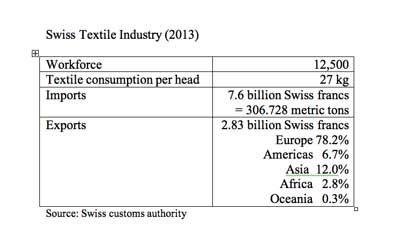
One of these former textile countries is Switzerland. After World War II, there were more than 50,000 people working directly in the textile industry, today there are not more than 12,500. Switzerland remains an important country for textile machinery and some outstanding technical textiles, but certainly not for apparel. However, one very traditional textile company is trying to swim against the current  — the Schild Group, a fashion house that is implementing a very interesting project that could be of interest to many other Western countries.
 
… As Much As Possible
In 2012, Schild launched a brand called “Schild since 1922” to recall the tradition of the house and its foundation 92 years ago. On the other hand, it should also help to expand the range of apparel of Swiss origin. The company, based in Lucerne, comprises 720 employees and netted a consolidated turnover in 2013 of 189.3 million Swiss francs (US$213.3 million) and derived a cash flow of 12.7 million Swiss francs (US$14.3 million). The Schild Group has retail shops all over Switzerland — including 30 fashion houses, four outlets, 22 branded shops and 14 boutiques.
 
Schild was founded in 1922 by Swiss weaver Adrian Schild. Over the years, the enterprise shifted from a weaving mill with a few retail sales outlets to a renowned menswear company. Over time, the weaving mill evolved to become a manufacturer of fine fabrics and menswear with many retail stores in Switzerland, and became finally the Fashion House Schild — domestically, a very popular ladies- and menswear specialty shop.
 
From Tradition Into The Future
The new branding is a strategic project for Schild. Schild since 1922 should improve the company’s position and visibility in the market and contribute to increasing the number of regular customers. For this project, profiling is rather more important than profitability, implying that the calculated selling prices are very tight and will bring less profit. Company management accepts this situation; however, it expects that money can be earned with the new products. Currently, the range of the new line includes shirts, polo shirts, sweaters and ties. The concept of the new line is based on the local textile industry’s capability of replacing or substituting for imports, which had previously been made in Asia, at least partially.
 
The generated revenue so far — just under 1 percent of group revenue in 2013 — is marginal. However, the dynamism in the development of the new line is considerable. This year, company management expects a 23-percent growth rate; by 2015, it should be 25 percent.
 
Therefore, it is of utmost importance to emphasize the less visible, but very important characteristics of the premium products: top-quality cotton, heat-set buttons that won’t fall off, metal reinforcement of the collar points instead of plastic inserts. The target, according to Schild, is to convince the buyer that these extras justify the higher price of the shirt. A lot of the hoped-for success depends on a very smart marketing plan.
 
Traceability
Private-label products account for about half of the entire product range. Schild already started reshoring the procurement of private-label products even before the launch of this new Swiss-made line. From 2008 to now, the share of Far Eastern purchasing has been reduced from 28 to 13 percent. Thus, the purchase prices indeed have risen; however, the greater proximity to the supply sources provides the advantage of reacting quickly to any new fashion trends. Even the value chain is easier to control — which, according to Schild CEO Thomas Herbert, has become more and more important in view of the increasing consciousness of the buyers, who want to know the conditions under which the product was manufactured.
 
The plan is to continuously expand the product range by adding pants, jackets, and suits. Moreover, the range of ladieswear will be extended. In the long term, the target is to achieve a future turnover of some 3 million to 5 million Swiss francs (US$338.2 million to US$563.6 million) with the 1922 brand.
 
Pros And Cons Of Tricky Pricing
Pricing, however, is a tricky endeavor. The products, of course, are more expensive than the usual mass-produced goods. Shirts and sweaters cost 149 Swiss francs (US$168), and ties will be 129 Swiss francs (US$145). The articles will have a more timeless style than fashionable mass-produced products and can therefore be kept for several seasons, which can be used as an argument to justify the relatively high price. However, Herbert said, “It’s not possible to place the range in a luxury segment.” To promote the new line, the price had to be kept under the crucial barrier of 150 Swiss francs (US$169). Yet, this pricing needs a considerable turnover. With a more expensive product, it might be possible to achieve more sales, but at a lower volume, and this was not the intention of the management. Another idea of this strategy was that the conscious tightly budgeted margins would prevent competitors from starting in the “Swissness” business with lower prices.
 
An Experiment
The launch of the new brand must be regarded as an open-ended experiment. On the other side, it is unclear whether the Swiss textile industry has the capacity and quality to fulfill the target of selling a “full Swiss product.” So far, the value chain of the targeted products is only two-thirds in Switzerland. There are plans to shift more work processes into Switzerland, but the limited number of suitable producers will likely be an obstacle for a long time. To be continued …

 
July 1, 2014
 

Burlington Debuts Just U.S. Fine Worsted Wool

Greensboro, N.C.-based Burlington, a division of International Textile Group Inc., has launched a line of fine worsted wool fabrics that have been woven and finished in the United States. Just U.S. fabrics, now available for sampling for Fall 2015 menswear collections, are targeted to better men’s suits and suit separates, as well as trousers, blazers and sports coats; and for made-to-measure custom tailors, specialty shop brands, and branded and better department stores.
 
Burlington has been producing worsted wool and wool-blend fabrics since 1954, and has been providing those fabrics to the U.S. military as well as globally for better menswear brands. In recent years, however, fine worsteds have not been produced in the United States, according to Peter Baumann, senior vice president merchandising, Burlington Menswear. 
 
“Burlington’s new collection of fine worsted fabrics opens up exciting opportunities for Made in America better apparel,” Baumann said. “With our new Just U.S. worsteds, made in Cordova and Raeford, North Carolina, designers and brands can now re-connect the heritage of classic men’s dress with modern constructions and color ways for performance and year-round comfort.”
 
July 1, 2014


Cotton Inc’s Blue Jeans Go Green Program© Recognized For Leadership And Innovation

BEL AIR, Md. — June 30, 2014 — Three leading international recycling organizations gathered in Miami, Florida for the first-ever international conference on the used clothing recycling industry. Nearly 100 members of the Secondary Materials and Recycled Textiles Association (SMART), the Bureau of International Recycling’s Textiles Division (BIR), and the Council for Textile Recycling (CTR) held the first International Textile Recycling Summit (ITRS) at the Fontainebleau Hotel on Miami Beach. Conference attendees were there to discuss industry trends, concerns, and emerging markets.

The three organizations represent for-profit textile recycling companies, non-profit organizations involved in textile recycling, apparel manufacturers, representatives from academia, and governmental agencies, all of which are focused on recycling, especially used clothing and textiles.

In addition to the conference seminars and panel discussions the organizations presented the Leadership in Sustainable Apparel – Recycling Innovator Award to Cotton Inc. for their Blue Jeans Go Green© program. Blue Jeans Go Green© Co-director of Strategic Alliances, Marissa Barlin was on-hand to accept the award.

“Blue Jeans Go Green and Cotton Inc. are honored to be the first recipients of this award,” said Barlin. “Since the program began in 2006 the denim collected has not only been used by builders and home-owners, we have also been able to provide grants of the insulation to civic institutions and to Habitat for Humanity programs throughout the U.S.”

Since its inception, Blue Jeans Go Green© has diverted more than 600 tons of denim out of landfills. To date, more than 2-million square feet of Ultratouch© denim home insulation has been generated from the denim recovered by the Blue Jeans go Green© program. Ultratouch© home insulation is manufactured by SMART member-company Bonded Logic of Chandler, AZ.

Barlin says denim of any color, and in any condition, can be converted into home insulation. For information on recycling unwanted denim products go to BlueJeansGoGreen.org.

Panel discussions held during ITRS included discussions of the global sustainability of the clothing industry and reuse and recycling as seen from the perspective of clothing manufacturers and retailers. Other panel discussions focused on the challenges of the core industry of used clothing collection, reclaimed wipers and fiber conversion and global trends, and innovations in the used clothing/textile recycling industry.

According to the United States Environmental Protection Agency’s most recent report on municipal solid waste, 20.44 billion pounds of clothing and footwear was discarded in 2012. An additional 2.58 billion pounds of towels, sheets and pillowcases were also thrown away. The 2012 EPA report indicates only 14.4% of clothing and footwear products were recovered (recycled) and only 17.8% of towels, sheets and pillowcases were recovered.1   Of the clothing, footwear, towels, sheets, and pillowcases that were thrown away, SMART estimates 95% of those items could have been reused or recycled.2

 SOURCES:
1  Municipal Solid Waste Generation, Recycling, and Disposal in the United States: Tables and Figures for 2012. Tables 15 and 16,

2  Secondary Materials and Recycled Textiles Association Media Kit:   http://www.smartasn.org/about/SMART_PressKitOnline.pdf

Posted July 1, 2014

Source: Secondary Materials And Recycled Textiles
 

Hinks Named Interim Dean Of Textiles Of NC State University’s College Of Textiles

Dr. David Hinks will serve as interim dean of NC State University’s College of Textiles, starting July 1. Provost Warwick Arden announced the appointment May 30.  

Hinks was born and raised in Derby, England and worked for Courtaulds Research for two years prior to attending the University of Leeds, where he earned a Bachelor of Science degree in 1989 and a Ph.D. in colour chemistry in 1993.

Hinks moved to NC State’s College of Textiles as a postdoctoral research associate and later as a visiting assistant professor investigating the genotoxicity of dyes and pigments. In 1996 he joined Milliken & Co. in Spartanburg, South Carolina, as an R&D chemist. Two years later he returned to NC State as an assistant professor in the College of Textiles. He was promoted with tenure in 2004, becoming director of the newly created polymer and color chemistry program. He was promoted to full professor in 2009 and became the Cone Mills Professor of Textile Chemistry in 2010. He currently serves as the director of the emerging Forensic Sciences Institute and associate head and director of graduate programs in the Department of Textile Engineering, Chemistry and Science.

Hinks is a member of NC State’s Academy of Outstanding Teachers and Academy of Outstanding Faculty Engaged in Extension. He enjoys serving on the Park Scholars Advisory Committee and the North Carolina Forensic Science Advisory Board that was established by the North Carolina General Assembly in 2011.

“It is truly an honor and a privilege to be entrusted to serve the college and university as interim dean,” Hinks says. “I believe what sets the College of Textiles apart from other renowned academic programs is our passion for service to a global industry, and our faculty, staff and students’ reputation as a close-knit family that supports each other, and our outstanding alumni. Through Dean Godfrey’s leadership, we are recognized as having broad and deep national and international reach in first quality undergraduate and graduate education, research, and local and global engagement. I very much look forward to working with our outstanding community in making the college even stronger and at the same time creating a safe, creative, inspiring, impactful and enjoyable place to work and learn.”

The search for a permanent dean, which was suspended in May, will be restarted in the coming academic year, Arden said. Blanton Godfrey, who has served as dean for 14 years, will return to the faculty.

Posted July 1, 2014

Source: NC State University College of Textiles
 

ICAC: Rising Stocks, Reduced Imports Puts Downward Pressure On Price

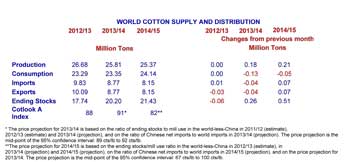
WASHINGTON — July 1, 2014 — Higher ending stocks outside China and lower imports into China will put downward pressure on international prices in 2014/15. Additionally, world production is likely to exceed consumption in 2014/15, though by a lesser amount than in the past four seasons. As a result, world ending stocks are expected to rise by 6% to 21.4 million tons and the stock-to-use ratio would be 89%, or in other words there would be enough cotton stocks to cover consumption for nearly 11 months. This would be the fifth consecutive season of increase in ending stocks, after a 27% fall in 2009/10. China is estimated to hold nearly 60% of the world’s stocks, most of which is held in its government reserve. At the end of June, the Secretariat estimates that the Chinese government will still hold 11.7 million tons. While consumption in China is forecast to grow during next season, a strong preference exists for high quality cotton, so it is unlikely that the government will be able to quickly draw down its reserve without offering significant discounts. At the end of 2013/14, China is forecast to hold 11.5 million tons, an increase of 19% from 2012/13, and these stocks are likely to further expand in 2014/15. Additionally, ending stocks outside China are also expected to rise by 7%, to 8.7 million tons at the end of this season and are projected to reach 9.7 million tons at the end of 2014/15.

In 2014/15, world production is forecast to drop by 2% to 25.3 million tons due to reduced planting in China, where cotton production may reach only 6 million tons. Production in the rest of the world is expected to increase by 1% to 19.3 million tons. In 2013/14, production in India is estimated at a record 6.5 million tons due to higher yields and better prices, which encouraged farmers to plant more cotton in 2014/15. Assuming yield is similar to the 3-year average, Indian cotton production is projected to reach 6.3 million tons in 2014/15, but this result is highly dependent on the timing of monsoon rains. The Southwest region of the United States has received much needed rain, which could help reduce the abandonment rate and result in a higher harvested area than last season. In 2014/15, production in the United States is expected to grow by 14% to 3.2 million tons.

In 2013/14, world consumption grew by less than 1% to 23.4 million tons, but a rise of 3%, to 24.1 million tons is anticipated in 2014/15. The high price of domestic cotton in China, restrictions on imports, difficulties with financing and weak demand for cotton yarn have caused many mills in China to further reduce operations this past season. However, with the ending of China’s reserve policy, many mills are anticipating lower prices later this year, as already reflected in futures markets. Consumption in China should improve slightly and reach 7.9 million tons 2014/15. India experienced strong consumption growth in 2013/14, increasing by 5% to 5.1 million tons. In 2014/15, consumption is projected to grow by an additional 6% to 5.4 million tons.

World trade is projected to decline by 8% to 8.1 million tons, as a result of a reduction in China’s imports from 3 million to 2.2 million tons next season. Imports in the rest of the world are forecast to rise by 3% and reach 5.9 million tons. Imports into Southeast Asia have grown in line with the expansion of consumption in the region, since little cotton is grown there. In 2014/15, the Secretariat expects imports by Bangladesh to increase by 2%, to nearly 900,000 tons, and those of Vietnam to rise by 9%, to nearly 700,000 tons.


Please click chart to view larger

MonoSol Breaks Ground on new Manufacturing Facility in Portage, Ind.

MERRILLVILLE, Ind. — June 30, 2014 — MonoSol LLC, A Kuraray Company, the world leader in water-soluble delivery systems, has broken ground for their new high-tech production facility, Duneland Site, in Portage’s Ameriplex at the Port. Mayor James E. Snyder was joined by MonoSol CEO and Division head/Kuraray WS Film Division, P. Scott Bening and Keiji Murakami, Director/Primary Executive of the Vinyl Acetate Company of Kuraray along with several other MonoSol staff members and dignitaries from the City of Portage and the State of Indiana for the brief ground breaking ceremony.
 
This new production facility will feed the growing global demand for all water-soluble film products, as MonoSol takes a large integration step as the core of the Kuraray WS Film Division.  It will be constructed in three phases with the first phase scheduled to be operational in late 2016, generating an approximate 15 percent capacity increase over MonoSol’s current global production levels. The final phase will be complete by the end of 2020. When fully operational, the plant will create at least 150 new jobs. Hiring will commence mid-2015 for the 2016 opening. The Ross Group has been retained as the general contractor for the project. 

“As a member of the global Kuraray team, we examined locations on multiple continents for this expansion,” said P. Scott Bening, CEO of MonoSol. “Portage, Indiana was chosen over several European locations and other North American locations in Michigan, Ohio and Wisconsin. Our roots, natural resource availability, workforce confidence, relationships with service providers and the support from the State of Indiana and City of Portage tipped the scales. Mayor James Snyder and his team did a great job coordinating the necessary supporters. The State stepped up and assisted with a competitive incentive package as well. We are blessed with a great team of people who started in Portage in 1953, expanded to LaPorte, Indiana and to Europe and now find cause to build even more back in Portage,” said Mr. Bening. “This region is full of ‘can do’ individuals and we are proud to be a part of the community.”
 
“Portage cannot express the extent of its gratitude and honor at being chosen by MonoSol as its new growth location,” stated Portage Mayor James E. Snyder. “We truly believe this company represents the very essence of what Portage strives to bring its residents in terms of new job opportunities. Portage has the best team with Economic Development Director Fitzer and Redevelopment Commission Director John Shepherd, who worked hard to earn this opportunity for the ever-promising future of Portage.”
 
Further, Mayor Snyder said, “CEO Scott Bening and the MonoSol team are committed to participating in our youth training program in Portage schools and this project will be instrumental in helping them find quality employees and our students finding quality jobs that will keep some of our finest in Portage.”
 
“MonoSol’s humble beginnings started in Portage and we have insured that Portage will be instrumental in their incredible future. This is truly one of Portage’s finest achievements on many levels,” said Snyder.

Posted July 1, 2014

Source: Monosol
 

Applied DNA Sciences And Wakefield Inspection Services Announce Collaboration To Expand Textile And Apparel Business

STONY BROOK, N.Y., July 1, 2014 — Applied DNA Sciences, Inc. (APDN), a provider of DNA-based security and product authentication solutions, is pleased to announce that it has signed an agreement with Wakefield Inspection Services (“WIS”) for a collaboration to provide global supply chain, traceability and security-driven solutions to customers using SigNature(R) T DNA marking and DNA authentication services. Operating in over 60 countries around the world, WIS is a trusted industry leader in the textile business for providing independent quality assessments and inspections with incomparable standards for accurate, objective and quality verification and reporting services.

Applied DNA Sciences’ SigNature T DNA platform ensures traceability of textile raw materials from point of origin to finished product. The identity of textiles is thus assured throughout the supply chain. Combined with the services of WIS, textile customers will gain worldwide access to the consultation, training, documentation, and enhanced inspection services required to ensure a seamless implementation of the program.

The products and services offered by both companies will give textile customers confidence that raw materials are inspected, marked, tested and forensically authenticated from the point of origin.

“With Applied DNA Sciences, we will map out the most cost-effective processes and procedures for ensuring that the SigNature T DNA marker in fiber, yarn or fabrics can be securely obtained and authenticated throughout virtually any textile supply and logistic chain. Our international reputation in controlling textile quality and supply makes our collaboration with ADNAS a good fit,” said Greg Wakefield, Director, WIS.

The agreement establishes a cost-effective, end-to-end implementation solution that ensures traceability of SigNature T DNA marked fiber, yarn or fabric from the field to the forensic lab. It begins with proven, scalable
methods that allow ginners and wool scourers to incorporate and authenticate the SigNature T DNA marker with little impact to existing processes at the raw fiber stage of cotton and wool production. In addition, Applied DNA Sciences’ patented fiberTyping(R) testing for cotton, will ensure the identity of the feedstock. As part of this collaboration, Applied DNA Sciences and WIS will target key customers and markets for joint commercial development, with a focus on value-added, cost effective solutions.

“Consumers will continue to buy products made from trusted sources. They are acutely aware when a product does not look or feel good after one or two washings, and they are increasingly aware of the damage from “leaky” supply chains. Consumers ultimately decide if they buy from the same retail outlet, or not. It’s all about quality, integrity and trust. WIS is among the best channels for our approach to the industry,” stated Dr. James A. Hayward, President and CEO, Applied DNA Sciences.

Posted July 1, 2014

Source: Applied DNA Sciences
 

Retailers Call for Action On TPA And Smarter Enforcement Of Trade Rules

ARLINGTON, Va. — June 25, 2014 — The Retail Industry Leaders Association (RILA) today emphasized the need for Congress to renew Trade Promotion Authority (TPA) as quickly as possible and also highlighted the need for smarter enforcement of trade rules, as the Senate Committee on Finance held its hearing,”Trade Enforcement: Using Trade Rules to Level the Playing Field for U.S. Companies and Workers.”

“A successful trade agenda requires renewal of Trade Promotion Authority as soon as possible. TPA enables U.S. negotiators to open markets to U.S. goods and secure robust enforcement rules in our free trade agreements. Moreover, effective enforcement of trade rules depends on the United States having smarter and more timely rules to enforce,” said Stephanie Lester, vice president, international trade at RILA. “A modernized TPA will go a long way toward ensuring the best possible outcomes in pending and new U.S. trade negotiations, ensuring America remains competitive in the globalized economy.”

In addition to the passage of TPA legislation, RILA advocates for smarter enforcement of existing rules, such as more timely duty collections.  The current “retrospective” antidumping and countervailing duty (AD/CVD) assessment system regime creates a substantial lag time for duty collections of more than three years, disadvantaging U.S. companies. A “prospective” AD/ CVD assessment system in the United States would improve duty collections and enforcement, decrease supply chain uncertainty, enhance U.S. manufacturing competitiveness, and more effectively prevent unfair trade.

“It is time for the U.S. to join the rest of the world and adopt a ‘prospective’ regime for AD/CVD duty collections,” Lester continued. “The needless risk and uncertainty caused by the U.S. Government’s ‘retrospective’ regime undermines U.S. competitiveness and has allowed unfair trade to occur for years. The ‘retrospective’ system harms American businesses and jeopardizes jobs; collecting duties up front would efficiently and effectively level the playing field for U.S. companies and workers.”

A “prospective” collection of duties has repeatedly been recommended by both the Government Accountability Office (GAO) and the Commercial Operations Advisory Committee (COAC). A prospective system is less complex and uses fewer resources, and eliminates unfair trade before it occurs. Adopting this system is an efficient way of ensuring the market is fair for U.S. companies and their workers.

Posted July 1, 2014

Source: Retail Industry Leaders Assocation
 

Downlite Becomes First Responsible Down Standard (RDS) Certified Company In China

MASON, Ohio — June 30, 2014 — After going through extensive audits conducted by Control Union, Downlite, a major down and feather processor and supplier of performance fills, is the first company to earn the Responsible Down Standard (RDS) certificate in China – which constitutes the largest down supply chain in the world.

RDS was developed by The North Face in partnership with Control Union, a respected global certification body, and Textile Exchange for research, writing, and stakeholder review, of which Downlite was an integral contributing party. RDS certification, which traces the entire down supply chain from farm to control standards, ensures companies that the down in their products comes from ethically treated geese.

“Responsibly-sourced down has always been part of our DNA, which is why we’ve embraced the RDS since its inception,” said Chad Altbaier, VP Sales and Business Development, Downlite. “Because 80% of the world’s down comes from China, we prioritized Control Union’s audit of our high-quality goose down supply chain here first. Downlite is positioned to offer significant volumes of RDS certified white and grey goose down with a broad spectrum of qualities for the F15 and S16 apparel and sleeping bag seasons.”

Altbaier further commented that RDS certification audits for Downlite’s European supply chain are underway and with certification expected shortly thereafter.

Posted July 1, 2014

Source: Downlite
 

Sponsors