
ITMF: World Yarn Output Up But Fabric Output Down In Q1/2014

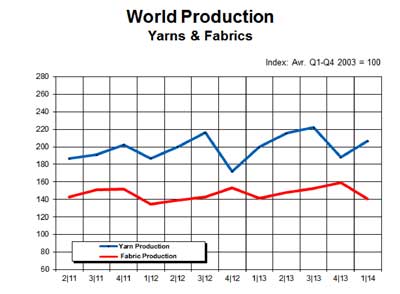
ZURICH, Switzerland — July 9, 2014 —Global yarn production increased in Q1/2014 compared to the last quarter in 2013 due to higher output in Asia, North America, and Europe, and despite a drop in South America. On an annual basis yarn production increased as well even though output levels were lower in South and North America. Worldwide yarn stocks decreased slightly in comparison to the previous quarter as a result of lower inventories in South America and Europe. Year-on-year global stocks jumped with higher stock levels in Asia and Europe and despite lower ones in South America. Yarn orders in Europe and Brazil were up in Q1/2014. Compared to last year’s quarter yarn orders were lower in Europe and in Brazil.
 
Global fabric production was down in Q1/2014 as a consequence of lower fabric production in Asia with South America and Europe recording higher output levels. Year-on-year world fabric production decreased slightly with Asia’s output having shrunk and Europe’s and South America’s having grown. Worldwide fabric stocks were lower in Q1/2014 with South and North America recording lower stock levels and despite higher ones in Asia and Europe. On an annual basis fabric stocks fell as well as a result of decreasing stocks in South America and despite higher stocks in Asia, North America and Europe. Fabric orders rose in Q1/2014 both in Europe and Brazil. Also in comparison to last year’s first quarter fabric orders were up in Europe and Brazil.

Estimates for yarn production for Q2/2014 are positive in Asia and North America, unchanged in South America but negative in Europe. Estimates for fabric production for Q2/2014 are positive in Asia and Europe and unchanged in South America.
 
The outlook for yarn production for Q3/2014 is positive in Asia and unchanged in Europe. The outlook for fabric production for Q3/2014 is positive in Asia and Europe.
 
In comparison to the last quarter in 2013 global yarn production increased in Q1/2014 by +10.0% due to higher output levels in Asia (+11.0%), North America (+3.2%) and Europe (+0.5%) and in spite of a drop in South America (-8.2%). In comparison to Q1/2013 global yarn output had increased as well (+3.3%) with production in Asia and Europe up by +4.0% and +3.0%, respectively, while a decline was recorded in South and North America (-16.8% and -1.7%, respectively).
 
In comparison with the previous quarter world fabric production fell in Q1/2014 by -11.6% as a result of a reduction in Asia (-14.3%) and despite higher output levels in South America (+11.0%) and Europe (+2.9%). Year-on-year fabric production worldwide decreased slightly by -0.6% which could be attributed to a decrease in Asia (-1.2%) that could not be offset by increases in Europe (+4.0%) and South America (+1.0%).
 
Global yarn inventories fell slightly (-0.8%) in Q1/2014 as a result of reduced stocks in South America (-8.0%) and Europe (-0.6%) while stocks in Asia were unchanged. On an annual basis, global yarn stocks jumped by +11.1% due to higher inventory levels in Asia (+14.4%) and Europe (+6.9%).
 
Global fabric stocks in Q1/2014 fell by -1.0%. In South America they declined by -4.1%, while Europe and Asia recorded increases of +2.0% and +0.1%, respectively. In comparison to last year’s quarter global fabric stocks decreased as well as result of lower tocks in South America (-11.8%) and despite higher inventories in Europe (+2.2%), North America (+0.9%) and Asia (+0.4%).
 
In Q1/2014 yarn orders jumped by +21.8% in Brazil and by +1.0% in Europe. Compared to last year’s quarter yarn orders were down in Europe (-4.2%) and in Brazil (-0.5%).

In Q1/2014 fabric orders increased both in Brazil and Europe by +6.9% and +5.1%, respectively. Also on an annual basis fabric orders rose by +13.5% in Brazil and by +6.6% in Europe.

Posted July 15, 2014

Source: ITMF

 

Kaeser Expands International Headquarters In Coburg, Germany

COBURG, Germany — July 15, 2014 — Kaeser Kompressoren SE, the international headquarters of Kaeser Compressors, Inc., has broken ground on a major expansion at its main location in Coburg, Germany.
 
The newly planned facilities will primarily serve to manufacture the company’s industry-leading rotary screw compressors and feature the latest in energy saving and sustainable design practices. Construction is scheduled to be completed in June 2016. When complete, the new facilities will add over 200,000 square-feet of manufacturing space.
 
“With this expansion, our goal is to continue to build superior quality products that represent the best in engineering and innovation,” explained company CEO Thomas Kaeser.
 
This news follows the recent announcement that Kaeser Compressors, Inc. made regarding the additional 50,000 square-feet they plan to add to their facility located in Fredericksburg, Virginia.

Posted July 15, 2014

Source: Kaeser Kompressoren
 

INDA Announces “Pure Opportunity” At The Filtration® 2014 International Conference & Exposition

CARY, N.C. — July 10, 2014 — INDA announces the Filtration® 2014 International Conference & Exposition will be held at the Baltimore Convention Center in Baltimore, Md. Nov. 18-20 and will focus on nonwoven media for air and liquid filtration. The conference and expo will highlight industry-leading presentations, filtration educational training, face-to-face business meetings and showcase new products on the exposition floor. The “Pure Opportunity” theme of the event builds on the purification function of filter media and the healthy 4 percent annual growth rate of this important business sector which accounts for $6 billion in end-use sales.

The conference portion of the Filtration 2014 features preeminent speakers that will spotlight the advancements in technology and applications; the issues surrounding healthy, safe air quality and how it can be improved; human health; and a special focus on nanotechnology. A few of the highlights of the conference program are:

  • “The Long View: The Future of Filtration,” Behnam Pourdeyhimi, Ph.D., The Nonwovens Institute
  • “Use of Air Filtration Systems to Reduce Risk of Swine Viruses,” Montserrat Torremorell, DVM, Ph.D., University of Minnesota
  • “Towards Sustainable Nanotechnology: Opportunities and Challenges with Engineered Nanoparticles,” Georgios A. Sotiriou, Ph.D., Harvard University
  • “Evaluating and Controlling Exposures to Nanoparticles: The Role of Filtration – Research and Application Studies,” Charles L. Geraci, Ph.D., National Institute for Occupational Safety and Health (NIOSH)
  • “Health Effects of Nanoparticles,” Joseph D. Brain, Ph.D., Harvard University

A new feature for FILTRATION 2014 is the co-location of INDA’s Nonwoven Filter Media Training Course prior to the exposition, all day on Nov. 18 and Nov. 19, Wednesday morning. Led by Christine Sun, Ph.D., Principal, Textile Research Associates, this training course presents an opportunity to discover the principles of filtration, market and technology trends, technologies, products, test standards, unmet needs, and the growing potential of filter media products.

Concurrently, the National Air Filtration Association will present the NAFA Air Tutorial, Nov. 18, Tuesday morning, and will cover the following topics:

  • “Technology of Clean Air: How Do Filters Remove Micro-contaminants from the Environment?,” Chris Zaker, Glasfloss Industries
  • “Air Filter Application and Best Practice,” Stephen Nicholas, Air Industries, Inc.
  • “Air Filtration Applications for Health and the Indoor Environment,” Jim Rosenthal, Allergy Clean Environments

Dave Rousse, INDA’s President, said, “The addition of INDA’s Nonwoven Filter Media Training Course and the NAFA Air Tutorial to the 2014 Filtration Conference & Exposition enables attendees to optimize their travel spend. It demonstrates INDA’s commitment to bringing together in one place high- quality content to advance the success of filtration professionals.

Filtration is a key growth sector within nonwovens and Filtration 2014 continues to be the major event of the year for this important market.”

For full details on the conference program and the exposition, or to register for Filtration 2014 or the Nonwovens Filter Media Training Course, visit inda.org/events/filt14.

Posted July 15, 2014

Source: INDA
 

Outlast Debuts Spherix PCM Filling Material

Outlast Technologies LLC, Golden, Colo., has introduced Spherix phase change material (PCM) temperature-regulating filling — a fiber ball fiber blend comprising 30-percent PCM short cut viscose fiber and 70-percent standard polyester balls. According to the company, the fiber balls contribute lightness, volume and loft to the filling, while the PCM viscose fibers contribute the temperature management function.
 
“We are working with a highly filled PCM viscose fiber,” said Martin Bentz, managing director of Germany-based Outlast Europe GmbH. “With 7 dtex the diameter of the viscose fiber is quite high, so we can reach approximately four times higher performance levels compared to our standard PCM viscose fiber.”
 
Outlast reports the new filling is soft and breathable, and is especially suitable for summer outerwear and quilted jackets, in which it provides comfortable, lightweight temperature regulation.
 
July 8, 2014
 

HeiQ Introduces Identity By HeiQ For Outdoor Apparel Industry

Switzerland-based HeiQ Materials AG, a manufacturer of high-performance sustainable textile finishes, has released Identity by HeiQ — a smartphone application developed specifically for the outdoor apparel industry. The application utilizes serial numbers combined into a unique quick response (QR) code. When scanned, the QR code provides information — such as origin, consumer label certifications, manufacturing technician and date produced — on all components of a garment specified by the brand. According to HeiQ, a brand now can offer consumers full product accountability and authenticity from fiber to point of sale.
 
July 8, 2014


Südwolle Group Opens First U.S. Location

Germany-based Südwolle Group, a pure wool and wool-blend worsted spun yarn manufacturer, has announced it will open an 18,000-square-foot distribution center in Mount Airy, N.C. The center, Südwolle’s first operation in the U.S., will open in mid-July. The company selected the location for its proximity to manufacturers of legwear and circular knit fabrics, which are two of its key markets. The area also provides Südwolle with convenient access to other textile, apparel and legwear manufacturers in the South and Midwest, and along the East Coast.
 
“The U.S. market for wool yarns is critical for us and continues to grow in importance as consumers demand more premium wool products. Through our new facility in Mount Airy, we can respond even more effectively to our customers here in the U.S.,” said Hans von Schuh, managing director, sales, Südwolle Group. “The City of Mount Airy has been most welcoming. We look forward to being a part of the vibrant community there for many, many years.”
 
July 8, 2014
 

Karl Mayer Opens Its First Factory In India

OBERTSHAUSEN, Germany — July 4, 2014 — India is an important market for KARL MAYER. This traditional textile country is currently the second most important sales region for its Warp Preparation Business Unit. In some sectors, such as direct beaming and sizing machines, KARL MAYER has a market share of more than 90%.

Also KARL MAYER’s Warp Knitting Business Unit is increasingly successful in India. The Business Unit achieved roughly 4% of its machine revenue in India in 2013. Since the end of 2010, there has been strong growth in the warp knitting industry, and this Obertshausen-based company is way ahead in this field. Roughly 80% of all tricot and raschel machines in India are manufactured by KARL MAYER.

KARL MAYER is recognising the increasing significance of India for its business by increasing its presence there. The service subsidiary, KARL MAYER India Private Ltd., was set up as early as 2009. The company’s own training facility, the KARL MAYER Academy India, was opened in June 2012. Now KARL MAYER has set up its first processing, i.e. assembly, facilities in Ahmedabad. This new factory belongs to KARL MAYER India Private Ltd.
 
A strategy of small steps
KARL MAYER’s site is located in Ahmedabad and covers an area of 3,700 m2, of which 2,100 m2 are taken up by the assembly hall.

For now here are assembled the creels used most frequently for warp preparation in India. If this slow start was a success, then capacity could gradually be expanded further. The aim was to build other types of creel step by step for India, and to obtain the necessary components as far as possible from domestic suppliers.
To ensure that the assembly work is of the highest quality, experienced local service technicians were trained to be responsible for quality assurance – a strategy that has already been successful in China. Between 12 and 14 workers were taken for the start of the new assembly operations.

“If we are really successful here, we can offer our customers all the advantages of local production, i.e. short delivery times, customer-specific solutions and favourable acquisition costs, without any of the tax disadvantages associated with imports.” said the project leader, Alexander Kistner.

Opening of the facility with great ceremony
A celebration was held on 27 May to mark the opening of the KARL MAYER factory in India. Representatives from the company and its local agent, A.T.E., took part in the celebrations. Official visitors from KARL MAYER’s top management included the CEO, Arno Gärtner, the head of the Warp Preparation Business Unit, Roland Kohn, and Jochen Schmidt, head of Technical Textiles, Kevin Socha and Milind Mirkar – the managing director and general manager of KARL MAYER India – and head of the Warp Knitting Business Unit, Oliver Mathews. Also included in the special celebrations were representatives from A.T.E., the managing director, Anuj Bhagwati and the director, Gurudas V. Aras.

The newly developed DS EC2 machine was also premiered at the opening celebrations, amid great ceremony. The opening and inauguration event included traditional ceremonies, such as the saying of prayers, the burning of incense sticks, gifts of flowers to the god, Ganesh, dances in traditional costume and the cracking of a coconut shell. And of course, Arno Gärtner, cut the red ribbon.
 
Outlook on further activities
These opening celebrations on a smaller scale will be followed by an open house event for KARL MAYER customer at the end of April 2015. In this respect, it is planned to present a warping machine, a wider MJ model as well as some tricot machines. Moreover, by end of December 2014 the KARL MAYER Academy India will move from Surat to Ahmedabad. By concentrating the service activities KARL MAYER hopes to achieve a lot of synergies. The participants in the training courses can see for themselves and be convinced by the quality of KARL MAYER’s location in India and they can have a look at the machines produced there. On the other hand, KARL MAYER benefits from the proximity to its customers.

Posted July 8, 2014

Source: Karl Mayer
 

Paper Solicitation For AATCC’s 2015 International Conference

RESEARCH TRIANGLE PARK, N.C. — AATCC, the Association of Textile, Apparel & Materials Professionals, is soliciting papers for its 2015 IC which will be held March 24-26 in Savannah. We have a Call for Papers posted on our website and encourage submittals for both oral and poster presentations. We are seeking abstract submittals for our three educational tracks, Concept 2 Consumer, Chemical Applications, and Materials. 

The deadline for submittal is July 21 for oral presentations and November 7 for poster presentations. We encourage submittals on innovative fibers; innovative and sustainable technologies for textile processing; troubleshooting issues; new machinery and chemistries; performance/protective fabrics/garments; color management in the supply chain; QC testing; new research for textile application; biomaterials; medical textiles; consumer oriented topics; nonwovens; functional textiles; trade issues; care labeling; nanotechnology; product performance and innovation for the retail marketplace; case studies; and innovative designs and trends. For a complete list of topics for which presentations are solicited please visit our website.

We are also seeking a plenary speaker for this conference and looking for recommendations. If you would like to recommend a speaker, please email your suggestion to me at pickettp@aatcc.org. Please share this email with your colleagues and encourage their submittals.

Posted July 8, 2014

Source: AATCC


Optitex Announces Launch of Version 12.3: Introducing Expanded 2D and 3D Capabilities and Production Enhancements

NEW YORK CITY — July 8 2014 — Optitex, a provider of 2D and 3D CAD/CAM and virtual prototyping software solutions for sewn products, today announced the release of Version 12.3 of its market-leading software. This latest version includes several major developments: a new tool within Optitex PDS that significantly improves the design and development workflow for garments that use printed fabrics; and a new add-on module to Optitex CutPlan that enables improved inventory utilization.

The new Printed Fabric Tool, now integrated into Optitex Pattern Design Software (PDS), facilitates the accurate positioning of style pieces on printed fabric. From within Optitex PDS, designers and pattern makers can see how the printed image will lie on the garment, make adjustments and immediately view the effects of every change. With Optitex 3D Suite, users can make changes on the 2D pattern or 3D model and see the results simultaneously in both. This greatly increases pattern design accuracy for any garment that utilizes printed fabric, and eliminates the time and costs of creating physical samples. Full 3D visualization also facilitates communication and speeds the approvals process. Roll Management is a new optional module available for Optitex CutPlan that enables cutting room managers to integrate roll inventory data into their order cutting process, in order to optimize utilization of inventory fabric according to user-defined priorities. With this new module, individual rolls of different widths are automatically assigned to specific markers to meet the requirements of the order while supporting inventory management goals. Usage data from the Roll Management module can be exported to a spreadsheet to update the inventory control system.

“The new capabilities we are introducing with Version 12.3 are based on the needs of our strategic customers, answering real-world challenges that fashion companies on both the design and production ends of the industry face every day,” said Gil Almog, VP Products and Technology. “Our close cooperation with major customers is a defining element in our success in providing cutting edge 2D and 3D software solutions that optimize the garment design, development and production processes and take virtual prototyping to a new level.”

Posted July 8, 2014

Source: Optitex
 

Hohenstein Institute’s Contact Office In Bangladesh Celebrates 10 Years Of Existence

BÖNNIGHEIM, Germany — June 30, 2014 — On 6 June the 10-year anniversary of this foreign branch was celebrated at a ceremony attended by the 75 staff from the Bangladeshi contact office of the Hohenstein Institute as well as Institute Director Prof. Dr. Stefan Mecheels and International Sales Manager Jörg Diekmann. “The positive response since opening our office in Dhaka in 2004 and our rapid growth in the workforce from just one representative at the start to our current headcount underlines the key importance of Bangladesh as a supply market for the textiles sector”, explains Mecheels.

To cater for the ever-increasing demand for a wide range of quality assessments by independent specialist test centres such as the Hohenstein Institute, the company is continuously stepping up its presence in Bangladesh with experienced professionals from the branch. “What our customers, who are predominantly from typical consumer markets like Germany, other EU states or the USA, particularly appreciate”, comments Mecheels, “is the wide range of services we offer, our prompt order processing system and the expert advice of our partners in the relevant manufacturing countries”. The successful office in Bangladesh has joined a number of other Hohenstein branches such as China or India, adds Mecheels. He has headed up this family firm from Swabia since 1995 and has meanwhile built up a network of in all 44 test laboratories, branches and contact offices in over 40 countries around the world.

The most successful example of the services offered by the Hohenstein Institute in Bangladesh is its programme of testing textiles for harmful substances based on OEKO-TEX® Standard 100. With the issue of 768 certificates in 2013 Bangladesh comes in fifth in the international ranking for the 97 countries participating in the OEKO-TEX® system. In addition, Hohenstein is currently preparing to certify a multi-stage clothes factory with a workforce of 3000 as an environmentally friendly and socially responsible production facility that complies with the requirements of STeP by OEKO-TEX® Standard for sustainable textile production.

“Given the series of accidents occurring at factories in recent years, this sends out an important signal, not only for this industry in Bangladesh but also to the customers it supplies in the target markets”, says sales manager Diekmann not without satisfaction. “This shows that it is a question here of each company assuming personal responsibility and consistently upholding this claim in its supply chain. Sustainable textile production is also possible in countries such as Bangladesh and can pay off for suppliers and their customers in equal measure.”

Another issue that is popular with the customers of Hohenstein’s office in Dhaka is fit testing fit and testing of professional workmanship for garment manufacturing.

Combined with the inspection service offered by the Hohenstein Institute to the local factories, clothing companies can be sure ahead of shipment that their deliveries will satisfy the expectations of the relevant sales markets in terms of quality.

Posted July 8 , 2014

Source: Hohenstein Institute
 

Sponsors


