Quality Fabric Of The Month: Comfort & Safety In The Extreme

By Janet Bealer Rodie, Contributing Editor

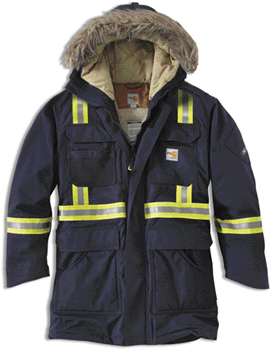
Workers involved in hazardous activities such as oil and gas exploration and drilling and utility work in extreme weather environments like those found in Alaska, Canada or North Dakota now have a new outerwear solution that provides protection from the elements as well as from hazards associated with electrical arc flash and flash fire. According to Brian Schmidt, senior category manager for Dearborn, Mich.-based workwear manufacturer Carhartt, the company spent more than two years developing its Carhartt Extremes® Arctic outerwear line comprising a parka, coat, biberall and hood — all meeting NFPA 70E Hazard/ Risk Category 4 (PPE Level 4) requirements and able to shield workers from high winds and temperatures well below zero — even as low as -60°F. The line features Carhartt’s proprietary Wind Shield® wind-resistant technology applied to Mount Vernon Mills’ 9-ounce AMTEX™ PLUS cotton/high-tenacity nylon flame-resistant (FR) canvas fabric, woven by the Mount Vernon FR division in Trion, Ga.


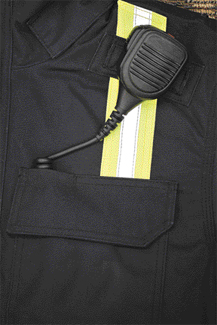
Carhartt’s Extremes® Arctic parka and coat feature special pockets inside and outside to hold tools, and an innovative pass-through port for a radio microphone and cord.

“We did some research with end users in Alaska and determined that their outerwear needed to be warm, comfortable, nonrestrictive and lighter-weight than what’s currently on the market,” Schmidt said. “It also needed to have a great amount of functionality, with pockets to hold tools — specifically, a gas monitor and a radio including microphone and cord.

“The combination of the Amtex Plus canvas with our Windshield technology makes for a really good outerwear fabric,” Schmidt said. “It has a nice drape, moves easily, is not as stiff as comparable fabrics, and yet still feels and looks like what you would expect from Carhartt.”

The FR performance of Amtex Plus is guaranteed for the life of garment. “We use an FR process, not a finish,” explained Craig Tutterow, FR technical director, Mount Vernon FR,. “We saturate the fabric with a monomer that will be polymerized when treated with nitrogen delivered in an ammonia gas, so you get a 3-D polymer chain formed within the fabric. It can’t be washed off, scraped off or blown off — it’s inside, outside and within the fabric.”

The quilted lining in the garments is comprised of lightweight 3M™ FR Thinsulate™ 200-gram platinum insulation and a 6-ounce Amtex Plus twill. There is moisture-wicking Polartec® FR grid fleece on the inside of the coat collar. To further keep the core of the body warm, Carhartt’s FR Sherpa lining helps insulate the wearer’s back.

“A lot of heat is exhausted across the shoulders and down the back,’ Schmidt said, noting that keeping the core of the body warm will help keep the extremities warm. “The Sherpa lining on top of the quilt package provides an additional layer that keeps the back warmer.”

The Carhartt Extremes Arctic line is produced for the North American market in Carhartt’s factory in Mexico.


For more information about Carhartt’s Extremes® Arctic outerwear, contact carhartt.com or mvmfr.com


July/August 2014

Bulletin Board

The Association of Italian Textile Machinery Manufacturers (ACIMIT), Milan, has released a video on its Sustainable Technologies project. The video may be viewed on YouTube.

The Association of the Nonwoven Fabrics Industry (INDA), Cary, N.C., has published “INDA Impact 2014,” its inaugural annual report analyzing industry-wide events that impact the nonwovens industry.

AATCC, the Association of Textile,  Apparel & Materials Professionals, Research Triangle Park, N.C., has released four AATCC Test Method Online Training Videos including Color Evaluation, Colorfastness to Crocking, Colorfastness to Perspiration & Water, and Water Resistance and Repellency.

SGS Consumer Testing Services, Geneva, has released its RAPEX Annual Report 2013 covering notifications on dangerous products in Europe.

Textile Rental Services Association of America (TRSA), Alexandria, Va., has certified 11 textile services plants Hygienically Clean in the quarter ending May 31, 2014.

GSD (Corporate) Ltd., United Kingdom, is offering free practitioner card replacement to GSD Practitioners who have previously been GSD certified and lost their certification credentials. Card holders may initiate a card replacement request by contacting gsdhq.com/contact-us/.

Midland, Mich.-based The Dow Chemical Company’s Dow Microbial Control business unit has launched a Certified Mill Program to recognize textile manufacturers who have successfully completed a training program and demonstrated their proficiency in applying  SILVADUR™ Antimicrobial in their production processes.

The International Oeko-Tex Association, Switzerland, has developed an Application Programming Interface (API) that enables verification of certification data via external online portals and company databases/software.

The Technical Association for the Pulp, Paper, Packaging and Converting Industries (TAPPI), Peachtree Corners, Ga., is accepting nominations through August 1 for the TAPPI 2015 awards.

July/August 2014

Alvanon Launches Virtual AlvaForms

Alvanon Inc., New York City, is introducing a virtual fit form avatar based on its AlvaForm technical fit mannequins.

Garment designs may be fitted on the new Virtual AlvaForms and then manipulated and designed in 3-D environments and shared across the supply chain. The new avatars are designed to help garment suppliers apply an accurate fit and size standard consistently across an entire supply chain; and increase speed of the design-to-market process while offering significant savings in physical fittings and sampling, according to Alvanon.

Virtual AlvaForms are compatible with multiple 3-D fashion design and prototype development systems.

July/August 2014

National Safety Apparel Introduces CARBON ARMOUR™

CLEVELAND — July 8, 2014 — National Safety Apparel (NSA) introduces the newest fabric technology to the welding and metals industries: CARBON ARMOUR™, a premium inherent FR fabric technology that is NOT your traditional safety gear. These welding jackets and sleeves have exceptionally high resistance to pin holes and superior tensile strength. The Carbon Armor line provides unsurpassed breathability and drying rate, making it one of the most advanced moisture management flame resistant fabrics on the market.

These garments go a step above to provide comfort, while providing protection against burns caused by sparks and/or welding spatter. National Safety Apparel worked hard to develop the Carbon Armor line and ensure that it would meet the demands of welders, grinders, and industry workers. NSA is not willing to cut corners when it comes to the quality of their products and the safety of their customers.

Innovating new safety gear to meet the needs of customers and the industries they serve, while providing the newest technology is what National Safety Apparel does best!

Posted July 22, 2014

Source: National Safety Apparel
 

AATCC Seeks to Revise Dry Cleaning Test Methods

RESEARCH TRIANGLE PARK, N.C. — July 21, 2014 — AATCC, the Association of Textile, Apparel & Materials Professionals, is seeking participation in the revision of AATCC test methods related to dry cleaning.
 
The current perchloroethylene solvent used in several AATCC test methods has been identified as potentially dangerous and is being phased out of use in some regions. AATCC research committee RA43 plans to update the following test methods to include more environmentally friendly solvents:
 

  • Test Method 86-2011 Drycleaning: Durability of Applied Designs and Finishes
  • Test Method 132-2013 Colorfastness to Drycleaning
  • Test Method 158-2011 Dimensional Changes on Drycleaning in Perchloroethylene

 
To participate in these activities, contact Committee Chair Joseph J. Nilsen at +1.215.737.2405 by October 1, 2014.

Posted July 22, 2014

Source: AATCC
 

Klüber Lubrication Obtains ISO 21469 Certification For Its Manufacturing Facilities

LONDONDERRY, N.H. — July 21, 2014 — Klüber Lubrication, a worldwide manufacturer of specialty lubricants, has received the National Sanitation Foundation (NSF) ISO 21469 certification at its Londonderry, N.H., facility. The certification from the NSF ensures food-grade lubricants from Klüber Lubrication are manufactured in a hygienic environment, using both best practices and the safest ingredients. Klüber Lubrication leads the industry with five global locations that are NSF ISO 21469 certified.

ISO 21469 specifies hygiene requirements for the formulation, manufacture, use and handling of lubricants which, during manufacture and processing, can come into incidental contact with products and packaging used in the food, food processing, cosmetics, pharmaceutical, tobacco and animal-feeding-stuffs industries.

The certification specifies requirements to ensure ingredients used in lubricant products are safe and product labels are true and accurate. In addition, it ensures the manufacturer has identified and evaluated relevant hazards associated with the use of the certified lubricant. Furthermore, it confirms quality procedures and good manufacturing practices are followed through production facility audits and analytical testing has verified the integrity of the product composition.

With the certification, Klüber Lubrication is in an ideal position to provide better recommendations to customers on best practices within their own facilities.

“It goes beyond the lubricant formulations being recommended,” says Toby Porter, market manager for the food industry at Klüber Lubrication North America L.P. “With the NSF ISO 21469 certification, these products are being manufactured through a hygienic process that works to avoid risks for contamination. We then offer support on best practices to the end user that include the proper storage, handling and use of these lubricants to further mitigate these types of risks and deliver more than food safety.”

Posted July 22, 2014

Source: Kluber Lubrication North America
 

GreenWizard And Mohawk Group Announce The Launch Of A Three-Year Emerald Partnership

CHARLESTON, S.C. — July 22, 2014 — GreenWizard Inc., the leading Product Management platform of building product data and documentation for sustainable and green construction, and Mohawk Group, the award-winning commercial flooring company, are pleased to announce the formation of a three-year Emerald Partnership. The enhanced partnership will allow both companies to better promote the value and urgency of product transparency. The GreenWizard online tool enables users to search for sustainable product attributes, including the Living Building Challenge and LEED certification. 

“The vision and commitment that Mohawk Group continues to demonstrate in furthering environmental and health awareness is significant,” said Jerry Lepore, CEO of Green Wizard. “They are leading the evolution of flooring products for the industry.  This newly created Emerald Partnership strengthens both companies’ shared vision and commitment to product transparency.” 

This three-year Emerald Partnership is the first in the history of GreenWizard. With the Mohawk Group taking the lead in the manufacturing sector with the largest and most varied selection of flooring products that have associated Environmental Product Declarations (EPDs), Health Product Declarations (HPDs) and Declare labels, and GreenWizard being the conduit for this information to the design and construction community, great things are expected to come of this partnership.

“We are delighted to join forces with GreenWizard and view them as a strong ally in the building transparency movement,” said Rochelle Routman, Director of Sustainability at Mohawk Group. “We love that architects, designers and building construction professionals can locate any Mohawk product in a few clicks using GreenWizard’s powerful search tool, whether it be a selection from our extensive list of more than 120 red list free Declared products, as well as products with HPDs or EPDs.”

GreenWizard is the only complete building product management solution for the design and construction community and the Mohawk Group has been a lead supporter of GreenWizard’s efforts since day one.

July 22, 2014

Source: GreenWizard
 

The Rupp Report: Physiological Apparel – Still Going Strong

Over the summer, the Rupp Report will take a look at functional fabrics and sports apparel, which continue to be very important sectors of the textile industry, from fibers to ready-made apparel. This first report will take a look at the beginnings and the evolution of so-called physiological apparel.
 
The 2014 soccer World Cup in Brazil is over. In many regions of the world, family life is starting to go back to a more normal way. For more than a month, TV stations around the world broadcasted fascinating sport with strikers that always looked perfectly good thanks to their modern sportswear. How come the outfits look better than the players after 90 or 120 minutes of a tough game?
 
Physical activities are certainly a way to compensate for the daily stress. Since Olivia Newton-John’s song “Physical” debuted in 1981, a real body consciousness has evolved. The leisure industry followed this trend, and the development of modern sports equipment culminated in new products. In parallel, the textile industry realized a big chance to move away from manufacturing traditional garments toward modern textiles.
 
Physiological Apparel
As with every product, a precise specification list is a prerequisite for a perfect product. Now, the term “physiological apparel” has been coined. What does this mean? The word “physiology” refers to the study of the function of living organisms. Therefore, apparel physiology is the study of interactions that take place between the body and the apparel. It should provide information about the physiological characteristics of the apparel.
 
The Right Functions
Physiologically correct apparel includes the proper function of apparel during the performance of physical activity. It is influenced by the correct interaction of the following:
 

  • fiber material;
  • spinning, weaving or knitting technology;
  • density, thickness and weight of the fabric;
  • dyeing;
  • finishing;
  • cut; and
  • apparel technology.

 
In general, physiological apparel is based on the interaction of three components in the so-called triangle of Body – Climate – Apparel. The body, the surrounding climate and the apparel make up a system of mutual interdependence. The body and the environment are given. Only the apparel is changed according to the activity of the wearer. An example: Everyone knows that one wears “warm” dresses in winter and “light and airy” dresses in summer. Now, if the person enters a shopping mall in winter, the positive effect turns into a negative situation: with all the warm textiles around the body, the wearer gets hot. That’s already a very simple example of physiological apparel.
 
Body Temperature — A Key Point
Why does this unpleasant feeling occur? The human body has an operating temperature of some 98.6°F, and the body wants to maintain this temperature. During certain activities, such as sports, the body temperature increases. By secretion of sweat, the body cools back down to its normal temperature. Sweat will generate water vapor, and this vapor can’t be discharged to the outside through the many layers of apparel. The result is a virtual greenhouse effect, and the wearer feels uncomfortable. In this admittedly dramatic example, it is clear to see that the right apparel is the key to wellbeing. It’s not the heat itself that causes difficulties for the human body; it is the unpleasant sensation of heat.
 
Body Moisture
This sweat secretion process provokes probably the most important requirement of apparel, and of functional sportswear in particular: the removal of body moisture. Body moisture must be able to immediately wick away from the skin to the outside of the apparel. In a dry situation, many fiber materials are capable of removing body moisture. However, the problem starts with the body sweat: natural fibers soak it up, the fabric gets wet, the body starts to feel chilly and the sweat can’t evaporate through the fibers, which are virtually adhered to the body. To avoid this uncomfortable situation, there is only one solution: to use water-repellent or hydrophobic, man-made fibers. That’s why physiological apparel mainly involves using man-made fibers.
 
The Right Apparel
However, there are different situations — everything changes according to the respective activity. It is always the sweat that influences the human wellbeing. Everyone has apparel in which he feels better, and therefore the feeling is more comfortable than in other products. So to develop physiological apparel is not that easy. Today, after athleticwear, everyday apparel is the most important field of activity for apparel physiologists. If every garment manufacturer would apply this knowledge to its products, there would be no apparel in which one “doesn’t feel well.”
 
However, every textile professional knows that such an expectation is not realistic. There is a broad spectrum of virtually perfect apparel, and pleasant wearing comfort is a main consideration. Even bedding manufacturers take these considerations very seriously into account, for example, particularly for hospital linens. The reasons for doing so are many: the range of possible combinations of fibers, material and equipment is seemingly endless. Today, the creation of modern apparel and technical textiles is no longer the job of a tailor, but of an engineer. In order to develop optimal apparel for all living and environmental conditions, scientific methods are needed. In the last 25 to 30 years, apparel physiologists have developed these methods successfully and have continuously improved them. But is it really possible to measure comfort? This seems unlikely, but to a certain extent, it is possible today.
 
Research
Various institutions and the man-made fiber industry have been working for many years on requirements for physiologically correct apparel. The methods have been refined over the past few years, and it is now possible to simulate the behavior and the mechanism of the human body. There are many institutes and organizations around the world that support the textile industry in its endeavor. However, one must be careful to select the right partner, which should be an independent — probably state-owned — institute, or a department of a polytechnic school.
 
The Swiss Federal Laboratories for Materials Science and Technology (EMPA) is an example for such an independent institute. It is situated as a domain of the Swiss Federal Institutes of Technology, ETH. The aim is to develop materials and systems for the protection and optimal performance of the human body. EMPA claims that its Body Simulation Systems (BSS) develop and run the most advanced physiological measurement systems worldwide; and that, thanks to a human-like apparatus, BSS can simulate human thermoregulation and study the coupled heat and mass transport through multilayer apparel combinations.
 
In the next report of this series, the Rupp Report will look at the functions and requirements for physiological apparel.
 
Have Your Say
The sector of functional and smart fabrics is very big. If you, dear reader, have some experience in this field, please let us know your thoughts. Have your say and write to jrupp@textileworld.com.
 
July 15, 2014

 

Bayer MaterialScience Debuts INSQIN™ Solution For PU Coated Fabrics

Germany-based Bayer MaterialScience now offers INSQIN™, a sustainable technology for producing polyurethane (PU) coated fabrics without using solvents. According to the company, brand owners now have access to “an integrated package of pure waterborne PU technology, material co-development and a certified manufacturer partner program for PU coated fabrics.”

PU leather and other PU coated fabrics are used to make shoes, bags and apparel. Bayer has set up pilot lines at laboratories in China and Germany, enabling brand owners to work with Bayer technicians and use the INSQIN technology in the design and development of new products with improved environmental performance

“Not only are we now able to join efforts with brand owners to shape a more productive innovation process, we are also contributing a practical solution that addresses the ongoing battle between sustainability and scalability,” said Nicholas Smith, global head of textile coating, Bayer MaterialScience. “Our hope is that by interacting directly with brands as well as with manufacturers, we can reshape material innovation in the apparel and footwear industry. We are committed to reducing harmful effects on people and the environment, by enabling manufacturing that eliminates worker exposure to solvents and lowers resource consumption.”

INSQIN’s solvent-less manufacturing technology will be especially beneficial at Chinese PU fabric manufacturing sites, the company reports, noting that 90 percent of the 4 billion-plus square meters of PU leather produced annually is made in China, and there are concerns about worker exposure to solvents as well as the pollution of local ecosystems. In addition to requiring no solvent, the technology reduces coating process water consumption by up to 95 percent and energy consumption by up to 50 percent, according to Bayer.

Through its INSQIN Partner Manufacturer Program, Bayer will help manufacturers cut water and energy consumption as well as safely manage chemicals. The company will maintain an INSQIN partner list of manufacturers that comply with its standards for applying the technology.

July 15, 2014

Odlo Adopts Lectra Modaris® 3D

PARIS — July 15, 2014 – Lectra, the world leader in integrated technology solutions dedicated to industries using soft materials—fabrics, leather, technical textiles and composite materials—is pleased to announce that Odlo is implementing Lectra Modaris® growth in the sportswear market.

Established in 1946 in Norway, and a Swiss company since 1986, Odlo is the European leader in sports underwear and is known for their technological innovation in this field. In addition to their technical sports underwear collection, Odlo produce specialized clothing for running, cycling, cross-country and outdoor wear for adults and children.

They produce two collections per year in each category and are present in 20 markets. Odlo’s goal is to increase their market share in the sports outerwear market by developing versatile sportswear to the same standard as their underwear, but that can be worn as fashion items. “We want to be perceived not only as a sports underwear brand, but also as a supplier of fashionable sports outerwear,” declares Ulrike Froitzheim, Head of Quality Management and 3D Project Manager.

Odlo’s challenge is to maintain their reputation for comfort, quality and performance while delivering more fashionable collections at a faster pace. Working with technical materials and sport-specific fit presents unique challenges that Odlo also has to consider. “The unique fit requirements of a sports garment need to be respected, as well as demands for sun protection, breathability, elasticity, and resistance to water and wind,” explains Ulrike Froitzheim. “The pattern for a pair of bike shorts, for example, is designed specifically to support the athlete in a seated position.”

Lectra Modaris 3D’s ability to respond to unique fabric and fit challenges made it a natural choice for Odlo. Styles are visible onscreen and modifications can be done immediately and shared visually, contributing to better communication between different teams, including design, product development, product marketing, management and sales. “Not everyone can interpret 2D sketches in order to understand the final product; 3D gives us a way to visualize the product,” says Ulrike Froitzheim. “Better communication and better understanding will help us make better decisions.”

Pattern complexity and special fabrics make sportswear prototypes very expensive. Odlo hopes to cut development costs and lead-time by reducing the number of prototypes they produce. Improved product visualization before physical prototypes are available will also help Odlo make earlier, more accurate estimations. “We have to reduce our development time and make better decisions, and earlier. So we decided to start a 3D project,” adds Ulrike Froitzheim.

“Our motto is ‘one step ahead’. In our opinion, Lectra is one step ahead with their 3D solution and will support us to achieve our goals, once we integrate 3D into our development process,” concludes Ulrike Froitzheim.

Posted July 15, 2014

Source: Lectra
 

Sponsors