Optitex, Alvanon Collaborate to Take Sizing and Fitting Digital

NEW YORK CITY — June 12, 2014 — Optitex, a leading 2D & 3D CAD and virtual prototyping software provider and Alvanon, the global leader in integrated fit solutions for the apparel industry, announced today a collaboration that will enable apparel and fashion companies to use a digital version of their custom-designed Alvanon body forms in Optitex’s cutting-edge 3D Suite.
 
By bringing 100% accurate AlvaForm avatars into Optitex’s 3D environment, the resulting solution will offer a viable, realistic, and highly cost-effective virtual alternative to traditional product prototyping and development.

“The Fashion and Apparel industry is constantly looking for ways to optimize the product development process, and that is driving more and more products to be prototyped digitally.” said Asaf Landau, CEO of Optitex. “Our partnership with Alvanon highlights the industry’s evolution into the digital arena, with the world’s leading size and fit experts supplementing their existing physical tools with virtual ones. We are proud that they are doing so in Optitex’s 3D environment, and are happy to be collaborating with such industry leaders.”

Posted June 17, 2014

Source: Optitex
 

Polartec Announces 2014 APEX Award Winners

LAWRENCE, Mass. —Jun 12, 21014 — Polartec, LLC announces the winners of its annual Polartec APEX Award, recognizing the finest Polartec-based products available to consumers fall 2014 and spring 2015. Judges selected winners based on the style, function, workmanship, and overall design of garments with the most innovative and appropriate uses of Polartec fabrics.Over 100 apparel and accessory brands from around the world submitted their most innovative products. Judges selected 39 Polartec APEX winners ranging from lightweight next-to-skin layers, to breathable “puffy” products for active warmth using new Polartec® Alpha®, to fully waterproof garments that maintain high breathability with Polartec® NeoShell®. These winning garments are being recognized following close collaborative development with Polartec as an innovative solutions provider.

The winners are:

  • 66ºNorth Kjölur Alpha Collection (Shorts, Shacket, and Women’s Shirt)
  • Arc’teryx Argus and Gaea Jackets
  • Ariat International FR Work Tek Pullover Hoodie and Baselayer ¼ Zip
  • Athleta Overcast Coat
  • Bluesmiths Kula Hoody
  • Bomber Gear® Palguin Dry-Top
  • Choucas Glide Hat
  • Descente Women’s Polartec Power Dry Hot Grid Parka
  • Eider Blow Alpha Gloves
  • Giro Wind Guard ¼ Zip
  • Grifone ATUK Jacket with Hood
  • Houdini C9Loft Jacket (men’s and women’s)
  • KJUS Men FRX Equilibrium Jacket
  • KJUS Men FRX Polo
  • Louis Garneau Course Wind Pro LS Jersey and Arm Warmers
  • lululemon athletica Fleecy Keen
  • Makers & Riders Dispatch Rider Weatherproof Trouser
  • Marmot Cataclysm Glove
  • MEC Obsession Jacket
  • Millet Touring Insulated Neo Jacket (men’s and women’s)
  • Montane Axion Neo Alpha Jacket
  • Montane Fast Alpine Neo Pants
  • Mountain Force Fancy Jacket
  • NFM Garm All Weather Lightweight Jacket and Pants
  • NFTO HS-01 Jacket
  • Norrøna lofoten Alpha Jacket (men’s and women’s)
  • Northland Darcy Alpha Padded Coat (men’s and women’s)
  • Patagonia Diamond Quilt Snap-T Pullover
  • PING Soft Shell Hoody Jacket 2way and Soft Shell Pants
  • QOR Alpha Waxed Cotton Jacket
  • Rab Neo Guide Jacket and Pant
  • Reebok ReebokCF Anti-Freeze Mock
  • rh+ PW Alpha Jacket
  • rh+ PW Beta Glove, Hat, Bibtight and Jacket
  • Simms® Fjord Fleece Pant
  • Strafe Cham Jacket and Cham Pant
  • Sugoi Alpha Hybrid Jacket
  • Ternua Women’s Kush and Men’s Rumtse Jacket
  • Teton Bros Glory Jacket and Pants
  • Vaude Bormio Jacket and Bormio Pant
  • Wild Burnside Alpha
  • wings + horns Bunker Jacket 

“The Polartec APEX Award is all about recognizing excellence in innovation, function and design, and encouraging this type of collaboration with our team as Polartec continually expands the limits of what fabric can do,” says Allon Cohne, Polartec global marketing director.

This year is the 16th season of the Polartec APEX Awards, and to celebrate the designers, Polartec will create videos profiling the designers, their craft, and their award-winning products made of Polartec. Each winning partner brand will be honored with a Malden Trophy—the Polartec APEX Award—at special award ceremonies in the Polartec booth at the OutDoor Friedrichshafen and Outdoor Retailer Summer Market shows July 10, 2014 and August 6, 2014, respectively. Winners receive sales support with custom hangtags and marketing materials, and cross-promotional support to generate awareness and ultimately drive sales of these standout products.

Posted June 17, 2014

Source: Polartec


NCTO, CANAINTEX, CECATEC-RD Rally For Strong Rules In The TPP On Capitol Hill

WASHINGTON, D.C. — June 12, 2014 — On June 10, U.S. textile manufacturers joined with their counterparts throughout the Western Hemisphere to communicate to congressional leaders the importance of adopting fair and reasonable textile rules in the Trans-Pacific Partnership (TPP).  The event brought together the trade associations for U.S., Mexican, and Central American textile and apparel producers, CEOs of regional manufacturers, and trade representatives of CAFTA-DR governments. Meetings highlighted the strong growth in trade and investment in textile manufacturing as a result of the NAFTA and CAFTA-DR trade agreements.

The group met with House and Senate leadership offices, including aides to Senate Majority Leader Harry Reid, Speaker John Boehner, and House Majority Leader Eric Cantor, and staff for the House Ways and Means and Senate Finance Committees, and leaders of the House Textile Caucus. Discussions focused on the need for a strong “yarn forward” rule of origin, robust customs enforcement, and reasonable tariff phase outs for sensitive products in TPP.

“Mexico is a key textile and apparel producer in the Western Hemisphere and is a critical part of the supply chain for many American textile and apparel companies,” said Nora Ambriz, Executive Director of CANAINTEX. “Ninety-six percent of Mexican apparel exports are shipped to the United States each year and Mexico is the leading export destination for U.S. textiles and apparel. NAFTA has created this dynamic and integral relationship between the U.S. and Mexico’s textile and apparel sectors and it is critically important that TPP does not damage the Western Hemisphere supply chain in this sector.”

“A final TPP must contain provisions that have been the foundation of U.S. trade agreements over the past 25 years: fair rules of origin, common sense market access rules, and strong customs enforcement provisions,” said Jay Self, Chairman of NCTO and President and CEO of Greenwood Mills. “The NAFTA and CAFTA-DR free trade agreements have created a sustainable and competitive manufacturing platform for U.S. textile and apparel companies which allows us to compete in the global market. It is imperative that U.S. trade policy continues to foster the economic growth seen under these agreements by building on the successful rules they contain.”

“The U.S. and the CAFTA-DR region, including the Dominican Republic, have created a prosperous and sustainable integrated manufacturing platform,” said Karin de Leon, Executive Director of CECATEC-RD. “This partnership provides hundreds of thousands of manufacturing jobs throughout the CAFTA-DR region, and is responsible for billions in two-way trade with the United States.”

Posted June 17, 2014

Source: NCTO
 

AirDye Solutions Announces The Acquisition Of Cheran Digital Imaging And Key Executive Hires

NEW YORK CITY and GAFFNEY, S.C. — June 13, 2014 — AirDye Solutions LLC and Cheran Digital Imaging and Consulting Inc. announced today the acquisition of Cheran Digital by AirDye. Jesse Leskanic, the Founder and President of Cheran Digital, has been named the Chief Technology Officer of AirDye.

The acquisition combines the patented, water-free fabric printing and dyeing capabilities of AirDye with the patent-pending color management software of Cheran Digital. AirDye will apply the Cheran software to its existing printing and dyeing processes, as well as newly acquired digital printing assets to offer the textile market fast and accurate color matching across both processes.

“We immediately recognized the power and uniqueness of the color management approach that Jesse has invented and that Cheran has commercialized in this software,” said Evan Smith, Chief Executive Officer of AirDye Solutions. “Jesse is a true genius, a fourth-generation textile veteran who taught himself computer programming and developed this color management capability over the last decade. This software is globally unique. It enables us to mathematically direct textile coloration to immediately achieve the artwork and color selection of our customers, across different coloration processes. Nothing else can do this. Combined with our disruptive printing and dyeing technology, we now have the ability to shorten the textile supply chain and deliver tremendous economic and environmental efficiencies.”

“This is an industry ripe for change, and we expect to lead that change,” said Jesse Leskanic, the newly appointed CTO of AirDye. “The industry operates today much as it has for the last four centuries, full of delays and waste. The fundamental cause of this is very poor color management from design through bulk production. We are dedicated to changing this. AirDye has been making aggressive investments in disruptive technology innovation, and I felt that combining our companies would create a transformative force in the textile supply chain, which has been the goal of my career.”

AirDye Solutions was formed from the purchase of the assets of Transprint USA/Colorep Inc. in October of 2013 by Fuller Smith Capital Management LLC. The company provides textile design and coloration services, and is developing and acquiring innovative textile technologies.

AirDye used the occasion of the Cheran Digital acquisition to announce a number of recent executive hires. Jeff Tyrrell joined the company as the Vice President of Operations; Mark Lynch was hired as the Vice President of Human Resources; Ben Hanson was hired as the Vice President of Information Systems; and David Michael was hired as the Chief Software Architect, leading a team of software developers that were key contributors to Etsy, Bloomberg L.P., and Sony, among others.

“These new executive hires bring manufacturing optimization and turn-around expertise, as well as leading software development, systems architecture, and database management capabilities,” said Evan Smith. “We believe that the current applications of this color management software and our printing hardware are only the tip of the iceberg. The team that we have assembled will help us to both execute on our core business and to create entirely new business models for the company and for this industry. These are exciting times for AirDye and we look forward to bringing more innovation to the market.”

Posted June 17, 2014

Source: AirDye Solutions
 

GIZ And Huntsman Textile Effects Cooperate To Raise The Bar For The Textile Industry In Bangladesh Through Chemical Environmental Management

DHAKA, Bangladesh — June 16, 2014 — Deutsche Gesellschaft für Internationale Zusammenarbeit (GIZ) GmbH, a German federal agency that promotes sustainable development around the world, and Huntsman Textile Effects, the leading global provider of high-quality dyes and textiles chemicals, are cooperating to raise industry standards in the management of chemicals by textile mills in Bangladesh. Ten mills have so far signed up to the partners’ GIZ Chemical Environmental Management for Competitiveness Program.

The cooperation was formalized today with the signing of a Memorandum of Understanding between Huntsman Textile Effects and Promotion of Social and Environmental Standards (PSES) a textile industry initiative jointly developed by the governments of Bangladesh and Germany, and implemented by GIZ.

The GIZ Chemical Environmental Management for Competitiveness Program will include managerial and technical training, audit and consultancy services and implementation support from local and international Environmental Management System experts from GIZ and Huntsman Textile Effects. Working closely with the local textiles sector, the two partners will support the development of industry-wide chemical management (CM) best practices in Bangladesh and accelerate the adoption of these practices, with the ultimate aim of supporting the industry’s environmental and economic sustainability.

Bangladesh’s textile industry is the nation’s largest export sector. The ready-made garment (RMG) sector was worth US$19 billion in 2012, when more than 5,000 garment factories employed about 4 million people and accounted for 45% of all industrial workers. To remain internationally competitive, local textile mills and RMG factories increasingly have to demonstrate that they operate in a socially and environmentally sustainable way.

Mr. Magnus Schmid, PSES Program Coordinator, said “Textile factories in Bangladesh are now taking environmental issues more seriously as regulatory requirements become stricter and the economic benefits of sustainability become more widely recognized. PSES has already made a great impact with our CM training program and other initiatives and we look forward to doing even more through our new partnership with Huntsman Textile Effects. With Huntsman, we are committed to helping the industry eliminate hazardous substances from the production process in order to achieve a cleaner and safer textiles sector.”

GIZ has actively supported the development of the textile sector in cooperation with the Bangladesh government for several decades. Through PSES, it has already trained more than 60 consultants from 20 service organizations in the use of its CM tool. This CM tool covers the proper handling and storage of chemicals and seeks to improve workplace safety and compliance with environmental laws and achieve cost savings. Huntsman Textile Effects will support this ongoing work, contributing expertise in the optimization of washing and dyeing processes. It will also provide audit and consultancy services to local mills under its Productivity Improvement Program (PIP).

Mr. Peter Gregory, Brand & Retail Marketing Director of Huntsman Textile Effects, said, “Huntsman Textile Effects has a long established presence in Bangladesh. As a global leader in the transition to a more sustainable textiles sector, we are pleased to join hands with GIZ in Bangladesh to help local factories optimize their production efficiency and environmental compliance whilst also building local competence to enable continued adoption. Our international staff will also receive training from GIZ on its CM toolkit so that we can extend our efforts to factories in other countries as well.”

The cooperation with GIZ is part of Huntsman Textile Effects’ commitment to the Zero Discharge of Hazardous Chemicals programme. This global initiative of 18 leading apparel and footwear brands and retailers intends to eliminate hazardous chemicals from textiles production by 2020.

Note on statistics:
5,000 factories & 4 million workers from Deutsche Welle
Other stats from “Textile Industries in Bangladesh and Challenges of Growth” Research Journal of Engineering Sciences paper (Feb. 2013)

Posted June 17, 2014

Source: Huntsman Textile Effects

 

Business & Financial: A Long Look Ahead

By Robert S. Reichard, Economics Editor

The U.S. textile and apparel industries — even after factoring in continuing foreign competition — are looking increasingly healthy — not only for the next year or two but also over the really long pull. That’s the consensus of a growing number of studies that essentially mirror Textile World’s own upbeat outlook. To be sure, no one, including TW’s editors, anticipates any really big gains — the kind that would dramatically recoup previously lost market share. On the other hand, the feeling now seems to be that industry erosion is pretty much over — and that in certain sectors, especially where new niche markets are being developed, there could even be some modest increases. One new study that probably best sums it all up is provided by Global Insight, a top business-forecasting firm. Its economists, for example, now see a steady to slightly higher level of textile mill dollar shipments for both this year and 2015 — with any losses after that, if they indeed to do occur — expected to be minimal. And the story told in another just-released publication — the U.S. Bureau of Labor Statistics’ 2014 Occupational Outlook Handbook — isn’t all that much different. Again, zero in on textile mills — this time measured in terms of production, a physical volume concept — and the average annual rate of slippage for the next decade is again put at under 1 percent. Moreover, translate this production into Global Insight’s dollar shipments yardstick — which includes some modest price increases — and some fractional gains could be in the cards.

More Productivity Gains, Too
The Occupational Outlook Handbook study just referred to contains long-term employment as well as production estimates — numbers that together can provide some hints on textile and apparel efficiency gains. In the case of domestic textile mills, for example, the only fractional declines expected for output are being accompanied by a projected 2.5-percent annual decline in the number of anticipated jobs. That’s pretty much a confirmation that recent productivity gains will continue. And the scenario for domestic apparel manufacturers is even more positive. This time, a similar less-than-1-percent annual rate of expected slippage in production is being accompanied by an eye-opening 8-percent drop-off in the number of projected workers. To be sure, the implied 7-percent or so jump in annual productivity that this implies might be on the high side. But even if you reduce this expected efficiency gain a few percentage points, it still points to an increasingly competitive domestic apparel industry. It might also be pointed out that these productivity gains are actually a bit higher than those projected for the entire U.S. economy, where the annual efficiency increase is put at only 1.5 percent. Credit several reasons for why the two industries are likely to fare better than average. But the key factor here is clearly the willingness on the part of U.S. producers to continue shelling out more than a billion dollars a year for new, state-of-the-art plant and equipment. See “More Positive Numbers,” TextileWorld.com, May/June 2014, for a more detailed discussion on industry capital spending.

A Brightening Import Picture
Meantime, still other new government data — this time on trade — are also giving industry executives something to smile about. Specifically, incoming shipments of textiles and apparel on a square-meters-equivalent basis have actually edged a bit lower in some recent months. And that’s on top of the leveling-off of the past few years. Since 2010, for example, import totals have remained relatively unchanged after rising more than 35 percent over the previous 10 years. Again, it should be emphasized that nowhere are domestic producers about to regain any meaningful portion of previously lost markets. On the other hand, these new numbers clearly represent an encouraging shift —one that is likely to continue, given such other recent signs as sharply rising overseas supplier labor costs, the now considerably lower U.S. energy tabs, consumer preference for domestically produced goods, and the growing interest on the part of U.S. companies to bring some production back to U.S. shores. Other things being equal, the combination of these factors suggests that the U.S. industries’ relatively upbeat 10-year production and shipment projections that were outlined above could actually be somewhat on the conservative side. In any case, the changing scenario would seem pretty much to assure vibrant and profitable domestic textile and apparel industries through the foreseeable future.

June 2014

Pulling Double Duty: Phifer Insect Screening Outfits African Screen Structures In Malaria Research Operation

TUSCALOOSA, Ala., — June 11, 2014 —A popular Phifer insect screening product commonly used for pool enclosures in the U.S. is serving as a tool to aid in malaria research abroad.

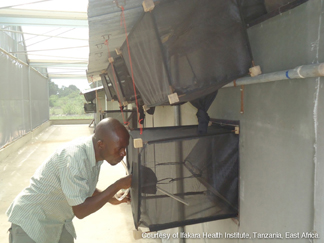
The Ifakara Health Institute, one of Africa’s eminent health research organizations, is using Phifer’s 18×14 Fiberglass Insect Screening to cover large screen house structures for malaria research in Tanzania, East Africa. While building these structures, the IHI realized a need for a strong, durable screening with a specific mesh count as well as UV resistance, and Phifer’s 18×14 screening met the call.

“The screen houses allow us to test our eradication techniques in a ‘natural’ and safe environment with uninfected mosquitoes,” said Jason Moore, IFI project manager. “Such research is cutting-edge in the field as results are far more representative of what happens in nature compared to the usual, small caged experiments.”

Woven from permanent glass yarn, Phifer’s fiberglass screen is coated with protective vinyl to ensure lasting color and flexibility and produced under the most exacting conditions to meet rigid specifications. This screen will not rust, corrode or stain.

Located in Dar es Salaam, Tanzania, the IHI conducts a wide range of health-related research, including biomedical and environmental studies, drug trials, vaccines and diagnostics, health-systems research, monitoring and evaluation. The institute is best-known for its contributions to malaria research.

The work in the IHI’s entomology department centers on researching and combating malaria, which, according to the Centers for Disease Control, affects more than 200 million each year and killed more than 600,000 in 2010, mostly in the African region. Work focuses on finding ways to control the disease with the goal of malaria eradication.

Posted June 12, 2014

Source: Phifer

adidas announces Detox roadmap

HAMBURG, Germany — June 11, 2014 — Sports brand adidas today announced a new roadmap towards the elimination of hazardous chemicals from its products and supply chain. In collaboration with Greenpeace’s Detox campaign, the official World Cup sponsor has laid out a credible plan for the elimination of per-and polyfluorinated chemicals (PFCs) and set key milestones to achieve full supply chain transparency. [1]

“Today’s announcement represents a major step towards the toxic-free future we need. This credible approach with achievable milestones shows adidas is back onside with Detox,” says Manfred Santen, Detox Campaigner at Greenpeace Germany.

As part of the agreement, adidas will ensure 99% of all its products are PFC-free by 2017, leading to full elimination by 2020. PFCs are used in the manufacturing of clothing and shoes to keep them dirt and water resistant. However, once released, these chemicals are known to accumulate in the environment and can impact upon human health, damaging the immune and reproductive systems, as well as leading to thyroid disease.

adidas has also set ambitious goals to achieve full supply-chain transparency by 2020. In line with the ‘Right-to-Know’ of local communities and the brand’s customers, adidas will publish discharge data from 99% of its Chinese suppliers by the end of 2014, 80% globally by mid-2016. The textile industry remains one of the biggest polluting sectors in China, where it is estimated that half of the rural population has no access to drinking water that meets international standards.

“This is a victory for adidas’ customers, for the local communities forced to live with toxic-water pollution and for our future generations. Global brands like adidas have the power and the responsibility to help us kick out these dangerous chemicals for good,” added Santen.

adidas committed to Detox three years ago [2] but up to now, the brand failed to take the credible steps needed to meet its 2020 target. Over the past three weeks thousands of sports fans, volunteers and cyberactivists joined Greenpeace call on adidas to come clean, following an investigation [3] into hazardous chemicals in football products made by adidas, Nike and Puma. Hundreds of activists in more than 30 cities worldwide took action at adidas shops, while thousands sent letters to CEO Herbert Hainer and hundreds more joined one of the biggest ever digital Mexican Waves [4].

“We have once more seen the strength of people power – adidas has listened to the global call for action and accepted responsibility for its environmental footprint. With this news adidas has regained its position as a Detox frontrunner in the sports industry – the world is watching and waiting for Nike and Puma to catch up,” added Santen.

Notes
[1] adidas text: www.adidas-group.com/media/filer_public/2014/06/11/11062014_chemical_management_progress_at_the_adidas_group.pdf
[2] See www.greenpeace.org/international/en/news/Blogs/makingwaves/detox-campaign-hat-trick-adidas-joins-nike-an/blog/36569
[3] A Red Card for Sportswear Brands: www.greenpeace.de/sites/www.greenpeace.de/files/publications/20140515-rote-karte-fuer-sportmarken-englisch.pdf
[4] See www.greenpeace.org/international/en/news/Blogs/makingwaves/detox-top-11/blog/49467

Posted June 12, 2014

Source: Adidas
 

Auburn Manufacturing To Supply Protective Fabrics To U.S. Navy

Auburn Manufacturing Inc. (AMI) — a Mechanic Falls, Maine-based developer, manufacturer and marketer of textile products for extreme-temperature industrial applications — has been awarded a $3.5 million, five-year contract by the U.S. Department of Defense to supply more than 200,000 yards of its AMI-SIL® fabric to the Puget Sound Naval Shipyard (NSY) in Bremerton, Wash., for use in hot work operations during ship repair.
 
AMI-SIL silica fabrics are third-party-certified and comply with the ANSI/FM 4950 performance-based standard for hot-work fabrics. The standard is a requirement under the National Fire Protection Association’s NFPA 51B: Standard for Fire Prevention During Welding, Cutting and Other Hot Work. The company reports the fabrics can withstand temperatures of 1800°F on a continuous basis, compared to 1000°F for AMI’s fiberglass fabrics, and have a melting point exceeding 3000°F. AMI also notes that when used horizontally for welding protection, one layer of AMI-SIL AS3600 fabric — which has a “Pad” rating per ANSI/FM 4950 — can withstand molten metal slag without burning a piece of paper directly under the fabric.

“The contract reflects the continued confidence the Department of Defense has in our products,” said Kathie Leonard, President and CEO, AMI. “We’ve been supplying hot work safety fabrics to the Navy for over twenty years under various contracts, and are now well over 1.5 million yards. Our AMI-SIL fabrics have consistently passed the government’s rigorous inspections and meet all their specifications.”

All of AMI’s manufacturing operations are carried out at the company’s facilities in Maine. Leonard noted that retaining its U.S. manufacturing based helped AMI win the contract.

June 10, 2014
 

Surya To Open Facility In Cartersville, Ga., Add 200 Jobs

Surya Inc. — an India-based vertically-integrated manufacturer of machine and hand-knotted area rugs and soft goods for the home furnishings market — is investing $30 million to open a U.S. corporate office and distribution facility in Cartersville, Ga., and add 200 employees to its U.S. workforce. 
 
Surya currently manufactures its products abroad and ships them to the U.S. for sales and distribution. The company markets its rugs and home accessories to the retailer, interior designer and hospitality markets; and operates showrooms in Atlanta; Dallas; High Point, N.C.; Las Vegas; New York City; Tupelo, Miss.; Toronto; and India.
 
The state-of-the-art, 1,000,000-square-foot Cartersville facility will handle Surya’s supply chain management, sales, and web creative development services. The company currently has a corporate facility in Calhoun, Ga., and reports that 250 jobs will be retained with the opening of the new facility.
 
“During the past several years, Surya has invested in a number of home accessories categories, resulting in significant year-over-year growth and steady expansion of our employee base and warehouse capacity,” said Satya Tiwari, president, Surya. “Our new facility will enable us to consolidate our product offerings under one roof, providing a highly efficient logistics base and the operational flexibility needed to optimally serve our designer and retailer customers. The addition of 53,000 square feet of inviting office space, designed with Surya’s energetic and collaborative culture in mind, will provide a great working environment for both existing employees and new talent as we continue to execute on our strategy to become a $1 billion company.”
 
June 10, 2014
 

Sponsors