U.S. And African Companies Call For Immediate Renewal Of AGOA

WASHINGTON — August 13, 2014 — The United States Fashion Industry Association (USFIA) joined six U.S. and African fashion and retail trade organizations in a call for immediate renewal of the African Growth & Opportunity Act (AGOA), which is scheduled to expire on September 30, 2015. 

The organizations also called for long-term renewal of the program for at least 15 years—including the third-country fabric provision—and extension of the third-country fabric provision to all AGOA beneficiaries. The statement is attached and online.

“AGOA not only allows U.S. companies to produce quality, affordable apparel for their customers, but also provides much-needed jobs and economic opportunities in sub-Saharan Africa,” says Julia K. Hughes, President of USFIA. 

“However, those opportunities are at stake as the expiration date looms,” she adds. “In our recent benchmarking study, fashion executives told us that they want to continue sourcing from the AGOA region, and even place more orders. But without duty-free treatment, sourcing apparel from the region is cost-prohibitive for many fashion brands and retailers, and since they plan their sourcing six to twelve months in advance, many are already considering leaving the region altogether.” 

“We hope that the discussions at the U.S.-Africa Leaders Summit last week, as well as the recent Congressional hearings, will lead to quick, long-term renewal of this important trade preference program so fashion brands and retailers can continue placing orders and expand their business in the AGOA region,” Hughes concludes. 

In addition to USFIA, the signatories of the statement include the African Cotton and Textile Industries Federation (ACTIF), the American Apparel and Footwear Association (AAFA), the Footwear Distributors and Retailers of America (FDRA), the National Retail Federation (NRF), the Outdoor Industry Association (OIA), and the Retail Industry Leaders of America (RILA).

Posted August 19, 2014

Source: United States Fashion Industry Association
 

TUKA3D Virtual Prototyping Supports Voler’s Made-In-America Produce-On-Demand Mission

LOS ANGELES, Calif. — August 18, 2014 — When Voler, the custom-cycling-clothing company, hired Aaron Barker as its eCommerce director seven years ago, the then-21-year-old company was at a turning point. Known for its custom designs, often for teams or cycling groups, Voler increasingly was focusing on a broader semicustom retail market, providing all cyclists with the same superior cycling gear available in its full custom line.

“They knew they had to shift their business to do online ordering for direct-to-client — everything from individual cyclists to bike shops to someone ordering thousands of units,” Barker says. “Everything was moving online in general, and they brought me in to build up the order-management side.”

For Barker, making sure that Voler’s jerseys and shorts, which are hand-cut and entirely made in the USA, could be produced quickly was key. “We have a high number of SKUs, but we don’t carry the inventory on all of those,” he explains. “Our process is produce on demand. We take the order one day and have it delivered in less than seven days.”

At the time, Barker noted that for its garment production Voler was using software from Tukatech, the apparel industry’s leading provider of fashion software and hardware technology solutions. Voler’s designers worked with TUKAcad software for their patternmaking, marking, and grading, and with a Tukatech plotter to print the markers. Tukatech’s innovative founder and CEO, Ram Sareen, continued to work with Voler’s president, Michelle Costanzo, as new capabilities developed. Two years ago, he introduced Costanzo to SmartMark, Tukatech’s software module that maximizes marker placement with near-surgical precision.

“It sounded a little too good to be true at first,” Barker admits. “Our guy had been doing it by hand for 20 years. They showed us how it worked, they let us use it for 30 days, and the lightbulb went on. It was a no-brainer. Once we saw it in action, it became clear that their software would do a better job no matter how much experience someone had.”

SmartMark “was able to save us a ton of money on fabric utilization by smartly nesting the pieces,” Barker notes. “It increased our efficiencies and raw materials costs. It definitely paid for itself pretty quickly.”

Recently, Voler worked with Tukatech on another major project, this time a custom software program to better communicate and collaborate with clients online in the design process. Called TUKA3D, the software is “a virtual product development tool,” as Sareen explains it. The artwork is developed on CAD, patterns for the jerseys are done on 2D TUKAcad, the artwork is imported on 2D patterns, the fit model is virtual, and the garment is sewn on TUKA3D virtually. The result is a 3D sample of a client’s order, with exact measurements per size, that can quickly be converted into an actual garment.

“They are not some sketches or Photoshop output,” Sareen says. “They are based on real CAD data for that exact size. With the motion simulator you can see the actual drape of the fabric in motion, such as on a runway or, in Voler’s case, on a bicycle. See video here. This enables the final garment to be approved digitally and made on demand.”

Once one garment is completed and approved, hundreds of virtual samples can be made using different combinations of artwork and colors.

“This software turns a design into something 3D that someone can make sense of,” Barker says, “allowing us to share the design online without having to stitch up a sample. Previously we didn’t have a way to do this. We would create some kind of 2D sketch of a jersey. Now we can actually have graphic representation of every garment we are going to sell to that person before they place their order. It’s huge that they can be part of it this way.”

And that, Barker says, is a big competitive advantage. “If you know what you are buying, you will buy more, right? It allows us to sell more and provide a better service all around.”

“While most eCommerce retailers take six to eight months from concept to consumer, with TUKA3D, they can go live with a new collection in less than 30 days,” says Sareen. “New styles are developed, corrected, and approved digitally. Once approved, the digital image is transferred to the eCommerce site and offered for sale. No samples, no photo shoot, no inventory in this business model.”

“What we make,” says Voler President Michelle Costanzo, “is a product that fits the body like a glove, leaving very little tolerance for mistakes. Besides fit, the process of development is complex, and Tukatech customized our system to simplify our manufacturing process.”

What impressed Barker the most was the Tukatech staff’s willingness to roll up their sleeves and immerse themselves in Voler’s process to achieve a common goal. “The 3D imaging was a very specific thing that we needed for our business,” Barker says. “There was no off-the-shelf program that could do it. They saw that and thought they had the capability to help us out. The responsiveness, the customer service, the desire to see their customers succeed at what they are doing are what I think makes them stand apart from others.”

Posted August 19, 2014

Source: Tukatech
 

NCTO Joins With Leading Manufacturing Organizations To Call For Immediate Action On Currency Manipulation

CLEVELAND, Ohio — August 13, 2014 — The National Council of Textile Organizations (NCTO) joined with the American Automotive Policy Council (AAPC) and the American Iron and Steel Institute (AISI) today to seek U.S. government action to stop currency manipulation. NCTO called upon lawmakers to adopt meaningful legislation to stop predatory currency practices and the Executive Branch to include strong and enforceable currency manipulation disciplines in all future trade agreements.

Export-oriented countries such as China and Vietnam have been shown to purposefully devalue their currency in order to promote their exports and to block imports into their markets. This practice places the entire U.S. manufacturing base at a considerable disadvantage when it comes to international trade.  

During an event today at the City Club in Cleveland, Ohio, the three organizations highlighted how unfair currency policies hurt American job creation and economic growth. According to a 2014 study by the Economic Policy Institute, ending unfair currency policies can create as many as 2.3 million new manufacturing jobs in the United States by leveling the playing field in global markets.  

“NCTO is pleased to join with other major manufacturing associations to highlight the need for currency reform,” said Augustine Tantillo, President of NCTO. “Currency manipulation distorts the global marketplace and puts American workers at a disadvantage. NCTO calls upon congressional leaders to support legislative initiatives that create tangible remedies for U.S. manufacturers that have been damaged by unfair currency practices.”

“Currency manipulation affects all U.S. manufacturing,” Tantillo continued, “and as a result we need a bipartisan solution that involves both the Legislative and Executive Branches of our government.”

The U.S. textile and apparel industries employ nearly 500,000 workers in the United States, including 4,796 textile industry jobs in Ohio.

Posted August 19, 2014

Source: NCTO
 

Yarn Market: Cotton Prices Continue To Fall

By Jim Phillips, Yarn Market Editor

Despite the continued growth of the industry in recent years, trouble spots still arise from time to time. Of particular concern to spinners at the moment is the precipitous drop in cotton prices over the past eight weeks.

In late July, cotton prices fell to their lowest in nearly five years, driven in large part by the revised and more pessimistic economic growth forecast by the International Money Fund.

Cotton on the ICE Futures U.S. exchange fell to 63.89 cents a pound in mid-August, the lowest settlement since October 2009.

“We are keeping a close watch on this to see where it goes,” said one spinner. “The fall in cotton prices can be attributed to the global economic forecast and the fact that there is more cotton on the market than previously anticipated. Already, folks are saying that cotton prices for next year are likely to stay low because of increased production. The key, of course, is what is going to happen to consumer demand. Will folks become cautious again and stop discretionary spending, or will they continue to spend as they have for the better part of this year? That’s the important question.”

Spot cotton quotations for the base quality of cotton (color 41, leaf 4, staple 34, mike 35-36 and 43-49, strength 27.0-28.9, uniformity 81.0-81.9) in the seven designated markets measured by the U.S.Department of Agriculture averaged 63.88 cents per pound for the week ended Thursday, August 14, 2014. The weekly average was down from 64.61 cents the previous week and 86.83 cents reported the corresponding period a year ago.

America’s Five-year Plan
Whether the current crisis in cotton prices proves to be short-term or long-term, the turnaround of the U.S. textile industry has been nothing short of phenomenal. Five years ago, the outlook for U.S. spinners, and the textile complex as a whole, was as bleak as at any time in history.  Employment was at an all-time low. The number of large, diversified yarn manufacturers had, in a matter of months, gone from three to one, with Parkdale as the sole survivor. Smaller companies were shutting doors every day.

Fast-forward five years and the entire industry dynamic has shifted. Business conditions have been consistently strong for more than 30 months, with just a random downward blip here and there. Operating and raw material costs, for the most part, have remained relatively stable. New plants are being built, and employment is increasing to pre-Great Recession levels.

Today, some spinners are finding they now have more business than capacity. Demand for ring-spun yarns has consistently outstripped capacity for more than a year. And open-end is currently the strongest it’s been in some time, spinners say.

Why such a turnaround — especially when things looked so bleak just five years ago?

“A lot of spinning has returned to this hemisphere,” said one rep who sells both domestic and imported yarn. “And, due to the weak dollar and the need for quick turnaround, it looks like it is going to stay around for quite some time.”

Rising wages in China and other countries, along with higher transportation costs, have resulted in numerous programs returning to the Western Hemisphere. Furthermore, the grassroots Made in USA campaign has contributed, as more and more retail establishments create special sections for domestic merchandise. Wal-Mart, for example, has committed to stock and promote more than $50 billion of American-made products, including home fashions.

Said one industry insider: “I know a lot of people are working on Made in USA programs. Part of this is consumer-driven, as retail customers pay increasing attention to country of origin, sustainability, traceability and transparency. But a lot is also driven by customers who continue to see their costs in Asia go up. With reduced transportation and inventory costs, it is beginning to make more sense for many companies to return their programs to the United States.”

From 1997 until 2009, some 650 textile plants closed. Today, however, the industry is beginning to expand again. “In 2013, companies in Brazil, Canada, China, Dubai, Great Britain, India, Israel, Japan, Korea, Mexico and Switzerland, as well as in the U.S., announced plans to open or expand textile plants in Georgia, Louisiana, North Carolina, South Carolina, Tennessee and Virginia,” reported USA Today.

“Barring some unforeseen upheaval, our industry is healthier today than it has been in many years,” said one spinner. “I see the potential for continued growth, as more and more customers realize the advantages that can be had by placing programs with U.S. companies. These are great times for the industry.”

Added an industry insider: “Given the history of this business, I think a lot of us are just waiting for so
mebody, somewhere to pull the rug out from under us. It’s what we’ve come to expect. But this time, I believe there is substance and sustainability to our recovery.”

August 2014

Saurer Inaugurates Service Center In Mohali, India

MUMBAI, India — August 1, 2014 — The re-established Saurer Group with 160 years of excellence in production of various textile machines has passion for Customers. Innovation and quality are deeply in-rooted with its vision, mission and values. Passion for the customer means the group is constantly putting the customer first. The inauguration of the service center is to enhance customer support in the Chandigarh region.

The new premises include Sales, After Sales and a state-of-the-art Service center. The official inauguration took place on August 1, 2014. Daniel Lippuner, CEO of the Saurer Group, officially inaugurated the premises together with the local sales and service team. This goes to emphasize the customer first attitude throughout the whole group.

While addressing the opening ceremony, Lippuner expressed the managements passion for innovation, customers, and quality and explained that the regional presence of strong work force and a state-of-the-art facility are important steps to ensure the group to achieve it’s primary goal of customer satisfaction.

Angelo Bonacci, Regional Sales Director of Schlafhorst, said that, considering the strategic decision taken during 2006 to open up the offices in the region and the ever growing customer base, today Saurer is expanding the facility to ensure an even increased level of customer service. Bonacci expressed his confidence in achieving the goals. The new facility at Mohali, will allow the group to be even closer to the customers.

Ashok Juneja (Head of Sales & Service, Schlafhorst in India) wished the team led by U. D. Kothari, (Head of Customer Support, Schlafhorst in India), Mr. Mohanan (Sr. Manager Service, Schlafhorst in India), Amit Sethi (Sr. Manager Sales, Schlafhorst in India) and Mr. Suresh, (Area Sales Manager, Saurer Components brands Texparts and Accotex in India) and the whole sales and service team a great success.

Posted August 19, 2014

Source: Saurer Group
 

Cone Denim Announces Level II SGene® – The Next Evolution Of Stretch

GREENSBORO, N.C. — August 14, 2014 — Cone Denim, a global leader in denim innovation, is pleased to announce the enhanced stretch of Level II SGene® yarn technology. Developed under the direction of Cone’s R&D incubator, Cone® 3D, Level II expands the Collection and takes SGene’s superior stretch performance to the next level using Cone Denim’s patented dual-core spun yarns. The superior force of Level II SGene combined with its expanded global scale out of the U.S., Mexico, and China opens exciting strategic and sourcing opportunities for apparel brands worldwide.

Independent lab tests show Level II SGene dual-core yarns are engineered with 25 percent increased stretch power and snapback effect that provide even greater shape conformity and slimming effect for advanced comfort and confidence.

“Our SGene technology revolutionized stretch denims,” said Kara Nicholas, vice president product development and marketing. “Using our patented stretch technology hidden within the yarn, we virtually eliminated ‘bagging knee’ syndrome and created a new standard for superior shape retention and recovery performance. Our new Level II fabrics are a great addition to the SGene family, elevating the performance of stretch to the next level and unleashing the newest generation of denim fabrics that conform, slim and shape but with unbelievable power and comfort.”

Cone Denim’s innovative dual-core stretch and recovery SGene technology was originally introduced in denim fabrics in 2007, creating a new global standard for stretch denim. The technology was patented in 2012. Level II SGene takes the evolution of stretch to the next level using yarns that contain spandex and filament polyester covered with cotton providing a soft cotton hand and appearance.

“We spin our dual-core yarn in-house to high quality standards,” says Allen Little, director of product development for Cone Denim. “Every element of the Level II SGene technology is engineered for maximum quality and performance, and the filament component is designed and produced specifically for SGene Yarns. To create these patented yarns, we insert the spandex component using a method that maximizes recovery and optimizes stretch, which is then wrapped in a cotton covering and spun to provide a soft cotton hand and natural appearance.”

Posted August 19, 2014

Source: Cone Denim
 

People

The Cranbrook Educational Community Board of Trustees, Bloomfield Hills, Mich., has named Christopher Scoates director, Cranbrook Academy of Art and Art Museum.
 
Innovatext, Hungary, has named Lívia Kokas Palicska, Ph.D., director.
 
New York City-based Simparel Inc. has named Larry Mora senior project manager.
 
Brand & Oppenheimer Co. Inc., Red Bank, N.J., has named Lizz Gillcrist business development and marketing manager.
 
August 2014

SGS Inaugurates New Textile Testing Laboratory In Phnom Penh, Cambodia

GENEVA — August 19, 2014 — The newly-inaugurated laboratory is equipped with the-state-of-the-art facilities to provide physical and restricted substances testing for the entire range of apparel and textile products and restricted substances testing for footwear products. The presence of SGS here will contribute to and strengthen the local apparel industry’s ability to attain a Global standard and acceptability.

Textile and Garment Industry in Cambodia
Cambodia remains the hub of ready-made garment exports to European and USA markets. This clearly demonstrates the increasing demand for consumer product testing services in the region. Product safety, quality and compliance requirements of REACH and CPSIA regulations have increased the need for chemical test parameters in the textile supply chain. The SGS new state-of-the-art facility is fully equipped to address these restricted substance requirements as well as sustainability management in the textile and apparel industry.

Improved Textile Testing Capabilities
The new capacity and testing capabilities of the SGS Cambodia laboratory serve the country’s ever expanding textile industry by providing valuable and rapid testing services to local textile and garment manufacturers needing to comply with international regulations and requirements. In addition to testing, quality inspection, compliance audits, factory assessment and loading supervision make SGS Cambodia a one-stop service provider for the country’s textile industry.

Textile Testing Laboratory – Inauguration Ceremony
The inauguration ceremony, attended by over 100 participants, was held on 8th August 2014 with a ribbon cutting ceremony and laboratory tour.  Management representatives from SGS Group and honorable guests such as H.E. Christoph Burgener, the Swiss Ambassador to Cambodia, Myanmar and Lao, H.E. Touchayoot Pakdi, the Thai Ambassador to Cambodia, Mr. By Pitou , the Deputy General Director of Ministry of Industrial and Handicraft, and Mr. Oknha Van Sou Ieng, the Chairman of Garment Manufacturers Association of Cambodia (GMAC) attended the inauguration ceremony.

Posted August 19, 2014

Source: SGS Consumer Testing Services
 

Business & Financial: Fiber Costs: No Sweat

By Robert S. Reichard, Economics Editor

Both cotton and manmade fiber quotes continue to resist upward cost pressure, and this could be one of the key reasons why domestic textile and apparel industry earnings are being maintained and in some cases are actually edging higher. Looking at the cotton situation first: The U.S. Department of Agriculture’s production estimates for the 2014-15 marketing year puts global output at more than 116 million bales. That’s actually a bit higher than projected a few months ago. Mill usage over this period, on the other hand, is expected to fall short of this output estimate by some 5 million bales. Result: Year-ending stocks for the new marketing year are heading for their fourth consecutive year of advance. Viewed from another perspective, the global stock/usage ratio currently is targeted to top 91 percent. That’s more than double the extremely low ratio prevailing during the 2010-11 marketing year, when prices for the fiber skyrocketed — rising to well over $2 per pound. Zero in on U.S. numbers, and this year’s anticipated stock/usage ratio should also rise — again, more than doubling the four-year earlier level. This kind of inventory buildup, plus the fact that China now holds huge excess supplies, would seem to suggest that prices likely will remain fairly shaky. Indeed, they’ve already dropped significantly over the past few months, with some further modest erosion possible through year-end and into 2015.

A Look At Man-mades
The market outlook isn’t all that different when it comes to key man-made fibers. Again, it’s a scenario of more than adequate capacity with little or no near-term price firming anticipated. A closer look at polyester, which by far accounts for the largest share by far of the man-made market, pretty much tells the story. At last report, global production for this synthetic textile far exceeded the amount currently being consumed. Result: The combined polyester filament and staple utilization rate at last report was put only in the low 70- to 72-percent range. More importantly, this measure of market strength is not expected to change by much over the next two years as new capacity coming on-stream limits any significant improvement in operating rates. Best estimate for 2016: only a small polyester capacity utilization creep up to about 72 to 74 percent. And similar supply-demand imbalances are apparent when looking at most other man-made fibers. Given this scenario, Textile World editors see pretty much smooth sailing when it comes to near-term manmade fiber costs, not only for polyester, but also for other major constructions like acrylics, nylon and rayon. It also might be pointed out that there is still another price-rise inhibitor operating, namely the fact that man-made fiber feedstock costs — mainly petrochemicals — also are expected to hold fairly steady. To sum up: The near stability of man-made tags that has prevailed for more than 30 years now —they’ve risen less than 1 percent annually over this period — is likely to continue. As such, TW’s beginning-of-year forecast calling for only fractional increases in these costs can now be extended out to 2015 and perhaps even into 2016.

The Industry Impact
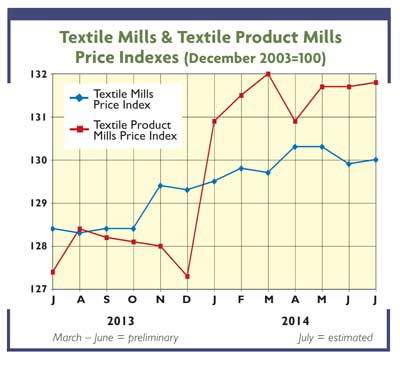
As noted above, these fiber cost trends are having significant positive repercussions on domestic industry health. And with good reason — namely because fiber procurement makes up a huge part of the average textile mill and apparel manufacturer sales dollar. This year, TW editors figure that fiber costs for mills making basic fabrics will account for about 51 percent of each dollar of product shipped. To be sure, that’s still a hefty chunk. But it’s a lot less than the huge near-70-percent-share noted in 2011, when cotton costs went through the roof. Similar declines in material costs per sale dollar are also noted for more highly fabricated textile mill products like carpets and home furnishings, with this year’s estimated material bite expected to run well under the 65-percent peak level recorded a few years back. Nor are things all that different in the apparel sector, where the 45 percent currently being earmarked for material needs remains well under the 3-year-earlier 62 percent reading. The implications of all this are pretty clear: Not only have these declines in the textile and apparel industries’ major cost outlay helped to holster profits and margins (see “Business & Financial,” TW, July/August 2014), but they have also helped keep textile and apparel prices at relatively unchanged levels — levels that remain extremely attractive to today’s cost-conscious consumers.

August 2014

The Rupp Report: A Lot Of Question Marks: Is India Isolating Itself?

Instead of continuing with the reports about physiological apparel, the Rupp Report is forced to take a look at India again: Some weeks ago, the Rupp Report asked: “What’s wrong with India? With millions of cheap workers and a huge domestic market, the country should be as successful as China, but it is not. The industry is underdeveloped and unproductive, and it contributes only some 16 percent to the gross domestic product (GDP). Responsible for this misery are the excessive bureaucracy, endemic corruption, poor infrastructure, permanent energy shortages, excessive taxes as well as outdated property rights and restrictive labor laws.” (See “The Rupp Report: Will India Recover Now?” TextileWorld.com, May 20, 2014.)
 
And now, there is the next act in a somewhat tragic drama, which might bring the second-largest population in the world into even deeper trouble and isolation.
 
India In Isolation?
For years, trade facilitations and standardizations of processes in the customs authorities have been central concerns of the World Trade Organization’s (WTO’s) somewhat dormant Doha Round of trade negotiations. At WTO’s Ninth Ministerial Conference in Bali, Indonesia last December, the unanimous adoption of the so-called Bali Package was celebrated as an historical breakthrough in the multilateral way and as an instrument to stimulate world trade.
 
And now, the Doha Round has suffered a severe blow. The first global agreement on trade facilitations in the WTO’s 20-year history has failed owing to the resistance of India and a handful of developing countries. In a night meeting of the representatives of the 160 WTO members in Geneva on July 31, WTO Director General Roberto Azevêdo reported that finalization of the agreement on global trade facilitations in customs matters had failed and could not be signed. It is a paradox: Experts have calculated that just the implementation of this agreement would create 21 million jobs around the globe and would boost the production of goods.
 
The United States’ WTO Ambassador Michael Punke was sad and disappointed after the short session — which did not include any discussion by the 160 WTO members — that a small number of countries were unwilling to meet obligations that they had agreed to during the Ministerial Conference in Bali.
 
Stubborn Indians?
In recent weeks, seconded by some developing countries, India has shown some signs of backing out of the agreement. The new nationalist government in Delhi doesn’t feel a responsibility to fulfill the obligations of the previous government. India is willing to sign the protocol to the agreement of Bali only if a solid waiver for India, supported in the basic rules of the WTO for the subsidy of staple food, is connected. Of course, this request was rejected by the majority of WTO members.
 
According to the WTO, it is mainly the developing and emerging countries that would benefit from the reforms in the Bali Package. However, a small group of malcontents, led by the new Indian government, took the opportunity to play trade liberalization against food security, and, once more, to paralyze the WTO. In short, the group not only killed the agreement on trade facilitations, which aims to simplify and harmonize the intricate, corruption-prone customs in industrialized and developing countries. Now the reputational damage to the WTO as the global supporter and referee of the trading system is very great.
 
At the Ministerial Conference in Bali last December, the participants managed to agree on a minimal program to wake up the Doha Round from its agony. In Bali, the Indian Minister of Commerce played all cards to expand the subsidization of Indian agriculture under the disguise of protecting the food supply chain. Now, an exception that was granted until 2017 should soon be replaced by a permanent regulation. If the new regulation were not to be concluded soon, Delhi was ready to collapse the agreement; and that’s what has happened now.
 
With this procedure, the Indian government is undermining its own credibility as a negotiating partner. Ultimately, former Indian Trade Minister Anand Sharma gave his blessings in Bali for the agreement on trade facilitations. Now, India is isolating itself within the WTO.
 
Meaningless WTO?
In contrast, according to conjectures by diplomats in Geneva, the WTO has now the risk of ending up in a dead-end street again and slipping into irrelevance if it should continue to prove its incapability to stimulate world trade through agreements for reduction of customs barriers and other impediments to the exchange of goods.
 
However, the major economies would not suffer, Azevêdo said. They have other options to push their trade relations. Victims of the final failure to reach a global agreement would primarily be developing countries.
 
The open and unanswered questions around the Bali Package are detracting from the real goal of the meeting of trade ministers: It was up to the member states to identify which concrete, unilateral measures they would contribute to the growth target that the G-20 finance ministers set last February. These measures stipulate that the collective GDP would be 2 percent higher than the forecasted growth.
 
And Now?
Many voices now predict the end of the multilateral treaty system in world trade. As for areas such as the climate and disarmament issues, there is no common mutual understanding. While the WTO has paralyzed itself in recent years, bilateral and regional trade agreements have filled the vacuum many times. There are also so-called multilateral agreements, where like-minded people grant preferences and get rid of mere copycats. With their blackmail, the Indians have rendered a big disservice to multilateralism.
 
Trade facilitation and standardization of customs procedures are one thing. The rightly feared sellout of a country’s food security, at first glance, is actually something else. At second glance, however, it is not. Between rich and poor countries, trade facilitations can always cause a dangerous tendency for one country to sell out its food security at the expense of poor countries. For the government of India, and particularly the billions of Indians, food security is of vital importance. One has to wonder whether it would be better to develop more sensitivity toward the existential needs of poor countries, instead of rich WTO countries deploring the pigheaded attitude of India.
 
And The Textile Industry?
Perhaps no other industry is so dependent on easier terms between countries as is the textile industry. It is to be hoped that the outcome of this Doha Round will not trigger bigger problems for the global movement of goods in the textile sector. It seems that precautionary measures should not be wrong.
 
The earlier Rupp Report about India asked the question, “Will India now recover?” For the moment, it seems rather not.
 
August 12, 2014


Sponsors