CS Carolina Doubling Its Workforce In Alamance County

RALEIGH, N.C. — August 20, 2014 — Governor Pat McCrory and N.C. Commerce Secretary Sharon Decker announced today that CS Carolina, Inc. is expanding operations in Alamance County. The company plans to create 22 new jobs and invest $7.3 million over the next three years in Burlington.
 
“It’s crucial that we continue to create an environment where our existing businesses can expand,” said Governor McCrory. “North Carolina’s manufacturing workforce help companies like CS Carolina grow. We welcome these new jobs to Alamance County and look forward to CS Carolina’s contribution to continuing our state’s long history in textile manufacturing.” 
 
CS Carolina, Inc. manufacturers, sells and distributes yarn. CS Carolina employs 27 workers in Alamance County. As part of its expansion, the company will relocate its plant from Swepsonville to Burlington, retaining those jobs and adding to the workforce. The need for a larger building was the catalyst for the company’s expansion. 
 
“Textile manufacturing is a rich part of North Carolina’s history,” said Secretary Decker. “It is great to see this yarn manufacturer build upon its presence in the Piedmont and double its workforce in Alamance County.” 
 
Salaries will vary by job function, but the annual payroll for the new jobs will be $772,200. 
 
“We believe in the revival of the textile industry in North Carolina,” said In Tae Joo, president of CS Carolina.  “We are excited to help lead the way with our investments in the latest technology and our new expansion.” 
 
The project was made possible in part by a performance-based grant from the One North Carolina Fund of up to $80,000. The One NC Fund provides financial assistance, through local governments, to attract business projects that will stimulate economic activity and create new jobs in the state. Companies receive no money up front and must meet job creation and investment performance standards to qualify for grant funds.  These grants also require and are contingent upon local matches. 
 
“Over the years CS Carolina, Inc. has been an outstanding corporate citizen and employer in Alamance County,” said Senator Rick Gunn.  “I applaud their decision to add these new jobs to their workforce here and help grow the economy in Alamance County.” 
 
“New jobs are always good news in Alamance County,” said Representative Dennis Riddell.  “By adding these new jobs CS Carolina is demonstrating its continued confidence in North Carolina and Alamance County as a great location for business.” 
 
“This is great news for Alamance County, we will continue to strive to make Alamance County a family and business friendly place and I’m glad to see that companies are starting to notice our county,” said Representative Stephen Ross. “These additional jobs show North Carolina is continuing its economic comeback.” 
 
Other partners that helped with this project include: the N.C. Department of Commerce, N.C. Community Colleges, Alamance County Community College, Alamance County Area Chamber of Commerce, Alamance County, the City of Burlington and N.C. Ports.

Posted August 26, 2014

Source: North Carolina Office of the Governor
 

The Rupp Report: Physiological Apparel Part V: The Right Finish For Perfect Functions

Possibly the most important factor of all jobs to be done downstream in the physiological and functional apparel production chain is the finishing of the fabric. The right finish for a defined end product and its requirements provides the ultimate opportunity to give the fabric the desired properties. In the fifth round of its physiological apparel series, the Rupp Report highlights some fundamental characteristics and requirements of appropriate finishing.
 
Finished fabrics for physiological and functional apparel have to fulfill many requirements and desired characteristics. The recent Rupp Reports have shown quite clearly that it is not possible to produce one single fabric for every end-use. It is the other way around: Appropriate finishing improves the properties of the fabric for the desired end product. If one takes into consideration how many performance characteristics and requirements have to be and can be checked, everyone can see this is not an easy task. Just to name a few requirements, there are lightfastness, colorfastness to water, fastness to perspiration and rub resistance.
 
Furthermore, many other factors have to be examined if physical and physiological aspects of the apparel are the focal point of the fabric to be produced: waterproofness; spray test; rain test; air permeability; water vapor permeability; abrasion test; crease angle; tensile strength; tear strength; seam slippage; and recovery to washing at 30° C.
 
Main Treatments And Finishes
Some of the main finishes for functional fabrics used for correct physiological apparel are:
 

  • water-repellent finishes — impregnation with silicone or fluorocarbon resin, not applicable for microfiber fabrics;
  • fine coatings — acrylic resin, polyurethane elastomer and silicone coatings with weights under 30 grams per square meter (g/m2), resulting in a low water density of about 30 millibars, however, with sufficient water vapor transmission resistance.
  • microporous coatings — a well-known and popular method. A very fine coating is applied, usually via a series of strokes. Pore diameter is slightly larger than Teflon®, about 0.3 microns;
  • calendering and chintzing —thermal and mechanical dry finishes that can increase the water- and wind-repellent properties considerably and very inexpensively; and
  • brushing — a mechanical and dry treatment that is mainly used on the inside of fabrics for sweatshirts and similar products to improve the insulation properties — the more air between the fibers, the better the insulation properties. 

Waterproofness
One of the most important factors is waterproofness. The scale unit for waterproofness is millimeter (mm) water column, for example, 250 mm/hg (mercury). Among the many components that affect the waterproofness, or water density, are yarn or filament fineness, type of texturing, weave density, calender treatments, impregnation. washing process, thermal treatments and coatings.
 
As one can see, it is a great deal to combine all these requirements in one piece of fabric for tailor-made physiological apparel. However, if the desired properties are defined, other factors must match too. Here is an opportunity for clever technicians and engineers of all textile faculties.
 
Dyeing And Finishing
Coatings are the most compromising solution to fulfill the desired properties of the finished apparel or the corresponding end-use. On the one hand, fabrics for protective apparel can be easily produced and made waterproof, but breathability is zero. On the other hand, fabrics with high air permeability are lacking in water-repellent properties. This list of compromises can be extended.
 
There are many ways to improve fabrics by all kinds of finishing treatments. Luckily, the textile finishers, the machinery manufacturers and the chemical industry are very much aware of all the requirements about aspects of physiologically correct apparel. All three sectors are constantly working to improve their treatments, machinery and chemicals. In the last decade, microporous coatings, which are breathable, in particular have made a lot of positive noise. The trend is clearly moving away from the traditional treatment and closer to the characteristics caused by the proper choice of the yarns and the design — that is, the construction — of the fabric.
 
Allergies
As mentioned in the last Rupp Report, many people think they have an allergy caused by textile products, when their apparel — mainly made of man-made fibers — has direct contact with the skin. In almost 100 percent of cases, it is a simple skin irritation, not an allergy. These sensations can be avoided through proper material design. Allergies to man-made fiber materials are extremely rare. However, Table 1 below shows a lot of factors that provoke skin irritation or even allergies:

Table 1:

Material Factors To Provoke Skin Irritation
Fibers Animal, natural vegetal, man-made
Dyestuff Azo dyes, anthraquinone dyes
Finishing material Formaldehyde, optical brightners
Foreign fibers Rubber components, elastomer (spandex)
Contamination In manufacturig, while wearing
Cleaning Residues, cleaning agents
Additives Spinning preparations, special additives, preservatives
Unwanted components Broken glass, iron, metal and such
Non-physiological Tight apparel, ventilation problems
Accessories Zippers, sewing thread and such

 
All these factors have nothing to do with man-made fibers. A lot of irritation is caused by cheap washing agents in the household. Especially detergents or cleaning agents for hand washing in a sink are particularly aggressive, noticeable on a relatively sensitive skin. It is more about mechanical action that causes mechanical problems on the outermost skin layer, the epidermis. Some marathon runners put a plaster on their nipples to protect them against mechanical actions by a scratching T-shirt.
 
Forget about the old wives’ tales of allergy-causing chemical fiber — it is simply not true. There can be many reasons for skin irritation, but the fiber material is not one. Even surgeons are using monofilament man-made fibers in the operating theater, definitely not cotton or other natural fibers. A perfect fabric for sportswear is piqué, which has only a small direct contact with the skin. Between this material and the skin there is “room” for the air, allowing better ventilation and convection. Wet sportswear is unpleasant when it sticks to the skin. The less the material touches the skin; the better is the wicking action. And forget about the odor from wearing apparel made of man-made fibers. Everyone should have a shower after sports activities.
 
The next and final Rupp Report about physiological apparel will describe some important points about cut and sew, making-up, and washing and care of functional apparel.
 
August 26, 2014
 

Commercial Textiles’ Superior Sustainability Verified

ALEXANDRIA, Va. —Aug. 19, 2014 — An independent study, commissioned by TRSA, the leading global textile services trade association, indicates reusable textile products (cloth) have less environmental impact when substituted for disposable counterparts (paper/synthetic) in three common commercial scenarios:

  • Using a napkin in a mid-priced or upscale restaurant
  • Wearing a shoulder-to-shin gown to protect clothing in a hospital
  • Wiping oil, grease, solvent, chemicals and other soils in an industrial setting

The research quantifies the natural resources needed and waste generated in the manufacturing, distribution, use and disposal of various reusable and disposable versions of these products. “The findings suggest that across the wide variety of available products’ materials and weights, reusables have the lowest environmental impact throughout their normal life cycle,” explained TRSA President and CEO Joseph Ricci.

Results of this product life cycle assessment reinforce TRSA members’ longstanding competitive advantage over disposables manufacturers due to the favorable economics of textile reuse and commercial laundering. Now reusables’ lower environmental impact can be added to the case that they are the more sustainable option for businesses.

For isolation gowns and wipers, the assessment found that regardless of product weight, resource consumption or waste, a disposable always contributes more to global warming than its reusable equivalent. Even the most resource-conservative and least wasteful disposables have a greater impact than the worst reusables.

In the case of napkins, a single use of a heavier, intensely washed reusable (usually found in mid-priced or upscale restaurants) has significantly less impact than a single heavier disposable. A single, smaller disposable with recycled content (fast food) has slightly less impact than a single use of a lighter reusable. But when fast-food patrons use multiple disposables in a meal, that thin margin disappears.

According to the study, disposables’ impacts are driven primarily by raw materials, followed by manufacturing energy. Reusables’ impacts are dominated by laundering and, to a limited extent, by raw materials production.

“This is solid evidence that across the board, the combined water, energy and chemical impact of commercial laundering and reusable textile service intrudes less on our planet than the same impact from manufacturing, transport and use of disposables,” Ricci said. “While no study using broad parameters can take into account every possible substitution, it’s clear that in scenarios where the two compete most closely, reusables prevail.”

The independent study was conducted by Exponent, an engineering and scientific consulting company that offers multidisciplinary teams of scientists, physicians, engineers and regulatory consultants to perform in-depth scientific research and analysis across a range of industries.

Posted August 26, 2014

Source: TRSA
 

The World of Wipes® (WOW) International Conference 2015 Seeks Abstracts

CARY, N.C. — August 25, 2014 — INDA, the Association of the Nonwoven Fabrics Industry has issued a call for papers for the ninth annual World of Wipes® (WOW) International Conference to be held June 16-19, 2015, at the InterContinental Buckhead Atlanta Hotel, Atlanta, Ga. WOW2015 is the only conference devoted solely to the entire wipes value chain.

The successful WOW2014 explored topics and issues affecting the global nonwoven wipes market ranging from flushability, and the new Industrial Wiper regulations, to wipes that reduce Healthcare Acquired Infections (HAIs), branding strategies, certification, and technical advances. Attendees are wipes professionals including: senior leadership, new business development, corporate and division management, research and development, marketing, sales, and plant production interested in presentations focused on relevant and informative subject matter regarding the latest innovations and advancements.

For WOW2015, professionals are encouraged to submit their technical or marketing abstracts by December 1, 2014 for the opportunity to gain recognition for their work amongst the industry, potential partners, and customers. Topics currently under consideration are:

  • Antimicrobials
  • Dry and wet wipes
  • End use markets
    • Automotive, baby and toddler wipes, bathing, cosmetic, electrostatic, hard surface, industrial, healthcare, food service, and adult personal care
  • Raw materials & fibers
    • Bicomponent fibers, binders – standard and specialty, biobased fibers, PP & PET, and Rayon, lyocell, and cotton
  • Flushability and dispersibility
  • Machinery and equipment
  • Market statistics & data
    • Global, Americas, Europe, Asia, emerging markets, and sales by type or region
  • Packaging
    • Flexible and rigid
  • Preservatives and fragrances
  • Substrate formation
    • Airlaid, carded, coform, composites, needlepunch, spunlace, spunlaid, and wetlaid

“Year after year, wipes industry professionals have raised the bar as far as the quality, breadth, and wealth of knowledge shared at the World of Wipes Conference. The research, innovations, and advances being made in this market are truly impressive. Improved raw materials and machinery – not to mention the niche product segments – are consistently breaking new ground. I look forward to seeing what the wipes industry will be sharing at WOW2015,” said Dave Rousse, INDA President.

Abstracts of approximately 300 words should be emailed to Deanna Lovell, dlovell@inda.org December 1, 2014. Include contact information and the relationship of the research or marketing to wipes or wipes manufacturing. Authors will be notified of the abstract’s status within 30 days after confirmed receipt.

Posted August 25, 2014

Source: INDA
 

ITMF Annual Conference 2014: “Shared Responsibility – Shared Opportunity”

ZURICH, Switzerland — The ITMF Annual Conference 2014 will be held in Beijing/China from October 16-18 hosted by the China National Textile and Apparel Council (CNTAC). The general theme of the conference “Shared Responsibility – Shared Opportunity” indicates that the global textile industry cannot be looked at and analyzed in an isolated manner. With a long and complicated supply chain the industry as a whole – from fiber to fashion – is responsible to develop an efficient and sustainable supply chain. This in return offers enormous opportunities to all stakeholders. Therefore, a better understanding of the entire textile supply chain and closer partnerships are becoming increasingly important as compared to isolated analyses of individual markets or industries. That is why every stage of the textile value chain from fiber to retail are always represented at ITMF conferences and respective speakers from all textile areas are invited. Approximately 400 participants from around the world will attend. The conference will cover the following areas in open general session:

  • Fibers
  • Textile Supply Chain
  • Retail
  • Technical Textiles & Nonwovens
  • Textile Machinery

Since the conference will be held in Beijing a special focus will be on the Chinese fibers, textile and apparel industry.

The Director General of the World Trade Organization (WTO), Mr. Roberto Azevedo, has provisionally accepted the invitation to be the keynote speaker. In addition, the Vice President of the Development Research Centre of the State Council, Mr. Liu Shijin, will give a keynote address about the global economic situation and outlook. Speakers from the following companies and organizations have confirmed their participation:

  • China Cotton Association
  • ACSA, Australia
  • IHS Chemical, Singapore
  • China Chemical Fiber Association
  • Birla Cellulose, India
  • CNTAC, China
  • Coteminas, Brazil
  • Development Research Centre of the State Council, China
  • Luthai Textile, China
  • Jiangsu Jinsheng Group, China
  • Gildan Active Wear, Canada
  • Alibaba Group, China
  • Hong Kong Research Institute of Textiles and Apparel
  • IKEA, Sweden
  • Aimer Lingerie, China
  • Esquel, Hong Kong
  • Poly Nederland, Netherlands
  • China Nonwovens and Industrial Textile Association (CNITA)
  • TenCate, Netherlands
  • Formosa Textiles, Chinese Taipei

Posted August 25, 2014

Source: ITMF
 

Beaulieu International Group To Establish U.S. headquarters, Manufacturing Facility In Cartersville

ATLANTA — July 14, 2014 — Gov. Nathan Deal announced today that Belgium-based Beaulieu International Group (B.I.G.) will establish its U.S. headquarters and create 350 jobs in Cartersville over the next five years.

“My recent economic development mission allowed for our state to strengthen relationships in the global marketplace, expanding Georgia’s international presence and increasing opportunities for our economy to grow,” said Deal. “It was a pleasure to meet with officials from B.I.G. during my time in Belgium and to celebrate our partnership with this leading global company. Not only does this project have huge implications for the surrounding region, but the company’s success in Georgia will attract other suppliers to the area. Our state continues to be the No. 1 most competitive state for business, and it is projects like this that underscore the strength of our pro-business climate.”

The plant will be constructed on 120 acres of land, previously owned by Anheuser-Busch InBev. In the first phase, the B.I.G. manufacturing campus will design and produce 47 million square yards of cushion vinyl for commercial and residential application.

“We are experiencing growth across the globe for finished floorcoverings,” said Geert Roelens, CEO, Beaulieu International Group. “Our new plant in Cartersville will significantly increase our production and enable us to better supply the U.S. market. We greatly appreciate the state and local authorities in Georgia who supported this project.”

Beaulieu International Group is a renowned international entity with headquarters in Belgium. Today, this industrial group holds a solid market position both in producing raw materials and intermediate goods and in offering an extensive range of perfectly finished floorcoverings.

B.I.G. has 3,500 employees spread across 13 countries and plans to continue to invest in innovative manufacturing processes. The Bartow-Cartersville Joint Development Authority assisted the company in locating to Georgia.

“We are honored to add another world-class manufacturer such as Beaulieu International Group to Cartersville’s family of industries,” said Cartersville Mayor Matt Santini. “Cartersville welcomes this respected company with a global presence, a long history of success and a vision for continued success in the years to come. The city of Cartersville looks forward to providing our quality services and a skilled workforce to Beaulieu International Group to make its vision a reality. I personally thank the company’s leaders for their investment.”

Nico Wijnberg, a project manager for the international investment team at the Georgia Department of Economic Development (GDEcD), and Antje Abshoff, GDEcD managing director in Europe, assisted the company on behalf of the state of Georgia.

“International floor covering manufacturers are regularly looking at Georgia as an ideal location to grow their business,” said GDEcD Commissioner Chris Carr. “More than 72 percent of the nation’s carpet and rug mill manufacturing jobs are located in Georgia. When high-caliber companies such as B.I.G. choose Georgia to call home, they not only enhance our portfolio of quality companies, but they also highlight the strength of our solid labor pool.”

Posted August 25, 2014

Source: Office of the Georgia Governor Nathan Deal


Latvia-based Fiberglass Manufacturer To Create 150 Jobs In Dublin, Ga.

ATLANTA, July 28, 2014—Gov. Nathan Deal announced today that Valmiera Glass, a Latvia-based manufacturer of fiberglass products, will locate to Dublin, creating 150 jobs and investing $20 million within five years into its first U.S.-based headquarters and manufacturing facility.“It is no surprise that Valmiera Glass would select Georgia for its first U.S. headquarters,” said Deal. “This project represents the first substantial investment from the former Soviet Union, which underscores the fact that Georgia’s thriving automotive and aerospace industries are gaining attention in the international marketplace. Valmiera Glass will set the stage for other companies in that region to locate to Georgia.”

Valmiera Glass will locate on 40 acres in an industrial park on I-16 in Dublin. The approximately 80,000-square-foot facility will manufacture fiberglass products for the North American market, heavily utilizing the Port of Savannah. Because its manufacturing process is highly automated, the newly created jobs will be well paid and will require well-trained candidates. Valmiera Glass will also take advantage of QuickStart, Georgia’s top-ranked workforce training program.

“The new manufacturing facility in the United States is a customer-oriented business development step,” said Andre Heinz Schwiontek, board member and vice president of Valmiera Glass Group Joint-Stock company Valmieras stikla šķiedra. “Valmiera Glass Group sales increase in North America every year with 14 percent of the total turnover of the company exported directly to the United States and Canada. Now we will have the ability to efficiently reach our current customers and grow our customer base. This manufacturing facility will provide new opportunities and strengthen Valmiera Glass Group’s position in the global marketplace.”

As a global partner to industries such as aerospace, oil and gas, automotive and others, Valmiera Glass offers a range of products including fiber production, processing and the coating of textile fiberglass structures.

Georgia Department of Economic Development (GDEcD) Project Manager Nico Wijnberg assisted the company on behalf of Georgia, along with GDEcD European Office Managing Director Antje Abshoff and Lonnie Smallwood, project manager at Electric Cities of Georgia (ECG).

“The Dublin-Laurens County Development Authority is extremely happy to have Valmiera Glass join our community,” said Scott Beasley, chairman of the Dublin-Laurens County Development Authority. “They are very strong financially and will be manufacturing products that will be used in the automotive industry. We appreciate their investment into Laurens County and the jobs that will follow.”

“A highly educated workforce is critical for high-tech companies such as Valmiera Glass,” said GDEcD Commissioner Chris Carr. “Without question, Georgia’s advanced labor pool, combined with an interconnected transportation infrastructure and one of the fastest growing container ports in North America, the Port of Savannah, will provide the support that Valmiera Glass needs in order to better reach the North American market.”

About Valmiera Glass
As a major international producer of glass fiber fabrics for many technical applications, Valmiera Glass Group operates a quality control system that fulfills strict international requirements for a variety of industrial markets including composites, thermal and technical insulation and construction industries. Valmiera Glass Group products benefit from innovative production and application technology, plus the most up-to-date manufacturing facilities.

Valmiera Glass Group consists of two companies, Valmiera Glass UK Ltd, located in the United Kingdom and Joint-Stock company Valmieras stikla šķiedra located in the city of Valmiera in Latvia. JSC Valmieras stikla šķiedra and the city of Valmiera are the origins of the company’s brand name and the location of the group’s head office.

Posted August 25, 2014

Source: Office of Georgia Governor Nathan Deal
 

The Rupp Report: Physiological Apparel Part IV: The Right Fabrics For Maximum Performance

One of the key factors of all functional apparel is the fabric, whether it is woven, knitted or warp knitted. The property of the fabric gives the final product its comfort and wearing performances. In the fourth round of its Physiological Apparel series, the Rupp Report highlights some fundamental characteristics and requirements of physiological apparel.
 
There are four different kinds of textile fabrics: wovens, knits, warp knits and nonwovens. According to their construction and finish, these fabric materials comply with the relevant apparel requirements.
 
For the understanding of the following fabric constructions, it is important to know that man-made fibers are produced as endless, so-called continuous filaments. Continuous filaments are basically flat, but, depending on the application, they can be treated by various methods such as texturing. Textured yarns are more bulky, more flexible and elastic, which is important, especially for knitted fabrics. Through the ongoing development of man-made fiber yarns, functional apparel could be improved significantly. Thanks to always finer yarns and surface treatments, coating with polyvinyl chloride (PVC) has largely been eliminated, with the exception of 100-percent waterproof fabrics.
 
Wovens
Apart from fashionable aspects, woven fabrics for activewear mainly serve two functions: protection against wind and weather, and insulation. Thanks to their mostly dense construction, wovens usually perform better than knitted fabrics. Previously woven fabrics for weatherproof apparel were in most cases coated with PVC. The PVC coating ensures absolute waterproofness, but has a serious handicap: After a few minutes, the wearer feels like he is in a sauna — because the fabric can’t conduct air, the wearer sweats after a few minutes, and the body moisture cannot be transported to the outside. This coating corresponds to an airtight package and is normally applied only for heavy rainwear, the so-called oilskin. There are valuable alternatives, which will be discussed in the next installment of this series, which covers finishing.
 
Looking back to the yarns, thanks to the increasingly finer, microdenier yarns, many fabrics can be produced today that do not require additional coating for particular characteristics, but meet all the requirements for functional sportswear. They are wind- and waterproof, yet breathable. Why? Remember the Rupp Report about fibers and yarns (See “The Rupp Report: Physiological Apparel Part III: The Right Yarn For A Functional Product,” TextileWorld.com, August 5, 2014). Consider the filament bundle in the yarn, as in the example 167 f 48. There are 48 filaments in the yarn. If the yarn is 167 f 128, there are 128 individual filaments — the same yarn count, but the individual fibrils are finer, and consequently, the fabric is much denser with this yarn because the “space” between the fibrils is much smaller. Also, the surface area of the fabric is increased, and it can be expected that the moisture transfer proceeds through more fiber material with improved capillary action and good thermoregulation. In this fabric construction, water penetration is limited, but the body moisture can exhaust to the outside. It is scientifically proven that most moisture-transport mechanisms depend on the yarn and the fabric construction. With the same fiber material, one can produce suitable and efficient products, but also completely unsuitable products, if not all known requirements are taken into consideration.
 
Membranes
In this context, especially concerning waterproofness, a new concept for activewear has emerged in the last 10 to 15 years: membranes. A lot of companies have claimed that their product is windproof, waterproof, and can even be breathable. Newark, Del.-based W.H. Gore & Associates Inc. was the first company to deal with membranes. The company started the business by producing artificial arteries and claimed that the polytetrafluoroethylene (PTFE) material would be suitable for functional activewear. Gore says it works; the Rupp Report says it doesn’t. The method to show how it works uses boiling water, which penetrates through the Gore membrane. But whose body moisture has a temperature of 212°F and the same partial pressure to penetrate through the membrane?
 
To give you, dear reader, an idea of what we are talking about, here are some numbers of diameters of molecules and pores in microns:
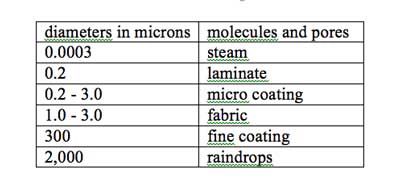

 
Knitwear
Knitted and warp-knitted fabrics have a great advantage compared with wovens: their elasticity. These fabrics mainly fulfill two important functions: to guarantee the unrestricted freedom of movement; and to transport body moisture to the next textile layer. Knitted and warp-knitted fabrics especially have made tremendous improvements. New combinations of materials, yarns and fabric constructions make knitted fabrics the ideal material for functionally correct activewear. Knitted activewear products mainly are worn directly against the body. Therefore, special attention must be paid to the chosen construction and the yarn. Of particular importance in this context is the skin-sensory behavior. Incorrect fabric construction can provoke uncomfortable sensations, such as itching, caused by the physical contact with the skin. Often, people talk about allergies when these sensations occur, which is completely wrong. This issue will be described when in the finishing installment.
 
Ideal Material: Double Jerseys
The ideal fabrics for truly physiologically correct activewear are double knits, also called double jerseys. The inside of the fabric is usually made of texturized filament or staple-fiber yarns, and the surface is made of natural fibers, mostly cotton. Why? The principle of all correct functional wear is the ability to transport the body moisture up to the next layer, which is in this case the surface of the double knit. The principle is very simple: the hydrophobic man-made fiber yarns transport the moisture by capillary action to the outside, where it is absorbed by the hydrophilic cotton. On the surface of the fabric, the moisture can evaporate. With this system, the wearer never feels wet and chilly. With this simple conclusion, the entire apparel physiology could be explained.
 
Nonwovens
Last but not least, thanks to ongoing fast development, nonwovens are gaining ground in modern functional apparel. For activewear, they are used primarily as insulation or filling material. Tailor-made nonwovens can almost achieve the same properties as down, but are much cleaner and more easy-care. On top of that, the durability and resilience is much better. Also in the production of nonwovens, it is important to know that the finer the basic material of the nonwovens product, the better the insulation capabilities. And, nonwovens should always be made according to the same guidelines as other materials and provide the same unhindered moisture transport through the web to the next (outside) layer.
 
Man-made fiber nonwovens have further advantages compared to natural fillers such as down: even when wet, the air permeability and thermal insulation remains. A wet down fill insulation loses at least 50 percent of its isolation properties, which is higher than 25 percent of its own weight. In addition, these nonwovens dry very quickly. And, last but not least, the price of the filler plays an important role. Natural goose down is much more expensive. In the last few years, the price for down has soared. That’s why many producers replace the fillings with cheaper goose feathers or nonwovens. Sometimes the fillings in “100-percent” down jackets are stretched with goose feathers, which can cause big problems for the producers, if one thinks of the power of today’s social media.
 
August 19, 2014



People

The Cranbrook Educational Community Board of Trustees, Bloomfield Hills, Mich., has named Christopher Scoates director, Cranbrook Academy of Art and Art Museum.
 
Innovatext, Hungary, has named Lívia Kokas Palicska, Ph.D., director.
 
New York City-based Simparel Inc. has named Larry Mora senior project manager.
 
Brand & Oppenheimer Co. Inc., Red Bank, N.J., has named Lizz Gillcrist business development and marketing manager.
 
August 2014

SGS Inaugurates New Textile Testing Laboratory In Phnom Penh, Cambodia

GENEVA — August 19, 2014 — The newly-inaugurated laboratory is equipped with the-state-of-the-art facilities to provide physical and restricted substances testing for the entire range of apparel and textile products and restricted substances testing for footwear products. The presence of SGS here will contribute to and strengthen the local apparel industry’s ability to attain a Global standard and acceptability.

Textile and Garment Industry in Cambodia
Cambodia remains the hub of ready-made garment exports to European and USA markets. This clearly demonstrates the increasing demand for consumer product testing services in the region. Product safety, quality and compliance requirements of REACH and CPSIA regulations have increased the need for chemical test parameters in the textile supply chain. The SGS new state-of-the-art facility is fully equipped to address these restricted substance requirements as well as sustainability management in the textile and apparel industry.

Improved Textile Testing Capabilities
The new capacity and testing capabilities of the SGS Cambodia laboratory serve the country’s ever expanding textile industry by providing valuable and rapid testing services to local textile and garment manufacturers needing to comply with international regulations and requirements. In addition to testing, quality inspection, compliance audits, factory assessment and loading supervision make SGS Cambodia a one-stop service provider for the country’s textile industry.

Textile Testing Laboratory – Inauguration Ceremony
The inauguration ceremony, attended by over 100 participants, was held on 8th August 2014 with a ribbon cutting ceremony and laboratory tour.  Management representatives from SGS Group and honorable guests such as H.E. Christoph Burgener, the Swiss Ambassador to Cambodia, Myanmar and Lao, H.E. Touchayoot Pakdi, the Thai Ambassador to Cambodia, Mr. By Pitou , the Deputy General Director of Ministry of Industrial and Handicraft, and Mr. Oknha Van Sou Ieng, the Chairman of Garment Manufacturers Association of Cambodia (GMAC) attended the inauguration ceremony.

Posted August 19, 2014

Source: SGS Consumer Testing Services
 

Sponsors



