Suominen Extends Its Growth Investment Program To 60 Million Euros; Specifies The Value Of Its Investment At The Bethune Plant

HELSINKI, Finland — September 1, 2015 — Suominen, a global manufacturer of nonwovens, announces it has decided to extend its growth investment program to approximately 60 million euros because of the promising growth prospects in the high value-added nonwovens. Earlier, Suominen had stated that the company will spend 30-50 million euros in growth investments during the strategic period of 2015-2017.

Additionally, Suominen specifies the total value of its investment in a new wetlaid line at the Bethune plant in South Carolina. The total value of the investment project, including both equipment and facilities, will be close to 50 million euros. Suominen has selected Andritz as the main supplier and integrator of the project.

“With the investment at Bethune plant, Suominen will take the wetlaid technology to a totally new level in its industry,” said Nina Kopola, president and CEO, Suominen Corp. “The new manufacturing line will be tailor-made, based on our unique nonwovens technology expertise, enabling us to supply our customers with exclusive, best-in-class nonwoven products for wiping, medical or hygiene applications. This is perfectly in line with our strategic intent to achieve product leadership. As the demand for nonwovens with higher value added is forecasted to grow at an attractive pace, I am pleased that we are able to intensify our growth investment program which supports our target to achieve the above-industry-average growth in our net sales”,

The new line is anticipated to be installed during the second half of 2016.

Posted September 1, 2015

Source: Suominen
 

Clariant’s New VAMax™ Catalysts Improve The Economics Of The Vinyl-acetate Monomer Production Process

MUNICH, Germany — August 25, 2015 — Clariant has announced the successful expansion of its selective oxidation catalyst portfolio with its new VAMax-series catalysts, which offers high-activity for Vinyl-Acetate Monomer (VAM) producers.

VAM is produced by reacting ethylene and acetic acid with oxygen in the presence of a catalyst. It is an essential building block for various polymer and co-polymer derivatives, which find broad applications in the manufacture of paints, adhesives and performance plastics for the automotive and construction industries. Global VAM consumption is expected to reach nearly 8-million tons by 2020, growing at a CAGR of +4.4 percent.*

Clariant’s VAMax series of catalysts have demonstrated consistent and outstanding performance in commercial scale production of VAM over extended run-lengths. An attractive aspect of VAMax is its high activity characteristic. This can allow a VAM producer seeking to increase production to achieve higher yields on the basis of the same scale of production equipment. In consequence, this makes new plant projects more attractive by helping reduce the specific investment amount required per metric tonne of VAM capacity. Clariant’s high activity catalysts can further be a viable option for de-bottlenecking existing VAM plants, as well.

Catalysts within the VAMax series can be matched to meet the specific requirements of diverse VAM plants. Because of this, Clariant can work with VAM producers to find the most suitable catalyst solution depending upon their economic and technical needs.

Stefan Heuser, Senior Vice President & General Manager BU Catalysts, Clariant, said: “Our new VAMax product line gives our VAM producing customers new options to increase production without added infrastructure expense.”

*Grand View Research, “Global Vinyl Acetate Monomer (VAM) Market Analysis And Segment Forecasts To 2020,” January 2015

Posted September 1, 2015

Source: Clariant
 

Stoll Enters Into A Partnership With Shang Gong Group

REUTLINGEN, Germany — August 29, 2015 — The well-known German flat knitting company Stoll has announced a partnership with Shanghai based Shang Gong Group (SGG) which is focusing on sewing and textile welding. Together the two renowned companies strive to develop innovative solutions along the textile value chain. Both companies share the vision of Industry 4.0 in the textile industry and of new fields for technical textile applications.

Stoll emphasizes that all current corporate values — including innovation, quality, service, support and responsiveness — will remain key priorities. This partnership supports future growth and sustainability and is the basis for further expansion of products and solutions. Stoll will benefit from additional know how and an even broader presence in Asia.

SGG is a strong international partner who deeply understands the textile industry. With its famous German brands Dürkopp Adler, Pfaff Industrial and KSL Keilmann SGG also has a significant footprint with considerable operations in Europe. In addition SGG can facilitate deeper access to the Chinese respectively Asian markets.

Shang Gong Europe (SGE) – the Germany based subsidiary of SGG – will join H. Stoll AG & Co. KG as a limited partner with a minority share by means of a capital increase. Also SGE will have one member in Stoll’s supervisory board while the Stoll family will keep the dominate majority in the company. The formal partnership will become effective after clearance by the relevant merger control authorities.

Posted September 1, 2015

Source: Stoll


DAK Americas Announces Fiber Capacity Increase

CHARLOTTE — August 28, 2015 — DAK Americas LLC has announced an increase in its polyester staple fiber (PSF) capacity of 230 million pounds per year (lbs/yr) to meet growing demand in the Americas. The new fiber capacity will be installed at DAK’s Pearl River site in Bay St. Louis, Miss., with a project start-up in the second half of 2016.

“DAK is proud to expand its trade leading fiber offerings for low, mid and high tenacity fibers engineered for textile and nonwoven applications,” said Mark Ruday, vice president, DAK Americas Fibers Business Unit.

Production will focus on lower denier (< 3.0 denier) fibers, but will have the capacity to produce fiber products from 0.9 to 9.0 denier.

“DAK’s ability to utilize considerable infrastructure currently in place at its Pearl River Site, provides us with a unique opportunity to grow our fiber capacity and meet customer demand with a very competitive investment,” said Jorge Young, DAK president and CEO. Furthermore, “the new fiber facility at the Pearl River site geographically strengthens DAK’s ability to supply PSF across the Americas with a second U.S. fiber manufacturing location and places DAK in a good position to service the growing Mexico fiber market.”

The project will create 86 new full-time positions including operations, maintenance, technical and management roles on-site. DAK recently completed a PSF expansion (announced October 2014 ) at DAK’s facility near Charleston, S.C., adding 27 million lbs/yr of PSF capacity. Upon completion of the Pearl River site fibers expansion, DAK’s total PSF sales capacity in NAFTA will be approximately 700 million lbs/yr. The Pearl River site will continue to produce high quality Laser +® PET resins in support of customers in the region.

Posted September 1, 2015

Source: DAK
 

Oerlikon Textile Inc. Celebrates 50th Anniversary: 50 Years As The Technological Ambassador To The United States

CHARLOTTE/Dalton, Ga. — August 21, 2015 — Products such as nylon stockings and denim jeans, brands such as Lycra® and companies such as DuPont are global landmarks in American textile history. However, for the past 50 years two German imports also have made invaluable contributions to the success of the region of the textile world so dominant for many years: Barmag and Neumag, today part of Oerlikon Manmade Fibers, with its U.S.-based activities and subsidiaries. The American Barmag Corp. and  Neumag USA Corp. have been important cornerstones of Oerlikon’s foreign business for many years now, and have been technology ambassadors in the United States.
 
Many things change over time, but some things remain the same. With a service station in Dalton that opened in 2015, Oerlikon Manmade Fibers is making a clear statement about the high value it attributes to customer support in the United States. “We wanted to strengthen our service offerings, and Dalton is an important step towards achieving this goal,” said Chip Hartzog, president, Oerlikon Textile Inc. “And our customers are also investing in this region.”
 
Exactly 50 years ago, Barmag decided — for the very same reasons — to establish its first U.S. subsidiary. In 1965, the United States was the largest manufacturer of man-made fibers, producing one-third of global output. Barmag’s business activities in the United States were still limited to occasional deliveries. In 1958, the company had signed a license agreement with a U.S. partner for the manufacture of extruders and extrusion systems — a new production segment at the time. However, the U.S. market was now awarded special attention, as outlined in the Barmag company chronicle: to secure its position as a machine supplier, ‘its own company in the United States’ was required, comprising sales, customer service and technical support. As the U.S. textile industry has been traditionally concentrated in the cotton centers in the southeastern states, the economically-strong Charlotte site was chosen as the base. From here, the company wanted to show its presence and compete with local players in the United States, Canada and Mexico.
 
A veritable success story began with the founding of American Barmag Corp. (ABC), and initially just two employees. Over the three following years, U.S. imports of textile machines rose to a ratio of 27 percent, whereby Germany alone accounted for well in excess of one-third of these imports. The reasons for this were seen in the high quality and performance standards achieved by the German technology. And Barmag also assumed an increasing share of this: over time, successful products, such as the FK4, and later the FK6, the FK6M80 all the way through to the AFK and eAFK texturing machines, polyester and nylon spinning machines, winders and take-up machines, opened up — and then conquered — the hitherto natural fiber-dominated U.S. market for manmade fibers.
 
In the first 10 years, ABC staff already expanded to include 76 employees. On its own 80,000-square-meter industrial plot, the company site was successively expanded to more than 5,000 square meters providing premises for workshops, mechanical manufacturing, warehousing, offices and exhibitions rooms. In 1968, the United States became Barmag’s largest export region and remained in the top group in the following years as well.
 
Neumag USA Corp. Founded In 1989
In this timeframe, a new player entered the stage: the Neumag USA Corp. was founded in 1989, also headquartered in Charlotte. Two employees were responsible for the U.S. and Mexico markets, while the most important spare parts were stored at the depot for fast delivery. Even decades earlier, the German parent company was, above all, successful as a supplier of staple fiber lines — a status that continues to this very day. The early 1980s saw the beginning of the activity for which the name Neumag is today decisively known in the United States: the BCF systems business. U.S. customers were secured in particular for draw-texturing machines for manufacturing BCF carpet yarn made from polypropylene.
 
In the 1990s, Neumag secured itself a market share of around 40 percent in the United States with its BCF business — above all thanks to the new company in Charlotte. Neighbor and competitor Barmag was also successful: ABC repeatedly reported record sales, increased its staff to 240 employees and influenced the entire US manmade fiber and textile industry with such developments as draw-texturing and fast-speed spinning for POY.
 
Dawning Of A New Age With Saurer And Oerlikon
A new age of textiles began at the turn of the millennium. The global textile industry was increasingly shifting to the Far East, with the major players reorienting themselves — also in the direction of manmade fibers. In 2000, the Swiss Saurer Group acquired Barmag and Neumag, with the Oerlikon Group taking over the textiles division of Saurer six years later. During these years, the businesses were consolidated and restructured: Neumag assumed the BCF activities and increasingly focused on the newly-oriented nonwovens division; Barmag concentrated its attention on the filament business. Here, the high-performance technologies of both companies complemented each other and resulted in superior products and, in part, high market shares. To this end, Neumag secured the lion’s share of the entire US BCF market with its S5, S+ and Sytec One BCF platforms and simultaneously supported the increasing polyester boom. Today, Neumag is the premium BCF brand throughout the world and is admired by its American clientèle for its high quality at reasonable costs as well as for its local service and support offerings.
 
However, the modern U.S. textile market, once the birthplace of many commercial manmade fibers, has reoriented itself – creating a mix of commodities, specialty goods and products for local requirements or goods with high value-added. Sustainability and recycling are playing an increasingly major role. While labor costs elsewhere are rising, certain U.S. regions with low energy costs are once again becoming more interesting as manufacturing sites. Add to this the fact that many of the machines installed over the course of the past 30 years are still in operation.
 
This creates opportunities for Oerlikon Manmade Fibers with its current tally of 51 employees in the United States. “We are adding BCF, IDY, FDY and texturing capacities in North America and are also modernizing equipment delivered many years ago,” Hartzog said. “We recognize an opportunity to better support our industry partners, further decrease their lead times for parts and services and provide highly-specialized repair services to keep them competitive in the worldwide marketplace. This was a primary reason for our investment in the new Dalton Service Center. We have been the technological ambassador to the U.S. for 50 years now — and are prepared to continue that tradition.”
 
Posted August 25, 2015

Source: Oerlikon Textile
 

Kraig Biocraft Laboratories Files For Patent Protection Of Dragon Silk

LANSING, Mich. — August 19, 2015 — Kraig Biocraft Laboratories Inc., a developer of advanced spider silk based fibers, announced that it, along with the University of Notre Dame, filed two additional patents to strengthen its intellectual property protection surrounding its transgenic silkworms and spider silk technologies.

These patent applications are designed to protect the creation of the Kraig Labs transgenic silkworms and the resultant chimeric spider silk. The Company currently has open patent actions in 10 countries, including key silk producer and consumer nations.

“From our inception, Kraig Labs has remained dedicated to a spirit of innovation and refused to accept can’t as an answer,” said Kim Thompson, company founder and CEO. “This pursuit of the seemingly impossible led to a series of first of its kind inventions, including our recently announced Dragon Silk genetic line.  The filling of these two additional patents seeks to protect the creativity and value of that work for Kraig Labs and our shareholders, and goes hand in hand with our commercial market development plans.”

Posted August 25, 2015

Source: Kraig Biocraft
 

INDA’s Filtration To Feature View Of Future Filter Media Requirements

CARY, N.C. — August 24, 2015 — INDA’s Filtration International Conference & Exposition will feature a view of future filter media requirements by a leading industry expert when the industry’s premier event makes its return to Chicago’s Navy Pier November 17-19.

Filter media products offer companies growing potential in this market segment valued at $15.4 billion in North American sales to end users. Keynote speaker Armando Brunetti, Executive Vice President, Camfil Americas, will share his perspectives on customers’ needs based on the realities of the North American market and global business trends.

Focused on the theme of “Pure Opportunity,” Filtration 2015 will bring together high-quality educational program content, training, product displays, and connection opportunities in one location to advance the success of filtration professionals. The full program and event details are now available at the newly launched website at http://www.inda.org/events/filt15.

INDA expects more than 130 exhibitors and 1,500 attendees to attend this singular event for professionals involved in the air and liquid filtration business. Among the topics that will be discussed by leading industry experts at the newly formatted one-day conference on November 17 are: North American filtration forecasts, statistics, and recent mergers and acquisitions; cabin air filtration; water purification; electrospun membrane filter media; and particulate matter 2.5 removal.

New program highlights include: Nanofibers in Filtration: Beyond F9, Beyond MERV 15, Beyond Surface-Load and Pulsing by Fred Lybrand, CEO of ELMARCO Inc.; and Pleated Filter Media as a Direct Replacement for Filter Bags by Jack Clements, Principal, SF Air Filtration.

In addition, INDA is offering premium educational content with the co-location of its Nonwoven Filter Media Training Course, November 17-18. Led by Christine Sun, Ph.D., Principal, Filtration Technologies International Inc., the one and a half day training course will cover everything from the principles of filtration to market and technology trends.

A welcome reception will be held the evening of November 18 after the first day of the exposition. The networking exposition will be held November 18-19, providing industry participants from around the world and across the supply chain the opportunity to connect with decision makers.

Registration is open for both the Filtration International Conference & Exposition and Nonwoven Filter Media Training Course.

Posted August 25, 2015

Source: INDA
 

Teijin Begins Production And Sales Of Teijinconex® neo

TOKYO — August 19, 2015 — Teijin Corp. (Thailand) Ltd., a wholly owned subsidiary of Teijin Ltd., announced that it has begun producing Teijinconex® neo, a new type of highly heat-resistant and dyeable meta-aramid fiber, on the premises of Teijin (Thailand) in Bang Pa-in Industrial Estate, Ayutthaya, Thailand. Teijin is now the first company to ever to produce high-function, high-performance fibers in the ASEAN region.
 
The 2,200-tons-per-annum plant was built at a cost of around 4.5 billion yen ($36 million) and has begun operating with a workforce of 70 people. The site measures 22,985 square meters. Construction of the plant started in December 2013.
 
Teijinconex neo offers unsurpassed heat resistance and excellent dyeability that enable highly diversified solutions for the design and manufacture of protective apparel. Teijin’s production technologies assure that products are compliant with REACH and other environmental regulations directly out of the factory, without additional treatment.
 
Teijinconex neo will strengthen Teijin’s position and competitiveness in the emerging markets of Asia and other regions, where the demand for heat-resistant, flame-retardant high-performance materials is growing. Teijin expects to take a leading position in the global market for protective apparel, targeting sales of 20 billion yen ($160 million) by 2020.
 
“Teijin first began operating in Thailand in 1966 and now has seven group companies with 1,500 employees,” says Tadashi Sakata, president of Teijin Corp. (Thailand). “We are also expanding our automotive rubber materials business in Thailand and are shifting polyester fibers production to this market from Japan. Going forward, we will upgrade our production and processing capabilities for high-performance fibers by steadily introducing advanced technologies in Thailand, the hub of the ASEAN region.”
 
Teijin’s Teijinconex meta-aramid fiber, Twaron® and Technora® para-aramid fibers, Pyromex® flame-resistant fiber and Endumax® high-performance polyethylene have made significant contributions to the advancement of protective apparel over the decades. Today, strong demands exist in developed markets for protective clothing made with aramid fibers offering comfort, maneuverability and excellent dyeability, as well as high protection. In Asia and other emerging countries, rising standards for protective apparel are boosting the demand for Teijinconex and Teijinconex neo meta-aramid fibers in these markets as well.

Posted August 25, 2015

Source: Teijin Ltd.
 

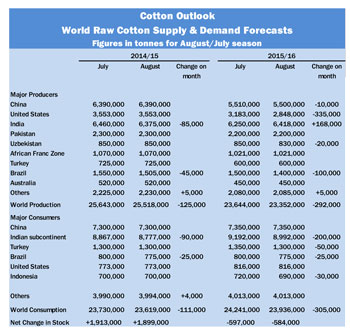
Cotton Outlook’s Supply And Demand Forecast Continues To Imply Lower World Ending Stocks In 2015-16

BIRKENHEAD, United Kingdom — August 20, 2015 — Cotton Outlook’s latest forecast of world production and consumption in the 2015-16 season suggests a reduction of 584,000 metric tons in world stocks, with the biggest fall in China.

The world production figure is reduced by 292,000 metric tons. An increase for India was more than offset by large reductions for the United States and Brazil. Consumption is also lower, mainly owing to a downward adjustment for India.

For 2014-15, the net addition to world stocks has been lowered very modestly, to 1,899,000 metric tons,
resulting from a reduction to global output which was not quite offset by lower consumption.


Posted August 25, 2015

Source: Cotton Outlook
 

First ITMA Sustainable Innovation Award Finalists Revealed: Award Winners To Be Unveiled At ITMA 2015 Gala Dinner

France — August 25, 2015 – CEMATEX, the European Committee of Textile Machinery Manufacturers, is pleased to announce that six finalists have been shortlisted from some 30 entries for its first ITMA Sustainable Innovation Award. Three of the finalists are vying for the ITMA Industry Excellence Award while the remaining three are competing for the ITMA Research & Innovation (R&I) Excellence Award.

Industry Excellence Award
The Award recognises textile and garment manufacturers who have leveraged on technological innovations to advance business sustainability that benefit people, planet and profit. After much deliberation, the judges have picked the following three finalists who have worked closely with ITMA 2015 exhibitors to introduce innovative solutions to their production process or products:
 

Berto Industria Tessile S.r.l., Italy
Berto Industria Tessile, a leading vertically integrated manufacturer of denim products, was quick to recognise the economic and ecological advantages of the Matex® Eco Applicator range by ITMA exhibitor Monforts. They were the pioneer in adopting Monforts’ innovative technology, which enabled them to significantly reduce the amount of liquid needed in finishing denim fabrics, leading to energy savings and a huge reduction in waste water produced.
Gebrüder Otto GmbH & Co. KG, Germany
Gebrüder Otto, one of the leading yarn manufacturers in Europe, implemented Mayer & Cie.’s spinitsystems® to produce single jersey fabric using up to 35 per cent less energy compared to the conventional process. As a spinning mill, Gebrüder Otto produces the roving bobbins which are processed on the Spinit machines.
 
Levi Strauss & Co., United States
Levi Strauss & Co., one of the world’s largest brand name apparel companies and a global leader in jeanswear, has started preliminary development work in their Plock facility in Poland using the NoStone® garment washing technology. Tonello’s NoStone technology provides Levi Strauss & Co. an important first step to solving an industry challenge to make denim finishing more sustainable, cost-effective and efficient.
 

Mr Charles Beauduin, who sits on the Industry Excellence Award judging panel and is also President of CEMATEX, said: “We thank ITMA 2015 exhibitors for supporting this award. What differentiates this award from other industry recognition is that we celebrate the successful collaboration between technology providers and industry users, which ultimately benefits consumers.

“Necessity is the mother of invention, and the synergies from both parties working together towards a common goal will bring about more innovative solutions that will positively impact the environment and the business bottom line.”

R&I Excellence Award – Masters
The three finalists for the award are:

  • Jan Vincent Jordan, Institut Für Textiltechnik, RWTH Aachen University — Master’s Thesis: ‘Development & Assembly of a Test Bench for the Analysis of Magnetic Weft Insertion’
  • Jenifer Schneidereit, Hochschule Niederrhein — Master’s Thesis: ‘Sustainable Water Use in Textile Wet Processing: Development of a List of Improvement Measures for a Self-Assessment Tool for Factories’
  • Moniruddoza Ashir, Institute of Textile Machinery and High Performance Material Technology, TU Dresden — Master’s Thesis: ‘Development of Hybrid Woven Structures for Lightweight Applications’

The winners of the ITMA Sustainable Innovation Award will be announced at the ITMA 2015 Gala Dinner held at the La Pelota in Milan on November 12. The winner of the Industry Excellence Award will receive a cash prize of 10,000 euros and a trophy, among other rewards. A cash prize of 4,000 euros will be given to the winner of the R&I Excellence Award.

CEMATEX has launched ITMA Sustainable Innovation Award as part of its ongoing efforts to encourage and recognise outstanding industry members and post-graduate students for their contributions to the sustainable development of the global textile and garment industry.

ITMA 2015 will be held at the Fiera Milano Rho November 12-19, 2015. It showcases end-to-end solutions for the entire textile and garment making chain. The exhibition has a gross size of over 200,000 square metres. To date, more than 1,500 exhibitors from 47 economies have signed up to take part in the exhibition. Visitors can purchase their ITMA 2015 badge online before October 15, 2015 to enjoy early-bird rates.

Posted August 25, 2015

Source: ITMA

 

Sponsors