Frankfurt — February 18, 2016 — German and European manufacturers of laundry and textile cleaning technology are optimistic as they look forward to Texcare International which opens its doors from 11 to 15 June 2016 in Frankfurt. This leading international trade fair is globally the most important technology platform for the laundry and textile cleaning sector.
“Across the world there is an ever increasing demand for automation, sustainability and workplace safety and this continues to set the industry new challenges” says Günter Veit, chairman of the VDMA Garment and Leather Technology speaking at the international press conference for Texcare in Frankfurt. “What is more, the textile-care sector is a rapidly growing market all over the world with large growth opportunities, as for example in the areas of textile rental, information technology and inventory management systems,” adds Veit. This increases the demand for new cutting edge technologies.
Texcare International is the ideal platform for the manufacturers of laundry and textile cleaning technology to present their new product innovations to an international audience – this time across an extended floor space in Halls 8 and 9 due to high demand.
Texcare International’s main themes will include, amongst others, Industrie 4.0, sustainability, resource efficiency and hygiene.
Industrie 4.0 will be key to competitive edge
Industrie 4.0 is already ubiquitous in textile-care encompassing themes such as digital logistics and production in textile services and in laundries. In textile services, for example, permanent traceability is already standard practice, with laundry, once cleaned appropriately, being re-assigned to the individual user. Other examples are laundry cupboards which register removal of linen or apps with which it is possible to continuously trace the path the textiles take. The digitalisation of the textile-care sector is dependent on textiles already being labelled and identified at the time they are manufactured, using identification technologies such as RFID, for example. Full interlinking of machines, systems and data is also essential for a smart, self-regulating laundry.
German laundry and textile cleaning technology continues on course for growth
German manufacturers of laundry and textile cleaning technology can reflect on two successful years: in 2014 order intake was in real terms 17 percent above the previous year’s results, with turnover increasing by 34% in real terms. Likewise it was also possible to increase exports by 6 percent from € 466 million in 2013 to € 494 million in 2014. The most important export markets for German laundry and textile cleaning technology in 2014 were China, France and the USA.
It was also possible to increase turnover again in 2015 by 5.5 percent compared to the previous year. Only order intake in 2015 registered a small minus of 2.6 percent, although this is compared with a high base figure for the previous year.
Südwolle’s eco-friendly Naturetexx® Plasma treatment uses electricity and air rather than chlorine to make machine-washable wool.
By Janet Bealer Rodie, Contributing Editor
For some years, the standard, most cost-effective treatment for producing machine-washable wool has involved the use of chlorine and Hercosett, a thin polymer resin, to prevent the scales, or cuticles, of the wool fiber from interlocking and causing felting and shrinkage. However, adsorbable organohalogens (AOX) can form as a byproduct of the chlorine process, and the AOX, if not properly treated, can pollute the process wastewater.
One environmentally sustainable alternative to the chlorine-Hercosett process is a plasma treatment, branded Naturetexx® Plasma by Germany-based yarn manufacturer Südwolle Group, that uses electricity and air to make the wool machine- washable. This treatment, which has been in development for about 10 years, is already featured in organic Merino wool and wool-blend performance apparel offered in niche markets, and it is on track to become a viable commercial alternative for broader performance apparel markets. It complies with the Global Organic Textile Standard and Naturtextil IVN Best standard for organic use, and the bluesign® system for sustainable textile production. The technology received an Industry GOLD Award at the 2015 OutDoor trade show in Germany, where Naturetexx Plasma yarns were featured in Germany-based Engel GmbH’s Engel Sports collection of Merino wool/silk athleticwear. Südwolle also presented the technology at the latest Outdoor Retailer markets in Salt Lake City and reports serious interest from a number of brands.
Engel Sports’ machine-washable activewear collection features Südwolle’s Naturetexx® Plasma yarns in a Merino wool/silk blend.
Hamish Allan, Südwolle’s marketing manager, explained how Naturetexx Plasma differs from the Chlorine-Hercosett process: “In the chlorine treatment, the chlorine basically damages the cuticles to make the surface smoother, and then a resin is added in a wet solution to smooth the fibers so they can move past one another in both directions during washing. The plasma treatment essentially achieves the same outcome, but an electricity discharge between two electrodes creates a field of energy that reacts with the surface of the wool fiber and reduces the scales without damaging the fiber itself.” No resin nor process water is required in the plasma treatment, he added.
Allan said the resulting Naturetexx Plasma wool is more hydrophilic and has a slightly drier hand than conventional Superwash wool, and offers comparable strength and good pilling performance. To add to its ecological credentials, the plasma machine runs using renewable energy. Südwolle also notes that other company facilities generate more solar energy than is needed for the plasma treatment.
Südwolle offers its Naturetexx Plasma yarns in a variety of counts and blends.
The wool top going into those yarns is processed at the company’s dyehouse and treatment plant in Germany, which has sufficient capacity to service customers with supply chains in Europe and in Asia.
For more information about Südwolle’s Naturetexx® Plasma wool, contact Hamish Allan, yarns@suedwolle.de.
Chattanooga, Tenn.-based PA Group USA has acquired Cloud Nine Solutions, a certified partner for Microsoft Dynamics Customer Relationship Manager (CRM).
“I’m very excited about the acquisition because it gives us entry into key public sector verticals such as economic development and education that are very strategic to our growth,” said Jon Buchan, CEO, PA Group.
In addition, PA Group was accepted into the Microsoft Cloud Solutions Provider program.
Germany-based Schlafhorst, a Saurer Group company, reports it has sold its 1,000th rotor-spinning machine to Turkey-based Emateks, a member of the Emre Tekstil Textile Group. Emateks is completing its vertical integration with the addition of a spinning mill, and the Schlafhorst Autocoro 9 will be installed in the new facility. The mill will produce approximately 20,000 metric tons of yarn per year in counts ranging from Ne 10 to Ne 40.
“We of course only want to use state-of-the-art rotor-spinning technology in our own yarn production,” said Gürdal Adal, owner, Emateks. “The Autocoro 9 has impressed us in particular with its high flexibility and economic efficiency, as well as through the huge energy savings of more than 20 percent.”
Switzerland-based Oerlikon’s Manmade Fibers Segment reports it received orders for Oerlikon Neumag staple-fiber plan engineering technologies totaling more than 50 million Swiss francs ($49.7 million) following ITMA 2015 in Milan. Orders came from Europe, and Asia outside of China. The orders will be fulfilled over the next two years.
“We are pleased that key customers continue to place their trust in our technologies and have selected our latest Neumag solution to expand their staple fiber production,” said Dr. Brice Koch, CEO, Oerlikon Group. “We will continue to develop competitive technologies in order to create more value for our customers, including those in growth markets.”
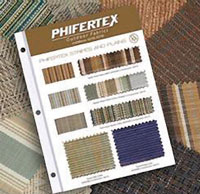
Phifer’s Phifertex 2015-16 Stock Line Additions Cards
Phifer Inc., Tuscaloosa, Ala., has unveiled its 2015-16 Stock Line Additions Cards. The swatch cards highlight new designs and updated colors for its Phifertex® sling and GeoBella® lines.
Carmel, Ind.-based Top Value Fabrics has introduced eight new fabrics for printed banners, flag, exhibit graphics, backdrops and retail displays. The fabrics are available in widths up to 126-inches-wide and are designed for color consistency and image sharpness.
Safety Components, Greenville, S.C., has introduced an 80-inch-wide WeatherMAX high-performance fabric.
Cleveland-based National Safety Apparel has introduced HYDROlite FR™ Rainwear featuring Gore® Pyrad fabric.
Hong Kong-based Intertek has introduced Chemical Smart Screening, a service designed to detect the presence of restricted substances in chemicals and auxiliaries used in the textile, apparel and footwear manufacturing process.
Brussels-based CIRFS: European Man-made Fibres Association has published the 51st edition of its, “Information on Man-made Fibres” report.
Research Triangle Park, N.C.-based AATCC — the Association of Textile, Apparel and Materials Professionals — has announced its 2016 Metamorphosis Concept 2 Consumer® Student Design and Student Merchandising Competitions. Entries will be accepted until April 8, 2016, and winners will be announced May 24, 2016, for the design competition; and entries are due April 20, 2016, for the merchandising competition with winners announced by May 31.
Trion, Ga.-based Mount Vernon FR has developed a line of flame resistant clothing with Peoria, Ill.-based Caterpillar Inc.’s CAT® Apparel as well as Fort Worth, Texas-based Westmoor Manufacturing Co.’s Rock and Roll Cowboy brand.
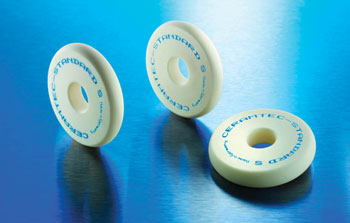
Germany-based CeramTec GmbH has engineered a new surface structure for its Standard S friction discs used in the nylon texturing processes. According to the company, when the new discs were used on a Barmag eFK machine with a 1/6/1 setup to produce 78/68 decitex nylon 6,6 yarns, elongation improved by more than 6 percent, and strength increased by more than 5 centiNewtons per tex when compared to yarns produced using the standard discs.
The new surface modification process creates a disc with a roughness of Ra 0.85 ± 0.15 micrometers, but finer roughness also is available on request.
The new surface structure of the CeramTec Standard S friction discs can improve the properties of textured nylon yarns.
Rock Hill, S.C.-based SDL Atlas Inc. has upgraded three of its core laboratory testing instruments. The Martindale Abrasion and Pilling Tester, the Rotawash Colorfastness Tester and ICI Pilling and Snagging Tester — now known as RotaPill Pilling and Snagging Tester — now feature a state-of-the-art multilingual touch-screen controllers. All three models also were redesigned for function as well as appearance. The Martindale’s new design incorporates a storage rack for the light weight motion plate. The Rotawash now is constructed using stainless steel, and the washpots press into place on the new design making changes easier. The RotaPill now features magnetic cork-lined plates that can accommodate snagging points for easy cork changes and to eliminate the need for a second set boxes dedicated to snagging.
The Bloomfield Hills, Mich.-based Crypton Companies and Nanotex® hired Michael Grigat as vice president, research and development. In addition, Hardy Sullivan has been promoted to vice president, market development.
Dr. David Hinks has been named dean of North Carolina State University’s College of Textiles, Raleigh, N.C., after serving as its interim leader since July 2014
New York City-based Alvanon Inc. has named Tracy Woosley senior consultant.
Israel-based Nilit Fibers has appointed Marco De Silvestri vice president, Nilit Israel.
Christopher Veit is now in charge of global manufacturing, research and development, and human resources with the Veit Group, Germany.
Glenn Funk has joined New York City-based Simparel Inc. as senior director, enterprise solutions and product strategy.
Aceto Corp., Port Washington, N.Y., named Scott Herrington senior account manager, Specialty Chemicals.
Troy Corp., Florham Park, N.J., has named Jan S. Beck vice president and general counsel.
Paris-based Lectra has named Jean-Patrice Gros director, Lectra Northern Europe.
TSG Finishing, Hickory, N.C., has hired Charles Gossett as director of operations.
Effective February 15, 2016, Rick Helfenbein will assume the role of president and CEO of the Washington-based American Apparel & Footwear Association (AAFA).
Andreas Wirz has joined Switzerland-based Crealet AG as a technical assistant.
Cordova, Tenn.-based National Cotton Council of America announced Dr. David B. Weaver as the recipient of the 2015 Cotton Genetics Research Award.
Italy-based Eurojersey S.p.A. has appointed Matteo Cecchi sales director.
Nordine Meniai was named new business unit manager, packaging, ITW Dynatec, Hendersonville, Tenn.
Despite concerns prior to the event, ITMA 2015 was a success.
By Rachael S. Davis, Managing Editor
There were some reservations leading up to ITMA 2015 — which was held in Milan, Italy, November 12-19, 2015 — about just how successful the event would be.
Concerns about global economic uncertainties, especially the growth rate of China’s gross domestic product; the timing of the show with it occurring so late in the year; and questions about the value of an ITMA in Europe today all swirled around show preparations.
But despite all the reservations and concern before the event, ITMA was a resounding success. The halls were busy for the entire show, and seemed to be full of excitement and energy. Many exhibitors reported their booths were constantly busy with high-level customers during the show, and many exhibitors were happy to report strong sales during and after the show.
The overall success of the show was summed up perfectly in a comment from Carlo Rogora, CEO, ITEMA Group. “Considering the current situation in the textile industry in some markets, we are pleasantly surprised with these results,” Rogora said. “ITMA 2015 has been especially satisfactory, both in terms of the organization and logistics of the show and the significant level of attendance of customers. The contacts and orders we established, above all from India[n] and [Turkish] markets, largely exceeded our expectations.”
At 10 a.m. on the first day, visitors were lining up to enter the Fiera Milano Rho. Photograph courtesy of ITMA 2015.
Exhibitor, Visitor Success
The success of the show was confirmed by the post-show numbers released by the show’s owners the European Committee of Textile Machinery Manufacturers (CEMATEX), and organizers Singapore-based MP Expositions Pte. Ltd. The show hosted the largest number of exhibitors since its inception in 1951. Some 1,691 exhibitors participated from 46 countries and economies, which breaks the previous record of 1,451 exhibitors set in 2007 at ITMA in Munich, Germany. Net floorspace totaled 108,000 square meters and covered 11 halls at the Fiera Milano Rho fairgrounds in Milan. The total exhibit space was approximately 20-percent larger than floorspace at ITMA 2011.
“ITMA has a very strong reputation as the world’s most established textile and garment exhibition,” said Charles Beauduin, president, CEMATEX. “We are grateful to our exhibitors and industry partners who have put their faith in the ITMA brand. The key to ITMA’s success is its ability to reinvent itself and remain relevant to the industry that it serves.”
Exhibitors from Europe occupied by far the largest amount of floorspace at the show with 69-percent of the total net exhibit space. Of those exhibitors, 453 Italy-based companies occupied 32,540 square meters of floorspace and the 238 Germany-based companies booked 21,380 square meters of exhibit space.
From outside of Europe, companies from Turkey, China, India and Japan booked the greatest amount of floorspace.
Visitor numbers also were impressive during the eight-day event. The show attracted approximately 123,000 visitors from 147 economies, which was an increase of 20-percent compared to numbers recorded in 2011. The visitors also were reported to be high-quality attendees.
“We registered a 20-percent jump in visitors numbers compared with ITMA 2011,” said Beauduin. “More importantly, from participants’ feedback, we can confidently say that this is one of the best ITMA exhibitions! Our message on sustainability has resonated greatly with buyers.
“Our exhibitors have discovered that the visitors — whether they are seasoned ITMA visitors or attending the exhibition for the first time — are serious about checking out new innovative solutions to improve their competitive edge.”
Sustainability
ITMA’s theme, was “Master the Art of Sustainable Innovation.” Exhibitors certainly embraced the theme, and much of the technology presented at the show offered some sort of energy, costs and materials savings all contributing to more sustainable production.
“We felt for the first time there’s a real understanding and interest in energy efficiency and green technology,” said Regina Brückner, CEO of Brückner Trockentechnik GmbH & Co KG, Germany. “There’s a trend among our customers to want to upgrade their very old equipment because they understand the necessity of a highly productive and efficient production over the entire textile production process.”
Textile World will have more in-depth coverage of the various technologies on display at ITMA in the next few issues. Spinning and knitting technologies appear in this issue; and wet processing, nonwovens, digital printing and weaving will be covered in future issues.
Around The Fairgrounds
The busy booths suggested that a lot of business was taking place, and reports from exhibitors confirmed just as much. Exhibitors also used the occasion to share news and celebrate milestones.
Erwin Devloo, marketing communications manager, Belgium-based weaving machine manufacturer Picanol NV, reported the company had sold more machines in one day at the show than ever before.
After the show, Switzerland-based Oerlikon’s Manmade Fibers Segment received a number of large orders worth approximately $50 million for its Oerlikon Neumag staple fiber plant engineering technologies.
The Netherlands-based SPG Prints hosted a press conference to introduce its Pike® single-pass digital printing machine featuring Archer® technology. After the show, the new machine was heading to customer Germany-based KBC Fashion GmbH.
Germany-based LTG AG was at the show promoting a new compact drum filter that can be shipped completely assembled. The company also was celebrating its 90th anniversary. Gerhard Seyffer, president, LTG Inc., Spartanburg, S.C., said the quantity of visitors was very good during the show, and the company sold some equipment.
Switzerland-based Bräcker AG used ITMA to celebrate the company’s 180th anniversary. Daniel Link, managing director, underlined the success of the company and its products and recalled some of the history during a celebration at the company’s booth.
Germany-based Trützschler GmbH & Co. KG had a banner in its booth announcing that the company had reached a milestone during 2015 —selling its 50,000th carding machine.
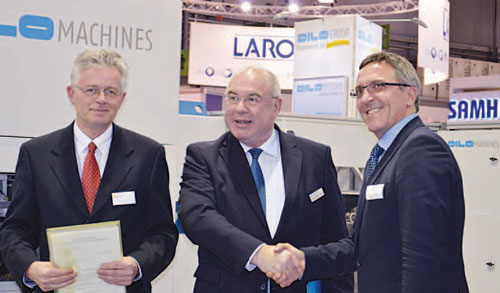
Germany-based DiloGroup CEO Johann Philipp Dilo signed over a state-of-the-art universal compact line for needling recycled carbon fiber that was on display in the booth to the Institut für Textiltechnik Ausburg gGmbh. The line includes material storage and feeding, carding and stackers, needle machine and winder. The generous donation will be used to advance carbon fiber research, and Dilo said the machine will get more use at the institute than if it was at a Dilo facility. DiloGroup reported initiating a large number of new projects as well as receiving numerous orders for deliveries during ITMA.
(left to right): Prof. Dr. Stefan Schlichter, Johann Philipp Dilo and Prof. Dr. Thomas Gries, with the compact line the DiloGroup presented to Institut für Textiltechnik Ausburg gGmbh for research purposed.
At a press conference hosted by China High-Tech Group Corp., parent company of Fong’s Industries, Roland Hampel, joint managing director of Germany-based A. Monforts Textilmaschinen GmbH & Co. KG announced the company had acquired the know-how of Austria-based Timatec Corp. Timatec specializes in coating and has a wide portfolio of coating equipment — including knife-over-air, knife-over-roller, magnetic roller and printing-head coating options — that now will be manufactured at the Monforts Montex plant in Austria.
MS Printing Solutions hosted a special “Transparent as Water” debate centered on sustainability. The event explored sustainability and the associated sociological and cultural implications and featured Francesco Morace, a sociologist and essayist who worked in social and market research for more than 30 years; Piero Formica, an economist, professor and founder of the International Entrepreneurship Academy; and Giuseppe Miroglio, president of Italy-based textile printing company Miroglio Group.
This is just a small slice of the events, happenings and business that took place during ITMA.
Next Show
CEMATEX announced that ITMA will return to Barcelona in June 2019. A somewhat surprising choice, given that the city hosted the event in 2011, and Munich was considered the front-runner. However, participants were happy with Barcelona as a venue, and the industry looks forward to another record-breaking show.