Tokyo-based Teijin Frontier Co. Ltd. has established Teijin Frontier Mexico S.A. DE C.V. in Mexico City. The plant is the company’s first automotive material subsidiary in the Americas and will function as a headquarters for the North American market. Sales and marketing activities for the auto manufacturing products, such as materials for car seats and airbags, are scheduled to begin in July.
Valdese, N.C.-based Meridian Specialty Yarn Group Inc. (MSYG) recently broke ground on a new plant in Valdese. The multimillion dollar investment will expand the company’s current operation by 113,000 square feet. In addition to its package-, space- and top-dyed yarns, the new plant also will produce tow-dyed acrylic for vertical integration with the company’s Ranlo, N.C., plant.
(l to r): Alan Wood, Burke Development Inc.; Talmadge and Chuck Strickland, Strickland Construction; Stephen Hudson, MSYG; Valdese Mayor Pro Tem Susan Stevenson; Burke County Commissioner Maynard Taylor; Neil Wright, MSYG; John Marlow, MSYG; Marcello Galvanin, Galvanin S.p.A.; and Tim Manson, MSYG, at the recent ground breaking ceremony for MSYG’s new facility in Valdese, N.C.
Toronto-based McRae Imaging has purchased its second Reggiani digital printer. The company recently selected the EFI™ Reggiani ReNOIR 340 printer from Fremont, Calif.-based Electronics For Imaging Inc. (EFI), new owner of Italy-based Reggiani Macchine. The new printer increases McRae’s maximum digital textile output to 13,000-square-feet per hour or 1,200-square-meters per hour. “There are just so many advantages to fabric printing,” said Bob Murray, co-owner and CEO, McRae Imaging. “Our machines are eco-friendly, and that’s another advantage to the Reggiani printers.”
In other EFI news, England-based Prompt Side Theatrical Drapery has invested in an EFI VUTEk® FabriVU® 340 soft-signage printer. Using the printer, the company will expand the types of scenery, backdrops and drapery it can produce for a wide variety of applications. The Vutek Fabrivu printer will allow Prompt Side to work with lightweight, polyester-based materials that are easier to deliver and install.
“I am delighted to be at the vanguard of theatrical digital print,” said Peter Baker, managing director, Prompt Side. “This is an exciting time for Prompt Side as we expand our range of products and massively increase the creative opportunities available to designers.”
Singapore-based Huntsman Textile Effects has added neon Erionyl® Flavine FF and Rhodamine FF dyes to the Erionyl product range for polyamide fibers. The dyes are compatible with Huntsman’s Albatex® and Erional® auxiliaries, and Invalon® FL machine cleaner.
“With Erionyl Flavine FF and Rhodamine FF dyes, we now have dyes to achieve the demands of the attractive neon shade segment,” said Lee Howarth, global marketing manager, Huntsman Textile Effects. “Due to their high-color strength and with neon shades representing an essential collection item of many swimwear, beachwear, sportswear and even lingerie brands, we can now meet the growing demand for high quality neon dyes.”
Tricol International Group Ltd. — a Marshall Islands-based company substantially owned by China-based Weifang Tricol Trading Co. Ltd. — and its wholly owned subsidiary
Tricol Biomedical Inc. have acquired the assets of Portland, Ore.-based HemCon Medical Technologies Inc. Moving forward, HemCon will operate under the name Tricol Biomedical Inc. The HemCon brand is well-established in the wound closure device market, and future focus is on high-growth markets including surgical and chronic wound care.
HemCon President and CEO Michael Wax will continue his role at Tricol. In addition, the Ireland- and Czech Republic-based facilities previously associated with HemCon will continue to operate independently as HemCon Medical Technologies Europe Ltd. reporting to Wax.
“With our combined world-class global presence and expertise in chitosan materials, the synergy between the two companies’ business models will allow us more flexibility and faster response time to customer needs and trends in the market”said Hongwei Duan, CEO, Tricol International Group. “With this acquisition we are also establishing our entry into the wound care market, a key focus for Tricol, while building on the momentum in the core professional, surgical, and emergency medical market customer base, accessing new consumer markets worldwide with innovative products currently in development.”
Nonwoven fabric producer Fitesa Simpsonville Greenville, S.C., has announced plans for an additional expansion at its facility. The $52-million investment includes an additional 20,000-square-feet of space to increase production capacity of spunmelt fabrics, and is expected to create 38 jobs over the next five years. It is anticipated the expansion will be completed by the fourth quarter of 2017, and the company will start the hiring process for new jobs in the spring of 2017.
“Our mission is to be the preferred choice for the supply of nonwoven fabrics to the global hygiene industry, and to deliver high-quality products with exceptional service and sustainable processes,” said Ray Dunleavy, global marketing director, Fitesa Simpsonville. “We are pleased to continue to grow our operations here and appreciate the support of Greenville County in making this announcement a reality.”
Germany-based Trützschler Nonwovens & Man-Made Fibers GmbH has announced plans to sell its staple fiber technology to the Switzerland-based Oerlikon Group’s Man-made Fibers Segment. Trützschler will concentrate on nonwovens machinery and filament lines moving forward. Business with spinning plants for carpet yarns and industrial yarns will not be affected by the sale.
Oerlikon will integrate the acquired staple-fiber technologies into its Germany-based Oerlikon Neumag business.
The two companies have committed to ensuring reliable spare parts still will be available to customers in a timely fashion.
“With this restructuring in Egelsbach we will focus our capacities and competencies on the key topics of our nonwovens’ customers,” said Dr. Georg Reinhold, managing director and CEO, Trützschler Nonwovens & Man-Made Fibers GmbH. “It will shorten the time to market of our innovative solutions and will further strengthen our worldwide service. Trützschler’s name stands for technological innovations as well as for a high level of customer focus. In this regard, we will set new standards.”
After years of decline, the last surviving cotton mill in Manchester, England, closed its doors in the 1980s. But some 30 years later, Culimeta-Saveguard Ltd. has announced plans to open a modern spinning plant in Manchester.
The £6-million ($8.7-million) investment features state-of-the-art spinning machinery from Germany-based Saurer Zinser including the 351 2Impact FX compact-spinning machine, Zinser 670 roving frame, and the Saurer Schlafhorst Autoconer 6 for winding.
Culimeta-Saveguard will spin ultra-fine combed cotton compact yarns in counts Ne 60 and larger using cotton imported from Barbados, India, Egypt and the United States.
“We are proud that ring spinning machines from Zinser are being installed in the first new cotton spinning plant to be erected in England,” said Burcu Sevinis, product manager, Saurer Zinser.
Computer vision systems and robotics technology have the potential to automate the labor-intensive sewing process.
By K.P. Reddy
The art of sewing has not fundamentally changed since the first seamstress put needle and thread to fabric thousands of years ago. Even with great engineering advances including mechanized looms and sewing machines, the way sewn goods are produced is just as labor intensive today as it was 100 years ago. To further complicate matters, today’s consumers want inexpensive, high-quality goods delivered to their doorstep within days, pushing the limits of the traditional manufacturing business model to its breaking point.
Over the past few decades, sewn goods manufacturers lowered overhead by relocating operations to the countries paying the lowest wages. However, this business strategy is becoming increasingly difficult to maintain because of rising labor costs in the developing world, a global shortage of skilled seamstresses, and a change in consumer behavior pushed by fast fashion brands and social media platforms. New market conditions have made the sewn goods industry ripe for a new age of automation.
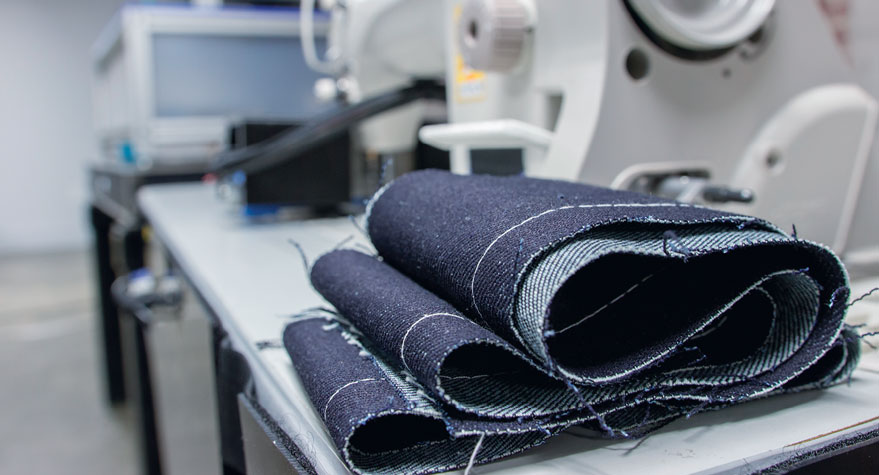
There have been attempts in the past to fully automate the sewing process. Most of the previous systems relied on clamps to hold the fabric taught, making it more rigid and less susceptible to distortion. This system limited automation to certain operations during the sewing process such as when sewing on buttons or pockets. Aligning two pieces of fabric correctly and feeding them through the sewing head without slippage or buckling occurring — while maintaining the correct tension levels — has proven to be a process better managed by human hands.
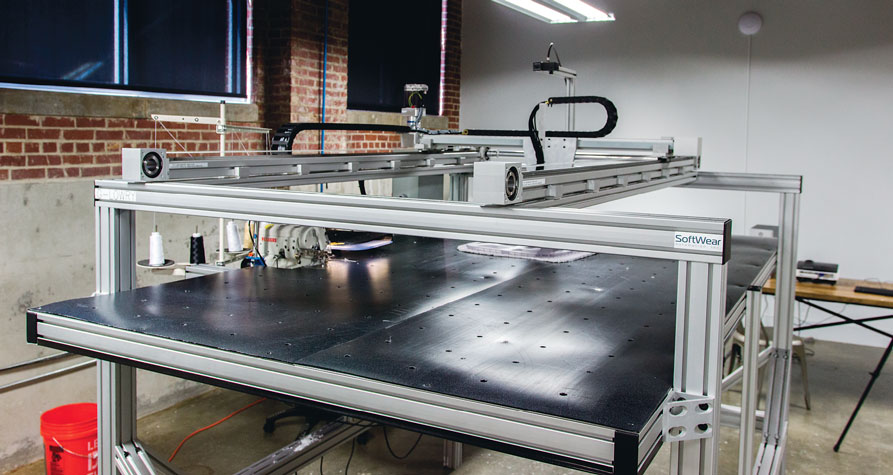
Some U.S.-based customers currently are using the G-Series Gantry version of the Lowry robot in production.
Advances In Automation
Atlanta-based SoftWear Automation Inc. recently introduced a radical new approach to sewing automation. The company has developed a system that eliminates fabric distortion issues by relying on an advanced computer vision system. The camera tracks stitching at the needle and coordinates the precise movement of the fabric using lightweight robots.
SoftWear’s line of sewing robots, with their patented high-speed computer vision systems, have the potential to transform today’s labor-intensive manufacturing plants into high-tech automated production facilities. The “sewbots,” or sewing robots, reduce production costs, increase quality, cut lead times and allow brands to take back control of their manufacturing process.
As sewn goods manufacturing moved from high-wage labor markets such as the United States and Europe to low-wage labor markets, brands went from being experts in their craft to marketing and merchandising machines completely disconnected from their manufacturing operations. Development that was once overseen by in-house teams with an advanced knowledge of production processes now is performed a world away and managed by contract manufacturers who often place high piece minimums on orders and modify designs to streamline production. This new paradigm stifles brand creativity and has created a situation where one misstep in trend forecasting can result in millions of dollars lost in inventory.
Instead of guessing what the market will want and then meeting piece minimums set by contract manufacturers, SoftWear’s technology allows brands to be more agile and able to meet consumer specific demands in a real-time environment. Because SoftWear’s sewbots are priced comparable to the wages of a skilled seamstress in industrialized nations, brands will be able to relocate their manufacturing operations closer to the consumer, further reducing time to market.
Last year, SoftWear launched the LOWRY robot, a pick and place system that integrates with a manufacturer’s existing sewing machines. As the product was introduced, the company expected manufacturers in the United States and Europe to show the most interest. However, a large number of calls came not from the United States, but from contract manufacturers in low-cost labor markets like Bangladesh and China — the very countries who benefited the most from outsourcing in the 1990s. Just like Western countries, manufacturers in the developing world are having trouble finding and retaining skilled seamstresses. Globally, Millennials are migrating to city centers and generally are uninterested in factory work. The combination of this shortage of skilled labor with the market’s desire for lower costs and faster delivery is driving many brands to look to fully automated sewing lines.
Future Outlook
The Automatic Sewing Machine (ASM) is capable of full garment assembly and is available for preorder from SoftWear Automation.
The trend toward automation will not immediately force large swaths of sewing machine operators from their jobs. In fact, automating production actually will create new jobs, especially in high-cost labor markets. From a robotics and automation perspective, SoftWear has seen many workers taking an interest in learning about the company’s technology so they can move from low-wage, less-skilled work into higher-wage positions. Someone is needed to program and maintain the machines, and there is a strong pipeline of young people who are eager to take those jobs.
As with any new technology, automation in sewing still has some hurdles to overcome before robots fully replace seamstresses. Some of these issues lie with executives in the sewn products manufacturing industry who have relied on an outdated business model for far too long. When it comes to the technology itself, SoftWear is working diligently to increase its machines’ capabilities around the wide array of fabric types and operations that go into producing stock keeping units for manufacturers in home goods, automotive textiles, apparel and footwear markets.
With time-to-market, customization, and cost being the primary drivers in sewn goods production — especially in relation to apparel — it is only a matter of time before low-cost, technologically advanced robots replace traditional seamstresses around the world.
Editor’s Note: K.P. Reddy is CEO of Atlanta-based SoftWear Automation Inc. This article is based on Reddy’s presentation given at the 2015 Textile World Innovation Forum.
Pearl Izumi has a rigorous product development process to meet the high-quality and high-performance demands of the fast-growing sports apparel market.
By Carol Little
Louisville, Colo.-based Pearl Izumi is a cycling, running, and triathlon apparel and footwear company committed to crafting and delivering the best fitting, feeling, and functioning run/ride/tri performance products. The company’s goal is to provide its consumers with apparel that allows them to comfortably run or ride 365 days a year.
According to teonline.com, performance apparel is defined as garments that perform or function for some purpose such as to help athletes and active people keep cool, comfortable and dry using moisture management and other techniques.
Performance apparel is one of the fastest-growing sectors of the global textile industry. The growth of the performance apparel market can be attributed to lifestyle changes made by a majority of the population. As such, high-tech fabrics and apparel made for high performance are in demand. Clothing no longer represents just status and sophistication — functionality and performance count and clothing should be fit for a purpose.
In 2017, the global sports apparel market is estimated to generate about $165 billion in revenue according
to statistics portal statista.com. “Activewear is booming, with sales growth exceeding that of the apparel market as a whole,” said NPD analyst Marshal Cohen, chief industry analyst, The NPD Group Inc., Port Washington, N.Y. “Consumers are drawn to its comfort and versatility, and the fact that it still makes a fashion statement.”
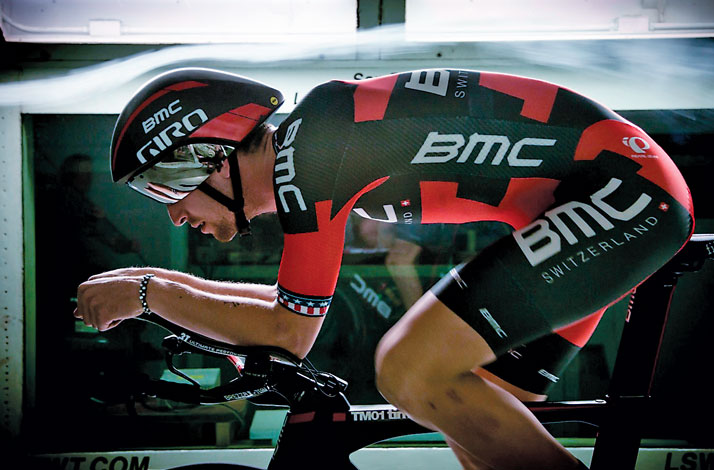
Pearl Izumi tested varying clothing designs and materials in a wind tunnel with its sponsored pro team, BMC, in preparation for the upcoming racing season.
Performance Plus Quality
Material technology is essential for addressing the needs of Pearl Izumi’s consumers. Its design and development team works year round to build products that meet consumer expectations and anticipates their future needs. Because Pearl Izumi products are warrantied with a lifetime guarantee, the company’s materials and quality teams diligently work to validate the products. It has strict quality programs in place for both materials and garments, as well as a vigorous development testing process to confirm the fit and functionality of the performance products.
Pearl Izumi takes pride in providing high-quality products that deliver high-quality performance. The company uses technical materials that enhance the athlete’s experience. There are a number of different options for incorporating technology into an activewear garment, which include yarn technologies, material technologies, and construction technologies.
Yarn Selection
Yarn choice is critical when initiating new fabric development. When working with mill partners, Pearl Izumi considers how the yarn selection will affect the stretch, look, and feel of the material. After the target aesthetic is determined, the development team then considers additional performance criteria that can be achieved with yarn selection. Advances in yarn development improve the material’s drying time, cooling properties, heating properties and water repellency. There also are yarns available that offer thermoreactive properties, which can aid in blood circulation and recovery after extensive activities.
Material Properties
After the yarn requirements are confirmed, Pearl Izumi considers specific material properties. Fabrics are engineered to provide specific stretch and compression properties for the best garment fit. The comfort region for stretch lies between 20- and 40-percent elongation. Less than 20-percent stretch limits the range of motion. Proper stretch in the fabric improves the overall fit of the garment, and a proper fitting garment allows the athlete to focus on the workout, not the apparel. Pearl Izumi tests the stretch and recovery properties of all of its fabrics containing elastane to ensure consistency so that the garments fit the same year-after-year.
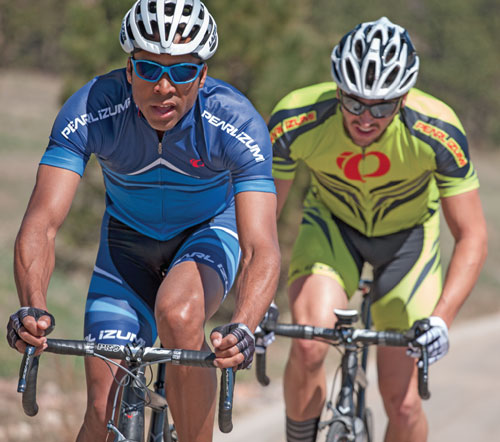
Pearl Izumi develops and tests its clothing in real world situations
Construction Considerations
Fabric construction can improve or reduce moisture transfer from one side of the fabric to the other. Athletes sweat in order to regulate body temperature. Perspiration increases rapidly with increasing skin temperature. The human body makes use of evaporative cooling by perspiration to give off energy and maintain thermal equilibrium. Innovation in materials and garment design help to regulate skin temperature and perspiration so that the body is able to continually perform. Pearl Izumi selects functional yarns that enhance wicking or the ability to move moisture from the surface of the skin through the fabric. Wicking yarns have a higher surface area created by the number of filaments or cross sections of the yarn. This increases the surface area throughout the fabric, which allows for faster drying. In addition to using functional yarns in its materials, Pearl Izumi considers two-layer fabric constructions that move moisture using an osmosis-like process. Moisture is pulled through the less absorbent layer against the body to the more absorbent surface of the garment for fast evaporation.
Treatments and applications to the finished fabric provide weather protection in a variety of environments. Pearl Izumi selects materials that will protect the athlete in any weather condition without inhibiting comfort. The company works with its mill partners to engineer laminated materials that are waterproof, windproof, as well as breathable, so that the product breathes well during the intense effort on the uphill and protects an athlete from the wind and elements on the downhill. The company chooses the components of the laminated material based on the intended weather conditions for the activity. For cold and dry environments, water-resistant materials with an extremely breathable windproof coating and thermal backing are chosen. For wet conditions, the company focuses on seam-sealed garment construction and 100-percent waterproof materials with a durable water-repellent treatment.
More and more athletes are concerned about their safety when out and about, and there are a number of new technologies, in addition to color selection, that ensure an athlete is seen. Color selection improves the visibility of the rider or runner so that they feel safer in poorly lit environments. For many years, Pearl Izumi’s screaming yellow colorway consistently has been the most popular outerwear color choice. Advances in textile visibility include reflective, luminescent, and glow in the dark yarns, membranes, and prints. Some luminescent technologies are activated by headlights. Pearl Izumi tests all of its reflective elements to ensure they meet a specific candlepower and luminous intensity requirement to ensure the rider or runner can be seen from 100 meters away.
Designing For Aerodynamics
Pearl Izumi is the sponsor of the BMC pro cycling team. In events like the Tour de France, cyclists’ speed and efficiency are critical. Therefore, the company designs products to be aerodynamic. Like the dimples on a golf ball designed to help it soar further, texture on the surface of a material can improve its aerodynamic properties for a cyclist. Reducing the total amount of drag and resistance on the bike will allow the athlete to put forth less effort to go faster. In a solo event or triathlon, lowering total aerodynamic drag by 10 percent — from 7 pounds (lbs) of drag to 6.3 lbs — without changing power output, will cut 21 minutes of time, or 7 percent, from a rider who averages 20 miles per hour over 100 miles. Total time will drop from 5 hours to 4 hours and 39 minutes, and average speed will go up to 21.4 miles per hour.
Sustainability Matters
Sustainability continues to play a role Pearl Izumi’s material and vendor selection. This is an initiative undertaken by most of the outdoor and active apparel industry. Multiple organizations such as the Outdoor Industry Association (OIA) and Sustainable Apparel Coalition (SAC) are addressing compliance and transparency in the manufacturing processes. According to the SAC, the Higg Index — a groundbreaking suite of self-assessment tools that empowers brands, retailers and facilities of all sizes, at every stage in their sustainability journey, to measure their environmental and social and labor impacts and identify areas for improvement — is its core driver. “Higg delivers a holistic overview of the sustainability performance of a product or company — a big-picture perspective that is essential for progress to be made,” reports SAC.
There are multiple choices that apparel companies can make in order to be more sustainable. Options include using bioderived or recycled yarns, and lighter and more efficient fabrics. Many companies regulate the chemicals used to finish materials. These include fluorocarbon-free water-repellent finishes and more efficient dyeing processes. The textile industry is second only to the agriculture industry as the largest polluter of drinking water. Many large brands now are using dyeing methods that use less water or even no water at all. In addition, more brands are looking at using anti-odor yarns and finishes to further reduce water usage by reducing the number of times the garment needs to be washed. Brands also are reducing packaging to reduce waste. Carlsbad, Calif.-based activewear company PrAna has eliminated 31,000 pounds of waste by reducing the size of its poly shipping bags.
Pearl Izumi and many active and performance brands continually are looking at new technologies to improve products.
Editor’s Note: Carol Little is senior materials manager at Pearl Izumi. This article is based on Little’s presentation given at the 2015 Textile World Innovation Forum.