Bahir Dar University, Ethiopian Institute Of Textile and Fashion Technology, Chooses Tukatech 

BAHIR DAR, Ethiopia — August 18, 2016 — Tukatech Inc. proudly announces that Bahir Dar has purchased 50 licenses of TUKAcad Learning Edition software, with modules for pattern making, grading, and marker making, along with digitizers.

Bahir Dar University, Ethiopia’s largest institute of Textile and Fashion Technology, is the most advanced university in Ethiopia’s apparel sector.

“With the ever growing demand of setting new factories in Ethiopia, and so many established Tukatech users like Arvind, EPIC, Hirdaramani, Indochine, and many others who are setting up or already operating, need qualified CAD users.  With our training program and 50 TUKAcad stations, we will be able to help fill those positions,” explained Ram Sareen, CEO and founder, Tukatech.

“Historically, Bahir Dar University has been known for supplying the Ethiopian market with some of the best technicians who are now running most of the local businesses in many different sectors. Our partnership with Bahir Dar University and now offering TUKAcad on the cloud as a subscription, both students and industry can benefit tremendously,” added Sonia Chhabra, director, Tukatech.

Posted August 22, 2016

Source: Tukatech

King Louie America Selects Shop Floor Solution From Incentive Payroll Experts

GREENVILLE, S.C. — August 22, 2016 — Incentive Payroll Experts (IPE), the fast-growing developer of shop floor control and incentive payroll solutions for apparel and sewn products manufacturers, announced plans for implementation of its IP-Batch™ solution at Baxter Springs, Kansas-based King Louie America. The new system promises to streamline piecework payroll processing and provide increased visibility into production flow and performance.

“We envisioned an easier to operate and maintain system that would immediately save us time and simplify training of future employees,” said King Louie General Manager Dick McClearen. “Because of our longstanding relationship with the IPE team, we trust the system will be beneficial to our operations. We expect it to streamline payroll processing and simplify integration with our ADP gross-to-net payroll service. Additionally, we anticipate streamlining shop floor control capabilities by being able to more easily monitor production and report on efficiency and movement of work-in-progress.”

The 70-year old workwear company has committed to keeping the entirety of its production in the United States since their doors opened in 1937. With 160 employees, King Louie manufactures men’s and women’s workwear, primarily moisture management shirts and outerwear. The company produces both to order and to stock, and sells directly from their website as well as through distributors nationwide. With increasing demand from clients such as General Motors, AT&T, Verizon and more, the company has added more outerwear and color options, creating the need for a shop floor system that could scale with this growth.

“We are extremely grateful for King Louie’s loyalty and partnership over the years,” said IPE Managing Partner Brad Mikes. “We are looking forward to overseeing their implementation process with the IP system, and the inevitable growth that our system will support.”

Posted August 22, 2016

Source: Incentive Payroll Experts (IPE)

Affiliates Of Apollo Global Management, Nike Announce Strategic Partnership For Apparel Manufacturing In The Americas

BEAVERTON, Ore. — August 18, 2016 — Funds affiliated with Apollo Global Management, LLC (together with its consolidated subsidiaries, “Apollo”) and Nike Inc. today announced that Nike and affiliates of Apollo have entered into a strategic partnership regarding the apparel supply chain in the Americas. This innovative strategic partnership will increase regional manufacturing capabilities, enable quicker delivery of more customized product to consumers and drive investment in sustainability.

To establish the strategic partnership, a new apparel supply chain company has acquired existing apparel suppliers in North and Central America and plans to invest in advancing their manufacturing operations and expertise to produce innovative, technical and customized apparel. In addition, this new company expects to acquire additional textile and apparel suppliers in the Americas in order to broaden and diversify its capabilities and product offerings. This will create a more vertically integrated apparel ecosystem – from materials suppliers and apparel manufacturers to final embellishment, warehousing and logistics.

“We are excited to be working with Apollo to rethink a new supply chain model to revolutionize apparel manufacturing in the Americas,” said Nike COO, Eric Sprunk. “The new company, under Apollo’s leadership, is committed to embedding sustainability and transparency into the business, investing in new technology, vertically integrating critical elements of the supply chain and delivering the best Nike performance product to our retail and sports partners.”

Josh Harris, Co-founder and senior managing director of Apollo, said, “We see a tremendous opportunity to meet the rising demand for responsive apparel manufacturing to serve increasing consumer expectations for products delivered when and where they want them. We intend to work with management to develop a regional supplier capable of servicing the needs of a wide variety of customers, and we are particularly enthusiastic to be working with such an iconic brand as Nike. While Nike has not made a capital investment in the company, this strategic partnership is a testament to Nike’s commitment to increasing regional manufacturing capabilities, driving investment in innovation and creating long-term growth.”

While terms of the agreements were not disclosed, Apollo today announced the new supply chain company has acquired two businesses to form the cornerstone of this strategy: the apparel manufacturer, New Holland; and the embellishment, warehousing and logistics operator, ArtFX. The investment is made by the Apollo-managed Special Situations I fund.

Posted August 19, 2016

Source Nike, Inc.


Denim North America Introduces New Use Of Clickable Paper™ Technology

COLUMBUS, Ga. — August 18, 2016 — Denim North America (DNA), a division of DNA Textile Group, is pleased to introduce new use of the latest in point and click technology, “Clickable Paper™”.

“This technology will allow our customers to easily access the most up to date information on our products and services with the touch of a button” said to Linsey Flitcroft, vice president, Merchandising and Development.

By downloading the free CP Clicker app to your smartphone and snapping photo of a Clickable Paper™ enabled image, you are able to access the r3denim.com website highlighting our sustainable R3 Denim collection. Clickable Paper™ connects printed materials to online resources using image recognition software. It is one-touch access to multiple links giving direct access to our website and the ability to make a call or send an email.

Denim North American plans to continue use of this technology with future product releases saving valuable time communicating latest innovations and providing interactive services with one touch access.

Posted August 18, 2016

Source: Denim North America (DNA)

Scott A. Malcolm Joins Valdese Weavers As Senior Vice President Of Operations

VALDESE, N.C. — August 17, 2016 — Scott A. Malcolm has been appointed senior vice president of Operations for Valdese Weavers, according to Carson Copeland, CEO. Malcolm assumes a newly created position for the company, and will be a member of the executive staff.

Malcolm comes to Valdese Weavers after having served as President of ITEMA America, a highly respected Italy-based textile machinery and technology manufacturer. He began his textile career with Springs Industries, where he held a variety of management responsibilities. He then served as a plant manager for Springs, Pillowtex and Burlington Glass Fabrics, before joining ITEMA in 2000. Malcolm holds a bachelor’s in Business Administration and Marketing from Winthrop University.

“Valdese Weavers is extremely fortunate to attract an exceptional leader in the textile industry like Scott Malcolm to join our executive team,” said Copeland. “His vast experience in a wide range of disciplines in our industry will be a tremendous asset to our company as we address the opportunities and challenges that we face as we enter the next chapter in the history of Valdese Weavers.”

Posted August 17, 2016

Source: Valdese Weavers

T-SCAN – Multiple Detection For A Comprehensive Foreign Part Separation

MÖNCHENGLADBACH, Germany — August 17, 2016 — Today there are many sensors for the detection of foreign parts on the market. What they all have in common is that they only can detect certain foreign parts. A color sensor cannot detect white or transparent parts. An ultrasonic sensor does not detect small parts and an UV sensor sees only optically brightened particles.

For this reason, five technologies work hand in hand in the Trützschler Foreign Part Separator T-SCAN to detect all foreign parts:

  • F-module: Detection of colored parts;
  • P-module: Detection of semi-transparent and transparent parts;
  • UV module: Detection of fluorescent parts;
  • G-module: Detection of glossy and white parts; and
  • LED module: Detection of even the smallest thread-shaped parts.

These modules permanently work in parallel. Even though many foreign parts are detected by several modules, detection with only one module is sufficient as well.

The two LED units are of particular importance, especially for the detection of smallest parts.

With 534 high performance LEDs each, they provide the perfect light for the three cameras. Here, the old photographic saying applies: The better the light, the sharper and more detailed the photo.

Posted August 17, 2016

Source: Trützschler

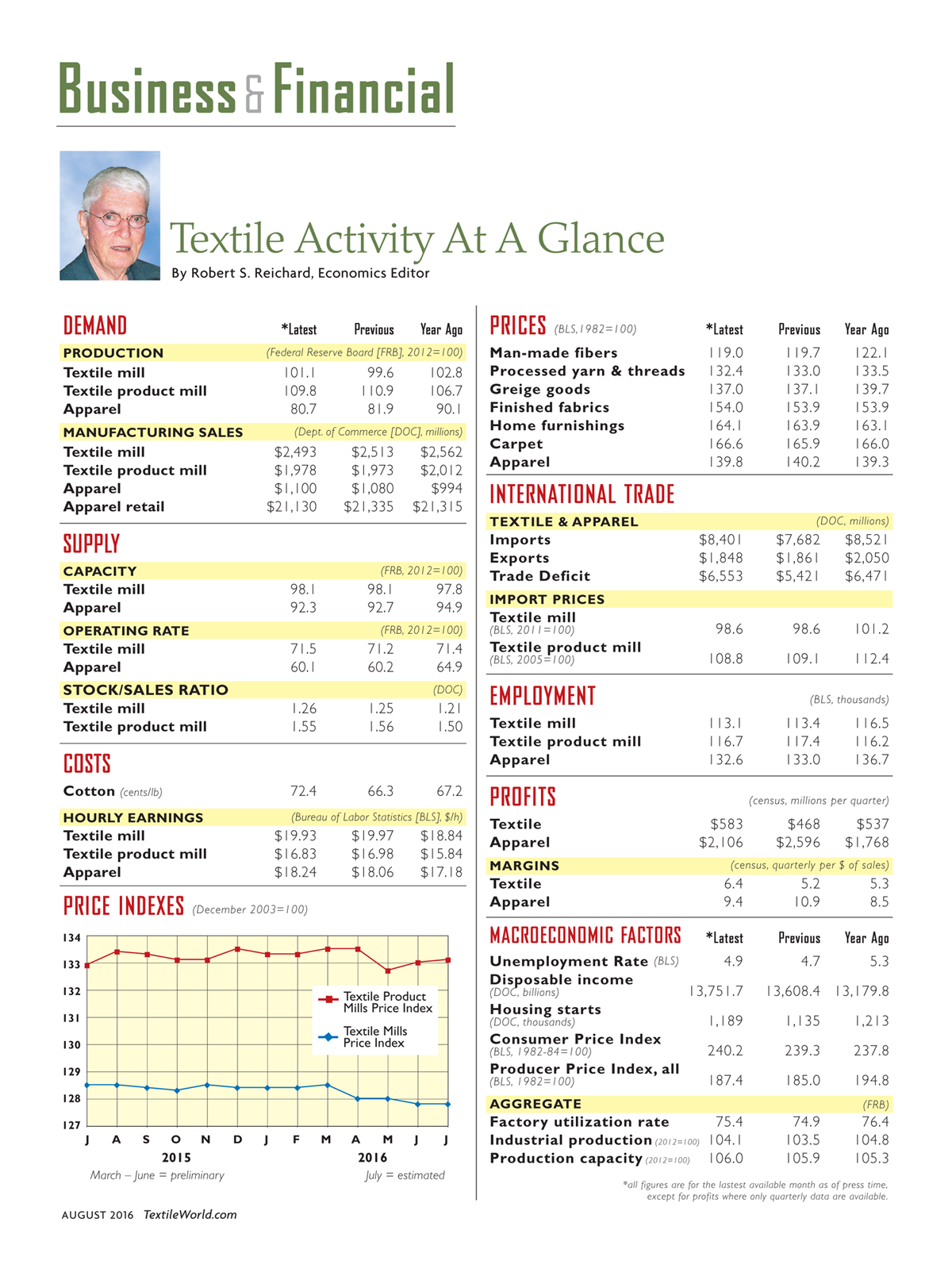
August 2016: Textile Activity At A Glance

BFAugust2016

August 2016

Sluggishness Continues

Jim-Phillips-colorBy Jim Phillips, Yarn Market Editor

“Lackluster.” That is how one spinner characterizes the continued sluggishness of business through the end of July. “We’re getting business, staying busy, but it is week to week.”

Added another spinner: “We are getting small orders that need very quick turnaround, but, compared to this time last year, we have very little backlog.”

Orders for yarn through the first seven months of the year have fallen well below the expectations of many spinners. “In the first part of the year, I think most of us thought a slowdown was the result of inventory adjustment,” said one spinner. “We knew that at the end of year, a lot of customers had a more yarn on hand that they needed. We were expecting that situation and believed that orders would return to normal once the inventory correction was over, so we weren’t too concerned. However, now it is months later and things have not appreciably changed.”

The feeling of one spinner is that the volatility of the current U.S. Presidential campaign has created an atmosphere of fear and uncertainty among consumers and businesses alike. “A lot of people are concerned about who is going to be the next President and how it is going to affect the economy and the relationship of our country with the rest of the world. Many people are not happy with either candidate, and they are just adopting a wait-and-see attitude.”

Another spinner agreed: “There are a lot of variables that could change the whole sales picture for the remainder of the year. Election years always make me nervous, because you never know what to expect from people. Will they like what they hear and be confident about the future? Or will the scare tactics of some politicians make them close their purses until they are more secure about the direction of the economy?”

Another reason cited by an industry observer cites consumer confidence as a reason for reduced spending on textiles and apparel. “It is not that consumers are saving money; it is just the opposite. After a steady and consistent recovery from the recession, Americans are now actually spending money again on big-ticket items. Those dollars that last year were going to clothes, sheets, towels and such are now going to automobiles, home improvements, appliances, luxury vacations and things along those lines.”

An industry executive noted that a considerable difference in the business climate today, as opposed to five years ago, is that the position of the industry in the marketplace is now much more robust. “In the past, it was always either boom or bust. We were either running flat out or closing plants. Today, that is not happening. There is enough business to go around. Our complaint isn’t that business is terrible. It isn’t. It just isn’t as good as it was last year.”

Cotton Prices Increase

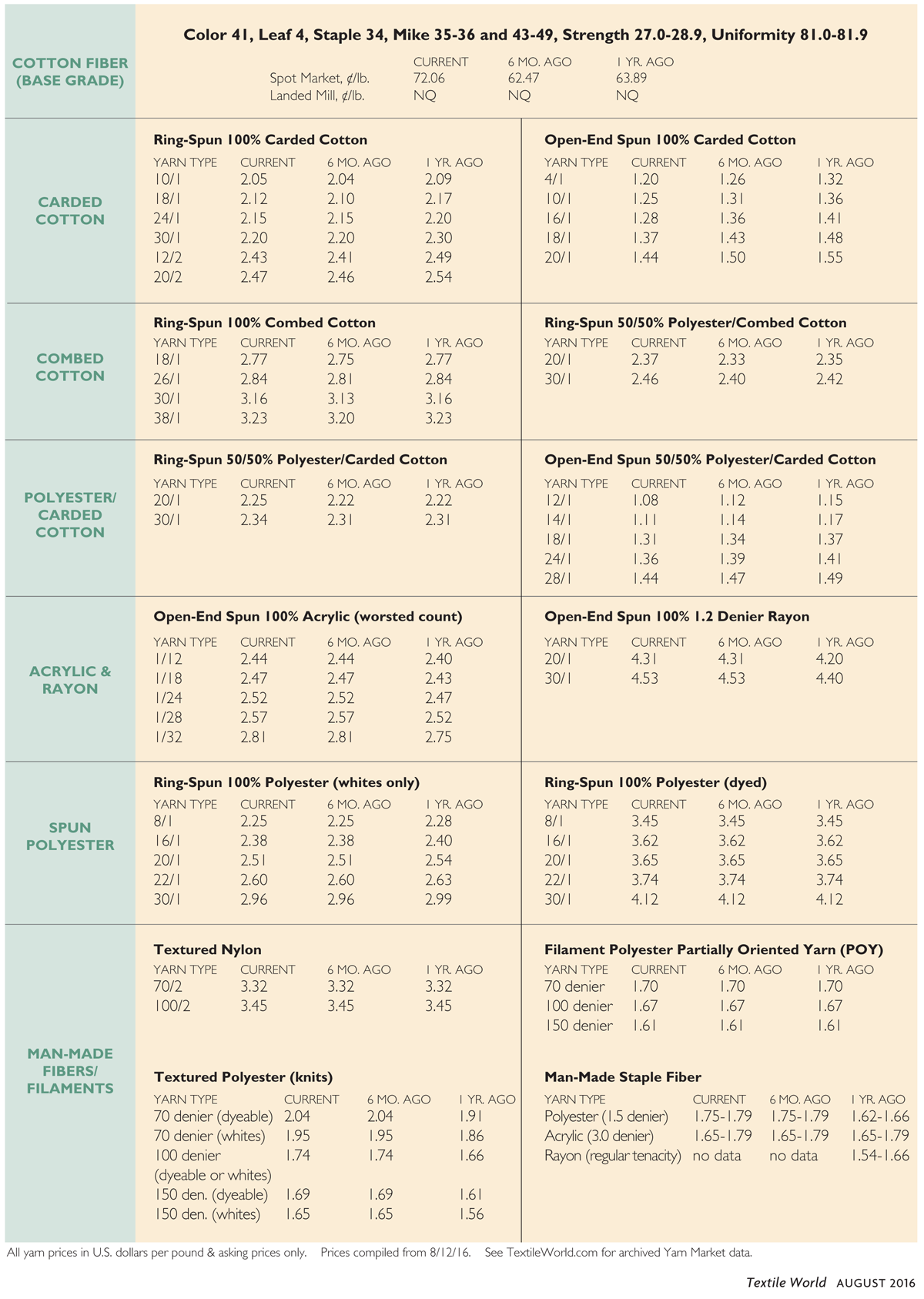
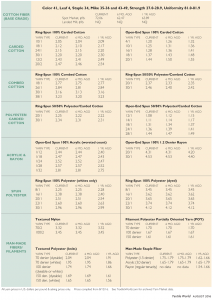
Cotton prices have begun to increase for the first time in over a year.  As of August 12, spot quotations for the base quality cotton (color 41, leaf 4, staple 34, mike 35-36 and 43-49, strength 27.0-28.9, uniformity 81.0-81.9) averaged 72.06 cents per pound, down slightly from the 72.75 cents of the previous week, but up substantially from the 60.92 cents reported during the same period last year.
YarnMarketAugust2016

August 2016

Jakob Müller AG Expands Its Business Operations; Takes Over Benninger AG

FRICK/UZWIL, Switzerland — August 16, 2016 — On August 15, JMBT Beteiligungen AG acquired 100-percent of the share capital of Benninger AG from Benninger Holding AG. With this acquisition Jakob Müller AG is expanding its position in the textile finishing sector.

As a result of its integration in the Jakob Müller Group, Benninger will benefit from the sound structures and common ground with regard to technology, production and sales and can therefore extend its operations.

With this acquisition, Jakob Müller AG will be able to expand into an associated business field and profit from Benninger’s know-how in respect to textile finishing.

In 2015 the Benninger Group workforce totalled around 330 employees, 110 of these in Switzerland.

As the technological and market leader, the Swiss company develops, produces and sells textile finishing systems as well as systems for tire cord production around the world. Its cus- tomers are active in the premium segment. Benninger offers integral solutions, which include not only the plant engineering but also the required chemical processes. The products are very well positioned for fulfilling current and future demands with regard to quality and re- source conservation. The company also has a process automation division including switch cabinet assembly, supplying third parties as well.

JMBT Beteiligungen AG is a 100% subsidiary of Jakob Müller Holding AG and an affiliate of Jakob Müller AG in Frick.

Jakob Müller AG is the parent company of various companies that operate exclusively in the field of narrow fabric looms. In this sector Jakob Müller AG is the global leader with produc- tion facilities in Switzerland, Germany, Czech Republic, Italy, India and China as well as sales offices in all major textile markets.

Jakob Müller Holding AG is family owned and does not publish any figures. Head office is Frick, Switzerland.

Posted August 16, 2016

Source: Benninger AG

Trützschler And EREMA Cooperate On Inline BCF Systems For R-PET

MÖNCHENGLADBACH, Germany — August 16, 2016 — After having worked successfully together during the past year, both companies have signed an agreement on the cooperation in the area of reclycled materials, especially of recycled polyester (R-PET). The cooperation covers BCF lines which produce carpet yarns by spinning recycled polyester or blends of virgin PET chips and recycled flakes.

The overall spectrum of products offered includes a VACUREMA Basic Line and secondary components from EREMA which feed the inline connected symTTex spin positions of Trützschler Man-Made Fibers with a high-quality polymer melt.

For cost reasons, recovered secondary raw materials, such as flakes from used PET bottles, have long been a popular commodity in both the plastic and in the fiber industry. Since the quality of the raw material plays a decisive role when spinning thermoplastic polymers, the bottle flakes have to be treated with special care.

Erema’s VACUREMA technology offers modular solutions with a vacuum reactor, a directly connected single-screw extruder and a high-performance filter for this process step. The high quality of the melt with respect to viscosity (IV value) and purity lays the foundation for top-quality filaments. The upstream processes have little impact on the directly following spinning process, since only small pressure fluctuations occur during backwashing or screen changes.

Trützschler’s R-PET-spinning technology is based on the proven system components for spinning primary chips. The process involves the well-known spin packs and the double-shell godets, the HPc-texturing system and the fully automatic winder.

Existing customers will appreciate the use of the same key components for operation of the R-PET plant. The support of process and product development for recycled polyester through process engineering in Winterthur is part of the package.

Last year, Trützschler and Erema jointly developed a carpet yarn plant for BCF yarns from recycled PET on customer demand. While the reactor, the extruder and the polymer filters were delivered by Erema, Trützschler Man-Made Fibers was responsible for spinning, drafting and winding. The plant is very flexible, so that both yarns from 100% recycled material or blends with PET primary granules can be spun.

Posted August 16, 2016

Source: Trützschler

Sponsors