Lectra Equips Ruyi Group With Smart Technology To Upgrade And Optimize Its Cutting Rooms

PARIS— November 22, 2016 — Lectra brings state-of-the-art digital and automated cutting technology to support Ruyi Group’s intelligent cutting line and the company’s alignment with the country’s ‘Made in China 2025’ initiative.

Carving a clear path towards smart cutting rooms, Ruyi’s installation of eight Lectra cutting machines — including the Vector® Matchline which automatically matches lines and grids for suit-making and is a first for Asia Pacific — clearly demonstrates the company’s commitment to a fully automated factory with expert cutting capabilities.

“Lectra Vector Matchline is the world’s most advanced cutting machine capable of cutting with every line and grid perfectly matched,” said Qiuya Fu, chairman of Shandong Ruyi Group. “As a company dedicated to technology innovation, we are glad that Ruyi is the first in China to introduce this cutting machine in fashion making. This enables us to rival with western competitors in terms of technology. It is the value of Ruyi to use the best equipment to manufacture the best products.”

Implementing innovative and high performance solutions is pivotal for Chinese companies to embrace the ten-year strategic plan ‘Made in China 2025’. Drafted by the Chinese Ministry of Industry and Information Technology — with the guiding principle to upgrade China’s industries—the initiative is fast propelling the Chinese economy towards value-added manufacturing and smart industrial production.

Embracing ‘Made in China 2025’, Ruyi has selected Lectra’s advanced technology for the company’s recently-launched intelligent men’s suits production line, at a factory in Yinchuan, Northern China. A blossoming market in China — influenced by an improvement in people’s living standards, and the parallel desire to showcase personality through clothes  —mass customization demands production systems with robust end-to-end integrated data. For Ruyi, installing Lectra’s leading edge technology will optimize manufacturing and efficiency, reduce waste and improve overall product quality.

“This is a new milestone in the strategic alliance between Lectra and Ruyi, signed in 2014,” said Céline Choussy Bedouet, chief marketing and communications officer, Lectra. “Drawing on over four decades of innovation and expertise in the fashion industry, Lectra is the right partner to accompany Ruyi as it continues to embrace innovative solutions for the cutting room.”

Posted November 22, 2016

Source: Lectra
Sewbo Automates Garment Sewing

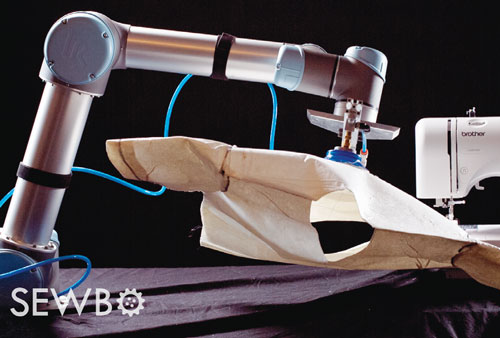
Seattle-based Sewbo Inc. reports its automated sewing robot has successfully managed to sew a T-shirt. The company worked around the one hurdle that has previously stymied automation in the sewing industry — a robot’s inability to handle a limp, fluid piece of fabric — by temporarily stiffening the fabric with a water-soluble sizing prior to sewing. Now that the concept has been proven in practice, Sewbo plans to expand its team and work on producing a commercial version of the technology.

“Our technology will allow manufacturers to create higher-quality clothing at lower costs in less time than ever before,” said Jonathan Zornow, the technology’s inventor. “Avoiding labor issues and shortening supply chains will help reduce the complexity and headaches surrounding today’s intricate global supply network.”

kasewbo
Sewbo has used an off-the shelf industrial robot to sew a T-shirt.

November/December 2016

Under Armour, Lectra Partner For UA Lighthouse

Paris-based Lectra reports Under Armour, Baltimore, Md., has chosen Lectra equipment  — including the Brio fabric spreader and Vector™ fabric-cutting machine — for its new 35,000-square-foot UA Lighthouse manufacturing and design center. Housing the latest technologies, the collaborative center will allow designers and manufacturers to develop innovative methods for creating and delivering state-of-the-art product.

“This partnership is the start of what we hope will be a long and fruitful relationship between two like-minded global companies,” said Jason Adams, president, Lectra North America. “Our technology is very much in line with where Under Armour wants to take manufacturing. As a company that also strives to push the boundaries of innovation, we applaud the leadership Under Armour has shown and we are honored to be involved in the launch of such an ambitious project.”

November/December 2016

Tonello Introduces Core Finishing Technology

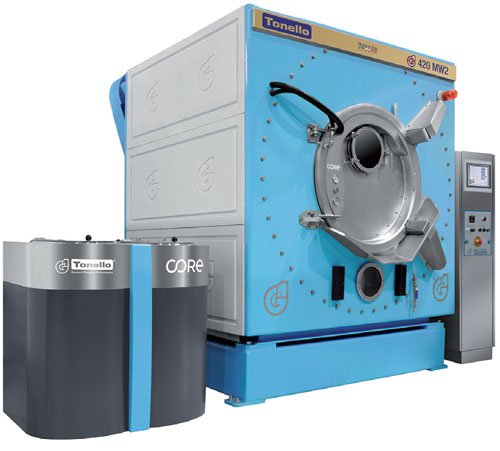
Italy-based Tonello has introduced Core technology for producing uniform or contrasting effects during garment finishing using reduced water volumes with liquor ratios as low as 1:1. The technology is a compatible with various Tonello washing and dyeing machines, and may be implemented in any production cycle without interrupting the process.

According to the company, the Core technology offers the following advantages: product savings of between 50 and 80 percent and 96-percent water savings; reduced processing times; improved performance; and versatility because the machine can be used for multiple processes. Core also may be used to apply a variety of softeners, resins and finishes and essences.

dpftonello
Tonello’s Core technology is compatible with various Tonello washing and dyeing machines.

November/December 2016

NSF Awards Grant To Stony Creek Colors, Danforth

The National Science Foundation’s (NSF’s) Division of Industrial Innovation and Partnership has awarded a one-year grant of $224,676 to Springfield, Tenn.-based Stony Creek Colors and the Donald Danforth Plant Science Center, Creve Coeur, Mo., to help make denim manufacturing more sustainable.

The Danforth Center will work to better understand the genetics of the existing indigo plant stocks through DNA analysis. Stony Creek will use this research to develop an improved bio-based chemical derived from the renewable Persicaria tinctoria indigo crop with the goal of reducing the use of chemically synthesized indigo dye made from petroleum derivatives and harmful chemicals.

“Our bio-based dyes improve profitability and ecosystem health for farmers, while empowering designers, brands, and mills with greater transparency and traceability,” said Sarah Bellos, CEO and founder, Stony Creek Colors. “Stony Creek Colors’ research collaboration with the Danforth Center funded by this NSF grant is a critical next step in the evolution of this plant-derived chemical.”

November/December 2016

Textiles 2017: Will Manufacturing Thrive?

BornemanBy James M. Borneman, Editor In Chief

jborneman@textileworld.com

Regardless of your political views, there appears to be a change in attitude toward manufacturing in the United States. For some time, the importance of domestic manufacturing has been much maligned as something of the past rather than of the future. America developed a post-manufacturing service-based economy. In reality, strong manufacturing jobs were replaced by imported goods and service jobs.

According to the Bureau of Labor Statistics, the average hourly wage in textile manufacturing is approximately $20.06 an hour in a textile mill, $16.93 in a textile product mill and $17.87 in apparel manufacturing. Those are significant wages compared to wages in the service jobs that many were forced to pursue after losing textile jobs.

The good news is that if the promise of reduced regulation and reduced tax burdens come to pass, the industry can continue or even accelerate the recent investment trends.

Energy costs, an important factor in industry growth, may further be reduced and influence future global investment in U.S. manufacturing.

In building a manufacturing company and investing time and money, it also is encouraging to think the government might support your work rather than discourage your efforts.

Is manufacturing dirty, unsustainable and old? Or is it the core of a strong economy, providing good jobs and striving to drive technology forward?

The president-elect has had the responsibility of making a payroll, he understands the regulatory environment and knows how to navigate the tax code.

Good tax policy and meaningful regulation lowers the barriers to investment, expansion and economic growth. Industry needs to be regulated — no doubt — but fair regulation
with regulators that understand the consequences is imperative.

Whether or not it is just window dressing, U.S. manufacturers seem to have embraced green and sustainability trends. Strong consideration is given to new facilities, processes and facility upgrades. A sustainable supply chain is supported by consumer interests — driven by market forces rather than government regulation. The same can be said for U.S.-manufactured goods. It would appear “Made in the USA” currently matters.

International trade is another matter. Without becoming protectionist, will the administration focus on fair trade and application of current trade law focusing on enforcement? Time will tell.

The effect of healthcare benefits on manufacturing has been a major cost center, while workers struggle with high deductibles and narrower care selections. Can the new administration deliver on fixing the system and lowering costs?

The year 2017 will be a new environment for US textiles and manufacturing in general. Innovation continues, investment continues, and if economic growth can take hold,
new opportunities can take hold.

Over the years, U.S. textiles have survived, and in some cases thrived. Let’s see what 2017 delivers.

November/December 2016

UCMTF Sponsors Dalton Carpet Conference

The Association of French Textile Machinery Manufacturers (UCMTF) recently hosted the “Innovative Solutions for the Flooring Industry — From Polymer & Natural Fibers to Final Product” conference in Dalton, Ga. — an event that featured presentations about the latest technology innovations for the floor covering sector.

With gratitude to the Greater Dalton Chamber of Commerce, the Municipality of Dalton and the American Floorcovering Association (AFA), UCMTF welcomed approximately 130 industry members to the Dalton Convention Center. Presentations from executives with nine Europe-based textile machinery manufacturers — primarily from France and Belgium — ran the gamut from fiber extrusion, heatsetting and natural fiber processing to weaving, tufting, finishing and recycling.

It was interesting to see that Van de Wiele has expanded its offering to service additional segments of the floorcovering industry.

newsmacke
Van De Wiele Inc.’s Benjamin E. Mackey presented information on carpet weaving as well as finishing.
newsroom
Approximately 130 members of the floorcovering industry gathered at the Dalton Convention Center to hear presentations on the latest floorcovering manufacturing technologies.
newsexecs
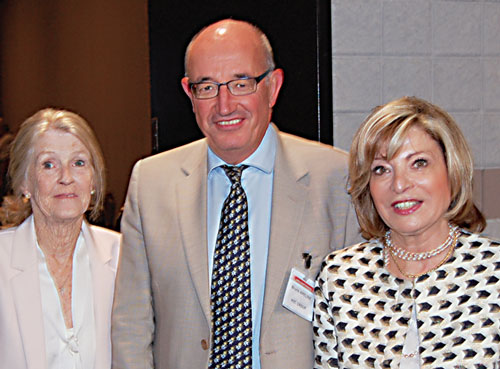
(left to right): Wanda Ellis, executive director, AFA; Bruno Ameline, UCMTF president; and Evelyne Cholet, UCMTF secretary general, welcomed attendees to the Dalton Carpet Conference.

November/December 2016

Aurora Specialty Textiles Opens New Plant

Yorkville, Ill.-based Aurora Specialty Textiles Group — a subsidiary of Milwaukee-based Meridian Industries Inc. — recently held a grand opening celebration for approximately 100 customers, staff and community leaders at its new 124,000-square-foot manufacturing plant. The opening adds wide-width coating and finishing to Aurora’s capabilities with the addition of an ultra-wide-width coating and finishing line for woven and nonwoven substrates up to 134 inches wide from Korea-based Ehwha Glotech.

The company also unveiled a new logo and mission statement during the celebration.

“Today is a tremendous day for Aurora Specialty Textile Group,” said Dan LaTurno, president. “It marks the symbolic end of our transition from the Aurora plant to our new Yorkville operation, and the beginning of a new, exciting era. We’ve been committed to becoming a global leader in wide-width coating and finishing, and this new plant, which could not operate today without the hard work of the people here, is testament to what we are calling today ‘The New Aurora.’”

LaTurno stated that the term “The New Aurora” is a nod to the company’s commitment to staying ahead of the industries it serves.

“As the world changes, we now have the world-class capabilities, state-of-the-art equipment and expertise within R&D to meet those challenges,” LaTurno said.

November/December 2016

Alandale Knitting Celebrates Its 50th Anniversary

Commission circular knitting company Alandale Knitting LLC, Troy, N.C., is celebrating 50 years in business this year. Founded in 1966 by Alan Gutschmit, the company has grown to house 225 machines offering a production capacity of more than 500,000 pounds per week.

The late founder garnered 18 patents for textile processing systems including the Filter Flow™ lint cleaning system, yarn threading technologies and tools for detecting broken hooks and needles. All of his innovations still are in use today at Alandale.

The company recently gathered employees, suppliers and friends at its 120,000-square-foot facility to recognize this milestone anniversary.

“While the U.S. textile industry has clearly had its ups and downs over the years, Alandale Knitting has always been recognized as the go-to provider for new and difficult constructions,” said Don Trexler, president. “Our ability to quickly deliver high quality, complex knit programs enables us to fulfill the needs of both new brands that are focusing on Made in USA goods and established companies that are looking for specific technical capabilities, extra capacity, or the benefits of reshoring. We are, of course, also accomplished in providing greige fabric programs to serve the needs of our clients that produce in the NAFTA and CAFTA-DR regions.”

November/December 2016

Suzhou Tianyuan Invests In Arkansas

Arkansas Governor Asa Hutchinson has signed a memorandum of understanding with China-based Suzhou Tianyuan Garments Co. for a $20 million investment in Little Rock that will create 400 jobs.

Tianyuan produces approximately 10 million casual and sportswear garments annually for brands including Adidas, Reebok and Armani.

“I am thrilled to announce that Tianyuan has chosen Arkansas as their North American home,” said Governor Hutchinson.

“This deal with Tianyuan shows the continued momentum we have with companies looking to invest in Arkansas,” said Mike Preston, executive director, Arkansas Economic Development Commission (AEDC).

AEDC will work with Tianyuan to finalize the details, and the company hopes to be operational by the end of 2017.

November/December 2016

Sponsors