SICOMIN, France — January 13, 2025 — Sicomin has announced its partnership with MADskis, the Swiss company renowned for crafting handmade skis with a commitment to innovation and sustainability. MADskis will now incorporate GreenPoxy® 56 resin, known for its industry-leading bio-content of 51 percent, into its high-performance ski production.
The Sicomin and MADskis collaboration sets a new standard in winter sports manufacturing, showcasing maximum sustainability, uncompromised performance on the slopes and improved working conditions. With the highest bio-content available, GreenPoxy 56 delivers great mechanical performance as well as meeting MADskis challenging production and environmental requirements. It also ensures a cleaner, safer production environment for the MAD production team, as they hand laminate wooden top sheets, natural fibres and European wood cores in their boutique workshop.
MADskis was co-founded by Aurélien Ducroz, a celebrated professional skier and Class40 ocean racing world champion. Ducroz’s Class40 yacht was constructed using Sicomin GreenPoxy resins and flax fibers, highlighting the resin’s durability. Ducroz will now apply the similar processing techniques and materials at MAD, creating cutting-edge, lower impact skis. MAD’s revolutionary UNDO-REDO process uses bio-based resins and natural wooden topsheets to enable skiers to repair or replace the upper layers of their skis. This innovation significantly extends the lifespan of the skis, reducing waste and promoting eco-responsibility.
“MADskis share our vision to enhance the sustainability of their products without compromising on their performance,” said Matthieu Chaloin, Sicomin. “We are proud to support their mission as they craft unique wood-finished, eco-conscious skis for dedicated customers that understand how advanced bio-based materials can help support the future of winter sports.”
GreenPoxy 56 is a high-performance resin system formulated with 51% of its carbon content from biobased sources. Its unique formulation and low viscosity mean it quickly and efficiently wets out reinforcements under hand lamination, vacuum bag or press consolidation processes. A range of different reactivity hardeners are available to suit the varied laminating and bonding challenges of custom ski manufacturing.
DORNBIRN, Austria — January 13, 2025 — Warm greetings as we welcome the start of a new year filled with opportunities and innovation!
As a leading platform for knowledge exchange, research, and innovation in the fiber industry, Dornbirn GFC is set to (co)-host a series of expert-driven events in 2025. These four key events will showcase groundbreaking advancements and foster global collaboration:
Dornbirn GFC ASIA / Korea
In collaboration with DYETEC, KOFOTI, and Textile TechForum, this event will take place on 3rd & 4th April 2025 at the Busan Exhibition and Convention Center (BEXCO), Busan, South Korea.
The 4th Dornbirn GFC-ASIA 2025, co-organized by the Dornbirn GFC,
DYETEC , KOFOTI and Textile TechForum in Korea, will be held on April
03rd and 04th 2025 at the Busan Exhibition and Convention Center (BEXCO) in Busan, South Korea as a 2 day On-Site event. The two days international conference will consist of plenary lectures, oral presentations and culture event for foreigners.
From the reputation as a world class beautiful city of tourism and culture, we welcome you to the 4th Dornbirn GFC-ASIA 2025. To present furthermore the most important developments and findings, we kindly invite you to submit your lecture proposals for 2025 program.
CRETE 2025 International Conference
Organized together with the Technical University of Crete, this conference will run from 27th to 31st May 2025 in Chania, Greece.
The 8th International Conference on Industrial and Hazardous Waste Management will be held from 27 to 31 May, 2025 in Chania, on the beautiful island of Crete in Greece. CRETE 2025 is organized by the Technical University of Crete, Vienna University of Technology, Nanyang Technological University, Tsinghua University of Technology, Austrian Fibers Institute (Dornbirn GFC), Korean Basel Forum and the University of Stavanger.
CRETE 2025 will once again include an extended spectrum of topics, in order to allow a holistic approach of industrial and hazardous waste management and create an appealing, interesting and riveting Conference program. This time a focus on recovery potential and processes will be pursued. The renewed CRETE 2025 Organizing Team is working on new ideas and events, in order to make the upcoming Conference even more successful, always counting on your high quality contributions and presentations.
64th Dornbirn GFC & 5th Innovation Days
Join us for the flagship event from 10th to 12th September 2025 in Dornbirn, Austria, show-casing cutting-edge research and innovation.
The Dornbirn GFC is inviting researchers, experts, manufacturers, and practitioners to submit papers for the 64th edition, taking place in September 2025. This congress offers a platform to present cutting-edge research and innovations that will shape the future of the fiber and textile industries.
Submissions possible until 14th of February 2025!
Dornbirn GFC ASIA / India
In partnership with Techtextil India 2025, this event will be held on 18th November 2025 in Mumbai, India.
Details will be announced soon, but the spotlight will undoubtedly be on cutting-edge fiber innovations and transformative solutions for sustainability. Stay tuned for updates on how this event will shape the future of the industry!
Join us in shaping the future of the fiber industry through these transformative gatherings.
Posted: January 13, 2025
Source: Dornbirn GFC Global Fiber Congress / Austrian Fibers Institute
WASHINGTON — January 13, 2025 — The National Council of Textile Organizations (NCTO) and the National Chamber of the Textile Industry (CANAINTEX) commend the Mexican government for its decisive action to curb the flow of illegal and subsidized apparel products from Asia that evade tariffs and undermine the U.S.-Mexico textile co-production chain.
In as joint letter to Mexican President Claudia Sheinbaum, NCTO and CANAINTEX expressed strong support for Mexico’s new decree, which imposes penalty tariffs and taxes on imported finished textile and apparel goods and certain inputs into Mexico from non-Free Trade Agreement countries. These measures will shield regional supply chains and ensure fair competition for production in the United States and Mexico.
The decree also targets the misuse of the U.S. “de minimis” trade loophole by taxing goods entering the U.S. from Mexican warehouses that exploit the rule to avoid tariffs, a practice that has significantly harmed U.S. and Mexican textile and apparel manufacturers. The associations are also asking the incoming Trump administration to immediately close the de minimis loophole.
U.S. textile producers have lost 25 plants and 26,000 jobs in the past 18 months, while Mexico’s industry has shed over 75,000 jobs, largely due to predatory trade practices by non-USMCA signatories like China.
“Despite the legal efforts of Mexico and the United States to prevent the importation of goods that are undervalued, made with forced labor or with tariff or regulatory restrictions, we have seen firsthand how the Asian market has gained an unfair advantage through predatory trade practices, displacing companies and workers in the USMCA industries and undermining our critical coproduction chain,” the associations wrote in the letter. “The countries participating in the USMCA produce ample supply to guarantee a continuous flow of cost competitive manufactured products. The Decree will improve the production chain, grow jobs and ensure tariff preferences are granted to goods manufactured in the region and stop rewarding non-signatories such as China and other Asian suppliers.”
Posted: January 13, 2025
Source: The National Council of Textile Organizations (NCTO)
KNOXVILLE, Tenn. — January 9, 2025 — The Institute for Advanced Composites Manufacturing Innovation® (IACMI), also known as IACMI–The Composites Institute®, celebrates today a decade of revitalizing American manufacturing and strengthening the nation’s defense industrial base. Established by the Department of Energy (DOE), IACMI was announced as the fifth of now 18 Manufacturing USA® institutes on January 9, 2015.
IACMI Impact: A Decade of Innovation and Economic Growth
For 10 years, IACMI has played a pivotal role in America’s reindustrialization, aiming to secure its position as a global leader in manufacturing innovation and workforce development. Reshoring initiatives have been key to bolstering U.S. economic and national security. Through multiple national workforce programs sponsored by DOE and the Department of Defense (DoD), IACMI has been inspiring, educating, and training a skilled workforce to help address the projected 4.6 million open manufacturing jobs in the coming decade.
IACMI’s impact for economic growth has been clear in four primary ways:
Public-Private Collaborations – convening more than 170 members and 4,500 professionals from industry, academia, and federal labs to tackle the composites industry’s toughest challenges in automotive, aerospace, wind, infrastructure and the circular economy
Technical Innovation – connecting 90+ of its members to conduct 60+ industry-led R&D projects that helped commercialize dozens of products, advance the Technology Readiness Level (TRL) of numerous technologies, and create hundreds of design, engineering, and manufacturing jobs
Workforce Development – catalyzing IACMI, ACE, and METAL programs to enable
100+ internships with industry collaboration, resulting in 100 percent placement in industry jobs or higher education
18,300+ STEM outreach engagements
12,400+ trained online across 50 states in CNC machining
5,100+ trained in-person in composites, CNC, metrology, and metallurgy
40 machine tool training centers in 14 states
Leveraging Resources – providing open access to over $400M in scale up facilities across 8 states has led to an additional $220M+ for companies, universities, national labs, and workforce initiatives
“For 10 years, IACMI has harnessed the power of public-private partnerships to improve products, processes, and people’s lives through composites innovation and workforce solutions that secure America as a global leader in advanced manufacturing,” said Chad Duty, CEO, IACMI. “With steadfast investment and support from industry and government partners, notably DOE and DoD, IACMI has empowered domestic manufacturers to accelerate design and commercialization, fostering a more reliable, secure, and competitive U.S. economy.”
Since 2015, IACMI, the DOE, and state economic development organizations have invested in a shared infrastructure that collectively delivers a breadth and scale of open-access advanced composites manufacturing R&D capabilities that stand unmatched in the U.S. These facility and infrastructure investments have been led by IACMI’s core innovation partners in Colorado, Indiana, Michigan, Ohio and Tennessee. Today, these capabilities uniquely position IACMI to build on past achievements, de-risk future research, and accelerate onshoring efforts in the United States.
Examples of state-of-the-art scale-up facilities include:
Manufacturing Demonstration Facility (MDF) at Oak Ridge National Laboratory (ORNL)
Carbon Fiber Technology Facility (CFTF) at ORNL
Fibers and Composites Manufacturing Facility (FCMF) at University of Tennessee, Knoxville
Laboratory for Systems Integrity and Reliability (LASIR) at Vanderbilt University
The Composites Laboratory at the University of Dayton Research Institute
The Composites Manufacturing & Simulation Center (CMSC) at Purdue University
The IACMI Scale-Up Research Facility (SuRF) in Detroit, Michigan
The Composites Manufacturing Education and Technology Facility (CoMET) at National Renewable Energy Laboratory (NREL)
IACMI has leveraged these facilities to undertake transformational R&D, in nation-critical industries including energy, transportation, aerospace, and infrastructure & construction. An IACMI-sponsored project team helped Volkswagen of America redesign and validate a composite liftgate for SUVs, reducing the weight by 35 percent and lowering its recurring cost by 9 percent compared with steel. Technological advances from this research are now being used across multiple VW platforms, including the new VW ID Buzz EV. The scaling, manufacture and testing of novel thermoplastic wind turbine blades that are recyclable and lower in cost has also been demonstrated. Further research in automating finishing processes for wind blades aims to reshore wind manufacturing jobs. Simulation and modeling work to develop a virtual twin for additive manufacturing is revolutionizing the production of tooling.
IACMI has become an “ecosystem of innovation” and has discovered an effective formula that works: Technical Innovation + Workforce Development = Economic Growth. As the first DOE institute to receive renewed funding in 2023, and with DoD investments expanding proven programs, IACMI is committed to building on these successes. Over the next few years, IACMI and its partners will leverage their full-scale facilities and equipment and significantly expand programs. In this next chapter, IACMI will advance its purpose to convene, connect, and catalyze the U.S. composites community by attracting startups and small enterprises while creating opportunities with large enterprises, national labs, and universities.
FUNDÃO, Portugal — January 10, 2025 — TWINTEX, a Portuguese clothing manufacturing company with 45 years’ experience and specializing in the production of garments for medium-to- high-end and luxury brands, has installed the Hänel Lean-Lift automated vertical warehouse from VRC WAREHOUSE TECHNOLOGIES to transform its logistics management and ensure greater accuracy in internal processes. The Hänel Lean-Lift from VRC enables operators to access materials quickly, eliminating low-value manual tasks and ensuring real-time control of stored items.
“Nowadays, a clothing manufacturing company is much more than just a warehouse where garments are produced. That is why we’ve embraced a highly complex logistical responsibility,” explained Mico Mineiro, COO of TWINTEX. “With VRC WAREHOUSE TECHNOLOGIES’ equipment, an operator can, in just a few steps, retrieve and organize all the necessary materials, while stock management is updated by the day, hour, and minute, significantly enhancing performance in an impressive way.”
The automated warehouse has also reduced the factory’s space usage by 40% and improved safety conditions for employees. “We no longer use ladders, and there’s no physical strain. This was a complete transformation,” emphasized Ana Almeida from TWINTEX’s Trimming Department.
Furthermore, this investment reinforces the company’s commitment to sustainability, an area in which it holds several eco-label certifications, such as the Global Organic Textile Standard (GOTS), Organic Content Standard (OCS), Responsible Wool Standard (RWS), and Global Recycle Standard (GRS).
“We have a pressing need to store and keep everything well-organized and compartmentalized. This upgrade in our organization has made us much more efficient and able to work in a much simpler way,” added Beatriz Tavares, Social and Environmental Sustainability Ambassador at TWINTEX. The installation of the Hänel Lean-Lift from VRC WAREHOUSE TECHNOLOGIES is a clear example of how technology can transform the textile industry, making it more efficient, sustainable, and future-ready.
TOKYO — January 8, 2025 — Teijin Frontier Co. Ltd. announced today that its group company, Nantong Teijin Co. Ltd. has been recognized by China’s Jiangsu Provincial Department of Ecology and Environment for reducing water usage by approximately 300,000 tons/year. Nantong Teijin, which manufactures polyester long-fiber woven and knitted fabrics in Jiangsu Province, independently developed equipment and systems for analyzing, recovering, storing and reusing wastewater from its water-intensive dyeing process. This initiative, which began in 2022, has also resulted in a 4 percent reduction in CO2 emissions, based on a third-party lifecycle assessment review conducted according to ISO14040. As a result, Nantong Teijin has been certified as a company promoting environmental initiatives in the Yangtze River Delta region.
The certification of model activities for supporting the environment was implemented to strengthen ecological and environmental protection in the Yangtze River Delta area. The Nantong City Bureau of Ecology and Environment in Jiangsu Province evaluated companies subjected for certification based on their self-reported efforts to reduce environmental impacts and on onsite inspections and recommended selected companies to the Jiangsu Provincial Department of Ecology and Environment. Out of a total of 164 companies recommended, 30 were selected by the Jiangsu Provincial Department of Ecology and Environment. Among this group, five companies, including Nantong Teijin, were particularly highly rated.
Nantong Teijin is the only Japanese company, and the only one in the textile industry, among these five companies.
The Teijin Frontier Group promotes environmentally friendly manufacturing and systems under its environmental strategy, THINK ECOⓇ. Using this certification as an opportunity, Nantong Teijin aims to further promote environmentally friendly manufacturing by expanding its water usage reduction initiatives to other group companies.
GRAZ, Austria — January 10, 2025 — International technology group ANDRITZ supplied and recently commissioned two new refining and cottonizing lines for Van Robaeys, France. These fully customized teXline bast fiber lines enable the company to increase its production of textile fibers from flax.
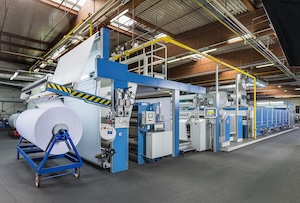
ANDRITZ teXline bast fiber line in operation at Van Robaeys, Image — ANDRITZ
With the new lines, Van Robaeys is responding to the growing demand from the French market for cottonized and high-quality textile fibers from natural sources. Europe is the world’s largest producer of flax fibers, showing a 133-percent increase in flax cultivation areas between 2010 and 2020.
The ANDRITZ teXline bast fiber lines can process up to 800 kg/h of fiber and use state-of-the-art equipment to ensure a high degree of flexibility throughout the fiber processing operations.
These lines are the seventh and eighth ANDRITZ cottonizing lines for Van Robaeys, with the first having been in operation for fifty years.
“It has been a real pleasure to collaborate with the ANDRITZ textile experts again, fifty years after purchasing our first ANDRITZ line. With our new equipment, we benefit from the latest bast fiber processing technology and significantly increase our capabilities in the production of high-quality fibers,” said Pierre D’Arras, CEO of Van Robaeys.
Van Robaeys is a family-owned company producing flax fibers for the spinning industry. Its extensive expertise in flax scutching dates back to 1919. The recent investment supports the company’s efforts toward sustainable and zero-waste fiber production.
ANDRITZ has many years of expertise in technology for the decortication of straw from bast fiber crops, as well as for refining and cottonizing fibers and shives for further processing. This premium quality fiber is ready to be used for nonwoven or spinning processes in the textile industry.
WASHINGTON — January 10, 2025 — A potential strike at East Coast and Gulf Coast ports has been avoided with the announcement of a tentative labor agreement, but the nation’s major container ports have already seen a surge in imports that is expected to continue because of potential increases in tariffs, according to the Global Port Tracker report released today by the National Retail Federation and Hackett Associates.
“The new contract brings certainty and avoids disruptions, and we hope to see it ratified as soon as possible,” NRF Vice President for Supply Chain and Customs Policy Jonathan Gold said. “But the agreement came at the last minute, and retailers were already bringing in spring merchandise early to ensure that they would be well-stocked to serve their customers in case of another disruption, resulting in higher imports. The surge in imports has also been driven by President-elect Trump’s plan to increase tariffs because retailers want to avoid higher costs that will eventually be paid by consumers. The long-term impact on imports remains to be seen.”
The International Longshoremen’s Association and the U.S. Maritime Alliance announced Wednesday that they had reached a tentative agreement on a new six-year labor contract, and that workers will remain on the job until the pact is ratified. A temporary contact extension reached in October was set to expire on Jan. 15 and the move avoided a possible strike on Jan. 16. The strike would have been the second in less than four months following a three-day walkout at the beginning of October.
“Just a few days ago, the clock was ticking down toward a possible strike at U.S. East and Gulf Coast ports, and an agreement that would avoid a shutdown appeared to be some way off,” Hackett Associates Founder Ben Hackett said. “We have narrowly averted a strike, but that doesn’t mean there hasn’t been an impact. Importers had already front-loaded cargo in anticipation of delays, giving a boost to imports in December and early January.”
U.S. ports covered by Global Port Tracker handled 2.17 million Twenty-Foot Equivalent Units – one 20-foot container or its equivalent – in November, although the Ports of New York and New Jersey have yet to report final data. That was down 3.2% from October but up 14.7% year over year.
Ports have not yet reported December’s numbers, but Global Port Tracker projected the month at 2.24 million TEU, up 19.2% year over year. That would bring 2024 to 25.6 million TEU, up 15.2% from 2023. Before the October port contract extension and the 2024 elections, November had been forecast at 1.91 million TEU and December at 1.88 million TEU, while the total for 2024 was forecast at 24.9 million TEU.
January is forecast at 2.16 million TEU, up 10% year over year; February at 1.87 million TEU, down 4.5% because of Lunar New Year factory shutdowns in China; March at 2.13 million TEU, up 10.6%; April at 2.18 million TEU, up 8%, and May at 2.2 million TEU, up 5.9%.
Global Port Tracker, which is produced for NRF by Hackett Associates, provides historical data and forecasts for the U.S. ports of Los Angeles/Long Beach, Oakland, Seattle and Tacoma on the West Coast; New York/New Jersey, Port of Virginia, Charleston, Savannah, Port Everglades, Miami and Jacksonville on the East Coast, and Houston on the Gulf Coast. The report is free to NRF retail members, and subscription information is available at NRF.com/PortTracker
As an authority and voice for the retail industry, NRF analyzes economic conditions affecting the industry through reports such as Global Port Tracker.
NEW YORK CITY — January 9, 2025 — KOLAB Collection, a sustainable clothing brand, will be launching its secondhand retail platform LOOP today. LOOP is KOLAB’s circular fashion platform that enables customers to extend the lifecycle of their KOLAB garments by passing it on to new wearers.
It is estimated that 92 million tons of textiles waste ends up in landfills every year. KOLAB offers an alternative solution through LOOP, where customers can sell their pre-loved KOLAB items instead of disposing of them. Sustainable fashion consumers can use the platform to source for preloved KOLAB clothing.
Launched in October last year, KOLAB Collection is one of the first clothing companies to use NFC tagging technology on a wide scale and day-to-day basis by using NFC tags to aid in authentication, inventory management, resale management, and traceability. The LOOP platform is the next node in this ecosystem, where users can pass on their KOLAB items to users who are looking for preloved clothing.
It is estimated that the United States’ demand for secondhand apparel will grow at a rate of 2.6 percent through 2034, driven by younger shoppers who recognize the cost-effectiveness and environmental impact of thrift shopping.
Paul Ng, Founder of KOLAB Collection, shared: “LOOP allows us to extend the lifecycle of our garments by offering our customers a centralized platform to sell items they no longer need, ensuring these garments find new owners instead of ending up in a landfill. Likewise for sustainable fashion consumers who want to stay true to their values, the LOOP platform provides them a simplified way to acquire authentic preloved KOLAB clothing.”
Streamlined Process
Each KOLAB outerwear piece is equipped with an NFC tag, simplifying the authentication process between buyers and sellers. This eliminates the need for third-party verification, inventory management, and complex shipping arrangements, ensuring a smooth transition of garments to their new owners.
How It Works
Existing KOLAB account holders can log in onto LOOP and sell previously purchased clothing items. Sellers have the autonomy to set prices, upload photos, and choose shipping options for their items. Prospective buyers can effortlessly browse the range of preloved KOLAB clothing and make purchases using their preferred payment method. Upon confirming the transaction, the seller will directly ship the clothing to the buyer, who can then add a sustainable clothing item to their wardrobe. With KOLAB outerwear being NFC-tagged, buyers are assured of the authenticity of their items and can trace the provenance of their clothing.
Future Plans
At present, the LOOP platform is exclusively available for KOLAB clothing. However, there are plans to expand and enhance the platform, including offering the technology on a B2B basis, enabling other businesses to integrate it into their inventory management systems. LOOP is an innovation that can embed circular fashion practices into the very fabric of businesses’ retail operations.
Retail Information
KOLAB Collection can be found on www.kolabcollection.com, with free shipping in the United States* and Canada. KOLAB is proud to partner with Greenspark, an innovative Impact-as-a-Service platform, to ensure that every order contributes to a positive environmental impact. Please refer to the Annex for further information.
*except remote areas
ANN ARBOR, Mich. — January 9, 2025 — The Association for Advancing Automation (A3), North America’s preeminent automation trade association, proudly announces the promotion of Alex Shikany to executive vice president. Previously serving as vice president of Membership & Market Intelligence, Alex brings over a decade of dedicated leadership and innovation to his new role.
Alex Shikany
As executive vice president, Alex will oversee several key operations for A3, serving as the day-to-day liaison to the A3 Board of Directors and leading the A3 Leadership Team. His focus will be on driving strategic initiatives, fostering collaboration, and enhancing member value to advance A3’s mission.
A3’s President Jeff Burnstein highlighted the importance of Shikany’s promotion in light of the Association’s rapid growth. “Over the past five years, we’ve doubled our team, established Automate as North America’s leading annual robotics and automation event, and expanded internationally into Mexico and India. With A3 in its strongest position ever, Alex’s leadership in internal operations allows me to focus on long-term strategy, including partnerships, accelerating adoption of automation, and growing our global footprint.”
Burnstein also praised Shikany’s contributions to A3’s success. “Alex has been a transformative force for our team, demonstrating visionary leadership, a strategic mindset, and collaborative approach. His efforts have shaped our direction, and I am confident he will continue to elevate the Association’s impact on the automation industry.”
Reflecting on his promotion, Shikany stated, “It’s an honor to step into this new role and further A3’s mission to drive innovation and growth in the global automation industry. I am grateful for the incredible team at A3, as well as our talented members and community, whose efforts drive meaningful change and innovation worldwide.”
Since joining A3 in 2012 as director of Market Analysis, Shikany has held increasingly impactful roles. Notably, he led A3’s rebranding initiative, unifying four organizations under the A3 umbrella in 2021—a two-year effort that set the stage for A3’s continued success.
In his previous role, Shikany spearheaded membership growth, expanding A3’s global reach to over 1,300 member companies while advancing its market intelligence capabilities in robotics, machine vision, motion control, and artificial intelligence. His contributions have solidified A3’s position as the trusted voice of the automation industry.
Posted: January 9, 2025
Source: The Association for Advancing Automation (A3)