World’s First Ski Jacket With HYDRO_BOT Technology – Eliminates Sweat At The Touch Of A Button

HÜNENBERG, Switzerland — November 14, 2018 — Today, the industry-leading premium Swiss sports apparel brand KJUS, unveiled the word’s first garment to feature an electronic, user-controlled membrane. The ground-breaking wearable technology — HYDRO_BOT, integrated by KJUS into a ski jacket, actively pumps out sweat from inside the jacket to keep skiers dry, warm, and performing at their best.

KJUS’s 7SPHERE HYDRO_BOT ski jacket actively pulls sweat away from the inner garments and out of the jacket using a process called electro-osmosis. This overcomes the issue of sweat becoming trapped inside a skier’s clothing system, and the dreaded post activity chill that results from having saturated inner garments. The technology not only boosts the enjoyment factor but also the performance factor, by ensuring the skier spends minimal energy on thermoregulation and maximum energy on their ski performance.

The HYDRO_BOT technology is incorporated into the jacket via two panels strategically located on the high-sweat zone of the back. The technology consists of 3 functional layers; a membrane made up of trillions of pores per m2, surrounded by conductive fabric. When a small electrical pulse is applied, the pores turn into micro-pumps, actively pumping sweat away from the body and out of the jacket quickly and efficiently. Ultra-simple to use, the jacket can we switched on and off with the integrated control unit or via Bluetooth from the iPhone & Android compatible app.

“HYDRO_BOT solves one of the biggest challenges in the ski & sportswear sector — breathability, and the issues that arise when a skier builds up a sweat in sub-zero temperatures, while wearing warm, waterproof clothing,” said Joacim Holter, managing director and chairman, Osmotex.

Up until now, ski jackets using regular membranes have not been able to wick moisture away from the body fast enough, especially in colder temperatures when the breathability of regular membranes take a plunge.

The revolutionary HYDRO_BOT jacket is up to 10 x more efficient than jackets with regular membranes, and is not adversely affected by freezing temperatures. It is the first ever garment to be able to match human sweat rates in terms of breathability. In fact, the more moisture the skier produces the faster it works. By measuring the amount of sweat passing through the panels the app is also able to make practical recommendations on how to regulate body temperature, enabling skiers to minimize sweat production in the first place.

“KJUS creates garments that enable sportspeople to focus on their performance and the experience. For two decades KJUS has been researching and developing new fabrics and technologies to tackle the challenge of breathability in skiwear,” comments KJUS’ Head of Innovation, Ken Kurtzweg, “The 7SPHERE HYDRO_BOT is a game-changing wearable-tech jacket that represents a giant leap forward on our mission to ensure skiers are kept dry, warm and comfortable from the first run of the day to the last.”

Developed and patented by Swiss technology company, Osmotex, HYDRO_BOT is a game-changer for the industry and the first significant innovation since membranes were introduced 40 years ago. Research and developed over a period of 10+ years in collaboration with the Swiss research institute EMPA (the Swiss Federal Laboratories for Materials Science and Technology) and fabric developer Schoeller this is the first application of the HYDRO_BOT technology within a garment.

The 7SPHERE HYDRO_BOT Jacket will initially be available for men only and retails for CHF 1599 (£ 1299 / € 1399 / $ 1699). It will be available for purchase on www.kjus.com and through KJUS stores and select retailers from December 10th. It can be reserved online from November 22nd.

The 7SPHERE HYDRO_BOT at a glance

User-controlled: on-demand moisture management at the touch of a button.

  • Smart Sweat Management: Actively sweats out moisture keeping you warm and dry from the first run of the day to the last.
  • Revolutionary: The only jacket to be able to match human sweat rates in terms of breathability.
  • Moisture Transport: The panels actively pump out moisture from inside the jacket when an electrical pulse is applied.
  • Body-Zoned: HYDRO_BOT panels are strategically located on the high sweat zone of the back.
  • Beat the Chill: Prevents your inner garments from being soaked with sweat and the post-activity chill that results.
  • Super-Efficient: Up to 10 x more efficient at reducing moisture inside your jacket than traditional membranes.
  • Weather Independent: Unlike traditional membranes HYDRO_BOT gives you high performance even in sub-zero temperatures.
  • Performance Boosting: With less energy spent on thermoregulation you can spend more energy on your ski performance.
  • Sweat Monitoring: By measuring the amount of sweat passing through the panels the app is also able to make practical recommendations on how to regulate body temperature.
  • User-Controlled: Use the iPhone and Android compatible app or the jacket’s control box to turn HYDRO_BOT on/off.

Posted November 15, 2018

Source: KJUS

Show Season: Something For Everyone

BornemanBy Jim Borneman, Editor In Chief

As 2019 quickly approaches, a hectic textile show calendar is about to start, and for some, may have already started. It is an unusual collision of quadrennial, triennial, biennial and annual show cycles across a number of events.

Techtextil North America takes a break from Atlanta and heads to Raleigh, N.C., at the end of February. The venue’s proximity to North Carolina State University’s Wilson College of Textiles as well as the college being named the show’s first ever official academic partner should present some unique opportunities.

INDA’s IDEA®19 will have the latest in nonwovens heading to Miami in late March to the newly renovated Miami Beach Convention Center. Last held in 2016, INDA reported a gathering of more than 7,000 attendees, and 550 exhibitors from more than 65 combined countries.

Recently Messe Frankfurt reported that with just about six months until the opening of the Techtextil/Texprocess shows in Frankfurt that the floor space is almost fully booked. Techtextil, to be held May 14-17, has approximately 1,000 companies from 54 countries registered as of early November. Organizers are expecting “…a significant increase in the fields of technology and fibers and yarns. Also very well represented are suppliers of woven fabrics, coated textiles and functional apparel textiles.” Texprocess, with more than 250 registrations already received from 31 countries, features textile processing technologies from design, cutting, making, trimming, textile digital printing, dressing and finishing, to textile logistics and textile recycling. According to the Messe Frankfurt, limited exhibition space is still available.

Of course, the 800-pound gorilla in the room is ITMA 2019 in Barcelona. Plans are in the works for attendees and exhibitors alike with the show arriving quickly June 20-26. According to organizers, the show floor was sold out as of mid-August which prompted CEMATEX President Fritz P. Mayer to say: “The response for ITMA 2019 is so overwhelming that we have not been able to meet the demand for space despite adding two more exhibition halls. ITMA is a show for the industry, by the industry. Hence, we are of the opinion that

ITMA should feature a wide spectrum of cutting-edge solutions from as many solutions providers as possible, whether established or new-to-market.”

“Currently, we were only able to accommodate some 1,660 exhibitors from 47 countries on the show floor,” said Charles Beauduin, chairman, ITMA Services. “We have to put many applicants on the waiting list.”

And there are many other shows and meetings of significance in the works.

It looks like 2019 will produce some tough choices as time and money costs are seemingly on the rise. On the other hand, a strong U.S. dollar and growing economy puts a premium on U.S. textile firms to scout out new ideas and opportunities worth investment.

TW editors will have no shortage of content to offer regarding the latest developments from the conference and show floors. The production value of the shows has been good, and the organizers need to deliver on the promise of the latest and greatest technologies and products.

It looks like 2019 shows will have something for everyone.

November/December 2018

NC State’s College Of Textiles Receives Large Gift, Names College After Donors

NewsWilson
Fred Wilson

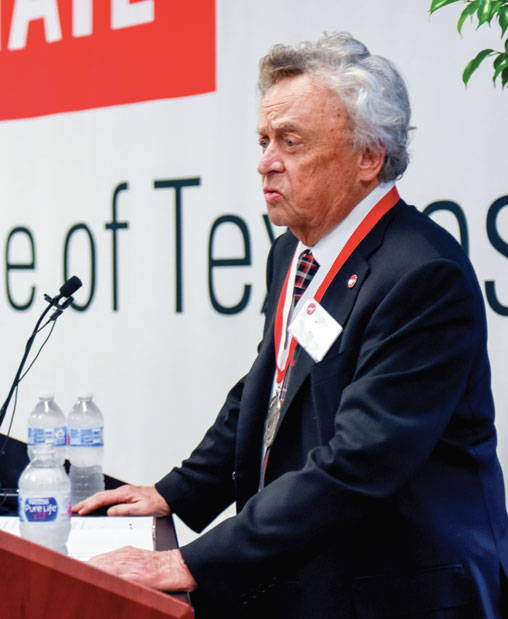
The College of Textiles at Raleigh, N.C.-based North Carolina State University (NC State) recently received a generous gift of $28 million from the family of Frederick “Fred” Eugene Wilson Jr. Fred graduated from the College of Textiles in 1961 with a degree in textile chemistry, and is chairman of the board at Piedmont Chemical Industries Inc., a family-owned and operated chemical company based in High Point, N.C.

The contribution is the largest-ever gift made to the college in its 119-year history, and to recognize a gift of this magnitude, moving forward, the college is now known
as the Wilson College of Textiles. It is only the second named school at NC State.

“This is a historic day for NC State and a truly transformational gift for the College of Textiles,” said NC State Chancellor Randy Woodson. “We are tremendously grateful to Fred
Wilson and the Wilson family. Their amazing generosity means that the Wilson College of Textiles will continue to be a vital, vibrant leader in education, discovery and practical application of innovation for years to come.”

The donation was made to the Think and Do the Extraordinary Campaign, which is a $1.6 billion fundraising effort to connect students with new opportunities, invest in award-winning faculty and research, and enhance campus facilities. Today, the Wilson College of Textiles is the only remaining textile college in the United States.

“When we were talking to the Chancellor about the college and about it being the only college of textiles remaining in the U.S., a lightbulb really went off,” Wilson said. “Somebody’s got to draw a line in the sand. We’ve got to remember what got us here and recognize where we can go in the future. I’m happy that we could be the ones to do that.”

November/December 2018

IVL, Huvis JV Announces Plans For LMF Operation

Huvis Indorama Advanced Materials is set to open a low melting fiber (LMF) manufacturing operation at Auriga Polymers Inc.’s Spartanburg County location. The company, a 50/50 joint venture between Thailand-based Indorama Ventures Plc (IVL) and South Korea-based Huvis Corp., has invested $48 million in a state-of-the-art operation with annual capacity of 60,000 tons. The facility will create approximately 50 jobs. LMF commonly is used as a binder fiber in core-sheath constructions and is used in automotive and industrial composites.

“After celebrating more than 50 years of manufacturing in Spartanburg County, it is exciting to see the creation of 50 new jobs in Spartanburg as a result of this substantial new investment,” said Auriga Polymers Vice President of Operations Mark Holden. “Both joint venture partners are appreciative of the pro-business environment in South Carolina and look forward to a strong future with this community.”

“We’re proud to congratulate Huvis Indorama Advanced Materials on this latest investment in Spartanburg County,” Governor Henry McMaster said. “Today’s announcement is a testament to Auriga’s commitment to our state and its people, and I look forward to watching them continue to thrive here for a long time to come.”

November/December 2018

Fluvitex Opens First U.S. Production Facility

NewsFluvitex
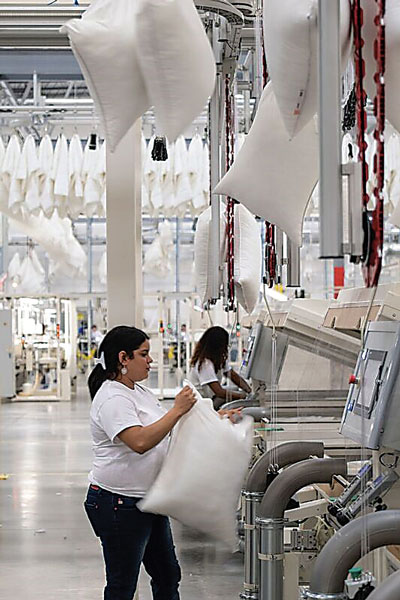
Pillows, comforters, and cushions are filled and stitched together at Fluvitex’s new Columbus, Ohio, facility.

Fluvitex, a long-time IKEA supplier, recently celebrated the grand  opening of its first U.S.-based production facility  in Columbus, Ohio. The 123,588-square-foot plant will manufacture roughly two-thirds of the quilts, pillows and cushions sold through IKEA in North America. The plant is expected to bring approximately 80 jobs to the area.

“We wanted to find more efficient textile production than what we had available,” said Nora Zullo, purchasing and logistics area manager for Inter IKEA Group in the Americas Region.

“IKEA started collaboration about seven years ago in Spain with the machine supplier Masias and its subsidiary Fluvitex. Together we designed a new concept that increased the production efficiency by about 50 percent. Now we take this concept to the United States.”

November/December 2018

Rhode Island Textile Innovation Network Launched

The Rhode Island Textile Innovation Network (RITIN) recently was launched during an event at the Slater Mill Museum in Pawtucket. The network — with its mission to make Rhode Island a leader in advanced textile manufacturing and to recruit and train the  sector’s furture workforce — is intended to foster  collaboration among textile industry leaders, designers, academia and the government. RITIN was created in 2016 by Senator Sheldon Whitehouse and the  University of Rhode Island Business Engagement Center, and operates with planning grants received from Real Jobs RI and the Rhode Island Commerce Corp. The program is managed by Polaris MEP, an affiliate of the National Institute of Standards and Technology’s Manufacturing Extension Partnership.

November/December 2018

CEMATEX Launches ITMA Innovation Lab

The European Committee of Textile Machinery Manufacturers (CEMATEX) has introduced the ITMA Innovation Lab to reiterate the innovation message to ITMA 2019 participants. The theme for the quadrennial show — to be held June 20-26, 2019, in Barcelona — is  “Innovating the World of Textiles.”

“Innovation is vital for the industry’s success as Industry 4.0 gains momentum in the manufacturing world,” said Fritz Mayer, president, CEMATEX.

“The shift towards open innovation has resulted in increased exchange of knowledge and new types of cooperation among education institutions, research organizations and business. ITMA has been a catalyst and showcase of ground-breaking innovation since 1951. We hope participants will be able to share new developments, discuss industry trends and spur creative efforts, thus ensuring a vibrant innovation culture in a global context.”

The Innovation Lab features four main components:
• Research and  Innovation Pavilion;
• ITMA Speakers  Platform;
• Innovation Video  Showcase; and
• ITMA Sustainable  Innovation Award.

“By launching the ITMA Innovation Lab feature, we hope to better drive industry focus on the important message of technological innovation and cultivate  an inventive spirit,” said Charles Beauduin, chairman of ITMA Services. “We hope to encourage greater participation by introducing new components, such  as the video showcase to highlight our exhibitors’ innovation.”

November/December 2018

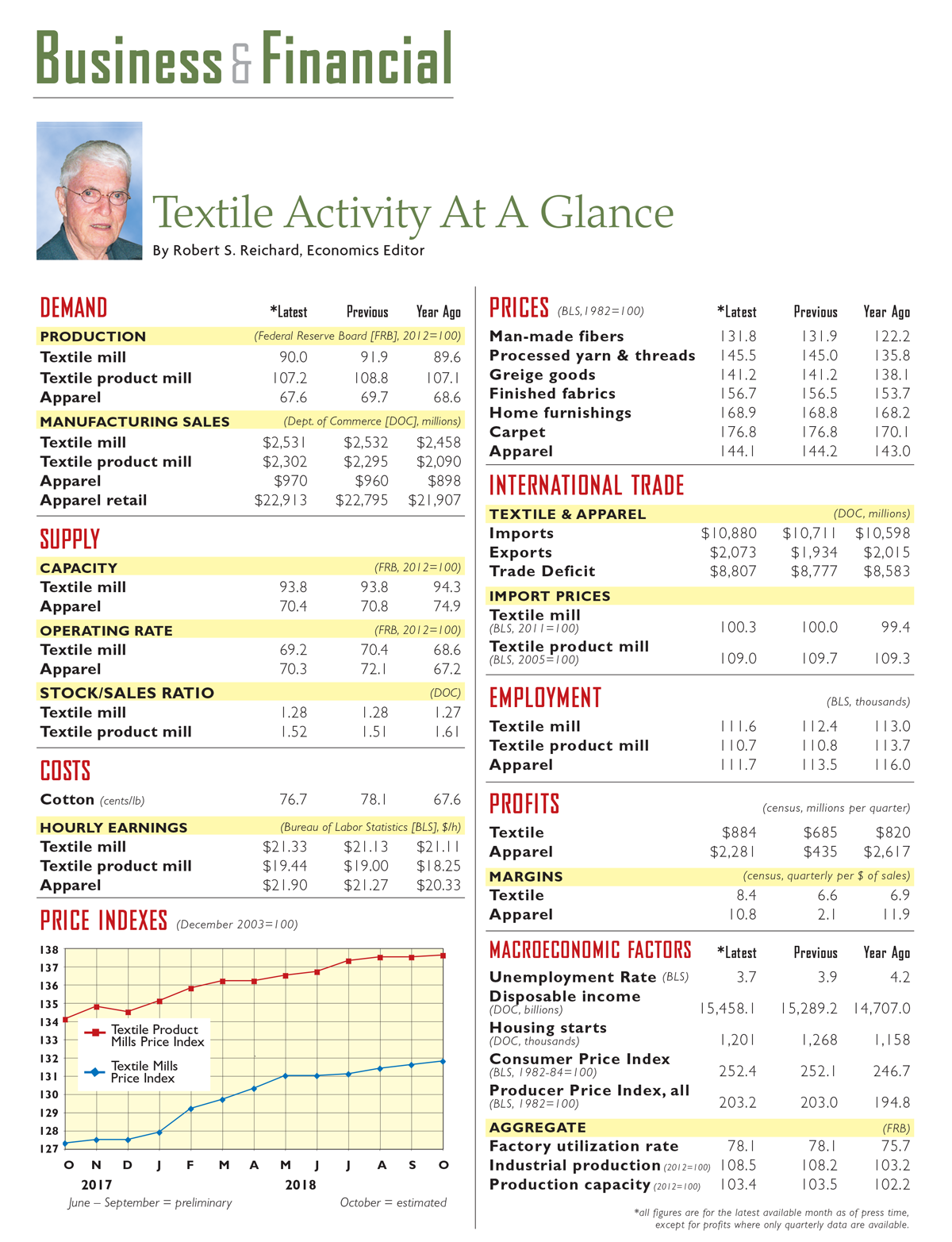
November/December 2018: Textile Activity At A Glance

BFBarometersND18

November/December 2018

Development Of New High-Tech And Sustainable Products Accelerates

Jim-Phillips-colorBy Jim Phillips, Yarn Market Editor

The U.S. textile industry promotes itself as the world’s most innovative, and it continues to back up the hype with the introduction of numerous high-technology and sustainable fibers and yarns.

For example, at the end of October, Kraig Biocraft Laboratories Inc., a developer of spider-silk-based fibers, announced that it is working under contract with the U.S. Army to develop a strain of genetically engineered silkworms that better match the physical properties required for applications in protective textiles.

Tentatively called Dragon Silk 2.0, according to the company, this new strain is the next evolution in the development of protective fibers, built upon the existing Dragon Silk line. Dragon Silk 2.0: “is a further example of the company’s ability to adapt and tailor the properties of its recombinant spider silk materials to meet end market performance requirements. Through the use of its fiber performance testing capabilities, paired with a select breeding program, the company created a strain that is stronger, yet less elastic, than the original Dragon Silk.

“When the Army chose to award the second phase of this project, we knew that we were given a great opportunity to prove the power of our technology and our approach using silkworms,” said a company executive. “We expect this new strain will play a critical role in our expansion and commercialization of spider silk far beyond the market for bullet proof vests.”

In another example, PrimaLoft Inc. announced at the end of October it has developed a synthetic insulation made from 100-percent recycled, biodegradable fibers. The insulation, called PrimaLoft® Bio, was developed over the past four years by PrimaLoft’s team of scientists and engineers, PrimaLoft achieved this

textile breakthrough without affecting the performance characteristics of the insulation. According to the company, in accelerated test conditions simulating a landfill environment, PrimaLoft Bio fibers reached near complete biodegradation in 394 days, a highly accelerated rate as compared to the negligible degradation observed in standard polyester under the same conditions. This proprietary technology is expected to be available to consumers in fall 2020.

The Lenzing Group, based in Austria, has one plant in Alabama and another expected to come on line in 2019. The $293 million plant in Axis, Alabama, is projected to significantly increase production of one of the company’s flagship products, TENCEL® fiber, when it begins production. However, Lenzing also has new products under development the its other global facilities. The company recently announced the launch of a new VEOCEL™ Lyocell fiber with Eco Disperse technology, which is designed for use in flushable wipes. “This new fiber demonstrates enhanced biological disintegration performance,” according to the company. “The inclusion of this new fiber enables more diverse design opportunities while providing exemplary wet strength and disintegration performance.

Productivity And Speed-To-Market

It is certainly no secret that, after years of decline and stagnation, the U.S. textile industry has begun to grow again — at times at an accelerated rate. Part of that can be attributed to the research and development of innovative products such as those mentioned above.

But three other factors loom large in the industry’s resurgence: quality, productivity and speed-to-market. “We certainly have an advantage in logistics,” said one spinner. “We can deliver products to more markets more quickly than just about anyone in the world. And with our degree of technology, our products are higher quality than most others are capable of producing.”

But a huge aspect of the comeback has been gains in productivity. U.S. textile mills have increased labor productivity by 60 percent since 2000, according to NCTO. Other nations — China, in particular — have seen costs increase without a corresponding increase in productivity. “China used to have a huge advantage over us in costs,” said one industry expert. “But China has a growing middle class, and wages increase every year. Unfortunately, for the Chinese industry, those wage increases have not led to more productivity per employee.”

Next month, as per tradition, Yarn Market will review the highlights of 2018 for fiber manufacturers and spinners. And in January, we will offer a preview of what spinning executives expect for 2019.

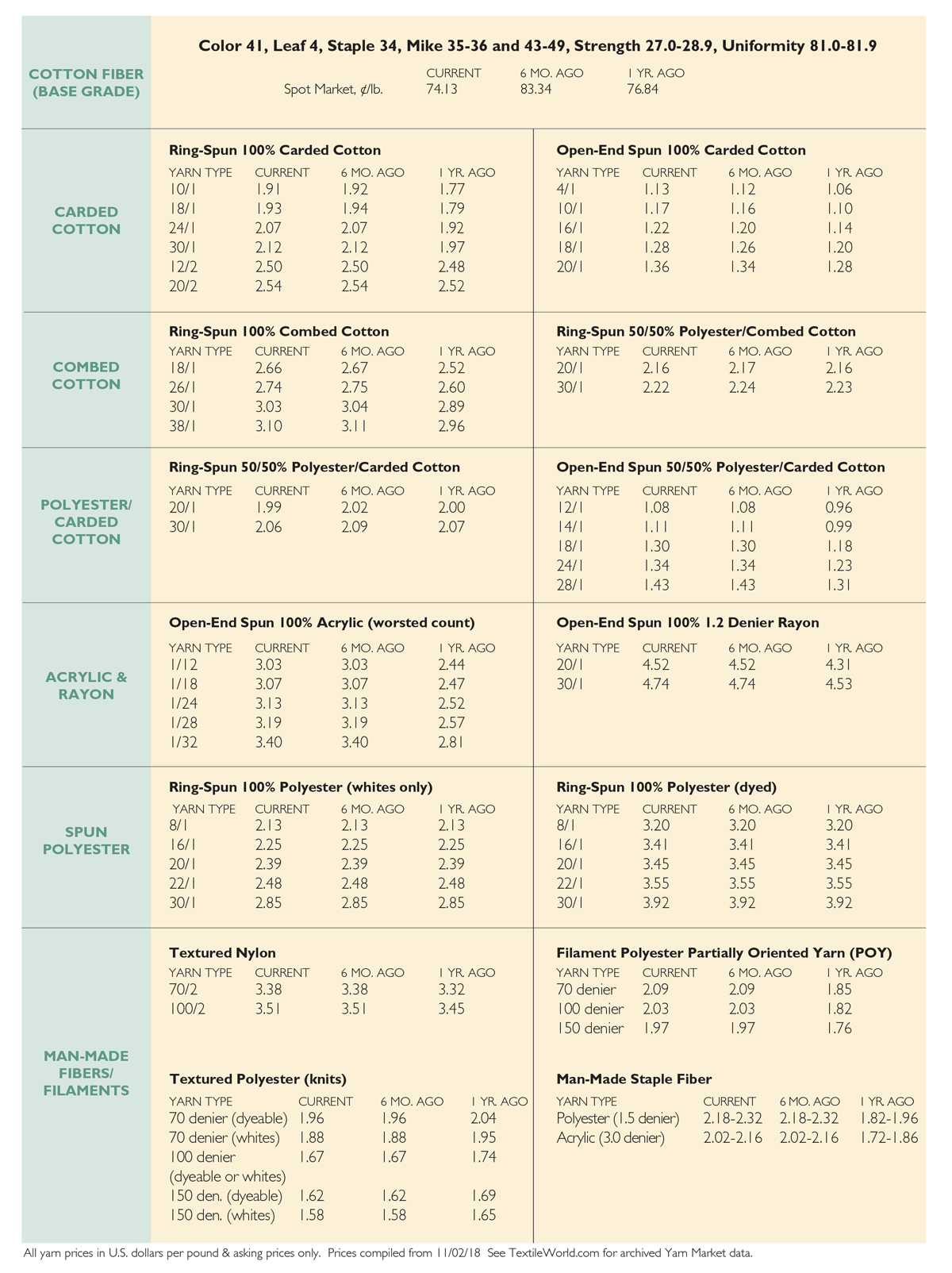
YMpricesND18

November/December 2018

IFAI: New Leadership Focused On The Future

IFAI President and CEO Steve Schiffman

TW Special Report

In April 2018, the Roseville, Minn.-based Industrial Fabrics Association International (IFAI) named Steve Schiffman, the association’s then vice president of media and sales, new IFAI president and CEO. Schiffman, with a career history in publishing, joined the staff of IFAI in 2013. Commenting on the announcement, retiring IFAI CEO Mary Hennessy said: “Steve has done a great job for IFAI since joining our team five years ago.

He is earnest and determined, and I have complete confidence in his abilities. I know he will be a strong and thoughtful leader.”

Following IFAI Expo 2018 in Dallas, Textile World editors spent a moment with Schiffman to gain insight into the association and his new leadership role.

TW: Congratulations on your new position with IFAI. What are your initial impressions of the organization?

Schiffman: Thank you very much. I’ve been here a while and had the opportunity to experience most areas of the association through my various responsibilities. My transition has been seamless so far for a variety of reasons. Mary was gracious with her time helping me get up to speed, the board has been very supportive, and the staff has adapted well and embraced the change. We have a great team who really cares about our members and want to contribute to their success.

TW: With your background in publishing coupled with IFAI’s multiple publications, how important are the publications to the association and its divisions?

Schiffman: We have strong media brands, starting with our flagship Specialty Fabrics Review. Each of our division-specific publications are also strong in each of their market segments. Our editorial team works with our division members and staff to identify important subjects to feature. Our print publications remain viable, relevant and frequently referenced as the most important member benefit. Our readers tell us that our content is valuable and over the past few years we’ve created brand extensions for all our print publications including monthly and twice monthly e-newsletters, custom content and, of course, our websites.

TW: What are the benefits of IFAI membership?

Schiffman: We have core member benefits that have remained constant over the years including a subscription to Specialty Fabrics Review and a division specific magazine, if applicable; access to InfoCentral, a fabric and product sourcing guide; a variety of educational offerings including access to educational video content; and free listings in our magazines and discounts for events, workshops, job postings in the Textile Career Center, e-store purchases, business services, and more. Suppliers also receive discounts on print advertising and exhibit space at both IFAI Expo and our Geosynthetics Conferences.

We’ve recently offered a new Energy Savings Program where members can save money on electricity and natural gas. We also are hoping to launch two other new benefits soon — the Textile Industry Retirement Plan and Textile Industry Health Plan.

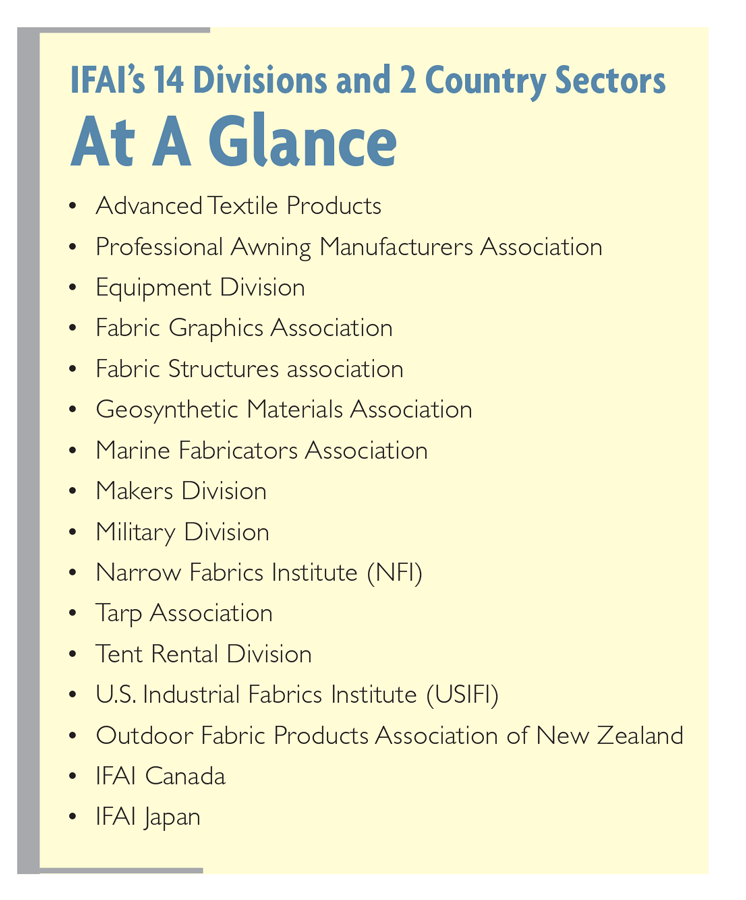
IFAITable1TW: Many TW readers are familiar with IFAI Expo, but please expand on other events that are central to IFAI’s mission.

Schiffman: Our next largest event after IFAI Expo is our Geosynthetics Conference which is now produced annually. Our division events include Marine Fabricator Conference; Tent Expo/ Tent Conference, which alternates each year; Outlook Conference; Smart Fabrics Summit; and our newest event launch, Women in Textiles Summit.

TW: With IFAI Expo in Dallas now a wrap, what trends did you take away?

Schiffman: I think the overarching takeaways were that companies are embracing technology and automation, reimagining business practices and innovating to prepare for the future. As customer needs continue to evolve, their expectations of customized products will continue to increase, and companies want to be prepared to meet those needs.

TW: What is your perception of the health of the industrial fabrics industry, and what are its biggest challenges?

Schiffman: I think the Specialty Fabrics and Technical Textiles industries continue to be strong. The feedback I received after speaking to many companies at IFAI Expo is that things are good right now. Early 2018 weather issues slowed sales for a while, but they bounced back as the weather improved. Finding trained sewers continues to be a challenge for many companies. The current tariffs remain a concern at different levels for different companies which makes longer term business planning more challenging.

TW: How important is member education to the IFAI mission and what forms does education take?

Schiffman: Member education is central to our mission. We produce a significant amount of content across a variety of different channels to help our members grow and prosper. Education used to be limited to our publications and events. Over the past few years we’ve launched educational webinars in most of our divisions that allow members to listen to content designed to help them succeed, either live or later on-demand. We also believe there is an opportunity to bring education to members through hands-on workshops. Our Video Technical Library has just scratched the surface of providing educational videos members can use to educate their employees and we’re in the planning stages of developing podcasts to make it easier for members to access our content anytime from anywhere. In April 2019, we will try something new in how we deliver education by launching the Smart Fabrics Virtual Summit, a full day of programming available online, in cooperation with the U.S. Department of Commerce.

TW: Looking forward, what do you think are the biggest challenges facing IFAI members? What about opportunities?

Schiffman: In our 2018 Membership Survey our members told us that their biggest challenge is finding qualified employees. We’ve always worked to provide resources for education and training through IFAI Expo, our Makers Division and magazines. Most recently we’ve added to those efforts with our new Textile Career Center, Technical Video Library, Small Business Center and an increasingly robust webinar schedule. I think the opportunities are in leveraging automation and innovation to help create efficiencies and better meet customer demands.

TW: What does the future look like for IFAI?

Schiffman: I’m excited about the future of IFAI. Even though member satisfaction is at an all-time high we’re constantly trying to improve and identify ways to enhance member value and return on their investment. That said, we’re not without challenges. We’re working to create a better understanding of IFAI Expo and how it’s part of a member driven trade association providing value to members every single day of the year. You’d be surprised at how many people don’t make that connection, so we must help them get there. We’ve added staff to our marketing department and we’re aggressively working to drive Expo attendance and membership by expanding our reach and marketing strategies to new markets where IFAI can provide value. We’re also interested in more collaboration with similar associations, events and other partners to the benefit of our members and the industries we serve.

November/December 2018

Sponsors