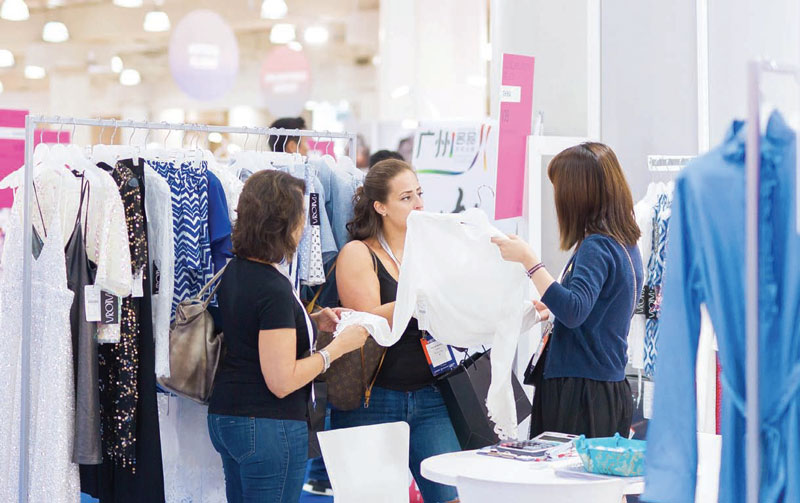
Collocated fabric, sourcing and home textiles shows will also feature new Fashionsustain conference this July.
TW Special Report
Texworld USA — along with Apparel Sourcing USA and the Home Textiles Sourcing Expo — will be held July 22-24, 2019. This summer, the events move up to the main exhibition level at the at the Javits Convention Center, New York City.
Texworld — produced by Atlanta-based Messe Frankfurt Inc. in partnership with Austria-based Lenzing AG — is based on sister show Texworld held in Paris and is designed to connect fabric manufacturers with top buyers.
Also produced by Messe Frankfurt, Apparel Sourcing USA is a marketplace dedicated to sourcing international manufacturing services. The show provides apparel brands, retailers, wholesalers and independent design companies a place to connect with international apparel manufacturers.
Home Textiles Sourcing Expo — produced by Messe Frankfurt in partnership with the China Council for the Promotion of International Trade (CCPIT-TEX) — offers manufacturers, retailers, jobbers, converters, contract specifiers and designers a venue to source fabrics and finished soft goods for home collections and applications.
According to organizers, the collocated events are sure to offer a one-stop shop for textile buyers, independent designers, fabric sourcing professionals and other industry people with an interest in apparel fabric sourcing, apparel design, trends, industry education, and manufacturing/private label development services.
Texworld USA, Apparel Sourcing USA and Home Textiles Sourcing Summer 2018 featured 837 exhibitors representing 19 countries and over 5,000 visitors. Similar participation is expected this July.
New For Summer 2019
This summer, Messe Frankfurt is also excited to offer Fashionsustain, a brand new one-day sustainability conference that was established in Berlin. The event, which will be held on July 22, aims to show how collaboration, new technologies and sustainability can lead to applied innovation.
Texworld USA
As an international business platform, Texworld USA offers a huge selection of quality and affordable fabrics covering the entire spectrum — from on-trend fabrics, and sustainable and eco-friendly fabrics to innovative performance fabrics — as well as trims and accessories from trusted suppliers from all over the globe. Exhibits will be organized into 16 product groups: Cotton; Denim; Embroidery/Lace; Faux Fur; Findings, Trims & Accessories; Functional Fabrics; Jacquard; Knits; Linens; Novelties; Prints; Shirting; Silk; Silky Aspects; Wool; and Yarns.
Highlights at the July 2019 event include a Texworld Showcase Trend area showcasing Autumn/Winter 2020-21 trends compiled by Texworld’s Art Directors — Louis Gérin and Grégory Lamaud; Textile Talks on the show floor featuring discussions led by industry experts; and the Explore the Floor series with expert-led guided tours of the show floors.
The schedule for the complimentary Lenzing Innovation Seminar Series will soon be published online at the Texworld website. Seminars are first-come, first-served.
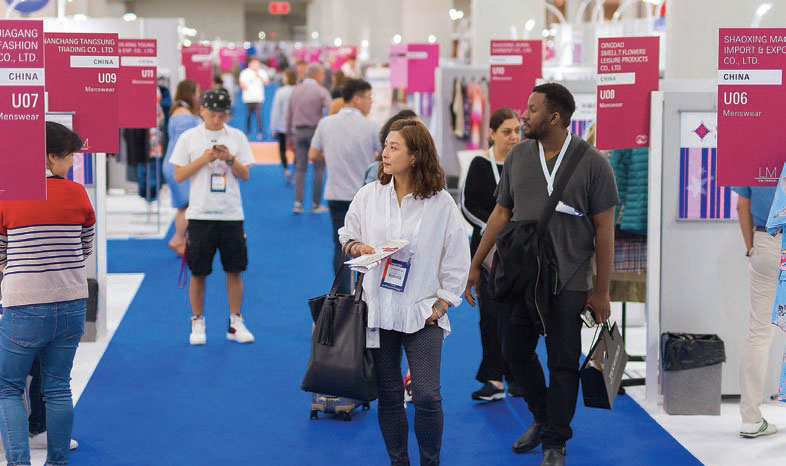
“Texworld USA consistently delivers an incredible show bringing the global textile and apparel companies to New York City,” said Tricia Carey, global business development, Lenzing Fibers. “Our collaboration of the Lenzing Seminar Series supports exchange of new ideas around design, sourcing, and sustainability.”
Apparel Sourcing USA/ Home Textiles Sourcing Expo
Exhibitors at Apparel Sourcing USA are organized into eight end-user groups as follows: Activewear, Childrens/Infantwear, Juniors, Ladieswear, Bridal/Special Occasion/Cocktail, Menswear, Sportswear, and Swimwear/Lingerie.
Products from international suppliers at Home Textiles Sourcing are grouped into six major categories:
Bed – including bed linens, bedding, quilts, throws and decorative cushions;
Bath — including bath textiles and accessories;
Table — including kitchen linens, table coverings and table decorations;
Floor — including carpets and rugs;
Window — including decorative fabrics, curtains and textile curtain accessories; and
Upholstery — including upholstery fabrics and decorative cushions.
Items in each category are made using a variety of fabrics and/or components.
Home Textiles Sourcing and Apparel Sourcing USA visitors also are welcome to attend the Lenzing Innovation Seminar Series.
“An opportunity to explore and interact with the hundreds of companies exhibiting in our new, expansive hall at the Javits Center, we are excited to spotlight a wide range of sustainable fabrics, trims and accessories,” stated Jennifer Bacon, show director, Texworld USA. “Consumers are increasingly concerned with social and environmental causes and when it comes to the textile industry, the number of designers and brands seeking sustainable materials is growing exponentially. Our platform is making it easier for buyers to connect and locate these fabrics on the show floor. Additionally, we are elevating our commitment through the educational programming, with an enhanced focus on sustainability in the Textile Talks, Lenzing Seminar Series and the new co-location of Berlin’s highly acclaimed, one day conference, Fashionsustain.”
Admission to the collocated events is free for qualifying trade show visitors. Guests may register online prior to the event, or on-site using photo identification and a business card. Exhibit halls are open on July 22 and 23 from 10 a.m. until 6 p.m., and on July 24 from 10 a.m. until 4 p.m.
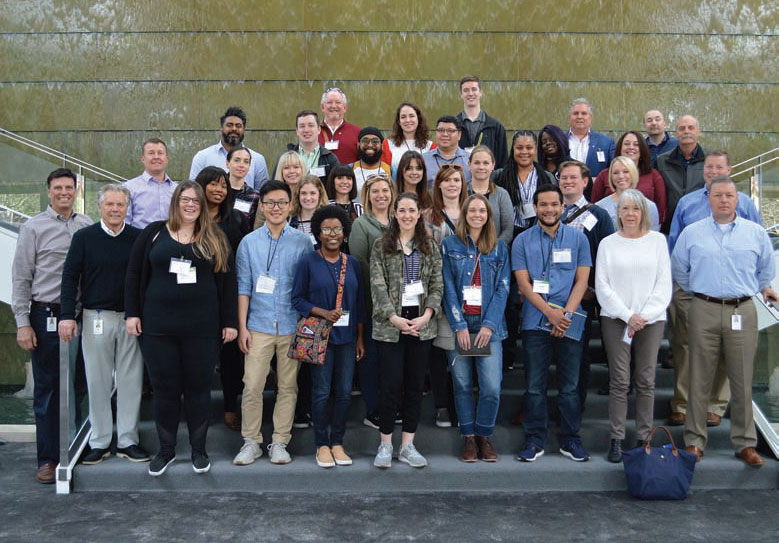
Milliken executives with AAPN’s Mike Todaro and Sue Strickland and the 2019 AAPN Carolina Mill Tour participants.
AAPN’s 2019 Carolina Mill Tour educated participants and highlighted the capabilities of seven Carolinas-based mills.
By Rachael S. Davis, Executive Editor
Pulling off the Carolina Mill Tour is no easy feat for the Atlanta-based American Apparel Producers’ Network (AAPN). The logistics and transportation required for the event take countless hours of planning, but for the past two years — with the assistance of participating mills — AAPN has made it happen.
Established in 2018, the idea for the tour originated with Ron Roach, president, Contempora Fabrics, Lumberton, N.C. (see sidebar). Over the course of five full days, the 2019 tour took 24 participants — who source fabric, production or trim directly for a brand/retailer — to seven mills located in North and South Carolina (see box) to learn first-hand about production methods and capabilities that exist in the Carolinas. The tour even threw in a regional AAPN meeting in Charlotte one morning, so participants also got to experience a regional AAPN meeting — one that featured VF Corp. Vice President Thomas A. Glaser.
Participants in the 2019 mill tour came from companies including PVH Corp.; Jockey International; Dick’s Sporting Goods; Fanatics; Tegra; VF Workwear; Haggar; and the U.S. Air Force Uniform Office.
Speaking of the 2019 mill tour participants, AAPN Managing Director Mike Todaro said: “We were delighted to have 24 people from 12 organizations, especially since 16 of those touring were women. This dovetails into our new AAPN (Women) initiative. These young people want to take new skills back to work. They come expecting to learn textiles, but what they also take away is knowledge that others share their profession and that there is a network of them as well.”
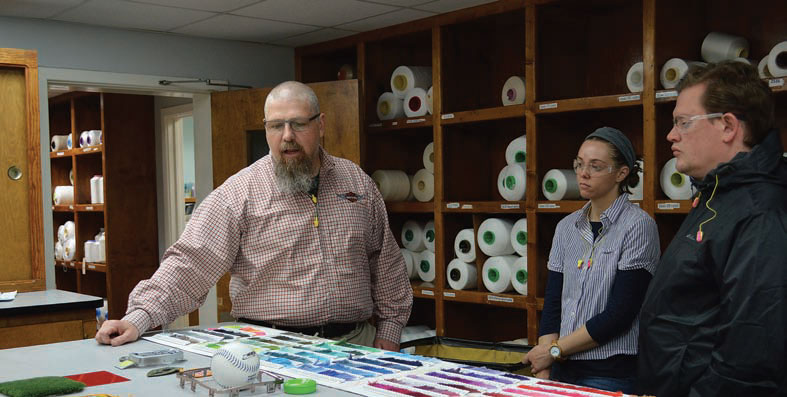
(left to right): Malcolm Mize, assistant plant manager, dyeing and finishing, A&E, explains the company’s color matching process to Miranda Tidwell, materials developer, VF Workwear; and Specialty Designer J. Aaron Needles, Air Force Uniform Office.
Learning Opportunities
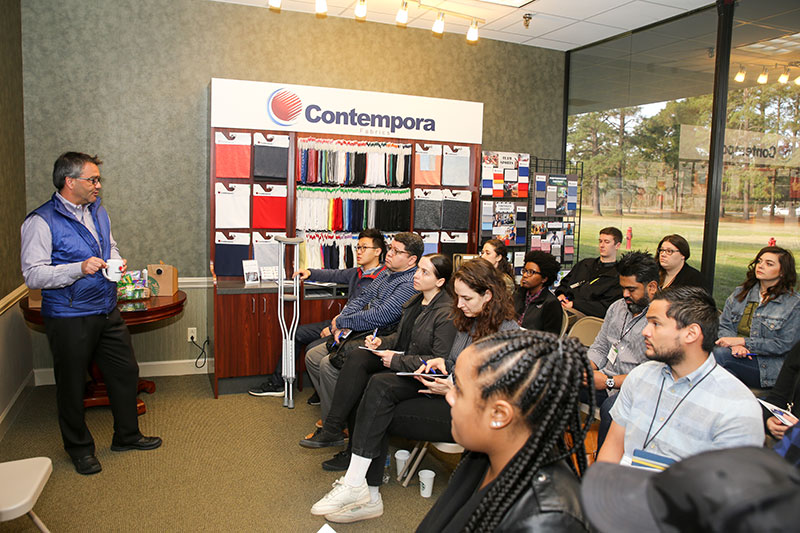
Each participating mill had the chance to showcase their capabilities, and was asked to offer insightful tours with education thrown in. American & Efird’s U.S. Global Retail Solutions Manager Bo Graham presented an interactive short course on different threads and when and how it makes sense to use them. The presentation was coupled with a tour of A&E’s Mount Holly dyeing and finishing facility.
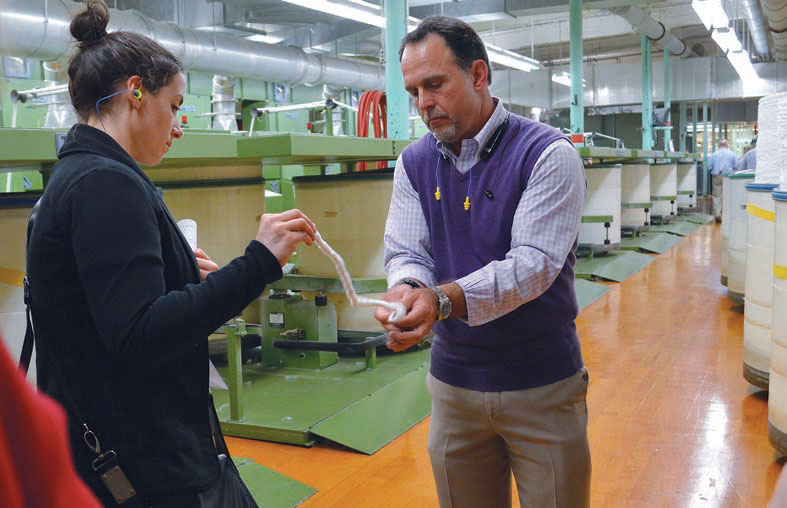
Jim Hopkins, director of sales, Hamrick Mills, demonstrated how twist turns sliver into a yarn with assistance from Dorota Arcentales, fabric manager, PVH Corp.
Hamrick Mills’ Director of Sales Jim Hopkins gave an entertaining, but insightful look into textile terms common to spinning and weaving — for example, in the textile world, sliver is not a term used to describe something that seeps out of the corner of one’s mouth while sleeping; and drawing is not something performed using a pencil and paper — before participants saw first-hand Hamrick’s spinning and weaving capabilities on a lengthy and informative tour.
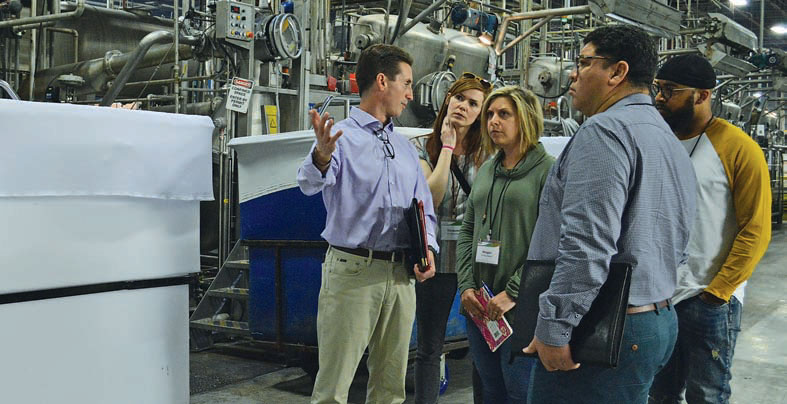
Stacey Bridges, vice president of sales, CCW, discussed a variety of dyeing and finishing processes in-depth with tour attendees before the group saw the technologies live and in action on the CCW plant floor.
Positive Reactions
Feedback regarding the 2019 tour was positive from both participating mills and tour attendees.
Stacey Bridges (left), vice president of sales, Carolina Cotton Works, explained the company’s dyeing capabilities in detail.
CCW was a second-time participant in the tour. “CCW had the opportunity to teach sourcing managers about dyeing and finishing knit and woven fabrics through the AAPN Carolina Mill Tour,” Bridges said. This opportunity allows us to not only show our plant, but also to teach sourcing managers in detail about dyeing different fibers and fabrics. The more sourcing managers know about the fabrics they purchase, the more this will help them speed up fabric development and reduce problems in production. It also gives CCW an opportunity to not only become a vendor, but a true partner with customers.”
“The Carolina Mill Tour provides us with the valuable opportunity of interacting with industry partners and showcasing A&E’s advanced thread technology and commitment to sustainable products and business practices,” said Robert Hallet, vice president, Global Retail Solutions, A&E — also a second-time participant in the tour. “We believe the week’s learning experience has been invaluable to both the host companies and the mill tour participants.”
“We at Hamrick Mills are very proud to be members of the AAPN and take great pride in participating in this event,” Hopkins said. “We are very pleased to be able to impart some knowledge of our company and of our product capabilities to this group of industry representatives from the downstream supply chain. Our belief is that the information gained from this event will benefit us in the long term.”
“The 2019 Carolina Tour was even better than 2018,” said Contempora’s Roach. “We had a younger group this year that was so eager to learn everything. This was the exact group that we are targeting. The participants all realized how passionate we are about our business and how eager we are to help them learn. One person said that they felt as if Contempora was investing in them, better equipping them for their own careers. That statement tells me we achieved our goals.”
“I found the tour to be both educational and insightful,” said Dilshan De Silva, senior manager, western hemisphere sourcing, global communications and product integrity, Jockey International Inc. “Not only do we take away a great deal of knowledge, we also take away a network of suppliers and possibilities within U.S./Western Hemisphere region.”
Parkdale’s Duke Kimbrell open-end yarn spinning plant was a featured mill on the tour.
Dorota Arcentales, fabric manager with PVH Corp., reported that not only did she learn a lot about textile manufacturing, but she also learned an invaluable lesson about the textile industry in the Carolinas. “I learned quite a variety of things on this tour — yet the most important ones aren’t exactly what I had anticipated,” Arcentales said. “Yes, I learned a great deal about textiles and the processes involved. Yes, I learned a lot about the industry from the hands-on tours and not-usually granted access to the plants we visited. Yet the greatest a-ha moment was with the tour group itself because it brought together people from all over the western hemisphere. We shared insights, talked about our experiences and formed new contacts.
“Being a self-centered New Yorker, my idea of fashion and the textile world always revolved around the notion that this industry is centered around sanctuary cities, like New York City or Los Angeles,” Arcentales continued. “All of a sudden, I discovered there’s a whole other world across the United States and Central/South America. I met professionals from Texas, Tennessee, Oklahoma, Ohio, Wisconsin, Oregon and Nicaragua. I’ve seen mills and dyehouses in the Carolinas that aren’t just thriving, they are proactively evolving — and much more rapidly than those who don’t travel within the U.S. region. This tour not only taught me about textiles; it expanded my world view and helped me visualize the progressive future of this industry, on the Western Hemisphere.
AAPN was happy with the feedback about the 2019 Carolina Mill Tour and aims to make the tour even better next year. “We adjusted this year‘s tour based on last year’s feedback, and will do the same for 2020,” Todaro said. “No-one is working harder to raise the ‘Apparel IQ’ of the industry than the board of directors of the AAPN. While so many others work with college students, we‘re the only ones working to help those who have the jobs now but lack the investment in their careers. Now we offer their companies a new way to learn, network, experience and gain confidence in this industry.”
Ron Roach (far right) explains the knitting process
The Idea That Started It All
Contempora’s management team has more than 250 years of combined experience in circular knits. I wanted to be able to transfer that knowledge and experience to our customers in a true manufacturing environment. There are so many young people at all levels working for brands and retailers that we felt could really benefit from a classroom-like experience.
So we created workshops that dove deep into fabric analysis, the inner workings of a knitting machine as well as all aspects of quality issues including root causes and solutions. Adding the rest of the supply chain companies in allows participants to get a week-long education of virtually every aspect of textiles. With the help of AAPN, and Mike and Sue, we were able to get this off the ground in 2018 with great success.
The Carolina Tour is all about education. We did not want this to be a fabric show or a trade fair. We wanted to educate in full detail as to how things get made. Hopefully, at the end of the week the participants go home with a better sense of how things get done as well. They see an aspect of a full U.S.-based supply chain in the Carolinas. A supply chain that is willing to trust, and willing to take ownership of inventory to gain speed to market.
We also established a dedicated email address that anyone can use to get any technical questions answered quickly. Not just our customers, but anyone that needs some help or has a question: educate@contempora fabrics.com.
The AAPN has a goal of raising the industry’s “Apparel IQ”, and the Carolina Tour has become one perfect example of these efforts.
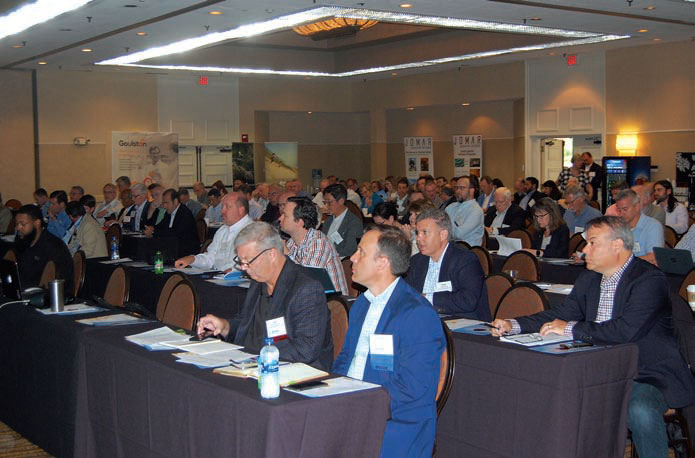
The Arlington, Va.-based Synthetic Yarn and Fabric Association (SYFA) recently held its annual spring conference at the Sheraton Charlotte Airport Hotel in Charlotte. The conference was titled, “A Sustainable Thread,” and featured a wide variety of presentations focused on innovation and sustainability.
Presenters came from such companies as NAPCOR, Polartec, Wells Fargo, Shaw Industries, Supreme Corp., Americas Apparel Producers’ Network, NC State, IFB — formerly Industries for the Blind — Twistechnology, and Indorama Ventures.
Senior Economist at Wells Fargo Mark Vitner presented the current state of the U.S. economy with an overall positive forecast, drawing attention to the importance of a new trade deal with China.
Supreme Corp. CEO Matt Kolmes talked about the use of Volt Smart Yarns in the development of innovative smart fabrics. End uses include fabrics with integrated sensors, bandages with an induced current that enhances healing, and grounded bed sheets.
Also featured was a presentation by Indorama Ventures’ Sustainability Platform Manager Sanjay Mehta, which highlighted the demand to transform the systems associated with polyester recycling. The presentation, entitled “New Horizon For Chemical Recycling,” moved beyond the mechanical processes as Mehta explained new processes that are in development to further chemically capture the polyester monomers in the physical waste discharged from the mechanical recycling processes currently in use.
SYFA secretary and treasurer Alasdair Carmichael, of Florence, Ky.-based NAPCOR, presented “Is There Enough US RPET To Meet Fiber Industry Needs?” Carmichael also led the election of new SYFA Officers and board of directors (see sidebar).
Sponsors for the spring conference included Gold Sponsor Premiere Fibers Inc.; Silver Sponsor Pulcra Chemicals LLC; and Bronze Sponsors Burlington, DAK Americas LLC, Goulston Technologies Inc. and Jomar Softcorp International Inc. Patrons and Exhibitors Sponsors were Clariant Corp., Economic Development Partnership of North Carolina, Milliken & Company, Polyspintex Inc., Techtextil North America, Textile World and Unifi Manufacturing Inc.
SYFA will hold its fall conference November 7-8, 2019, at the Sheraton Charlotte Airport Hotel.
1 of 6
Incoming SYFA President Dan Sistrunk, Milliken & Company
Mike Todaro, Americas Apparel Producers’ Network (AAPN)
(left to right): John Bradshaw, Shaw Industries; David Morano, Polartec; Mark Vitner, Wells Fargo; Matthew Kolmes, Supreme Corp.; Alasdair Carmichael, NAPCOR
INDA reports larger booths, positive feedback and key decision makers in attendance at triennial IDEA® nonwovens and engineered fabrics event.
TW Special Report
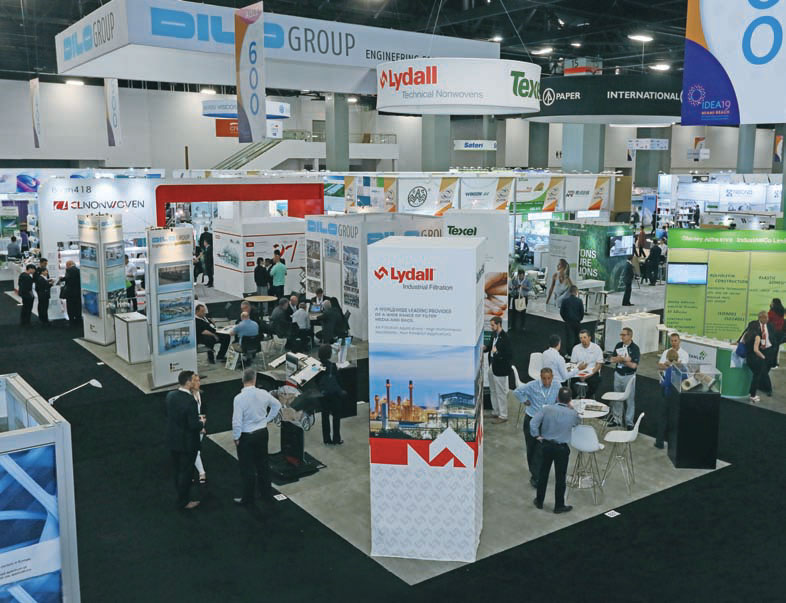
According to show organizer — the Cary, N.C.-based Association of the Nonwoven Fabrics Industry (INDA) — more than 6,500 participants and 509 exhibitors took part in the 2019 edition of IDEA®, the nonwovens and engineered fabrics event. Surprisingly, the final attendee figure came in lower than the number that participated in the last edition of the show held in Boston. Most had expected the figures to be higher given the show’s return to its usual Miami location and the fast-growing nature of the nonwovens industry. Theories abound to explain the visitor numbers, but most likely, the packed show calendar was mostly to blame. In a year with many major trade shows in a short space of time, both exhibitors and visitors have to consider time and budgets when choosing shows. Certainly, the amazing warm and sunny weather, and Miami Beach location did not serve as a detractor.
Regardless, INDA was happy with the show numbers and the quality of attendees. “IDEA provided exceptionally strong metrics in leadership presence this year,” said Dave Rousse, president, INDA. “The event attracted a high level of key decision makers, a testimonial to the show’s importance within the international nonwovens and engineered fabrics industry.”
INDA President Dave Rousse (center, holding scissors), led a ribbon cutting ceremony — that was attended by leaders from the global nonwovens industry associations — to open IDEA®2019 as it returned to its usual Miami Beach Convention Center location.
INDA also noted that exhibitors broke a show record occupying 168,600 square feet of exhibit space, which represented a 9-percent increase over the 2016 show. INDA reported that, “… industry participants expressed their business confidence through larger exhibition booths.”
INDA used the trade show to celebrate its 50th anniversary. An opening-night reception attracted some 500 people who enjoyed food, drinks and music, as well as a slide show highlighting events and milestones from 1968, the year the organization was founded. Pierre Wiertz, general manager, Belgium-based EDANA, the international association for the nonwovens and related industries; and Lingshen Li, president, China Nonwovens and Industrial Textiles Association, presented Rousse with anniversary gifts to thank INDA for its support and collaboration over the years.
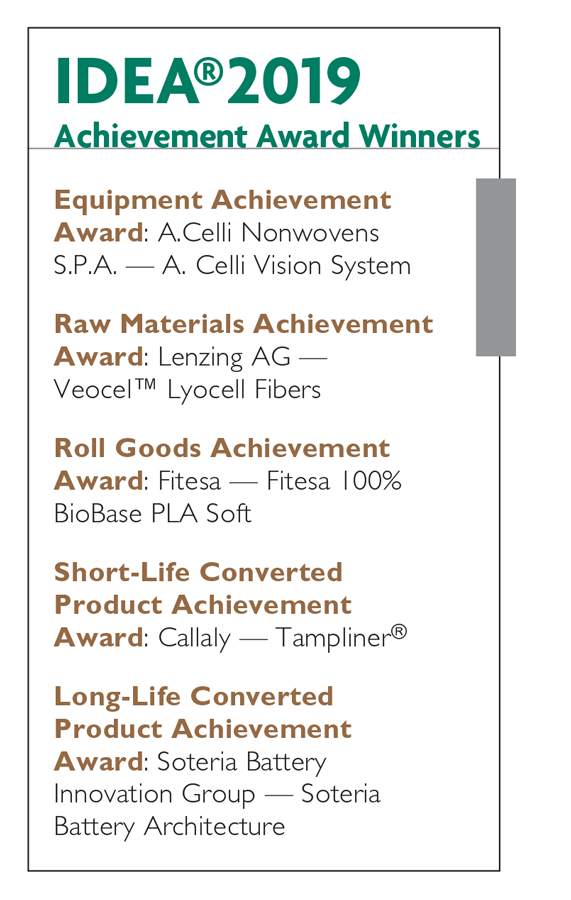
IDEA2019 featured seven new nonwovens training classes; market presentations from China, Asia, Europe, North America and South America; and industry recognitions with the IDEA Achievement Awards (see box), the IDEA Lifetime Achievement Award, and the IDEA Entrepreneurial Achievement Award.
This year’s recipient of the Lifetime Achievement Award was Robert Julius, president, Nice-Pak Products Inc., Orangeburg, N.Y., who was recognized for “his lifetime commitment to research, quality, innovation and service.” P&G Venture Labs was the recipient of the IDEA2019 Entrepreneurial Achievement Award. The company was recognized for its overall contributions in helping adults perform daily self-care activities and preserving dignity and independence rather than winning for one specific product invention.
More than 260 attendees also participated in INDA’s short course and training options available for the first time at IDEA. Training was offered in nonwovens basics, wet wipes, absorbent hygiene and filter media.
Exhibitors interviewed were happy with the show overall. “The IDEA show was a good show for Tietex,” said Martin Wildeman, chairman/ CEO, Tietex International Ltd. “We had better than expected traffic and made some good new contacts. We intend to exhibit again in the future.”
“I thought he overall ambience was very good, and much better than three years ago in Boston,” said Stefan Engel, CEO, American Truetzschler Inc. “The weather and the Miami ambience made this show very pleasant. It offered plenty of customer entertainment possibilities. We saw a great number of visitors, and the first two days were packed with meetings although the last day was slow. I saw a great number of international visitors, and noticed a larger Asian presence of both visitors and exhibitors than previous shows.”
“It was great to be back in Miami Beach in a fully modernized convention center,” said Dave Rousse, president, INDA. “We received great support for our 50th Anniversary Reception which confirmed INDA’s continued value to the nonwovens industry. Exhibitors reported high quality attendees and meetings where much new business was done. Our new ‘Short Courses’ in various nonwoven topics were well attended. All in, a great event for INDA and for the global nonwovens industry.”
The triennial event returns to the Miami Beach Convention Center March 28-31, 2022.
IDEA® Gathers Nonwovens Association Leaders From Around The Globe
During IDEA®2019, INDA hosted a strategy meeting with leaders from the global nonwovens industry associations. The meeting was designed to tackle two key issues currently impacting the global nonwovens industry — free and fair trade in nonwovens, and the growing concern about the impact of plastics on the environment.
The International Organization for Standardization (ISO) recently published an updated and uniform definition for nonwovens, which introduces the concept engineered material without reference to “textiles.” ISO 9092:2019 defines a nonwoven as an “engineered fibrous assembly, primarily planar, which has been given a designed level of structural integrity by physical and/or chemical means, excluding weaving, knitting or papermaking.”
INDA believes this new definition is a first step in advancing free and fair trade in nonwovens.
During the meeting, attendees agreed to encourage adoption and use of the ISO definition in the Harmonized Commodity Description and Coding System to ensure nonwovens and nonwoven products are considered in a more relevant way for tariff classification purposes.
When discussing the plastics concerns, INDA presented an overview of public concern about plastics may impact nonwovens and what the industry can do to manage the issue. Belgium-based EDANA, the international association for the nonwovens and related industries, spoke about the European Union Single Use Plastics Directive and the development of Extended Producers Responsibility.
“The shared vision of our association leaders is to effectively represent, protect, and actively promote common interests of nonwovens and their related industries throughout the world,” said Dave Rousse, INDA president. “I believe our initial steps on these two current issues are a good start toward global coordination.”
In addition to Rousse, the following people participated in the meeting:
Carlos Benatto, president, Brazil Association of the Nonwovens Industries, (ABINT);
Dr. Hiroaki Kanai, chairman, and Hideo Tsuchiya, secretary general (deputy), Asia Nonwoven Fabrics Association (ANFA);
Masato Miki, vice president, All Nippon Nonwovens Association (ANNA);
Li Lingshen, president, and Eric Zhang, general manager, China Nonwovens and Industrial Textiles Association (CNITA);
Yang Xiang, general manager, China Nonwovens Technical Association (CNTA);
Pierre Wiertz, general manager, and Gil Stevens, external relations & sustainability director, EDANA;
Socrates Ng, president, and Michael Wong, secretary, Hong Kong Nonwovens Association;
C.K. Wong, executive committee appointee, INDA;
Samir Gupta, managing director, INDIA Nonwovens Association;
Billy Hidjaja, chairman, Indonesia Nonwovens Association; and
Steven Chen, chairman, Taiwan Nonwovens Association.
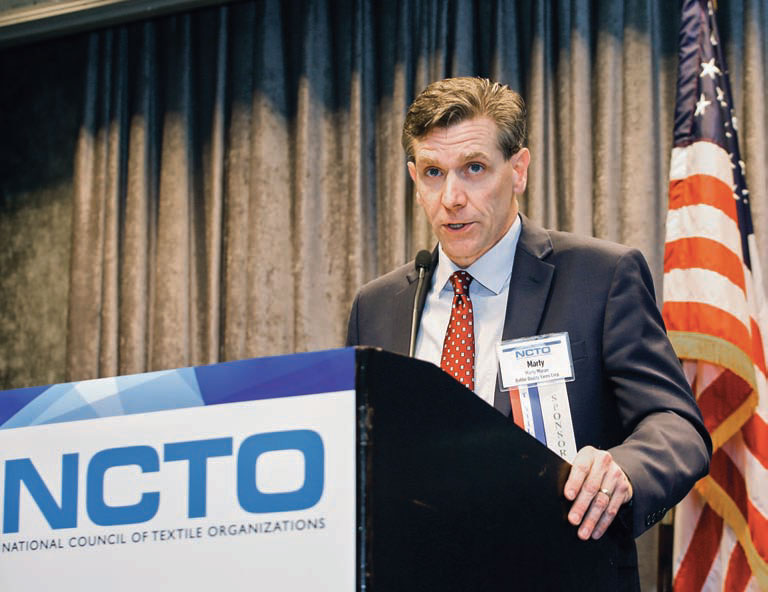
Outgoing Chairman Marty Moran outlined economic, employment and trade data; 2019 priority policies; and other NCTO activities during his “State of the U.S. Textile Industry” address during NCTO’s 16th annual meeting.
By Marty Moran
It has been an amazing year for the U.S. textile industry and the National Council of Textile Organizations (NCTO). President Trump’s pro-manufacturing agenda is forcing Washington to question longstanding norms, forcing the Washington establishment to rethink policies on trade, taxation, regulatory reform and a host of other issues.
The time for change is now and NCTO is committed to working with the Trump administration and our allies in Congress to achieve the best policy outcomes on these and other issues. But before laying out NCTO’s policy agenda, I want to recap how the industry fared in 2018.
The Numbers
Thanks to its productivity, flexibility and innovation, the U.S. textile industry has cemented its position in the global market.
In 2018, the value of U.S. man-made fiber and filament, textile, and apparel shipments totaled an estimated $76.8 billion, this is an uptick from the $73 billion in output in 2017, and an increase of 12 percent since 2009.1
The breakdown of 2018 shipments by industry sector is:2
$30 billion for yarns and fabrics;
$27.4 billion for home furnishings, carpet & other non-apparel sewn products;
$11.6 billion for apparel; and
An estimated $7.7 billion for man-made fibers.
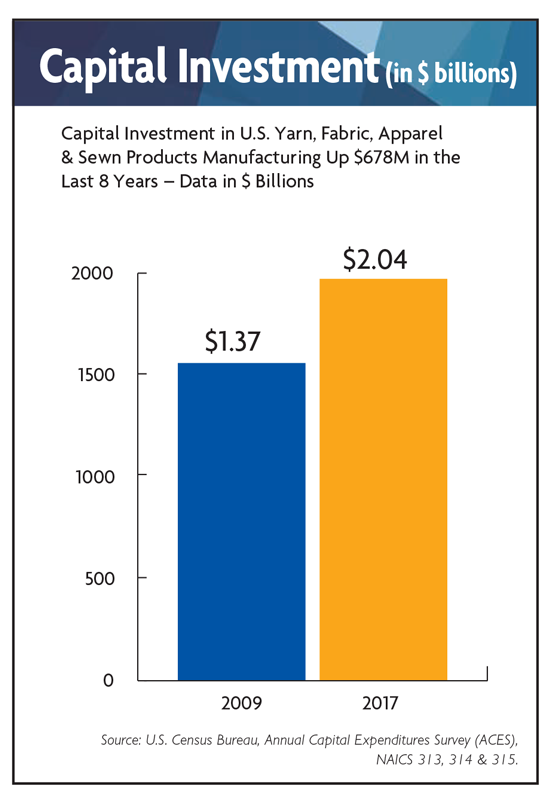
Capital expenditures also are healthy. Investment in fiber, yarn, fabric, and other non-apparel textile product manufacturing is up 79 percent from $960 million in 2009 to $1.7 billion in 2018.3
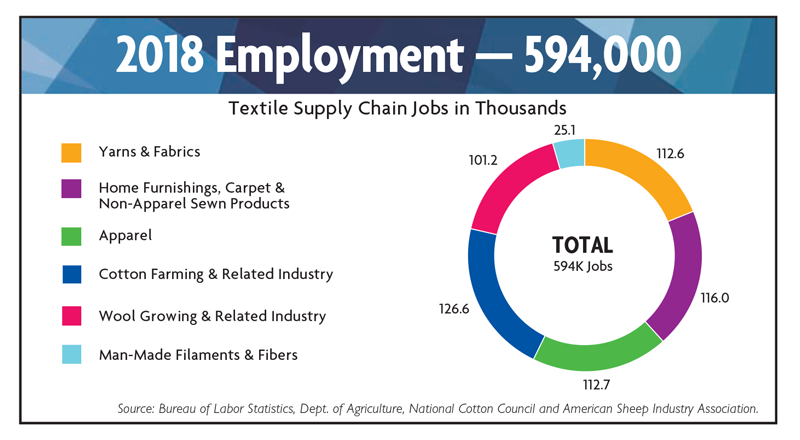
116,042 jobs in home furnishings, carpet, and other non-apparel sewn products;
112,692 jobs in apparel manufacturing;
25,100 jobs in man-made fibers;
126,553 jobs in cotton farming and related industry; and
101,186 jobs in wool growing and related industry.
As we examine these numbers, it is important to note that the heavy job losses incurred because of massive import surges in the 1995-2008 timeframe, virtually have stopped.5 Today, like most other U.S. manufacturing sectors, fluctuations in employment figures are generally due to normal business cycles, new investment, or productivity increases.
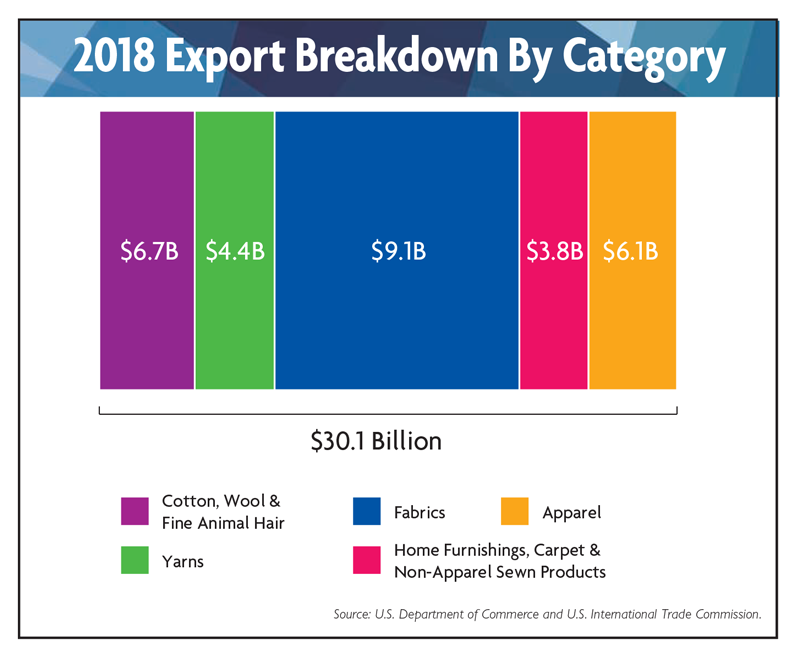
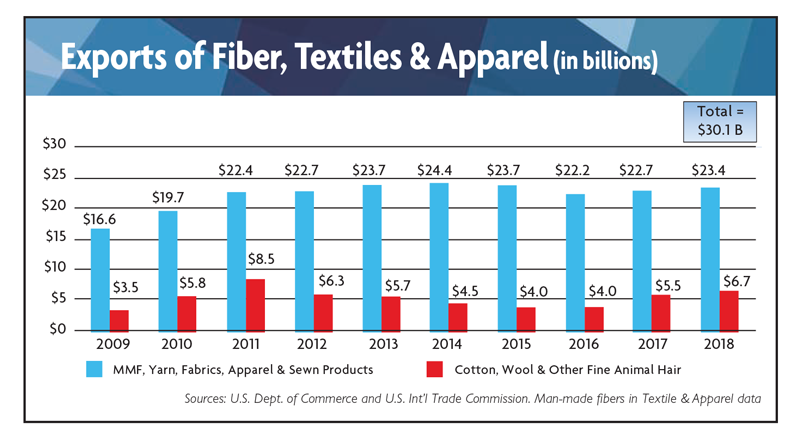
U.S. exports of fiber, yarns, fabrics, made-ups, and apparel were 30.1 billion in 2018.6 This is 5.4 percent increase in export performance over the $28.6 billion figure for 2017. Shipments to NAFTA and CAFTA-DR countries accounted for 47.5 percent of all U.S. textile supply chain exports.
The breakdown of exports by sector is as follows:
$6.7 billion – cotton and wool;
$4.4 billion – yarns;
$9.1 billion – fabrics;
$3.8 billion – home furnishings, carpet & other non-apparel sewn products; and
$6.1 billion – apparel.
The United States is especially well-positioned globally in fiber, yarn, fabric, and non-apparel sewn products markets; it was the world’s 2nd largest individual country exporter of those products in 2018.7
The most important U.S. export markets by region are:8
$11.7 billion – USMCA;
$3.5 billion – CAFTA-DR;
$2.8 billion – Asia;;
$2.7 billion – Europe;; and
$2.8 billion – Rest of World.
Focusing solely on America’s $19.7 billion in manufactured fiber, yarn and fabric exports, the countries buying the most product are:9
$4.4 billion – Mexico;
$2.1 billion – Canada;
$1.6 billion – China;
$1.5 billion – Vietnam; and
$1.4 billion – Honduras.
The numbers show that the fundamentals for the U.S. textile industry are sound. This is true even though some markets for U.S. textiles and apparel were soft last year. For the most part, any sluggishness was due to factors beyond control, such as disruption in the retail sector caused by the shifting of sales from brick-and-mortar outlets to the internet. With that said, the U.S. textile industry’s commitment to capital re-investment, and a continued emphasis on quality and innovation make it well-positioned to adapt to market changes and take advantage of opportunities as 2019 moves along.
Policy Issues
For decades, U.S. policy systematically undervalued the importance of domestic manufacturing, and President Trump is right that this has hurt America.
Consequently, NCTO fully endorses President Trump’s macro policy objectives of reshoring industry, fighting for free, but fair trade, enforcing U.S. trade laws, making the U.S. tax code more competitive, buying American, cutting unnecessary regulation, revitalizing infrastructure, ensuring cheap energy, and fixing health care.
On trade, NCTO agrees with President Trump that U.S. trading relationships must be rooted in fairness and reciprocity to benefit a broad swath of American society.
America’s most important trading relationship is NAFTA, a pillar upon which the U.S.-Western Hemisphere textile supply chain is built. At $11.7 billion combined, Mexico and Canada are the U.S. textile industry’s largest export markets. Moreover, Mexico provides vital garment assembly capacity that the United States lacks at this time.
While strongly supporting the free-trade structure established under NAFTA, NCTO also firmly agreed with President Trump’s desire to improve the terms of the original agreement. Specifically, NCTO advocated for the following improvements as part of the NAFTA renewal negotiation:
Maintain yarn forward as the fundament rule-of-origin for our sector;
Require use of NAFTA-origin components beyond the “essential character” of the fabric, i.e. sewing thread, pocketing & narrow elastics;
Strengthen buy American laws for Department of Homeland Security textiles & clothing by closing the Kissell Amendment loophole for Canada & Mexico; and
Strengthen customs enforcement.
We are pleased that the majority of our stated objectives were accomplished in the agreement reached between the parties late last year under what has come to be known as the United States-Mexico-Canada Agreement (USMCA). Especially the fact that the basic yarn forward rule was preserved as the origin requirement for duty-free treatment.
In addition, the USMCA represents a demonstrative improvement for U.S. manufacturers of component parts such as thread, pocketing, narrow elastics, and coated fabrics. These items will have stronger origin requirements under the new agreement that will certainly boost sales to North American customers.
The USMCA will also close the Kissell loophole for Transportation Security Administration contracts. This new requirement will make it impossible for TSA prime contractors to replace U.S. textile inputs with competitive materials made in Mexico.
We are also pleased that enhanced customs enforcement language, specifically for textiles, was included as part of the new terms. This language will require various customs activities designed to address the unique challenges associated with textile-related customs fraud.
While the goal of complete elimination of the NAFTA TPL system was not achieved, the new agreement is better than the existing NAFTA in this area, also. A number of the NAFTA TPLs will experience a reduction from their current levels. Especially in the case of Canada, some of these reductions are sizable.
Finally, there is an important fundamental objective that was achieved with the finalization of an agreement between the three countries. When the United States first announced its intention to renegotiate NAFTA, there was overwhelming input from NCTO members that a dismantling of NAFTA, or a significant dilution of the yarn-forward rule of origin, would be disastrous. These fears were driven by the critical need to preserve the nearly $12 billion in current U.S. textile exports to our NAFTA partners. With the conclusion of a successful negotiation, these fears have now largely abated.
The achievement of these goals has led NCTO to formally endorse USMCA and to ask our congressional representatives to vote for its adoption this year.
The Trump administration’s Section 301 trade case against China’s intellectual property abuses is another issue that has seen a high degree of activity over the past year. In response to China’s trade-distorting practices, the United States has imposed penalty tariffs on three tranches, or groupings, of products to date targeting a total of $250 billion in U.S. imports from China. While NCTO is highly supportive of the initiation of a 301 case against China and we applaud the President for finally tackling China’s illegal trade practices, some products selected have negatively impacted our membership. Examples include dyes and chemicals used in the textile manufacturing process, which have resulted in increased production costs.
Overall, the vast majority of products identified for penalty tariffs in our sector have been inputs, and we think that a major opportunity is being missed by this approach. Throughout the process, NCTO has consistently pressed for a more precise and refined approach involving finished products as opposed to manufacturing inputs. Selecting finished goods, which generally contain 100-percent Chinese fiber, yarn and fabric components, would create benefits throughout the U.S. supply chain. Further, end items — specifically apparel and home furnishings — are the root of our sector’s problem with China. As a result, we feel that the targeting of finished products would dramatically improve the chances of bringing about serious reforms. NCTO will continue to make this case and engage heavily in the 301 process.
Beyond these issues, NCTO has already begun engagement with the Trump Administration in relation to its intention to negotiate new free trade agreements with the following:
The European Union;
The United Kingdom; and
Japan.
We welcome the opportunity to gain greater access to these important overseas markets. Reducing tariff and non-tariff barriers will help put U.S. textile manufacturers on a much more even footing than we may currently enjoy with some these trading partners.
With that said, the rules for determining duty free privileges must be consistent with our existing free trade agreements. To that end, the United States government should insist on the following fundamental aspects in these negotiations:
Establishment of a strong yarn forward rule of origin;
Extended duty phase-outs, where warranted, for products deemed to be sensitive; and
Inclusion of effective and separate customs textile enforcement language.
As for any new trade negotiations, beyond those announced by the Trump Administration, NCTO supports President Trump’s preference for individual bilateral free trade agreements (FTAs) over multilateral arrangements. Moreover, any new FTA targets should be limited to countries that trade in a fair, reciprocal manner. NCTO would oppose any FTAs with non-market economy countries like China and Vietnam because of the unfair advantages that producers in those countries derive from their state-run economies.
Beyond the actual negotiation of trade agreements, NCTO welcomes President Trump’s view that U.S. has made a mistake by not prioritizing trade enforcement in recent years.
As such, NCTO has worked to ensure that textiles be designated a Priority Trade Issue by Congress, recognizing the fact that textile and apparel shipments comprise more than 40 percent of all duties collected by Customs and Border Protection (CBP). Noting that the U.S. collected over $13 billion in textile and apparel tariffs in 2018, there exists tremendous incentive to circumvent customs laws in our sector.
Working with key members of Congress, such as Representative Patrick McHenry of North Carolina and former Representative Trey Gowdy of South Carolina, this past June a meeting with CBP Commissioner Kevin McAleenan was constructed to review textile enforcement activities. Follow-up meetings were also held CBP Executive Assistant Commissioner Brenda Smith, who toured a number of U.S. textile facilities in October of last year. NCTO’s intention as part of this initiative is to press CBP for an enhanced focus on our sector and the assignment of a greater level of resources to specifically address textile customs fraud.
Further, I am pleased that Assistant Commissioner Smith gave a presentation at our meeting yesterday. Her presentation helped to frame the steps that CBP intends to take in order to work more effectively with us as an industry toward improved customs enforcement.
Beyond the policy initiatives already discussed, there remain some additional items that will require our attention in 2019. They include the fact that the Miscellaneous Tariff Bill process will reengage later this year. The International Trade Commission will initiate a vetting process for the renewal of MTBs in October. NCTO members should be prepared to seek MTB treatment on inputs that are not available from a domestic source. Members should also be prepared to oppose MTB requests for items that would undermine your U.S. production and employment. Further, NCTO will be expressing opposition to the inclusion of finished products, noting that they distort the intended premise of providing duty relief on inputs that undergo further processing by U.S. manufacturers.
NCTO is also monitoring and is prepared to oppose various evolving initiatives that are designed to undercut the U.S. tariff structure. These include proposals such as:
Granting duty relief under the Generalized System of Preferences for apparel;
Expanding the use of Section 321 De Minimis duty breaks for importers; and
Eliminating U.S. duties on high-performance outerwear.
With respect to government procurement policy, NCTO steadfastly supports the Berry Amendment. This “buy American” provision for the military is an example of how the government and private sector can work together for mutual benefit. The U.S. military gets a secure U.S. supply line for thousands of superior, highly-advanced products. In return, the domestic textile sector receives $1.5 to $2 billion in annual Defense Department sales that boost U.S. investment and employment.
NCTO is deeply concerned by congressional attacks on the Berry Amendment in recent annual defense bills, including the 2018 National Defense Authorization Act. NCTO urges Congress to reject any proposals to weaken the Berry Amendment, and instead work to strengthen the law.
NCTO also encourages Congress to include textiles in any efforts to enact commonsense laws or regulations that would strengthen “buy American” requirements applying to infrastructure or other federal spending. As demonstrated by Berry, when the federal government buys “American,” it is good for the U.S. textile industry and even better for America.
NCTO urges Congress to follow President Trump’s lead by drafting and passing a comprehensive plan to rebuild America’s infrastructure. Besides boosting U.S. productivity and facilitating commerce, infrastructure is a key market for textile products such as workwear, geosynthetics, and filtration systems.
Fostering a national culture of innovation is also important. NCTO urges continued support for the Advanced Functional Fabrics of America (AFFOA). This Defense Department-funded program is matched three to one with private dollars, and tasked with making it easier to develop and commercialize the next generation of high-performance textiles.
NCTO also calls for the U.S. government to invest in improving automation for garment assembly. This technology shows promising potential to reshore U.S. textile and apparel production and jobs.
Another NCTO priority is ensuring that the U.S. textile industry has uninterrupted access to reasonably priced energy. This is certainly critical to power our facilities in a cost effective and globally competitive fashion. In addition, most man-made fibers are derivatives of petroleum products and many textile producers are reliant on natural gas to power manufacturing operations. Noting this, NCTO supports construction of expanded oil and gas pipeline capacity to keep energy prices low.
Finally, the U.S. textile industry must acknowledge its workforce is aging, making the recruitment of new talent a priority. U.S. companies must continue to forge links with local and state leaders, and educators to make sure government policy nurtures a labor pool both adequate in size and well prepared to succeed in a competitive global economy.
Other NCTO Activities
There were also matters of focus beyond strict policy issues. One year ago, we initiated a merger with the American Fiber Manufacturers Association (AFMA), a fellow trade association representing domestic manufacturers of man-made fiber. I am pleased to report that the merger has been highly successful.
From NCTO’s perspective, the merger with AFMA helped to add new members, financial resources and extend NCTO’s political reach. It also solidified NCTO’s status as the policy voice of every facet of the U.S. textile production chain.
From the perspective of former AFMA members, the merger has preserved a seat at the federal policy table for the multi-billion dollar U.S. man-made fiber sector.
In terms of membership recruitment as a whole, NCTO enjoyed a superlative year. A total of 22 new companies joined NCTO’s membership rolls for the first time. An additional three companies, who were not members in our most recent fiscal year, rejoined NCTO’s membership.
This past year we also continued NCTO’s American Textiles: We Make Amazing™ campaign, which is helping to rebrand the U.S. textile sector’s image. America’s textile industry is world class thanks to leveraging the most cutting-edge production processes, investing in the best machinery, and leading in sustainability and innovation. Our We make Amazing campaign is intent on making sure that policy makers and members of the press have an accurate and positive understanding of the modern U.S. textile industry.
Campaign highlights include:
Launching a new website to promote the U.S. textile industry, Textiles in the News (TIN), textilesinthenews.org, this site is a platform to drive policymakers and opinion leaders to content that rebrands the U.S. textile industry along the American Textiles: We Make Amazing message;
Publishing a fourth edition of Textures, NCTO’s member magazine;
Emailing a weekly news blog, also called Textiles in the News;
Publishing the quarterly NCTO Newsletter;
Posting planned social media on Twitter, Facebook, LinkedIn, and Instagram;
Regular public relations outreach to selected media; and
Generating more than $2 million in earned media coverage.
Judging by the engagement generated by American Textiles: We Make Amazing marketing efforts, more and more people are getting an accurate, positive description of our sector, and as a result, are viewing the U.S. textile industry in a new light.
Conclusion
Although the U.S. textile industry is world-class, it cannot afford to rest. There will always be intense and sometimes unfair competition from abroad, changing consumer demands and inevitable economic downturns.
As I have outlined, NCTO is involved in the policymaking process on all major matters affecting the entire textile production chain. This includes key international trade negotiations, congressional initiatives, federal procurement, and regulatory activity. However, good policy does not materialize from thin air, and NCTO must have the financial and political resources necessary to help build a stable and prosperous future for U.S. textile companies.
In order to remain effective, NCTO must maintain the broadest possible membership. Doing so expands and strengthens our political footprint. Just as important, however, is the need for our members to actively engage with Washington policy makers. There is no stronger or more accurate voice for sound economic and manufacturing policy than those who have invested their careers in the U.S. manufacturing sector.
My year as chairman of NCTO has taught me that there are thousands of interest groups and entities seeking a choice position at the federal policy table. If we do not aggressively defend our business interests, those with a different and often adverse agenda will gladly push our industry to the side. For the sake of our investments, our workers, and the communities that are so dependent on our continued viability, that is simply not an acceptable outcome.
Fortunately, the Trump administration wants to spur manufacturing output and jobs. It is incumbent upon the U.S. textile industry to seize this generational opportunity to usher in a new era of growth. With so much at stake, I implore all members of NCTO to stay active in this indispensable association that is fighting to promote the interest of our industry here in Washington.
Thank you for the opportunity to be Chairman of NCTO for this past year. It has been a privilege to serve this great industry.
Sources:
1: U.S. Census Bureau Manufacturers’ Shipments, Inventories, and Orders. Data covers NAICS categories 313 (Textile Mills), 314 (Textile Product Mills), 315 (Apparel), and 32522 (Artificial and Synthetic Fibers and Filaments). 2018 Data for NAICS 32522 is not yet available. Our 2018 estimate for the value of shipments in that category is $7.7 billion.
2: U.S. Census Bureau Manufacturers’ Shipments, Inventories, and Orders. Data covers NAICS categories 313 (Textile Mills), 314 (Textile Product Mills), 315 (Apparel), and 32522 (Artificial and Synthetic Fibers and Filaments). 2018 Data for NAICS 32522 is not yet available. Our 2018 estimate for the value of shipments in that category is $7.7 billion.
3: U.S. Census Bureau, Annual Capital Expenses Survey (ACES). Data covers NAICS categories 313 (Textile Mills) and 314 (Textile Product Mills).
4: U.S. Bureau of Labor Statistics, U.S. Department of Agriculture, National Cotton Council, and the American Sheep Industry Association.
5: U.S. Bureau of Labor Statistics
6: Data for textiles and apparel is from The Export Market Report produced by the U.S. Department of Commerce, Office of Textiles and Apparel (OTEXA). U.S. export data for cotton, wool, and fine animal hair is calculated from the U.S. International Trade Commission Interactive Tariff and Trade DataWeb using HTS Codes 5101, 5102, 5103 (wool), 5201, 5202, and 5203 (cotton).
7: U.N. COMTRADE Database, HTS Chapters 50-60
8: U.S. Commerce Department and U.S. International Trade Commission
9: Id.
Editor’s Notes: Marty Moran is CEO of Jefferson, Ga.- based Buhler Quality Yarns Corp. He served as the 2018-2019 NCTO chairman. At the annual meeting in Washington, Leib Oehmig, president and CEO of Glen Raven, N.C.-based Glen Raven Inc. succeeded Moran as NCTO chairman for 2019-20 (See “Executive Forum,” TW, this issue).
The North American Industry Classification System (NAICS) is the standard used by Federal statistical agencies in classifying business establishments for the purpose of collecting, analyzing, and publishing statistical data related to the U.S. business economy. NAICS Subsector 313 covers Textile Mills, subsector 314 covers Textile Product Mills and subsector 315 covers Apparel.
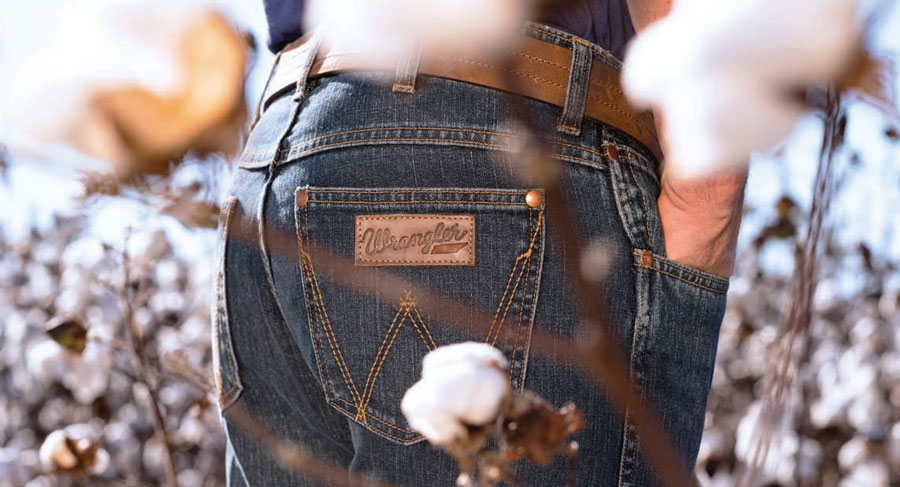
The Wrangler Rooted Collection™ features five state-specific pairs of jeans — the Alabama Jean, the Georgia Jean, the North Carolina Jean, the Tennessee Jean and the Texas Jean
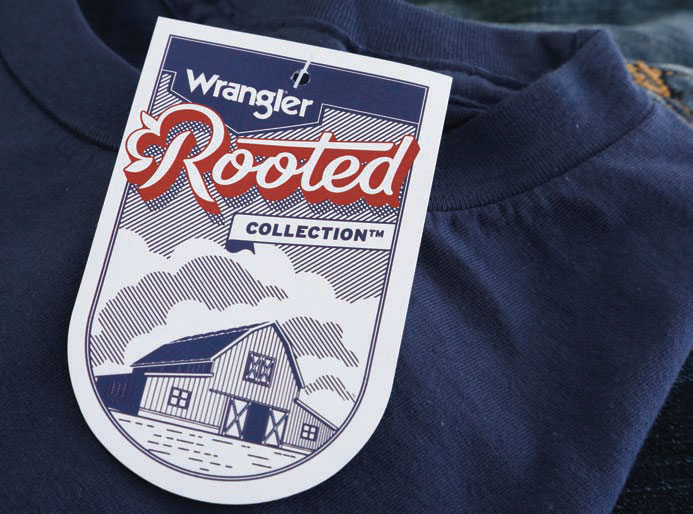
Wrangler recently announced The Wrangler Rooted Collection™, a jeans and T-shirt program featuring cotton garments grown, milled, cut and sewn in the United States.
TW Special Report
For more than 70 years, Greensboro, N.C.-based Wrangler® has been committed to bringing consumers authentic American style through its apparel collections for men, women and children in jeanswear and casualwear. Recently however, the company has taken “Authentic American” a step further as it introduced The Wrangler Rooted Collection™. Wrangler is proudly naming names in its U.S.-based jeans and T-shirt supply chains beginning with family-owned cotton farms in five southern states and moving through the textile and apparel manufacturing supply chain, largely located in Georgia and the Carolinas.
Origins Of The Program
As an iconic western-wear brand, Wrangler has worked closely with the ranching community for decades and was inspired by ranchers who are at the forefront of land stewardship and regenerative agriculture. The company began exploring ways it could integrate such stewardship thinking into its own cotton supply chain.
The idea for the Rooted Collection was conceived of by the Wrangler Science and Conservation team — a collaborative group of scientists, farmers, nonprofits and industry experts working to identify and encourage best practices for land stewardship to maintain healthier soils and more viable and productive farms. This team helped Wrangler contract with some of the most sustainable cotton producers in the United States for the Rooted Collection.
“The Wrangler Rooted Collection reflects our commitment to strengthening local communities and supporting U.S. farmers,” said Tom Waldron, president, Wrangler. “Equally important, the introduction of this collection aligns with our goal to continually improve the environmental performance and traceability of our products.”
Cotton Grown In The USA
The Rooted Collection features five state-specific pairs of jeans — the Alabama Jean, the Georgia Jean, the North Carolina Jean, the Tennessee Jean and the Texas Jean — and the sustainable cotton used for each state’s jean is fully traceable to a family farm in that state:
The Alabama Jean — Newby Family Farms, Athens, Ala;
The Georgia Jean — McLendon Acres, Leary, Ga;
The North Carolina Jean — Lassiter Family Farms, Conway, N.C.;
The Tennessee Jean — Pugh Farms, Halls, Tenn.; and
The Texas Jean — Vance and Mandie Smith, Big Spring, Texas.
The design for each state-specific jean includes a unique wash, as well as trim and patch details featuring the state’s silhouette and other embellishments.
In addition, the collection includes two T-shirt designs for each state, as well as three national designs.
“The family farms supplying cotton to the Rooted Collection are the first growers in the Wrangler Science and Conservation program, which advocates for land stewardship and soil health best practices,” said Roian Atwood, director of sustainability, Wrangler. “These science-backed methods build crop resilience to weather disruptions while improving yield, reducing water and energy inputs, fighting erosion, and reducing greenhouse gas emissions. Wrangler aims to source 100 percent of its cotton from farms using land stewardship practices by 2025.”
A Healthy Textile/Apparel Supply Chain
Yarn and denim fabric used in the jeans collection is woven by Maudlin, S.C.-based Mount Vernon Mills at its Trion, Ga., plant. The company has been in continuous operation for more than 150 years and operates 13 production facilities making a wide range of products.
“As a longtime and trusted Wrangler supplier, we knew Mount Vernon would be the perfect partner for this collection,” Atwood said. “Mount Vernon ensured the yarn and fabric was kept traceable to the farmer by keeping the cotton laydowns separate through the carding process and into spinning. They cleaned out the machines between each run to ensure each state fabric was 100-percent made from each state’s cotton.”
The denim is cut and sewn by El Paso, Texas-based Excel Manufacturing, a garment manufacturer that opened its doors in 1977. The company employs more than 150 associates and maintains a 62,000-square-foot main facility, 20,000-square-foot cutting facility and a 30,000-square-foot warehouse. Excel makes various garments for the military, well-known apparel brands, and has a tactical products line.
A T-Shirt From Field To Final Garment
The T-shirt program uses a North and South Carolina manufacturing supply chain and features cotton grown by fifth-generation farmers Vance and Mandie Smith in Big Springs, Texas. The Smiths have been caring for their family’s land for the past 13 years and focus on sustainable farming methods and soil health.
The Wrangler Rooted Collection™ features T-shirts manufactured using a 100-percent U.S.-based supply chain.
The Smith’s cotton is spun into yarn by Kings Mountain, N.C.-based Patrick Yarns Inc. Patrick was founded in 1963 and has continued to invest in state-of-art spinning technology. Interestingly, according to the company, Patrick Yarns’ legacy can be traced to the American War for Independence. According to the company: “Patrick family ancestors participated in the key battle of Kings Mountain, N.C., in which the British were soundly defeated. This tradition of rising to challenges and commitment to success is carried on by the current family ownership, and the main plants are still located [in Kings Mountain] today.”
Lumberton, N.C.-based Contempora Fabrics knits Patrick’s yarn into fabric for the T-shirts. Contempora is an employee-owned circular knitter founded in 1972. The company has more than 200 machines and a 2-million-pound-per-month capacity.
The knit fabric is dyed and finished by Gaffney, S.C.-based Carolina Cotton Works (CCW). Founded in March 1995, CCW’s primary focus is on dyeing and finishing knits and wovens for the apparel industry, however the company also serves non-apparel markets.
The dyed cotton knit fabric is cut and sewn into T-shirts by Andrews, S.C.-based Palmetto Apparel Service, and printed by Burlington, N.C.-based TS Designs — founded in 1977 as a small manual screen printer that grew over time into a fully automated printer with an environmentally conscious mind-set.
Full Transparency
The Wrangler Rooted Collection takes the unusual step of revealing the various members of the supply chains from cotton farm to finished product. In most instances, supply chain information is kept confidential and is often considered a competitive advantage. However, Wrangler has created a unique opportunity for the consumer to make a choice — to know and understand the origins of the garment they are purchasing and the farms and manufacturers they are supporting. “Authentic American” through and through.
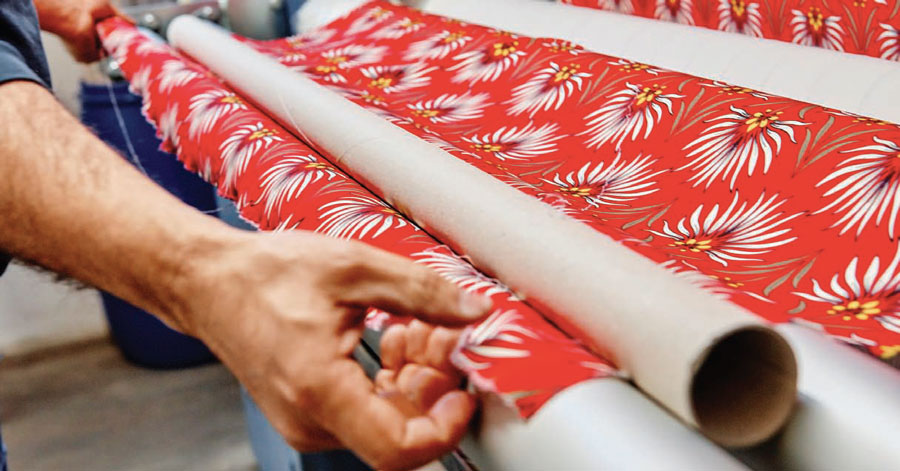
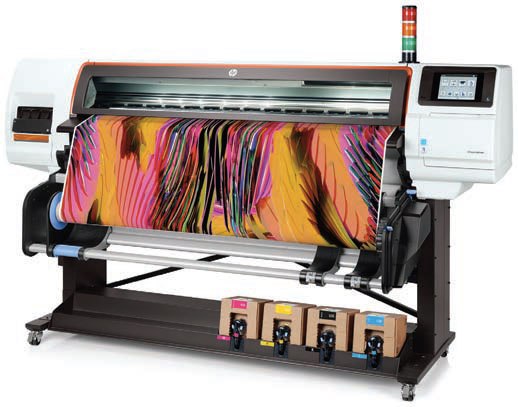
Printed fashion fabrics created using dye sublimination methods have brilliant, colorful designs.
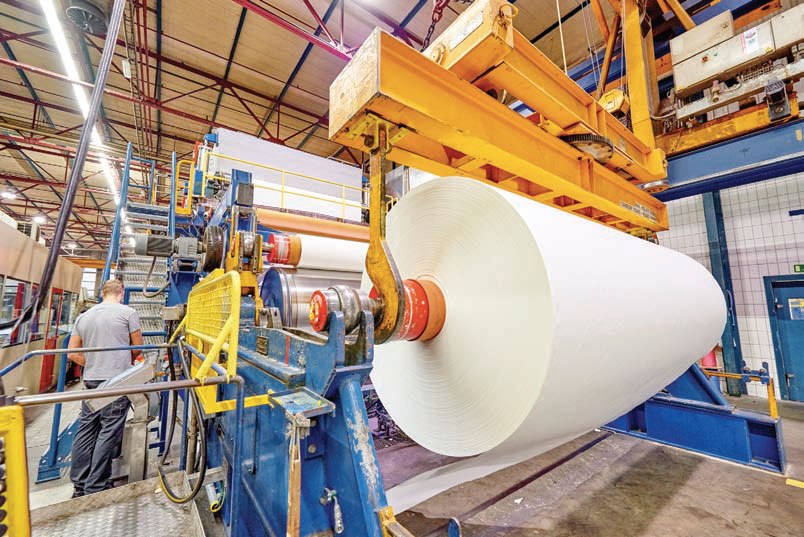
State-of-the-art, family-owned Neenah Coldenhove serves global customers with its innovative paper solutions.
By Mike Todaro
Everyone in the apparel industry has sent and continues to send nearly infinite volumes of digitized everything to the cloud(s), especially brilliant colorful designs and prints. Now it is time for the rain, for this tsunami of pixels to begin to fall and ironically, as important as the pixels that fall is the paper into which they land and dry. This paper is about … paper.
Shorter cycles are driving faster fashions with design-to-consumer turn times measured not in months but weeks. This fact is seen during Americas Apparel Producers’ Network (AAPN) meetings where the fiber, fabric, trim, factory and brand executives are all sitting in the same conference. Speed comes from ink and paper.
Inkjet Sublimation
The inkjet sublimation process starts with a high color fabric design that is printed onto special paper. Next, the paper is overlaid with a man-made fabric and run through high pressure rollers. During this step, the ink turns into a gas and combines with the fabric at the molecular level. The process creates designs that will never fade or run.
The apparel industry has seen countless trends and changes over the years including digitalization, globalization, computerization, fast fashion, short cycles, verticalization, 2D/3D systems, lean manufacturing, and so much more. Today, digital rules and nothing proves this more than inkjet sublimation.
Anyone in today’s supply chain located in between the designer and the consumer, is seemingly in the way. Advances in inkjet sublimation have even in some cases made the designer and the consumer the same person! This technology allows 10-minute turn times for small shops and one-day turn times for 20,000 yards of fashion fabric for the major players.
It’s The Paper
The Atlanta-based AAPN recently visited member company Neenah Coldenhove, the Netherlands. Since 1661, Coldenhove has produced paper at its facility — a place chosen because of the clean, clear, soft water springs.
Trucks arrive at Coldenhove with virgin cellulose harvested from renewable controlled forests of fast-growing eucalyptus trees. The environment is an emotional issue and Coldenhove goes above and beyond in its sustainability efforts. It has been recycling and innovating its water and energy use for nearly 350 years.
Some 95 percent of this special regional water used in Coldenhove’s production goes right back into production. The other 5 percent is used in production elsewhere on site. This Dutch company ironically will soon install an energy windmill. The company has a written goal to reduce energy by 8 percent by 2020.
The sublimation paper manufacturing process starts with pulp, which is turned into paper in a continuous sequence. Fiber and filler are soaked in water, filtered, then run through an enormous machine out of which emerges massive rolls of coated paper, ready for inkjet sublimation. Coldenhove invented a coating that is key to full color transfer.
The company knows how to make paper of a consistent weight and strength that creates predictable prints at high speeds. Its special coating is added inline as an integrated part of the process, not later. Without this key coating, more than 35-percent of the ink is absorbed into the paper and never reaches the fabric.
It is this coating — the target for the pixels of ink — that delivers instant drying and quick release of nearly 100-percent of the expensive inks to create sharp images. Currently, this paper is delivered within 48 hours to 70 countries worldwide.
It’s The Culture
How does a company that began operations in 1661 find itself still hiring and growing and expanding its customer base today? The answer is by never stopping the creation process. As one senior manager reported: “It is not our machines or fiber or paper or coating, it is our culture that gives us a competitive advantage.”
This is why such a historical company has managed the exponential growth in volume and breadth of global coverage to more and more companies. Over this decade, for example, it has experienced double digit growth every year.
The paper Coldenhove produces is not a new technology, it’s what the company does that is so innovative. It is the company’s focus to keep ahead of the ever-changing standards of the fashion industry that matters. The speeds and flexibility of digital printing is bringing production back closer and closer to the designers, to the Americas.
Coldenhove has been manufacturing paper at the same site in the Netherlands since 1661.
Ron Sportel, Coldenhove’s manager of innovation and development, saw the digital revolution coming in the industry. He invented digital inkjet sublimation paper, and the design that is used to apply the coating inline. Both inventions are key to Coldenhove’s value and brand name leadership in the industry.
In 2012, the industry saw a dramatic advance in the speeds of inkjet printers with increasing scale. This put enormous pressure on producers of both ink and paper. Coldenhove responded with its first product, JETCOL HTR 1000®. Today, the company offers 14 branded products with more in development.
Coldenhove prints sublimation inks on different polyester substrates with the knowledge that there is an optimum paper for every application, and countless applications. Some 43 percent of its market is in fashion, 30 percent in sporting applications, 15 percent in signage, and the balance is in home furnishing applications.
It’s The Speed And Accuracy
AAPN member El Salvador-based Textiles Opico SA de CV (TexOps) was founded in 2009. The company started slowly with inkjet sublimation printing and has reached a large scale of investment there today. TexOps has used Coldenhove paper from the very beginning.
“My partner David Ha went [to Coldenhove], very impressive place,” said TexOps President Juan Zighelboim. “They are a key vendor to us, very good reputation, make a high-quality product. We are very loyal due to quality, service and value. We don’t switch out for cheaper knock-offs available in the market.”
One mill in Europe that prints fabric for Zara’s dresses uses a single pass high-speed inkjet printer with six bridges of 100,000 nozzles each firing pixels of 3 picoliters of ink onto paper passing underneath at 2 meters per second. Think about that. If the mill receives a digital file in the morning, it can ship 20,000 yards of fashion fabric that evening. This is not only amazing speed, but can also be accomplished with monumental accuracy. This is design at its best, at speeds that are the world’s fastest for garment cycle times with margins no other brand can touch.
In her presentations, Coldenhove marketing executive Reshma Bhansing quotes Thomas Fuller who said: “All things are difficult before they are easy.” Pair that with Margaret Mead’s quote: “Never doubt that a small group of thoughtful, committed citizens can change the world. Indeed, it’s the only thing that ever has,” and this sums up Coldenhove’s team.
The power of this process is in its simplicity — printer, ink, paper, press and polyester fabric. The surprise, the secret ingredient, the piece of the puzzle that delivers exponentially more color and value than you ever imagine comes wrapped to you as what it is — the paper, the target of the designs you want to matter.
Editor’s Note: Mike Todaro is managing director of the Atlanta-based Americas Apparel Producers’ Network (AAPN).
Palo Alto, Calif.-based HP launched its first digital textile printers. The HP Stitch S series features HP Thermal Inkjet printhead technology and uses industry standard dyes for high-quality prints using transfer paper or short-run direct-to-fabric methods. HP also offers preventative support through HP Proactive Services.
According to HP, a built-in spectrophotometer enables fast color matching within the printer, in the Raster Image Processor and in the cloud. The Stitch is currently available in three versions — the HP Stitch S300 64-in Printer, the HP Stitch S500 64-in Printer, and the HP Stitch S1000 126-in Printer. In addition, HP introduced a line of transfer papers compatible with the Stitch series machines.
The HP Stitch S300 also offers a user-replaceable printhead, which reduces downtime and service costs. “Our experience with HP Stitch S300 has been much easier and faster than other dye sub printers we’ve previously used,” said Teunis Roos, Color Concepts. “Most printers require manual action in terms of head maintenance and alignment, but the HP Stitch S300 is more proactive and automated when it comes to performance.”
Israel-based Kornit Digital has introduced the Kornit Presto, an industrial single-step solution for direct-to-fabric printing capable of running of speeds of up to 450 square meters per hour. According to the company, the Presto eliminates the need for pre- or post-treatment of the fabric, and may be used on a wide variety of fabric types. The Presto also is a water-free process that uses the new NeoPigment™ Robusto pigment-based inks. Kornit reports that the fast physical and chemical bonding characteristics of the Robusto inks offer a significant reduction in curing time. Presto is targeted toward on-demand fashion and home décor applications. The system will be commercially launched at ITMA 2019 in Barcelona.
“We were thrilled to be able to test the new system and found the Presto to be in a class by itself; it prints beautifully on all kinds of fabrics, in a single-step, with an environmentally friendly dry process, and now at a multiple of productivity,” said Gart Davis, CEO, Spoonflower — a web-based service for custom, on-demand fabric and design creation and a long-time Kornit customer.
In other company news, Kornit also introduced the Kornit NeoPoly Technology for high-quality printing on polyester. Kornit’s Avalanche Poly Pro is the first system equipped with the new NeoPoly Technology, which is aimed at the T-shirt and sport apparel market, where polyester is a key substrate.
“Kornit is on a mission to reinvent the textile printing industry with game-changing sustainable technologies for growing market segments,” said Omer Kulka, Kornit’s vice president of marketing and product strategy. “We continually work to break technology boundaries, so that our customers can innovate and open new markets and new business opportunities, while being more operationally efficient.”
Fremont, Calif.-based Electronics For Imaging Inc. (EFI™) reports it has entered into an agreement to be acquired by an affiliate of Siris Capital Group LLC, New York City — a private equity firm focused on investing in technology companies that provide mission-critical solutions and are facing technology transitions.
The all-cash deal is valued at approximately $1.7 billion. EFI’s board of directors has unanimously approved the terms, whereby the Siris affiliate will acquire all the outstanding EFI common stock for $37 per share. EFI maintains the right to solicit alternative proposals from third parties and may terminate the agreement if a superior proposal is found subject to the terms and conditions of the agreement. The proposed transaction is expected to close by the third quarter of 2019 subject to EFI shareholder and antitrust regulatory approvals.
EFI reports it anticipates first quarter 2019 revenue to be between $220 million and $225 million.
“We believe this transaction delivers superior and immediate value to our shareholders while providing us with a partner that can add strategic and operational expertise to our business,” said Bill Muir, CEO, EFI. “We are excited to partner with Siris’ highly experienced team on this next phase of growth for EFI.”

 Collocated fabric, sourcing and home textiles shows will also feature new Fashionsustain conference this July.
 New For Summer 2019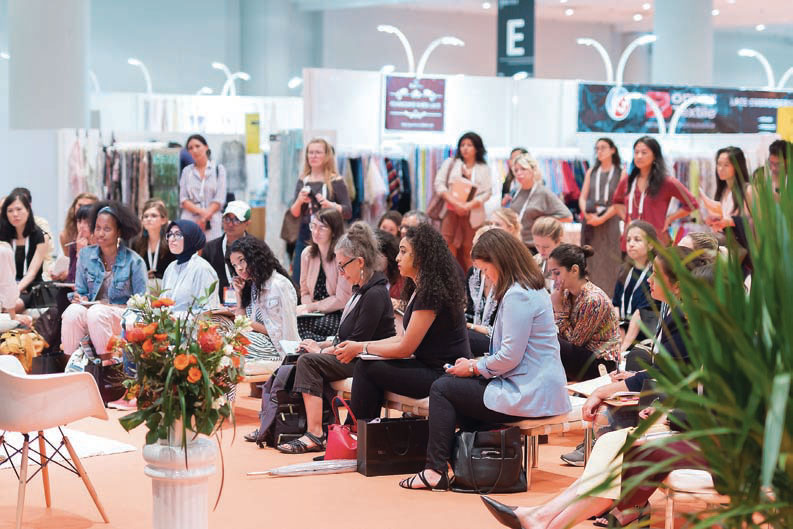
 “Texworld USA consistently delivers an incredible show bringing the global textile and apparel companies to New York City,” said Tricia Carey, global business development, Lenzing Fibers. “Our collaboration of the Lenzing Seminar Series supports exchange of new ideas around design, sourcing, and sustainability.”