Building A Smarter Textile Enterprise With AI And Automation

AI, automation and robotics help textile manufacturers boost quality, cut waste and deliver customer value.

By Marcio Manique

The textile industry is one of the oldest in the world, dating back to the late 1700s. It has survived centuries of transformation with each new wave of technology and now stands at another inflection point. As AI, automation and robotics reshape production, legacy manufacturers that want to remain competitive must be willing to rethink how they operate.

As customer expectations for quality, performance and lead times continue to evolve, digitalization and AI can no longer be viewed as optional or experimental. Companies that treat data as a core business need — rather than a passing trend — will be the ones best positioned for long-term success.

One of the most common misconceptions about automation is that it exists solely to replace jobs. In reality, the goal of digitalization in the textile industry is to empower teams and deliver enhanced value to customers. By embedding data analytics into operations, manufacturers can accelerate operational feedback loops, make better decisions and deliver better products with significantly less scrap.

In the end, this new era in the textile industry is about unlocking real business value. By strategically integrating AI models, robotics and sensors, manufacturers can elevate product quality, increase asset reliability, enhance workplace safety and empower the next generation of industrial workers.

Elevating Quality And Precision In Production

Maintaining consistent textile product quality has historically been a subjective task. Key processes like fabric inspection, color matching and dye development have relied almost entirely on the human eye. However, relying on the human eye adds some variables, like differences in color perception or visual acuity, which can make an already complicated process even more so. While human judgment is still needed, relying only on manual visual inspection for high-volume production is tiring and can lead to mistakes that waste materials.

To solve this, leading manufacturers are turning to AI to enhance human oversight. During a typical shift, a team member may visually inspect three to five miles of fabric. Today, camera systems paired with AI software can support this work by monitoring fabric in real time. Trained to detect specific defects, AI-supported systems can flag issues automatically and consistently. Unlike the human eye, these systems apply the same level of detection every time, regardless of fatigue or differences in vision. Because the software builds a comprehensive catalogue of defects, it can also help determine the most efficient way to parse out flaws and piece the fabric back together.

Similar technologies can also enhance decision making in color matching and the dye development processes. By digitizing visual inspection and color analysis, facilities can ensure greater specificity and significantly reduce scrap material. Automating these tedious tasks allows manufacturers to move workers to more satisfying roles, which makes the experience better for everyone involved and results in a better product.

Shifting From Reactive To Prescriptive Maintenance

While AI transforms finished goods inspection, it is equally beneficial for maintaining the complex machinery that produces textiles. Asset reliability is critical, especially since unplanned equipment breakdowns can typically cost about three times as much as planned maintenance. Adding to this challenge is the ongoing labor shortage of specialized trades like electricians and maintenance technicians.
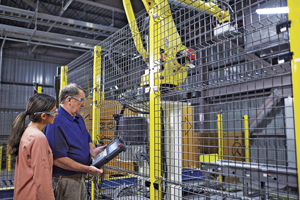
Prescriptive maintenance programs help address these risks. By equipping machinery with sensors that monitor critical operating data like temperature, pressure and vibration, data can be fed into AI models around the clock. Once a baseline for normal operation is established, the system can quickly detect unusual behavior and flag potential issues well before they escalate into failures.

Instead of reacting to costly breakdowns, plant managers can use AI insights to proactively plan repairs and schedule downtime around limited technical resources. This reduces unplanned disruptions and supports consistent output and overall efficiency.

Redefining Workplace Safety And Ergonomics

As experienced workers retire, the manufacturing sector is undergoing rapid change. By 2033, up to 3.8 million manufacturing jobs are expected to be needed, with as many as 1.9 million potentially going unfilled. As new hires who have never worked in manufacturing enter the industry and learn how to navigate complex, fast-moving environments, safety training and monitoring become increasingly important.

To support this transition, many facilities are using AI to enhance workplace safety. By layering AI software onto existing security camera systems, AI models can be trained to recognize established safety protocols. These tools can identify situations where personnel get too close to moving equipment or are missing required personal protective equipment (PPE), like high-visibility vests.

The goal is not surveillance, but insight. For example, if an AI system detects a spike in missing high-visibility vests in a specific warehouse zone, team leaders may discover that outside delivery drivers are overlooking protocols. Plant leadership can then address the root cause without placing blame on the factory floor.
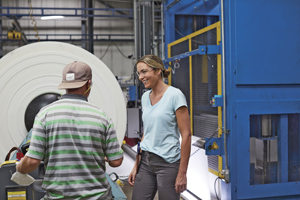
Beyond AI-supported safety monitoring, introducing robotics into material-handling operations reduces ergonomic risks associated with tasks like moving heavy rolls, loading equipment and transporting materials, helping prevent injuries while improving efficiency.

Empowering The Workforce And Weaving The Path Forward

Discussions about robotics in manufacturing often come with underlying assumptions and “automation anxiety.” However, employees who work alongside these technologies quickly see the benefits, including reduced physical strain, improved safety, and more efficient workflows.

By automating repetitive tasks like manual fabric inspections and heavy lifting, textile manufacturers can better address persistent recruiting challenges and redeploy talent to dynamic roles. AI can also help preserve institutional knowledge. Digitizing decades of operational data can help teams quickly search and reference past insights, bridging the gap between retiring experts and the next generation of workers.

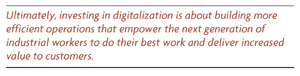
As data costs decrease and technologies continue to advance, textile manufacturers must adopt a practical test-and-learn approach to assessing new technologies. Evaluating tools on a small scale to prove their business value before broad rollouts allows teams to validate business impact and embrace adoption with confidence. Ultimately, investing in digitalization is about building more efficient operations that empower the next generation of industrial workers to do their best work and deliver increased value to customers.


Editor’s Note: Marcio Manique is executive vice president and managing director, apparel, at Milliken & Company.


2026 Quarterly Issue II

Apparel Brands Expand CiCLO Technology To Address Microplastics

Gastonia, N.C.-based Intrinsic Advanced Materials announced expanded adoption of CiCLO technology across performance apparel, outdoor and protective workwear as brands address microplastic fiber pollution.

CiCLO technology is embedded in polyester and nylon fibers during production, enabling the material to biodegrade at rates comparable to wool when exposed to seawater, soil or wastewater. According to the company, third-party lab studies show CiCLO fibers fully biodegrade in under four years compared to conventional fibers that remain intact.

New product launches include Fruit of the Loom’s Iconic Premium and Iconic 250 Sweats collections in Europe, ROFA’s MOVE EASY Workwear line and Black Diamond Equipment’s Rift Fleece collection in the United States.

“Integrating CiCLO technology into these collections allows us to introduce an ingredient innovation directly into core apparel categories,” said Christian Lanvermann, senior marketing manager for Fruit of the Loom Europe.

CiCLO fibers are available from certified manufacturers globally.


2026 Quarterly Issue II

Polartec Introduces Pre-Dyed Standard To Simplify Color Production

Spartanburg, S.C.-based Polartec, a Milliken & Company brand, introduced Standard Issue, a unified pre-dyed option available in black on its fleece fabric platform. The technology will be rolled out across the Polartec portfolio and expanded based on market demand.

According to the company, brands independently order thousands of rolls of fleece in nearly identical black shades annually. Each variation requires its own dye batch, minimum order quantity and production setup, adding time and complexity without meaningful differentiation.

“Standard Issue invites the industry to consider a shared alternative to producing countless variations of a visually identical color like black,” said Ramesh Kesh, senior vice president at Milliken & Company and business leader for Polartec.

“By providing brands with a consistent, ready-to-use color option, we are helping design teams move from concept to production more efficiently,” added Karen Beattie, director of product management at Polartec.


2026 Quarterly Issue II

Penn Emblem Receives NAUMD Innovation Award For Glow-In-The-Dark Silicone Emblem

Trevose, Pa.-based Penn Emblem Company received the 2026 Network Association of Uniform Manufacturers and Distributors (NAUMD) Innovation Award for its glow-in-the-dark silicone emblem technology.

The award-winning design, the Centurion FR Silicone on Glow-in-the-Dark, combined advanced silicone molding, intricate detail and functional low-light visibility. According to NAUMD, the emblem “pushes the frontier of emblem design” by combining “detailed FR logo artistry with a functional glow-in-the-dark silicone backing.”

“Silicone has been dominating the emblem market for the past few years, so our goal was to take it to the next level,” said Rich Hirsh while accepting the award on behalf of Penn Emblem. “Seeing it go from concept to a finished product and now to this stage is incredibly rewarding for our whole team.”

The company’s silicone emblems feature embossed 3D dimension, waterproof flexibility and wear resistance for uniforms, promotional products and branded apparel.


2026 Quarterly Issue II

LYCRA Introduces VintageFX Fiber For Heritage-Style Denim

LYCRA® VintageFX delivers the authentic look of heritage denim with the comfort and fit that customers expect from stretch denim.
Wilmington, Del.-based LYCRA Company announced the global launch of LYCRA VintageFX fiber at Kingpins Amsterdam, April 15-16. The fiber delivers the look of vintage denim in modern silhouettes while providing comfort, fit and shape retention.

Designed for denim and woven fabrics, LYCRA VintageFX fiber enables brands and mills to recreate rigid, heritage-inspired looks without sacrificing recovery, durability or comfort. The fiber addresses challenges in wide-leg, flares, boyfriend and mom jeans, particularly in the waist, hips and crotch.

“For brands and garment makers, its dual-core yarn construction, low growth and high recovery open new design possibilities,” said Ebru Ozaydin, product category director for denim and ready-to-wear at LYCRA Company.

Engineered with a proprietary fabric application, LYCRA VintageFX fiber works with LYCRA fiber in a dual-core structure. During finishing, the fiber shrinks under heat, controlling elastic extension and delivering enhanced shape retention.


2026 Quarterly Issue II

Teijin Frontier Develops Stretch Polyester Yarn

Tokyo-based Teijin Frontier Co. Ltd. announced it has developed a stretch polyester yarn offering compatibility with high-performance polyester materials for sports and outdoor wear.

According to the company, its proprietary polymer design and spinning technology impart elasticity to the yarn, adding stretchability and recovery to high-performance polyester materials. The yarn’s elasticity derives from polymer design and spinning control technology rather than yarn structure, providing soft stretchability and shape stability with recovery comparable to polyurethane-based elastic fibers.

The yarn enables development of 100% polyester textiles that maintain advanced functions including moisture absorption, quick drying and durable water repellency. The all-polyester composition also simplifies recycling.

Teijin Frontier plans to combine the yarn with high-performance polyester materials in textiles for sportswear, casual wear and innerwear. The company will begin selling to domestic and overseas markets in 2027, targeting annual sales of 100,000 meters in fiscal 2027 and 500,000 meters in fiscal 2029.


2026 Quarterly Issue II

Americhem Launches PFAS-Free Technology For Functional Fibers

Cuyahoga Falls, Ohio-based Americhem Inc. announced the launch of nDryve, a PFAS-free, in-melt surface-modifying technology platform designed to deliver durable multi-fluid repellency against alcohol and other low-surface-energy fluids in fiber systems.

As global regulations accelerate the phase-out of per- and polyfluoroalkyl substances (PFAS), manufacturers face pressure to maintain barrier performance without fluorinated chemistries. nDryve integrates directly into the polymer during melt processing, embedding surface-modifying functionality within the fiber matrix rather than relying on removable finishes.

“Evolving global PFAS regulations are reshaping how manufacturers evaluate barrier and surface performance technologies,” said Matt Miklos, vice president of corporate strategy and marketing at Americhem. “nDryve provides a PFAS-free pathway that aligns performance with emerging regulatory expectations.”

The technology is optimized for polyolefin and engineering fiber systems including PP, PET and PA6 for applications such as medical fibers, apparel, hygiene materials and industrial protective fabrics.


2026 Quarterly Issue II

Barmag Huitong Makes PA6 Direct Spinning Economically Viable

Remscheid, Germany/ Yangzhou, China-based Barmag Huitong (Yangzhou) Engineering Co. Ltd., a subsidiary of Barmag, commissioned the first continuous polymerization plant for polyamide 6 in China’s Zhejiang province.

Following a construction and commissioning phase, the plant began production at the end of 2025. According to the company, 20 metric tons of high-quality polyamide 6 are produced daily with significantly reduced energy consumption. The material is processed into filament yarn for textile applications via a direct spinning facility.

The joint venture between German chemical fiber plant manufacturer Barmag and Chinese chemical plant specialist Huitong has further developed the classic two-reactor technology, making it competitive and establishing the concept as an option for future PA6 direct spinning. Barmag Huitong Engineering is working on process and equipment innovations to increase plant efficiency while promoting sustainable development of the nylon industry chain.


2026 Quarterly Issue II

UNIFI Introduces Luxel™ Linen-Inspired Performance Yarn

UNIFI®, Makers of REPREVE®, introduces Luxel™: a linen-inspired, easy-care performance yarn
Greensboro, N.C.-based Unifi Inc., maker of REPREVE recycled yarn, announced the launch of Luxel, a yarn technology that combines the look and feel of linen with performance features and recycled materials.

Luxel captures the natural look and feel of linen while offering moisture-wicking, wrinkle resistance and odor control. The technology is built into the yarn and is suited for apparel, footwear, home furnishings, workwear and accessories.

Luxel is made with REPREVE recycled polyester yarn, including 30% REPREVE Takeback, which incorporates textile waste.

“We developed this yarn to provide designers and manufacturers with a product that delivers the premium look and tactile appeal of linen but delivering on enhanced benefits of easy care, durability and sustainability,” said Eddie Ingle, CEO of UNIFI.


2026 Quarterly Issue II

A Conversation With Freudenberg Performance Materials CEO Dr. Andreas Raps

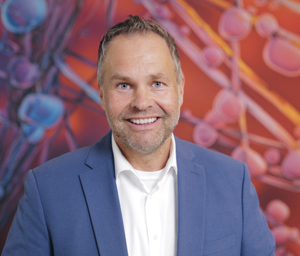
Dr. Andreas Raps
CEO Dr. Andreas Raps outlines growth strategy, portfolio management and sustainability initiatives shaping Freudenberg Performance Materials.

By James M. Borneman, Editor In Chief

Weinheim, Germany-based Freudenberg Group is a family-owned company operating in 60 countries, with more than 51,000 employees and 2025 sales of more than 11.7 billion euros, roughly $13.9 billion.

Freudenberg Group’s portfolio includes seals, filtration, technical textiles, specialty chemicals, medical products and cleaning technologies, among others. Freudenberg & Co. KG is Freudenberg Group’s strategic parent company and Freudenberg SE serves as the corporate parent overseeing business operations.

Freudenberg Performance Materials is Freudenberg Group’s specialist in nonwovens and technical textiles. The company reports that it operates 35 locations in 14 countries.

Widely known for Evolon, its proprietary microfilament textile platform used in technical and industrial applications, as well as other branded technical textile platforms such as Colback, Dripstop, Enka Solutions and Lutradur, Freudenberg Performance Materials develops and manufactures nonwovens and technical textiles for markets including apparel, automotive, building materials, energy, filtration, health care, footwear and specialty applications.

Dr. Andreas Raps was appointed CEO of Freudenberg Performance Materials on Jan. 1, 2024. He previously held several executive positions at Freudenberg Sealing Technologies, starting in 2004 and most recently as CEO of the global Special Sealing Division, which has 17 manufacturing sites worldwide.

From 2016 to 2024, Dr. Raps was CEO of EagleBurgmann, a joint venture between the EKK Group of Japan and the Freudenberg Group.

Before joining Freudenberg, Dr. Raps worked for management consulting firms in Boston, Munich and Zurich. He holds an MBA from the University of Passau and earned a PhD in business administration with a thesis on strategy implementation. Dr. Raps has also been a member of the Freudenberg SE Executive Council since 2020.

Recently, Dr. Raps sat down with the editors of Textile World to discuss his vision of Freudenberg Performance Materials’ many innovations, the management of a complex product portfolio and the company’s commitment to future-oriented, sustainable technical textiles.

Textile World: Dr Raps, Freudenberg Performance Materials’ size, complexity and international footprint must present significant demands, what do you perceive as the most challenging aspect?

Dr. Andreas Raps: The biggest challenge is finding the right balance between global consistency and local responsibility. At Freudenberg Performance Materials, we operate worldwide, but our customers and markets are very specific. That’s why we set clear global standards for aspects like quality, safety and performance, while empowering our regional teams to adapt solutions locally.

Secondly, collaboration is critical. We actively connect customers, R&D and Operations early on. Innovation doesn’t happen in isolation. Cross-functional teams and standardized development processes help us turn ideas into reliable solutions.

Finally, our Guiding Principles give us orientation. Principles like Customer Value, Innovation, Responsibility and Long-term Orientation are deeply rooted at Freudenberg and actively lived today. They help us stay stable, adaptable and trusted – by our customers and by our people.

TW: How do you prioritize opportunities across people, products and markets?

Dr. Raps: For us, it always starts with people. We invest strongly in developing our employees and in creating a culture where responsibility, collaboration and entrepreneurship are encouraged.

Our global talent management is very systematic because opportunities only become reality when people are empowered to act.

On the product side, close collaboration with customers is key. Innovation happens when we combine material science expertise with deep application and market understanding. International and cross-functional teamwork ensures that good ideas move quickly from concept to real impact.

In terms of markets, we continuously observe regional trends and emerging applications. Market responsibility is largely decentralized, which allows us to respond fast to local opportunities, while still leveraging the strength and scale of our global network.

TW: Many people speak about innovation, but how do you create and propagate a culture of innovation? How do you support it? What barriers impede it?

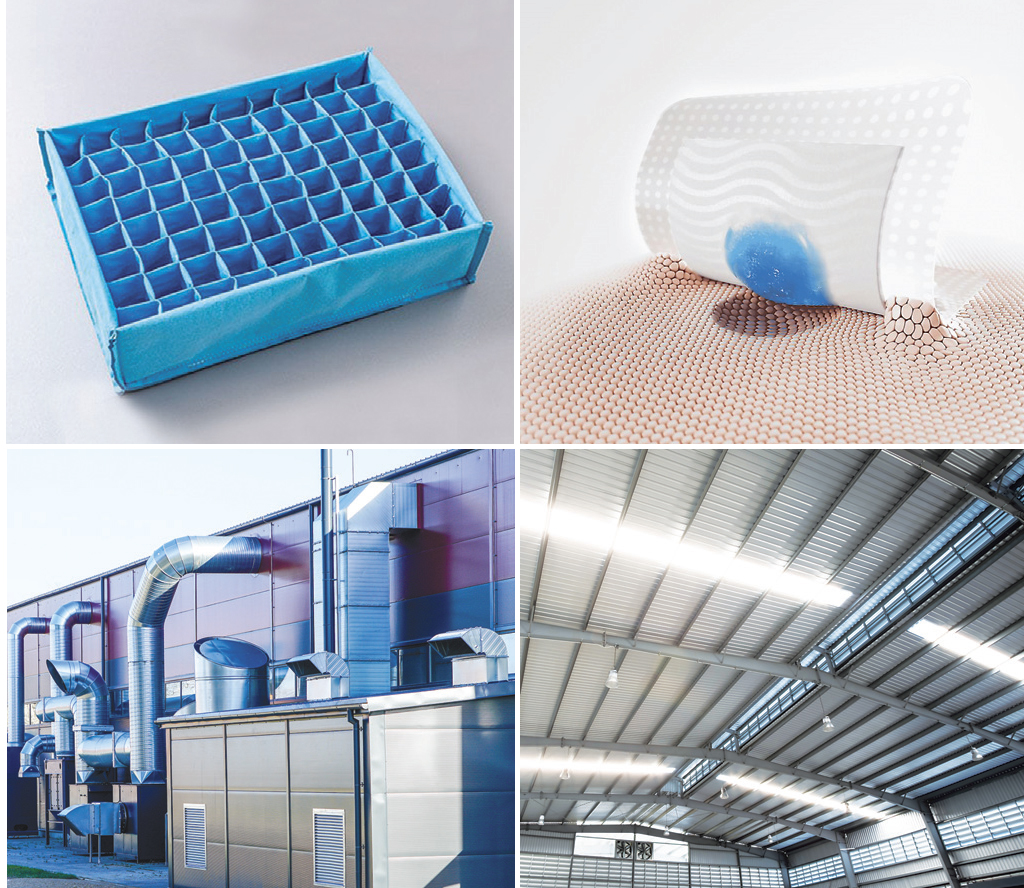
Some of the many technical textile solutions by Freudenberg Performance Materials include (clockwise from upper left) Evolon® packing; Tacnera® silicone foam dressings; Dripstop® condensation control; and Filtura® air filtration.
Dr. Raps: Innovation at Freudenberg Performance Materials is not a buzzword — it’s anchored in our Guiding Principles and starts with real customer needs. We empower teams, encourage local decision making, and at the same time connect people globally through ONE FPM. ONE FPM is our shared way of working that breaks down silos and connects people, functions and regions worldwide to focus consistently on customer value and long-term success.

Leadership plays a central role. We lead based on trust, responsibility and clear direction. Cross-functional and cross-regional collaboration is actively supported and manufacturing expertise is an integral part of innovation, from the first idea all the way to industrial scale.

Of course, there are barriers. Our size and complexity can slow things down, so we work continuously on simplifying structures.

Risk aversion can also be an obstacle. We address this by encouraging learning, experimentation and — maybe most importantly — trust. And regarding silo thinking, ONE FPM helps us overcome it.

TW: How do you understand such a diverse product portfolio? How do you manage it and keep each product responsive, or even leading in its respective market segment?

Dr. Raps: We organize our portfolio around customer applications, not around internal technologies. That keeps us close to real market needs.

Every three years, we run a structured strategic planning process, including technology roadmaps. Each product area has clear ownership, a defined strategy and a clear customer value proposition.

Application expertise is crucial here. It keeps us connected to the realities of each segment. At the same time, our matrix organization and corporate functions ensure coordination and alignment across the company.

TW: With such a large footprint and capabilities, how do you drive synergies across products and processes within the company?

Dr. Raps: ONE FPM is the central enabler. Shared technology platforms allow us to reuse solutions and accelerate development.

Global manufacturing and process standards help ensure consistent quality and scalability. In addition, joint development projects across sites and structured knowledge transfer are part of our daily work.

Corporate functions support this coordination, but real synergies come from people collaborating openly across functions and regions.

TW: How do you stay on top of the future opportunities these products serve and beyond current markets?

Dr. Raps: Our sales teams continuously analyze how customer requirements, applications, and technologies are evolving. We look at new growth markets, strengthen local for local approaches, and advance circular economy concepts.

At the same time, we are very disciplined in focusing our resources on healthy and promising areas. This means avoiding tying up capacity in markets with declining demand, and freeing up investment for future-oriented solutions.

TW: The manufacture of nonwovens and technical textiles is an intensely technical business. How do developments, refinement of processes and innovation proliferate among Freudenberg’s divisions, sites and members?

Dr. Raps: International collaboration is part of our daily routine. Development expertise is bundled in global development teams, and production sites continuously share best practices under unified quality standards.

Dedicated process engineers run both local and global projects to improve our assets. This ensures that improvements and innovations are spread across the entire organization.

TW: Dr. Raps, how do you combine the company’s overarching goals with developing a product from concept to market?

Dr. Raps: Sustainability is a good example, and currently a challenging one.

That’s why we focus on applications where sustainability delivers a clear functional and economic benefit. One example is plant propagation systems.

Our nonwoven paper pots are designed to remain in the soil, eliminating removal and disposal steps. They are made from 100% bio-based PLA and wood pulp, without chemical binders, combining functionality, ease-of-use and environmental benefits.

TW: How do you balance internal process innovation with customerdriven innovation? Does innovation take many different paths?

Dr. Raps: We aim for a healthy and balanced innovation portfolio.

As said, we develop solutions that are clearly market driven, where we see a concrete customer need and strong long-term potential. At the same time, we are deliberately pursuing technology push approaches, which usually take more time and involve higher risks. They can also lead to strong differentiation.

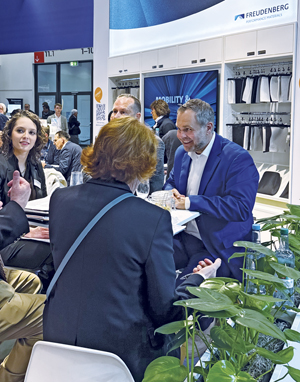
Engaging with clients is key to Freudenberg Performance Materials’ CEO Dr. Raps for building a clear customer value proposition.Our Evolon is a good example of that. It’s a unique microfilament textile that combines extremely fine fibers into a strong, breathable and versatile material for demanding industrial and consumer applications.

Both paths are important.

TW: As a global manufacturer, what challenges lay ahead and how do you strategically prepare for them?

Dr. Raps: Sustainability is a major challenge. Our goal is CO2 neutrality by 2045, which requires further development of our energy-intensive processes, reducing energy consumption and transitioning to green energy.

Digitalization and automation are another key area. We focus on replacing safety-critical and ergonomically-demanding tasks, scaling successful solutions globally.

For example, at our Emmen site in the Netherlands, automated guided vehicles and robotics now handle heavy, repetitive tasks. This improves safety, productivity and product quality, giving people more time for quality critical work.

Overall, we aim to actively shape the market, guided by a strong customer perspective and long-term orientation.

TW: The topic of AI seems to enter every conversation. How will AI impact Freudenberg Performance Materials?

Dr. Raps: I see AI as a strategic enabler. It can make processes more efficient, sharpen demand analysis and accelerate innovation. But AI must be implemented responsibly. People development is at the core. We qualify our employees to use new technologies effectively.

TW: How do you foster the company’s commitment to future-oriented, sustainable technical textiles?

Dr. Raps: Sustainability is deeply rooted in our values and history. Today, it is firmly embedded in our strategy and increasingly demanded by our customers. Dedicated structures like our sustainability governance ensure that this commitment is translated into concrete action across the organization.

Our goal is to enable our customers to meet their own sustainability responsibilities through high-performance materials.


2026 Quarterly Issue II

Sponsors