Luxury Custom Clothier Adrian Jules Digitizes Its End-To-End Workflow With Gerber Technology

NEW YORK CITY — May 18, 2020 — Adrian Jules Ltd., an established bespoke design house and tailoring outfit based in Rochester, N.Y., has transformed their 55-year-old business offering the finest hand-made garments in America through a deep and personal partnership with Gerber Technology, the industry leader in the apparel and textile technology space, by digitizing their entire process — from design to cutting — by integrating Gerber Technology’s AccuMark® 3D & 2D CAD software, Gerber’s AccuNest™, and the GERBERcutter® Z1 for production-ready, made-to-measure garments.

Darren Beaman, senior director of Technical Design and production director, outlined how they transformed their business and found the ultimate balance between old-world tradition and cutting-edge technology including 3D. With a 10-percent savings in material utilization and 75-percent time savings for faster manufacturing productivity, Adrian Jules sees embracing technology as a no-brainer. Beaman added, “we’ve gone from 20 samples per year, down to 5,” representing a significant cost savings for the company.

3D has not only been instrumental in bringing the business into a brand-new technological era, but it has also been crucial to operations due to the present day geopolitical challenges of COVID-19. In a matter of days, Adrian Jules was able to convert to mask and PPE production — all with the aid of AccuMark 3D. Thanks to embracing Gerber’s end-to-end technology, Beaman was able to bring Adrian Jules to the front lines of the important fight against the current pandemic.

“55 years ago we used paper, pencil and old wooden rulers … now, we’re using the most innovative technology available to the industry. For someone who is a technical director, this is very exciting for me” Beaman said, commenting on their success in adopting Gerber’s suite of end-to-end solutions. “We’ve been working with Gerber for over five years. I feel privileged to be part of the Gerber family and am excited to see AccuMark 3D and it is so easy to use.”

Adrian Jules now attributes their success to being a tech-forward company, while still maintaining the core values put in place by its founder generations ago.

Gerber Technology offers end-to-end solutions for soft goods and apparel manufacturers looking to save money, time, and the environment. With over 50 years of experience, Gerber has come to be known as the go-to-market leader for companies looking to effectively digitize and connect the entire supply chain, all the way from design, product development, and production to retail. Mary McFadden, vice president, CAD Product Management at Gerber Technology, noted that “Gerber and Adian Jules are the perfect pairing of talent, as well as tradition, with over 100 years of combined industry experience and backgrounds in traditional manufacturing.”

Speaking to the tradition of excellence at Adrian Jules, Alexa Roberti, director of sales, explained: “My grandfather started this company with the dream of delivering the finest hand made garment in America, and that’s actually our mission statement today.” Roberti also stated that “we are proponents of technology here at Adrian Jules, and we really see Gerber’s AccuMark 3D assisting not only in sustainability but giving us flexibility when we need to develop patterns.”

Posted May 18, 2020

Source: Gerber Technology

INDA Supplements World Of Wipes® Conference With New Virtual Option: Experience Conference Presentations Online

CARY, N.C. — May 18, 2020 — INDA, the Association of the Nonwoven Fabrics Industry, announces the addition of a “virtual” registration option for its World of Wipes® (WOW) International Conference August 24-27 in Minneapolis, Minn. WOW will enable those not able to be there in person to experience the full educational program of this important industry event.

Virtual WOW offers wipes professionals a unique website link that will contain each speaker’s presentation with audio and visuals to replay at any time. Details for both Virtual WOW and in-person WOW registration information is available on  www.worldofwipes.org/register.html. 

Content of the 14th edition of the World of Wipes is focused on breakthrough wipe technologies, buyer demographics, sustainability, industrial and flushable wipes, substrates, preservatives, single use plastics, and strategy-setting market intelligence. Presentations will also address industry changes prompted by COVID-19.

“While nothing can replace the value of face-to-face meetings and we look forward to seeing the industry reconvene in person, Virtual WOW is an option for our industry members who cannot attend in person yet want the benefit of the highly relevant program content,” said Dave Rousse, INDA president. “Virtual participants will hear and see each speaker’s presentation and slides as if they were sitting in a front row conference seat. We’re adapting to the “new normal” to better serve the dynamic wipes industry. With this Virtual WOW option, no one should miss this exciting event.”

WOW 2020 will connect senior-level wipes professionals during four value-packed days combining relevant technical and educational content with business engagement opportunities.

Over 400 senior-leadership participants attended WOW in 2019. For the full conference agenda and full line-up of industry speakers, visit: www.worldofwipes.org/conference.php

Preceding the conference, INDA’s WIPES Academy will be led by instructor Chris Plotz, Director of Education & Technical Affairs, INDA, August 24-25. The WIPES Academy is the first and only comprehensive wipes training for the entire wipes supply chain.

Posted May 18, 2020

Source: INDA, the Association of the Nonwoven Fabrics Industry

UniFirst Corp. Continues Hygienically Clean Food Safety Certification Commitment

ALEXANDRIA, VA — May 15, 2020 — UniFirst Corp.’s Tulsa, Okla., and Goldsboro, N.C., laundries have recently qualified to renew their Hygienically Clean Food Safety certifications. This accomplishment reflects UniFirst’s commitment to best management practices (BMPs) in laundering as verified by on-site inspection and their capability to produce hygienically clean textiles as quantified by ongoing microbial testing. UniFirst currently has 55 laundries that hold this certification; their locations are (one in each state except where noted): Ariz.; Calif. (four); Colo.; Conn.; Fla. (three); Ga. (two); Ill.; Kan. (two); La.; Mass. (two); Md. (two); Maine (two); Mich., Mont., N.C. (four); N.H. (two); N.J.; Nev.; N.Y. (two); Ohio; Okla.; Ore.; Pa. (two); S.C. (two); Texas (seven); Utah; Va.; Wash.; and Wis. Canadian provinces represented are Alberta (two) and British Columbia.

The Hygienically Clean Food Safety certification confirms the laundry’s dedication to compliance and processing garments and linens using BMPs as described in its quality assurance documentation, the focal point for inspectors’ evaluation of critical control points (CCPs) that minimize risk. The independent, third-party inspection must confirm essential evidence that:

  • Employees are properly trained and protected;
  • Managers understand legal requirements;
  • OSHA-compliant; and
  • Physical plant operates effectively.

To maintain their certification, laundry plants must pass quarterly testing of outcome-based microbial testing, indicating that their processes are producing Hygienically Clean garments and other reusable textiles with diminished presence of harmful bacteria. Testing ensures that as laundry conditions change, such as water quality, textile fabric composition and wash chemistry, laundered product quality is consistently maintained. This process eliminates subjectivity by focusing on outcomes and results that verify textiles cleaned in these facilities meet appropriate hygienically clean standards and BMPs for animal processing, dairies, fruit/vegetable, bakeries, grain and other food and beverage industry segments.

Hazard Analysis and Critical Control Points (HACCP) practices are examined in the Hygienically Clean Food Safety inspection process, evaluating the plant’s techniques for:

  • Conducting hazard analysis;
  • Determining CCPs, monitoring their control, correcting them if not under control;
  • Validating and verifying HACCP system effectiveness; and
  • Documenting and record-keeping to show ongoing conformance.

On-site inspections also evaluate practices relevant to handling and processing textile products used in food manufacturing/processing establishments for adherence to U.S. Food and Drug Administration (FDA) and Centers for Disease Control and Prevention (CDC) directives. Introduced in 2014, Hygienically Clean Food Safety brought to North America the international cleanliness standards for laundering garments and other textile products for food manufacturing used worldwide by the Certification Association for Professional Textile Services and the European Committee for Standardization.

“More and more, we’re seeing our customers in food-related industries looking for third-party validation that our specialized Product Protection Process and our Hygienically Clean standards are consistent with HACCP and GFSI guidelines,” said Adam Soreff, director of marketing and communications at UniFirst Corp., Wilmington, Mass. “Working with a Hygienically Clean Food Safety certified laundry helps reassure them that their managed unif

Posted May 15, 2020

Source: TRSA

Picanol Reaches Production Milestone With 100,000th Rapier Weaving Machine

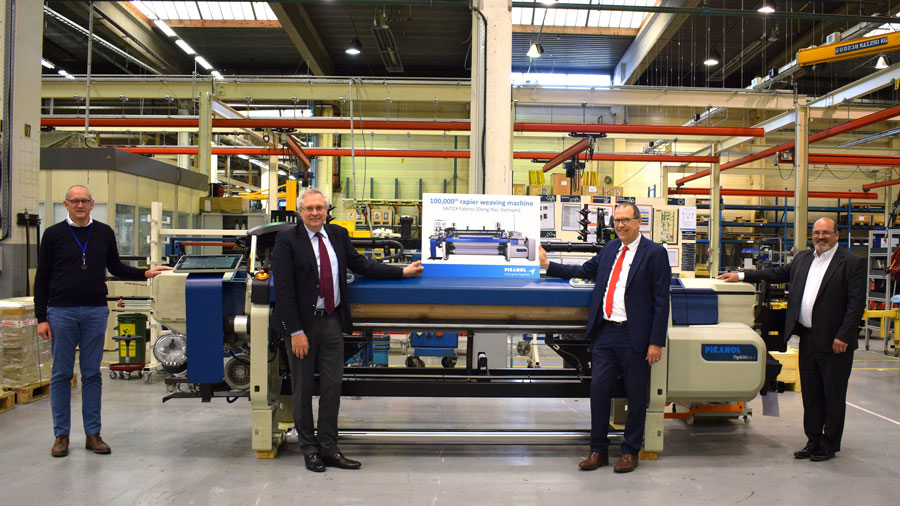
IEPER, Belgium — May 15, 2020 — This week, Picanol realized a milestone when its 100,000th rapier weaving machine rolled off the production line at its plant in Ieper, Belgium. Picanol is also celebrating 45 years of manufacturing rapier weaving machines in 2020. Once again, this reaffirms the leading role Picanol plays in the rapier weaving machine segment worldwide. The 100,000th rapier weaving machine — an OptiMax-i — will be shipped this week to the company SAITEX Fabrics, which is based in Long Tho, Vietnam.

Picanol has an extensive track record in the production of high-tech rapier machines. In 1975, it launched its very first weaving machine with a rapier insertion, which was named the PGW. Since the launch of the first rapier machine all that time ago, Picanol has introduced various new generations of rapier machines. These include, among other machines, the GTM in 1983, the Gamma in 1996, the GamMax in 2002, and the OptiMax and the GT-Max in 2007. Its current flagship rapier weaving machines — the OptiMax-i launched in 2015, and the GTMax-i 3.0 launched in 2018 — cover a complete range of applications.

“The fact that the 100,000th machine mark has been reached now represents a sign of hope and optimism during this COVID-19 time,” said Johan Verstraete, vice president, Weaving Machines. “Our people are working hard to build, install and service weaving machines, even under these extraordinary circumstances — and this is taking place while simultaneously respecting all of the measures needed to ensure safe and healthy working conditions. We have every reason to be proud of the fact that we have produced 100,000 rapier weaving machines and we are extremely grateful to all of our employees who have made this possible. Achieving this milestone once again demonstrates our ability to produce best-in-class, dedicated weaving machines for the world’s most reputable textile manufacturers. In addition, this is further proof of the confidence that our customers have in the Picanol brand, its quality and its rapier technology. By working in close cooperation with our customers, even in these challenging times, we will grow together!”

Posted May 15, 2020

Source: Picanol

A New JEC Innovation Award With Hexcel’s Support

STAMFORD, Conn. — May 14, 2020 — Hexcel is pleased to announce its role as materials development partner for the Institut de Soudure Group’s winning JEC project — the Innovative Solutions for Welding (ISW) of Thermoplastic Composites.

ISW is a novel solution co-developed and patented by both the Institut de Soudure Group (IS Group) and Arkema, providing high-performance welding for thermoplastic composites. Hexcel congratulates the two companies that were announced as the winners of the Aeronautics Category at the JEC Innovations Awards ceremony yesterday.

Hexcel and strategic alliance partner Arkema provided high-performance carbon fiber reinforced thermoplastic polyetherketoneketone (PEKK) materials for the high-quality welding targeted by the ISW process. ISW can also be applied to any other TP matrix — from polyamide to polyaryletherketone (PAEK) — and fibers such as glass or aramid.

Developed to meet challenging performance and cost targets for thermoplastic composites in high-rate primary aerostructures, the innovative ISW solution should allow weld joint performances of approximately 85 percent compared to the co-consolidated reference, without any remaining heat transfer material or strip at the weld line after the operation.

In 2019, initial evaluations of the ISW solution were carried out at major OEM project partners Stelia Aerospace and Latecoere. From 2020 forward, the focus will be on maturing the new technology and bringing it to qualification in specific aeronautics projects.

Posted May 14, 2020

Source: Hexcel Corp.

Borealis Supports Austrian Face Mask Initiatives Through Production Of Meltblown Fabrics On Its Unique Pilot Line In Linz, Austria

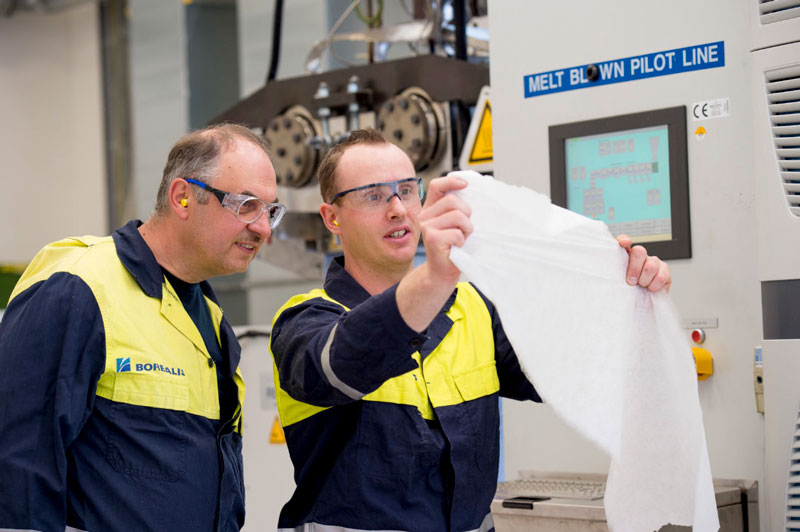
VIENNA, Austria — May 14, 2020 — Borealis announces that it has started production of meltblown fabrics for face mask applications on its unique pilot line in Linz, Austria. Borealis has managed quickly to convert the way of working from pure development to smaller scale pilot production to regularly produce rolls of fine fiber fabrics for face masks. Recently developed by Borealis, a new proprietary polypropylene (PP) meltblown resin has boosted filtration properties due to its capability for finer fibers. By exploiting a robust network of cooperation partners in the country, Borealis is helping bolster the supply of filtration media to increase face masks production.

Responding to the Covid-19 crisis with flexibility, collaboration and innovation

A broad variety of PP based meltblown fabrics might not be visible to us, but belong to our daily lives. Such advanced PP solutions for meltblown fabrics are used not only in household appliances, vacuum cleaners for example, but also air cooling and heating devices. Their crucial importance for the hygiene and healthcare industries — in particular for face masks and protective wear — has been made painfully apparent as the global coronavirus pandemic has led to dramatic global shortages of essential personal protective equipment (PPE) for healthcare workers and others.

Borealis holds a 35-year track record in PP meltblown innovations and grades, and the unique pilot line in Linz has played an important role in the development. The pilot line is now being re-purposed to help meet the need for face masks. By teaming up with value chain partners, local and regional governmental organizations and non-governmental organizations (NGOs), Borealis shows its dedication to enhance health and safety of communities in which it does business. This is done by supplying filtration fabrics for face masks in order to quickly respond to an urgent need in the region. The temporarily converted small-scale pilot testing facilities are located in the Application Hall at Borealis Innovation Headquarters in Linz. The newly developed Borealis HL912FB is being used to produce meltblown fabric to be applied for customized inlays in cotton-based mouth-nose masks, for conventional mouth-nose masks, and also for high-end face masks worn by medical professionals (FFP1 to FFP3).

Unique PP meltblown resins for filtration excellence

A typical mask is made out of spunbonded outer layers and a meltblown middle layer. The spunbonded layers provide the structure while the meltblown layer is providing the barrier properties. For high-end FFP1 to FFP3 masks, more advanced meltblown structures with extremely fine fibres are essential. Borealis offers both the unique meltblown materials and a variety of spunbond PP grades.

The well-known Borealis meltblown resins HL708FB and HL712FB are reference grades for filtration. Recently, a new resin Borealis HL912FB was introduced to the market, which can be processed at higher processing temperatures allowing the production of even finer fibers. According to in-house testing, the use of Borealis HL912FB results in a significant improvement in filtration efficiency. All three grades are manufactured at Borealis facilities in Europe and made available to customers worldwide.

“The Covid-19 pandemic has led to a sudden steep increase in the need for PPE, while supply chains are being disrupted around the globe. We would like to assure our partners that we remain the reliable supplier of advanced polymers for the manufacture of high-quality face masks and other PPE,” says Lucrèce Foufopoulos, Borealis executive vice president, Polyolefins, Innovation and Circular Economy Solutions. “True to our company purpose, ‘Life demands progress — we are re-inventing for more sustainable living’, we are offering innovative solutions like Borealis HL912FB and are re-purposing our own pilot facilities to a small-scale production line for meltblown fabrics. We have capitalised on our close collaboration with governments, NGOs and value chain partners to optimally deploy our innovation and manufacturing capabilities at the service of society.”

Posted May 14, 2020

Source: Borealis


Bed Bath & Beyond Inc. Appoints Cindy Davis As New Chief Brand Officer And President Of Decorist

UNION, N.J. — May 13, 2020 — Bed Bath & Beyond Inc. announced the appointment of Cindy Davis as executive vice president, chief brand officer of Bed Bath & Beyond Inc. and president, Decorist, effective May 26, 2020. Davis will report directly to Mark Tritton, Bed Bath & Beyond’s president and CEO.

Davis will be responsible for developing and implementing the Promise pillar of the company’s strategic growth plan. Her responsibilities will include stewardship and execution of brand strategy, as well as marketing and communications across the company’s retail banners. Davis will also support the team responsible for developing and executing the growth strategy for the company’s online interior design platform, Decorist, which provides customers with personalized home design services.

“We have continued to invest in our business and take measured steps to enhance how we serve our loyal customers throughout the COVID-19 crisis,” Tritton said. “Cindy’s arrival as chief brand officer follows a number of recent executive appointments as we establish a world class leadership team to rebuild our business and strengthen our authority in the Home space.

“Cindy has an incredible track record leading brand strategy, digital, and consumer insights for some of the largest and most beloved brands in the country and her expertise will be invaluable as we strengthen our omni-always shopping experience and deepen our relationship with customers.”

Davis will join the company from L Brands, where she currently serves as executive vice president and chief digital marketing officer, responsible for innovating marketing solutions to drive growth across brands and geographies, accelerating digital capabilities company-wide and building loyal customer relationships. Previously she was executive vice president, Consumer Experience, at Disney/ABC Television, prior to which she held strategic leadership positions at other leading retail and leisure brands, including Walmart Inc., Sam’s Club, Yum! Brands, Starwood Hotels and Hilton Hotels.

Davis said: “Our homes have never been more important to us and I am excited to join Bed Bath & Beyond at a time when it is making it easy for customers to feel at home.  I look forward to working with Mark and this outstanding leadership team to build an even stronger connection with customers in the future.”

Davis’ appointment bolsters the Company’s new senior leadership team, which also includes several recent appointments:

  • Gustavo Arnal – executive vice president, chief financial officer and treasurer
  • John Hartmann – executive vice president, chief operating officer and president of buybuy BABY
  • Joe Hartsig – executive vice president, chief merchandising officer and president of Harmon Inc.
  • Gregg Melnick – executive vice president, chief stores officer
  • Rafeh Masood – executive vice president, chief digital officer
  • Arlene Hong – executive vice president, chief legal officer & corporate secretary

Posted May 14, 2020

Source: Bed Bath & Beyond Inc.

ASICS Ventures Invests In Seevix Material Sciences, An Israeli Synthetic Spidersilk Startup

JERUSALEM — May 14, 2020 — Seevix Material Sciences Ltd. (Seevix), developer and manufacturer of man-made SVX™ spidersilk, announced today that ASICS Ventures Corp. has invested in Seevix. SVX™ possesses natural spidersilk’s extraordinary strength and elasticity and is durable, yet sustainable and biodegradable.

Seevix manufactures SVX through biomimicry in a controlled fermenter-based process to create thinner, lighter and tougher products on a commercial scale. SVX is a bioprotein functional silk with the sustainability characteristics of the natural fiber.

Seevix and the ASICS Institute of Sport Science will jointly develop sporting goods utilizing SVX spidersilk.

One of the core strategies in ASICS’s medium-term management plan — ASICS Growth Plan (AGP) 2020 — is to “Create differentiated innovation”. ASICS has continued to introduce advanced technologies into its products to improve both sustainability and functionality, and has shifted to sustainable materials, including those deriving from biotechnology, by collaborating with external partners. ASICS aims to contribute to a circular economy while creating innovative products, services, and processes that significantly change customers’ lifestyles and experiences.

Posted May 14, 2020

Source: Seevix Material Sciences Ltd.

Retailers Ask Appeals Court To Overturn California Worker Classification Law Affecting Truck Drivers

WASHINGTON — May 14, 2020 — The National Retail Federation (NRF) this week asked a federal appeals court to overturn a recently passed California worker classification law, saying the measure makes it harder for companies to contract with independent truck drivers by narrowing the circumstances under which an individual can work as a contractor rather than an employee.

“The court’s decision will have a significant impact on retailers’ ability to deliver merchandise to their stores and distribution centers across the country,” NRF Vice President for Government Relations and Workforce Development Lizzy Simmons said. “Owner-operators play an important role in maintaining a nimble supply chain. This law narrows opportunities for independent truckers, reducing flexibility in delivery and upending the retail supply chain.”

NRF, the Retail Litigation Center and the U.S. Chamber of Commerce filed a friend-of-the-court brief in the U.S. Court of Appeals for the 9th Circuit on Wednesday. The case was brought by the California Trucking Association and challenges the application of Assembly Bill 5, which took effect in January, to motor carriers.The sweeping new law codifies and expands a 2018 California Supreme Court ruling that established the state’s “ABC test,” which sets strict criteria that must be met for a worker to be classified as an independent contractor. There are about 70,000 independent truckers based in California, including many who work at ports where the bulk of imported merchandise enters the United States and others who drive beyond the state’s borders.

The brief argues that AB 5 violates the Federal Aviation Administration Authorization Act, a 1994 federal law that expressly preempts any state law or regulation related to the “price, route or service” of motor carriers and was intended to prevent a patchwork of state regulations that could undermine federal deregulation of interstate trucking.

“California Assembly Bill 5 frustrates Congress’s aims by prohibiting motor carriers from hiring the independent owner-operators they have historically relied on to transport property in American commerce, with drastic impacts on carriers’ prices, routes and services,” the brief said. “AB 5 will impose an impossible choice between violating the law, backed by potential criminal penalties, and incurring unrecoverable costs from the forced restructuring of business operations.”

The California Trucking Association won an injunction against the law in U.S. District Court earlier this year. In addition to the truckers’ lawsuit, it has been challenged by lawsuits brought by freelance journalists and rideshare companies.

Posted May 14, 2020

Source: The National Retail Federation (NRF)

Cotton And Textile Sectors Call For Collaborative Action

ZÜRICH — May 14, 2020 — The Better Cotton Initiative (BCI), The Committee For International Co-Operation Between Cotton Associations (CICCA), The International Cotton Association (ICA), The International Cotton Advisory Committee (ICAC) and The International Textile Manufacturers Association (ITMF) are unified in promoting a common set of values and shared commitment to safe trading and contract sanctity across the global cotton community. Our joint challenge today is to ensure that fair and equitable trade practices govern the commercial relationships throughout the cotton and textile supply chains. We believe that these principles have never been more important than they are now.

The loss of demand resulting from COVID-19 and the preventative measures that are being applied throughout the world affects the cotton and textile sectors from end to end. It is essential for each trading partner to be mindful of each other’s position. We must strive to find mutual agreements which keep in mind our shared commitment to the long-term health of the international cotton and textile trade, and to the principles of fair and equitable trading practices on which it is built. We encourage that all those engaged in the cotton and textile value chains jointly and collaboratively commit to:

  • Take actions that are considered and designed to contribute to the recovery of the cotton and textile sectors in 2021 and beyond;
  • Communicate, collaborate and be responsive to the needs of their counterparties;
  • Continue to respect the trade rules that govern the sectors;  and
  • Recognize and publicize positive behaviors. Identify and call out negative, counter-productive commercial behaviors.

The strong sense of community in the cotton and textile world will continue to be a source of strength. The constraints we are currently facing will pass and many of the freedoms that we are used to are likely to return before too long. We have confidence in the future of our industry.

Posted May 14, 2020

Source: The Better Cotton Initiative (BCI), The Committee For International Co-Operation Between Cotton Associations (CICCA), The International Cotton Association (ICA), The International Cotton Advisory Committee (ICAC) and The International Textile Manufacturers Association (ITMF)

Sponsors