Huntsman Completes The Acquisition Of CVC Thermoset Specialties

THE WOODLANDS, Texas — May 18, 2020 — Huntsman Corp. today announced that it has completed the acquisition of CVC Thermoset Specialties, a North American specialty chemical manufacturer serving the industrial composites, adhesives and coatings markets. Huntsman acquired the business from Emerald Performance Materials LLC, a majority-owned affiliate of American Securities LLC, for approximately $300 million, subject to customary closing adjustments. The all-cash transaction was funded from available liquidity.

The acquisition of CVC Thermoset Specialties, with its highly specialized toughening, curing and other additives used in a wide range of applications and markets, is strongly aligned with Huntsman’s strategy of growing its specialty Advanced Materials portfolio. CVC Thermoset Specialties has annual revenues of approximately $115 million with manufacturing facilities located in Akron, Ohio, and Maple Shade, New Jersey.

Scott Wright, president of Huntsman’s Advanced Materials division, commented: “These products deliver enhanced performance, such as durability, flexibility, and chemical, crack and impact resistance, in harsh environments. Its applications make vehicles, aircraft, infrastructure and electronics lighter, stronger and last longer. Not only will this acquisition strengthen Advanced Materials’ position in North America, it offers products and technologies that we intend to rapidly grow and globalize by utilizing our existing asset footprint and routes to market in Europe and Asia. We expect to achieve approximately $15 million of annualized synergies within two years.”

Peter Huntsman, chairman, president and CEO, further commented: “This acquisition provides unique technology, cost efficiency, an expanded customer base, and greater shareholder value. We look forward to continuing to expand through transactions such as this.”

Posted May 18, 2020

Source: Huntsman Corp.

Against Business As Usual: Renewing Our Commitment To A Sustainable Future with TENCEL™

LENZING, Austria — May 17, 2020 — The start of 2020 was met with different challenges due to the global COVID-19 pandemic which, alongside the impact on public health, has resulted in economic and environmental shifts. During this time, everyone must take the responsibility to keep themselves and those around them healthy and strong, given the aftermath of the virus is sure to bring further challenges.

Despite global headwinds, the TENCEL™ brand shall continue to “stay on course” through good and bad times and find ways to sustain its core DNA to promote sustainability. Last year, the brand launched multiple initiatives across the trade and consumer sector, aligning with business development goals. This year, TENCEL will continue long-term business planning to offer expertise and products across different segments, improve customer experience, and work closely with stakeholders on driving sustainability awareness and industry reforms.

Some latest TENCEL brand stories include:

TENCEL Luxe collaborates with Red Carpet Green Dress™ to unveil sustainable eco-couture textiles and custom-made gowns for Oscars 2020

TENCEL Luxe partnered with RCGD to deliver an exceptional range of eco-couture gowns for the Oscars® 2020. With high-end fashion historically lacking in naturally-sourced materials, this groundbreaking partnership is driving sustainable fashion to new heights. TENCEL Luxe is leading the charge for the future of eco-couture by meeting the increasing demand from high-end fashion brands for environmentally friendly fabric alternatives.

Lenzing introduces TENCEL Modal fibers with Eco Pure technology to strengthen sustainability commitment at Première Vision

With sustainability always front of mind, Lenzing introduced TENCEL branded modal fibers with Eco Pure technology at Première Vision. Manufactured using a chlorine-free bleaching process, textiles made of these fibers tend to be softer and are perfect for making undergarments, loungewear, bedding and more.

Lenzing bagged two awards at Transform Awards Europe for excellence in brand transformation

At Transform Awards Europe, Lenzing and branding partner Siegel+Gale, were awarded “Best Brand Architecture Solution” and “Best Visual Identity from the Engineering and Manufacturing Sector”. Lenzing was thrilled to receive the awards in recognition of the brand’s transformation and collaborative efforts.

GUESS announces sustainable Summer collection using TENCEL and LENZING™ ECOVERO™ branded fibers

Lenzing is once again excited to partner with GUESS as they continue to grow their “Smart GUESS” collection made with TENCEL and LENZING ECOVERO branded fibers. An array of styles that incorporate Lenzing’s environmentally conscious fibers have been created for men and women, demonstrating GUESS’ rapid progress in sustainability.

TENCEL encourages young designers to BEDifferent in bedding design competition to promote sustainability

The TENCEL brand launched the “BEDifferent” project, during which they asked design students from European fashion academies to create a bedding collection that expressed the future of eco-friendly bed linen using TENCEL x REFIBRA fibers. Three winners were selected for their truly unique collections that brought the “BEDifferent” campaign to life.

Italy’s ACBC put their best foot forward with sustainable shoe concept in collaboration with TENCEL

Two Italian designers came up with a solution to revolutionize footwear sustainability. Their shoe brand, ACBC, designed a “Jogger” shoe that came in two parts, the skin and the sole, connected via a patented zipper system. The biodegradable “skin” of the shoe offers wearers multiple footwear design options and is made from TENCEL branded fibers for enhanced breathability and, above all, environmental sustainability.

Fashion and sustainability unite at Neonyt in Berlin

During Neonyt, Harold Weghorst, Lenzing’s Vice President of Global Brand Management, spoke on a panel titled “SDGs X Fashion – The UN’s Fashion Industry Charter for Climate Action,” alongside industry peers. The panel discussed the charter, upcoming industry challenges and how the fashion industry can collaborate effectively to address current issues in sustainability.

TENCEL and fashion brand, LANIVATTI launches first eco-collection in Jakarta

TENCEL and fashion brand, LANIVATTI, launched an exciting collaboration for their “Beyond Borders 2020” collection in Jakarta. Eighty percent of the materials in the collection were made from TENCEL branded fibers. The grand launch event saw top influencers, fashion experts, and local media come together to celebrate the special occasion.

Posted May 18, 2020

Source: TENCEL

Magnetic Attraction Of The Latest Fully Integrated Montex®Coat Finishing Lines From Monforts

MÖNCHENGLADBACH, Germany — April 24, 2020 — A typical integrated Monforts coating line is automated from the inlet feed to the winder and includes weft straightening, the Montex®Coat coating device, Montex TwinAir drying chambers, an Eco Booster heat recovery system and a cooling zone, with visual touchscreen control via the proven Qualitex system and full Teleservice access and as well as a new hand-held device.

A number of doctor blade options are available for the Montex Coat coating unit, including air knife, roller knife, magnetic roller and foam coating, in addition to screen printing. The company also provides fully explosion-proof lines for solvent-based coatings and for high-temperature processes up to 320°C, such as for PTFE sintering.

Wide widths

There has been a notable adoption of magnetic roller coating technology, the company, which is headquartered in Mönchengladbach, Germany, notes — especially by technical textiles and nonwovens manufacturers who are finishing wide-width materials.

With this option, it is possible to carry out applications such as full PVC coatings, pigment dyeing or minimal application surface and low penetration treatments

Typical products this technology is eminently suited to range from tents and awnings, black-out roller blinds and sail cloth to automotive interior fabrics and medical disposables.

“Magnetic roller coating allows a wide range of coatings and finishes to be carried out, while being easy to handle for operators and much easier to clean at the end of the process,” explained Jürgen Hanel, Monforts’ head of Technical Textiles. “As important as anything, however, is the coating uniformity it guarantees, with no difference in tension across the entire width of the fabric — which is particularly important when companies are operating at wide widths.

With traditional dip coating systems, he adds, as well as with many standard knife coating technologies, there is always a difference in the tension — and hence the amount of pressure with which the coating is applied — between the center and the edges of the wide width fabrics being treated. With the use of a magnetic roller, there is no difference in the pressure being applied anywhere on the fabric.

“Our magnetic roller technology provides textile finishers with an expanded range of options due to the fully-adjustable positioning of the magnet within the roller,” Hanel said. “With four different magnet positions possible, the roller can be set to operate both as a direct coating system and as an indirect coater. We recommend the use of this technology for companies working with fabrics of over 2.4 meters.”

Adjusting the roller surface, rather than changing the finishing formulation, to match the required add-on and viscosity for each coating effect required, leads to much higher output from the line, he adds.

Hand-held control

Furthermore, adjustments can now be made simply and easily with the new hand-held remote controller which has recently been introduced for the Montex Coat unit.

“This is a really big help because making adjustments manually was previously quite time consuming and operators had to move between the fixed control panel and the position of the adjustment constantly,” Henel says. “It also allows an operator to check that the knife is precisely positioned by simply holding the device in the position where he or she can see and measure the gap. With the device the motors can be controlled and the necessary adjustments carried out.”

Also offered as an option for the Montex Coat is a carbon fibre roller for meeting even the highest level of coating accuracy that is being demanded by the most exacting customers today.

This provides the extreme stiffness necessary to deal with the winding tension required in the processing of materials such as prepregs for composites and other heavyweight fabrics, but at the same time, a significant improvement in coating accuracy is achieved, even for very lightweight flexible materials. In addition, the surfaces of the rollers are protected against both abrasion and damage from aggressive chemicals by a special ceramic coating.

“We continue to focus on incremental improvements to our technologies to better serve our customers — and with our Montex Coat we have a most versatile product in our portfolio.” said Monforts vice president Klaus Heinrichs.

Posted May 18, 2020

Source: A. Monforts Textilmaschinen GmbH & Co. KG

Truetzschler‘s My Mill — The All-In-One Platform For Mill Management

MÖNCHENGLADBACH, Germany — April 24, 2020 — Whether information about production, quality, maintenance or simply a complete overview — with My Mill, mill managers can fulfill any individual information need. Mill managers can now make informed, data-based decisions and generate quick wins as of day one.

Especially in times with COVID-19 it is essential to focus on the bottlenecks, stay operational and thus profitable. My Mill enables spinning mills to generate profits faster, bundle resources, optimize processes and save costs.

What if the investment in digitizing a spinning mill pays off in no time?

The current crisis forced many companies to push their digital transformation. What kept companies from digitalizing earlier could be the fear that new tools will have a negative impact on the already established processes.

With My Mill, Truetzschler put a special focus on quick wins. Not all spinning mills feature a fully equipped IT department with full-time employees. The goal is to guide customers to their focus areas intuitively and provide analyses for production, quality and maintenance that they can extend individually at any time.

Big data

An easy-to-understand data preparation makes it possible to discover optimization potentials immediately and to plan resources sensibly. Fault statistics, shift data and quality comparisons provide a solid entry point to focus on production bottlenecks and quality limiters. Notifications will appear, when attention is required, e.g. when a machine leaves its limits.

My Production – the ideal My Mill extension

The My Production app is the perfect companion for managers while on the road. They can find out about their current production with just a few touches on their smartphone – anytime and anywhere.

My Production shows an overview of the complete installation right up to detailed information on machine level. Push notifications will inform users, if any action is required.

Talk to me

Spinning mills very often feature a heterogeneous machine and laboratory environment. Data acquired in one system might be required by another system. My Mill provides the possibility of an external interface, so users can utilize the data generated by Truetzschler machines as required in their mill. In addition, My Mill can also be used for data from other manufacturers.

Cloud-based solution

In terms of cyber security, Truetzschler’s digital offers are cloud-based and extremely secure. The applications rely exclusively on the highest security standards.

Posted May 18, 2020

Source: The Truetzschler Group

ITMF’s Cotton Contamination Survey 2019: Contamination Level Up And Stickiness Level Down Compared To 2016

ZURICH — May 18, 2020 — “ITMF’s Cotton Contamination Survey 2019 shows that the level of contamination of raw cotton by foreign matters and the appearance of seed-coat fragments have increased compared with 2016, underscoring the importance of clean cotton to spinners. At the same time the level of stickiness has fallen slightly to the lowest level. Furthermore, the survey reveals that there are significant differences between cotton varieties when it comes to the level of contamination.” These are the main conclusions to be drawn from the “Cotton Contamination Survey 2019” which has just been released by the International Textile Manufacturers Federation (ITMF). This 15th edition covers 128 spinning mills located in 25 countries which evaluated 81 different cotton growths.

Contamination – increase

The level of cottons moderately or seriously contaminated as perceived by the spinning mills from around the world grew from 23% in 2016 to 26% in 2019. A closer look at the extent of the contamination shows that 7% (2016: 7%) of all cotton evaluated were seriously contaminated by some sort of foreign matter whereas 18% (2016: 18%) were only moderately contaminated. As the summary data are arithmetic averages of the different contaminants, the extent of contamination is fully illustrated by the results for the individual contaminants. They range from 6% all cottons processed being moderately or seriously contaminated by “tar” to 55% of them being moderately or seriously contaminated by “organic matter”, i.e. leaves, feathers, paper, leather, etc. Other serious contaminants are “strings made of plastic film” (39%), “fabrics made of plastic film” (39%), “strings made of woven plastic” (36%) as well as “fabrics made of woven plastic” (31%). The most contaminated cotton descriptions considered for the survey originated in India (MCU-5, J-34, India- Others, DCH), Pakistan (NAIB, Pakistan Others, MNH93), Tajikistan (Medium Staples) and Mozambique. In contrast, very clean raw cottons were produced in Australia, the USA, (Memphis Territory, California, Pima, South Eastern, Texas H. Plains and Arizona), Argentina, Brazil and Spain.

Stickiness – slight decrease

The presence of sticky cotton as perceived by the spinning mills is close to constant (i.e. 16% in 2016 vs. 15.7% in 2019) and remains at the lowest level since 1989. Descriptions that were affected most by stickiness were those from Sudan, the USA (Pima, USA-Others, Memphis Territory, Texas H. Plains, California, South Eastern), Mexico (Juarez) and Turkey (Turkey – Others). On the other end of the range, cottons from South Africa, Tanzania (Mwanza, Coastal), China (Shandong, Xinjiang), Mozambique, Chad, and Pakistan (MNH93, Pakistan – Others, NAIB) were not or hardly affected by stickiness.

Seed-coat fragments – increase

With regard to seed-coat fragments, the Cotton Contamination Survey 2019 shows that their appearance in cotton growths remains an issue for spinners around the world. 34% of all cotton growths consumed contained moderate or significant amounts of seed-coat fragments, a slight increase since 2016 (32%). The origins affected most by seed-coat fragments are those from Turkey (Turkey – Others, Cukurova / S.E.), India (India-Others, J-34, MCU-5), Sudan (Sudan – Others), and Pakistan (MNH93, Pakistan – Others). Countries for which the existence of seed- coat fragments were negligible included those from Tanzania (Coastal, Mwanza), India (Shankar-4/6), Australia, the USA (California, Pima, Memphis Territory, USA – Others, Texas H. Plains).

Posted May 18, 2020

Source: International Textile Manufacturers Federation, (ITMF)

Luxury Custom Clothier Adrian Jules Digitizes Its End-To-End Workflow With Gerber Technology

NEW YORK CITY — May 18, 2020 — Adrian Jules Ltd., an established bespoke design house and tailoring outfit based in Rochester, N.Y., has transformed their 55-year-old business offering the finest hand-made garments in America through a deep and personal partnership with Gerber Technology, the industry leader in the apparel and textile technology space, by digitizing their entire process — from design to cutting — by integrating Gerber Technology’s AccuMark® 3D & 2D CAD software, Gerber’s AccuNest™, and the GERBERcutter® Z1 for production-ready, made-to-measure garments.

Darren Beaman, senior director of Technical Design and production director, outlined how they transformed their business and found the ultimate balance between old-world tradition and cutting-edge technology including 3D. With a 10-percent savings in material utilization and 75-percent time savings for faster manufacturing productivity, Adrian Jules sees embracing technology as a no-brainer. Beaman added, “we’ve gone from 20 samples per year, down to 5,” representing a significant cost savings for the company.

3D has not only been instrumental in bringing the business into a brand-new technological era, but it has also been crucial to operations due to the present day geopolitical challenges of COVID-19. In a matter of days, Adrian Jules was able to convert to mask and PPE production — all with the aid of AccuMark 3D. Thanks to embracing Gerber’s end-to-end technology, Beaman was able to bring Adrian Jules to the front lines of the important fight against the current pandemic.

“55 years ago we used paper, pencil and old wooden rulers … now, we’re using the most innovative technology available to the industry. For someone who is a technical director, this is very exciting for me” Beaman said, commenting on their success in adopting Gerber’s suite of end-to-end solutions. “We’ve been working with Gerber for over five years. I feel privileged to be part of the Gerber family and am excited to see AccuMark 3D and it is so easy to use.”

Adrian Jules now attributes their success to being a tech-forward company, while still maintaining the core values put in place by its founder generations ago.

Gerber Technology offers end-to-end solutions for soft goods and apparel manufacturers looking to save money, time, and the environment. With over 50 years of experience, Gerber has come to be known as the go-to-market leader for companies looking to effectively digitize and connect the entire supply chain, all the way from design, product development, and production to retail. Mary McFadden, vice president, CAD Product Management at Gerber Technology, noted that “Gerber and Adian Jules are the perfect pairing of talent, as well as tradition, with over 100 years of combined industry experience and backgrounds in traditional manufacturing.”

Speaking to the tradition of excellence at Adrian Jules, Alexa Roberti, director of sales, explained: “My grandfather started this company with the dream of delivering the finest hand made garment in America, and that’s actually our mission statement today.” Roberti also stated that “we are proponents of technology here at Adrian Jules, and we really see Gerber’s AccuMark 3D assisting not only in sustainability but giving us flexibility when we need to develop patterns.”

Posted May 18, 2020

Source: Gerber Technology

INDA Supplements World Of Wipes® Conference With New Virtual Option: Experience Conference Presentations Online

CARY, N.C. — May 18, 2020 — INDA, the Association of the Nonwoven Fabrics Industry, announces the addition of a “virtual” registration option for its World of Wipes® (WOW) International Conference August 24-27 in Minneapolis, Minn. WOW will enable those not able to be there in person to experience the full educational program of this important industry event.

Virtual WOW offers wipes professionals a unique website link that will contain each speaker’s presentation with audio and visuals to replay at any time. Details for both Virtual WOW and in-person WOW registration information is available on  www.worldofwipes.org/register.html. 

Content of the 14th edition of the World of Wipes is focused on breakthrough wipe technologies, buyer demographics, sustainability, industrial and flushable wipes, substrates, preservatives, single use plastics, and strategy-setting market intelligence. Presentations will also address industry changes prompted by COVID-19.

“While nothing can replace the value of face-to-face meetings and we look forward to seeing the industry reconvene in person, Virtual WOW is an option for our industry members who cannot attend in person yet want the benefit of the highly relevant program content,” said Dave Rousse, INDA president. “Virtual participants will hear and see each speaker’s presentation and slides as if they were sitting in a front row conference seat. We’re adapting to the “new normal” to better serve the dynamic wipes industry. With this Virtual WOW option, no one should miss this exciting event.”

WOW 2020 will connect senior-level wipes professionals during four value-packed days combining relevant technical and educational content with business engagement opportunities.

Over 400 senior-leadership participants attended WOW in 2019. For the full conference agenda and full line-up of industry speakers, visit: www.worldofwipes.org/conference.php

Preceding the conference, INDA’s WIPES Academy will be led by instructor Chris Plotz, Director of Education & Technical Affairs, INDA, August 24-25. The WIPES Academy is the first and only comprehensive wipes training for the entire wipes supply chain.

Posted May 18, 2020

Source: INDA, the Association of the Nonwoven Fabrics Industry

UniFirst Corp. Continues Hygienically Clean Food Safety Certification Commitment

ALEXANDRIA, VA — May 15, 2020 — UniFirst Corp.’s Tulsa, Okla., and Goldsboro, N.C., laundries have recently qualified to renew their Hygienically Clean Food Safety certifications. This accomplishment reflects UniFirst’s commitment to best management practices (BMPs) in laundering as verified by on-site inspection and their capability to produce hygienically clean textiles as quantified by ongoing microbial testing. UniFirst currently has 55 laundries that hold this certification; their locations are (one in each state except where noted): Ariz.; Calif. (four); Colo.; Conn.; Fla. (three); Ga. (two); Ill.; Kan. (two); La.; Mass. (two); Md. (two); Maine (two); Mich., Mont., N.C. (four); N.H. (two); N.J.; Nev.; N.Y. (two); Ohio; Okla.; Ore.; Pa. (two); S.C. (two); Texas (seven); Utah; Va.; Wash.; and Wis. Canadian provinces represented are Alberta (two) and British Columbia.

The Hygienically Clean Food Safety certification confirms the laundry’s dedication to compliance and processing garments and linens using BMPs as described in its quality assurance documentation, the focal point for inspectors’ evaluation of critical control points (CCPs) that minimize risk. The independent, third-party inspection must confirm essential evidence that:

  • Employees are properly trained and protected;
  • Managers understand legal requirements;
  • OSHA-compliant; and
  • Physical plant operates effectively.

To maintain their certification, laundry plants must pass quarterly testing of outcome-based microbial testing, indicating that their processes are producing Hygienically Clean garments and other reusable textiles with diminished presence of harmful bacteria. Testing ensures that as laundry conditions change, such as water quality, textile fabric composition and wash chemistry, laundered product quality is consistently maintained. This process eliminates subjectivity by focusing on outcomes and results that verify textiles cleaned in these facilities meet appropriate hygienically clean standards and BMPs for animal processing, dairies, fruit/vegetable, bakeries, grain and other food and beverage industry segments.

Hazard Analysis and Critical Control Points (HACCP) practices are examined in the Hygienically Clean Food Safety inspection process, evaluating the plant’s techniques for:

  • Conducting hazard analysis;
  • Determining CCPs, monitoring their control, correcting them if not under control;
  • Validating and verifying HACCP system effectiveness; and
  • Documenting and record-keeping to show ongoing conformance.

On-site inspections also evaluate practices relevant to handling and processing textile products used in food manufacturing/processing establishments for adherence to U.S. Food and Drug Administration (FDA) and Centers for Disease Control and Prevention (CDC) directives. Introduced in 2014, Hygienically Clean Food Safety brought to North America the international cleanliness standards for laundering garments and other textile products for food manufacturing used worldwide by the Certification Association for Professional Textile Services and the European Committee for Standardization.

“More and more, we’re seeing our customers in food-related industries looking for third-party validation that our specialized Product Protection Process and our Hygienically Clean standards are consistent with HACCP and GFSI guidelines,” said Adam Soreff, director of marketing and communications at UniFirst Corp., Wilmington, Mass. “Working with a Hygienically Clean Food Safety certified laundry helps reassure them that their managed unif

Posted May 15, 2020

Source: TRSA

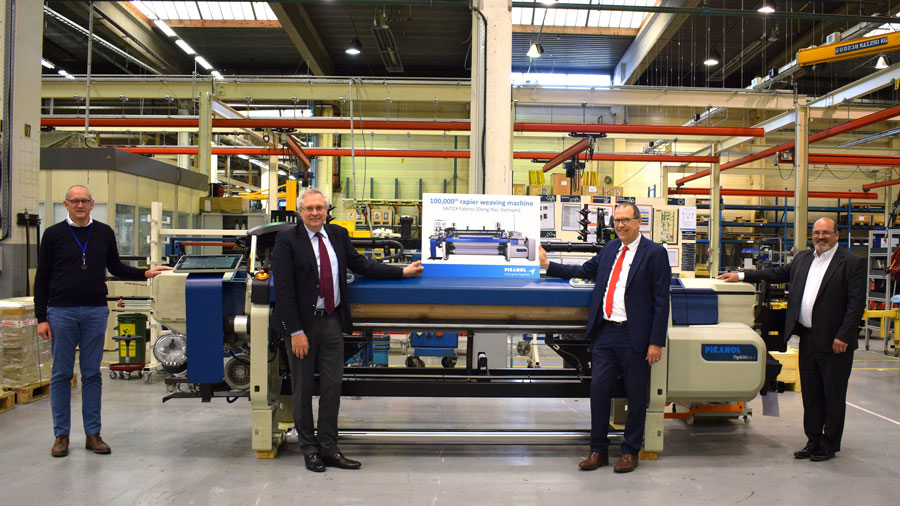
Picanol Reaches Production Milestone With 100,000th Rapier Weaving Machine

IEPER, Belgium — May 15, 2020 — This week, Picanol realized a milestone when its 100,000th rapier weaving machine rolled off the production line at its plant in Ieper, Belgium. Picanol is also celebrating 45 years of manufacturing rapier weaving machines in 2020. Once again, this reaffirms the leading role Picanol plays in the rapier weaving machine segment worldwide. The 100,000th rapier weaving machine — an OptiMax-i — will be shipped this week to the company SAITEX Fabrics, which is based in Long Tho, Vietnam.

Picanol has an extensive track record in the production of high-tech rapier machines. In 1975, it launched its very first weaving machine with a rapier insertion, which was named the PGW. Since the launch of the first rapier machine all that time ago, Picanol has introduced various new generations of rapier machines. These include, among other machines, the GTM in 1983, the Gamma in 1996, the GamMax in 2002, and the OptiMax and the GT-Max in 2007. Its current flagship rapier weaving machines — the OptiMax-i launched in 2015, and the GTMax-i 3.0 launched in 2018 — cover a complete range of applications.

“The fact that the 100,000th machine mark has been reached now represents a sign of hope and optimism during this COVID-19 time,” said Johan Verstraete, vice president, Weaving Machines. “Our people are working hard to build, install and service weaving machines, even under these extraordinary circumstances — and this is taking place while simultaneously respecting all of the measures needed to ensure safe and healthy working conditions. We have every reason to be proud of the fact that we have produced 100,000 rapier weaving machines and we are extremely grateful to all of our employees who have made this possible. Achieving this milestone once again demonstrates our ability to produce best-in-class, dedicated weaving machines for the world’s most reputable textile manufacturers. In addition, this is further proof of the confidence that our customers have in the Picanol brand, its quality and its rapier technology. By working in close cooperation with our customers, even in these challenging times, we will grow together!”

Posted May 15, 2020

Source: Picanol

A New JEC Innovation Award With Hexcel’s Support

STAMFORD, Conn. — May 14, 2020 — Hexcel is pleased to announce its role as materials development partner for the Institut de Soudure Group’s winning JEC project — the Innovative Solutions for Welding (ISW) of Thermoplastic Composites.

ISW is a novel solution co-developed and patented by both the Institut de Soudure Group (IS Group) and Arkema, providing high-performance welding for thermoplastic composites. Hexcel congratulates the two companies that were announced as the winners of the Aeronautics Category at the JEC Innovations Awards ceremony yesterday.

Hexcel and strategic alliance partner Arkema provided high-performance carbon fiber reinforced thermoplastic polyetherketoneketone (PEKK) materials for the high-quality welding targeted by the ISW process. ISW can also be applied to any other TP matrix — from polyamide to polyaryletherketone (PAEK) — and fibers such as glass or aramid.

Developed to meet challenging performance and cost targets for thermoplastic composites in high-rate primary aerostructures, the innovative ISW solution should allow weld joint performances of approximately 85 percent compared to the co-consolidated reference, without any remaining heat transfer material or strip at the weld line after the operation.

In 2019, initial evaluations of the ISW solution were carried out at major OEM project partners Stelia Aerospace and Latecoere. From 2020 forward, the focus will be on maturing the new technology and bringing it to qualification in specific aeronautics projects.

Posted May 14, 2020

Source: Hexcel Corp.

Sponsors