It is no secret that those U.S. yarn manufacturers and fabric makers that have the capability to produce personal protective equipment (PPE) have weathered the COVID-19 pandemic better than many others in the textile industry.
Many companies came together and focused on producing face masks, isolation gowns and other medical textiles to help keep front-line healthcare workers, emergency responders and other essential personnel safe.
The problem is, however, that overall U.S. PPE production capacity trails behind some other countries and falls well short of meeting domestics needs. “It is not good when, in a time of national crisis, we have to rely on companies in China and other nations to provide us with critical life-saving apparel and accessories,” said a well-placed industry analyst. “We must learn a valuable lesson from the current pandemic and prepare not to be caught short again.”
To that end, the National Council of Textile Organizations (NCTO) recently launched a paid social media video campaign that highlights the extraordinary efforts the industry has taken to respond to the PPE shortages.
“NCTO is launching a social media and email campaign today to show members of Congress how this industry has significantly contributed to the nation’s PPE crisis, while demonstrating the importance of immediate policies and legislation, such as Buy American mandates, to establish a sustainable domestic supply chain for the future,” said NCTO President and CEO Kim Glas.
“Our campaign underscores the importance of ending our overreliance on China for PPE and calls on Congress to craft policies that support domestic procurement requirements and the onshoring of jobs,” Glas added. “It is high time we had a national strategic plan in place to spur investment in the industry and ensure our country has a permanent domestic PPE supply chain to confront the next pandemic our country faces.”
Accordingly, NCTO has recommended Congress enact several policies that support the production of PPE in the United States through a long-term domestic supply chain:
Create strong domestic procurement rules for federal PPE purchases substantially similar to the Berry Amendment and the Kissell Amendment. The Berry and Kissell Amendments require the U.S. Department of Defense and Homeland Security to purchase American-made textile products for certain applications.
Implement forward-looking policies to shore up the Strategic National Stockpile and to identify, incentivize, and maintain a robust domestic supply chain for PPE and medical supplies.
Create federal incentives for private sector purchases of domestically produced PPE.
Provide funding assistance for companies to reconstitute domestic PPE supply chains.
Strengthen the Berry Amendment.
Several manufacturers and institutions have already begun exploring how to increase U.S. PPE production. For example, Gaston College’s Textile Technology Center (TTC)
is partnering with others in the community to create a launch pad for prototyping and testing reusable PPE products for entrepreneurs and existing manufacturers. The project has been funded by the North Carolina Legislature.
More than $5 million will be allocated to Gaston County to construct an Incubator and Extrusion Center for Advanced Fibers for Gaston College’s TTC. “I’m excited about this new initiative and the building of a new fiber innovation center,” said Dr. John Hauser, president of Gaston College. “Now we have an opportunity to expand our expertise to produce high-quality products to benefit our communities.”
Achieving Greater Productivity, Profitability
While COVID-19 issues still dominate the news, U.S. fiber/yarn/fabric makers continue to seek innovative ways to increase efficiency and productivity. A recent example is the introduction by Cotton Council International of a technical consultancy program that helps mills and manufacturers achieve greater productivity, process efficiency and, ultimately, profit for their businesses.
The program is called Cotton USA Solutions™ and is designed to help enable mills and manufacturers to optimize the use of U.S. cotton with cutting-edge offerings to profitably transform their businesses.
Jordan Schindler and Huntley Bossong cut the ribbon to officially open the Nufabrx Innovation Center.
By Jim Kaufmann, Contributing Editor
Conover, N.C.-based Nufabrx recently held a ribbon cutting ceremony to formally christen its new Innovation Center, which is located at manufacturing partner Bossong Hosiery Mills in Asheboro, N.C. Jordan Schindler, Nufabrx founder and CEO, and Huntley Bossong, president of Bossong Hosiery Mills, cut the ribbon together to signify the opening. Tours of Bossong’s manufacturing area and the Innovation Center, where a table display of Nufabrx’s current product offerings were on display, followed along with a luncheon featuring a presentation by Schindler focused on the Nufabrx journey.
Founded in 2011, Nufabrx developed a proprietary biomaterial platform that embeds active ingredients into textiles. The company produces treated yarns at its Conover location at the Manufacturing Solutions Center (MSC), while simultaneously developing product applications specific to each yarn’s performance properties. Embedded active ingredients include medications, supplements and vitamins, which respond to temperature and moisture and are released when in contact with the wearer’s skin. Schindler spoke very highly of his collaboration with MSC: “We would not be where we are today without the connections and talents that MSC afforded us.”
Schindler explains how Nufabrx’s Soliscia mask is knit.
The Innovation Center at Bossong is configured as a clean room with the appropriate control systems. It expands Nufabrx’s production capability as well as shortens the production cycle and increases speed-to-market for its products.
Bossong Hosiery was founded in 1927 and has been actively participating in developing and producing the Nufabrx branded products, which it also packages and ships. Current offerings include a variety of branded compression sleeves with capsaicin for pain relief and the new Soliscia reusable face mask. Products in development include athleisure garments and maternity wear.
Bossong’s Medical Division is ISO 13485 certified and FDA registered for Class 1 and 2 medical devices, which helps Nufabrx maintain a controlled process from the application of its proprietary technology to the yarn throughout manufacturing, final assembly of finished product and packaging.
A selection of Nufabrx products
“We work well together, and it’s really developed into a true partnership,” Schindler said of the growing relationship with Bossong, now in its second year. “The Soliscia mask is a great example of this partnership as it literally took 48 hours to turn this mask from a concept idea into a viable product ready for manufacturing.” The new mask is a multi-layered, knit-to-shape construction. It features Nufabrx shea butter yarns to improve comfort and wearability, as well as CuTEC® copper yarns to deter bacterial growth.
When asked about future opportunities, Scott Fogleman, Nufabrx’s vice president of product and technical innovation, offered: “With this technology, the possibilities are endless!”
Wilmington, N.C.-based PolyQuest Inc. reports it will invest in its Darlington, S.C., polyethylene terephthalate (PET) recycling operation. The expansion, including at least one recycled PET (rPET) resin line, is in response to demand for post-consumer rPET. The line is expected to be operational by the third quarter of 2021. PolyQuest serves the fiber, bottle, film, strapping and sheet PET markets with its amorphous, crystallized and solid-state rPET resins.
“This additional investment is ultimately driven by our customers’ commitments to sustainability,” said John Marinelli, PolyQuest CEO. “They have entrusted PolyQuest
with their current and future post-consumer rPET resin supply requirements. As such, we have chosen to pro-actively expand our recycle capabilities to support their strategic sustainability initiatives and stay ahead of the curve.”
Tokyo-based Toray Industries Inc. has introduced Ecodear Nylon, a product made using sebacic acid sourced from castor beans. Toray reports the nylon is 60-percent biobased and makes it possible for the company to manufacture biobased versions of its established Entrant® and Dermizax® fabrics. Ecodear Nylon initially is available in 10, 20 and 50-denier versions, and may be spun using conventional nylon processes. According to the company, the nylon exhibits the same durability and soft hand customers would expect from a nylon yarn. The yarn is targeted to the active outdoor sports and skiing markets, and athleisure. Ecodear Nylon will be available through New York City-based Toray International America Inc.
Needled carpeting manufacturer Foss Floors, Rome, Ga., has ordered its fourth complete production line from Germany-based DILOGroup. The line features fully automatic fiber blending from Dilo Temafa, carding from Dilo Spinnbau, high-speed crosslapping, pre-
and finish needling, and the specialty DI-LOOP machine.
Dilo reports the tailor-made line will have large production capacity at high fiber throughput rates and is designed for final product widths more than 6 meters.
DiloGroup, as the general contractor, will deliver, assemble and commission the DI-LOOP line.
Helsinki-based Suominen has added BIOLACE® Pure for wipes applications to its Biolace product line. According to the company, the chemical binder- and plastic-free product is made using “biodegradable, compostable, and renewable plant-based and wood pulp from certified forests.” The wipe will be commercially available in 2021.
“BIOLACE Pure offers our customers a unique, sustainable option that does not compromise on the most important features needed for a perfect wet wipe,” said Marika Mäkilä, manager, marketing and category management, Europe.
“Its three-layer solution guarantees optimal liquid management and the soft outer layers ensure that the wipe cleans effectively, yet softly.”
Switzerland-based Uster Technologies has introduced the Uster® Jossi Vision Shield N fiber cleaning system specifically adapted for high-output man-made nonwovens producers. The fiber cleaner is configured with built-in spectrascopes that look for the typical contaminants found in nonwovens including metal, wood particles, grease deposits or colored fibers. The
spectrascope operates on a greater wavelength than a conventional color camera and can detect “invisible” contamination in the infrared and ultraviolet light range as well as contamination the same or similar shade to the fibers as fine as a human hair, according to Uster.
“It is important to ensure a minimum of good fiber is lost. Trials have shown that the advanced Uster technology results in about 75-percent less waste comparing with other fiber cleaners — saving tons of raw material every year,” said Giacomo Frattesi, product manager, Uster Technologies.
“The combination of Uster Jossi Vision Shield N and Uster EVS FabriQ Vision N means that
Uster can offer a complete quality monitoring solution for the nonwovens industry,” Frattesi said.
Face coverings for use by the general public come in many shapes, sizes and materials. (Image Mona El Falaky/Pixbay)
AATCC has introduced a face covering standard — AATCC M14-2020, Guidance and Considerations for General Purpose Textile Face Coverings: Adult — based on the work of an ad-hoc industry group.
By Diana A Wyman
Face coverings are now required or recommended in many areas. Regardless of personal or political opinions, there is a growing demand for these items. To meet this vital need, manufacturers — and consumers — need clear guidance on the function and expected performance of general use face coverings.
Throughout April and May 2020, a group of industry stakeholders met to compile this much-needed guidance. The group included representatives from manufacturing, testing, and research organizations. They drew from their combined knowledge of medical personal protective equipment (PPE), textiles, and regulations as well as face covering standards published for France, China and Belgium, among other countries.
To make the document as widely accessible as possible, the group submitted it for ballot as an AATCC standard. The American Association of Textile Chemists and Colorists (AATCC), Research Triangle Park, N.C., is already well-known for publishing standard test methods, procedures, and monographs for the textile industry. By the end of July, AATCC’s Executive Committee on Research approved the document as AATCC M14-2020, Guidance and Considerations for General Purpose Textile Face Coverings: Adult. The standard is now available as a free download from the AATCC website.
One of the main drivers in developing what became AATCC M14 was practicality. The goal was to deliver something that was easy to understand and provided useful guidance to the myriad of manufacturers who were willing to pivot operations to fill the face covering need, but whose expertise lay elsewhere. Tests and requirements in AATCC M14 were kept as simple and accessible as possible.
A figure included in AATCC M14 shows that a face covering should be worn in direct contact with the skin along the entire perimeter as indicated by the dotted red line. (Image courtesy of AATCC)
What’s Covered (No Pun Intended)
The title and scope of AATCC M14 includes some important limitations. The guidance applies only to general use face coverings such as a face covering someone may wear to the grocery store or office, and not to a more specialized mask or respirator prescribed for medical or occupational use. The term face covering is used intentionally to help differentiate general use face coverings from medical face masks. Both terms are clearly defined in the AATCC M14 standard.
The AATCC M14 title also specifies that the guidance is for textile face coverings including woven, knitted and nonwoven constructions. The standard does not address face coverings or face shields made of cast or molded plastic, metal or other non-textile materials.
Finally, AATCC M14 is for adult face coverings. While most of the same recommendations also apply to child face coverings, there are additional regulatory and practical considerations that must be addressed for children’s items.
The AATCC M14 guidance is voluntary — except for the applicable regulations cited — but all face covering manufacturers are strongly encouraged to follow the recommendations for design and testing. Specifiers and regulatory bodies also may require that the face coverings they purchase or approve meet some or all the AATCC M14 guidelines. Even before the standard was officially published, the Atlanta-based Centers for Disease Control and Prevention (CDC) did just that when soliciting strategies to reduce the spread of COVID-19 in a Broad Agency Announcement (BAA 75D301-20-R-68024). In the BAA, the CDC noted that proposals should “consider cloth face covering designs that address some of the features identified in the draft AATCC Guidance and Considerations for General Purpose Textile Face Coverings.”
Regulatory Considerations
Applicable regulations provide manufacturers a clear understanding of what they must do to legally sell a face covering in the United States or Canada. Regulations for other countries are not explicitly enumerated in AATCC M14 because it would require an extremely long list and constant updates; however, the general categories are similar for many countries — flammability, fiber content, care instructions and possibly toxic substance analysis.
An air permeability tester can be used to evaluate the breathing resistance of face covering materials. (Image courtesy of SDL Atlas LLC)
Design Considerations
Some sections are less clear-cut. The standard’s authors wanted to provide practical options without restricting design or material selection. To be effective, a face covering must cover the wearer’s nose and mouth with minimal gaps. The dimensions required to achieve a proper fit obviously vary based on the wearer and the type of face covering. AATCC M14 includes resources for average head and face measurements, but allows flexibility for those developing face coverings to fit specific populations or size ranges.
Other sections of the standard take a similar approach. There are examples of fabrics and constructions likely to perform well and examples of those to avoid. For a manufacturer not sure where to start, the suggestions may save valuable time and money that might otherwise be wasted on numerous failed iterations.
While the testing recommendations may be a challenge for small manufacturers, even home sewers can benefit from the material and design considerations included in AATCC M14. Consumers also may consult these sections for help in choosing a face covering for personal use.
Performance Testing
AATCC M14 recommends several tests to evaluate the effectiveness of a face covering. Particle filtration and breathing resistance are the most important properties to be considered. The recommended test methods are ones already in use for other applications so laboratories should be equipped and trained to perform such tests. The methods are the same or similar to tests specified for face coverings to be sold in Europe, simplifying things for multinational manufacturers.
Research
As AATCC M14 was under development, limited quantitative data on the effect of face coverings on the spread of COVID-19 was available. However, research continues and though there is much still to be learned, most current research agrees:
Airborne transmission is common. People are more likely to contract COVID-19 from inhaling contaminated air than by touching a contaminated surface.3&5
Asymptomatic and presymptomatic individuals are a significant source of transmission. Multiple studies suggest that more than half of interhuman transmissions is from those who don’t appear sick and may not even know they are infected.1
Face coverings are an important tool for reducing transmission from infected individuals. A recently published paper concludes that a face covering “corresponds to the most effective means to prevent interhuman transmission” though the authors — and most experts — note that face coverings should be used in conjunction with social distancing and other strategies.5
The CDC emphasizes the role of face coverings in “source control” and research seems to support this idea. The primary function of a general use face covering is to reduce the spread of respiratory droplets from the wearer’s nose and mouth.
Face coverings work because viruses travel on respiratory droplets. These droplets leave the body every time a person breathes, coughs, speaks, sings or sneezes. With no barrier, the virus-containing droplets evaporate to aerosolized particles and can float through the air for more than 12 hours, contaminating surfaces or people they meet along the way.3
Most of what leaves the mouth is relatively large droplets that are easily trapped by a textile face covering. These droplets don’t have a chance to become the longer lasting aerosols or to float away. Even slowing the droplets can have a beneficial effect as they won’t travel as far before falling to the ground. As noted above, individuals may be carrying the virus without even knowing, so a best practice is for everyone to contain his or her droplets just in case!
Of course, some face coverings contain droplets more effectively than others. Several recent studies have looked at different factors, but the variety of test methods employed makes it difficult to compare results or generalize conclusions. Common sense says that a tighter construction with smaller spaces between yarns and fibers is better. But there are other considerations. Hydrophilic fibers and fuzzy fibers with high surface area can also help trap droplets. Triboelectric charging — for example, rubbing a latex glove on a polyester or polypropylene fabric may also help.6 Fit is critical, but this is difficult for a manufacturer to control. Ultimately, consumers must understand the importance of face covering fit and how to achieve the best fit.
It is important to note that most textile face coverings are not designed to filter viruses out of the air a wearer inhales, and the evidence of efficacy for this purpose is less compelling. It is much easier to prevent infected droplets from entering the environment than to filter them out once present.
Because general use face coverings are intended to prevent droplets from entering the atmosphere, they should not include a one-way valve.1 Such valves are used in some respirators to filter incoming air and freely expel air as the wearer breathes out. For general use face coverings, it is the outgoing air that needs to be restricted.
In general, better droplet and/or particle filtration means higher breathing resistance — which means it is more difficult to breathe — but very few studies found any textile material that significantly restricted breathing, even with numerous layers. Greater surface area, with the same breath volume, means less pressure. It will be easier to breathe through the face covering and wearers won’t be as likely to inadvertently create gaps at the sides of the face covering.1
In June 2020, the World Health Organization (WHO) updated its recommendations regarding use of face coverings.4 Although WHO is still noncommittal about the use of face coverings for the general public, it does offer some very specific advice for construction of non-medical face coverings. Materials should provide good filtration efficiency and breathability, properties also addressed by AATCC M14. WHO and AATCC M14 both recommend avoiding coatings that can interfere with breathing and ensuring a close fit at the edges to avoid leakage. WHO requires a minimum of three layers while AATCC M14 suggests two to three layers. As noted above, general use face coverings are intended to contain respiratory droplets, so both WHO and AATCC M14 highlight the importance of selecting inner and middle layers that absorb and/or hold these droplets. WHO guidance suggests an outermost layer made of hydrophobic material “which may limit external contamination from penetration through to the wearer’s nose and mouth.” Aside from research showing minimal effectiveness of most textiles for this type of filtration, there is evidence that the virus survives longer on hydrophobic materials.2 This means wearers must be especially careful about touching the outside of such face coverings while wearing or removing them.
As new research is performed and published, there will undoubtedly be more precise recommendations regarding the best materials and design for face coverings. Hopefully, there will also be simpler, quicker, or more accurate ways to evaluate face covering performance.
Next Steps
While the first version of AATCC M14 was developed by an ad-hoc industry group, future revisions and related standards will be developed by AATCC committee RA113 Emerging Technologies Test Methods. As with all AATCC committees, participation is open to all interested parties.
“The first task the committee will be working on is to develop a guideline for children’s face coverings that provides considerations in regulatory compliance, material selection, performance standards and evaluation methods, design and care instructions, and any other related aspects,” said Committee Chair Min Zhu, SGS North America. The committee is currently focusing on face coverings but will evolve as new industry demands arise. “The specific scope of work will change as new issues emerge due to the increasing uncertainty of the market,” Zhu explained. “The committee is aiming at developing new test methods or providing industry guidance in a timely manner to help textile industry stakeholders respond to ever-changing challenges with more resources.”
Related Efforts
In addition to the new AATCC M14 standard, AATCC provides several test methods and materials in high demand for medical PPE testing. The standards are currently available at no cost.
In July, ASTM International subcommittee F23.65 on Respiratory opened a new work item (WK73471) to develop a new specification for barrier face coverings. F23.65 is part of committee F23 on Personal Protective Clothing and Equipment. The title and scope of the specification is still under discussion, but the intent is to define minimum requirements allowing manufacturers to certify that a product “Meets ASTM FXXXX.” The basic criteria of fit, filtration, and breathing resistance are similar to those cited in AATCC M14, though different test methods are used, including a new leakage factor test currently being developed by the same ASTM subcommittee.
There are several other general use face covering standards currently in use around the world. AFNOR SPEC S76 was one of the first to be published in March 2020. This French standard includes sample patterns and construction procedures. It also includes wearer instructions for use and care of face coverings. AFNOR SPEC S76 forms the basis of several other documents, including the European guide CWA 17553. China, Korea, and other countries have also published national standards or guides. As of August 2020, there are no required criteria for general use face coverings in the United States. Manufacturers should refer to voluntary industry guidelines such as AATCC M14, along with current research and the latest advice from relevant government agencies.
References:
1 Kahler, C. J., & Hain, R. (2020, May). Fundamental protective mechanisms of face masks against droplet infections. Journal of Aerosol Science. Retrieved from https://www.researchgate.net/publication/342693523_Fundamental_protective_mechanisms_of_face_masks_against_droplet_infections
2 Lai, M. Y., Cheng, P. K., & Lim, W. W. (2005, October). Survival of severe acute respiratory syndrome coronavirus. Clinical Infectious Diseases, pp. e67-e71. Retrieved from https://pubmed.ncbi.nlm.nih.gov/16142653/
3 Prather, K. A., Wang, C. C., & Schooley, R. T. (2020, June 26). Reducing transmission of SARS-CoV-2. Science, pp. 1422-1424. Retrieved from https://science.sciencemag.org/content/sci/368/6498/1422.full.pdf
4 World Health Organization. (2020, June 5). Advice on the use of masks in the context of COVID-19: Interim guidance. World Health Organization. Retrieved from World Health Organization: https://apps.who.int/iris/rest/bitstreams/1279750/retrieve
5 Zhang, R., Li, Y., Zhang, A. L., Wang, Y., & Molina, M. (2020, June 30). Identifying airborne transmission as the dominant route for the spread of COVID-19. PNAS, pp. 14857-14863. Retrieved from https://www.pnas.org/content/117/26/14857
6 Zhao, M., Liao, L., Xiao, W., Yu, X., Wang, H., Wang, Q., . . . Cui, Y. (2020, June 2). Household Materials Selection for Homemade Cloth Face Coverings and Their Filtration Efficiency Enhancement with Triboelectric Charging. Nano Letters, pp. 5544-5552. Retrieved from https://pubs.acs.org/doi/10.1021/acs.nanolett.0c02211
Editor’s Notes: Diana Wyman is executive vice president of the Research Triangle Park, N.C.-based American Association of Textile Chemists and Colorists (AATCC). Individuals interested in AATCC committee RA113 Emerging Technologies Test Methods can find out more or submit an application at aatcc.org/testing/committees. Additional information, updates, and resources related to COVID-19 are posted at aatcc.org/covid.
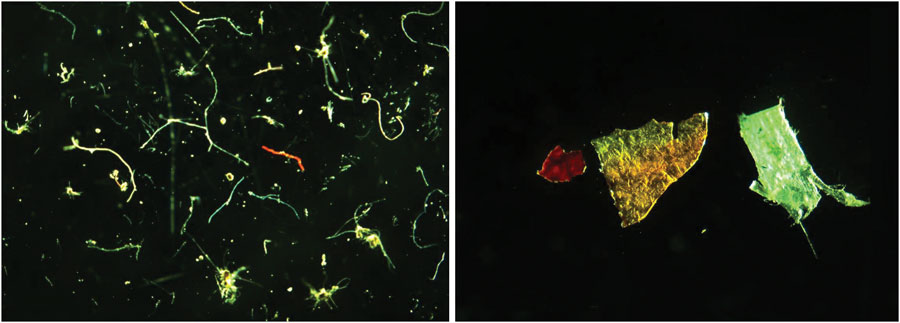
Microplastic fibers (left) and microplastic fragments (right) both from Tyrrhenian Sea seafloor cores at a depth of approximately 800 meters.
The textile industry can work together to formulate solutions to tackle to complex issue of microplastics in the environment.
By Dr. Davis Lee, Dr. Erin Kirkpatrick, Dr. A. Sydney Gladman and Dr. Donald Ripatti1
Microplastics are a growing concern for the textile industry, compounding the complexities of the broader sustainability discussion. Yet, there is much to be discovered about this multifaceted issue, and how to best respond to it.
At present, there is no broad-based agreement on a single definition for microplastic. The National Oceanic and Atmospheric Administration (NOAA) defines micro plastics as “plastic pieces less than 5 millimeters [mm} long which can be harmful to our ocean and aquatic life.” 2
The European Chemicals Agency (ECHA) are more specific in its proposed definition:
“‘microplastic’ means particles containing solid polymer, to which additives or other substances may have been added, and where ≥ 1 [percent] w/w of particles have: (i) all dimensions 0.1 µm [micrometers] ≤x ≤ 5 mm, or (ii) for fibers, a length of 0.3µm ≤ x ≤ 15 mm and length to diameter ratio of >3.” 3
The study of marine microplastics is not new. Woods Hole Oceanographic Institution (WHOI) has been conducting research and publishing on this subject since the 1970s.4 Other organizations have been active as well. For instance, the Science Advice for Policy by European Academies (SAPEA) consortium has published an extensive review pointing out the need for standardization and harmonization of testing methodologies. SAPEA states that there is “no evidence of widespread risk to human health from [nano/micro plastics] at present.” 5
While the quantification of the ocean plastics issue remains a challenge, researchers estimate that 4.8 to 12.7 million tons of plastic waste are expected to enter the ocean every year, with current accumulation estimated at 50-150 million tons.6 As of 2014, researchers have estimated that a minimum of 5.25 trillion pieces of plastic, weighing roughly 269,000 tons, persist at the surface level of our world’s oceans.7 In surface water, sampling studies have indicated that microplastics may exist in a wide range of concentrations; roughly 1×10⁻³ to 10 particles per liter for particles greater than 0.3 mm.8
As regulatory bodies are actively engaged in drafting rules and regulations that could affect the industry as well as consumers, it is important to understand the issues in order to respond appropriately.
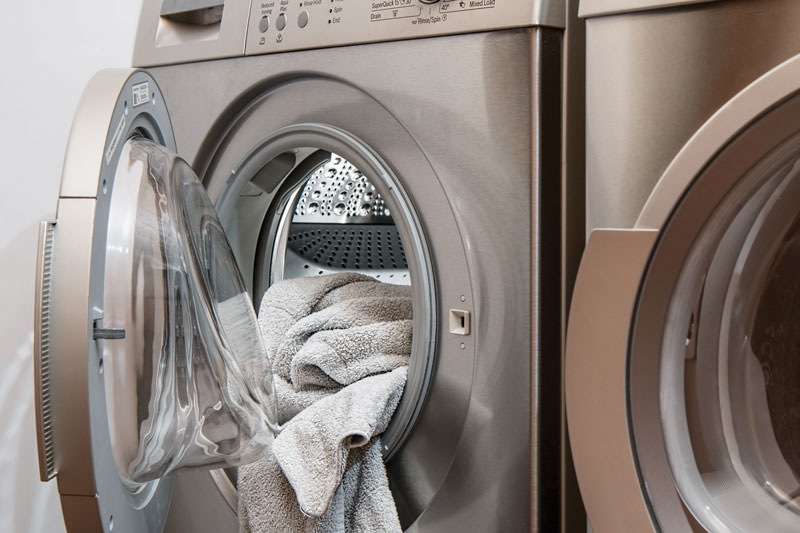
Home laundering, which can release microfibers from articles of clothing, is understood to be one source of microplastics entering the waterways. (Steve Buissinne/Free Images)
The Problem For Textiles
Current aquatic sampling for microplastics finds that fibers are the second most identified “shape” of microplastics.9 However, the focus on surface-skimming sampling methods may not accurately quantify the amount of fiber that is present. Polyethylene terephthalate (PET), nylon, and acrylic fibers have densities greater than seawater, and are thus thought to accumulate at the seabed — an emerging subset of microplastic research.10 While researchers generally believe most microplastics originate from the fragmentation of larger pieces of plastic over time, it is unclear if this is the case for textile-derived microplastics.11
Many studies on microplastic release from textiles have focused on home laundering as a source of fibers entering the waterways. These studies have found shedding to be dependent on the properties of the textile article including fiber material, yarn size, fabric construction, fabric weight and fabric finishing.12 For example, polyester fleece has been identified in multiple studies to release higher fiber counts — >7000 fibers/m-2/L-1 — than other types of polyester fabrics.13 Variability in laundering equipment and settings as well as detergents also can influence the amount of fibers released from a garment or article, where both washers and dryers can result in shedding of textile fibers. Other studies have identified a 3.5-fold increase in fiber release during tumble drying as compared to the wash process for polyester fleece articles.14
Other potential sources of textile-derived microplastics in the environment may include fragmentation of fishing ropes and netting, or from breakdown of improperly discarded nonwoven hygiene products.15 In addition, the role of household-level filtration and wastewater treatment in preventing the release of microplastics to the environment requires further investigation.
Standards And Certifications
Currently, there are few standards to guide the industry on best practices for measuring the emission rates of microplastics from textiles. Industry recognized standards and environmental labels like ISO 14000 environmental management standards, ASTM environmental standards, Global Organic Textile standard, EU Ecolabel, OEKO-TEX® labeling standards do not yet include an evaluation of fiber shedding.
However, other industry testing organizations and independent researchers have been working to develop reproducible methods to help educate and support the industry. For example, the American Association of Textile Chemists and Colorists (AATCC), Research Triangle Park, N.C., is developing a gravimetric method of calculating fiber/mass loss using an accelerated laundering machine.16 The Hohenstein Institute, Germany, has developed a suite of test methods designed to provide a quantitative analysis of microfibers. These test methods include a gravimetric method adopted from the University of Leeds/The Microfibre Consortium Method, an assessment of fiber count, shape, and size distribution using Hohenstein’s method for Dynamic Image Analysis, and an assessment of cellulosic versus non-cellulosic content.17 Further, there are some standardized test methods that that may have the ability to be modified to directly evaluate microplastics. For example, test methods for evaluating dry lint count and laundering.18
Quantifying the amount of microplastics in oceans is a challenge for researchers. (Miha Rakar/Unsplash)
Regulations
Currently, microplastics legislation has primarily targeted the sale or production of personal care products which contain microplastics. However, more comprehensive legislation is on the horizon. In August 2019, the European Chemicals Agency (ECHA), drafted an amendment to Registration, Evaluation, Authorization and Restriction of Chemicals (REACH) that would ban the sale of “microplastics on their own or in mixtures where their use will inevitably result in releases of microplastics to the environment, irrespective of the conditions of use” in the European Union zone. The proposed amendment defines microplastic (see ECHA definition above) containing materials as:
“… a substance on its own or in a mixture as a microplastic in a concentration equal to or greater than 0.01 [percent] w/w.”
Polymers that occur in nature and that have not been chemically modified — other than by hydrolysis — are excluded, as are polymers that are biodegradable. In addition, this proposed legislation would only apply to intentionally added microplastics, which are present at the point of use and could foreseeably be released to the environment. Products which generate or shed microplastics at the point of use or disposal, but did not originally contain added microplastics as defined above, would not be subject to this proposed regulation. Committee for Socio-economic Analysis (SEAC) will issue a final opinion on the legislation by September.19 A draft of the legislation by the European Commission is due in December 2020,20 and will likely be put to a final vote in 2021.
Currently, unmodified natural and biodegradable polymers are not regulated as microplastics under the proposed regulation. Natural fibers are defined under REACH as per their origin, not by their chemical structure. For example, polymers which occur naturally but are polymerized in an industrial setting would be regulated.21 The biodegradability of a polymer will be assessed by ISO 17025 certified laboratories which conduct approved tests outlined in the proposed REACH legislation to ensure that a polymer meets the target specifications for a biodegradable material.22
In the United States, microplastic regulations are being debated at the state level. In June, the California State Water Board adopted a definition of microplastics following the requirement in California Senate Bill No. 1422. The definition of microplastics in drinking water are defined as:
“Solid polymeric materials to which chemical additives or other substances may have been added, which are particles which have at least three dimensions that are greater than 1 [nanometer] and [have a volume] less than 5,000 micrometers (µm).3 Polymers that are derived in nature that have not been chemically modified (other than by hydrolysis) are excluded.” 23
Due to the dimensional constraints given, the threshold length for a man-made fiber will ultimately depend on its diameter. In addition, SB 1422 requires that a quantification methodology for the above definition of microplastics in drinking water be developed by July 1, 2021.24 Another California senate bill, SB 1263, mandates that a statewide microplastics strategy to protect ocean waters from microplastics to be developed on or before December 31, 2021.25
State-level legislation related to microplastics is expected to grow. And, as fibers are a commonly detected microplastic shape,26 it is likely that the textile industry will be impacted. What can the industry do? Become familiar with the issues and consumer concerns and work with trade associations, standards organizations, regulatory bodies and research organizations to formulate coherent and sensible solutions. Microplastics in the environment is a challenging and complex issue. However, working together, and employing sound science to understand and address the issue should help to provide a better environment and a stronger industry.
References:
1 The authors are consultants in the Polymer Science and Materials Chemistry practice of Exponent, Inc., a science and engineering consulting firm. This publication was authored by employees of Exponent, Inc. No portion of this publication has been funded or paid for by external sources.
2 What are microplastics? National Ocean Service website, https://oceanservice.noaa.gov/facts/microplastics.html, accessed on July 6, 2020.
6 Jambeck, J., et al. Plastic waste inputs from land into the ocean. Science, 347. 6223:768–771 (2015).
7 Eriksen M, Lebreton LCM, Carson HS, Thiel M, Moore CJ, et al. (2014) Plastic Pollution in the World’s Oceans: More than 5 Trillion Plastic Pieces Weighing over 250,000 Tons Afloat at Sea. PLoS ONE 9(12): e111913. doi:10.1371/journal.pone.0111913
8 A.A. Koelmans et al. Microplastics in freshwaters and drinking water: Critical review and assessment of data quality. Water Research 155 (2019) 410-422.
9 A.A. Koelmans et al. Microplastics in freshwaters and drinking water: Critical review and assessment of data quality. Water Research 155 (2019) 410-422.
10 F. Salvador Cesa et al. Synthetic fibers as microplastics in the marine environment: A review from textile perspective with a focus on domestic washings. Science of the Total Environment, 598 (2017) 1116–1129; Kane et al., Seafloor microplastic hotspots controlled by deep-sea circulation Science 368, 1140–1145 (2020).
11 Kormann, C. Where Does All the Plastic Go? The New Yorker (2019).
12 F. Salvador Cesa et al. Synthetic fibers as microplastics in the marine environment: A review from textile perspective with a focus on domestic washings. Science of the Total Environment, 598 (2017) 1116–1129; Carney Almroth, et al. Quantifying shedding of synthetic fibers from textiles; a source of microplastics released into the environment. Environ Sci Pollut Res (2018) 25:1191–1199; Cai et al. Systematic Study of Microplastic Fiber Release from 12 Different Polyester Textiles during Washing. Environ. Sci. Technol (2020) https://dx.doi.org/10.1021/acs.est.9b07395
13 Carney Almroth, et al. Quantifying shedding of synthetic fibers from textiles; a source of microplastics released into the environment. Environ Sci Pollut Res (2018) 25:1191–1199; Cai et al. Systematic Study of Microplastic Fiber Release from 12 Different Polyester Textiles during Washing. Environ. Sci. Technol (2020) https://dx.doi.org/10.1021/acs.est.9b07395; Pirc, U., et al. Emissions of microplastic fibers from microfiber fleece during domestic washing. Environ Sci Pollut Res (2016) 23:22206–22211.
14 Pirc, U., et al. Emissions of microplastic fibers from microfiber fleece during domestic washing. Environ Sci Pollut Res (2016) 23:22206–22211.
15 F. Salvador Cesa et al. Synthetic fibers as microplastics in the marine environment: A review from textile perspective with a focus on domestic washings. Science of the Total Environment, 598 (2017) 1116–1129.
18 Jonsson, C., et al. Microplastics Shedding from Textiles—Developin Analytical Method for Measurement of Shed Material Representing Release during Domestic Washing. Sustainability 2018, 10, 2457; International Organization for Standardization. ISO 9073-10:2003 Textiles—Test Methods for Nonwovens—Part 10: Lint and Other Particles Generation in the Dry State; International Organization for Standardization. ISO 105-E03:2010 Textiles—Tests for Colour Fastness to Chlorinated Water.
26 A.A. Koelmans et al. Microplastics in freshwaters and drinking water: Critical review and assessment of data quality. Water Research 155 (2019) 410-422.
Editor’s Notes: Dr. Davis Lee is senior managing scientist, Dr. Erin Kirkpatrick is managing scientist, Dr. A. Sydney Gladman is manager, and Dr. Donald Ripatti is a scientist in the Polymer Science & Materials Chemistry practice of Exponent Inc. — a multi-disciplinary engineering and scientific consulting firm.
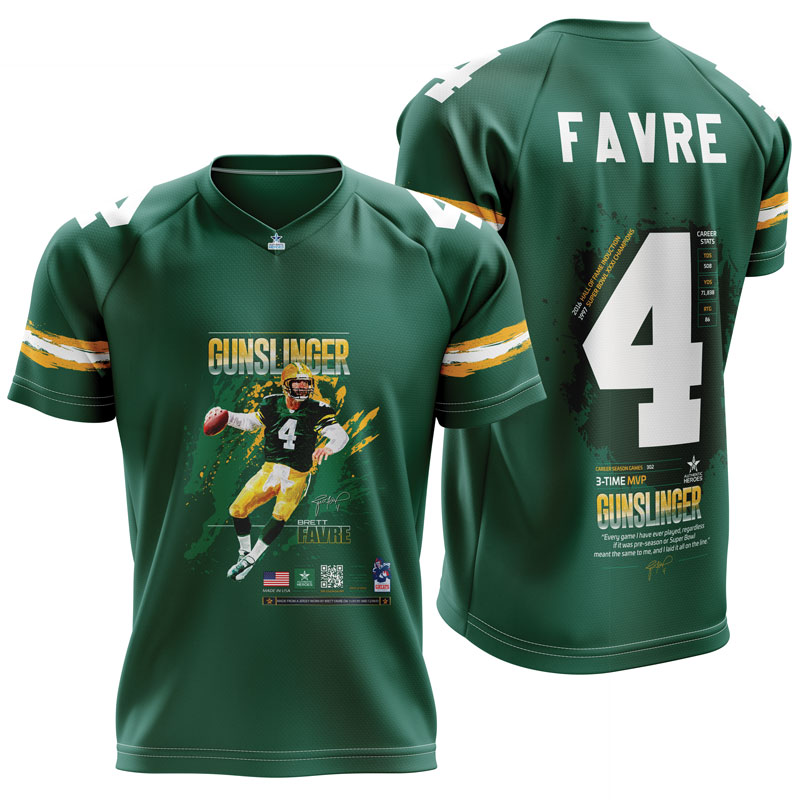
The commemorative jersey, containing reclaimed fiber from Brett Favre’s game-worn jersey, is now a piece of history — authenticated, preserved and shared with Brett Favre fans.
Eco Tek 360 and Authentic Heroes divisions create unique collectible clothing directly from original stage or game-worn items from historic artists and athletes.
TW Special Report
Global Fiber Technologies, Princeton, N.J., is a publicly traded fiber technology company founded in 2016 with the goal of creating repurposed fiber from end of life uniforms. The company operates three divisions: Eco Tek 360, Authentic Heroes and Fiber Chain.
“We utilize trade secrets we developed to treat the articles of clothing with our proprietary formulas before they enter a sequencing process on our textile opening line,” said Chairman and President Chris Giordano.
The Eco Tek 360 division has a unique, end-to-end supply chain that recovers the fiber from corporate uniforms at the end of their useful life and uses the recovered fiber to produce new products for their client companies.
The 360-degree concept is working with clients to develop a full circle — cradle-to-cradle — supply chain, reclaiming the fiber and putting it back into the chain. The Eco Tek process works with a wide range of fabric content including natural, man-made and blends.
The recovered fiber can either be used to make the same rejuvenated garment — for example, a polo shirt at the end of useful life is used to make new polo shirts — or the recovered fiber may be used to make other textile products that are required in the clients’ business such as tote bags, place mats or furnishings. Clients are not limited to uniform supply companies and also could include institutions and prison systems.
Provenance is a key issue in any supply chain. Knowing the true source of materials in a textile supply chain, all the way back to the fiber level, assures end product quality as well as fabric content and country of origin. It also can substantiate advertising claims related to use of branded fiber or sustainability claims.
Eco Tek Spawns Authentic Heroes Idea
The concept of Authentic Heroes’ garments is to share the original game- or stage-worn garment with a broader audience “allowing more fans to own a piece of history.”
Understanding the provenance provided by the Eco Tek 360 process, Authentic Heroes sources original game- or stage-worn items directly from athletes or musicians and reclaims the fiber from these authenticated garments. The fibers are then used to create unique, collectible clothing.
Under U.S. patent, the reclaimed fibers from the original garment are treated with a scientifically identifiable process and spun with new fiber to create a reclaimed fiber blended yarn. The blended yarn is then knit or woven into fabric that is used to sew a unique collectible garment with original designs and individual serial number.
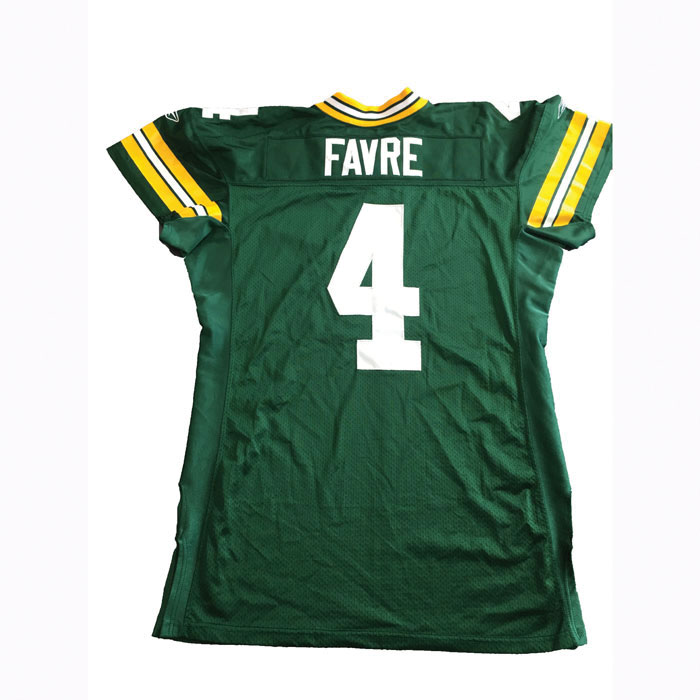
Hall of Famer and former Green Bay quarterback Brett Favre’s jersey worn in match-ups against Atlanta and Chicago in 2001.
Preserving Authentic Heroes
Authentic Heroes’ unique end-to-end supply chain connects more fans than ever with the unique wearable memorabilia of athletes and music artists.
“Our first Heroes are Brett Favre and Warren Sapp,” Giordano said. “These football legends will have limited edition series created with reclaimed fibers from game-worn jerseys.”
Hall of Famer and former Green Bay quarterback, Brett Favre, shared a jersey he wore in match ups against Atlanta on November 1, 2001, and Chicago on December 9. 2001. “With recovered fiber from Favre’s jersey, his commemorative jersey is now a piece of history — authenticated, preserved and shared with Brett Favre fans.
“Fans’ ownership is recorded in a database which eventually will be kept in a block chain,” Giordano said. “By tracking provenance through strict chain of custody from original through all production, sales, shipping and transfer of ownership of final garments end-to-end throughout their life, the company is able to assure the authenticity of these collectibles.”
Authenticity of the collectible garment is guaranteed using a a strict chain of custody from original to final garment.
Future Opportunities
“We are excited about the future and the talent we’ve brought on board with both the Eco Tek 360 commercialization and Authentic Heroes,” Giordano said. “On its own, I believe the Eco Tek 360 technology will provide a 360-degree sustainable solution for companies dealing with high volumes of apparel where rejuvenation makes sense. And with Heroes there are opportunities with individual players in multiple sports, but also energetic musical artists with tremendous fan-bases that are a perfect fit for authentic memorabilia.
“With Eco Tek 360, we could even create a commemorative jersey that represents and incorporates an entire winning team’s game worn jerseys. So many possibilities …
“Currently we are in negotiations with several popular musical artists and expect to sign 10 more licenses in 2021,” Giordano concluded.
The company also recently announced that Eco Tek 360 signed a collaboration agreement with Broadalbin, N.Y.-based Fiber Conversion Inc. to further the commercial viability of Eco Tek 360’s rejuvenation technology.
“We are now at the point where we feel confident that we can start making commercial grade repurposed products from what are known as end-of-life fabrics that are headed for a landfill or incinerator,” Giordano said. “The collaboration with Fiber Conversion is particularly important because it allows us to see how our process for rejuvenating textile fibers works on a large commercial grade machine in comparison to our pilot line at the facility in Somerset, N.J. Fiber Conversion has a large facility inclusive of two commercial grade recycling lines and a full machine shop which will allow us to start testing our commercial viability immediately.”
“The principals of Fiber Conversion have deep expertise in recycling that spans almost 100 years,” reported Paul Serbiak, CEO, Global Fiber Technologies. “After recent discussions both parties found it mutually advantageous to take the relationship to another level. There is more work to be done but our most recent in-house results to date are extremely encouraging. We have now moved our sample line to their facility so we can bring efficiencies, cost savings and further know-how to the process and the goal of potentially developing large-scale commercial scale projects together.”

 By Jim Phillips, Yarn Market Editor