Manufacturing PMI® At 53.3%; June 2026 ISM® Manufacturing PMI® Report

TEMPE, Ariz.  — July 1, 2026 — Economic activity in the manufacturing sector expanded in June for the sixth consecutive month, say the nation’s supply executives in the latest ISM® Manufacturing PMI® Report.

The report was issued today by Susan Spence, MBA, Chair of the Institute for Supply Management® (ISM®) Manufacturing Business Survey Committee.

“The Manufacturing PMI® registered 53.3 percent in June, 0.7 percentage point lower than in May. The overall economy continued in expansion for the 20th month in a row. (A Manufacturing PMI® above 47.5 percent, over a period of time, generally indicates an expansion of the overall economy.) The New Orders Index expanded for the sixth consecutive month after four straight readings in contraction, registering 56 percent, down 0.8 percentage point compared to May’s figure of 56.8 percent. The June reading of the Production Index (52.2 percent) is 2.1 percentage points lower than May’s reading of 54.3 percent. The Prices Index remained in expansion (or ‘increasing’ territory), registering 73 percent, a 9.1-percentage point decrease from May’s reading of 82.1 percent. The Backlog of Orders Index registered 50.5 percent, down 1.7 percentage points compared to the 52.2 percent recorded in May. The Employment Index registered 49.7 percent, up 1.1 percentage points from May’s figure of 48.6 percent,” says Spence.

“The Supplier Deliveries Index indicated slowing performance for the seventh month in a row after one month in ‘faster’ territory. The reading of 57.4 percent is down 3.2 percentage points from its May reading of 60.6 percent. (Supplier Deliveries is the only ISM® PMI® Reports index that is inversed; a reading of above 50 percent indicates slower deliveries, which is typical as the economy improves and customer demand increases.)

“The Inventories Index registered 51.4 percent, returning to expansion territory and up 1.5 percentage points compared to May’s reading of 49.9 percent. The Customers’ Inventories Index reading of 42.3 percent is 0.4 percentage point lower compared to the 42.7 percent recorded in May.

“The New Export Orders Index returned to contraction territory with a reading of 48.5 percent, 2.1 percentage points lower than the 50.6 percent registered in May. The Imports Index registered 52.9 percent, 0.1 percentage point lower than May’s reading of 53 percent.”

Spence continues, “In June, U.S. manufacturing activity remained in expansion territory, growing at a slightly slower pace as compared to the month before. Of the five subindexes that make up the PMI®, the New Orders and Production indexes grew slower as compared to the previous month, the Supplier Deliveries Index slowed at a slower rate, and the Employment and Inventories indexes improved with the latter entering expansion territory.

“In June, 34 percent of the comments were positive and 66 percent negative, with a 1-to-1.9 ratio of positive to negative sentiment. Among negative comments, the Iran war was mentioned in 31 percent and tariffs in 17 percent; 50 percent of the panelists mentioned pricing volatility as an issue for their companies.

“In June, two of four demand indicators (New Orders and Backlog of Orders) were in expansion, and the Customers’ Inventories Index remained in ‘too low’ territory, contracting at a faster rate. A ‘too low’ status for the Customers’ Inventories Index is usually considered positive for future production. New Export Orders returned to contraction, losing 2.1 percentage points since May.

“Regarding output, the Production Index is in expansion for the eighth month in a row, and the Employment Index increased by 1.1 percentage points but remained in contraction. Among panelists, 36 percent indicated that managing head counts remains the norm at their companies, while 64 percent are hiring — a near reversal of those numbers from the start of the year (66 percent of companies were managing staff levels in the January report).

“Finally, inputs (defined as supplier deliveries, inventories, prices, and imports) were mixed, with the Supplier Deliveries Index decreasing 3.2 percentage points, the Inventories Index entering into expansion, the Imports Index losing 0.1 percentage point but staying in expansion, and Prices Index relief coming with a 9.1-percentage point drop, a reading of 73 percent versus 82.1 percent in May.

“Looking at the manufacturing economy, 5 percent of the sector’s gross domestic product (GDP) contracted in June, compared to 2 percent in May, and the percentage of manufacturing GDP in strong contraction (defined as a composite PMI® of 45 percent or lower) was 3 percent, compared to 2 percent in May. The share of sector GDP with a PMI® at or below 45 percent is a good metric to gauge overall manufacturing weakness. All but one (Petroleum & Coal Products) of the six largest manufacturing industries expanded in June, in the following order: Computer & Electronic Products; Machinery; Transportation Equipment; Chemical Products; and Food, Beverage & Tobacco Products.”

The 14 manufacturing industries reporting growth in June — listed in order — are: Printing & Related Support Activities; Electrical Equipment, Appliances & Components; Textile Mills; Primary Metals; Apparel, Leather & Allied Products; Fabricated Metal Products; Computer & Electronic Products; Machinery; Plastics & Rubber Products; Transportation Equipment; Nonmetallic Mineral Products; Chemical Products; Miscellaneous Manufacturing; and Food, Beverage & Tobacco Products. The three industries in contraction are: Paper Products; Furniture & Related Products; and Wood Products.

WHAT RESPONDENTS ARE SAYING

  • “The conflict in Iran has impacted pricing in every category of raw materials. Especially, items that have a heavy concentration of oil in the components like our adhesives.” [Chemical Products]
  • “Continued pressure from conflict in Middle East is resulting in a more conservative approach to capital expenditures. We are seeing an increase in consumables and services purchasing from sectors like chemical analysis, per- and polyfluoroalkyl substances (PFAS), and environmental and pharmaceutical testing.” [Computer & Electronic Products]
  • “General purchasing operations are being shaped by (1) moderating but still elevated inflation, (2) higher interest rates and (3) continued policy uncertainty, particularly around tariffs and global trade. While overall economic growth remains resilient, it is slowing as consumer spending weakens under pressure from higher costs for energy and essential goods, reducing demand visibility and increasing cost sensitivity for buyers. Meanwhile, supply chains have stabilized compared to prior years but remain structurally complex, with trade policy volatility, geopolitical tensions and regulatory changes now ongoing cost drivers rather than temporary disruptions. Our organization continues balancing cost control with resilience, shifting sourcing strategies, tightening inventories and prioritizing supplier diversification and risk management.” [Computer & Electronic Products]
  • “Retail electronics sales seem to have stabilized to some extent. The pause in tariff changes has been welcomed the last two months, but it’s only a matter of time before more confusion is introduced.” [Electrical Equipment, Appliances & Components]
  • “Input costs remain elevated across key categories, driven largely by Middle East conflict impacts and ongoing tariff uncertainty. Supplier lead times have stretched, which is influencing our inventory strategy and sourcing decisions. We are managing exposure through diversified supplier bases and contract structures that balance cost certainty with operational flexibility.” [Food, Beverage & Tobacco Products]
  • “Conditions are optimistic but not yet booming for our company, even though many others, it seems, are experiencing growth. Machinery in support of defense and semiconductor manufacturing is very strong, a bright spot for our team. Industrial and medical clients are slow to purchase, focusing more on refurbished and upgraded units versus new ones.” [Machinery]
  • “Core business remains solid in the face of ongoing geopolitical uncertainty. Cautiously optimistic that a deal will be reached to reopen the Strait of Hormuz; concerned about ongoing ripple effects even when the strait reopens but situation is highly concerning if the strait remains closed. AI industry continues to have huge capacity consumption for critical electronics. Monitoring impact of U.S. defense industry needs on supplier capacity.” [Miscellaneous Manufacturing]
  • “No major changes from last month. With the potential ending of the Iran war, management is expecting us to go back to February pricing structures and plans since the increase in oil prices was driven by the war and not regular market influences.” [Petroleum & Coal Products]
  • “Requests from suppliers in Europe and India for ‘energy surcharges’ have stopped this past month. We’re seeing continued capacity growth in the Asia-Pacific region (excluding China), including Vietnam, Thailand and South Korea. Most suppliers are building for the longer term as geopolitical protection from all sides.” [Transportation Equipment]
  • “The new Section 232 tariffs continue to destroy our profitability and demand as we have to raise prices to deal with this gigantic tax. Add the ‘incentives’ for our company to pivot to purchasing non-U.S. sourced material, and one realizes the total ineptitude of this tariff policy.” [Transportation Equipment]
MANUFACTURING AT A GLANCE

June 2026

Index Series
Index

Jun

Series
Index

May

Percentage

Point

Change

Direction Rate of
Change
Trend*
(Months)
Manufacturing PMI® 53.3 54.0 -0.7 Growing Slower 6
New Orders 56.0 56.8 -0.8 Growing Slower 6
Production 52.2 54.3 -2.1 Growing Slower 8
Employment 49.7 48.6 +1.1 Contracting Slower 33
Supplier Deliveries 57.4 60.6 -3.2 Slowing Slower 7
Inventories 51.4 49.9 +1.5 Growing From Contracting 1
Customers’ Inventories    42.3 42.7 -0.4 Too Low Faster 21
Prices 73.0 82.1 -9.1 Increasing Slower 21
Backlog of Orders 50.5 52.2 -1.7 Growing Slower 6
New Export Orders 48.5 50.6 -2.1 Contracting From Growing 1
Imports 52.9 53.0 -0.1 Growing Slower 5
OVERALL ECONOMY Growing Slower 20
Manufacturing Sector Growing Slower 6

ISM® Manufacturing PMI® Report data is seasonally adjusted for the New Orders, Production, Employment and Inventories indexes.
*Number of months moving in current direction.

COMMODITIES REPORTED UP/DOWN IN PRICE AND IN SHORT SUPPLY

Commodities Up in Price
Aluminum* (31); Aluminum Products (3); Brass (2); Copper (12); Copper Based Products (7); Corrugated Products (3); Electrical Components; Electronic Components (6); Freight (4); Fuel* (4); Memory Components (4); Metal Products (3); Ocean Freight (2); Oil (3); Oil Based Products (3); Packaging Materials (3); Paper Products (3); Plastic Based Products (3); Plastics (4); Printed Circuit Boards; Resins (5); Semiconductors; Steel (8); Steel — Hot Rolled (6); Steel — Stainless (5); Steel Products (7); and Sulfur Products (3).

Commodities Down in Price
Aluminum*; Corn; Crude Oil; Fuel*; and Polypropylene Resin.

Commodities in Short Supply
Electrical Components (12); Electronic Components (16); Memory (6); Semiconductors (4); and Steel — Hot Rolled.

Note: The number of consecutive months the commodity is listed is indicated after each item.
*Indicates both up and down in price.

JUNE 2026 MANUFACTURING INDEX SUMMARIES

Manufacturing PMI®
The U.S. manufacturing sector expanded in June for the sixth straight month following a 10-month period of contraction, registering 53.3 percent, a decrease of 0.7 percentage point compared to May. Of the five subindexes that directly factor into the Manufacturing PMI®, four (New Orders, Production, Supplier Deliveries and Inventories) were in expansion territory, one more than in May. The Employment Index stayed in contraction but improved compared to May. Five of the six largest manufacturing industries expanded in June, with Petroleum & Coal Products the exception. A reading above 50 percent indicates that the manufacturing sector is generally expanding; below 50 percent indicates that it is generally contracting.

A Manufacturing PMI® above 47.5 percent, over a period of time, generally indicates an expansion of the overall economy. Therefore, the June Manufacturing PMI® indicates the overall economy grew for the 20th straight month. “The past relationship between the Manufacturing PMI® and the overall economy indicates that June reading (53.3 percent) corresponds to a 2-percent increase in real gross domestic product (GDP) on an annualized basis,” says Spence.

THE LAST 12 MONTHS

Month Manufacturing
PMI®
Month Manufacturing
PMI®
Jun 2026 53.3 Dec 2025 47.9
May 2026 54.0 Nov 2025 48.0
Apr 2026 52.7 Oct 2025 48.8
Mar 2026 52.7 Sep 2025 48.9
Feb 2026 52.4 Aug 2025 48.9
Jan 2026 52.6 Jul 2025 48.4
Average for 12 months – 50.7

High – 54.0

Low – 47.9

New Orders
ISM®‘s New Orders Index expanded in June with a reading of 56 percent, a decrease of 0.8 percentage point compared to May’s reading of 56.8 percent. “Of the six largest manufacturing industries, four (Computer & Electronic Products; Machinery; Transportation Equipment; and Chemical Products) reported increased new orders. Demand sentiment was positive in June, with a 2.7-to-1 ratio of positive to negative comments,” says Spence. A New Orders Index above 51.9 percent, over time, is generally consistent with an increase in the Census Bureau’s series on manufacturing orders (in constant 2000 dollars).

The 11 manufacturing industries that reported growth in new orders in June, in order, are: Primary Metals; Apparel, Leather & Allied Products; Printing & Related Support Activities; Electrical Equipment, Appliances & Components; Computer & Electronic Products; Machinery; Nonmetallic Mineral Products; Fabricated Metal Products; Plastics & Rubber Products; Transportation Equipment; and Chemical Products. The six industries reporting a decline in new orders in June, in order, are: Paper Products; Furniture & Related Products; Food, Beverage & Tobacco Products; Miscellaneous Manufacturing; Wood Products; and Textile Mills.

New Orders %Higher %Same %Lower Net Index
Jun 2026 22.3 64.3 13.4 +8.9 56.0
May 2026 30.9 55.2 13.9 +17.0 56.8
Apr 2026 31.6 53.2 15.2 +16.4 54.1
Mar 2026 29.1 56.3 14.6 +14.5 53.5

Production
The Production Index expanded in June for the eighth month in a row, registering 52.2 percent, a 2.1-percentage point decrease compared to May’s reading of 54.3 percent. “Of the six largest manufacturing industries, four (Computer & Electronic Products; Machinery; Transportation Equipment; and Chemical Products) reported increased production. Panelists had a 2-to-1 ratio of positive to negative comments regarding output,” says Spence. An index above 52 percent, over time, is generally consistent with an increase in the Federal Reserve Board’s Industrial Production figures.

The eight industries reporting growth in production during the month of June — listed in order — are: Printing & Related Support Activities; Fabricated Metal Products; Electrical Equipment, Appliances & Components; Computer & Electronic Products; Primary Metals; Machinery; Transportation Equipment; and Chemical Products. The six industries reporting a decrease in production in June, in order, are: Paper Products; Wood Products; Furniture & Related Products; Miscellaneous Manufacturing; Food, Beverage & Tobacco Products; and Textile Mills.

Production %Higher %Same %Lower Net Index
Jun 2026 19.0 68.0 13.0 +6.0 52.2
May 2026 26.7 57.8 15.5 +11.2 54.3
Apr 2026 28.3 58.7 13.0 +15.3 53.4
Mar 2026 24.5 62.8 12.7 +11.8 55.1

Employment
ISM®‘s Employment Index registered 49.7 percent in June, 1.1 percentage points higher than May’s reading of 48.6 percent. “The index posted its 33rd consecutive month of contraction after expanding in September 2023. Since January 2023, the Employment Index has contracted in 41 of 42 months. Of the six big manufacturing industries, three (Machinery; Transportation Equipment; and Chemical Products) reported higher levels of employment in June. The panelist comment ratio of hiring to managing/reducing head counts was 1.8 to 1 in June, nearly a reversal of the 1-to-2 ratio at the beginning a year,” says Spence. An Employment Index above 50.3 percent, over time, is generally consistent with an increase in the Bureau of Labor Statistics (BLS) data on manufacturing employment.

Of the 18 manufacturing industries, nine reported employment growth in June, in the following order: Printing & Related Support Activities; Paper Products; Primary Metals; Electrical Equipment, Appliances & Components; Plastics & Rubber Products; Machinery; Miscellaneous Manufacturing; Transportation Equipment; and Chemical Products. The three industries reporting a decrease in employment in June are: Nonmetallic Mineral Products; Food, Beverage & Tobacco Products; and Fabricated Metal Products. Six industries reported no change in employment in June.

Employment %Higher %Same %Lower Net Index
Jun 2026 16.2 70.0 13.8 +2.4 49.7
May 2026 17.0 67.6 15.4 +1.6 48.6
Apr 2026 17.5 62.3 20.2 -2.7 46.4
Mar 2026 14.2 70.8 15.0 -0.8 48.7

Supplier Deliveries
Delivery performance of suppliers to manufacturing organizations was slower in June for the seventh consecutive month after one month of faster deliveries. “The Supplier Deliveries Index registered 57.4 percent, 3.2 percentage points lower than May’s reading of 60.6 percent. Of the six big industries, five (Computer & Electronic Products; Machinery; Food, Beverage & Tobacco Products; Chemical Products; and Transportation Equipment) reported slower supplier deliveries,” says Spence. A reading below 50 percent indicates faster deliveries, while a reading above 50 percent indicates slower deliveries.

The 12 manufacturing industries reporting slower supplier deliveries in June, in order, are: Textile Mills; Primary Metals; Miscellaneous Manufacturing; Electrical Equipment, Appliances & Components; Fabricated Metal Products; Nonmetallic Mineral Products; Computer & Electronic Products; Machinery; Food, Beverage & Tobacco Products; Plastics & Rubber Products; Chemical Products; and Transportation Equipment. No industry reported faster deliveries in June. Six industries reported no change in supplier deliveries in June.

Supplier Deliveries %Slower %Same %Faster Net Index
Jun 2026 18.1 78.5 3.4 +14.7 57.4
May 2026 24.6 71.9 3.5 +21.1 60.6
Apr 2026 22.6 75.9 1.5 +21.1 60.6
Mar 2026 19.5 78.8 1.7 +17.8 58.9

Inventories
The Inventories Index registered 51.4 percent in June, up 1.5 percentage points compared to the reading of 49.9 percent in May. “Of the six big industries, three (Machinery; Food, Beverage & Tobacco Products; and Transportation Equipment) expanded inventories in June,” says Spence. An Inventories Index greater than 44.5 percent, over time, is generally consistent with expansion in the Bureau of Economic Analysis (BEA) figures on overall manufacturing inventories (in chained 2000 dollars).

Of 18 manufacturing industries, the seven reporting higher inventories in June — in the following order — are: Textile Mills; Apparel, Leather & Allied Products; Electrical Equipment, Appliances & Components; Machinery; Food, Beverage & Tobacco Products; Fabricated Metal Products; and Transportation Equipment. The five industries reporting lower inventories in June are: Miscellaneous Manufacturing; Primary Metals; Computer & Electronic Products; Chemical Products; and Wood Products. Six industries reported no change in inventories in June.

Inventories %Higher %Same %Lower Net Index
Jun 2026 15.4 70.4 14.2 +1.2 51.4
May 2026 18.1 65.4 16.5 +1.6 49.9
Apr 2026 14.5 68.3 17.2 -2.7 49.0
Mar 2026 16.7 64.3 19.0 -2.3 47.1

Customers’ Inventories
ISM®‘s Customers’ Inventories Index remained in “too low” territory in June, with reading of 42.3 percent, a decrease of 0.4 percentage point compared to the 42.7 percent reported in May. (For more information about the Customers’ Inventories Index, see the “Data and Method of Presentation” section below.)

The four industries that reported that customers’ inventories were too high in June are: Textile Mills; Wood Products; Miscellaneous Manufacturing; and Plastics & Rubber Products. The eight industries reporting customers’ inventories as too low in June, in order, are: Fabricated Metal Products; Electrical Equipment, Appliances & Components; Primary Metals; Food, Beverage & Tobacco Products; Machinery; Computer & Electronic Products; Transportation Equipment; and Chemical Products. Six industries reported no change in customers’ inventories in June compared to May.

Customers’
Inventories
%
Reporting
%Too
High
%About
Right
%Too
Low
Net Index
Jun 2026 78 7.5 69.5 23.0 -15.5 42.3
May 2026 73 7.0 71.3 21.7 -14.7 42.7
Apr 2026 73 7.6 62.9 29.5 -21.9 39.1
Mar 2026 74 6.9 66.3 26.8 -19.9 40.1

Prices
The ISM® Prices Index registered 73 percent in June, a decrease of 9.1 percentage points compared to its May reading of 82.1 percent, indicating raw materials prices increased for the 21st straight month. This is the largest decrease in the index since July 2022, when it dropped 18.5 percentage points. Of the six largest manufacturing industries, five — Machinery; Computer & Electronic Products; Transportation Equipment; Chemical Products; and Food, Beverage & Tobacco Products — reported price increases in June. “The Prices Index reading is still being driven by (1) increases in steel and aluminum prices that impact the entire value chain, (2) tariffs applied to many imported goods and (3) increases in petroleum-based products as a result of the Middle East conflict. Higher prices were reported by 55.1 percent of respondents in June, down 11.2 percentage points from May’s 66.3 percent,” says Spence. A Prices Index above 52.8 percent, over time, is generally consistent with an increase in the Bureau of Labor Statistics (BLS) Producer Price Index for Intermediate Materials.

In June, the 15 industries that reported paying increased prices for raw materials, in order, are: Electrical Equipment, Appliances & Components; Nonmetallic Mineral Products; Fabricated Metal Products; Miscellaneous Manufacturing; Machinery; Primary Metals; Wood Products; Plastics & Rubber Products; Paper Products; Computer & Electronic Products; Transportation Equipment; Furniture & Related Products; Textile Mills; Chemical Products; and Food, Beverage & Tobacco Products. Only one industry (Petroleum & Coal Products) reported paying decreased prices for raw materials in June.

Prices %Higher %Same %Lower Net Index
Jun 2026 55.1 35.7 9.2 +45.9 73.0
May 2026 66.3 31.5 2.2 +64.1 82.1
Apr 2026 70.3 28.5 1.2 +69.1 84.6
Mar 2026 59.4 37.8 2.8 +56.6 78.3

Backlog of Orders
ISM®‘s Backlog of Orders Index registered 50.5 percent in June, a decrease of 1.7 percentage points compared to the May reading of 52.2 percent. Of the six largest manufacturing industries, three (Computer & Electronic Products; Chemical Products; and Machinery) reported expansion in order backlogs in June.

The eight industries reporting higher backlogs in June — listed in order — are: Nonmetallic Mineral Products; Electrical Equipment, Appliances & Components; Plastics & Rubber Products; Computer & Electronic Products; Primary Metals; Chemical Products; Fabricated Metal Products; and Machinery. The six industries reporting lower backlogs in June — listed in order — are: Textile Mills; Wood Products; Food, Beverage & Tobacco Products; Paper Products; Miscellaneous Manufacturing; and Transportation Equipment.

Backlog of
Orders
%
Reporting
%Higher %Same %Lower Net Index
Jun 2026 88 20.4 60.2 19.4 +1.0 50.5
May 2026 87 20.4 63.5 16.1 +4.3 52.2
Apr 2026 90 22.1 58.6 19.3 +2.8 51.4
Mar 2026 90 24.6 59.6 15.8 +8.8 54.4

New Export Orders
ISM®‘s New Export Orders Index returned to contraction territory in June, as it registered 48.5 percent, down 2.1 percentage points from May’s reading of 50.6 percent. “Among panelists’ comments, the positive-to-negative sentiment ratio was 1.5 to 1,” says Spence.

Of the 18 manufacturing industries, the four that reported growth in new export orders in June are: Computer & Electronic Products; Fabricated Metal Products; Electrical Equipment, Appliances & Components; and Miscellaneous Manufacturing. The nine industries that reported a decrease in new export orders in June — in the following order — are: Wood Products; Petroleum & Coal Products; Apparel, Leather & Allied Products; Plastics & Rubber Products; Paper Products; Food, Beverage & Tobacco Products; Chemical Products; Transportation Equipment; and Textile Mills.

New Export
Orders
%
Reporting
%Higher %Same %Lower Net Index
Jun 2026 71 10.9 75.2 13.9 -3.0 48.5
May 2026 74 12.8 75.6 11.6 +1.2 50.6
Apr 2026 75 10.4 75.0 14.6 -4.2 47.9
Mar 2026 74 12.1 75.5 12.4 -0.3 49.9

Imports
ISM®‘s Imports Index was 52.9 percent in June, a 0.1-percentage point decrease compared to May’s reading of 53 percent.

The 10 industries reporting higher imports in June — in the following order — are: Wood Products; Textile Mills; Primary Metals; Machinery; Computer & Electronic Products; Electrical Equipment, Appliances & Components; Fabricated Metal Products; Food, Beverage & Tobacco Products; Chemical Products; and Transportation Equipment. The two industries that reported lower volumes in June are: Printing & Related Support Activities; and Paper Products. Six industries reported no change in imports in June compared to May.

Imports %
Reporting
%Higher %Same %Lower Net Index
Jun 2026 86 12.5 80.7 6.8 +5.7 52.9
May 2026 85 15.4 75.2 9.4 +6.0 53.0
Apr 2026 85 10.6 79.3 10.1 +0.5 50.3
Mar 2026 87 15.1 75.0 9.9 +5.2 52.6

The Supplier Deliveries, Customers’ Inventories, Prices, Backlog of Orders, New Export Orders, and Imports indexes do not meet the accepted criteria for seasonal adjustments.

Buying Policy
The average commitment lead time for Capital Expenditures in June was 171 days, the same as May. The average lead time in June for Production Materials was 84 days, a three day increase since May. The average lead time for Maintenance, Repair and Operating (MRO) Supplies was 48 days, the same as May.

Percent Reporting
Capital
Expenditures
Hand-to-
Mouth
30 Days 60 Days 90 Days 6 Months 1 Year+ Average
Days
Jun 2026 16 5 7 15 30 27 171
May 2026 17 5 7 11 34 26 171
Apr 2026 15 4 7 13 35 26 174
Mar 2026 17 3 10 12 32 26 170
Percent Reporting
Production
Materials
Hand-to-
Mouth
30 Days 60 Days 90 Days 6 Months 1 Year+ Average
Days
Jun 2026 8 23 28 26 10 5 84
May 2026 8 25 27 25 11 4 81
Apr 2026 7 26 25 28 10 4 81
Mar 2026 8 26 27 26 7 6 82
Percent Reporting
MRO Supplies Hand-to-
Mouth
30 Days 60 Days 90 Days 6 Months 1 Year+ Average
Days
Jun 2026 28 35 17 13 6 1 48
May 2026 27 39 16 12 4 2 48
Apr 2026 27 36 18 14 4 1 46
Mar 2026 29 38 15 13 4 1 44


Posted: July 1, 2026

Source Institute for Supply Management

Reju Opens First U.S. Research & Development Center In Conshohocken, Pennsylvania

PARIS and CONSHOHOCKEN, Pa.  — July 1, 2026 — Reju, the textile-to-textile materials regeneration company, today announced that it had opened a Research & Development Center in Conshohocken, Pennsylvania, marking the company’s first dedicated research facility in North America. Located within Technip Energy’s Advanced Materials and Catalysts’ existing research center, the lab will help Reju accelerate the deployment of its recycling technologies and will help develop Reju’s next-generation circular solutions.

Reju opens its first U.S. Research & Development Center in Conshohocken, Pennsylvania, accelerating the path from circular innovation to industrial-scale textile regeneration.

The R&D Center marks the relocation of Reju’s core research team from IBM’s Almaden Research Center in San Jose, California, where Reju’s Volcat depolymerizaztion technology, a catalytic chemical recycling method breaking down polyester into reusable raw materials, was first developed.

“I am excited to be joining such an innovative company and to be part of the team moving the technology towards industrialization and supporting the infrastructure for true post-consumer textile-to-textile recycling at scale,” said Gregory Breyta, Reju’s Director of Research & Development.

The facility will be focused on the full development spectrum, from early-stage feasibility through to kilo-scale production. It will span polyester recycling, mixed-fabric solutions, and new circular chemistry pathways, enabling rapid iteration and accelerating Reju’s path from concept to industrial reality. The new R&D center will support the development and validation of technologies intended for deployment across Reju’s future Regeneration Hubs.

By locating the facility within Technip Energies’ existing research infrastructure, Reju will benefit from direct access to decades of Technip Energies’ expertise in catalysis, process development, technology integration and industrial scale-up.

The establishment of the R&D Center is a component of Reju’s broader strategy to build a closed-loop recycling ecosystem that converts discarded fabric and textiles back into quality products. The center joins Reju’s growing global infrastructure, including their first textile-to-textile facility Regeneration Hub Zero in Frankfurt, Germany and future Regeneration Hubs that have been announced in Sittard (Netherlands), Lacq (France), and Rochester, New York (USA).

“Together, these facilities form a replicable global circular infrastructure designed to turn today’s textile waste into tomorrow’s raw materials,” said Breyta.

Posted: July 1, 2026

Source Reju / Technip Energies

DiloGroup: Complete Nonwoven Needling Line For Hygiene Materials In The United States

EBERBACH, Germany — July 7, 2026 — DiloGroup has received an order for a complete needling line designed for the production of hygiene materials in the United States. This project further strengthens our position in the American hygiene sector and reflects the continued demand for reliable, high-performance nonwoven equipment.

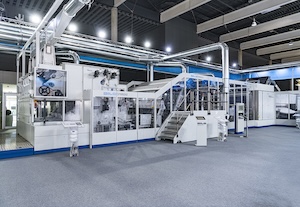
Dilo Nonwoven Production Line

The scope of supply covers all process stages, beginning with fiber opening. The line includes the latest TEMAFA fiber-opening and filtration system, ensuring stable operation, precise fiber preparation, and efficient dust and particle management throughout the process.

At the core of the installation is the card feeding and carding system from Dilo Spinnbau, as well as crosslapping and high-performance needlelooms from DiloMachines supported by the CV1 system. This configuration ensures controlled fiber processing, stable web formation, and high throughput. The selected machinery highlights the advantages of Dilo’s high-capacity equipment, particularly in applications where process stability, uniform web quality, and consistent production parameters are essential for hygiene-grade materials.

With this new line, the customer will operate a modern and efficient production setup tailored to the requirements of the U.S. hygiene market. The order confirms the trust placed in DiloGroup’s complete solutions and long-standing expertise in nonwoven production systems.

Posted: July 1, 2026

Source DiloGroup

Statement From PLASTICS President And CEO On USMCA Negotiations

WASHINGTON, D.C. — July 1, 2026 — The Plastics Industry Association (PLASTICS) President and CEO Matt Seaholm today issued the following statement:

“As we reach today’s milestone in the review of the U.S.-Mexico-Canada Agreement (USMCA), the Plastics Industry Association supports continued engagement among the United States, Mexico and Canada to preserve and strengthen an agreement that has become foundational to North American manufacturing.

USMCA provides the certainty businesses need to invest, innovate and build resilient supply chains across North America. For the U.S. plastics industry, Mexico and Canada are our two largest export markets, purchasing nearly $19.8 billion and $14.3 billion in U.S. plastics products annually. Those trading relationships support American manufacturing, sustain high-quality jobs and strengthen industries ranging from healthcare and food packaging to automotive and construction.

As global competition intensifies, a strong and modernized USMCA will help ensure North America remains the world’s most competitive manufacturing region. We look forward to working with the administration and policymakers to strengthen the agreement, expand opportunities for American manufacturers, and provide the long-term certainty businesses need to grow, invest and create jobs here at home.”

Posted: Revised July 1, 2026

Source: The Plastics Industry Association (PLASTICS)

AATCC: Register Early For Basics Of UV Calibration Digital Learning

DURHAM, N.C. — July 1, 2026 — Learn about the Basics of UV Calibration with AATCC in a Digital Learning opportunity presented by Carrie Gray, AATCC Technical Associate. This training is an advanced training for users of the UV Calibration reference fabric and includes best practices that will enhance the expertise of textile color experts. Join this live session for the opportunity for a live-Q&A session at the end of the presentation. The Basics of UV Calibration digital session will be offered on Wednesday, July 29 at 9AM ET and Thursday, July 30 at 8PM ET. Register for your preferred time here: https://www.aatcc.org/events/basics-of-uv-calibration

About Basics of UV Calibration

This training covers the best practices of using AATCC UV Calibration Reference Fabric for AATCC Evaluation Procedure 11. This training features a walkthrough of AATCC EP11 and focuses on how UV calibration impacts color measurement accuracy. Participants will learn what UV calibration does, why it matters when working with whiteness and fluorescent standards, and how comparing measurements with and without UV included can uncover issues in base fabrics, dyes, optical brighteners, and end use performance. If your work involves evaluating fabric, managing color data, or using a spectrophotometer, this session will help you make more informed, defensible color decisions.

Key Takeaways

  • Understand the purpose and steps of AATCC Evaluation Procedure 11
  • Best practices when using AATCC UVC: UV Calibration Reference Fabric
  • Learn what UV calibration is and how it affects spectrophotometer measurements
  • Identify when and why to use UV included vs. UV excluded measurements
  • Evaluate base fabrics before and after the application of optical brighteners
  • Improve color troubleshooting when working with fluorescent or non-traditional dyes
  • Assess how laundering, detergents, and end use conditions can impact measured color

Who should attend?

  • Fabric Color Coordinator
  • Color Management Specialist
  • Product Developer
  • Color Specialist
  • Textile Technologist
  • Quality Control / Quality Assurance Professionals
  • Textile and Color Professionals who use or work with a spectrophotometer
  • Professionals responsible for fabric evaluation and color approval

About the Speaker, Carrie Gray

Carrie Gray is a seasoned AATCC Technical Associate with a wide breadth of textile testing experience. As part of her role, she specializes in color management with her work on the AATCC UV Calibration Reference Fabric. Carrie instructs proper conducting of textile test methods to a diverse audience of professionals. Her work aids in the development of standard control fabrics and evaluation tools. She has further honed her expertise by managing AATCC Proficiency Testing Programs including Color Evaluation and Colorfastness. Carrie is a graduate of NC State Wilson College of Textiles with a Bachelors in Textile Technology with a focus in Medical Textiles.

Posted: July 1, 2026

Source: The American Association of Textile Chemists and Colorists (AATCC)

Italian Technology Charts The Course For Revival. Acimit: “Focus On Innovation And Sustainability To Win Global Challenges”

MILAN— July 1, 2026 — Operating in a scenario characterized by geopolitical instability, slowing industrial investments, and new protectionist pressures. This is the main challenge for the Italian textile machinery industry that emerged during the General Assembly of ACIMIT (Association of Italian Textile Machinery Manufacturers), held today in Milan at the Shareholders’ Hall of Palazzo Edison.

Marco Salvadè ACIMIT President

The president, Marco Salvadè, presenting the sector’s final figures for 2025 based on ISTAT data, highlighted how the weakness of the European and global manufacturing framework conditioned the sector’s results. However, despite widespread instability and contraction in traditional markets, Italian technology confirms its position as a world leader.

The President: “The path to revival goes through innovation, sustainable transition, and preparation for the great milestone of ITMA 2027.”

In 2025, domestic production in the textile machinery sector stood at approximately €1.94 billion, recording a 9% decrease compared to the previous year. Exports also suffered a contraction, falling by 8% to a total value of €1.675 billion. On the domestic front, home sales amounted to €266 million (-14%), highlighting a demand that, although showing moderate growth in overall domestic consumption thanks to rising imports (+14%), remains insufficient to trigger a genuine acceleration in national investments.

The decline in Italian exports affected numerous traditional target markets, including North America and Turkey, the latter experiencing a particularly difficult trend. However, Asia confirms its position as the primary destination, absorbing 40% of total exports (€667 million), followed by the European Union (24%) and non-EU Europe (11%). In terms of product categories, finishing and dyeing machinery led overseas sales (33% of the total), followed by accessories (20%) and spinning machinery (15%).

Amid this complex scenario, India’s outstanding performance stands out. In 2025, it became the leading market overall for Italian textile machinery exports, with sales leaping to €176 million (+28% compared to 2024). This signal rewards the dynamism of the local supply chain and the recognized value of Italian technological quality.

The President: “The 2025 data require attention but must be read within an unprecedented and fragmented global economic situation. Our sector competes globally through technological quality and customized, high-value-added solutions. To support this drive, we reiterate to the institutions the need for coherent industrial policies, with incentive tools for innovation and digitalization that are stable over time and easily accessible.”

Sustainability is confirmed as the true competitive pillar of Italian technology. ACIMIT manufacturers continue to invest heavily in R&D to develop highly energy-efficient machinery and advanced automation, while also focusing on solutions capable of drastically cutting the consumption of customer textile companies, simultaneously contributing to a reduction in production costs.

The President: “Today, the ecological transition is no longer an optional accessory, but our main distinguishing feature on international markets. The priority is to strengthen the dialogue with the school and research systems to attract young talent, because without skills there is no innovation.”

If 2025 was a year of transition and resilience, the 2026-2027 biennium will be entirely focused on preparation and global relaunch, with all eyes set on ITMA 2027—the world’s premier showcase for the sector, taking place from September 16 to 22, 2027, in Hanover, Germany. ACIMIT has already launched intensive internationalization programs, translating into numerous dedicated promotional activities carried out in synergy with the Italian Trade Agency (ICE) and the Ministry of Foreign Affairs.

The major ongoing changes were at the heart of the subsequent Public Assembly, titled “Competing in a Changing World.” The debate, moderated by Luca Orlando, journalist and correspondent for Il Sole 24 Ore, brought together institutions and influential figures from the economic and manufacturing spheres.

In addition to Marco Salvadè’s report, the event featured valuable macroeconomic and geopolitical insights from Marco Fortis (Vice President of the Edison Foundation) and Paolo Magri (Chairman of the ISPI Scientific Committee). The perspective was then broadened to encompass the challenges of the supply chain and the European market through contributions from Luca Sburlati (President of Confindustria Moda) and Dirk Vantyghem (Director General of Euratex).

The speakers’ presentations clearly highlighted how the ability to act as a cohesive system, combined with a steadfast commitment to the core pillars of Italian industrial identity—flexibility, innovation, and quality—are decisive factors in cementing the global leadership of Made in Italy.

Posted: Revised July 1, 2026

Source Association of Italian Textile Machinery Manufacturers (ACIMIT)

Econogy Hub Spotlights Sustainable Material Innovation Amid Evolving Sourcing Priorities At Intertextile Apparel

SHANGHAI — June 29, 2026 — Intertextile Shanghai Apparel Fabrics will return from 25 – 27 August at the National Exhibition and Convention Center (Shanghai), continuing to serve as a key sourcing platform for the global apparel textile industry.

Yet this sector is one that is consistently changing with the times. Against a backdrop of shifting energy markets and evolving sustainability priorities, the Autumn Edition’s dedicated Econogy Hub will spotlight next-generation natural, bio-based, and recycled textile solutions that support the industry’s long-term development.

Across the value chain, manufacturers and brands are reassessing raw material strategies and expanding the integration of renewable and recycled inputs into mainstream production. With synthetic fibres accounting for around 60% of global fibre consumption[1], diversification and material innovation are becoming central to sourcing decisions. The industry is entering a phase characterised by upgrading, with greater emphasis placed on performance, differentiation, and supply stability.

Within this landscape, the Econogy Hub serves as a focused platform responding to the industry’s evolving priorities. Bringing together certifiers and standards organisations, fibre producers, manufacturers, mills, and technology providers, the zone highlights scalable solutions aligned with recognised sustainability frameworks. Sustainability as a concept is increasingly linked not only to environmental responsibility, but also to operational efficiency and long-term economic viability – principles reflected across the zone’s cross-sector exhibitor showcase.

The Econogy Hub underscores the connection between ecological responsibility and economic performance, highlighting how material innovation supports both environmental progress and commercial success. Structured to facilitate direct exchange between exhibitors and sourcing professionals, the Econogy Hub forms part of Intertextile Apparel’s broader sustainability framework.

Previous editions have featured innovations such as bio-based dyes, waterless dyeing technologies, advanced cellulosic fibres, bio-based leather alternatives, and high-performance recycled yarns from established international companies including Birla, Hyosung, Lenzing, LYCRA, Nilit, and Unifi. With its open-structured layout, dedicated seminar space, and eco-focused display areas, the Econogy Hub is designed to facilitate direct exchange between exhibitors and buyers, and forms part of the fair’s broader sustainability framework. At the upcoming edition, the zone will once again feature a strong lineup of exhibitors, including:

  • Haelixa AG (Switzerland): a provider of DNA-based traceability solutions enabling textile brands to verify material authenticity from fibre to finished garment. Using natural DNA markers, Haelixa supports transparent supply chains for fibres such as organic cotton and cashmere. Its technology is used by international brands including C&A, OVS and Hugo Boss, with over 30 million garments traced in 2024.
  • Hong Kong ZAKER New Material Technology: specialising in advanced material innovation, the company has developed the Rborne polyurethane platform, engineered for scalable, high-performance plant-based leather applications. The solution is designed to support the transition toward bio-based alternatives while maintaining durability and production efficiency for commercial use.

Sustainability as a sourcing requirement gains more prominence with each passing season. Which is why sustainable exhibitors across the fairground can be identified through the Econogy Finder initiative, with the number of approved suppliers increasing year on year to reach over 100 in the upcoming edition. The programme enhances transparency and sourcing efficiency, enabling buyers to identify verified sustainable enterprises across product categories.

Also within the fair’s green framework, an Econogy Tour will guide visitors to selected exhibitors aligned with evolving material and compliance priorities, while Econogy Talks will offer a series of forums and seminars for industry experts to exchange insights on related developments. In addition, the Econogy Hub Display Area will spotlight selected sustainable products, providing a consolidated overview of material innovations presented at the fair.

Beyond the Econogy Hub, Intertextile Apparel will present a comprehensive portfolio of specialised zones addressing diverse sourcing needs. In response to growing interest in material diversification, the Premium Wool Zone will highlight high-quality wool fabrics valued for their natural performance characteristics and versatility, particularly in suiting applications. Additional featured zones – including Accessories Vision, Beyond Denim, Essential Suits & Shirts, Functional Lab, the Innovation & Digital Solutions Zone, SalonEurope, and Verve for Design – will collectively reflect the breadth of today’s apparel textile market.

The fair is co-organised by Messe Frankfurt (HK) Ltd; the Sub-Council of Textile Industry, CCPIT; and the China Textile Information Center. It will take place alongside Yarn Expo Autumn, CHIC and PH Value at the National Exhibition and Convention Center (Shanghai), with the venue playing host to the entire apparel textile value chain. For more details on this fair, please visit: www.intertextileapparel.com.

Intertextile Shanghai Apparel Fabrics – Autumn Edition will be held from August 25 – 27, 2026.

Posted: June 30, 2026

Source: Messe Frankfurt (HK) Ltd

Cotton Incorporated Advances “Plant Not Plastic” Message Through Month-Long Education Initiative While  Concerns Around Microplastics Continue

CARY, N.C. — June 30, 2026 — As awareness of microplastics continues to grow among consumers, brands and retailers, Cotton Incorporated is expanding its efforts this July to educate the textile industry and consumers about the benefits of natural fibers and the role cotton can play in addressing evolving concerns around microplastics and sustainability, reinforcing a plant, not plastic approach to material choice.

©2025 Steve Makowski Studio LLC | http://stevemakowskistudio.com

Since 2010, Cotton Incorporated has conducted biodegradation research and continues to provide science-based resources that help brands, retailers and manufacturers navigate evolving conversations around fiber selection, sustainability, circularity and textile waste.

Recent Cotton Incorporated consumer research highlights why these conversations matter. Consumer awareness of microplastics pollution has more than doubled over the last decade, with 41% of U.S. consumers now reporting awareness of the issue, up from 17% in 20171. As awareness grows, purchasing behavior may be shifting as well: nearly six in 10 consumers (59%)2 say they are likely to look for clothing made with microplastic-free fibers. The findings point to growing interest in fiber composition and sustainability, creating new opportunities for brands and retailers to align product assortments with evolving consumer expectations.

The industry is also responding with two-thirds (67%) of textile professionals responding to a recent survey, noting their companies are actively taking steps (43%) or plan to take (24%) actions to reduce microplastics pollution.3

“Our research shows that consumers are paying closer attention to what products are made from and how those materials align with their values,” said Bev Sylvester, chief marketing officer, Cotton Incorporated. “Awareness of microplastics’ pervasive impact continues to grow, and many consumers are actively seeking products made with microplastic-free fibers. The conversation around fiber choice happening at the brand and consumer level reinforces a simple truth: cotton comes from a plant, not plastic. Through research, education and collaboration, we’re helping the industry better understand how natural fibers can support both consumer expectations and sustainability goals.”

During July, Cotton Incorporated will highlight a series of educational resources and engagement opportunities designed to help the textile industry navigate evolving conversations around microplastics, fiber selection and sustainability.

Activities include a new educational video series, expanded resources and findings on CottonWorks™ – Cotton Incorporated’s online resource hub for textile professionals, along with new consumer insights, webinar learning sessions and targeted digital communications.  Programming will also extend to key industry tradeshows (Kingpins New York featuring an interactive “Plastic in the Sea” photobooth, Interfilière in Los Angeles).

Cotton Incorporated will continue consumer education initiatives throughout the month that encourage greater awareness of cotton’s natural fiber benefits, along with the “Plant not Plastic” message. Activities include video content across major streaming and social media platforms, digital content, influencer collaborations, media relations and educational programming including the launch The Science of Style: Clothes and the Environment, a new curriculum developed in partnership with Young Minds Inspired for students in grades 9–12.

Additionally, the Blue Jeans Go Green™ denim recycling program will support awareness efforts through an extension of its “Monumental Impact” campaign, highlighting the scale of denim recycling and circularity efforts while encouraging participation in the program.

While July provides a timely platform to elevate these discussions, Cotton Incorporated’s work in this area extends throughout the year. Through ongoing research, consumer insights and industry outreach, the organization continues to provide resources that help brands, retailers and manufacturers navigate evolving conversations around sustainability, fiber choice, circularity and end-of-life textile considerations.

1 Source: CCI & Cotton Incorporated Global Sustainability Survey, 2026 (U.S., n=1,022); CCI & Cotton Incorporated Global Sustainability Survey, 2017 (U.S., n=1,029)

2 Source: CCI & Cotton Incorporated Global Sustainability Survey, 2026 (U.S., n=1,022)

3 Source: Sourcing Journal & Cotton Incorporated’s Industry Microplastics Survey, 2026 n=228

Posted: June 30, 2026

Source: Cotton Incorporated

Orbital Composites Wins U.S. Space Force Contract To Advance Extreme Environment Materials Manufacturing

Orbital S – Multi-Robot Additive Manufacturing Platform for Advanced Composite Rocket Nozzles

CAMPBELL, Calif. — June 25, 2026 — Orbital Composites, Inc. (“Orbital”), a Campbell, CA-based advanced manufacturing company, today announced a $1.9 million Tactical Funding Increase (TACFI) contract award from SpaceWERX, the innovation arm of the U.S. Space Force. The contract funds continued development of Orbital’s robotic additive manufacturing (AM) platform for extreme environment materials — components engineered to survive conditions that destroy conventional parts: temperatures exceeding 3,000°C, high-velocity combustion gases, and repeated thermal shock cycles.

The award reflects growing recognition across defense, space, and energy sectors that the United States faces a structural shortfall in its ability to manufacture the advanced materials that underpin next-generation systems. Extreme environment materials — used in rocket nozzles, heat shields, hypersonic vehicle structures, jet engine hot sections, and nuclear reactors — have historically been constrained by prohibitive cost, 12- to 18-month production cycle times, and limited domestic capacity. Orbital combines robotics, advanced materials, and physical AI to streamline manufacturing of extreme environment materials.

“This work addresses a critical barrier to the rapid scaling of manufacturing for high-temperature rocket nozzles to serve the U.S. warfighter. Our initial goal is to eliminate the supply constraints on solid rocket motors that have long limited what the warfighter can field — and this award is a concrete step toward that objective. This is also about restoring U.S. manufacturing dominance in materials that are foundational to our national security and economic competitiveness. We are grateful to our SpaceWERX, AFWERX, and AFRL partners for their leadership in making that possible.”

— Amolak Badesha, Chief Executive Officer, Orbital Composites.

3D Printed Rocket Nozzle from Orbital Composites

Extreme environment materials sit at the intersection of some of the most urgent national security and strategic industrial priorities. Solid rocket motors, hypersonic vehicles, low-cost missile defense interceptors, nuclear microreactors, and space vehicles all depend on components that can be produced faster, cheaper, and in greater volume than current methods allow. Orbital’s technology is designed to serve these markets from a single scalable manufacturing platform.

“Extreme environment materials are the bottleneck in some of the most critical systems the U.S. fields, and today’s manufacturing methods are too slow, too costly, and too capacity-constrained to meet what the moment demands. We are building toward a future where that constraint no longer exists — where AI-driven factories take in a design file and produce a mission-ready part, at operationally relevant cycle times and cost.”

— Cole Nielsen-Cole, Founder and Chief Technology Officer, Orbital Composites.

Orbital is working with defense prime contractors, U.S. government program offices, and commercial space and energy providers to scale qualification and production. The company is investing in manufacturing capacity, program qualification, and the physical AI systems that underpin its autonomous production vision.

The views expressed are those of the author and do not necessarily reflect the official policy or position of the Department of the Air Force, the Department of War, or the U.S. government.

Posted: June 29, 2026

Source: Orbital Composites

ECS Composites Drives Next-Generation Carbon Fiber Innovation For Modern Military Demands

GRANTS PASS, Ore. — June 29, 2026 — ECS Composites (“ECS” or “the Company”), a Becklin Holdings company and industry leader in the design and manufacturing of high-performance, custom protective enclosures, today announced groundbreaking advancements in its carbon fiber composite solutions. These innovations expand the company’s capabilities in protecting mission-critical equipment operating in some of the world’s harshest and most demanding environments.

At the center of this work is the company’s unmatched expertise in composite materials and protective system designs that led to the development of significantly lighter carbon fiber. This enhanced material, while more agile, maintains the impact resistance and structural integrity required for military and field-based applications.

“As military systems become more mobile and technologically advanced, we’re continuing to evolve our composite technologies to meet those changing operational demands,” said Sterling Becklin, Chairman of the Board of Becklin Holdings and President of ECS Composites. “Compared to traditional fiberglass designs, these advanced materials can reduce thickness and overall weight by as much as half without compromising protection, durability, or long-term performance.”

A lightweight, integral design is especially important in military environments where equipment must be transported, deployed, and operated under unpredictable and often extreme conditions. Protective enclosures must withstand shock, vibration, environmental exposure, and repeated handling while ensuring the systems inside remain fully operational throughout the mission lifecycle.

“In addition to material innovation, we’re continuing to refine our manufacturing offerings through proprietary molding techniques and in-house tooling expertise that provide precise control over quality, consistency, and product performance,” continued Becklin. “This vertically-integrated approach enables us to deliver highly engineered solutions that meet the rigorous standards required in modern defense applications.”

As defense systems become more mobile, integrated, and operationally challenging, ECS remains focused on advancing composite technologies that help protect mission-critical equipment in real-world environments.

Posted: June 29, 2026

Source: ECS Composites/Becklin Holdings

Sponsors