Milestone In The Mask-Alliance Bavaria: FFP2 Certification For Masks Made Using Sandler Nonwovens

Schwarzenbach/Saale  SCHWARZENBACH/SAALE — December 4, 2020 — Founded in May 2020, the Mask-Alliance Bavaria established a complete value chain for the manufacture of face masks in Germany. Futurus, the alliance’s latest development, has now been certified as an FFP2 protective mask. In December, production will start at alliance member Zettl Group’s plant in Weng, Bavaria.

Since the beginning of their cooperation, producing mouth-nose protection masks, the founding members of the Mask-Alliance Bavaria — PIA Automation (automation specialist from Amberg), Sandler Group (manufacturer of high-tech nonwovens from Schwarzenbach/Saale) and Zettl Group (leading supplier in the field of automotive interiors) — had been working to produce certified FFP2 masks in Bavaria, which can protect the wearer from infection.

On December 3rd, Jörg-Timm Kilisch, managing director of DEKRA Testing and Certification GmbH, officially presented the certificate at the Zettl Group company site in Weng, Landshut district. Hubert Aiwanger, deputy Prime Minister and minister of Economic Affairs of the State of Bavaria, and Thorsten Glauber, Bavarian minister for the Environment and Consumer Protection, were also personally on site. The Bavarian Ministry of Consumer Protection has a special role to play in the wake of the pandemic, as it is home to the Central Office of the German Federal States for Safety Technology (ZLS) and is thus responsible, among other things, for the approval of safety equipment such as protective masks across the federal states. Both ministers congratulated and acknowledged the managing directors and board members of the founding members, as well as representatives of the new alliance partners Ludwig-Maximilians-University Munich and Bayern Innovativ GmbH.

FFP2 or FFP3 masks are particularly recommended as personal protective equipment for healthcare workers who are exposed to an increased risk of infection in their work. The quality of the filter medium, the mask design, the fit and the available filter area are decisive for the classification of the product. In joint development work and close cooperation with the new association member DEKRA, the certification process was successfully completed at the end of October.

The fully automated production lines in Weng will now produce up to 6 million Futurus masks per month. An expansion of the production capacity to up to 10 million masks per month is already being planned. The Mask-Alliance Bavaria is thus expanding its contribution to securing the supply of these important medical products.

Posted December 15, 2020

Source: Sandler

MMI Textiles To Expand Operations With New 30,000-Square-Foot Production Facility In Lenoir, N.C.

WESTLAKE, Ohio — December 15, 2020 — MMI Textiles Inc. — a global diversified supplier of industrial and custom fabrics and textile components with military, tactical, medical, commercial and apparel expertise — has announced a major expansion of its operations. MMI will open a 30,000-square-foot production facility in North Carolina to begin producing select narrow fabrics during the first quarter of 2021.

The new facility in Lenoir, NC will be focused on manufacturing and printing narrow fabrics, including a full line of mil-spec webbing and binding tape products. The main driver behind the new operation is MMI’s CTEdge® Printed Narrow Fabrics that use patented technology to give the border of webbing and binding tape a more concealed edge, because it is woven with different color threads that allow it to blend into the materials behind it. This product line has seen momentous growth over the last few years with sales on a global scale and multiple international distributors.

“Our new facility reflects MMI’s commitment to deliver the best quality products within the best possible lead times,” explained MMI President and Founder Amy Bircher. “In addition to the investment in a new manufacturing facility, new equipment and new personnel, we have aligned with Mikan Printing, our existing print partner, to ensure quality control and timely delivery.”

MMI will hire new staff and acquire new equipment in Lenoir to ensure better control of the manufacturing process for this line. The new facility will house both MMI Textiles’ new manufacturing facility and Mikan’s print facility under one roof. Mikan is one of the country’s most respected and innovative leaders in the textile printing industry.

“We believe this significant investment — especially at a time when businesses around the globe are being challenged as never before — demonstrates our agility as an always-on, end-to-end provider and producer of innovative customer solutions,” Bircher said.

The new MMI Textiles manufacturing and print facility will be integrated under one roof to ensure efficiencies and consistencies that are better aligned with the MMI Textile brand promise of unmatched service and innovation. All sales and customer service transactions will continue to be handled through existing channels.

MMI Textiles, a woman-owned business enterprise with over 23 years of experience, is a global supplier of industrial and custom fabrics and textile components to the diverse textile marketplace. From its headquarters in Cleveland, Ohio, its newest operation in Lenoir, N.C., and its resource base of more than 250 suppliers, the company delivers innovative solutions from fabrics, webbing, binding tape, hook & loop, hardware, labels, and more.

Through its products and its solutions-focused services, MMI has become an end-to-end supplier to the commercial, outdoors, medical and military markets. It also oversees the production of its own stock and custom products — many of which are 100 percent domestically produced. An ISO 9001 certified company, MMI assures customers receive the best quality and expertise at all times.

Posted December 15, 2020

Source: MMI Textiles Inc.

Cotton Incorporated Shares Fashion Trends Ahead Of The New Year

NEW YORK CITY — December 15, 2020 — This holiday season is unique, and while we decide what to wear for our virtual celebrations, we all want to be comfortable and stylish with looks that will make us feel extra special this time of year. Aubrey Howard, a Cotton Incorporated trend forecaster, virtually sat down with fashion and lifestyle influencer Lexi Holden of @lexandthecity_, to discuss the brand’s outlook on how the current circumstances have affected what people purchase and provides a forecast of trends for the upcoming year.

As we look ahead at trends for 2021, Howard shares “since things have slowed down a little bit in everyday life, people are going back to basics and wearing the classics like T-shirts and jeans. I’m seeing a bit of updates and tweaks to these tried-and-true pieces, such as the addition of shoulder pads in a t-shirt for an exaggerated silhouette. This is also reflected in jeans, and while we’re all accustomed to the wide leg jeans and the skinny jeans, we’re now seeing the balloon silhouette.”

To look and feel good this holiday season, consumers are going for items that are practical. Howard shared that shoppers are making sure the pieces can be styled in different ways so that items can go a long way wearing-wise. Matching sets are great, especially within the active and loungewear category, as people are staying at home in the current environment. These cotton-rich items particularly provide both comfort and versatility.

Staple pieces and more are available at Cotton Incorporated’s Cotton Style House – Holiday Edition. There is a wide variety of styles for those who want to either stay cozy or dress up in cotton at home. From denim to dresses and sweaters, cotton will do what it does best, and that’s keeping consumers comfortable, yet stylish, for any occasion at any time of the year.

The Cotton Style House – Holiday Edition is available with exclusive content on Amazon. Through December 31, Amazon shoppers can purchase a variety of on-trend cotton apparel, gifting and home items curated by internationally-recognized celebrity stylist Irma Martínez that will fit for every holiday celebration.

The collection will bring people together through virtual programming with the goal to create connections across all communities and cultures. Among others, actress Debby Ryan shows us some of her favorite women’s contemporary pieces in the collection, while influencer Daniela Ramirez and her husband show us how to coordinate the family in comfort and style. Custom video content will also help us deck our homes with holiday cheer and find unique gifts– all in cotton. The collection will be available at Amazon.com/ShopCotton.

From Mara Hoffman to Levi’s, Calvin Klein, and STAUD, as well as other brands, each piece found in the Cotton Style House – Holiday Edition exhibits the versatility and comfort of cotton. Inspiration was drawn from a range of participating trendsetters including Debby Ryan, Daniela Ramirez, Ryan Clark, Gregory Dava, Coco Bassey, and Jill Wallace, who will be showcasing their favorite go-to cotton finds for the holidays.

Posted December 15, 2020

Source: Cotton Incorporated

Evolution St. Louis Hires General Manager At Its High-Tech Knit Factory

ST. LOUIS — December 15, 2020 — Evolution St. Louis today announced it has hired Sevan Altan as its first general manager. Altan brings decades of experience in flatbed knitting, production, design, programming and business development. He will oversee all departments at the company’s high-tech knit manufacturing facility at 3830 Washington Blvd. in St. Louis, Missouri.

“Evolution St. Louis’ advanced technology offers great opportunities for designers to demonstrate their talents in fashion, technical textiles and more. With our STOLL flatbed knitting machines, a designer’s only limit is their imagination,” Altan said. “I have been in this industry for 28 years and I’m excited to be working for Evolution St. Louis. I’ve been impressed by St. Louis’ strong roots in fashion and apparel manufacturing and the team’s passion for the industry.”

Altan comes from Stoll America, where he managed operation and programming for flatbed knitting. His previous experience includes working in Istanbul for Abiteks Tekstil and Arslanli Örme as a Stoll programmer, designer, machine operator, production manager, knitwear designer and senior merchandiser.

“Sevan brings decades of knit manufacturing, apparel industry and Stoll experience to our company,” said Jon Lewis, co-founder of Evolution St. Louis. “His leadership will help support our continued growth at Evolution St. Louis.”

Posted December 15, 2020

Source: Evolution St. Louis

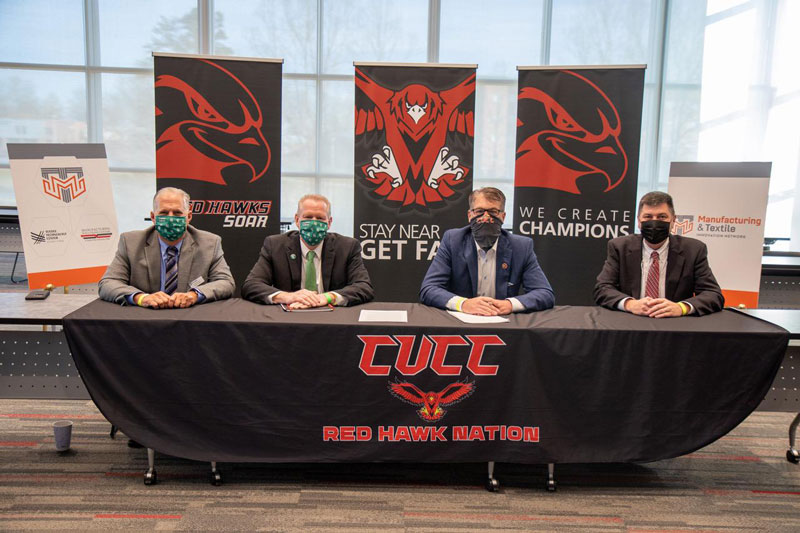
Manufacturing & Textile Innovation Network Created Through Catawba Valley Community College, Gaston College Partnership

DALLAS, N.C. — December 15, 2020 — Through a partnership with Catawba Valley Community College’s Manufacturing Solutions Center (MSC) and Gaston College’s Textile Technology Center (TTC) comes the birth of the Manufacturing & Textile Innovation Network (MTIN).

The partnership of these two centers is a vision of Dr. Garrett Hinshaw, president of Catawba Valley Community College and Dr. John Hauser, president of Gaston College. Both leaders see the MTIN as an opportunity for their respective colleges to work together to develop a regional workforce focused on advanced materials and textile testing development.

“This partnership is a model demonstration of how regional community colleges can leverage their assets to create value within a region’s economy,” said CVCC President Dr. Garrett Hinshaw. “Catawba Valley Community College and Gaston College are creating additional partnership opportunities for the future that will strengthen the workforce and provide a solid foundation for regional economic development.”

The collaborative effort has developed a new two-year associate degree in Textile Technology with three specialty tracks in Textile Design, Textile Technician and Textile Manager. In addition to the current customized industry training programs, MTIN will be developing new industry certifications opportunities to serve business and industry.

The Textile Technology Advisory Board and the Board of Trustees at both colleges have approved the merger of the partnership.

“The partnership exemplifies the future of how community colleges, regions and communities work together to create success,” said Gaston College President Dr. John Hauser. “The value this partnership brings to the state of North Carolina and our regional businesses and industry is tremendous. This partnership also focuses on enhancing our workforce development programs to create opportunities for our students. We are committed to strengthening our region and this is one of the many opportunities for Gaston College and Catawba Valley Community College.”

Currently, CVCC’s Manufacturing Solutions Center provides technical assistance, product testing, training, business incubation and product research and development for commercial manufactures, including commercial manufacturers that specialize in textile and fabrics and non-textile related products.

The Textile Technology Center at Gaston College provides technical assistance, testing services, product prototyping and sample production and customized training for commercial manufacturers using textile and fiber in the manufacturing process.

By themselves, the Manufacturing Solutions Center and the Textile Technology Center each lead the way in providing solutions for manufacturing and textile processes and advancement, but by combining these resources, the Manufacturing and Textile Innovation Network allows both Centers to operate in coordination with each other to provide better support to their respective clients, expand services to other related industries and provide more opportunities for research and development.

“This is a great example of how these two centers and partnerships have been collaborating is in the early stages of COVID and the need for PPE equipment,” said Robin Phillips-Hauser, director, Business Development for the MTIN. “The MSC, TTC and Carolina Textile District were able to react quickly because CTD was able to provide a pattern for masks. Together, we were able to assist industries to quickly adjust their existing product to start producing masks. Many projects like this has been taking place over the years, by collaborating and bringing organizations together, we can share resources and grow even better together.”

The vision of the MTIN is to create an end-to-end matchless resource for diversified manufacturing applied research and development, textile testing, prototyping, business incubation and training. The MTIN will serve companies within the US and around the world.

“Building the MTIN network partnership is unlimited with opportunities for collaborations on projects, grant funding, referrals, and industry support,” said Sam Buff, vice president and general manager of the MSC and TTC. “Most importantly, we can work together to test and help produce quality products, training, job creation and retention.”

The operational partnership of the two Centers will benefit the Centers, industry customers, the textile and manufacturing industries, and our respective communities. The MTIN serves as another economic development resource for the region and state of North Carolina, and it plans to work with manufacturing and textile organizations on projects that will benefit businesses and industry and widen our testing and training services and collaborate on research and funding opportunities.

Posted December 15, 2020

Source: Gaston College

Barco® Uniforms Partners with National Restaurant Association And ServSafe® To Distribute 20,000 Reusable Masks

LOS ANGELES — December 15, 2020 — Barco® Uniforms announced today it has partnered with National Restaurant Association and ServSafe to donate and distribute 20,000 reusable face masks to restaurant operators across the United States.

While Barco has focused on designing and manufacturing premium Healthcare apparel for more than 90 years, it has expanded its product line to support essential workers and everyday heroes who do their part to keep their community safe, including those in the foodservice industry.

Operators who sign up for the ServSafe Dining Commitment demonstrate an ongoing commitment to protecting the health and safety of all guests and employees, in addition to following all federal, state and local guidance or regulations concerning cleaning and sanitation, personal hygiene, social distancing, and health monitoring.

For 30 years, ServSafe has been at the forefront of preparing restaurant and foodservice workers to deliver safe hospitality experiences for their guests, while also keeping themselves safe. ServSafe’s safety training and certification program is sponsored by the National Restaurant Association, the leading business association for the restaurant industry, which comprises one million restaurant and foodservice outlets and a workforce of 15.6 million employees.

As restaurants continue the challenging process of reopening their dining rooms following closures due to COVID-19, protecting the health and safety of employees and guests is a priority. Most states require restaurant employees to wear a face covering; they also encourage employers to provide them with masks and other PPE.

“We honor and serve our everyday heroes who selflessly work on the front line each day to serve others,” said Barco president/CEO David Murphy. “As businesses begin to open back up and more than 15 million individuals employed in the restaurant industry return to work, everyone needs to do their part to prevent the spread of COVID-19. Masks are the most impactful way to do that, and it’s the most visible symbol of a restaurant’s commitment to keeping everyone safe and healthy.”

“Patron and employee safety have been our focus throughout the pandemic,” said Sherman Brown, executive vice president of Training and Certification for the National Restaurant Association. “Masks are the frontline of safety in our operations. This partnership will help ensure that restaurants that have made the ServSafe Dining Commitment have the needed resources to continue to welcome their communities to their tables.”

Posted December 15, 2020

Source: Barco® Uniforms

Honeywell’s New, Reusable, Dual-Layer Face Cover Offers Everyday Protection And Comfort

CHARLOTTE, N.C. — December 15, 2020 — Honeywell today announced a new reusable, three-dimensional knitted face cover with replaceable filters for everyday use.

The Honeywell Dual-Layer Face Cover incorporates Honeywell’s decades of expertise producing respiratory-protection products. The new face covering features an innovative 3D knit design that contours to the wearer’s face and is made with a washable material, making it easy to clean.

The face cover also has a hidden pocket that securely holds a Honeywell protective filter made with meltblown polypropylene, which is similar to the material used in the construction of N95s masks.1 The replaceable filter can block up to 97 percent of 3.0-micron-sized particles (BFE) and 0.1-micron-sized particles (PFE). 2

“Honeywell has vast experience in developing respiratory innovations for industrial workers and first responders, and we have leveraged that expertise to bring the Dual-Layer Face Cover to market,” said Praveen Reddy, president of Honeywell’s personal protective equipment business. “When social distancing measures are difficult to maintain, people want a protective face covering that is comfortable, easy-to-clean, stylish and manufactured by an industry-leading safety technology provider.”

The face covering’s base layer features a seamless, 3D knit construction using polyester, nylon and cotton and provides four-way stretch, minimizing gaps and enhancing comfort. It has a contoured design with adjustable ear straps, a flexible nose clip and ventilation holes for enhanced comfort, function and breathability for most adult face shapes and sizes.

In addition to the new reusable face covers, Honeywell also offers individual Safety Packs for people attending sporting events, traveling or visiting public places. The resealable, easy-to-open kits include a disposable face mask, gloves and wipes.

These new safety products are part of Honeywell’s strategic initiative to quickly develop and deploy solutions to help important sectors of the global economy recover and to help protect people as we return to public spaces. Honeywell also increased production of N95 face masks globally to help protect frontline healthcare workers, emergency responders and governments in responding to COVID-19.

To learn more and purchase the Honeywell Safety Packs and Dual-Layer Face Covers and replacement filters, please visit: ppe.honeywell.com.

1Note: Not FDA approved, not tested against COVID-19, and not intended for medical use.

2Filter material tested by external labs, as per testing requirements of ASTM F2100-19

Posted December 15, 2020

Source: Honeywell

Lenzing, Renewal Workshop, Salvation Army, Waste Management Join Eon Partner Network Data-Exchange To Close Fashion Retail Circular Economy Gap

NEW YORK CITY — December 16, 2020 — Eon has launched the industry’s first global Partner Network to build connected systems for the circular economy across fashion retail in collaboration with leading circular businesses: The Renewal Workshop, Trove, Reflaunt, Lenzing, Hallotex, Recurate, Optoro, Evrnu, Save Your Wardrobe, and Worn Again Technologies along with Salvation Army Trading Company and Waste Management.

The Eon Partner Network will unlock the fashion industry’s vision of a circular economy at scale by enabling brands and retailers to manage, direct and track the flow of garments across the value chain by connecting with those products using Eon’s Internet of Things platform.

Eon’s Internet of Things platform transforms the concept of a “Digital Passport” for physical products into viable reality by using the CircularID™ Protocol and creating a digital system of record for products across their lifecycle, giving brands unprecedented visibility into the journey and value of their products over time plus a transformational system for tracking and communicating with those products.

The Eon Partner Network will enable brands digitizing products on the Eon platform to provide participating circular business partners with instant access to connected product data crucial for enacting circular processes like recommerce and recycling. With Partner Accounts on the Eon Platform and accompanying devices for product scanning — RFID, NFC, QR code — these network partners will have the ability to immediately digitally identify and authenticate products that are connected on the platform and to drive their circular practices by accessing deep beyond-the-label data such as original sale price, images, key features and material content.

Additionally, network partners will have the ability to contribute to the ongoing enrichment of products’ digital passports by tying metadata to product lifecycle events — including location, resale price and channel — creating a continuous picture of a garment’s value in real-time and powering the re-monetization of a single product across multiple lifecycles.

“Making a circular system economically and operationally viable for the fashion industry hinges on the brands’ ability to communicate with their circular business partners about their products — and to connect, track and manage the products themselves. Eon’s Internet of Things platform delivers the enabling technology brands need to connect their products. Now, the Eon Partner Network unlocks the communication about those products between brands and their circular business partners — powering fully functional circular systems and enabling both brands and partners to capitalize on the ongoing value of their products and materials far beyond the first point of sale.”

– Natasha Franck, Eon Founder & CEO

The Eon Partner Network makes the promise of a digital system of connected products viable at scale using a functional language for communication and exchange of data between products digitized via the Eon platform.

“The launch of the Eon Partner Network is a transformational moment in the fashion industry’s journey towards a circular economy,” said Nicole Bassett Co-Founder The Renewal Workshop. “Like many circular partners today, the ability to instantly identify products and materials is our biggest struggle: No matter how a garment is made or what it is made with, reselling or recycling will become viable at scale only when brands are enabled with the technology they need to aggregate and share crucial circularity data. By brands granting us and other network partners access to that data through connected products and Eon’s suite of tools, the Eon Partner Network is opening the gates to a new circular reality for fashion.”

According to Eon Chief Strategy Officer Annie Gullingsrud, Eon has been in research and development on the language and platform architecture to enable this interconnected circular commerce network for several years.

“In partnership with leading global fashion brands and industry, Eon developed the CircularID™ Protocol, the global language for connected products, and has built a platform that supports the communication and data exchange between brands and circular partners using the CircularID Protocol. The launch of the Eon Partner Network is the culmination of Eon’s commitment to solve for the biggest obstacle facing circular economy—product and material identification — and is essential to ensuring products and materials can be managed and monetized at highest value.”

Over the next year, a growing number of brands will pilot the CircularID™ Protocol, bringing millions of connected products online via the Eon Platform and rapidly expanding access to those products and their data for circular businesses participating in the Eon Partner Network.

Posted December 15, 2020

Source: Eon

Kelheim Fibres Nominated For The “Cellulose Fibre Innovation Of The Year 2021” Award

KELHEIM, Germany — December 15, 2020 — Kelheim Fibres has been named as one of the finalists for the “Cellulose Fibre Innovation of the Year 2021” innovation award to be presented at the 2nd International Conference on Cellulose Fibres.

With its plant-based and biodegradable fibers, the Germany-based viscose specialty fibers manufacturer presents a significant contribution to a plastic-free future for AHP (absorbent hygiene products). In contrast to other natural fibers, which are already available in fiber-form and can only be treated on the surface, Kelheim’s technological flexibility offers the possibility to modify cross-sections and to introduce additives into the fiber matrix for intrinsic functionalization. Through these modifications, Kelheim tailors its fibers specifically to the requirements of the individual nonwoven layers of the AHP and is able to achieve comparable performance values to synthetic fibers.

In addition to this, the specialty fibers from Kelheim offer a very attractive ratio of cost to performance in comparison with other fibers of natural origin such as organic cotton. They are therefore not only able to enhance the performance of the final products more effectively than other bio-based alternatives, but are, at the same time, financially attractive.

“Consumers of absorbent hygiene products are often faced with a choice between sustainable solutions made from fibers of natural origin and products with better performance and good fluid management properties produced using synthetic fibers,” said Dominik Mayer, from Kelheim’s R&D team. “Our goal is to offer products to the consumer which combine both sustainability and performance. Our sustainable and functional fiber technologies now make this possible.”

The project is a good illustration of the central element of Kelheim Fibres’ innovation philosophy: the identification of unsolved problems in the market and the development of solutions in close cooperation with experts along the value chain using open innovation techniques. Fibers from Kelheim also offer a significant contribution to overcoming one of the biggest global challenges of our time, by reducing the amount of plastic waste in the environment. Step-by-step, or in this case layer-by-layer, Kelheim Fibres is moving towards a vision of a plastic-free future.

Kelheim’s developments include the hydrophobized Olea fibre — for fast acquisition and efficient transfer of liquid and for better rewet values in the topsheet — as well as the Galaxy® fibre — for an efficient and optimized distribution of liquids in the Acquisition Distribution Layer (ADL) via capillary channels — and the Bramante fiber that can store up to 260 percent of its own weight of liquids in chambers inside the fiber.

Kelheim’s fibers can also be processed in the textile sector, to enable solutions in the field of reusable hygiene products such as menstrual underwear.

All these fibers are already commercially available. Kelheim Fibres is cooperating with an innovative AHP manufacturer and an innovative nonwoven supplier to incorporate the fibers into new end products.

Posted December 15, 2020

Source: Kelheim Fibres GmbH

Cellulose Fibre Innovation Of The Year 2021: One Of Six Nominated New Technologies Or Applications Will Be Awarded This Title

HÜRTH, Germany — December 15, 2020 — For the first time ever, the innovation award “Cellulose Fibre Innovation of the Year” will be granted to the innovative cellulose fiber industry for the development of new technologies and applications. The election and award ceremony will take place at the 2nd International Conference on Cellulose Fibres (CCF), February 2-3, 2021, (online event). More information about the award can be found on www.cellulose-fibres.eu/award-application.

Cellulose fibers are the fastest growing fiber group in textiles, the largest investment sector in the bio-based economy, and a solution for avoiding microplastics. Producers and inventors along the entire value chain from feedstock to the final product joined the competition.

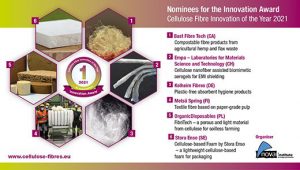
Out of twelve creative and promising inventions six have been finally nominated for the “Cellulose Fibre Innovation Award”. The selection was made by a jury consisting of nova‑institute employees and the advisory board of the conference. The audience will elect the three winners at the 2nd International Conference on Cellulose Fibres (www.cellulose-fibres.eu) which will be organized by nova-Institute on February 2, 2021.

Here are the six nominees:

Bast Fibre Tech, Canada: Compostable fiber products from agricultural hemp and flax waste

BFTi produces compostable fibre products out of agricultural waste from hemp and flax processing. Using biogenic waste from the production of fast-growing crops instead of using wood or fossil resources is environmentally and economically more sustainable. Applications for the obtained fibre with moisture absorbing properties are for example toilet paper and recyclable, thus flushable cleaning wipes.

Empa – Laboratories for Materials Science and Technology, Switzerland: Cellulose nanofiber assisted biomimetic aerogels for EMI shielding

Empa researchers combined cellulose-based aerogels with silver nanowires. The flexible composite blocks high-frequency electromagnetic radiation, which is traditionally achieved by using inflexible metal sheets or metallized foils. This ultra-light electromagnetic shielding material can be used to protect electronic components or the transmission of signals from electromagnetic fields caused by neighbouring electronic devices or motors.

Kelheim Fibres, Germany: Plastic-free absorbent hygiene products

Kelheim Fibres developed plant-based fiber solutions for absorbent hygiene products. These comprise specialty fibers for the single layers of AHP with different functionalities: a hydrophobized fiber for the top sheet, a trilobal fiber for the acquisition/distribution layer and a hollow fiber for the absorbent core. These biodegradable and sustainably manufactured fibers enable the replacement of plastic fibers without a loss of performance. The material has the potential to be used also for the production of textiles, such as reusable menstrual underwear. First commercial end-products using Kelheim’s fiber solutions are developed and intended to be launched in 2021.

Metsä Spring, Finland: Textile fiber based on paper‑grade pulp

The Metsä Group is developing a more energy-efficient process based on a new solvent family to produce Man-Made Cellulosic Fibre (MMCF). Using ionic liquids, the MMCF can be produced from paper-grade pulp, avoiding the use of energy-intensive dissolving pulp. MMCF, such as viscose, lyocell or ModalÒ, are important fibres for the textile industry.

OrganicDisposables, Poland: FibriTech – a porous and light material from cellulose for soilless farming

FibriTech is a new process for the production of porous and light material from cellulose and lignocellulose. A mixture of fibers can be used, including waste and recycled fibres. This extends the possible feedstock for usable materials and reduces waste. Desired properties are derived by the application of bio-additives. The resulting material can be used as a natural soilless substrate with favorable properties for both plants and soilless farming systems. Other possible applications are thermal and sound insulators and air filters.

Stora Enso, Sweden: Cellulose-based Foam by Stora Enso – a lightweight cellulose-based foam for packaging

“Cellulose-based Foam by Stora Enso” is a lightweight foam material made from cellulose. It is designed as an eco-friendly alternative for fossil-based packaging and cushioning materials such as expanded polystyrene or polyethylene. The foam has comparable shock-absorbing and insulating properties whilst being bio-based, biodegradable, compostable and recyclable in ordinary paper recycling.

2nd International Conference on Cellulose Fibre, February 2-3, 2020 (online event)

The “2nd International Conference on Cellulose Fibres” will cover the entire value chain from lignocellulosic feedstock, dissolving pulp, cellulose fibers — such as rayon, viscose, Modal, lyocell or new developments — to a wide range of applications, woven textiles (clothing) and non-wovens (wipes and technical applications). All these sectors have significantly gained momentum over the last few years.

The final programme is now available at: www.cellulose-fibres.eu/programme/

You can register to the online conference here: www.cellulose-fibres.eu/registration/

Kelheim Fibres (DE), Lenzing (AT) and Levaco Chemicals (DE) are supporting the conference as Gold Sponsors. Bronze Sponsor is NC Partnering (FI). Further information on our attractive sponsoring packages can be found at www.cellulose-fibres.eu/sponsoring/ – also the sponsoring of the Innovation Award is still possible.

nova-institute also wants to acknowledge the following associations and research institutions that actively participate as conference partners: BCNP Consultants (DE), C.A.R.M.E.N. (DE), CLIB – Cluster Industrial Biotechnology (DE), Fachagentur Nachwachsende Rohstoffe (FNR) (DE), Forest Stewardship Council (FSC) (DE), IBB – Industrielle Biotechnologie Bayern Netzwerk (DE), ITA – RWTH Aachen (DE), Russian Textile Association (RU), Textile Exchange (DE/US), The Fiber Year (CH) and World BioEconomy Forum (FI).

Posted December 15, 2020

Source: nova-Institut GmbH

Sponsors