Archroma Partners With University Of North Carolina Greensboro On Color Expert Education

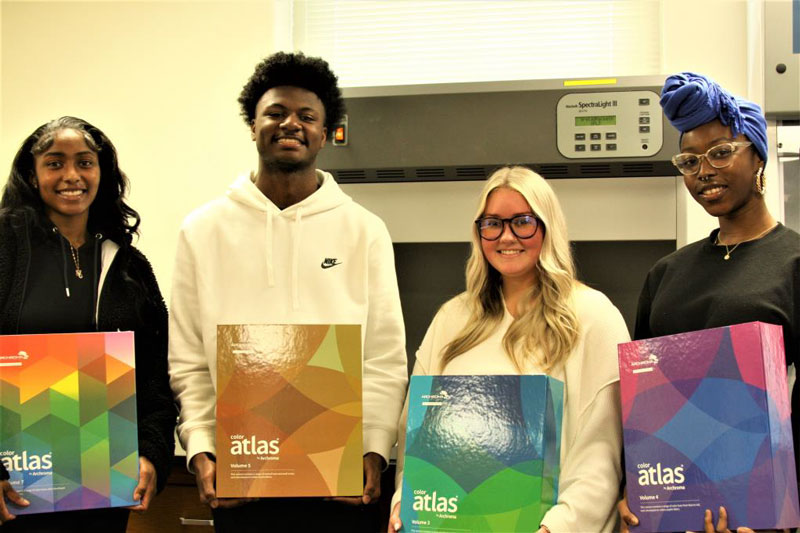
Students of the Consumer, Apparel, and Retail Studies (CARS) of the University of North Carolina Greensboro (UNCG) with the Color Atlas by Archroma®. Photograph: UNCG

PRATTELN, Switzerland — April 7, 2022 — Archroma has announced the launch of a collaboration with the University of North Carolina Greensboro (UNCG) and its Consumer, Apparel, and Retail Studies (CARS) department, aiming to further the education of its students in the area of color management expertise.

As per the agreement, Archroma will donate its leading-edge industry color management tools for their design projects, gaining hands-on expertise that equips them for successful careers in the fashion and textiles industries.

The students will have access to a complete set of the ready-to-use color library developed by Archroma for cotton and polyester. The library, well known among fashion designers and stylists as the Color Atlas by Archroma®, which was launched in 2016 to provide off-the-shelf color inspiration that can be implemented in production with just a few clicks.

Today, the Color Atlas contains 4,320 colors applicable on cotton poplin, almost the double compared to similar tools available to textile and fashion specialists, and 1,440 colors on polyester.

Beside the physical Color Atlas library, the students in the CARS program will also have access to the full digital files for use in the industry-leading 3D fashion design and development software Browzwear VSticher.

The students will be able to use the Color Atlas books and the digital data as a color selection resources to use in a variety projects and assignments.

“Archroma is very proud to help grow a young generation of students who launch in their careers armed with hands-on experience on our innovative color management tools,” said Fred Gliddon, Dyeing Operations and sales manager at Archroma. “The Color Atlas by Archroma is not only a practical, actionable platform for efficient, time-saving color management, it is also a wonderful source of inspiration with more than 5,760 colors.”

Dr. Nancy Hodges, Head of the CARS Department at UNCG, added: “We are excited to use The Color Atlas platform by Archroma in the classroom to teach students about the importance of color management, and to inspire creativity and innovation through color. By working together with Archroma, CARS students are sure to be industry-ready when they graduate.”

Posted: April 7, 2021

Source: Archroma

CORKonLINEN: Unique, Innovative And Compostable

BREST, France — April 7, 2022 — You all know about the planetary, animal and human problems that arise in the textile and leather goods industry. Today, leather is still dominant in these sectors. There certainly exists alternatives, however, 95 percent* of vegan products are made of PVC, polyurethane or a mixture.
All these materials have one thing in common: There is no way to recycle them, they then end up burned or in landfills.

The good news? By 2025, the vegan market will surpass the leather market*. Good news, but we can always do better to reduce our plastic consumption.

The solution to overcome these problems and this high demand? CORKonLINEN.

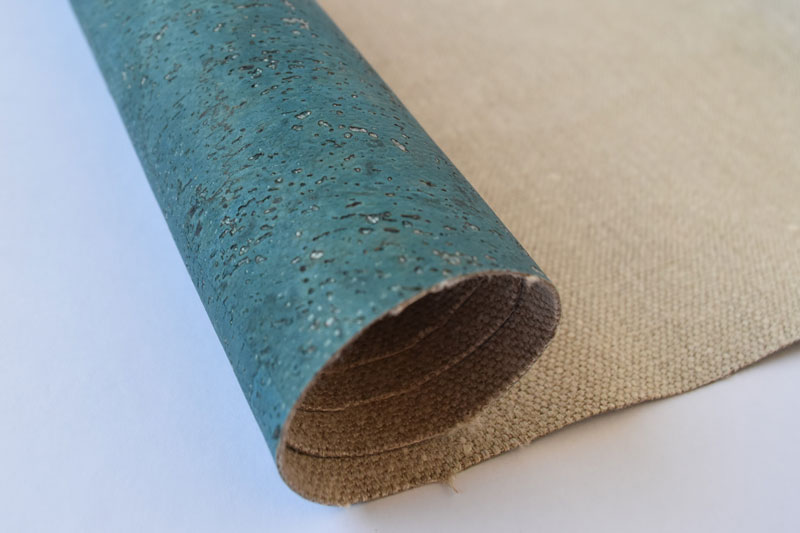
After more than a year and a half of research and development, RTFACT BRANDS offers you a new material: CORKonLINEN. A patented material, composed of only three elements: Portuguese cork, French linen and a water-based glue. 
A solution that breaks the codes and shakes up the world of textile.

CORKonLINEN is currently the only material with equivalent strength and technical properties than leather for the leather goods and textile sector, composed of 100-percent natural materials.

An innovative material for your bags, accessories or even shoes, which is the only one truly sustainable and responsible solution.

This material has been entirely designed in such a way that the impact on the environment is less: just like Portuguese cork, the linen, from the north of France, allows a totally natural culture, requiring no need of watering, pesticides or fertilizers.

RTFACT BRANDS has even thought about the end of life of the material, making it biodegradable and compostable,
 therefore offering a 100-percent green life. A true circular solution, truly sustainable and in compliance with the planet, animals and humans.

* synthetic leather market size, share & trendsanalaysis report

* vegan leather market, analysis report

Posted: April 7, 2021

Source: RTFACT BRANDS

DITF: Replacement Of Toxic Chemicals In The Manufacture Of Tires And Conveyor Belts

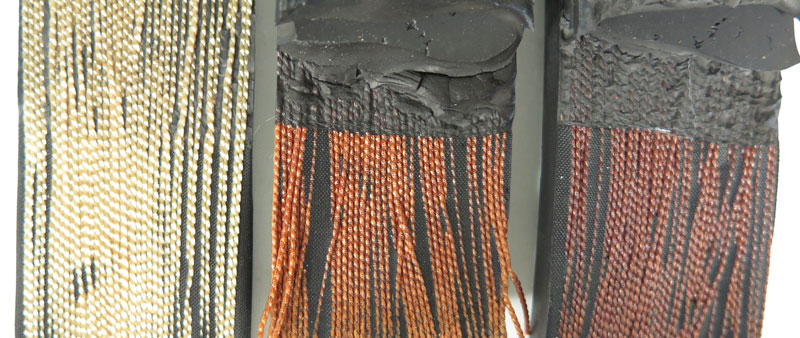
Adhesion of polyamide 6,6 to rubber: without adhesion promoter (left) with RFL-Dip (center) with HMF-Dip (right). Photograph: DITF

DENKENDORF, Germany — April 7, 2022 — The quality of composite systems made of cords of high-strength fibers such as polyester, aramid or polyamide and matrix materials of rubber is largely determined by the adhesion properties of the fibers to the matrix. In the established manufacturing process, adhesion promoters made of resorcinol-formaldehyde-latex (RFL) are used to improve the adhesion properties. Researchers at DITF are showing ways to replace the harmful formaldehyde with technically equivalent substances that are harmless to health.

In car tires, conveyor belts and V-belts, as well as in many applications in the manufacture of technical products, rubber materials are reinforced by cord. High-strength fibers made of polyester, polyamide or aramid are used. They provide the necessary strength and rigidity of the overall composite and counteract external forces. As a result, deformation, elongation and torsion of the material can be kept low.

However, these demands on the fiber composite material can only be met if there is sufficiently high adhesive strength between the fibers and the matrix (made of rubber or caoutchouc). Otherwise, delamination of the material composites, which are built up in alternating layers of fabric and rubber, is to be expected. Material failure would be the consequence.

Adhesion is increased by the use of adhesion promoters. Chemicals based on formaldehyde-resorcinol latex (RFL) have proven effective. They are applied to the fibers as so-called dips and ensure that their adhesion to the matrix of rubber is significantly improved. RFL is established as an adhesion promoter, but it has a significant drawback: since 2014, formaldehyde has been classified by the EU as demonstrably carcinogenic and mutagenic. The chemical industry is therefore urgently searching for alternatives that are harmless to health.

DITF have tackled the problem and developed a new, formaldehyde-free coating system. It is based on the substance hydroxymethylfurfural (HMF), which can be extracted from wood. HMF is formed during the thermal decomposition of carbohydrates. It is found in many heat-treated foods such as milk, coffee or fruit juices and is not considered to pose any health problems according to current scientific knowledge.

The HMF dips developed at the DITF are also promising from a technical point of view: In the case of yarns made of polyamide 6.6, a simple impregnation is sufficient to achieve the desired adhesion improvement. Yarns made of polyester or aramid require an additional prior plasma treatment or a sol-gel finish to achieve the necessary adhesion improvement. Application of the HMF dip is possible under the same conditions and with the same technology used for RFL dips. At this point, therefore, no additional investment is required to replace the adhesion promoter in production.

The advantages already demonstrated are to be expanded. Replacing resorcinol in the dip formulation is the next research goal. This is because resorcinol also has a toxic effect on humans. In cooperation with industrial partners, the extent to which resorcinol can be replaced by lignin is currently being investigated. The special feature of the lignin used is that it is obtained from annual plants. Thus, in contrast to the frequently used wood lignin, it is chemically much more active and offers more potential for further processing into a technically advantageous adhesion promoter.

Both approaches to replacing chemicals in adhesion promoters with substances that are harmless to health carry the idea of sustainable management throughout: the new adhesion promoters made from HMF and lignin are based on natural raw materials. Solving the problem within a demanding, technical application while adhering to sustainability aspects reflects the commitments of research to societal requirements. For small and medium-sized industry, the research results provide the basis for innovations and thus a real advantage in international competition.

Posted: April 7, 2021

Source: Deutsche Institute für Textil- und Faserforschung

Catalyst Fabric Solutions Installs Epson SureColor F10070 Printers

LOS ALAMITOS, Calif. — April 7, 2022 — As Catalyst Fabric Solutions decided to focus their business on home textiles due to the rapidly expanding market, they were in need of a printing solution to keep up with growing demand. This large web-to-print manufacturer of home textile solutions installed multiple Epson SureColor® F10070 dye-sublimation printers to increase productivity and fulfill print-on-demand orders. Catalyst Fabric Solutions offers customers over 10,000 custom home textile products such as tablecloths, placemats, bean bags, backpacks, lunch totes, pillows, and custom blankets that can be ordered through retailers or shipped directly to customers.

“The print on-demand business has tripled in the last four years, and it continues to grow at a great rate,” said Chuck Smith, owner, Catalyst Fabric Solutions. “We’ve seen business increase over the last two years and a lot of people are searching for internet on-demand businesses. We needed more technology; we needed more printers to keep up. The SureColor F10070 was everything we wanted.”

As business grew, Catalyst Fabric Solutions continued to experience an annual spike in sales during the fourth quarter, when customers prepare for the holiday season, leading to an increase in demand for photo products, including photo blankets, that are intensive print projects.

“The first of our SureColor F10070 printers were installed in December 2020 — in the middle of our busiest season,” said Jim King, operations manager, Catalyst Fabric Solutions. “Had they not been a plug-and-play set up, we would have had some real problems, as we were counting on their capacity to meet deadlines. However, they hooked into our network easily and we were able to begin printing immediately.”

“Because of the capacity on the SureColor F10070 printers, we were able to take all our blankets that we previously put through 30 other printers onto the new Epson printers. And they were printing them in less than a minute — about four times faster than our previous machines,” King said. “There’s nothing I haven’t put through this printer yet — it’s the workhorse right now for the plant.”

The Epson SureColor F10070 offers industrial reliability and round-the-clock productivity at a low total cost of ownership. The printer features four 4.7-inch PrecisionCore® printheads to deliver roll-to-roll performance at speeds up to 2,700 square feet per hour and consistently produces astounding-quality textiles, apparel and more, using vibrant UltraChrome® DS ink technology. It also offers an array of features to maximize efficiency and minimize downtime, including user-replaceable printheads and a low-cost, high-capacity replaceable ink pack system that holds up to 20 Liters of ink per color for longer print runs with less user intervention.

“As one of the largest and most advanced facilities of its kind, Catalyst Fabric Solutions runs an impressive operation,” said Tim Check, product manager, Professional Imaging, Epson America Inc. “They are putting the SureColor F10070 to the ultimate test in their industrial facility and pushing a vast majority of their dye-sublimation projects onto the SureColor F10070 printers to best deliver results for clients.”

Posted: April 7, 2021

Source: Epson

The 2022 Marcus Wallenberg Prize: Sustainable Concept For Wood-Based Textile Fibres

FALUN, Sweden — April 7, 2022 — The 2022 Marcus Wallenberg Prize is awarded to Professor Ilkka Kilpeläinen and Professor Herbert Sixta for the development and use of novel ionic liquids to process wood biomass into high-performance textile fibers.

The future demand for textile fibers is growing due to global population growth. Production of cotton, the predominantly used cellulose fiber for textiles, is not expected to keep up with the demand. Therefore, man-made cellulose fibers would be an excellent complement for cotton as these fibers have similar properties.

The main processes to produce man-made cellulose textile fibers are the viscose process, where cellulose is solubilized using alkali and carbon disulphide and the lyocell process, where N-methylmorpholine-N-oxide (NMMO) is used to dissolve cellulose. The viscose process has, however, become environmentally controversial due to the use of toxic carbon disulphide as the main reagent. The lyocell process on the other hand is hampered by the instability of the NMMO.

These challenges have led to extensive research on different solvent systems for cellulose to produce regenerated cellulose fibers. Ionic liquids have gained interest as green alternatives for organic solvents in different processes. Ionic liquids are salts that can be melted below 100°C and have unique properties including low vapor pressure, high thermal stability, and high dissolving capability of different organic and inorganic substances.

Man-made cellulose fibers from wood with high technical quality have been developed by two research teams in Finland, at the University of Helsinki and at the Aalto University. In this concept, the design and use of novel superbase ionic liquids to process wood pulp into high-performance textile fibers was developed and currently tested for scaling-up. The team led by Prof. Kilpeläinen at the University of Helsinki developed superbase ionic liquid solvents for dissolution of wood biomass e.g. bleached or unbleached pulp or recycled cellulose pulp. Prof. Sixta and his team, at the Aalto University, developed the ionic liquid-based fiber shaping process based on dry-jet wet spinning.

“This unique collaboration has resulted in novel sustainable concept of textile fiber production from wood. The innovation is expected to result in a large range of new product and business opportunities for the forest industry”, says Johanna Buchert, chairperson of the Marcus Wallenberg Prize Selection Committee.

The Marcus Wallenberg Prize 2022 will be presented by HM the King of Sweden to Professor Ilkka Kilpeläinen and Professor Herbert Sixta at a ceremony in Stockholm in October this year.

Key facts about the Prize winners

Professor Ilkka Kilpeläinen, was born in 1963 in Finland. He received his PhD in Organic Chemistry in 1993 at the University of Helsinki. In 1995 he was appointed docent degree in organic chemistry at the University of Helsinki and in 2003 in structural chemistry at the University of Oulu in Finland. Kilpeläinen was professor in chemistry at the University of Oulu, Finland, during the period between 2001 and 2003. Since 2003 he has been professor of organic chemistry at the University of Helsinki. Kilpeläinen is also Chairman of the board for Liuotin Group Oy, a development spin-off dedicated to scale-up ionic liquid production.

Professor Herbert Sixta, was born in 1954 in Austria. He has a PhD in Physical Chemistry from the University of Innsbruck in 1982 and Habilitation at Graz University of Technology in 1995 in Wood, Pulp and Fiber technology. He has been professor at the Aalto University since 2007 and was the head of the Department of Bioproducts and Biosystems. Sixta has had a long industrial career at Lenzing AG Austria, focused on the development of industrial regenerated cellulose fibres and their processing.

Posted: April 7, 2021

Source: Marcus Wallenberg Foundation

EFI Reggiani Celebrates 75 Years Of Innovative Solutions For The Textile World

BERGAMO, Italy — April 7, 2022 — Last June, EFI™ Reggiani celebrated 75 years of heritage, innovation and glamour in the textile world. As part of its anniversary celebration, the textile technology innovator is revealing the imminent launch of three new, state-of-the-art digital textile printers.

With three quarters of a century of innovation, research and technological excellence, EFI Reggiani has become the trusted partner for integrated, scalable solutions for the entire textile process — from yarn treatment to fabric printing and finishing. EFI Reggiani has always had its customers in the forefront, enabling their business’ success and growth.

“Textile has been in our DNA since the beginning,” said EFI Reggiani Senior Vice President and General Manager Adele Genoni. “We are always moving to the next level, thinking ahead and developing high-tech, quality and reliable products as well as new textile industry solutions and processes. We are proud of achieving this 75 years of innovation milestone.

“We are also pleased to be a part of the success of so many global textile manufacturers and apparel brands over the past seven decades and into the future,” she added. “We have very close relationships with our customers, and the collaboration we have together allow us to develop groundbreaking new technologies. The three new printers we are launching this year speak to the legacy and expertise for solutions that have made our technologies a benchmark of productivity and quality ever since the creation of the first Reggiani textile printer in 1946.”

Transforming the textile industry with innovation

Always striving to be at the cutting edge of technology, EFI Reggiani delivers world-class products offering boosted uptime and reliability, high performance throughput, unparalleled printing uniformity, and accuracy — all while helping customers increase the sustainability of their textile manufacturing activities.

From the creation of its first traditional printer to its latest technological innovations, EFI Reggiani’s tradition and dedication to its products have contributed to the global transformation of the textile market. EFI Reggiani solutions are used in high-quality, highly productive operations in all of the world’s major textile manufacturing centres. New EFI Reggiani innovations also help facilitate the spread and localisation of industrial textile manufacturing closer to end users in new geographic markets.

75 years of history and excellence

Reggiani Tessile — which was one of the largest fabric manufacturing companies in Italy — created the company to meet its needs in machinery development. Then known as Reggiani Macchine, the company grew tremendously over five decades thanks to continuous product innovation and close customer relationships.

Reggiani Macchine started a new chapter in the early 2000s with the introduction of digital printing technology to their product range. Then, in 2015, Reggiani Macchine joined the Electronics For Imaging family. Since then, the company, based in Bergamo, Italy, has accelerated its mission in driving the transformation of analogue to digital imaging in the textile segment. EFI Reggiani’s product portfolio has continued to expand, ranging from rotary and flatbed printing machines to scanning/multi-pass digital printers to the world’s fastest digital textile printer — the award-winning EFI Reggiani BOLT single-pass inkjet printer launched in 2018. The company has also substantially advanced its ink offerings, becoming a recognised leader as one of the only manufacturers of a full range of inks used in industrial textile manufacturing.

Driving customer success for the future

Today, EFI Reggiani’s leadership in innovation is the result of extensive research targeted at improving productivity and quality, optimising the textile manufacturing process, and reducing energy use, water consumption and overall environmental impact.

While the COVID pandemic made 2020 a difficult year for all involved in textile printing, EFI Reggiani took the opportunity to further strengthen its research and development activities — all to ensure that its customers have the right solutions as the market recovers.

Genoni believes productivity is key to any solution that will help customers recover and thrive post-pandemic, and one of the company’s new launches will specifically target a noticeable gap in the market.

“We want to help support our customers in their digital transformation,” she said. “One of our three new printers is going to target the industrial high-speed segment of the multi-pass textile printing sector. The new printer will not only be the fastest multi-pass printer that EFI Reggiani has ever developed, but we are also expecting it to be the fastest of its kind in the market.”

In the growing industrial, entry-level segment of the market, EFI Reggiani is strengthening its multi-pass offering by introducing two new scanning machines, which will help facilitate customers’ needs to manufacture closer to the end consumer. The pair of scanning printers EFI Reggiani is bringing to market in 2021 will enable new customers to take their first steps in industrial textile digital printing. The new printers will not only be easy to use, but, as with all of the company’s solutions, they will also give customers access to the best technology platforms and innovation for digital industrial printing with EFI Reggiani’s renowned quality and reliability.

Posted: April 7, 2021

Source: EFI™ Reggiani

Durst Group And Four Pees Agree Partnership For Integration Of Durst Software & Solutions Products

BRIXEN, Italy — April 7, 2022 — Durst Group, manufacturer of advanced digital printing and production technologies, has selected Four Pees as a key integration partner for the Durst Software & Solutions division. In this position, Four Pees will assist Durst to implement its Pixel to Output strategy and integrate its software solutions such as Durst Workflow or Durst Smart Shop at its clients.

Durst Group founded the Durst Software & Solutions division in 2019 with a team of over 60 people to provide intelligent and straightforward software solutions to streamline the complete print process. They consist of Durst LIFT ERP, a cloud-based ERP/MIS system, Durst Smart Shop, a comprehensive premium e-commerce solution for customizable print products, and Durst Workflow, a high-end solution for fully automated management of prepress and production tasks. The solutions are tailored for digital printing and offer a 360-degree approach for optimizing printing processes in a mixed-vendor production environment.

Michael Deflorian, business unit manager at Durst Software & Solutions, said: “Durst is known for quality, both in hardware and now with Durst Software & Solutions in the area of print automation software. We wanted to serve our customers even better in consultancy and integration and make our product portfolio easily accessible. We started looking for an experienced integration partner in Europe, and Four Pees quickly appeared on our radar. They have their finger on the pulse of the global printing industry and a proven track record in delivering complex automation projects. When we started talking to each other, we found that we were very complementary to each other in the way we work.”

Tom Peire, CEO at Four Pees, said: “For nearly fifteen years now, we have helped automate print-process around the world at big and small companies. With an increased focus on integration services and an expanded team, this new partnership with the Durst Software & Solutions division is the next step in our growth story. Its vision from pixel to output perfectly aligns with our vision of implementing automation from A to Z. We look forward to working with the different regional Durst teams to help printing companies get the best out of their print production.”

To dive deeper into this, Four Pees will be organizing a Four Pees Café on their new partnership and Durst’s 360 approach to print automation on 05/05/2022. Go to:  https://www.fourpees.com/en/events/2022/05/four-pees-cafe-durst-introduction to register for this webinar.

Posted: April 7, 2021

Source: Durst Group

NRF: U.S. Ports Seeing Brief Slowdown From Last Year But Imports Remain High

WASHINGTON — April 7, 2022 — The nation’s major retail container ports have begun to catch up with the backlog of cargo seen over the past several months, but could experience another surge this summer, according to the monthly Global Port Tracker report released today by the National Retail Federation and Hackett Associates.

“As we entered 2022, the biggest question was when the supply chain would return to normal,” NRF Vice President for Supply Chain and Customs Policy Jonathan Gold said. “Unfortunately, we still don’t have a definitive answer. Congestion at West Coast ports has eased, but congestion at some East Coast ports is growing. Ports aren’t as overwhelmed as they were a year ago, but they are still significantly busy moving near-record volumes of cargo.”

U.S. ports covered by Global Port Tracker handled 2.11 million Twenty-Foot Equivalent Units — one 20-foot container or its equivalent — in February, the latest month for which final numbers are available. That was down 2.3 percent from January but up 13 percent year-over-year.

Hackett Associates Founder Ben Hackett said volumes remained high in February despite factories in parts of Asia closing for the Lunar New Year holiday because U.S. ports were able to handle cargo from ships already waiting for a berth.

“With West Coast ports still congested, there were still plenty of containers to be unloaded,” Hackett said. Similarly, the current near-shutdown of Shanghai because of COVID-19 precautions means fewer ships are leaving China and “the wait on that side of the Pacific will help reduce the pressure of vessel arrivals at Los Angeles-area terminals.” An influx of vessel arrivals following the resumption of normal operations in China could result in renewed congestion at U.S. ports, however.

Ports have not yet reported March numbers, but Global Port Tracker projected the month at 2.27 million TEU, unchanged from the same month last year. April is forecast at 2.13 million TEU, down 1.1 percent from last year, and May at 2.21 million TEU, down 5.3 percent year-over-year. Increases are expected to resume in June, which is forecast at 2.26 million TEU, up 5.2 percent year-over-year. July is forecast at 2.32 million TEU, up 5.6 percent, and August at 2.35 million TEU, a 3.3 percent year-over-year increase that would set a new record for the number of containers imported in a single month since NRF began tracking imports in 2002. The current record is 2.33 million TEU in May 2021.

The first six months of 2022 are expected to total 13.1 million TEU, up 2.5 percent year-over-year. Imports for all of 2021 totaled 25.8 million TEU, a 17.4 percent increase over 2020’s previous annual record of 22 million TEU.

How to build a stronger and more sustainable supply chain will be addressed as retailers, industry experts and technology innovators meet at the NRF Supply Chain 360 conference in Cleveland in June.

Global Port Tracker, which is produced for NRF by Hackett Associates, provides historical data and forecasts for the U.S. ports of Los Angeles/Long Beach, Oakland, Seattle and Tacoma on the West Coast; New York/New Jersey, Port of Virginia, Charleston, Savannah, Port Everglades, Miami and Jacksonville on the East Coast, and Houston on the Gulf Coast. The report is free to NRF retail members, and subscription information is available at NRF.com/PortTracker

Posted: April 7, 2021

Source: The National Retail Federation (NRF)

Rieter Annual General Meeting 2022: All Motions Approved

WINTERTHUR, Switzerland — April 7, 2022 — The coronavirus also had an impact on the 131st Annual General Meeting of Rieter Holding Ltd., Winterthur, Switzerland, on Thursday, April 7, 2022.

Based on Article 27 of Regulation 3 on measures to combat the coronavirus (COVID-19), the board of directors of Rieter Holding Ltd. decided that shareholders can exercise their voting rights exclusively by authorizing the independent proxy. Shareholders therefore could not attend the Annual General Meeting in person. The Annual General Meeting was held on the premises of Rieter Holding Ltd. at the company’s headquarters in Winterthur.

At the Annual General Meeting of Rieter Holding Ltd. on April 7, 2022, the independent proxy represented a total of 1 986 shareholders who hold 64.4 percent of the share capital.

The shareholders approved the proposal of the board of directors to distribute a dividend of 4.00 Swiss francs per share. In addition, they approved the proposed maximum total amounts of the remuneration of the members of the board of directors and of the Group Executive Committee for fiscal year 2023.

Chairman of the Board Bernhard Jucker, and the members of the board of directors Hans-Peter Schwald, Peter Spuhler, Roger Baillod and Carl Illi, were confirmed for an additional one-year term of office. Sarah Kreienbühl and Daniel Grieder were newly elected to the board of directors for a one-year term of office.

Furthermore, Hans-Peter Schwald and Bernhard Jucker, the members of the Remuneration Committee who were standing for election, were also each re-elected for a one-year term of office. Sarah Kreienbühl was newly elected to the Remuneration Committee and is taking over the chair.

Shareholders also adopted all other motions proposed by the Board of Directors, namely the approval of the annual report, the financial statements and the consolidated financial statements for 2021, and formal approval of the actions of the members of the Board of Directors and those of the Group Executive Committee in the year under review. In addition, the authorized capital was extended for a further two years.

Posted: April 7, 2021

Source: Rieter Holding Ltd.

Applied Composites, A Portfolio Company Of AE Industrial Partners, Acquires North Coast Composites And North Coast Tool & Mold From Unitech

LAKE FOREST, Calif. — April 5, 2022 — Applied Composites Holdings LLC — an aerospace, space and defense composites supplier — announced today that it has acquired The companies of North Coast LLC, a manufacturer of Resin Transfer Molded (RTM) composite structures and tooling, from Unitech Holdings Inc. (Unitech). Terms of the transaction were not disclosed.

This marks the sixth acquisition by the Applied Composites platform created by AE Industrial Partners LP (AEI), a private equity firm specializing in aerospace, defense & government services, space, power & utility services, and specialty industrial markets.

North Coast consists of North Coast Composites and North Coast Tool & Mold, Unitech divisions located in the same facility in Cleveland, Ohio. North Coast Composites is a manufacturer of advanced composites for aerospace production through state-of-the-art fabrication of RTM and Vacuum-Assisted Resin Transfer Molded (VARTM) components. North Coast Tool & Mold Corp. is a designer and manufacturer of quality molds and tools for the aerospace industry and a provider of a wide range of innovative manufacturing solutions. With a reputation for stellar customer service, North Coast counts many of the world’s leading aerospace and defense OEMs as customers.

“We are excited for North Coast to become a part of Applied Composites,” said David Horner, CEO of Applied Composites. “North Coast’s best-in-class RTM and tooling capabilities are important to Applied Composites and help to reinforce our leadership position in advanced composite solutions throughout our core aerospace, defense and space markets.”

“We have been strategically focused on building a complementary set of capabilities able to deliver a one-stop set of composite solutions to our customers,” said Jon Nemo, senior partner at AEI. “North Coast and RTM are strategic additions to Applied Composites and our ability to serve our growing list of OEM partners.”

Kirkland & Ellis served as legal advisor and RSM served as financial advisor to Applied Composites. Vedder Price P.C. was the legal advisor and Moelis was the financial advisor to Unitech.

Posted: April 6, 2021

Source: Applied Composites; AE Industrial Partners

Sponsors