101 North Carolina Small Businesses Win Grants To Build Next-Generation Technologies

RALEIGH, N.C. — September 22, 2022 — The North Carolina Board of Science, Technology & Innovation announced today that 101 North Carolina small businesses have received 117 grants to advance the commercialization of innovative new technologies. The One North Carolina Small Business Program awarded a total of $4.95 million to innovative companies in 22 counties across the state.

“Support for early-stage technology companies pays off in better jobs, more investment, and new ways to make our state a great place to live and do business,” said Governor Roy Cooper. “These small businesses are tackling society’s most pressing challenges in many areas, including the life sciences, defense, and clean energy. Innovative small companies drive growth and competition, keeping our economy healthy and quality of life high.”

The One North Carolina Small Business Program, established in 2005, provides state grants to companies that are pursuing or have won federal awards through two highly competitive federal programs, the Small Business Innovation Research (SBIR) and Small Business Technology Transfer (STTR) programs. These federal programs, referred to as America’s Seed Fund,™ support small businesses that are developing technologies with a high potential for commercialization. The SBIR and STTR programs are the single largest source of early-stage technology development and commercialization funding for small businesses—more than $3.7 billion annually nationwide.

“Innovation drives our economy forward, and small businesses are the very best incubators of innovation,” said North Carolina Commence Secretary Machelle Baker Sanders. “The One North Carolina Small Business Program has supported the state’s small technology businesses for many years and I’m proud we’ve been able to extend the program’s reach and boost the number of small companies engaged with the program.”

Two types of state grants were awarded during the new funding round, Incentive grants and Matching grants.

Incentive grants support qualified North Carolina businesses as they prepare and submit SBIR or STTR proposals to federal agencies, helping offset some of the costs of developing these complex proposals. The Incentive program aims to increase the number and quality of proposals submitted for the federal grants, and to encourage broader geographic diversity among the North Carolina businesses that apply.

Matching grants award funds to North Carolina small businesses who have already received a federal Phase I SBIR or STTR award, with the goal of filling gaps left by the federal funding, attracting follow-on investments, and encouraging the businesses to grow their presence in North Carolina. The state matching funds leveraged more than $16 million in federal funds during this round.

This year represents the most geographically diverse cohort in the history of the One North Carolina Small Business Program, with companies in 22 counties — from Brunswick to Yadkin — receiving awards. The variety of projects funded was also the most diverse in the program’s history, with grantees receiving funding from 10 different federal agencies (out of 11 agencies that participate in the SBIR/STTR programs). Additionally, the number of first-time applicants receiving awards was the highest since the One North Carolina Small Business Program was established.

The One North Carolina Small Business Program is administered by the North Carolina Department of Commerce on behalf of the North Carolina Board of Science, Technology & Innovation.

“Recognizing the continued importance of fostering innovation statewide, this year the Board took deliberate action to create a larger and geographically diverse cohort,” said Rick Webb, chair of the Board’s Outreach & Funding Committee. “The Board’s actions are bearing fruit in more cities and counties. Demand for this program is strong and growing, and with increased funding, we can help North Carolina companies stay competitive as other states start to offer similar support for their small businesses.”

Since 2006, the One North Carolina Small Business Program has helped just over 400 companies across the state develop and bring to market hundreds of high-tech products. North Carolina is among a handful of innovative states that have chosen to bolster their economy this way. The Program’s grants support small businesses at a critical stage of their growth, shortening the time needed from technology development to the point where they become large, successful businesses. Many recipients have said the grants were the vital injection of capital they needed to put their companies on a successful trajectory.

The Program has been responsible for helping to create 1,000 North Carolina jobs, the development and commercialization of hundreds of high-tech products, and the generation of more than $2 billion in follow-on capital investments.

The entire list of One North Carolina Small Business Program awardees can be reviewed at the Commerce website.

Posted: September 23, 2022

Source: North Carolina Office of the Governor

Saint-Gobain’s Acquisition Of GCP Applied Technologies To Close On September 27, 2022

MALVERN, Pa. — September 22, 2022 — Saint-Gobain has now obtained approvals from all relevant competition authorities for its acquisition of GCP Applied Technologies Inc., a global player in construction chemicals, announced on December 6, 2021. The acquisition will close on September 27, 2022. GCP will delist from the New York Stock Exchange.

With approximately $1 billion revenues generated in 2021 by 1,800 employees working on 50 production sites in 38 countries, GCP Applied Technologies provides a global platform with established success in cement additives, concrete admixtures, infrastructure and commercial and residential building materials.

This acquisition is a major milestone in establishing Saint-Gobain’s leading position worldwide in construction chemicals and furthers the Group’s strategy as worldwide leader in light and sustainable construction.

The specialty building materials business in North America (c. $250 million of sales) will be integrated into the CertainTeed business serving local customers in its Region. All other businesses, consisting of mainly concrete admixtures and cement additives (c. $750 million of sales) will be combined with the Chryso business and be part of the High Performance Solutions segment.

The acquisition of GCP Applied Technologies follows several other growth investments in North America announced by Saint-Gobain in recent months:

  • In August, Saint-Gobain completed its $928 Million acquisition of Kaycan Ltd., a family-owned manufacturer and distributor of exterior building materials, becoming the top siding player in Canada.
  • In May, Saint-Gobain announced a $100 Million expansion of its CertainTeed roofing facility in Peachtree City, Ga., more than doubling the site’s production capacity while also reducing its carbon dioxide emissions.
  • Also in May, the company announced a $28 Million investment in its ADFORS technical textile products facility in Dublin, Ga., creating 400 jobs over the next two years.
  • In April, Saint-Gobain announced it was doubling the manufacturing footprint of its CertainTeed Architectural manufacturing site in Lakewood, Ohio, by moving to a new, state-of-the-art location in nearby Strongsville, Ohio.
  • Also in April, Saint-Gobain announced a $118 Million expansion of its CertainTeed roofing plant in Oxford, N.C., adding an additional 225,000 square feet of manufacturing space to what was already one of the largest roofing shingle manufacturing sites in North America.
  • In February, the company invested $32 Million in its CertainTeed insulation manufacturing site in Chowchilla, California, increasing the location’s production capacity by 13 percent while also reducing its carbon footprint.

Posted: September 23, 2022

Source: Saint-Gobain

Columbia Sportswear Outlines Strategic Priorities And Plan To Accelerate Profitable Growth

PORTLAND, Ore. — September 22, 2022 — Columbia Sportswear Co. — a multi-brand global innovator in outdoor, active and lifestyle products including apparel, footwear, accessories and equipment — is hosting a meeting with investors and analysts at its headquarters to outline the Company’s strategic priorities and growth strategies, and introduce three-year financial targets.

Chairman, President and CEO Tim Boyle commented: “From our IPO in 1998 to 2021, Columbia Sportswear Company delivered a 9 percent net sales compound average growth rate (CAGR), 11 percent diluted earnings per share CAGR and a 13 percent annual total shareholder return. Today, we are providing multi-year financial targets that demonstrate our confidence in our ability to accelerate growth opportunities over the next three years and beyond.

“Our three-year plan outlines our balanced, broad-based growth that will be amplified by three key accelerators: footwear, international expansion and digital sales growth. Columbia, with its differentiated innovation and value proposition, will add over $700 million in net sales by 2025. SOREL is expected to be our fastest growing brand, generating a 20 to 22 percent 3-year CAGR, fueled by its year-round product offering and brand momentum. We anticipate delivering operating margin improvement over this time period, while investing in several areas, including demand creation and digital and supply chain capabilities.

“We are focused on our strategic priorities to:

  • Accelerate Profitable Growth by unlocking the full potential of our brand portfolio;
  • Create Iconic Products that are differentiated, functional and innovative;
  • Drive Brand Engagement through increased, focused demand creation investments to grow brand awareness and build brand affinity;
  • Enhance Consumer Experiences by investing in capabilities to delight and retain consumers and better serve our wholesale partners;
  • Amplify Marketplace Excellence, with a digitally-led, omni-channel global distribution strategy that clearly reflects the quality and value of our products, wherever consumers choose to shop; and
  • Empower Talent that is driven by our core values, through a diverse and inclusive workforce.”

2022-2025 3-Year Financial Targets

(Additional financial outlook details can be found in the Investor Day presentation).

“Given the confidence we have in the collective strength of our brands and our ability to execute our strategic priorities, we are setting a 13 to 17 percent total annual shareholder return target over the three-year time period spanning 2023-2025,” said CFO Jim Swanson. “We’re poised to accelerate profitable growth with broad-based momentum across our portfolio and geographies, and further amplified with a focus on footwear, international and digital sales growth.”

Execution of the company’s plan is expected to achieve the following financial objectives for the period beginning January 1, 2023, through December 31, 2025:

  • Net sales are expected to grow at a three-year CAGR of 9 to 11 percent, compared to the midpoint of our 2022 financial outlook, reaching $4.5 to $4.7 billion in 2025.
  • Operating margin is expected to expand to approximately 14 percent of net sales in 2025.
  • Diluted Earnings per Share is expected to grow at a three-year CAGR of 12 to 15 percent compared to the midpoint of 2022, reaching $7.35 to $7.95 in 2025.
  • The Company is targeting an Annual Total Shareholder Return (TSR) of 13 to 17 percent, inclusive of net sales growth, margin expansion, dividends and share repurchases.

Full Year 2022 Financial Outlook Update

The company is reaffirming its full year 2022 net sales outlook of $3.44 to $3.50 billion, representing net sales growth of 10 to 12 percent compared to 2021, and full year 2022 diluted earnings per share outlook of $5.00 to $5.40.

Posted: September 23, 2022

Source: Columbia Sportswear Co.

112-Year-Old Linen And Textile Provider George Courey Transitions To The Fourth Generation Of Ownership

LAVAL, Quebec — September 23, 2022 — George Courey Inc., a 112-year-old business, owned by the same family for four generations, has undergone a successful transition from the third to the fourth generation. Taking a century-old business into the future requires a business acumen and maturity of leadership which Jeffrey Courey and Robert Courey bring to the table.

On September 15, 2022, the George Courey Inc. headquartered in Laval hosted the transition ceremony, in the presence of representatives from the House of Commons, clients and employees. Mindful of the wealth of experience Jeffrey Courey accumulated in the company as COO for 7 years, he was promoted to the role of president and CEO in January 2020. Robert Courey, who served for 16 years as the director of Business Development became the Vice President in May 2022.

Against the shifting sands of uncertainties induced by the Covid 19 pandemic and the high demand for limited supplies of personal protective equipment, George Courey Inc. never wavered in its mission to actively support governments in bringing much needed relief to hospitals and care homes. George Courey Inc. is currently known as a leader in North America’s linen and textile production and distribution. Inching closer to the creation of new warehouses in different locations across Canada and the United States is the next milestone unfolding.

Articulated by Jeffery Courey as “the passing of the torch to a new generation of Coureys, well-positioned to steward this company into the next century through our focus on People, Planet and Progress.” This will partly entail in his own words “continued success in the growing USA market while promoting reusable textiles across multiple sectors, offering our clients outstanding value, sustainable product innovation and an unparalleled customer experience.”

With Jeffrey and Robert at the helm, the company’s reputation as one of North America’s most reliable and respected linen and textile providers will continue to grow.

Posted: September 23, 2022

Source: George Courey Inc.

Apparel Impact Institute Announces The PVH Foundation As The Newest Lead Funder To The $250M Fashion Climate Fund 

SAN FRANCISCO, Calif. — September 22, 2022 — Apparel Impact Institute (Aii), the nonprofit organization dedicated to mobilizing climate action in fashion, today announced that The PVH Foundation is joining the catalytic $250 million Fashion Climate Fund as a lead funder. This advances the Fund’s aim to drive industry-wide convergence to modernize the fashion industry supply chain and meet the industry’s ambition to halve carbon emissions by 2030.

The PVH Foundation, which leads the global philanthropic efforts of PVH Corp., is the newest addition to the Fashion Climate Fund. PVH Corp., which owns iconic brands such as Tommy Hilfiger and Calvin Klein, joins Lululemon, H&M Group, H&M Foundation, and The Schmidt Family Foundation as a lead funder, with each committing $10M. This investment underscores PVH Corp.’s enduring trust and belief in Aii as a critical partner and intellectual clearinghouse that will help reach the fashion industry’s 2030 climate goals.

The first-of-its-kind Fashion Climate Fund is strategically designed to leverage industry treasury and philanthropic funds to execute foundational supply chain improvements; these include transitioning to renewable electricity, improving energy efficiency, eliminating coal in manufacturing, scaling sustainable materials and practices, and accelerating next-generation materials. In doing this work, the Fashion Climate Fund will also derisk investment opportunities, allowing the industry to engage larger financial institutions to unlock an estimated $2B in additional asset classes, including debt and equity.

“The leadership shown by PVH Corp., a long-time partner to Aii, represents a big step forward in our work to tackle fashion’s supply chain emissions,” said Lewis Perkins, Aii president. “The PVH Foundation is helping to fuel the Fashion Climate Fund’s unique grantmaking engine to accelerate proven programs, solutions, and innovations into the supply chain to lower carbon emissions.”

“Our company purpose, to power brands that drive fashion forward for good, is at the core of our multiyear growth plan and has guided us for many years,” says Stefan Larsson, PVH Corp. CEO. “We know that collaboration and funding are critical to driving solutions that address the fashion industry’s contributions to climate change and are proud to be supporting the Fashion Climate Fund in this work.”

Since the Fashion Climate Fund and first round of lead funders were announced in June 2022, Aii has made strides in developing the Climate Solutions Portfolio, an online registry of initiatives that tackle supply chain carbon emissions; finalizing the strategy and approach for the Fund’s blended capital approach; and building the framework for onsite carbon data collection.

In the coming months, Aii will continue to deploy funding into supplier carbon target-setting and prioritization projects, Clean By Design efficiency programs, and renewable energy pilots, and build the “use of funds” strategy for 2023, while it convenes more partners into this Fund and grows strategic relationships with investment capital, both commercial lending and private equity, looking toward the $2B capital unlock.

Posted: September 23, 2022

Source: Apparel Impact Institute (Aii)

HeiQ Launches HeiQ Allergen* Tech Making Home Textiles Sanitation Easier And Lasting

ZÜRICH, Switzerland — September 22, 2022 — HeiQ announces the launch of a 100-percent biobased, proprietary textile technology, HeiQ Allergen Tech, which aims to improve the lives of all the ones who suffer from allergies. This technology reduces inanimate allergens, like house dust mite matter, and pet allergens, and can be easily added in the finishing stage of the manufacturing process of textiles for bedding and furniture purposes.

Allergies are one of the most prevalent health problems in the world, estimated to affect about 40 percent of the global population, according to an article in the International Archives of Allergy and Immunology.

Building upon its tested and proven, proprietary Synbio ingredient, HeiQ is now launching HeiQ Allergen Tech, a new textile finish for home textiles, and textiles used for furniture and public transportation.

100-percent biobased HeiQ Allergen Tech creates an invisible protective layer that lasts at least 20 washing cycles and beyond according to performed tests. Its main advantage is cutting down the proliferation of allergens such as house dust mite matter and pet allergens (pet hair, dander, saliva), and creating conditions for reducing the health threats they pose to millions of people.

Sleeping with the “enemy”

One of the unsuspicious settings where these allergens are most present is in our bedrooms, mainly through accumulation in the sheets and other bedding items.

During sleep and when we make our beds, we inadvertently launch these allergens into the air and we end up breathing a high number of them, causing respiratory, skin, and ocular problems, just to name a few of the ones they cause (according to an article in the Iranian Journal of Public Health). Even just sleeping means that our body and airways are exposed between 6 to 8 hours each night, which is considered to be a long exposure.

According to Dr. Robin Temmerman, CEO of HeiQ Chrisal and Ph.D. in microbiology: “Chrisal joined HeiQ about a year ago on the mission to improve the lives of billions of people. It’s exciting to combine my two decades of research on synbiotics with HeiQ’s leading textile innovation capability to come up with the world’s first 100-percent biobased anti-allergen technology for textiles.

Our proprietary HeiQ Allergen Tech achieves an impressive reduction of allergens that can become airborne in our living and sleep environments, in nature’s way. It has a full biologic origin and utilizes the natural process of probiotic colonization on the textile surface to effectively reduce inanimate allergens.”

Certified for lasting protection

Several tests have proven the high effectiveness of HeiQ Allergen Tech in reducing the levels of house dust mite matter (96.6%), allergens from dog hair (76.5%) and cat hair (83.6%), keeping a durable effect even after frequent washing. Following these results, Allergy UK has assessed and certified HeiQ’s new allergen control textile technology.

This technology becomes even more helpful when applied to furniture textiles such as sofas or public transportation seats, which are more difficult to wash or sanitize.

*for inanimate allergens only

Posted: September 23, 2022

Source: HeiQ Materials AG

Crowley Participates In Carbon Ridge Funding Round To Support Decarbonization Solutions

LOS ANGELES — September 22, 2022 — Carbon Ridge Inc., a developer of modular onboard carbon capture and storage solutions (OCCS) for decarbonizing the maritime industry, today announced the company has raised $6 million in funding led by the Grantham Foundation for the Protection of the Environment, with additional investments from Crowley, a U.S.-based shipping and logistics company, and Berge Bulk, one of the world’s largest dry bulk owners, as well as Rusheen Capital Management and Plug and Play Ventures. The financing enables Carbon Ridge to continue development of the company’s OCCS technology for an onboard pilot in 2023.

“We believe onboard carbon capture and storage will be the lowest cost and most efficient pathway to achieve near-term decarbonization in the maritime industry. We are very excited about partnering with the Grantham Foundation, Crowley and Berge Bulk, as leaders in their respective sectors, each with strong commitments to long-term climate stabilization,” said Chase Dwyer, founder and CEO of Carbon Ridge.

Kevin Tidwell, managing director at Grantham Foundation, said: “Shipping will be one of the most difficult industries to decarbonize. We believe that Carbon Ridge’s maritime carbon capture systems will be cost-effective, ubiquitous and ultimately bend down the curve of shipping emissions.”

“Crowley’s ambition is to become the most sustainable and innovative maritime and logistics company in the Americas. Investing in and developing cleaner, low-carbon solutions will be critical in reaching the maritime industry’s decarbonization goals. Carbon Ridge’s novel approach to significantly lessen the impact of maritime emissions aligns with our target sustainability goals and we are pleased to support the scale-up of their technology,” said Tom Crowley, chairman and CEO of Crowley.

“We believe in the potential of onboard carbon capture & storage as one of the effective solutions to enable Berge Bulk’s commitment towards zero emissions. Our partnership with Carbon Ridge is a strong step forward in achieving those goals and consistent with our broader sustainability mission,” said James Marshall, CEO of Berge Bulk.

Posted: September 23, 2022

Source: Crowley

SHIMA SEIKI Announces Sales Promotion Package For Apparel Industry Together With KDDI

WAKAYAMA, Japan — September 23, 2022 — Fashion technologist SHIMA SEIKI Mfg., Ltd. together with telecommunications company KDDI Corporation, Tokyo, launched “XR Mannequin for APEXFiz,” a sales promotion package that links Shima Seiki’s APEXFiz design software for the apparel industry with KDDI’s XR (cross-reality) technology.

XR Mannequin for APEXFiz will be offered to the apparel industry. Using an XR Mannequin that enables viewers to check product images from any angle in 360 degrees on various devices, XR Mannequin for APEXFiz enables digital catalogues with 3D virtual sample image data of garments designed on APEXFiz design software, 360-degree VR showrooms, as well as digitally extended stores. It also realizes virtual proposals at exhibitions, showroom-style stores with no inventory, and user-friendly purchase experience on e-commerce sites, and more. It also allows users to reduce excess stock at stores and create new sales opportunities.

Eventually, by adding movement to models wearing Virtual Samples and rendering them on a cloud server, customers will be able to view high-resolution virtual fashion shows on their smartphones and other devices.

Visitors to Shima Seiki’s 60th Anniversary event which opened on September 1, 2022, will be able to experience XR Mannequin for APEXFiz first-hand.

Background and Aim

• Until now, the apparel industry has been making actual product samples in each of the planning and design stages of production. This process not only takes an enormous amount of time and cost, but generates waste of raw materials including fabric that require disposal. At the retail stage, stores also needed to have various sizes and colors in stock to address a wide range of customer preferences, resulting in excess inventory.
• With Shima Seiki’s APEXFiz, designs can be evaluated without making actual samples, minimizing resources spent on sample production as well as lead time, enabling environmentally-friendly manufacturing.
• In May 2022, KDDI developed a high-resolution XR mannequin for apparel sales, with support from Google Cloud. It enables various devices such as store signages and smartphones to check products from any angle in 360 degrees, enabling stores to sell products without maintaining inventory.
• Shima Seiki and KDDI combines APEXFiz and XR Mannequin to start providing XR Mannequin for APEXFiz. This brings DX solutions to all stages in the supply chain for the apparel industry, from planning and design to sample making, production, distribution, and retail sales.

Shima Seiki and KDDI will continue to create services together that link each other’s products, to bring about a sustainable society by reducing excess stock, and providing a customer experience that gives peace of mind when purchasing products.

Features of XR Mannequin for APEXFiz

• Virtual Samples created on APEXFiz and distributed with KDDI’s XR Mannequin can be viewed by customers from any angle in 360 degrees, three-dimensionally.
• This way, the seller can communicate product information in AR at the store or in VR in a space created to match product concept, resulting in sales promotion. Links to e-commerce sites can also be attached to each product to navigate customers toward purchases.
• Design data created on APEXFiz can be converted into data for WHOLEGARMENT knitting machine production, enabling on-demand production of orders for knitwear generated through use of XR Mannequin for APEXFiz, resulting in production with minimal wasted-resources and minimized stress on the environment.

Scenarios using XR Mannequin for APEXFiz [Immediately available scenarios]

  1. Digital catalogs — Use of realistic Virtual Samples enables users to create digital catalogs without actual products. Users are able to propose products to customers without maintaining stock at the store and use the catalogs as a sales promotion tool by linking to e-commerce and payment systems.
    Digital catalogs are based on the free-angle video distribution platform provided by MasterVisions Inc.
  2. 360-degree VR showrooms — Using au XR Door’s web edition, Virtual Samples can be exhibited in a VR space that matches the product concept, to be viewed from any angle in 360 degrees. Showrooms can be displayed anywhere as they are digital, enabling customers to see products anywhere, at any time, even in places which would otherwise be unfit for display in reality.
    Experience a demo here (https://www.xrdoor.xreality.au.com/shop/shimaseiki/vr-knit_en/).
    * au XR Door is a smartphone service by KDDI, enabling users to enjoy various VR spaces by passing through an AR door shown on the screen.
  3. Digitally extended stores — When customers hold their smartphones in the air inside the store, the camera recognizes the view and displays content and information in specific areas, enabling the seller to extend the store space digitally. Customers unable to visit the store can have a 360-degree VR store space displayed at home to enjoy a similar experience. This enables the seller to promote the store to people overseas and in remote locations to attract customers.
    Experience a demo here (https://www.xrdoor.xreality.au.com/shop/shimaseiki/60th_en/).
    [Future scenarios (under development)]
  4. Virtual display with smart glasses — Wearing “Nreal Light” smart glasses, the user will see a Virtual Sample projected three-dimensionally in front of them, allowing the user to walk around the sample 360-degrees. This allows virtual displays without actual products and requiring minimum space.
    * Nreal Light refers to smart glasses KDDI developed together with Nreal.
  5. Product PR and retail enhancement using virtual humans — The virtual human “coh,” an XR Mannequin developed by au VISION STUDIO, is used for product PR and to enhance the retail experience. coh in this image is wearing a virtual WHOLEGARMENT dress.
  6. Checking high-resolution Virtual Samples through cloud rendering — Google Cloud’s Immersive Stream for XR is used to store and distribute high-resolution Virtual Samples in their entirety in a content management system without having to reduce data size, which requires a lot of work in conventional XR content production. Users can enjoy viewing Virtual Samples in VR and AR at the same quality regardless of device performance.
  7. Virtual fashion shows — Virtual fashion shows can be distributed through Immersive Stream for XR, with movement added to models wearing Virtual Samples placed in the desired environment and with meticulous stage direction, enabling customers to enjoy shows interactively in high-resolution through VR and AR from any angle in 360 degrees.

Posted: September 23, 2022

Source: Shima Seiki

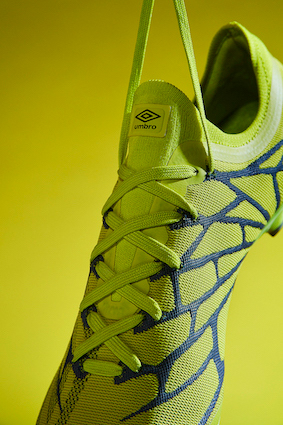
Texon’s ProWeave Technology Plays Striking Role In Umbro’s New Velocita Alchemist Football Boots

SALTBURN-BY-THE-SEA, England — September 23, 2022 — ProWeave, a jacquard weaving technology developed by Texon, has been used by global sports brand Umbro to create its new Velocita Alchemist football boots, which are available from today.

The use of Texon’s patented ProWeave technology by Umbro is a first in the sports sector and gives Velocita Alchemist boots new levels of elasticity and stability with recycled polyester yarns. In sports footwear, ProWeave delivers the ultimate adaptive fit acting like a second skin for sure-footed stability.

Featuring a single layer upper, the Velocita Alchemist has multi-zonal stretch for outstanding fit and breathability, plus a biomimicked bee-wing structure for strength and support using TPU yarns. The yarns enable extra grip, aiding ball control, spin and friction, and with full upper water-resistance finishing, bad weather won’t slow the wearer down either.

On the bottom of the boot, a Pebax Powered® Sprint+ outsole brings multidirectional agility, whilst the stud geometry distributes pressure evenly for strong traction and a comfortable change of pace and direction.

Colin Lomas, category director, Footwear and Equipment at Umbro said: “With a history of world-firsts, we’re proud to introduce another ground-breaking innovation to the game of football. In conventional boot manufacture, post-weave treatments add unnecessary weight and use 35 percent more energy. By introducing Texon’s ProWeave technology to the Velocita Alchemist, we have been able to deliver a high-performance boot with lower environmental impact.”

Paul Jackson, Business Acceleration leader for ProWeave at Texon, said: “ProWeave transforms the way performance fabrics are made and how they look, feel and function. Creating different elasticity, tenacity, and abrasion zones within the same weave, ProWeave helps brands bring new competitive, creative concepts to life. We’re delighted that Umbro have utilized ProWeave to such great effect in the Velocita Alchemist.”

Posted: September 23, 2022

Source: Texon

Seizing Growth Opportunities In The Bulgarian Textile, Clothing, Leather And Footwear (TCLF) Industries

BRUSSELS — September 23, 2022 — The textile, clothing, leather and footwear (TCLF) industries employ 80,000 workers in Bulgaria. However, employment has gone down by 20 percent in the past four years which is a concern. Social partners discussed the challenges and opportunities of the new EU Sustainable Textiles Strategy and focused on both environmental and social sustainability. They agreed that for the Strategy to be successful, all stakeholders must come together, and that a level playing field must be maintained between EU (Bulgarian) and non-European companies.

In the face of tough global competition, huge investment will be needed in both technology and people to ensure that the Bulgarian TCLF sectors can become greener and more digital. The modernization of these sectors would also help the sector to become more attractive to Bulgarian workers, thus reducing the need to hire workers from abroad.

Employers and unions called on the Bulgarian government to come up with an industrial strategy to make use of the growth opportunities for a country close to major European markets. In the EU Strategy, TCLF industries are one of 14 industrial priority sectors.

Concerns were raised by national social partners, similar to other central and south European countries, that some young workers have opted to leave for Western Europe. Proposals to tackle this issue included ensuring better purchasing practices from major fashion brands whose suppliers account for more than 90 percent of TCLF production. The social partners voiced their hope that with improvement in the purchasing practices of brands, changes in the behaviour of consumers and measures to ensure competitiveness that benefits could be felt by both industry and the workforce.

FOSIL-CITUB and FLI-PODREPA unions called for stronger social dialogue and sectoral collective bargaining. There has been no branch agreement since 2008, and existing company accords only cover 3 to 4 percent of the sector. This is far from the 80-percent coverage mentioned as reference in the upcoming European Minimum Wage Directive. As such, the unions have agreed to start developing a work plan to increase their leverage.

Employers wanted to have regulations to combat the grey economy and unfair competition. BAATPE and BATOK associations acknowledged that social partners must increase their representativeness to have a louder voice.

Luc Triangle, industriAll Europe’s general secretary said: “The message from trade unions in Sofia is clear: we need quality social dialogue and strong collective agreements to ensure a positive future for the TCLF industries in Bulgaria. The EU’s Sustainable Textiles Strategy offers a real opportunity if managed correctly, but investments – both in technology and the workforce – will be essential. This includes ensuring fair wages and good conditions to retain current workers and attract new ones.’’

Dirk Vantyghem, EURATEX director general, said: “In a context where Europe puts more focus on quality, transparency and sustainability, Bulgarian textile companies have a future. But they need support from the authorities to make that green and digital transition, and a constructive social dialogue, which ensures long term competitiveness of the industry.”

Carmen Arias, secretary general of CEC, said: “Moreover, a particular focus and attention should be given to investments on skills and lifelong learning of workers. People are the main asset for the growth and competitiveness of the footwear and leather goods industries, and the education system in Bulgaria should be able to respond to companies’ skills needs. For that purpose, adequate curricula and related training programmes should be developed and education infrastructures made available by public authorities, in particular when it comes to vocational education and training (VET).’’

Gustavo Gonzalez-Quijano, secretary general of COTANCE, said: “Leather producers in Bulgaria and all over Europe constitute a fundamental link in the world’s most demanding fashion value chains. They also play an important societal role, as they collect and transform a residue of the food & feed ecosystem into one of the most appealing textile ecosystem materials there is. For keeping generating wealth and jobs they need support from their public authorities for solving the problems of rocketing energy costs, unfair extra-EU competition, and a difficult labour market.”

The workshop was part of an EU-funded Social Dialogue project ’Ensuring a sustainable future for the Southeast European textile, clothing, leather and footwear industries’, carried out in cooperation between European industry associations EURATEX, COTANCE, CEC and industriAll Europe. The two-year project covers Bulgaria, Croatia, North Macedonia, Romania and Serbia, where the TCLF industries employ over 400,000 workers.

Posted: September 23, 2022

Source: EURATEX

Sponsors