A Textile Education Circa 2023: Going Global

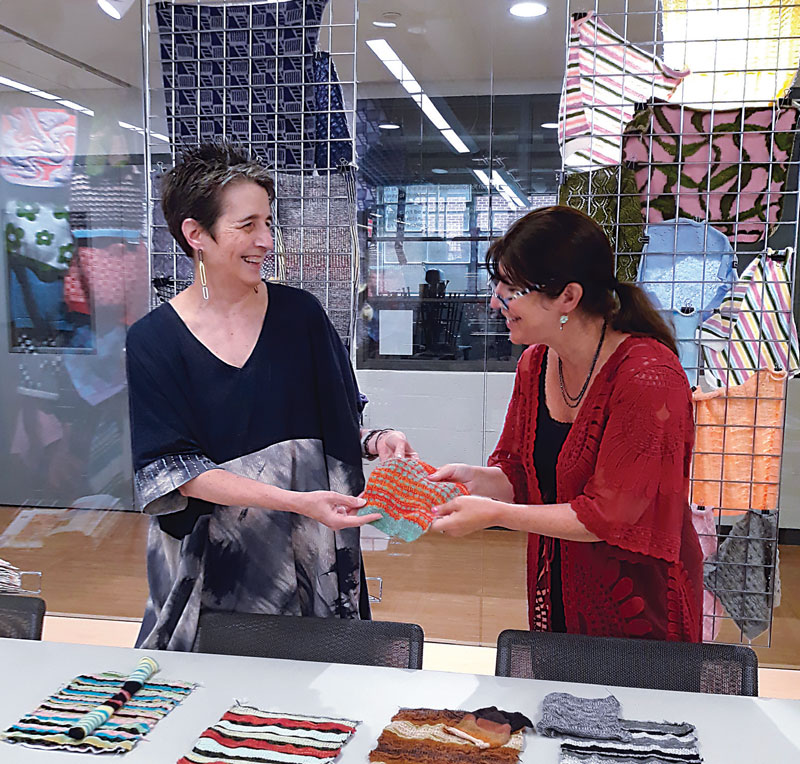
Professors Marcia Weiss (left) and
Marnie Collins reviewing textiles at Thomas Jefferson University.

Two of the world’s oldest textile universities partner to offer a joint Master’s of Science in Global Textile Design

By Jim Kaufmann, Contributing Editor

Thomas Jefferson University (Jefferson), based in Philadelphia, and Heriot-Watt University (Heriot-Watt) based in Edinburgh, Scotland, together recently announced a partnership to offer an exclusive joint Master of Science (M.S.) degree in Global Textile Design.

“This program is being positioned to enlighten students about the opportunities and issues which this global industry is currently facing,” said Marnie Collins, co-director of the Global Textile Design program and assistant professor, program director of Studies-Design for Textiles at Heriot-Watt. “We’ll also support the students in navigating their own leadership pathway in the field.”

“It is the first program of its kind in textile design that will offer joint masters degrees from each institution,” added Marcia Weiss, also co-director of the Global Textile Design program and director, Textile Design Programs, at Jefferson’s Kanbar College of Design, Engineering and Commerce.

Though the co-directors didn’t know each other in college, Weiss and Collins — both graduates of the textile design program at the then Philadelphia College of Textiles and Sciences which is now part of Jefferson (See “A Study in Collaboration,” TW, September/October 2020) — have followed similar career paths and passions. Each maintains a love of textile design, and both worked in various aspects of the textile industry before joining academia, albeit in different countries. “We’ve worked together for several years overseeing the longstanding international student exchanges between our Universities,” Collins said. “We learned we had common interests beyond woven textile design and higher education in artisanal textiles and the heritage and provenance of textiles.” A co-authored research paper, “The Role of Provenance in Luxury Textiles,” that focused on cultural similarities and differences in the perceptions and importance of design origins between U.K. and U.S. consumers formed the basis for a mutual friendship and interest in finding other ways to collaborate.
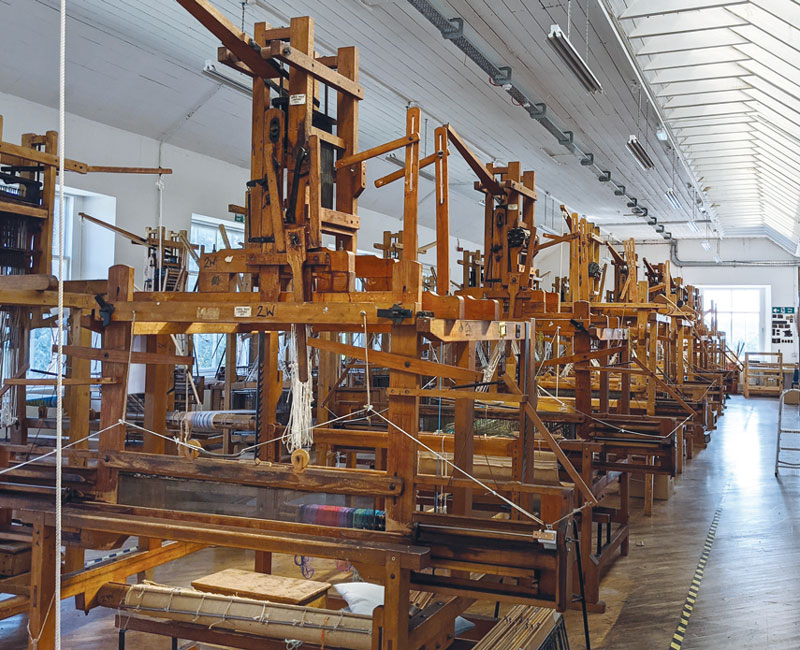
The weave shed in the High Mill at Heriot-Watt University

Ultimately, the women found themselves at what both Weiss and Collins agree “was the most enjoyable ‘business’ meeting ever!” “At various times, we’d have informal discussions on different ways to collaborate. Then in June 2016, Marnie was visiting family along the Jersey Shore and invited me out to Beach Haven, N.J., where we sat on the beach, looked out at the ocean, and inevitably started to piece together the program’s general scope and structure,” Weiss said. “I believe it was Marcia who came up with the idea of the joint master’s program which led to the ‘wouldn’t it be great’ question being asked quite often,” Collins added. “With such an inspiring location, it was inevitable for us to day-dream about what the most amazing joint master’s program would look like.”

The Program’s Structure

The first of its kind program for both universities has been finalized and will welcome its first class of students in the fall of 2023. “This program is structured to educate students about the opportunities and issues currently being faced throughout the contemporary textile industry and to support them in navigating their own leadership pathway in the field,” Weiss said. “Textile design creativity, sustainability, artisanal heritage as well as entrepreneurship will be emphasized.”

Structured as an 18-month-long master’s program, all students in the class will follow the same program path. It will begin with a full fall semester held at Jefferson in Philadelphia. After the traditional holiday/New Year break, students will spend the first half of the spring semester at Jefferson and then collectively move to Scotland during spring break to complete the second half of the spring semester at Heriot-Watt.

A key aspect of the joint program is the incorporation of a credit-bearing summer internship that will provide students with unprecedented opportunities because of the quality of industry partners and potential placement options offered. Each internship could be completed at select companies literally anywhere in the world. “Marnie and I have both worked directly in the textile industry prior to joining academia and with various other segments through university and industry collaborations. We both are focused on our student’s career opportunities and there are a high level of industry contacts and networks available that can be engaged specific to potential internships,” Weiss noted.

The final fall semester will be completed in full at Heriot-Watt. According to Weiss: “The sequencing and location of semesters were chosen based on the proximity of textile industry tradeshows occurring throughout the duration of the program.” A comprehensive tuition package will cover travel within courses, but not the back-and-forth between Scotland and Philadelphia. Students will need to be prepared for a considerable amount of travel as part of this global program which will also afford them the opportunity to visit and participate in a variety of international textile events both in the United States and Europe.

The program initially will be limited to a class size of 12 students. Because of the small class size, careful consideration will be given to the selection process ensuring a high quality of participants. Qualifications for those interested in enrolling will require a bachelor’s degree from an accredited institution and a level of creative experience, which doesn’t necessarily have to be specifically in textiles or textile design. “We are really looking for a demonstrated passion and interest in creative pursuits from the candidates,” suggested Weiss. Prospective students will also be asked to submit a portfolio of their work, a resume or curriculum vitae, as well as letters of recommendation. Decisions on acceptance will be made jointly by both Universities.

Value And Appeal Of Two Historic Textile Institutions

“The textile industry is obviously global,” Collins said. “There are aspects of the industry that have local challenges and concerns. However, the vast majority of modern-day issues facing the textile industry are shared across the world, including sustainability, ethical practices and artisanal skills preservation.”

“We view this program in a similar way to the ‘farm to table’ philosophy found in the restaurant industry,” Weiss noted. “People increasingly want to know the provenance of their textiles as well. So, the textile industry is pivoting towards thinking global, yet living local in order to meet the changing attitudes of consumers globally.”

There are numerous similarities between Jefferson and Heriot-Watt and their textiles and design programs. They each represent two of the world’s oldest textile institutions — The School of Textiles and Design at Heriot-Watt was formerly the Scottish College of Textiles, while Jefferson’s textile program was founded in 1884 as the Philadelphia Textile School. “The heritage and reputation of both institutions are widely known and highly respected,” stated Collins. “Both have expert staff who provide high quality support for their students for undergrad and post grad. And both have amazing facilities including textile processing labs and testing facilities, excellent historical archives and fantastic links with the industry. Graduates will find themselves with an expanded network and a much more varied experience to draw upon post degree.”

Differences between the two are subtle, but significant. Jefferson has better digital facilities and industrial machinery, while Heriot-Watt has prolific analog facilities and hand-weaving equipment. Given the different environments where each university is located, students also will be exposed to a variety of not only different cultures, but also industry networks. “There are so many great textiles globally. We hope to build on the legacy of both institutions with the arrival of this program and the international community it will foster,” stated Weiss.

Earning a degree from two of the world’s most prestigious and respected textile institutions can only provide a major benefit to the program’s graduates as they enter or re-enter the workplace. The plan was to introduce the program for the 2019/2020 school year, but the COVID pandemic hit and postponed its launch. On the bright side, this allowed for more discussions on and fine-tuning of the program details, the meshing of institutional regulations into one cohesive program, and additional time to attract national and international students. Now, both Weiss and Collins are ready to get this program off the ground. “We’re super excited for the opportunities it will bring to the students and to further connect our two schools,” said Weiss. “It’s going to be great fun!”

January/February 2023
Nuyarn®: Wool Yarn A New Way

New Zealand-based TMC Ltd.’s twist-free spinning technology allows wool’s natural properties to shine through for high-performance applications.

By Rachael S. Davis, Executive Editor

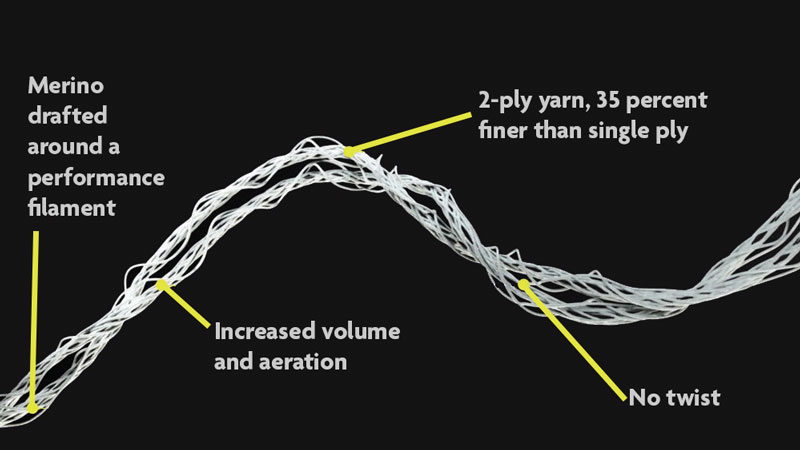
New Zealand has long been associated with wool, so it’s not surprising that New Zealand-based company TMC Ltd. is responsible for developing a new twist-free spinning technology for producing performance wool yarns. Dubbed Nuyarn® Merino, the spinning method drafts a superfine merino wool yarn with a high-performance nylon filament carrier yarn. The result is an ultrafine, two-ply yarn with more volume and aeration than merino yarns produced using traditional worsted spun-yarn technologies.

According to Nuyarn Founder Andy Wynne, the technology “unleashes the natural performance of merino wool,” and doesn’t “twist the life out of the fiber.” The idea behind the technology was to create wool products that perform as close as possible to wool in nature. Spun yarn processes compress natural air pockets, introduce tension, create loops and restrict natural fiber movement — all of which reduce the wool fiber’s inherent advantages and impart scratchiness to a garment.

Independent testing performed by Intertek® Vietnam and AgResearch, New Zealand, showed compared to a conventional ring-spun 100-percent merino spun yarn, Nuyarn yarns:

  • Dry five times faster;
  • Are 85-percent more elastic;
  • Offer 35-percent more thermal retention as a result of the increase in natural air pockets;
  • Are 35-percent more air resistant;
  • Feature a 50-percent increase in tensile strength;
  • Are 8.8 times more resistant to abrasion; and
  • Produce 120-percent stronger seams in garments.

These enhanced performance benefits all last for the lifetime of the garment because they are created using a mechanical versus a chemical process.

The company considers itself to be an ingredient brand and it works with all its partners to create unique products —modifying the merino to nylon ratio, weight, and feel, among other parameters, to meet performance criteria — and then controls the supply chain from fiber to end garment on behalf of the brand.

Nuyarn is suitable for a wide variety of applications, however, the light weight and softness of the yarns make them perfect candidates for next-to-skin applications in baselayer garments in particular. Multiple brands have collaborated with Nuyarn to create baselayer products including Artilect, Trew, KUIU, Outdoor Vitals, Odlo, Black Diamond, Wuru Wool, Mosko Moto and Universal Colours.

Mosko Moto uses Nuyarn® for its Strata Merino 3/4 hoodie and leggings for men.

“The problem with most traditional merino wool is you have to use higher weight fabrics to get an acceptable level of durability, and Nuyarn solves that basically by reinventing the way the yarn is created,” said Chris Pew, Trew co-founder and CEO. “Nuyarn construction is lighter, stronger, and more durable than anything that we’ve seen before it’s also stretchier, loftier, and has more thermoregulating capabilities.”

The ODLO team also noted: “While everyone at ODLO loves pure, natural merino, it does have one fatal flaw; once it reaches peak saturation, it ceases to wick sweat, and the fabric structure retains moisture. This is where Performance Wool powered by Nuyarn stands apart.”

According to Wynne, some of the limitations related to wool use in the performance apparel industry were related to how the yarns are spun.

The Nuyarn innovation removes those limitations and gives brands an opportunity to harness the natural attributes of wool along with weight and performance advantages in both winter and summer performance garments.


For more information about Nuyarn® Merino, visit nuyarn.com


January/February 2022

Jack Wolfskin And Microban International Produce Odour-Resistant Apparel That Is Ready For Adventure

HUNTERSVILLE, N.C. — January 26, 2023 — Jack Wolfskin — a provider of premium quality outdoor apparel, equipment and footwear — has partnered with Microban International to incorporate Scentry Revive® odor-neutralizing technology into its range of clothing. This odor-capture innovation from Microban seamlessly integrates into fabrics during manufacture to prevent odors from building up between washes, keeping garments fresh for longer. In addition, the non-biocidal technology has earned an Oeko-Tex® certification and is bluesign® approved.

A common issue with polyester, nylon and elastane — textiles which impart breathability and comfort to activewear — is their predisposition to odor retention. With long term use, athletic garments are susceptible to the accumulation of sweat, dead skin cells and body odours. Perhaps surprisingly, frequent washing of these fabrics is not a viable solution; laundering alone is inefficient at removing malodors, can reduce the robustness of fabrics, and contributes to costly water and utility bills. Therefore, there is high demand for sustainable built-in scent control in the textile industry.

Jack Wolfskin has decided to include Scentry Revive technology — which complements the contemporary, adventure-ready nature of its products — to extend the useful lifetime of apparel and reduce washing requirements. Integrating an odor-neutralzing technology from Microban, the world leader in antimicrobial and odor-control solutions, provides Jack Wolfskin with confidence that its products will remain fresh wear after wear, for up to 50 laundry cycles. Regina Goller, director of Fabric and Trim Management Apparel at Jack Wolfskin, commented on the benefits of Scentry Revive: “The team at Jack Wolfskin takes pride in applying revolutionary technologies to our product range. We wanted to produce odor-resistant garments that required less washing, to benefit both our customers and the environment, and Scentry Revive has made that goal attainable.”

Michael Ruby, president of Microban, added: “We are delighted to partner with Jack Wolfskin to complement their functional, contemporary activewear and accessories. The inclusion of Scentry Revive in apparel intended for adventure, travel and outdoor purposes demonstrates the robustness of the technology, and the ability of the formulation to neutralise odors even with sustained exposure to sweat and moisture. The odor-control solution also increases the number of uses before products need to be laundered, aligning with Jack Wolfskin’s eco-friendly ethos. We are proud of this partnership which will deliver a better consumer experience and allow for longer product lifecycles, less laundering, and reduced consumption of energy, water and other natural resources.”

Posted: January 26, 2023

Source: Microban International

Archroma Starts The FiberColors* Revolution

PRATTELN, Switzerland — January 26, 2023 — With the Earth population reaching 8 billion in November 2022, the need to address the issue of textile waste becomes more critical.

According to earth.org, 92 million tons of textile waste is produced every year, a number that is expected to soar to 134 million tons by the end of the decade. Around 85 percent of all textiles discarded in the United States are said to end up in landfills, leading to land and water pollution impacting first and foremost local communities.

Archroma, a company who creates colors for fashion, decided to look at the issue creatively: what if it could create colors from waste fashion?

Archroma had already developed a way to turn waste from the herbal and food industry into its range of EarthColors® featured by brands such as G-Star, Patagonia, Esprit, Tom Taylor, Pangaia, UGG, and Primark.

Archroma is now introducing another ground-breaking innovation: the FiberColors* technology.

With this technology, Archroma upcycles textile waste into gorgeous colors. The colors are synthesized from a minimum content of 50-percent waste-based raw material.

Archroma’s R&D experts have developed a way to use cotton and/or nylon and their blends (with a more than 95 percent purity) to substitute the major part of the petroleum-based raw material usually used to make dyestuff.

The resulting FiberColors* range, which is patent-pending and therefore exclusive to Archroma, includes five dyes covering a palette of timeless shades: Diresul® Fiber-Teak (brown shades), Diresul® Fiber-Ochre (olive shades), Diresul® Fiber-Maroon (bordeaux shades), Diresul® Fiber-Slate (blue grey shades) and Diresul® Fiber-Graphite (dark grey shades).

The dyes are especially suited for cellulose fibers such as cotton, viscose, linen and kapok, and can be used in continuous, exhaust, denim and garment dyeing and printing processes.

With this, a brand can turn its own pre- and post-consumer textile waste into its own beautiful colors, and create a complete collection including t-shirts, chinos, sweatshirts, hoodies, polo shirts, and home textiles.

FiberColors* are ideal for forward-thinking companies who want to help find a solution to textile landfills, and at the same time give value to waste including articles collected in their take-back schemes that cannot be reused.

Heike van de Kerkhof, CEO of Archroma, commented: “After creating colors from food and herbal waste with EarthColors, we are taking a step further in circular manufacturing with FiberColors*, addressing the huge textile and fashion waste global issue. This is how we make our purpose to lead our industry towards a more sustainable future for our customers and markets, a reality. Because it’s our nature.”

Posted: January 26, 2023

Source: Archroma

Kraig Biocraft Laboratories Delivers The First Two Hybrid Dragon Silk™ Silkworm Strains For Commercial Production

ANN ARBOR, Mich.  — January 26, 2023 — Kraig Biocraft Laboratories Inc. (Kraig Labs), the biotechnology company focused on the development and commercialization of spider silk, announces that it has delivered the first two hybrid-cross Dragon Silk™ strains to its third-party production partner in Vietnam. These strains were developed to address the most significant immediate hurdle to large-scale production, the robustness of the silkworms within the large-scale production environment. These new lines are the first of several planned silkworm strains in its hybridization program, which are explicitly designed to increase robustness and cocoon size.

These strains blend the mechanical performance of the company’s original Dragon Silk with the size and robustness of native production silkworm strains. The company engineered these strains as part of its development program to bring needed increased resiliency to the large-scale production environment.

Best practices employed by the most advanced silkworm egg production facilities include utilizing a multi-line cross-mating protocol to generate increased robustness. The result of first-generation cross-matings yield larger cocoons and more resilient silkworm offspring. As these increased performance attributes only last one generation, it is vital that central silkworm egg production operations sustain each of these separate lines in order to create successive generations of hybrid crosses.

Kraig Labs begins its transition to multi-line cross-mating with these two new hybrids. Once established at the production facilities, the company will start cross-matings to produce its first two-line production hybrids. Kraig Labs believes this will strengthen its production operations, increase silkworm resiliency, and significantly improve environmental tolerance.

As part of the company’s ongoing development efforts to commercialize spider silk production, it is also developing a four-line hybrid-cross program that should further improve yields. This program is under development at the company’s R&D headquarters located in the United States and is planned to begin rollout in stages later this year following the successful implementation of the two-line hybrid-cross model.

“Work with our production partner in Vietnam has accelerated the identification of challenges and opportunities in scaling up production to metric tonnage levels,” said Company COO Jon Rice. “We are very pleased to announce the delivery of these new hybrid lines and we are excited about our ongoing development of the four-line hybrid-cross. The implementation of the four-line hybrid program is designed to deliver significant improvements in production capacity and yield.”

Posted: January 26, 2023

Source: Kraig Biocraft Laboratories, Inc.

Polygiene Technologies Can Reduce Environmental Impact By One Third

MALMÖ, Sweden — January 26, 2023 — Polygiene®, a global supplier of antimicrobial and stay fresh technologies, has run a life cycle assessment showing that washing items of clothing less frequently can reduce environmental impact by one-third. The results of this trial show that by investing in garments treated with Polygiene StayFresh™, consumers can get the following benefits over the span of a year:

  • Save Energy – Up to 51 kWh
  • Save Water – Up to 3,800 liters of water
  • Save Time – Earn back four free days of wasted time spent washing

Polygiene calls this Mindful Living™, a term coined by the brand to show how one person can make one positive and significant change to reduce their impact on the environment.

How the life cycle assessment works

Polygiene partnered with Sweco®, one of the leading European engineering consultancies, to conduct a life cycle assessment on the benefits of simply skipping one of two washes. In the study, three scenarios were evaluated with same baseline of 3x trainings per week, equating to 156 trainings per year and using a standard polyester T-shirt (120 grams per square meter 90-percent polyester/10-percent elastane). Scenario A included the shirt not treated and washed after every use, scenario B, treated with Polygiene StayFresh technology and washed after every use, and scenario C, treated with Polygiene StayFresh and washed only every 2nd time. A cradle-to-grave analysis technique, the assessment evaluated the environmental impact associated with all stages of the T-shirt’s life.

A consumer will typically wear a garment once before washing it. This equates to about 50 washes before the garment reaches the end of its life. However, a T-shirt treated with Polygiene StayFresh means the garment stays fresher for longer. This powerful odor control technology inhibits odor-causing bacteria. Now the owner can confidently skip every second wash without worrying about bad odors from their T-shirt.

One less wash means saving on energy, water, CO2, time, and money — and the T-shirt lasts longer.

Choose Mindful Living

Heavy on both energy and resources, sport and fast fashion has a substantial environmental impact. Polygiene works with its partners to redefine product freshness, improve hygiene and achieve sustainability initiatives. We only have one planet — but one person can make a positive impact by choosing mindful living.

“Wearing garments treated with Polygiene StayFresh means less washing, more sustainable clothing, and longer-lasting, consumer-friendly products that are kind to the planet too,” shared Polygiene CEO Ulrika Björk.

Posted: January 26, 2023

Source: Polygiene Group™

Accelerating Circularity Catalyzes Connections For Textile-To-Textile Recycling

CAMPBELL HALL, N.Y. — January 25, 2023 — Accelerating Circularity is an action-oriented nonprofit focused on scaling textile-to-textile recycling through a collaborative approach. The mission is to create new supply chains and business models to turn spent textiles into mainstream raw materials in order to divert tons of textile waste from landfills and incineration. As part of that mission, Accelerating Circularity is releasing a comprehensive directory of international recyclers available today to catalyze connections between recyclers and the rest of the textile value chain including collectors, mills, brands, and retailers.

The comprehensive directory of textile recyclers is inclusive of the various commercial technologies for chemical and mechanical recycling of polyester and cellulosics. The catalog details the different aspects of each recycler, such as location, feedstock fiber type, restrictions, etc. The information can be organized and filtered by users in the Airtable platform in such a way that certain criteria can be input and information extracted to allow the recyclers of specific capabilities to be pinpointed.

Accelerating Circularity has proven to be a leading textile-to-textile circularity information resource as they have researched, mapped, and modeled capabilities to transition from a linear to a circular value chain. The aim is to create new linkages and to pilot textile-to-textile capabilities through trials in process currently in the United States and Europe.

“Circularity is a team sport!” said Karla Magruder, founder and president of Accelerating Circularity. “We are a shareholder lead collaborative focused on scalability, viability, and transparency. Our partners are leaders in the apparel industry and even competitors are engaged with the intent to make circularity a reality.”

The directory will be regularly updated by ACP as it grows and more details are collected. The catalog will be available through Airtable to allow these updates to be instantly received by users.

Posted: January 26, 2023

Source: Accelerating Circularity

Change Of Leadership At Rieter: Board Of Directors Appoints Thomas Oetterli As New CEO

WINTERTHUR, Switzerland — January 25, 2023 — Norbert Klapper, who has led Rieter as CEO for nine years, has informed the board of directors that he wishes to take on new professional challenges. The board of directors of Rieter Holding Ltd. has taken note of Klapper’s resignation, expressing its gratitude for his service to Rieter. The board of directors has appointed Thomas Oetterli as his successor as CEO of Rieter.

Thomas Oetterli has made a significant contribution to the successful development of the Schindler Group, starting in 2006 as CEO Switzerland, later as a member of the group executive committee responsible for Europe and China, and from 2016 until 2022 as CEO of the group. With his comprehensive leadership skills and many years of industrial and international experience, Oetterli brings ideal prerequisites to lead Rieter as a global market leader through the current challenges and successfully develop it further in the long term. He will take over the function of CEO from Klapper on March 13, 2023.

The board of directors would like to thank Klapper for his many years of hard work for Rieter and his lasting contribution to the company, particularly in terms of further strengthening its technology leadership, developing the components and service business, completing the systems offering, and wishes him all the best for the future, both professionally and personally. Following his departure as CEO, he will be available to the chairman of the board of directors as senior advisor until the end of September 2023.

Oetterli also proposed as member of the board of directors

In the course of the intensive talks with Oetterli that led to his appointment as CEO of Rieter, the board of directors came to the conclusion that, with his proven strategic competencies, extensive industrial experience and international network of contacts, he would also make important contributions to Rieter’s board of directors and strengthen its overall profile. As chairman of the board of directors of SFS, an industrial company in Switzerland, he is also familiar with the international industrial environment from the perspective of another globally active Swiss industrial company.

In view of the current challenges Rieter is facing in the current economic and market situation, which require close cooperation between the board of directors and the group executive committee, the board of directors considers a dual function of Oetterli as CEO and member of the board of directors to be advantageous and in the interest of all stakeholders. It will therefore propose Oetterli for election as a member of the board of directors at the upcoming Annual General Meeting on April 20, 2023.

Posted: January 26, 2023

Source: Rieter Holding Ltd.

Rieter: First Information On The Financial Year 2022

WINTERTHUR, Switzerland — January 25, 2023 — In a very challenging economic environment, Rieter succeeded in significantly increasing sales and expects a positive EBIT margin for the 2022 financial year.

For Rieter, in addition to the geopolitical uncertainties, the 2022 financial year was characterized by three main challenges:

Due to the rapid rise in inflation, the exceptionally high order backlog of around CHF 1 840 million at the beginning of 2022 was processed at significantly higher costs. It was only possible to offset these higher costs in part by means of price increases and other remedial measures.

In order to safeguard deliveries, it was necessary to compensate for serious material bottlenecks, particularly in electronic components, which resulted in considerable additional development expenditure.

Major expenses were also incurred in connection with the acquired businesses (Accotex, Temco and Winder).

Sales

The realization of sales from the exceptionally high order backlog developed better than expected. With sales of 1,510.9 million Swiss francs ($1,650 million), Rieter achieved an increase of 56 percent compared with the previous year (2021: 969.2 million Swiss francs ($1,058 million)). In the second half of 2022, especially in the fourth quarter, the measures introduced to address material bottlenecks had a positive impact. Consequently, sales increased to 890.3 million Swiss francs  ($972 million) compared with the first six months (first half-year 2022: 620.6 million Swiss francs  ($678 million).

EBIT margin

The trend in the EBIT margin was strongly influenced by substantial cost increases, which could only be offset in part through price increases and other remedial measures. In addition, to compensate for material shortages, expenses were incurred in connection with the development of alternative solutions and the acquired businesses.

Rieter succeeded in improving profitability compared with the first half of 2022 due to the higher sales volume and offsetting measures to compensate for increased costs, and expects a positive EBIT margin of around 2 percent for the full year 2022 (2021: 4.9 percent).

Order intake

In line with expectations, the order intake of 1,157.3 million Swiss francs ($1,263 million) in 2022 was below the record year of 2021 (2,225.7 million Swiss francs ($2,464 million). The market situation is characterized by investment restraint due to geopolitical uncertainties, higher financing costs and consumer reticence in important markets.

Order backlog

The company had an order backlog of around 1,540 million Swiss francs ($1,682 million) at the end of 2022, which thus extends well into 2023 and 2024. In 2022, Rieter recorded order cancellations of less than 10 percent of the order backlog of 1,840 million Swiss francs ($2,009 million) at the beginning of the year.

Preparations for ITMA 2023 on schedule

Rieter has continued to boost its innovative capability and, in order to further extend its technology leadership, will present new innovative solutions at ITMA 2023 in Milan.

Action plan to increase sales and profitability

Implementation of the action plan to increase sales and profitability is ongoing. With regard to the profitability of the order backlog, which remains high, the implemented price increases in combination with a favorable trend in costs, particularly in logistics, are having an impact. In addition, progress was made in eliminating material bottlenecks and reducing expenses for the three acquired businesses.

Rieter site sales process

The sales process for the remaining land at the Rieter site in Winterthur (Switzerland) is proceeding according to plan. In total, around 75,000 square meters of land will be sold.
The Rieter CAMPUS is not part of this transaction.

Results press conference 2023

Rieter will provide further details on the 2022 financial year and an outlook for the 2023 financial year on March 9, 2023. In addition, the full 2022 Annual Report will be published, and a press conference will be held.

Annual General Meeting of April 20, 2023

The next Annual General Meeting of Rieter Holding AG will take place on Thursday, April 20, 2023. Proposals regarding the agenda must be submitted in writing, accompanied by information concerning the relevant motions and evidence of the necessary shareholdings (with a par value of 0.5 million Swiss francs ($0.55 million) as stipulated by Article 9 of the Articles of Association), by no later than February 17, 2023, to Rieter Holding Ltd., Office of the Company Secretary, Klosterstrasse 32,
CH-8406 Winterthur, Switzerland.

Posted: January 26, 2023

Source: Rieter Holding Ltd.

Orion Sharply Reduces Air Emissions With New Technology At Borger, Texas, Plant

HOUSTON — January 24, 2023 — Orion Engineered Carbons, a global specialty chemicals company, said today it will sharply reduce air emissions at its Borger, Texas, plant with new control technology.

The $60 million project also involved upgrading the site’s cogeneration system, which takes heat created by the carbon black production process and converts it to electricity that can be used by the plant. The electricity is also sold back to the power grid. Such energy conservation equipment is used by many Orion plants worldwide.

“Investing in emissions control technology and generating more clean energy are key to our commitment to sustainability,” Orion CEO Corning Painter said. “I want to commend our engineers, the Borger team and our contractors for the timely completion of this complex project despite the Covid-19 pandemic and supply chain disruptions.”

The new emissions technology will lead to a major improvement in air quality, eliminating 23 tons of nitrogen oxide and sulfur dioxide emissions per day – a 90% reduction. The Borger plant produces carbon black for rubber and specialty clients.

Orion also recently upgraded its emissions control technology at facilities in Ivanhoe, La., and Orange, Texas. Later this year, Orion plans to finish its final U.S. emissions project at its site in Belpre, Ohio.

“We are proud that we’ve upgraded these plants, but it was an extremely demanding undertaking,” Painter said. “As we complete the Belpre project, Orion will have significantly more free cash flow to invest in growth projects. 2023 marks a new era for the company.”

Upgrading the Borger plant supports Orion’s efforts to achieve the targets in its sustainability-linked term loan. Last year, Orion was one of the first public companies to take out such a loan, which has interest rates that go up or down depending on whether a company meets specific environmental, social and governance goals.

Posted: January 24, 2023

Source: Orion Engineered Carbons

Sponsors