WASHINGTON — December 13, 2022 — The Plastics Industry Association (PLASTICS) is pleased to announce that Anthony DiGrado has been named manager of Digital Affairs, effective immediately.
In this role, DiGrado will be responsible for maintaining, managing, and developing PLASTICS’ digital strategy and online presence. DiGrado joins PLASTICS after working for IMGE, a full-service digital agency, where he developed and executed wholistic digital strategies for Fortune 500 companies, political campaigns, issue advocacy groups, and non-profits. Prior to his work at IMGE, Anthony worked in the offices of the U.S. Senate Committee on Small Business and Entrepreneurship and for the ClearPath Foundation.
“We are so pleased to have Anthony join our communications team,” shared Stephanie Polis, vice president of Communications at PLASTICS. “Anthony’s expertise will truly add to PLASTICS’ work in amplifying the voice of our industry and the good work that our members are doing. Anthony rounds out a terrific group of communications professionals here at PLASTICS and we are excited to have him on board.”
DiGrado is a lifelong native of Virginia and an holds a B.A. in Economics from the Catholic University of America.
AMSTERDAM — December 13, 2022 — Today, Fashion for Good launches the Home-Compostable Polybag Project, a pilot to test alternatives to conventional single-use polybags. Orchestrated by Fashion for Good in partnership with C&A and Levi Strauss & Co., this six-month project uses novel bags from Fashion for Good innovators TIPA Corp. and Greenhope. These bags are made with bio-based material to lessen fossil fuel consumption and are designed to compost in either home or municipal composting environments. The project aims to find alternative end-of-use for landfill-bound materials, and to provide an at-home option for consumers who do not have access to municipal composting programs.
Introducing Compostable Alternatives To Landfill-Bound Polybags
An estimated 180 billion polybags are produced every year to store, transport and protect apparel and footwear. Their production, use and end-of-use have a significant impact: conventional virgin polybags have a high carbon footprint and low recycling rates across the globe. Conventional bags are commonly incinerated, landfilled, or subject to environmental leakage, harming natural systems. To change this paradigm, innovation must both find appropriate disposal pathways that are less harmful to the environment and reduce fossil fuel consumption.
In the Home-Compostable Polybag Project, Fashion for Good partners C&A and Levi Strauss & Co. will test key home-compostable polybags that include, bio-based material from innovators TIPA Corp. and Greenhope, in their supply chain as a viable substitute to conventional plastic polybags.
“We are proud to participate in the Home Compostable Polybag Project by Fashion for Good,” said Aleix Busquets Gonzalez, head of Global Sustainability at C&A. “As part of our Sustainability Strategy, C&A has set high ambitions in the reduction of consumer-facing plastic by 2028. This pilot project plays a crucial part in reaching C&A’s plastic reduction goal and contributes significantly to an industry wide transition.”
Scaling Innovtive Plastics
There are several critical challenges to scaling home-compostable bags: functionality, impact, cost and infrastructure, all of which will be assessed over the course of the project. The innovative bags include bio-based content, which must be tested against key performance and quality properties, such as transparency, durability and longevity. This project seeks to benchmark these bags against conventional plastics in supply chains, as well as measuring the overall impact and associated costs of the materials.
“The Home-Compostable,Polybag Project with Fashion for Good is an exciting opportunity to pilot a solution for an ecommerce element our customers are all too familiar with – the polybag,” said Jeffrey Hogue, chief sustainability officer, at Levi Strauss & Co. “This pilot not only moves us toward achieving our goal of eliminating single-use plastic in consumer-facing packaging by 2030, it also puts into practice the industry collaboration required to solve these ubiquitous challenges in hopes of reducing harmful elements within the apparel supply chain.”
Building A Foundation For Circularity
The Home-Compostable Polybag Project is the third Fashion for Good polybag project following the Circular Polybag Pilot (completed in 2020) and Reusable Packaging(completed 2021) projects. These projects aim to validate innovations that reduce the dependence on virgin fossil fuels, reduce impact of production, and are capable of compostability, avoiding landfill.
“Fashion is one of the main segments where consumers are looking for alternatives to conventional plastic packaging,” said Daphna Nissenbaum, CEO and co-founder, TIPA Corp. “This is why we’re extremely proud to be selected by Fashion for Good to take part in this innovative pilot to test plastics that biodegrade into the soil at the end of use. By offering an alternative to conventional plastic packaging, TIPA helps sustainably-responsible fashion brands fight plastic pollution. A programme like this is crucial for demonstrating the viability of compostable packaging like TIPA’s and gaining scale by forming more alliances within the industry.”
“We are so excited to be selected by Fashion for Good to take part in this collaborative project with such credible global parties,” said Tommy Tjiptadjaja, CEO and co-founder, Greenhope. “Plastic waste pollution is a massive systemic issue and this collaborative platform approach is one of the most effective ways to quickly arrive at credible, scaled solutions. Through our technology, Greenhope is ready, willing, and able to support this all the way to its positive conclusion: linking sustainable consumption and production of global brands with positive social impact among developing countries’ farmer coops who provide the bio-based raw materials.”
STOCKHOLM, Sweden — December 13, 2022 — Coloreel provides significant environmental benefits for the textile industry. The company’s sustainability operations are now quantified and third-party verified.
Coloreel uses one single white thread to create millions of colors and intricate patterns. It unlocks new design possibilities, while providing environmental benefits. By dyeing a 100-percent recycled polyester thread in real time, water consumption is reduced by at least 97 percent compared to traditional dyeing methods. In addition, the technology significantly reduces thread waste.
“When Coloreel launched its ground-breaking technology for digital thread dyeing, the aim was to streamline an embroidery industry characterized by slow processes, difficulty in creating complicated designs and an excessive use of resources,” said Mattias Nordin, Sustainability manager at Coloreel.
The company has now published both a complete life cycle analysis (LCA) and an environmental product declaration (EPD) in the international database Environdec. Both documents are verified by a third party, the Swedish consulting company Miljögiraff.
50 times less wastewater
Through the documentation, a comparison can be made between Coloreel’s technology and one of the world’s leading thread manufacturers. Their public sustainability report shows that traditional thread dyeing produces 50 times more wastewater than Coloreel’s direct dyeing does.
“We have known for a long time that our technology gives a significant environmental advantage. Having it verified by an independent third party is of course important for our continued work. But for us, that’s not enough. We are currently focusing on further reducing the amount of energy and ink used in production,” Nordin said.
Coloreel’s environmental product declaration is available at environdec.com/library/epd4933
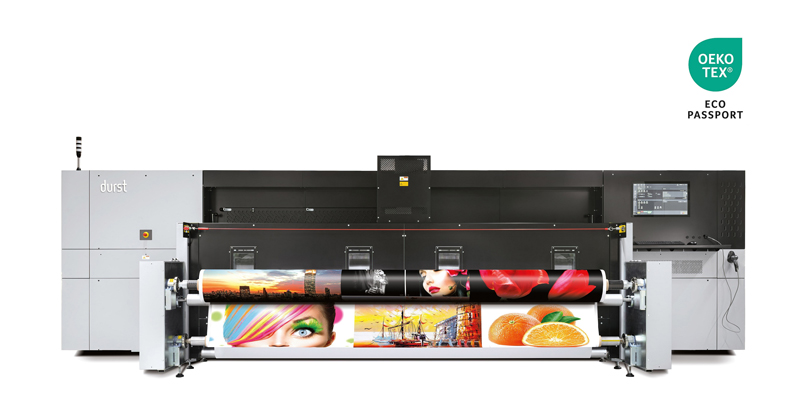
BRIXEN, Italy — December 13, 2022 — Durst has received a new ink certification that completes the overall sustainable package of the P5 TEX iSUB printer: the P5 Sublifix sublimation inks now have the ECO PASSPORT by OEKO-TEX®.
P5 TEX iSUB technology
Winner of an EDP (European Digital Press Association) award in 2022, the P5 TEX iSUB technology with its inline fixation technology sets a milestone for sublimation printing and allows the elimination of one step in the production process. The integrated inline fusing for direct printing on polyester fabrics means that no investment is required for external devices as a heat press or calender. Time and production cost reduction as well as energy savings of up to 50 percent compared to a traditional process with an external heat press, enable a significant increase in efficiency and reduction in total cost of ownership for the user.
The iSUB contactless technology ensures excellent color consistency along the whole printing width as well as extreme sharpness of detail in images and text, also blurring or bleeding of color is virtually eliminated. Furthermore, the multiroll feature offers a big advantage in media handling, enabling a fast media change through one man operation.
ECO PASSPORT by OEKO-TEX®
The P5 Sublifix sublimation inks have now the ECO PASSPORT by OEKO-TEX®.
OEKO-TEX ECO PASSPORT is an independent certification system for chemicals, colorants and auxiliaries used in the textile and leather industry. During a multistep process, each individual ingredient in the chemical product has been analyzed to meet the statutory requirements. Certified products are safe to human and environmental health, can be used for ecologically responsible textile production and are listed on the OEKO-TEX Buying Guide.
OEKO-TEX STANDARD 100 compliance of the sublimation inks has always been very important to DURST, this now available independent confirmation by ECO PASSPORT of the P5 Sublifix Inks further confirms their efforts and responsibility to anchor impact reduction as a central argument in their customers’ production chains.
Additionally, this certification enables the customers an accelerated and cost-optimized certification process of both, their production chain according to OEKO-TEX STEP, as well as their final products according to OEKO-TEX STANDARD 100.
Thus, obtaining the ECO PASSPORT certificate for the P5 Sublifix Inks also results in an immediate economic advantage for all customers using these inks.
ST. LOUIS — December 13, 2022 — Baldwin Technology Co. Inc. has appointed Adina Starke, a seasoned print and packaging professional with wide-ranging expertise, as regional sales leader for the West Coast.
Baldwin Technology Company Inc. is a global manufacturer and supplier of innovative process-automation equipment, parts, service and consumables for the printing, packaging, textile, plastic film extrusion and corrugated industries. Starke will be responsible for all product sales to print and packaging professionals in Washington, Idaho, Oregon, California, Nevada, Arizona, Utah, Alaska and western Canada.
Starke has spent the past 15 years in various technical and sales roles in the print and packaging industry. Most recently, she spent four years with All Printing Resources (formerly JVI Solutions), as a Territory Manager and a Technical Sales and Business Development Representative. Prior to that, she spent several years with Lohmann Specialty Coating and Sun Chemical.
Starke graduated from Clemson University with a Bachelor of Science degree in Graphic Communications.
“It’s exciting to have Adina join Baldwin and strengthen the team. Being based out of Los Angeles will give us a strong presence in a key market for us where we are looking to drive growth,” said Craig Black, Baldwin’s Vice President of Sales, Americas. “Her blend of technical and sales experience will be a great benefit coming into the role, as well as her experience in the flexo print industry. With Adina’s enthusiasm, drive and passion for delivering results, I look forward to seeing her contribute to Baldwin’s future growth across our print and packaging customer base out West.”
“I am excited to join such a dynamic and innovative organization,” Starke commented. “I look forward to meeting customers in the region, building new relationships as I settle into the role, and driving success for Baldwin Technology.”
AATCC President Harrie Schoots (right) unveiling new library plaque named in honor of former Executive Vice President John Y “Jack” Daniels.
RESEARCH TRIANGLE PARK, N.C. — December 13, 2022 — AATCC recently hosted hybrid Interest Group and Research Committee Meetings online and at the AATCC Technical Center in Research Triangle Park, N.C. Administrative meetings were held remotely in October.
Interest Groups started off the week with a series of speakers on Monday afternoon. The presentations were recorded and are available to AATCC members at https://members.aatcc.org/publications/.
Chemical Applications: Sustainable Dyeing for Black Knits; Bryan Dill, Archroma
Concept 2 Consumer: Dyestuff Overview; Rod Pedemonte, Dystar Americas
Materials: American Hemp for Textiles and Apparel—Where are We Now?; Guy Carpenter, Bear Fiber
Rising Professionals: Going from the Lab to Leading a Sourcing Team and How Being a Textile Chemist Helped; Rob Smith, Upwest
Research committees met Tuesday and Wednesday followed by the AATCC Board of Directors meeting on Thursday. Research committees develop and maintain all the standard test methods and procedures published in the AATCC Manual of International Test Methods and Procedures. In additional to this work, several informative presentations were shared that laid the groundwork for future standard development. Highlights from the research as well as administrative committee meetings are available online. https://www.aatcc.org/aatcc-events/research/#MeetingsHighlights
A total of 247 participants from 22 countries registered for the meetings. Represented countries include Bangladesh, Brazil, Bulgaria, Canada, China, Germany, India, Indonesia, Italy, Malaysia, Mexico, Morocco, Pakistan, Peru, Poland, South Africa, Switzerland, Taiwan, Thailand, Turkmenistan, United Kingdom, and United States of America.
A special feature of the Fall 2022 meetings was the dedication of the AATCC Technical Center library. The library was named in honor of former Executive Vice President John Y “Jack” Daniels with a small ceremony. Newly-elected members of the AATCC Board of Directors were announced at the Annual Meeting and incoming AATCC President John Crocker received the president’s pin from former President Robert Lattie at the conclusion of that meeting.
Bob Lattie (left) pinning incoming AATCC President John Crocker
Looking Ahead
While various committees hold meetings and events throughout the year, most meet during committee weeks each Spring and Fall.
The next round of Administrative committee meetings will be April 13-14 & 17-18, 2023. These meetings are all virtual. Committees addressing topics such as publications, conferences, and membership are free and open to all. Watch the AATCC website and other media for updates. Registration for Spring meetings will open early in 2023.
www.aatcc.org/aatcc-events/admin/
Research committees will meet May 16-18, 2023 virtually and at the Technical Center.
VANCOUVER — December 8, 2022 — Restoring sleep through constant innovation in material and technology, Rest Duvet, in collaboration with Noble Biomaterials, proudly unveils Silvercool™ Performance Sheets and Pillowcases. The high thermal conductivity incorporated into the Silvercool fabric absorbs and transfers heat faster than cotton, bamboo, and silk creating one of the coolest and highest Qmax (cooling) fabrics available. Noble’s IONIC+® Antimicrobial Technology eliminates bacteria that causes odors and stains, a permanent feature that does not wash out and helps the fabric last longer. The proprietary combination of both of these features, along with temperature-regulating capabilities establishes Silvercool as a unique and technologically advanced type of bedding that brings new meaning to a dream come true.
“It’s important to our brand to continue pushing boundaries when developing the most comfortable, luxurious and health conscious products possible,” said Rest Duvet Co-founder Andy Nguyen. “The creation of sheets and pillowcases with the Silvercool technology was a natural next phase in Rest Duvet’s line of bedding, and we couldn’t have imagined partnering with a better and more forward-thinking company than Noble Biomaterials to help us create and bring this to the market.”
The ultra fine yarn mimics silk proteins resulting in the Silvercool fabric being sensationally soft and cool to the touch, while also boasting moisture wicking and bacteria reducing capabilities. In line with the Rest Evercool™ Comforter, Silvercool’s sheets and pillowcases are gentle on the skin.The breathable fabric is beneficial to all types of sleepers, including hot sleepers, individuals going through menopause and individuals with generally sensitive skin.
“We’re excited to partner with Rest Duvet and continue our expansion into the bedding space,” said Noble Chief Marketing Officer Allon Cohne. “Our permanent IONIC+ technology requires fewer washes and saves energy, complimenting Rest’s mission to provide consumers with a cooling, sustainable bedding solution.”
The Silvercool Sheet Set includes a flat and fitted sheet as well as two pillowcases. Offered in Aqua Blue and Cool Gray, with free shipping and returns, as well as a 30-night risk-free guarantee. The sheets are 100 percent machine wash safe and are available in Queen Size ($299), King Size ($319) and Cali King Size ($329).
No matter what you’re producing, or for whom, that phrase likely conjures up a specific time of year in your mind. Producing licensed gear for schools means the “busy season” could be late summer — stocking shelves and fulfilling rush orders to coincide with the beginning of a new year. If most business comes from outdoor sports or concert festivals, early spring might be the “busy season.”
For a great many businesses, however — perhaps most commonly of all — the “busy season” comes between Halloween and Christmas. The holiday rush. Black Friday. The gift-giving peak. Your last chance to make a prosperous year even more profitable, or to at least break even when times are tougher.
Unfortunately, more traditional fashion, apparel and textile production/fulfillment mechanisms are limited in terms of efficiency. If your operational strategy isn’t built with peak periods in mind, you may be frantically working overtime at the last minute to meet demand — a predictable yet hellish “crunch time” leaving you especially vulnerable should something go wrong such as technology malfunctions, supply chain disruptions, natural disasters, or other unforeseen possibilities. If the operational strategy is geared towards meeting demands of a peak period, production may take place months and months ahead of time in anticipation of demand that may never come to fruition or might be delayed by significant periods of downtime — or both.
Answering the unique market dynamics of the “busy season” is a key virtue of sustainable, on-demand digital production. What’s going to be the popular item when the holidays come? How many garments will we need to produce?
With versatile, single-step digital textile print capabilities, the need to forecast such critical figures disappears.
What sells today, we make today. If something different sells tomorrow, we’ll make that tomorrow. And if there’s an opportunity to fulfill new demand throughout the next year — a virtual certainty in the age of social media monetization, micro moments, the proliferation of online design tools, the explosion of apps giving creators outlets for monetizing inspirations and building personal brands, NFTs, the Metaverse — agile digital production capabilities empower producers to meet those opportunities and grow, regardless of broader economic conditions. What sells on any given day, we make that day.
Take Trevco — an on-demand fulfiller of custom and licensed apparel with production facilities in Michigan and Utah. While it uses multiple production mechanisms to answer demand for various products in a timely manner, single-step, pigment-based digital Direct-to-Garment (DTG) production means meeting the heaviest seasonal volumes while supporting a consistent growth trajectory.
Describing these systems as a “game-changer” for on-demand fulfillment, vice president of Operations James Drake notes quick, digital production means “we don’t have to worry about pre-buying shirts and then pre-printing them to sell. We can grab a blank, print it after the order’s placed, and then ship it. The labor savings that you get and the savings in speed of production, because you don’t have to worry about pretreating, because you can print on demand, as long as you feel that you can capitalize on those savings, labor, being able to print on demand — getting shirts out your door faster; you know, a lot of times we work off of a one-day turnaround and a two-day turnaround — and being able to do that really saves a good amount of money.”
At minimum, the benefits of on-demand production are twofold. While ending the need for forecast-based production models reduces overstock and optimizes profit margins, the model also supplies an environmental benefit. By producing only what’s sold, you’re creating less landfill and using less energy. You’re producing less greenhouse gas emissions — all while offering consumers and brands more graphic and color possibilities, spanning a broader range of fabrics and applications, faster than ever before, without compromising quality or durability.
We believe the perfection of sustainable, on-demand digital textile production capabilities are the key to making apparel production less wasteful, more eco-friendly, and more responsive to the needs of a wildly creative and increasingly web-centric global marketplace.
As expressed in our 2021 Impact Report for Environmental, Social, and Corporate Governance, the ultimate goal is “to boldly transform the world of fashion and textiles for a better, more sustainable planet.” While this may sound lofty in the context of answering challenges of a busy holiday season, we believe digital on-demand production has matured to the point of empowering producers to meet any operational challenge — including seasonal ebb and flow, unforeseen disruptions (as experienced during COVID-19), the sudden popularity of new product applications, and localizing production to eliminate logistical complications and time to market. Producers who’ve shifted operations to on-demand digital production increasingly view sustainability as a core component of a growth strategy, rather than a compromise than must be accounted for.
“I think all companies should be doing absolutely everything they can do within their power to be as sustainable and eco-friendly as they possibly can,” says Axel Jones, director of Welsh apparel fulfiller My Needs Are Simple. While the business prioritizes responsible production practices in their technology investments, he noted the Kornit on-demand solution was “really head and shoulders above the competition when it comes to cost per print. It really is, you know, the most cost-effective direct-to-garment machine.”
The sentiment was echoed by Sherri Barry of Arizona-based fashion incubator The Fashioneer, which uses sustainable on-demand production to eliminate barriers to fulfillment for private and aspiring fashion designers: “I want fashion to be fun to create, to make people feel wonderful, so they have a unique piece they wear forever, which is the most sustainable garment available,” Barry said. “Technology like this allows all of these creators to have their creations printed, automated, cut, packaged, and shipped to their consumer.”
Digital on-demand production results in creating only what you sell, meaning higher margins and less waste. That generates the highest possible yield from your “busy season” while delivering an experience that is eco-conscious and elevates the apparel industry to something that makes producers, creators, and consumers feel good, in more ways than one.
May this holiday season see your business greener and stronger than ever.
Editor’s Note: Don Whaley is an industry veteran with more than 20 years of experience in leadership roles across sales, marketing, and the channel. He currently serves as vice president at Kornit Digital
KENNESAW, Ga. — December 12, 2022 — The INVISTA-owned CORDURA® Advanced Fabrics brand is celebrating 55 years of continuous advancements that have helped shape the world of military, workwear and outdoor products and gear with performance fabric innovations. The 55th year of the ingredient brand was a year celebrating milestones in innovation, exciting end-use applications and on-trend collaborations. Overall, the CORDURA Advanced Fabrics portfolio now consists of more than 15 different performance technologies, with 2,500-plus certified CORDURA fabrics available through its worldwide partner network.
“Since commercialization of the fabric in 1967, the CORDURA brand has worked hand-in-hand with its mill and supply chain partners to break molds and blaze new trails — with all signs, roads and paths leading to the next generation of durable solutions. Our continuous evolution of end-use apparel continues to generate demand for ingredient brands to diversify possible applications in end use products. By collaborating to innovate, we can work ever more closely with brands and mill partners to maximize on strengths and develop the next generation of sustainable solutions,” explained Malayka Erpen, Global Consumer Segment leader CORDURA® Brand.
Highlights of the 55th celebration year 2022 include:
New Fiber Technologies — CORDURA re/cor™ Recycled Nylon 6,6 (RN66) launched in January this year with one of the main goals to continue to deliver the performance expected of CORDURA Advanced Fabrics, while expanding our portfolio of responsible products. The CORDURA re/cor RN66 portfolio is ‘durable, responsible and innovated to last’ using 100 percent pre-consumer nylon 6,6 fiber material that is GRS certified. In terms of quantifiable benefits versus Virgin Nylon 6,6, the production of CORDURA re/cor RN66 fabric creates 83-fewer greenhouse gas emissions, uses 82-less energy and uses 57-percent less water.
Awarded — New CORDURA re/cor RN66 already awarded across ISPO Textrends, Functional Fabric Fair & PERFORMANCE DAYS®.
Expansion of CORDURA re/cor RN66 into workwear segment — C.F. Weber launches as first German mill to provide CORDURA re/cor RN66.
Expansion of CORDURA re/cor RN66 into footwear segment with Tiong Liong Corporation (TLC) — Starting collection consists of two versions of CORDURA re/cor RN66 rip-stop wovens in 4-way stretch and non-stretch.
Acceptance onto Material ConneXion library — Marking another milestone in the CORDURA re/cor Recycled Nylon 66 (RN66) platform launch, Material ConneXion, a leading material insights company, has accepted the CORDURA re/cor RN66 collection that features ten new CORDURA re/cor RN66 fabrics onto its platform.
Brand collaborations
Debut of CORDURA re/cor RN66 from US backpack company MYSTERY RANCH® – already available in 16 countries. German market entry coming soon.
Debut of Sapphire Finishing Mills Limited X CORDURA Advanced Fabrics Capsule Collection, marked a 5+ year working relationship. Inspired by iconic utility silhouettes, such as workwear overalls from the Gold Rush era, Americana inspired cowboy classics and vintage tactical, the latest Sapphire Finishing Mills Ltd. and CORDURA Advanced Fabrics partnership explores the versatility of CORDURA NYCO Fabrics re-imagined.
New workwear brand Schöffel PRO heralds new generation of workpants with CORDURA Naturalle™Fabrics – Lightweight, yet highly functional, tough and durable.
Debut of CORDURA re/cor RN6 into apparel – The iconic Skidoo jacket has been recreated using fully recycled CORDURA re/cor RN6 as part of Napapijri´s The Premium Collection.
CORDURA x Sapphire Finishing Mills Ltd. x Dovetail Workwear to produce the new Ready Set Cargo Pant. This latest Sapphire Finishing Mills Ltd. CORDURA NYCO Fabric innovation is designed for ultimate endurance. This third Dovetail Workwear x CORDURA Advanced Fabrics launch is yet again a testament to innovation through collaboration which has resulted in building durable relationships and products designed to withstand the test of time.
European launch of CORDURA re/cor RN66 with a Limited Edition tote bag from BACH EQUIPMENT – six different styles will be commercially available in 2024 collection
“At CORDURA® Advanced Fabrics, we stand behind the importance of products powered by performance-driven, built-to-last fabrics,” said Cindy McNaull, CORDURA Brand Business Development director. “With 55 years of delivering durable, reliable, and trusted solutions, we put our fabrics through rigorous laboratory testing and certification screenings. The CORDURA brand ethos has always been summed up in the belief that “Sustainability Begins With Products That Last™”. Our extensive CORDURA Advanced Fabrics portfolio is designed to challenge the throwaway mentality within the textile industry. This resonates in the marketplace now more than ever, and we are continuing to partner with our valuable authorized mills, brand customers and designers to push the limits of durability for the consumer of today and tomorrow”,
Sneak Peak on the new CORDURA brand family member, expected beginning of 2023
Stay tuned for exciting updates to the CORDURA fabric technology known for its unparalleled color durability. Innovative, sustainable color that stays true — engineered with high tenacity nylon 6,6 multi-filament fiber that is solution dyed, locking the color in at the molten polymer extrusion level with a manufacturing process that uses less water, energy and CO2 to help leave a lighter footprint along the path to sustainability.
GRAZ, Austria— December 12, 2022 — RecyOuest, France, has successfully started up the world’s first recycling line for agricultural plastic waste nets at its mill in Argentan. The innovative recycling line featuring a unique dry-cleaning system was delivered, installed and commissioned by the international technology group ANDRITZ in August 2022.
The ANDRITZ recycling line can process up to 8,000 tons of waste and produce recycling fibers for nonwoven applications and also for pellets made of waste from agricultural single-use plastic nets and twines. These pellets are then returned to the plastics industry by mixing both recycled and virgin raw materials, thus reducing the amount of virgin plastic used.
This line, inspired by the techniques from textile wastes recycling, is equipped with a unique mechanical dry-cleaning system that allows resource savings by avoiding the use of water and chemicals. This state-of-the-art ANDRITZ equipment allows RecyOuest to produce recycling fibers for nonwoven applications and also pellets for ever new eco-designed nets and twines for the agricultural sector, with the lowest possible environmental impact.
Marcela Moisson, founder and president, RecyOuest, comments: “We are very grateful for the excellent cooperation with the R&D team from ANDRITZ, who fully supported us in their technical center. Thanks to ANDRITZ Laroche’s expertise in textile industry, we succeeded in finding the exact process required for recycling agricultural waste, which was a huge challenge.
This unique dry-cleaning process allows us to minimize our environmental impact drastically in the long run, while giving a second life to agricultural waste for which, until now, there was no recycling solution, neither in France, the leading country in the agricultural sector, nor worldwide.”
RecyOuest, based in Argentan, France, is a green economy company that handles the recycling contaminated filamentary thermoplastics such as round bale nets and twines. With its recycling process, RecyOuest is part of a circular economy approach.