Ciba Specialty Chemicals Announces New Simplified Company Structure

Armin Meyer, chairman and CEO of Switzerland-based Ciba Specialty Chemicals, announced a simplified
company structure aimed at increasing profitable growth.The core of the strategy features an
alignment of business operational activities along customer industries. Ciba hopes this will
increase its speed of decision-making and accelerate the companys repositioning away from offering
just products to offering total integrated solutions with one face to the customer.The existing
nine business units will be grouped into five segments, and the divisional level will be
dissolved.Plastic Additives is headed by Felix Meyer and comprises the old Polymer Additives and
Process and Lubricant Additives business units. Coating Effects includes the Imaging and Coating
Additives and Colors for Inks, Paints and Plastics business units. It is headed by Hermann Angerer.
Water and Paper Treatment, a combination of the Paper Chemicals and Water Treatments business units
is headed by Mark Garrett. Textile Effects, headed by Christoph Biedermann, joins the Colors for
Textiles and Textile Chemicals units. Home and Personal Care, led by Tim Schlange, remains focused
on the same industry and will be adapted according to the new organization.Armin Meyer said, The
new simplified structure is aimed at increasing growth and profits and not at primarily saving
costs. We are creating five strong segments focused on their respective markets with all the
opportunities to respond faster and more efficiently to customer needs, to increase customer
relationships and to boost innovation.

April 2001

Speizman Industries Martint Agree To Joint Venture

Speizman Industries, Charlotte, N.C., has signed a joint venture agreement with Martint Equipment
Co., Cornelius, N.C., to distribute Braun dye/extracting machines worldwide. Martint has the
exclusive right to sell Braun dye/extracting machine principally to the textile industry through a
worldwide distributorship agreement with Syracuse, N.Y.-based G.A. Braun Inc.The terms of the
agreement between Speizman and Martint end in January 2004. The companies have agreed to work
together to acquire additional textile wet-processing equipment rights. We are excited about
selling Brauns pocketed textile-dyeing machines in North America and other international areas that
we feel are poised for growth. This joint venture will combine the strengths of Martints sales and
marketing department and Speizmans global network of sales agents and reputation for service, said
Robert S. Speizman, president and CEO, Speizman Industries.

April 2001

The Blue Revolution

The Blue Revolution
bluesign® Technologies promotes eco-compatability throughout textile-processing supply
chain.
 A new revolution is underway in industry, and it is starting in the textile and
apparel sector. There is a difference, however, between this new revolution and the Industrial
Revolution that began in the 18th century and completely transformed production processes. That
earlier revolution also sped up the processes that have polluted the air and water, created toxic
substances that threaten human health, caused climate changes and depleted natural resources. The
new revolution aims to halt the progress of environmental degradation by using only those
materials, technologies and processes that cause no harm to the environment and result in products
that are safe in all aspects for consumption and use by humans. Blue Is For CleanThe
Industrial Revolution is often associated with the color black, suggesting coal, smoke, iron and
black gold. The revolution taking place today often associated with the color green, which
signifies the earth can also be linked to the color blue, which represents clean water and air, as
well as purity in general. Switzerland-based bluesign® Technologies AG, a new consortium dedicated
to promoting and facilitating environmentally sustainable, toxin-free textile production, is
currently involved in the research and development of new processes, technologies and components
for the manufacture of apparel. 

Consumers looking for apparel guaranteed to be free of toxic substances and produced without
causing environmental harm can look forward soon to a day when garment hang-tags will certify the
eco-compatibility and safety of garments that conform to the new bluesign Standard. At the same
time, comfort, design and functionality levels of these new products will not be compromised. Since
1997, bluesign has been working in partnership with a number of textile and textile-related
companies in efforts to develop and market new products. With regard to textiles, the consumer
wants a simple and clear orientation system he can trust, states Dr. Cornelia Voss, nutritionist
and head of the Textile Department, Wissenschaftsladen Bonn e.V. Zentrum fur burgernahen
Wissenstransfer, Germany. Credible concepts for the greatest possible freedom from toxins, safety
and transparency are also receiving the support of powerful consumer and environmental
associations.Of course, the move to improve and clean up production processes and develop
sustainable technologies and products has gained momentum in recent years, and, indeed, is mandated
by certain government policies and laws.
TI has reported on a number of other efforts to this end in the textile community
including efforts in the carpet industry and Cargill Dows development of synthetic fibers using
polylactic acid (PLA) from corn sugars. Among bluesigns objectives is the creation of a network
throughout the textile product supply chain of companies dedicated to using environmentally safe
and responsible methods and materials at each step in the manufacturing process. First
Products In The MarketplaceThe first products of bluesigns venture, made from synthetic fibers,
have recently been introduced to the marketplace. Switzerland-based Schoeller Textil, a company
known for its innovative performance fabrics, has produced a line of polyester fabrics made
entirely without the use of environmental toxins. This new production process lowers energy
consumption by 85 percent and water consumption by 75 percent.The new production process for these
fabrics requires less raw materials and eliminates toxic by-products, said Tom Weinbender,
president, Schoeller Textil USA, Seattle, Wash. The quality of these cutting-edge fabrics is not
compromised in any way, resulting in the same high standards that Schoeller customers expect. 

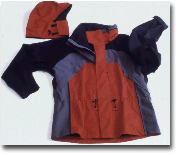
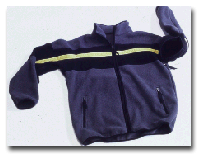
Schoellers new line includes a variety of fabrics, from soft and drapable microfiber fleece
knits to durable and rugged lightweight rip-stop weaves. In addition, the companys own Nano-Finish,
developed using nanotechnology applications in accordance with the bluesign Standard, provides
optional water- and soil-repellent attributes to the fabrics.Other development partners or
licensees in the bluesign system include Acordis, Ciba, 3M, Ems-Chemie, Eschler, Gortz KG
(Greenpeace products), KUAG, Nike, Prym, Rudolf Chemie, and Trevira.These partners are licensed by
bluesign to use its technologies, and their production processes are monitored to ensure that the
bluesign Standard will be maintained in products using the companys name. In turn, bluesign
reinvests the fees paid by these companies in new research. Licensees have access to bluesigns
entire body of knowledge; compatible components, processes and technologies; and engineering
services. The products are marketed by the labeling of bluesign® brands, company-brand
communication and distributor support.Leaders in science, environmental policy, industry, and
environmental and consumer organizations are monitoring bluesigns work. Research institutes
associated with the system include ETH Zurich, Tex-a-Tec and oko-Institut Freiburg. In addition,
bluesign is in a technology partnership with the Steilmann Group to develop new polyester textiles
that comply with its standards. What’s Blue And What’s Blackbluesign has placed products,
substances and technologies into three categories, according to their degree of compliance with its
standards. The bluesign standards exceed those set forth in oko-Tex Standard 100, the European
standard established in 1992 for the environmentally responsible production of textiles.The
bluelist includes products, substances and technologies that make the entire production chain as
toxin-free as possible and demonstrate totally environment-compatible behavior from raw materials
processing (including fiber and dyestuff manufacture) through fabric finishing and garment
manufacture. The list also embraces consumption and disposal methods. It includes:single-sort
materials that are easily reduced to their raw materials and are recyclable in raw-material form
(e.g., polyester into terephthalic acid and glycol);innovative technologies, such as
nanotechnology;the use of sustainable raw materials, such as cornstarch;catalyst systems that
comply with the bluesign standards;disposal methods that allow bio-compatible materials to break
down aerobically or anaerobically; anddisposal methods by which non-bio-compatible materials are
mineralized into carbon dioxide and water, so that their residues are bio-compatible.Next in rank
is the greylist of Best Available Technologies (BAT), comprising products and technologies that are
the best currently available. They are being used in the interim, but they will be improved upon as
better technologies become available, and once deemed eligible, they will be transferred to the
bluelist.Last is the blacklist of hazardous substances and technologies. These items will never be
used in the manufacture of bluesign-licensed products. The blacklist includes any substances that
have potential carcinogenic, mutational or adverse reproductive effects; that accumulate in water
or living organisms; or that have toxic or hormonal effects on living organisms. Included on this
list are antimony, mercury compounds, polycyclic aromatic hydrocarbons (PAH), tributyl tin (TBT)
and chlorine bleaching, among other items. Ecology And High-Tech Go Hand-In-HandEco-efficiency
is defined by bluesign as the relationship between the overall expenditure of nature and the
specific benefit per project or service unit. As Peter Waeber, CEO, explains: Ecology and high-tech
are not opposites. On the contrary, we can only observe our responsibility to living and future
generations by using the most modern technology. Ecological is no longer synonymous with hand-knit
We will be able to treat sustainable raw materials such as corn starch so that they display the
functions of modern chemical fibers and can be returned to the natural cycle at the end of their
useful lives.Another example of the ecology/ high-tech connection is the use of nanotechnology to
develop new textile-finishing processes that can imbue fabrics with various properties, including
dirt- and water-repellency, by changing the molecular structure of the fibers. Fabrics having dirt-
and water-repellent properties behave in the same way as a lotus leaf, which repels dirt and water
due to its rough, scale-like surface. The use of nanotechnology to create these properties in
fabrics eliminates the need to use halogenated compounds to achieve the same effects.Driving home
the importance of implementing eco-efficient practices is the fact that normal industrial
production creates 30 tons of waste for every one ton of finished product. 

The products of nature are not necessarily excluded from bluesigns efforts to develop new
eco-friendly products, although the consortium is concentrating on improving production of
synthetics because, in general, their manufacture generates more toxic pollution than the
processing of natural fibers. The key to compliance with the bluesign Standard is the use of
environmentally responsible cultivation, harvesting and processing methods. In the interest of
eco-efficiency, the bluesign system is promoting the following goals and ideas:Harvesting,
processing and finishing of raw materials and products must all be accomplished in an intelligent,
economical, environmentally safe (including toxin-free) mannerIntelligent solutions combine
eco-efficiency with a high degree of functionality, design and quality; combine nature and
technology; and use sustainable energies, such as solar and hydrogen energy.The elimination of
harmful materials and processes begins in the design stages of a product; hazardous substances and
technologies are never even considered to be viable. Science Is A Better Tailor Than NatureIt
is bluesigns contention that by pulling knowledge from the entire spectrum of textile processing,
studying natural processes and mimicking them, and taking a holistic approach to synthesizing it
all, scientists are able to achieve the best solutions for eco-friendly production. bluesign is
constantly updating research and development, as well as its own standard, to maximize the
environmental benefits of the products manufactured under its license. New processes, technologies
and components are put in place as soon as possible to ensure the best solutions are being used at
all times.Looking toward the future, bluesign plans to develop technologies for the polyamide field
and for new synthetic fibers produced from sustainable raw materials. In addition, Schoeller is
working on developing new processes for the production of nylon.bluesign is also pursuing further
developments in process and mechanical engineering, as well as environmental technologies. Among
the current projects are the vatting of indigo or copper dyestuffs and waste-water treatment
through anaerobic breakdown.Another new development is corfix, a new, patented process technology
to be used in pretreatment, dyeing or finishing. The process improves dye absorbency considerably
and requires much less energy and water than do other processes currently in use. The machinery to
be used in the process is being developed by Switzerland-based Tex-a-Tec, one of bluesigns
technology providers.
April 2001

Stork Offers New Version Of Its Color Physics System

Netherlands-based Stork has introduced the 4.1 version of its Color Physics System (CPS), a
software program for color measurement, recipe calculation and correction. CPS now runs under
Windows NT and features an open interface that allows easy communication with any CAD system. The
program converts color information on designs and colorways into color recipes, as well as
transmitting information on the available basic colors to the digital pre-print systems. The CPS
can be linked directly to a Stork IPS2/Saturn color kitchen for automatic recipe dispensing and
forwarding design/colorway information to production. Stork lists cost savings, flexibility and
efficiency as some of the advantages offered by the software. The CPS will determine which
dyestuffs should be used and what the maximum dyestuff yield should be, as well as indicating the
price per calculated recipe.

April 2001

Erhardt Leimer Offers Enhanced Control For Web Systems

Erhardt+Leimer Inc., Spartanburg, S.C., has announced that its DO 2000 command device is now
available for use with digital web-guiding systems. The new modular multi-use control station
combines advanced guidance technology with multi-language, user-oriented features, which are
designed to facilitate enhanced control, continual accuracy and ease of operation.With the command
device, users can operate up to eight control loops from a single command station. The device
features an integrated oscilloscope and voltmeter, and allows simple parameter setting.All input
and output elements on the panel are clearly displayed, and all function areas including
information, input control, operating mode and display are separated. All text on the DO 2000 is
presented in one of six available languages: English, French, German, Italian, Portuguese or
Spanish. In addition, the device is a diagnostic tool and can be used as maintenance aid to help
reduce downtime and eliminate waste.

April 2001

European Yarn Fair Expands

European Yarn Fair Expands
New quarters, acquisition strengthen Expofil Along with new fibers, colors and yarns
shown at the most recent Expofil in Paris, two major areas of expansion were announced by
management of this biannual yarn exposition. In June, the show will move to larger quarters at a
new location, where it will be able to accommodate international exhibitors. Yarn Fair
International, held in New York City every August, is being taken over by a consortium of French
trade organizations and will be run by Expofil management.In making these announcements, Didier
Tardy, Expofil president and recently retired head of the yarn firm Emile Tardy, said, For the
first time non-Europeans are exhibiting at Expofil. With the arrival of new countries, we will be
strengthening our profile and international viewpoint. By acquiring the show in New York, we now
have a foot on three continents. Expofil has a 50-percent interest in Filasia, a yarn fair which
takes place once a year in Hong Kong.Philippe Pasquet, secretary general of the Association franse
pour la promotion des fils textiles (AFPFT), the organization that runs Expofil, said that the move
from Quai Branly to Parc des Expositions, Paris Nord, will provide an additional 30,000 square feet
of exhibit space. This new space will be equally divided among exhibitors, fashion information and
visitor comfort facilities.About 7,000 weavers, knitters and manufacturers attended the December
Expofil, where close to 200 exhibitors gave a first look at fibers and yarns for the Spring/Summer
2002 season. Lenzing introduced Lyocell LF, a low-fibrillation fiber that has all of the properties
of lyocell and can be processed like conventional cellulosic fibers. Target end-uses are knitwear,
terry cloth, lace and garment dyes.Aquafil Textile Yarns, which is part of Gruppo Bonazzi, selected
Expofil as the venue to announce a new microfiber polypropylene to the market. Called Dryarn, it is
lightweight; resists abrasion, bacteria and moths; and offers UV protection. Like conventional
polypropylene, it is hydrophobic, so it expels perspiration and stains and transports
moisture.Dryarn is available in 12 colors. Research is underway to enable the fiber to be dyed. It
is expected to sell for sportswear, intimate apparel, hosiery, knitwear and medical
end-uses. Unifi Introduces New ProductsGreensboro, N.C.-based Unifi, the worlds leading
producer of texturized polyester and nylon, and a first-time exhibitor to Expofil, launched 10 new
products that, according to Jim James, European product development manager, have been in work for
three years. This is like our coming out party, he said.One new product, called Sorbtek, is a
moisture-management performance yarn that has been adapted by Nike for socks. Lee Gordon, Unifis
senior vice president, product development, said, The power behind Sorbtek is its advanced formula
that integrates itself into the molecular structure of the yarn. It outperforms all other yarns,
natural or synthetic, in the ability to catch, move and release moisture quickly and efficiently.
 

Sorbtek is available as continuous-filament polyester or nylon and in yarn counts ranging
from 70 to 150 denier. It can be used in the warp or filling in woven applications, and on
seamless, circular and warp knitting machines.Two new Unifi yarns that offer luster, brilliance and
shine are Sparkle and Novva. Sparkle is a false-twist yarn with a metallic look, and Novva is a
textured yarn with the brightness of a flat yarn.Myriad, another new yarn from Unifi, gives
striated or heather looks to fabrics. Eclypse is a thick-and-thin microfiber with the look of a
marled yarn. Donegal is a striated yarn with the touch of wool and the appearance of worsted.
Sultra is a splitable yarn that goes from 50 filaments to 450 after dyeing and imparts a peach-skin
touch. Augusta delivers the hand and drape of cotton. Sirrus is a false-twist yarn with inherent
stretch. It gives a crepe touch and thick-and-thin appearance to fabrics. Repreve is an
easy-to-process textured yarn made of post-industrial content.New at Nylstar are two nylon
variants, Meryl® Ecodye and Meryl® Skinlife. Meryl Ecodye is produced using a process that reduces
quantities of dyestuffs required and increases color saturation during the dyeing phase. The result
is less pollution, less clean-up and cost reduction ranging from 15 to 25 percent. Meryl Skinlife
is a bacteriostatic fiber that controls bacteria and keeps it at a natural level on the skin, even
during strenuous exercise. It lasts through repeated washings. New Technical Yarns From
FranceFrench spinner Paul Bonte, a division of Saint-Lieven and noted for technical yarns,
introduced new thermoplastic yarns containing Kevlar®. They can be laminated by applying heat and
pressure. Fabrics can be shaped and molded or spot-patterned. Other products of interest are
shrinkable yarns that can be used for seersuckers and plisses, semiconductive yarns,
electromagnetic yarns, antibacterial and antistatic yarns, and cut-and-slash protective yarns.With
the current trend to lightweight fabrics and open patternwork, Paul Bontes Chimere dissolvable yarn
is increasingly popular. Development fabrics shown are light, sheer, slubbed and nubbed.
Saint-Lievin also showed stretch yarns; plisses; light, ultra-sheer nylon crepe yarns; glittery
ribbon yarns; tie-dyes; raffia; and soft, dry-touch yarns.Crepe yarns are also popular at Emile
Tardy. One of the best sellers is a blend of viscose/nylon/elastane. Another is a twisted yarn of
acetate/textured Corterra. There are matte and shiny crepe yarns some with a dry touch, others with
a cold hand.Billion Mayor is selling new slubbed crepe yarns of 100-percent polyester and blends of
polyester/nylon. A twisted matte yarn of 44-decitex Corterra has a sensuous, silky touch. There are
trilobal polyesters, air-jet textured yarns, and dope-dyed, melange and pigtail yarns.At Chavanoz,
an increasing part of the line is selling to weavers of fabrics for the home. Fine polyester yarns
are going into organza for curtains; heavier, slubbed linen-type yarns are going into drapery and
upholstery fabrics. Wrinkle-Free LinenAnother French company, Safilin, has been spinning linen
since 1870. Today, it is producing 600 tons of yarn a month, of which 50 percent is exported.
High-twist yarns are selling to Northern Ireland. New are dry-spun yarns blended with Lycra® and
yarns that have been treated to be wrinkle-free.Italian spinner Linificio e Canapificio Nazionale
is noted for linen yarns. The company sells boiled natural yarns to apparel markets and bleached
yarns for bed, home and shirting fabrics. There are twisted yarns blending linen with nylon, iron
or copper; intimate blends of linen with silk or wool; covered yarns with top-dyed linen over
cotton; and dyed yarns to give a dvffect. A new high-twist crepe yarn is crease-resistant and is
selling to the shirting trade.Of the 68 Italian exhibitors at Expofil, Zegna Baruffa is one of the
most popular. Noted for stock color service, high performance and on-time deliveries, the company
sold 11.5 million kilograms of yarn to the United States last year, with a turnover of $200
million. 

Among the top sellers at Zegna Baruffa are waterproof cotton yarns with a cashmere touch;
antibacterial yarns containing Amicor; UV-protective yarns; and yarns with fragrance, aloe and
seaweed for anti-stress. Dry-touch yarns include a twisted yarn of cotton/cupro; another is a
linen/cotton blend. There are chunky tweed yarns and lightweight dressy yarns. The B Exclusive line
at Zegna Baruffa is showing silk for spring in stretch, ultra-sheer, twisted and crepe yarns. There
is a new spinning technique that gives cotton an extra-fine, dry hand.At Marioboselli, the focus is
on lightweight yarns for casual- to formalwear. Dressy clothing is coming back, said Carlo Boselli.
We are selling new crepe yarns to the apparel trade for formal- and streetwear. One yarn he pointed
out is a blend of triacetate/polyester that is machine-washable and wrinkle-resistant.Marioboselli
is known as a spinner of fine silk yarns. With the fluctuating price and availability of silk, the
company has added synthetics and blends. With China becoming more industrialized, workers can make
more money in factories, so silk production is lower. Today we are getting some silk from Brazil.
It is top-quality, but more expensive, said Boselli.Viscose is another fiber Boselli cited as being
in fashion, but in short supply because of the closing of several major facilities. As a result,
Marioboselli has developed yarns of bright monofilaments and semi-dull trilobal polyester.At
Jaeggli, there are continuous-filament textured, twisted and stretch yarns spun in blends of
acetate, nylon, cupro, Bemberg, viscose, polyester, silk, microfibers, elastane and metallic
fibers. There are melange yarns, crepes and ultra-fine yarns of 50 to 160 denier. They sell to
weavers and knitters for a variety of apparel and home furnishings end-uses. A Return To
EleganceReiner Elend, sales export manager for German spinner Schoeller, agreed that there is a
return to dressing up. He showed a lot of dry, paper-touch fine yarns in blends of viscose/nylon
and acrylic/cotton. An eyelash yarn of cotton/nylon and a glitter yarn of acetate/nylon are some of
the novelties. Both have a dry hand. For casualwear, there is a new light, high-bulk yarn of
cotton/acrylic/copper.There were 31 exhibitors from Spain at Expofil. Josep Campanera of Consejo
Intertextile Espa#44; who coordinates textile promotion in Spain, said that exports are on the
upswing. He expects a large number of spinners to sign up for Yarn Fair International in New York
City.The yarns at Edgarfil fall into three groups: viscose, which is available as bright and matte;
linen; and fancy yarns. Most of the fancy yarns are blends. There are flammarns of cotton/nylon,
glitter of acrylic/nylon with a dry hand or of acrylic/polyester with a soft touch, and
fine-twisted yarns of acrylic/nylon. 

Himiesa showed yarns that are printed, covered, twisted, slubbed and flamm. There is a
polyester/nylon stretch yarn that has a paper touch and a shiny, two-tone chain yarn of
cotton/acrylic/nylon.Catfils line has a lot of stretch, linen and fancy yarns. There are new tape
yarns in linen/nylon. Some are natural, others space-dyed.The Portuguese firm TMG Yarns is part of
Textile Manuel Goncalves. They are equipped with spinning, twisting and dyeing facilities. The
product range includes cotton, linen, polyester, Tencel®, A-100 and specialty performance fibers.
Optic white Amicor/cotton blends are going into a variety of products including hospital sheets and
athletic socks. New this season are flame-retardant yarns spun with Kanecaron®, a fiber from
Kanebo. These yarns are selling to contract markets.At Somelos, there is a lot of long-staple
cotton from the United States. Some of it is blended with wool or modal. There are single and plied
yarns in medium to fine counts. Linen, silk and viscose are other fibers here. Somelos sells yarns
to circular and flat knitters for apparel and to weavers for apparel and home fashions.The next
Expofil will take place June 5-7 at Parc des Expositions, Paris Nord, with focus on the Fall/Winter
2002/03 season. Dates for Yarn Fair International in New York City are August 21-23.

April 2001

Picanol Introduces Enhanced Terry Weaving

Belgium-based Picanol has recently introduced the TERRYplus weaving machine, which brings air-jet
flexibility to terry production. The machines motor-driven system provides increased operational
flexibility special fabric constructions with different pile heights are now possible.The TERRYplus
not only permits greater pile height and heavier fabric weights, but it also offers increased
flexibility of operation with the ability to change the fabric width and pile height. On the
TERRYplus, the drawing-in width can be changed using the same reed by shifting the weft stop motion
and the weft cutter. Moreover, the pile height is freely programmable with the same fabric. The
machine also offers enhanced electronic let-off and electronic take-up.

April 2001

Quality Fabric Of The Month: Structural Diversity


T
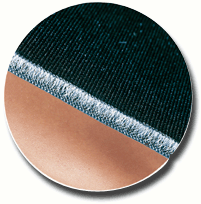
he Militex Division of New York City-based Gehring Textiles Inc. has added five new constructions to D3, its line of open, three-dimensional spacer fabrics for various medical, sports and industrial uses. The new fabrics replace neoprene foam in sports-medicine applications. D3 fabrics can combine as many as three different fibers in each construction, exploiting the particular properties of each fiber in the facings and the spacer yarns between them. Cushioning, compression and recovery, breathability, insulation and other performance propertiescan be structurally integrated into one fabric, depending on the intended end-use.

D3 Construction

QFOM_470 In D3 spacer fabrics, two separate face fibers are combined with an inner spacer yarn or yarns in a warp-knitted construction. The spacer yarns contribute engineered properties such as thickness, elasticity, compression, and physical spaces and channels. The face fibers provide such qualities as density, water-repellency, antimicrobial attributes, softness, breathability, UV or chemical resistance, fire retardation and texture. A fabric can be antibacterial on one side, water-repellent on the other and impact-resistant in between. One face can be Velcro®-compatible or
have a mesh construction. Possible face fibers include spandex, Kevlar®, Nomex®, PBI®, monofilament, microdeniers and other performance fibers. The fabrics can be thick or thin, and the
thickness within a fabric can also vary across its width.

The manufacturing process, unlike that for most laminated fabrics, is environmentally friendly. Because the materials used in the fabrics are all homogenous and no glues are used, they can be recycled.

More Versatile Than Neoprene, And More Durable

D3 fabrics are more versatile than neoprene for sports-medicine applications, as well as being more durable, said Skip Gehring, vice president. The fabric structure allows greater control over such properties as elasticity. Neoprene stretches in all directions, but elasticity in D3 fabrics can be confined to one direction, or the degree of stretch in various directions can be controlled to allow more in one direction than in another. Impact resistance can be incorporated
into the fabric without affecting elasticity or thickness.

As for durability, although neoprene is washable, repeated launderings cause it to dry out and lose its stretch and compression properties. D3 fabrics retain their qualities even after repeated washings.

Other advantages of D3 over neoprene include breathability, as well as the ability to control heat and moisture transfer. For medical applications, such qualities, along with improved elasticity, promote healing.

Gehring said the company will also custom-engineer fabrics to meet specific end-use requirements. The warp-knitted patterns possible are almost limitless.

April 2001

Radici Refocuses

Better BusinessBy Jim Phillips, Executive Editor Radici Refocuses 
American market penetration spurs Somet/Vamatex/Savio merger. Consolidations continue
to be the wave of the future in the textile industry, as more and more companies concentrate
resources to decrease costs and provide maximum benefit to customers.Such mergers and
reorganizations are not limited to textile manufacturers, but are becoming more and more common
among machinery manufacturers as well. Rieter, it was revealed at press time for
TI, is in talks with Suessen. Sulzer is for sale and, by the time this article is
published, may have found a new owner. In February, the Italy-based Radici Group announced that it
was consolidating three of its flagship companies Somet, Savio and Vamatex under a single umbrella
in the North American market. The new company is to be called Promatech.
TI visited the companys U.S. headquarters in Spartanburg, S.C., and spoke with the three
individuals who will be responsible for the new directions of the combined company in the American
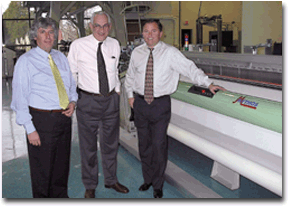
marketplace: Danilo Arizzi, chairman; Harold Hoke, CEO; and Nikolaos Perackis, commercial director.
Rino Morani continues as commercial director in Italy. 

(left to right): Danilo Arizzi, Nikolaos Perackis and Harold Hoke hope to guide Promatech to
a greater American market share. Consolidation Will Increase Chances For SuccessBefore, these
entities were separate, even though the ownership was the same, Arizzi said. As long as things were
excellent, it seemed that should be the way to do it. But now the world has changed, and you cant
continue with old ideas. The future is going to be a challenge. The number of textile manufacturers
in the United States is continuing to decrease. We think that, by joining these companies and
combining resources, we create a much better opportunity for success.A primary reason we are doing
this is for research and development. We previously had two groups doing essentially the same thing
developing technologies that increase the productivity of our customers.As well, Arizzi said, the
consolidation enables the company to better position itself in the replacement-parts business.
Because there is, at times, excess capacity in the market, we were not realizing some of the
economies necessary in this segment. With consolidation, we increase both our efficiency and our
leverage in containing costs for our customers. As a result, we have improved our service to our
customers.The consolidation applies to the weaving products offered by Vamatex and Somet.
Overlapping products will be consolidated, and efforts will be directed toward gaining more name
recognition in the American marketplace. The inclusion of Savio, as a producer of spinning, winding
and twisting machinery, will enable the company to provide more of a systems approach to its
marketing efforts. Brand Names Will RemainSomet, Vamatex and Savio will remain as brand names
for the new company in order to maintain the brand equity that has been built over the years,
Arizzi said. There is a history behind these names a reputation and a value for these brand names
that we want to maintain.The company, in its various incarnations, has made tremendous progress in
developing markets for its flagship product lines. The Vamatex Leonardo series has garnered a
substantial share of the rapier market (See In The Loop, ATI, February 2001), while Somets Mythos,
introduced in 2000, represents a foray into the high-performance air-jet arena. 

We anticipate that the consolidation of resources under the Promatech name will accelerate
our already active development program, said Perackis. This will enable us to add one plus one and
equal two-point-something, he said. This is our goal.Added Hoke: If you look at the worldwide
market for looms, its about 50/50 for air-jets and rapiers, he said. Of the 50 percent of rapiers,
Somet and Vamatex account for over half of that market. This goes to show that there is a lot of
synergy there that there are a lot of points in which Somet and Vamatex dont compete. Each company
has specific niches that they do very, very well in. While there is some overlapping, there are a
lot more areas in which they do not overlap. Its a very nice merger. It spreads our market
capabilities out through the whole line.Promatech sold more than 5,000 rapier machines in 2000.
Somet sold almost 1,000 of its Mythos model in the products inaugural year.The production of
high-technology rapier machines by Somet and Vamatex is more than the combined production of all
other manufacturers in high-technology rapier machines, Arizzi said.But, despite the worldwide
success of the products, both Vamatex and Somet suffer from name-recognition problems in the North
American market. This is part of what the Radici Group hopes to address through the creation of
Promatech.In the United States, we are perceived as a small company, Hoke said. Some of our
competitors who are perceived as bigger than we are Dornier, for example are actually much smaller.
But, the average rapier user in the United States would think just the opposite. In Mexico and
south of the border, Vamatex and Somet are considered the leaders. Diversification, Innovation
Must ContinueHoke is a big believer that U.S. manufacturers must continue to diversify and innovate
in order to compete successfully in a global market. The creation of Promatech will help them to do
just that, he said.I was with a customer just recently who talked about spinning and weaving yarns
that, 10 years ago, he didnt even know would exist crazy combinations of fibers, counts and plies
and so on. Combinations of woven fabrics and styles, pick densities and new applications. What weve
found is, in the past, the United States has purchased machines with the leading criterion being
flexibility. In reality, they didnt innovate; they ran the same fabrics they had been running for
years on these flexible machines. Its like the American market planned for flexibility, but never
reached it and then sacrificed 10- to 20-percent productivity to attain nothing. So instead of
buying Somet and Vamatex, where the productivity is so high and can run 90 to 95 percent of the
yarns capable of being run on a rapier, they would make a buying decision to sacrifice the
productivity of the 95 percent for the 5 percent. For the first time, you are seeing Americans
think about that about what the productivity increase could mean. They can move in a small number
of looms of other types to handle the 5 percent that we cant.Once that transition takes place, Hoke
predicts Promatech will become a dominant player in the United States, just like we are in the rest
of the world.Hoke said demand last year for Promatechs looms in the United States exceeded
expectations. I was thinking that there would be about 1,000 or 1,100 looms sold, but it turned out
to be about 1,450. About 20 percent of that was the rapier business. With the introduction of
Mythos and our established rapier presence, I think this puts us in very good shape for the future.
April 2001

Control Systems Prod Productivity

Technology TrendsBy Jim Phillips, Executive Editor Control Systems Prod Productivity 
Automation facilitates production efficiency, product quality, reduced costs. Todays
modern textile plants produce the highest-quality yarns and fabric, with less labor and more added
value than at any previous time in history. The equipment used plays a large role, of course.
High-technology air-jet and rapier weaving machines operate at higher speeds and with greater
efficiency than ever thought possible, as do circular knitting machines, needlepunch looms, cards,
roving frames, spinning frames, twisters, etc.But an increasing role is played by the control
systems employed to keep manufacturing within tolerance and maintain production efficiency and
product quality. From opening through shipping, systems are available that eliminate cost, increase
production and quality, and provide for ease of maintenance and less downtime.The term control is a
broad one that encompasses a wide range of solutions. For the purposes of this article, the term is
defined as a product that adds value by contributing to the automation of the manufacturing. The
equipment reviewed below ranges in cost from just a few dollars for a relatively simple, but
amazingly effective, yarn-tension-control device, to hundreds of thousands of dollars for
high-technology, digital fabric-inspection systems. For this review,
TI provides a look at products from Gaston County, Elbit Vision Systems, Erhardt+Leimer,
IKOS Technologies and Otto Zollinger.  Dyeing Controls From Gaston CountyGaston County Dyeing
Machine Co., Stanley, N.C., is known throughout the world for the quality of its equipment for the
dyehouse. What many may not understand, however, is that Gaston County is, as well, among the
worlds largest suppliers of control systems for the dyeing process. The company has a separate
division that manufactures control systems and employs 140 people in a 60,000 square-foot facility.
The companys SuperTex+SQL computerized control system provides supervision of virtually every
dyeing area, according to Harold Wilson, executive vice president. The program runs on a Pentium®
PC-based platform and incorporates high-speed peripheral controllers, printers, tape drives and
other components. 

The system is designed for modular installation, which allows a customer to start with just
the basic ControlTex system and then expand with additional software modules as business expands.
Among the processes the system controls are formula management, drug room supervision, boiler surge
control, automated chemical delivery, process analysis, machine control, dye/chemical inventory and
floor scheduling. The system, according to Wilson, increases machine production; reduces dye and
chemical cost and waste; identifies manufacturing inefficiencies; improves formula management,
product uniformity and workflow; and manages utility demand.The dyehouse of the future will be part
of an integrated facility that uses computer technology to capture, distribute and display
performance data for a wide variety of management uses, he said. Thanks to non-proprietary software
designs, SuperTex+SQL can join otherwise isolated control and information systems within the plant
to become an effective and efficient network. As part of this network, SuperTex+SQL will be able to
provide data for production planning and lot tracking, inventory and material cost control, quality
control and quality analysis, maintenance planning, and manufacturing cost control.In conjunction
with the companys MP6000-series machine controllers, the system ensures dyeing processes are
carried out with exacting precision, he said. SuperTex+SQL increases dyehouse productivity by
reducing idle machine time and labor inefficiency; reduces inventory cost by more effectively
managing dyes and chemical consumption; improves product quality by providing precise control over
all aspects of the dyeing process; and improves color kitchen management by overseeing systems that
automate dispensing and batching for dyes and chemicals.A key feature of the system is Sentry-Link,
which provides communications between Gaston County and the customers installation, Wilson said.
With Sentry-Link, Gaston County technicians and software engineers can provide remote assistance
with problem analysis and software changes.SuperTex+SQL users have, typically, enjoyed productivity
gains and cost reductions in excess of 20 percent after installation of the system, Wilson said.
The latest offering from Gaston County is the Sentinel Controller, which provides speed and
programming capability to operate dyeing machines and dryers. Based on a Siemens hardware and
software platform and using international communications standards, the Sentinel is easily
serviceable from virtually anywhere in the world, Wilson said.Built-in diagnostics alert operators
to internal component malfunctions or outlying sensor failures. Because of the non-proprietary
interface, the Sentinel Controller can be linked to chemical dispensers made both by Gaston County
and other vendors. The Sentinel system is designed to be linked to a host system or act as a
stand-alone installation. We can literally run a dyehouse anywhere in the world from here in Mount
Holly, N.C., with this system, Wilson said. Inspection Systems From EVSIsrael-based Elbit
Vision Systems Ltd. (EVS), with U.S. offices in Charlotte, N.C., is a company that develops,
markets and supplies web-inspection solutions, products and services to the textile market. EVS
systems automatically detect and categorize spinning, weaving, finishing and other fabric defects;
analyze the shade consistency of fabrics; or monitor printing processes with consistency and
reliability, and at very high speeds.The companys I-Tex program is a family of automatic
fabric-inspection systems based on image-understanding algorithms that imitate the human visual
system. The system can detect defects as small as 0.5 millimeters (mm) on fabric widths up to 600
centimeters (cm) and at speeds that reach 300 meters per minute (m/min). Also, I-Tex detects
diverse spinning, weaving, dyeing, finishing and coating defects on any uncolored fabric. 
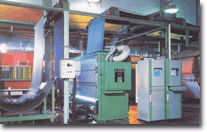
The I-Tex family of automatic inspection systems adapts to a variety of applications and can
be positioned in-line as part of a production process or as a stand-alone unit. In addition to the
standard I-Tex 100 system for greige and technical fabric inspection, the company offers I-Tex
100-Wide for greige and technical fabric; I-Tex 200 for unicolor dyed and finished fabric final
inspection; and I-Tex 2000 for home furnishing, technical, denim and apparel end-uses.The I-Tex
system imitates the human visual system and incorporates an image-acquisition unit, a system
computer, a system workstation and a video album of defects. The inspection process
comprises:Pre-inspection a preliminary learning stage that creates the set of parameters for each
learned fabric/style. The parameters represent statistical features of good fabric.Inspection a
process through which inspected fabric moves through the image acquisition unit; cameras transfer
the fabric image to the system computer; fabric image is scrutinized by a detection phase
algorithm; fabric irregularities are detected as defects, which are grouped according to size,
direction and shape and graded in terms of severity; defect map and images are displayed on a
monitor in real time; information for each defect is recorded; and the defect image is stored. As
an option, an alarm alerting the operator of the defects can be activated on any external
unit.Post-inspection a final phase during which rolls are graded according to predefined
guidelines; an inspection report is printed and sent to the plant computer for immediate or
subsequent action, defect images are analyzed using the incorporated video album; and mandatory
cutting points are regarded and identified.I-Tex monitors a wide range of smooth and rough fabrics.
It inspects fabrics that comprise all types of raw materials and that are designated for diverse
applications including apparel, home furnishing, technical, industrial and others. The system
detects multiple defect types such as: yarn and weaving faults; holes; oil, water and dyestuff
stains; missing threads; starting marks; broken yarn; and dyeing, coating and finishing
irregularities. EVS says virtually any visible defect is detectable.For knitted products, EVS
offers Kni-Tex, an in-line, automatic fabric-inspection system designed for the inspection of
open-width and warp-knitted finished fabrics. Kni-Tex is designed to overcome the knitted fabrics
elastic nature even when Lycra® blends are used. Kni-Tex is designed to inspect fabrics up to 240
cm wide at a speed of up to 60 m/min. Kni-Tex systems can be integrated with stenter frames,
sanfore machines, compactors, or automatic cutting and packing machines. The companys SVA offering
is an in-line system that measures shade variation in dyed fabric. The system uses a calibrated
traversing sensor and proprietary signal-processing algorithm. The sensor readings are compared to
a reading at the beginning of the roll to detect side-to-side and beginning-to-end shade
variations. The SVA is modular and can be accommodated to any fabric width. It is designed to fully
integrate with all I-Tex systems, or to operate as an independent, stand-alone unit.Prin-Tex is an
in-line printed fabric-monitoring and defect detection system that enables on-line detection and
alarm of repetitive printing defects, thus improving fabric quality and increasing printing speed
and efficiency. Printed fabric faults are displayed in real time on a video monitor, which enables
location of the defect and facilitates performing the appropriate corrective action. E+L
Focuses On Process ControlErhardt+Leimer Inc. (E+L), the Spartanburg, S.C.-based subsidiary of
Erhardt+Leimer GmbH, Germany, specializes in system solutions and automation technology for moving
webs and belts. The company offers guides, spreading systems, cutting systems, measuring and
inspection systems, tension-control systems, detwisting and opening systems, entry-frame systems
and exit-frame systems. For this report, TI looks at the companys offerings in wet finishing and
web guiding.In web guiding for wet finishing, the company offers an EGS entry frame system, which
is a compact machine infeed system equipped with pivoting tension rollers, segmented roller guider
systems with split guide plates and a variable-speed pull roll section. Two contra-driven selvage
uncurlers spread out the rolled web edges in front of the segmented roller guider. A wide band
sensor from E+L detects the web position over the full width of the web as a basis for guiding by
the machine center via the segmented roller guider. A pull roll section and compensator roller feed
the web to the washing unit at a set tension. 
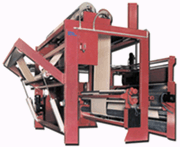
For the steamer outfeed, a flange-type segmented roller guider spreads the web out to its
full width as it leaves the steamer and precisely guides it to the following washing unit. To
optimize the spreading effect, a scroll roller with a contra-driven, pivotable spreader precedes
the segmented roller guider.A high degree of relative humidity, temperature, chemical ambience and
the mounting position make extreme demands on the entire web-guiding system. E+L claims it counters
these effects through the use of superior materials and advanced design. In addition, a drive
reduces bearing and gasket friction so that the web may run free of additional tension sources.
This, the company says, aids in the prevention of undesirable properties such as residual
shrinkage.The companys universally mounted AGS exit-frame system features a variable-speed pull
roll section and a plaiter. A surface-driven winder or reel plaiter is available as well.In
web-guiding framework systems, entry, bridge and exit frame systems may be flexibly designed to
meet specific requirements and permit the optimum positioning of web-guiding devices at the infeed
and exit of textile machines. The stable and modularly designed E+L framework systems are based on
steel or stainless-steel C-shaped sections and, according to the company, are equipped to satisfy
all processing technology demands. The framework systems combine all elements cloth guiders,
steering, rollers, segmented roller guiders, metal detectors, seam detectors, width-measuring or
inspection cameras and more to operate in harmony. Additional components, such as pull roll
sections or tension or dancing rollers, round off the framework system product spectrum, according
to E+L.A fully automated infeed or exit scray (i.e., non-stop web changing) assures the maximum
utilization of the processing system. A roller accumulator at the exit is a solution for
crease-sensitive materials, promoting top processing speeds. Depending on requirements, the final
processing unit implemented on the exit of textile machines may be a surface-driven winder, plaiter
or plaiter-winder combination in conjunction with E+Ls AGS exit-frame system. Software
SolutionsIKOS Technologies Inc., Charlotte, N.C., is a software-solutions provider with a
concentration on business concepts and solutions. The company has developed modules that can be
tailored to specific applications, according to Evan Parissis, president.The companys Locator®
system is a business-enterprise system that has the capability of addressing multiple business
solutions to provide the right combination for a particular industry. The system, Parissis says,
can manage manufacturing, distribution and supply-chain, as well as facilitate time and space
optimization. Among the modules available are those for security, messaging, animation, bills of
lading, employee time tracking, inventory control, invoicing, logging, maintenance, order entry,
product formulation, product procedure, reporting, scheduling, shipping, simulation,
transportation, user activity monitoring, warehouse management and data collection.  Yarn
TensionIn an era of increasing technology in virtually every area of business, it is sometimes
refreshing to review a product that is advanced due to the sheer simplicity of its design. Such is
the case with the OZ® Yarn Tension Control system from Otto Zollinger, Inc., Spartanburg,
S.C. 
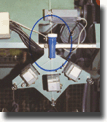
The OZ tension device uses a plastic cylinder or cup and one or more plastic or steel balls
to provide a highly variable response in order to control thread tensions.As the thread runs
through the tensioner, it enters at the bottom of the cup and runs along the surface of a ball,
causing the ball to be set into a rolling motion. The weight of the ball, combined with the thread
partly wrapping itself around the ball, provides a tensioner effect. A major feature of the OZ
system is that it doesnt have to be adjusted once it has been prepared for specific applications by
the inclusion of the correct number of balls and weights. Many machine builders incorporate
sophisticated electronic devices, said Otto Zollinger, president. In theory these are the ultimate.
But they require very expensive installation, complex moving parts and are subject to breakdowns.
Mechanical devices, such as the OZ, are much cheaper and require less maintenance.

April 2001

Sponsors