Springs, Maybank Textile Finalize Transaction Springs Industries Inc., Fort Mill, S.C., has
acquired the Cartersville, Ga., yarn mill of Maybank Textile Corp., Dalton, Ga.Maybank has been an
excellent supplier of quality yarns supporting our bath rug business for many years, said Stephen
P. Kelbley, executive vice president and president of the operations group, Springs Industries.
This acquisition is a strategic step in vertical integration to ensure quality products to our
customers and consumers. We are very pleased to welcome the highly trained and professional
workforce of the Cartersville plant to the Springs family and look forward to continuing to develop
an even stronger bath rug business.Springs will retain the 130 people employed at the Cartersville
facility.
March 2001
Springs Maybank Textile Finalize Transaction
Exergen Offers Sensors For Web Processes

Exergen Corp., Watertown, Mass., has recently introduced the IRt/c SV Infrared Thermocouple
for thermal control of both webs and rollers for paper, plastic, metals and textiles. The IRt/c
sensor works best for heating, drying, coating and cooling applications because of its small size
and ability to achieve the most accurate temperature reading. The sensors monitor the temperature
of the moving web and control the process, while maximizing quality and throughput.Constructed of
hermetically-sealed stainless steel, the IRt/c SV sensors are designed to withstand tough
conditions, such as the thermal processing of a web press, and are able to operate uncooled in
environments with temperatures of up to 212°F. The sensors can be held securely with tube fittings
or standard clamps to mount the sensor over the target area in spaces as small as .56 inches. In
addition, the sensors require no power supply and contain no moving parts.
March 2001
Benninger Takes Over Kleinewefers Wet Finishing
Switzerland-based Benninger Textile Systems AG has taken over the wet-finishing business of
Germany-based Kleinwefers Textilmaschinen GmbH. The two companies decided to undertake this step in
order to meet the demands of the future more efficiently. Industrial logic, strengthening the
market position, continuing as a preferred partner for customers and sustainable business
development are reasons cited for the takeover.The takeover gives Benninger access to the market
for elastic fabrics and will improve present capacity. Kleinewefers has become a minority
shareholder of Benninger.
March 2001
Expansion Strategy
Asian Fiber IndustryBy John E. Luke Expansion Strategy
Asian nations are now in the drivers seat in fiber production and
consumption. Recently, the statistical arm of the United States fiber industry, the Fiber
Economics Bureau, worked in conjunction with an industry consulting organization to reinstitute a
performance-measurement series detailing worldwide fiber trade by major region i.e., Asia, Europe,
the West. The series provides detailed analyses of regional production, consumption, and import and
export data by major fiber: cotton, wool, synthetic man-mades and cellulosic man-mades. It allows
examination in some detail of changes in fiber usage by regional area, as well as some smaller
divisions of these nations, and it provides signals of changes in regional strategies affecting
fiber consumption. The series highlights both natural and man-made fibers and allows the reader to
track inter-fiber competition, dig behind the macro-information and initiate in-depth
investigations. This research can point to areas where fiber usage has changed and provide a sense
and a warning of the direction from which the next market pressure will appear.It should come as no
surprise to regular readers of ATI that fiber consumption is increasing in virtually every Asian
nation. National strategies appear to be changing, from exporting only the labor content of
garments made with imported fibers and/or fabrics, to exporting both labor and content by bundling
fiber, fabric and cutting/sewing operations into a total export package. Investments are being made
in capital-intensive activities to produce fibers and fabrics, as well as cut, make and trim
garments and made-up items locally to employ the maximum number of people. The strategy is
expansion tactical application can take the form of bundling or pure export. In either case, the
value added by the entire production process is retained in the exporting nation. World Fiber
ConsumptionOver the past several years, ATI has devoted much space to discussion of the role of
several Asian nations in the transformation of the world fiber industry. The previously noted
bundling strategy is probably the largest innovation in the past 10 years, a change which
essentially puts Asian nations in the drivers seat in fiber production and consumption. According
to Fiber Economics Bureau information, between 1994 and 1998 world mill fiber consumption increased
at a compounded rate of slightly more than 4 percent, reaching 112 billion pounds by the end of
1998, with virtually all the growth occurring in synthetic man-made fibers in Asia. Asian mill
consumption of all man-made fibers (synthetic plus cellulosic) increased by more than 10 percent,
while usage of the same fibers in Europe and the Western Hemisphere increased at a rate only
slightly exceeding 2 percent annually. Simultaneously, in Asia, cotton usage increased marginally,
while the combination of cotton and man-made rose significantly. Table I details mill fiber
consumption in Asia in the years 1994 through 1998. Mill fiber consumption is defined as the
algebraic sum of local production minus exports plus imports. In the analysis, Asia is broken into
four sub-markets: Central Asia, China and Hong Kong; Northeast Asia, Korea, Taiwan and Japan;
Southeast Asia, Indonesia, Malaysia, Philippines, Thailand, Myanmar, Singapore and Vietnam; and
West Asia, India, Bangladesh, Pakistan and Sri Lanka. Each region will be discussed after the
macrostage is set.As mill consumption in Asia grew 6.5 percent, compounded annually, between 1994
and 1998, and world usage was growing at a lesser rate, Asias share of world fiber consumption grew
from 49 billion pounds and 51 percent of world usage in 1994 to almost 63 billion pounds and a more
than 56-percent share in 1998. Preliminary 1999 data suggests a continuation of the increase.The
interesting part of this information is the obvious growth of synthetic usage in Asia, rising at an
almost 11-percent compounded annual rate, while fiber exports from the region to all points of the
world continued to increase. This growth portends a regional strategy, with sub-regional/national
(i.e., Central Asian, Northeast Asian, etc.) priorities/preferences dictating fiber strategy
decisions built either on direct fiber export policy or on the bundling of all components of
garment manufacturing, supplemented by a vigorous strategy of exporting excess raw
materials.Because of the sub-regional structure of the Asian market, fiber exports from Asia tend
to follow an uneven course, often directed by national interests. As it stands, less developed
areas of Asia continue to be net importers of fiber, while the developed areas Northeast Asia,
Korea, Taiwan and Japan built enormous positive export accounts. This structure is logical as the
more industrialized economies begin the transition to capital-intensive directions versus the
labor-driven economies of the less-developed world.Overall region net exports increased 13.2
percent per annum, with the Northeast Asian region of Korea, Taiwan and Japan leading the parade
(See Table II). In 1998, for example, all Asian manufacturers imported 6.5 billion pounds of
synthetic fibers and exported 8.4 billion pounds, resulting in a net export balance of slightly
over 1.9 billion pounds. The Central, Southeast and West Asian regions were net importers, with the
entire export balance generated by activities in Korea, Taiwan and Japan which led exporters with a
positive export balance of 5.6 billion pounds. The Northeast Asian regions strategy appears to be
focused more on fiber exports than on product bundling, as total fiber consumption by mills in the
region rose only 3.5 percent annually, cotton consumption fell slightly and synthetic fiber
consumption rose 5.4 percent annually. Changes in mill fiber consumption by region by fiber are
shown in Table III. Man-made synthetic fibers starred, led by a virtual doubling of usage in the
Central Asian region. The enormous quantities of nylon and polyester exported to the United States,
particularly from Korea, are evidence of this incidence. Continued ExpansionTogether, the
Central, Southeast and West Asian regions increased fiber consumption almost as much as the
Northeast Asian area, but comparison of Tables I and III shows that three regions of Asia have
fueled expansion with man-made synthetic imports and internal growth, whereas the Northeast Asian
countries of Korea, Taiwan and Japan have expanded significantly internally but, more importantly,
appear to have paid for this expansion with exports, primarily to the Western Hemisphere. When will
it stop It would appear that stop is not a word in the lexicon of Asian nations.
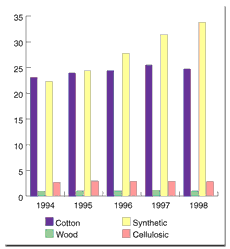
Table I: Asian Mill Fiber Consumption (millions of pounds)Source: Fiber Economics Bureau and
Author’s Estimates
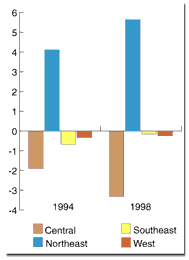
Table II: Asian Fiber Net ExportsBy Region Millions of poundsSource: Fiber Economics Bureau
and Author’s Estimates
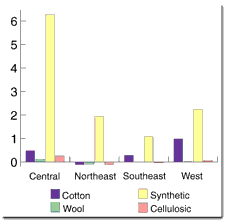
Table III: Changes In Asian Mill Fiber ConsumptionBy Region 1994 versus 1998Millions Of
PoundsSource: Fiber Economics Bureau and Author’s Estimates
Editors Note: John E. Luke is owner of Five Twenty Six Associates Inc., Bryn Mawr, Pa., a
consulting firm specializing in strategic marketing and operations facing textile fiber
manufacturers. He is also a professor of textile marketing at Philadelphia University,
Philadelphia.
March 2001
Charbert Picks Datacolors Colorite For Color Matching
Charbert Inc., Alton, R.I., a subsidiary of Narrow Fabric America, has selected the Colorite color
technology system developed and marketed by Datacolor International, Lawrenceville, N.J., for its
color matching.We have a strong commitment to give the client full access to our technical
strength, manufacturing expertise and innovative thinking. Datacolors color technology fits right
in with our operating philosophy. Its system not only allows us to perform quick and accurate
matches of Charberts exacting smaller dyelots, but it also gives us the ability to transfer color
information electronically throughout the supply chain, from the dyehouse directly to the
customers, retailers and designers, stated Bill Rowan, vice president of operations,
Charbert.Datacolors President, David Crozier, added, Charbert is a company committed to delivering
small lots of high-quality and custom fabrics. This makes it a perfect application for our system,
one that is designed to act as a seamless enhancer of the entire dyeing process, from expert color
matching through to on-screen color approval.
March 2001
Flame-Resistant Cotton Sleepwear Offered By Carters
Carters, Morrow, Ga., has developed a new line of flame-resistant cotton sleepwear for young
children. The new sleepwear is manufactured from Proban® cotton fabric, which has been used for
over 15 years in clothing for adults. The use of Proban makes it possible to manufacture safe, but
also comfortable and loose-fitting, cotton pajamas that conform to U.S. safety regulations applying
to childrens sleepwear. The flame-resistant qualities are incorporated into the cotton fiber and
are permanent. Carters new line is available in two-piece styles, with patterns created by blind
Japanese artist Emu Namae in striking color combinations.We waited years to introduce
flame-resistant cotton sleepwear because we wanted to develop a product that was safe, comfortable
and affordable, said Fred Rowan, chairman and CEO, Carters. Over the years, we passed on
alternative fabrics and fibers because they didnt meet our high standards. We are pleased to
introduce such a superior product and know that it will set the standard for the industry.
March 2001
Culp Announces Restructuring Initiative
Culp Announces Restructuring Initiative Increases in manufacturing efficiency, higher productivity
and lower operating expenses are the goals undertaken in a restructuring initiative announced by
Culp Inc., High Point, N.C. The company has identified restructuring actions, principally
consolidating yarn and upholstery fabric operations, that are expected to result in a charge of
approximately $3 million before taxes.The changes are involving some difficult personnel decisions,
said Robert G. Culp III, CEO. These moves are imperative, however, in order to adjust to the
current level of demand for our products, both in the United States and internationally. We have
decided to accelerate this program and consolidate certain other related operations, principally in
yarn manufacturing. This will involve eliminating some yarns used by customers outside the home
furnishings industry, but we will maintain substantially the same selection used to manufacture
upholstery fabrics and mattress ticking.
March 2001
Springs Board Appoints Special Committee
FORT MILL, S.C., Feb. 22 /PR Newswire/ — Springs Industries, Inc.(NYSE: SMI) announced today that
its Board of Directors has created a special committee composed of all the independent directors of
Springs to consider the proposal made February 20, 2001 by the Close family and Heartland
Industrial Partners, L.P. to take Springs private. The special committee has hired UBS Warburg as
its financial advisor, and Sullivan and Cromwell as its legal advisor, to assist the special
committee in its consideration of the proposal.Springs does not anticipate making any additional
public statements regarding the proposal until the special committee has determined whether or not
to approve the proposal. Springs Industries (NYSE: SMI) supplies leading retailers with a complete
line of sheets, towels, comforters, window treatments and other coordinated home fashions designed
to simplify home decorating for every consumer. Our major brands are Wamsutta(R), Springmaid(R),
Graber(R),Bali(R), Nanik(R), and Dundee(R). Springs also markets bed and bath products for
institutional and hospitality customers, home sewing fabrics, and baby bedding and baby apparel
products. The company operates facilities in 13 U.S.states and owns marketing and distribution
subsidiaries in Canada and Mexico.SOURCE Springs Industries, Inc.Web Site:
http://www.springs.comCopyright 2001 PR Newswire
ITMA Switches To Eight-Day Format Circular Knitters To Participate In 2003
ITMA Switches To Eight-Day Format;Circular Knitters To Participate In 2003Organizers of the 14th
International Exhibition of Textile Machinery (ITMA) have announced that the show will run from
October 22 to October 29, 2003, at the National Exhibition Centre (NEC), Birmingham, England. These
dates represent a change from the traditional 10-day show to an eight-day format. The decision to
shorten the length of the show applies to all future ITMAs.Maria Avery, exhibition director of the
ITMA03 organizing committee, stated, Overwhelmingly, feedback has confirmed that a 10-day show is
too long. We have acted accordingly and reduced ITMA03 to eight days, ensuring that the popular and
busy weekend is still embraced. The reduced period also means reduced expenditure for both
exhibitors and visitors.In other ITMA03 news, leading circular knitting machinery manufacturers
have confirmed that they will take part in the show in Birmingham, instead of attending another
show to be held at the same time in Italy. Avery said, Representatives of several leading knitting
machinery manufacturers have visited the NEC recently, and have been impressed both with the
facilities and the cost-effectiveness of the overall package we can offer we are delighted to
welcome circular knitting machine producers as an important exhibit group.
March 2001
Return To Fashion
Hosiery Show Preview ATI Special Report FAST 2001: Return To Fashion
The latest technology, fashion and design will be cornerstones of the Verona hosiery fair.
Following several seasons of banishment in favor of the nude-legs look and bare feet,
hosiery, with its allure and seduction, is being rediscovered by designers. The past 18 months have
seen the launching of designs with all the creative genius and provocative flair of past years.
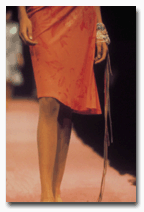
From Milan to Paris, the latest fashion shows have proven to be showcases for the latest in
hosiery: fishnet looks, printed and hand-painted styles, perforated styles, embroidered hosiery,
leopard-spotted designs, rhinestone-studded, sequined and beaded products all are prevalent in
todays market.The crisis of the past few years in womens hosiery seems finally to be over,
according to show organizers. The newest contributions to fashion have transformed hosiery from a
mere accessory to a fundamental component of feminine elegance. As well, mens hosiery continues a
positive trend. In the first nine months of 2000, hosiery production in Italy, for example,
increased by 7 percent. Italian exports in the first half of the year increased by more than 10
percent. Exhibition Space Sold Out This rededication to hosiery design and production has
created a great deal of enthusiasm for the upcoming FAST 2001 show, the third edition of the
European hosiery fair. FAST 2001 will held in Verona, Italy, March 21-24, and will feature more
than 160 registered exhibitors from countries throughout the world.Exhibition space in the show has
been sold out since October. Of the exhibitors, 94 are from Italy and 70 from other countries. The
largest group of exhibitors, other than Italians, comes from Germany, which will have 11 companies
represented. France follows with six exhibitors; and Switzerland and Japan have, respectively, four
and three each. Other countries represented include the United States, the United Kingdom, Spain,
Turkey, the Czech Republic, Russia, Japan and Mexico. There will also be 18 Italian and foreign
magazines and newspapers attending the event.Fast 2001 is promoted and organized by Sistema Moda
Italia (the Italian Association of Textile and Clothing Manufacturers). Latest Machinery,
Services And Yarns On Display The show promises to display much of the latest in technology,
accessories and services related to the manufacture of hosiery. Everything pertaining to
manufacturing and distribution cycles, from the most advanced and sophisticated machinery to the
most innovative fibers and yarns, will be on display.Among the machinery to be displayed are:
preparatory machines; yarn and hosiery accessories; circular hosiery knitting machines; linking,
sewing, assembly and packaging machines; special treatment and finishing machines; packing machines
and accessories for packaging; machine accessories; control and computer systems; and services.In
addition to providing a comprehensive overview on a manufacturing and technological level, FAST
2001 will provide show attendees with information, strategies, and financial and public relations
services. The Meeting PointNew for this edition of FAST 2001 will be The Meeting Point, which
was designed and created specifically for hosiery manufacturers. In the Meeting Point,
representatives from companies can meet, compare production, discuss agreements and partnerships,
and establish industrial and commercial synergies.
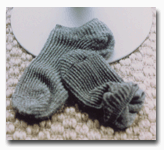
The Meeting Point will also host Trends and Hosiery and cultural exhibits. The Trends and
Hosiery display features six themes describing the fashion trends of the new millennium: Feminine
Touch hosiery and its eternal message of seduction; Geometric bold, graphic patterns of the latest
fashion trends; Over The Rainbow the imperative return of color; Relax playful and provocative
patterned hosiery for leisure time; Its Play Time hosiery for sports; Stocking and Dressing inside
and out, the new frontiers of seamless hosiery.FAST 2001 will also focus on the culture of hosiery
and its presence in art and design. An art exhibit will present works by contemporary Italian
artists from the collection of the Luigi Ciocca hosiery factory.More than 14,000 visitors from more
than 82 countries are expected to attend the show. Of those visitors, approximately 55 percent are
expected to come from Italy. Pre-Show Conference An international conference attended by
professionals, designers and experts from several countries will be held on March 20. The
conference will commence with a review of current marketing trends. It will then cover consumer
trends in Italy and throughout the world and will discuss forecasts for upcoming years.In addition,
the conference will touch upon the latest seamless fashions, which are produced on machinery
designed for hosiery production. The conference will also address the fact that hosiery is no
longer just an accessory but an integral element of fashion. The designers and stylists responsible
for this evolution in hosiery use will be present to discuss their work.The pre-show conference
will address e-commerce, as well. This discussion will focus on the prospects for hosiery producers
in business-to-business and business-to-consumer sales. Companies that work along these lines will
be in attendance to share their experiences. FAST 2001 Exhibitors
Agostoni s.a.s. di Paola e Giorgio AgostoniandCo.Agula S.A. Airily S.r.l.Alkotex S.r.l. Almatex
S.r.l.Aquafil Textile Yarns S.p.A. Arctronic S.r.l.Asahi Chemical Industry Co.Atateks-Istanbul
Atlas Copco Italia S.p.A. Divisione CompressoriAutotex Machinery Ltd. Bayer S.p.A. Bemberg S.p.A.
Borgolon S.p.A.B.T.S.R.Busi Giovanni S.r.l.Calzaccessori di Saleri GianfaustoCantu Egizio
S.a.s.Cason S.p.A.Celbo S.r.l.Centro Promozione FiloscoziaCentro Servizi Calza S.r.l.Cesare Colosio
S.r.l.Cetme di Cristina AttilioandCo. S.n.c. CF Italia S.r.l.Charme ModaChristoph Liebers
GmbHandCo. Condortech S.r.l. Aghi Platine e Tecnologia Tessile Conti Complett S.p.A.Continental
Fibre S.p.A.Cortese S.p.A.CoyarnCubotex S.r.l.Da Kong Enterprise Co. Ltd. Deimo S.p.A.Dinema
S.p.A.Dora EnricoandCo. S.n.c.DuPont de Nemours Italiana S.p.A.DuPont Tactel®Dynalace Textil
GmbHECAElettronica Valverde S.r.l.Eneas Informatica S.r.l.Eredi Ing. G. Fiore S.r.l.E.R.M.E.S.T.
Esox S.A.Exeltor Canada S.r.l. Fadis S.p.A.Fein-Elast Italia S.p.A.Fibrexa Ltd.Filati Borio Fiore
S.n.c.Filats Polinya S.L. Filbrescia S.r.l.Filelmo S.r.l. Filiere Maille
Filippini S.r.l.Filix S.A. Fillattice S.p.A.Filmar S.p.A.Fimatex S.r.l.Finelast de Mexico S.A.
de C.V. Firsan S.A. Flainox S.r.l.Franzoni Filati S.p.A.Fulgar S.p.A.Gabler Band AGGafitex
S.r.l.Giemme Filati S.p.A.Giletti S.p.A.Giornale della Maglieria e dellaCalzetteriaGiudici
DavideandFigli S.n.c.Globe Manufacturing Co. Grandis S.r.l.Groz-Beckert KGHaase + Kuhn Italia
S.r.l.Hamel AG Heliot International S.A.Hepp GmbH Strick-TechnikIluna S.p.A. International Textil
Diffusion Ltd. S.r.l.Investa International Co. Ltd. Irmac Tex S.r.l.Istanbul Corap San ASItalfil
S.p.A.Joint-Stock Co.Jorg Lederer GmbH Elastic-GarneJose Valeri Homs S.A. Kern-Liebers Knitting
Parts GmbHKnitting IntemationalKunert GmbH TWD GroupL. Payen et CieLa Esakon S.r.l.La SpolaLavatec
AG Legnano Tinti S.p.A.LegPromBusiness-Director Linea Intima ItaliaLogica S.r.l.Lonati S.p.A.M.S.
Costruzioni Meccaniche di Zecchi FlorianoandC.Madifil S.r.l. Maschen Industrie/Knitting
TechnologyMatec S.p.A.Memminger-Iro GmbHMendizza S.a.s.Menegatto S.r.l.Metalurgica Textil de
PrecisionMitchell Grieve Ltd.Moda e Industria Via MercatoModamarketing Monticolor S.r.l.
Mucchetti F.lli Elettrotermica S.r.l. Nagata Seiki Co. Ltd.Nilit Ltd.Noble Fiber
TechnologiesNuova Marc Tex S.p.A.Nuova Remital S.r.l.Nylstar CD S.p.A.Officine Meccaniche Riva
S.r.l.Orsi Macchine Tessili S.p.A.Pizzo Etichette S.r.l.PlusProllandLohmann Maschinen und Anlagen
GmbHPuntoandSeguidoR.M.B. Massardi S.n.c.Regal Manufacturing Co.RF Systems S.r.l.Richter
KammgamRifil S.p.A.Rimoldi Necchi S.r.l.Rosso Industrie S.p.A.Rubyco Inc.Rumi S.p.A.Sachsische
Nadel und PlatinenfabrikenSalzmann StretchSaurer-Allma GmbHScaglia S.p.A.Selezione Tessile
ShopperSimet S.r.l.Sina Giulio Agente Rappresentanze Filati IndustriaSiscodataSMC Italia
S.p.A.Soritex S.a.s.Speizman IndustriesSRA S.r.l.Stalam S.p.A.Stiltex S.n.c.Sutermeister
S.n.c.Tecma Engineering S.A.Tecnica del PuntoTecnofil Filati Elastici S.r.l.Tecnoyarn
S.r.l.TekstilandTeknik T&TA Tessile e TecnologieTextile Month Textiles Panamericanos The
Hosiery Association /IHETiflotel S.r.l.Tinarelli S.r.l.Trustfin A.S.Turini Francesco S.r.l.Valman
S.p.A.Wac Data Service Co. Ltd.Worldtex Inc.W. Zimmermann GmbHandCo.Zitec AG For
additional information on FAST 2001, or to register on-line, visit the FAST website at
www.fast-italy.com.
March 2001