
GREENSBORO, N.C., Feb. 2 /PRNewswire/ — Guilford Mills Inc. (NYSE: GFD) announced today that its
Home Fashions division has signed an exclusive licensing agreement with Jockey International Inc.
Under the agreement, Guilford Home Fashions will create and distribute a collection of bedding and
accessories under two labels -Jockey Home and Jockey Classic – which will be introduced at the
Spring Home Textile Market week beginning on March 31, 2001. John A. Emrich, President and Chief
Executive Officer of Guilford Mills,said, “In combination with our global sourcing initiatives, we
believe that licensing and branding opportunities will drive profitability and growth in our Home
Fashions business. We could not be more pleased to be working with Jockey, owner of one of the most
recognized brands in the world, and one that is synonymous with quality, performance and value.
Together, we will be better able to capture the growing opportunities in the home textile
business,especially within the age 35+ female consumer and baby-boomer groups – the largest sources
of home decorating dollars. “Guilford Mills is the largest warp knitter in the world and one of the
largest producers of Lycra(R)-containing fabrics. Our partnership with Jockey is a natural
extension of Guilford’s commitment to innovation and expertise in knitting high quality fabrics.
For instance, we will premiere an exclusive knit fabrication for Jockey that features compact ring
spun Supima(R) cotton,blended with Lycra(R). This high performance, fashion conscious fabric is one
example of Guilford’s innovation that we can leverage with a brand like Jockey to capitalize on the
growth in the home textile business,” Mr. Emrich concluded. Bob Nolan, President of Jockey Brands
said, “Jockey has continued to seek out partners in a number of markets to broaden the scope of
Jockey product potentials. In our quest to expand into other areas, we never lose sight ofour
commitment to fashion and quality. We are therefore extremely gratifiedto have a respected company
such as Guilford Home Fashions as our partner in this area.” About Jockey International Inc. Jockey
International Inc. is a manufacturer of men’s, women’s, boys’ andgirls’ underwear, which are sold
in major department and specialty stores across the country. The products are also available
globally in over 120countries. Located in Kenosha, WI, the 125 year-old-company is committed
toquality, fashion, innovation, comfort and value. About Guilford Mills Inc. Guilford Mills is an
integrated designer and producer of value-added fabrics using a broad range of technologies. The
Company is the largest warpknitter in the world and is a leader in technological advances in
textiles,including micro denier warp knits and wide width circular knits of cotton blended with
Lycra(R). Guilford Mills serves a diversified customer base in the home furnishings, apparel,
automotive and industrial markets. Through its Guilford Home Fashions subsidiary, the Company
produces bedding products,window treatments and shower curtains for the retail market.
Additionalinformation about the Company can be obtained from its website
athttp://www.guilfordmills.com. This press release may be deemed to contain forward-looking
statements and other projections within the meaning of Section 27A of the Securities Act andSection
21E of the Exchange Act. The Company assumes no obligations to update or revise any such
forward-looking statements. Such statements could be subject to risk and uncertainty that exist in
the operations of the Company and the business environment that could render actual outcomes and
results materially different from those predicted. These risks and uncertainties include, without
limitation, the following factors as well as risks and uncertainties disclosed in the Company’s
filings with the Securities and Exchange Commission: 1. General economic factors including, but not
limited to, changes in interest rates, foreign currency translation rates, consumer confidence,
housing starts, trends in disposable income, changes in consumer demand for goods produced, and
cyclical or other downturns 2. The overall level of automotive production and the production of
specific car models 3. Fashion trends 4. Information and technological advances 5. Cost and
availability of raw materials, labor and natural and other resources 6. Domestic and foreign
competition 7. Domestic and foreign governmental regulations and trade policies 8. Reliance on
major customers 9. Success of marketing, advertising and promotional campaigns 10. Inability to
achieve cost reductions through consolidation and restructuring or 11. Inability to obtain
financing on favorable terms or to obtain amendments or waivers with respect to non-compliance with
certain covenants in loan agreements SOURCE Guilford Mills, Inc.Web Site:
http://www.guilfordmills.com Copyright 2001 PR Newswire
Guilford Mills Announces Exclusive Licensing Agreement
Globe Manufacturing Files Involuntary Chapter 11
Globe Manufacturing, Fall River, Mass., announced that an involuntary petition for relief under
Chapter 11 of the United States Bankruptcy Code was filed in the United States Bankruptcy Court for
the Eastern District of Massachusetts by a group of holders of the companys 10-percent Senior
Subordinated Notes due August 2008.The company said that, for the last several months, it has been
in discussions with such holders, as well as its other creditor groups, regarding a restructuring
of its debt. Discussions with bank lenders are ongoing, and the company continues to explore a
number of alternatives, including the potential sale of the company and an operational
restructuring.In light of the recent filing, the company has decided to reduce its Fall River
workforce by approximately 130 persons. The staffing cuts will be made primarily from the
dry-spinning and reaction-spinning operations and include both manufacturing and administrative
positions.
February 2001
CollinsandAikman Announces Expiration Of Tender Offer
DALTON, Ga., Jan. 29 /PR Newswire/ — Collins and Aikman Floor coverings Inc.announced that it has
successfully completed its tender offer and consent solicitation for its outstanding 10% Senior
Subordinated Notes due 2007 and Series B 10% Senior Subordinated Notes due2007. As of 9:00 a.m.,
New York City time, on Thursday, January 25, 2001, the scheduled expiration for the Offer,
$84,750,000 in aggregate principal amount of the Notes had been validly tendered pursuant to the
terms of the Offer to Purchase and Consent Solicitation Statement, dated December 19, 2000. The
Company has accepted for payment and promptly will pay for all Notes validly tendered in the Offer.
Credit Suisse First Boston (“CSFB”) acted as Dealer Manager and MacKenzie Partners, Inc. served as
the Information Agent in connection with the Offer. An international manufacturer and supplier of
high-performance commercial carpeting for the corporate, health care, education, government, and
retailing sectors, the Company is renowned for pioneering the development of environmentally
responsible products. The Dalton, Georgia-based company produces floor coverings that last up to
three times longer than convention al carpeting, and remains the first and only manufacturer to
make a 100 percent recycled-content vinyl backing, ER3. In June 1999, the Company merged with
Monterey Carpets, a California-based manufacturer of high-end, award winning designs in broadloom
carpet for the corporate, retail store planning, and institutional markets. This was followed by
the acquisition of Nova Scotia-based Crossley Carpet Mills, in July 1999, continuing the Company’s
international growth strategy and enabling it to better serve the Canadian market. The Company is a
leading producer of modular carpet tile and the number one producer of six-foot roll carpet.SOURCE
Collins and Aikman Floor coverings, Inc.Copyright 2001 PR News wire
Evolon Wins First Avantex Award For Innovation
Germany-based Avantex, the international forum for high-tech garment textiles and fashion
engineering, awarded Germany-based Freudenberg Nonwovens, the creator of Evolon®, its Innovation
prize for new fabrics.In making the award, Avantex recognized Freudenbergs contribution to the
apparel industry using micro-system technology to create fabrics suitable for tomorrows high-tech
garments. Evolons lifestyle fabric is ideal for active-sport garments.Freudenberg developed Evolon
using a completely new textile technolgy to create high-performance, microfiber fashion fabrics.
Evolon is constructed from numerous microfilaments and is manufactured from polymer granulate in
one continuous process. The filaments create a fabric that will not fray and that can be designed
and developed for specific end-uses.
February 2001
New Bank Agreement For Duro Industries
Duro Industries, Fall River, Mass., has negotiated new bank terms that significantly reduce the
companys outstanding debt. The new agreement is for a three-year term and was reached between Duros
owners and a consortium of seven banks. The agreement reduces Duros debt from approximately $86
million to $46 million. As a result, the banks will hold a majority stake in the equity of the
company.Andraus, president, said that the new agreement, combined with some new contracts which
Duro has won over the last few months, means stable employment levels at Duro for the near future.
February 2001
Springs Industries Consolidates Production
Springs Industries Consolidates Production Springs Industries Inc., Fort Mill, S.C., announced it
would eliminate some production at its Katherine and Elliott plants in Chester County, S.C.,
affecting approximately 320 jobs. Outdated yarn spinning will be eliminated at both plants. In
addition, some narrow looms, which are not compatible with newer fabrication equipment, will be
phased out at the Katherine plant.By continuing to invest in modern technology and replace or
eliminate more costly manufacturing, we are able to produce more yarn and fabric at fewer
facilities and keep our domestic facilities competitive in this very demanding industry, said
William K. Easley, senior vice president and president of textile manufacturing.
February 2001
Jiangsu Sunshine Group Installs GERBERsuite Line
China-based Jiangsu Sunshine Group has entered into a joint venture with Italy-based Corneliani.
Under the terms of the agreement, Jiangsu Sunshine Group will manufacture 250,000 mens suits per
year under the Corneliani name for sale throughout the provinces of Shanghai, Beijing and
Nanjing.To support this venture, Jiangsu Sunshine Group has installed the GERBERsuite line of
solutions from Gerber Technology, Tolland, Conn. This includes two GTxL Gerber cutters, a DCS 3500
conveyorized cutter, a 122-station Gerbermover for automated assembly and two Gerberspreaders with
the Gerbersaver Flaw Management System.The Jiangsu Sunshine Group employs cutting-edge technology
for the manufacture of textiles, explained Steven Tang, Gerbers regional vice president for Asia
Pacific. Now, they have chosen state-of-the-art technology for their very high-quality mens suit
production.
February 2001
Nonwovens Technology
ATME-I 2000 ReviewBy Richard G. Mansfield, Technical Editor Nonwovens Technology
Acquisitions, alliances fuel growth for nonwovens machinery
manufacturers. Acquisitions, the formation of alliances and reorganizations of
nonwovens machinery producers are trends that were well in evidence at ATME-I 2000 trends that are
likely to continue. Examples of these trends include Rieters acquisition of ICBT Perfojet. Rieter
has evolved from a company that once was heavily concentrated in spun-yarn-processing equipment to
a key supplier of components and systems for man-made- fiber-manufacturing and nonwoven- processing
units. The recent entry of the company into spunbonded systems will give it more clout as a
supplier to the nonwovens industry.The acquisition by Autefa and Dilo of Spinnbau from Kleinewefers
enables a company, such as Dilo, to more easily provide customers with compatible components for a
whole nonwovens manufacturing system.A symposium presented during ATME-I, The German Nonwoven
Machinery Industry Partner for a Challenging Market, illustrated how companies are creating
alliances to aid their customers. Speakers at this symposium were from Dilo, American Truetzschler,
Spinnbau, Autefa, Kleinewefers, Fleissner and SchottandMeissner.Another important joint development
program is the work Fleissner and Hills Inc. have been doing to make microdenier spunlace fabrics
using Fleissners AquaJet spunlacing system and Hills bicomponent fiber manufacturing skills.The
Santex Group has reorganized in order to better service the highloft nonwovens business as well as
providing machinery for the coating and laminating of nonwovens. Nonwovens LeadersAutefa
Automation Group This German/Swiss company develops and manufactures components and logistics for
textiles and other industries. Autefa manufactures crosslappers for making nonwovens and textile
products. The functions of the crosslapper are to increase the surface weight of the web, improve
the longitudinal/transverse strength, increase the web width and improve the web quality.Autefa
Topliner crosslappers layering belts have low surface weight and friction, are chemically resistant
and highly conductive, and reduce static electricity problems.
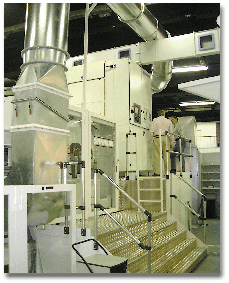
Dilo System Group The Dilo System Group includes alliances with Spinnbau, producers of
carding systems for nonwovens, and Siemens Mannheim in Europe and Siemens Westinghouse. The Siemens
companies provide on-call service and logistics with 24-hour emergency response for electrical
system repair and maintenance. As part of this alliance, Dilo and Siemens can provide training
options for the needleloom lines electrical and power systems.Spinnbau sells a carding unit for
producing thermal-bonded diaper coverstocks. The unit can make a 4-meter-wide web that runs at 370
meters per minute. In recent years, Dilo has supplied more than 70 needlepunch systems worldwide.
Sales of the companys geotextile systems have grown significantly.At ATME-I 2000, Dilo exhibited a
fully functional nonwovens line. Bale opening and fine opening were provided by Truetzschler. The
fiber flocks were then conveyed to the Dilo booth, where a dosage-control system fed the
Truetzschler Scanfeed FBK 539 unit, which then prepared the material via fleece-conveyor and
air-lay Turbo-Unit for the Spinnbau Turbo-Card. The Turbo-Unit is the air-lay web-forming unit to
be fed by either carded web, pre-needled fleece or a flock-feeding unit (Truetzschler FBK). The
Turbo-Card system combines a classic roller card and an air-lay unit when a maximum quality of
homogeneous blending and distribution of fiber in the fleece is required. In order to increase the
evenness of the product, two such lines may be combined into a tandem line by sandwiching two
fleeces with half the final weight of each on a collecting apron. The fleece is then consolidated
in the Dilo Hyperpunch needling system. With elliptical needling kinematics, it offers extremely
high throughput speeds of up to 150 meters per minute (m/min) at up to 3000 strokes per minute.
Dilo states that there are minimal dimensional changes (low draft and shrinkage close to 0
percent). When elliptical needling kinematics are combined with a special selection of
high-precision needles, interesting effects for the consolidation of fine-fleece hygienic wipes and
pads can be expected in regard to strength, drape and entanglement.Fehrer AG, Nonwovens Machinery
Division Fehrer exhibited a fully operative needle-punch machine type NL 21/SF-RV Superlooper in
2.4-meter working width. The machine is designed for the high-speed production of top-quality
random velours on a brush conveyor. Through the use of carbon fiber reinforcement for those
oscillating parts of the machine subject to extreme loads, it is now possible to achieve speeds of
up to 3,000 revolutions per minute (rpm). The Superloopers performance is enhanced by GBB 75 needle
distribution in both needle zones. Fehrer promoted to its customers the new mini-mill nonwovens
trial center in Linz, Austria, which allows running a wide variety of realistic customer trials for
many different applications of existing and potential customers.
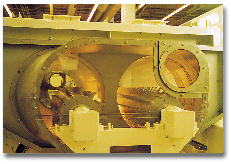
Fleissner GmbH Fleissner is a company that has been in business for more than 150 years as a
supplier of machinery for the textile and related businesses. Its initial products were targeted
for textile dyeing and finishing, but the companys product lines have broadened to include
machinery for synthetic fiber, paper and nonwoven fabric production.Fleissners Through-Air Drying
units have good acceptance by textile, nonwoven and paper manufacturers. Fabrics dried on these
units with minimum tension have a soft hand and low pattern distortion. The introduction of the
Fleissner AquaJet spunlacing system has enabled the company to broaden its participation in the
nonwovens industry. The AquaJet system can produce fabrics with weights from 10 to 100 grams per
square meter (g/m2) in widths up to 6,000 millimeters (mm) (240 inches) at pressures up to 600 bar
(8,800 psi). More than 30 AquaJet systems have been installed throughout the world.In conjunction
with Hills Inc. of Melbourne, Fla., Fleissner is developing spunlaced fabrics made with microdenier
fibers (less than 0.3 denier). Hills has developed fiber-spinning techniques to produce bicomponent
fibers that split during the spunlacing process to produce the microdenier fibers. The resulting
fabrics have a good hand and can be used for synthetic leather, substrates, velvet-like fabrics,
and for filtration and insulation applications. Spunlaced microdenier fabrics are used to make
wiping cloths for use in cleanroom processing installations.The Fleissner AquaTex system produces
Interspun® fabrics by the use of high-energy water impinging on the fabric. These fabrics have a
softer hand, improved abrasion resistance and reduced seam slippage. In some cases, latex for
stabilization can be eliminated.Kleinewefers (KTM) Kleinewefers (KTM) has been a producer of
calenders for the textile industry for many years. Thermobonding calendering units for nonwoven
fabric production now comprise an important segment of the companys business.KTMs Parotherm®
calenders are designed to provide for processes like spunbonding and for thermobonding of staple
fibers. The name Parotherm means the calender has a heatable roller with an integrated deflection
compensation engineered for these applications. In a two-roll Parotherm system, pressure is applied
externally and only one hydraulic system is required. KTM Parotherm rolls for making a
polypropylene coverstock use typical roll-surface temperatures, 160ºC and 250ºC for polyester
interlinings, with temperature tolerances plus or minus 1ºC. Speeds of up to 600 m/min can be
attained.Lurgi Zimmer Lurgi Zimmer is among the premier plant engineering companies for synthetic
fiber plants. The company has built production plants in 50 different countries and has built 390
polyamide plants; 160 polyester polycondensation plants; 147 high-speed spinning plants for POY,
FDY and FOY filament yarns; and 50 staple-fiber plants.Among the companys most significant recent
developments for fiber manufacturing are: PTT technology, jointly developed with Shell, for carpets
and apparel; modified polymers for high-performance spinning processes, high-tenacity technical
yarns; and high-performance spinning systems.Future research and development efforts include
optimization of PET processes to reduce capital operating costs, improvement of processes for
manufacturing PBT and PTT polyesters and use of renewable resources for cellulose processes.Neumag
The Neumag three-end BCF (bicomponent fiber) MAC (Modulus Assembly Concept) plant provides a mill
with the ability to start production of mono- or multicolored BCF yarns in just two weeks. The
unit, which is shipped in six 40-foot containers, can be assembled in nine days and is fully
functional in an additional five days.The Neumag BCF MAC unit can be supplied for polypropylene,
polyamide or polyester production. The machine and related utilities are placed into a modular
steel frame and assembled at Neumags facility prior to containerization and shipping. As well,
Neumag can provide modular specialized staple-fiber lines capable of producing bicomponent
fibers.N. SchlumbergerandCie In the nonwovens arena, N. SchlumbergerandCie has unveiled for the
first time to the public the worlds widest card cylinder (as claimed by the company) with a width
of 5 meters (197 inches). This cylinder usually would be integrated in the type CA11R35PPLL card.
According to company officials, such a card is already running in the industry with production
speeds of over 300 m/min. The CA11 card is adapted to the hygienic, clothing, medical and technical
products markets.Reifenhauser Reifenhauser was the first company to successfully introduce a
spunbonding system and has sold more systems throughout the world than any other company. The
Reicofil® system can produce spunbonded polypropylene fabrics from 10 to 150 g/m2 in widths up to
5,200 mm. The Double Reicofil line incorporates a second extrusion and spunbonding line, and raises
production rates while reducing energy consumption.The Reicofil Composite system incorporates
meltblowing units with the spunbonding units in order to produce SM (spunbond/meltblown), SMS and
SMMS composites.
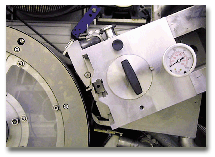
Rieter Perfojet Formerly known as ICBT Perfojet, this newest member of the Rieter group
manufactures spun- and filament-yarn processing equipment. This machinery produces nonwovens for
medical fabrics, personal and industrial wipes and synthetic leather.The Jetlace 2000 produces webs
from 20 to 400 g/m2 at 300 m/min. The water-jet injectors can operate at a pressure as high as
1,000 bar. Rieter Perfojet and M and J Fibertech have developed a spunlaced/air-laid combination
that produces wet wipes that are soft and have high uniformity and good absorption.In early 1998,
Rieter Perfojet started the design of a new generation of spunbonded fabric-production systems
under the trade name of Spunjet. The Spunjets advanced quenching system controls air in three
vertical zones and allows each zone to be controlled independently. All external air filters and
ductwork are integrated in line frames. Large volumes of air from the web former are accurately
controlled and managed. Heat dissipated within the system is collected and used for heating, and is
replaced by fresh air. Fiber drawing is achieved by using a specially designed slot device. The
Spunjet system can be erected within three weeks, and production can be started in another three
weeks.Santex Group (Santex Nonwovens) Santex Nonwovens was formed in 1999 in order to concentrate
the efforts of the Santex Group on nonwovens. In the United States, American Santex Inc. is the
organization selling and servicing nonwoven products.The Santex Wavemaker is a vertical lapping
unit that operates according to the rotation principle. The vertical position of the fibers in the
cross direction provides three-dimensional stability. The resulting products are finding use as
replacements for polyurethane foam in selected seating and bedding applications. The units can
handle card webs of up to 3,500 mm in width and infeed speeds of up to 150 m/min.The Santex
Santatherm unit is a thermal-fusion oven for nonwovens. Flowthrough and overflow techniques allow
the use of the same oven for air- permeable and impermeable materials. Each section of the unit
allows control of air-nozzle height adjustment, temperature and air regulation. Applications for
the Santatherm unit include thermal fusion with power or fiber, impregnation drying and heat-
setting. The Santext Santabond II is a smoothing and cooling calender that can be run under
pressure or with a gap.The Santex Highspeed I thermobonding line can run at speeds of up to 250
m/min, while the Highspeed II can achieve speeds of up to 350 m/min.Spinnbau Spinnbau, formerly
known as Krupp-Spinnbau, was part of the Kleinewefers group between 1981 and 1996. When Autefa and
Dilo acquired Spinnbau, the technical capabilities of former company Hergeth-Hollingsworth were
incorporated into Spinnbau.The Spinnbau carding program comprises universal cards with single and
double doffer, random cards with random and condenser rolls, specialty tandem cards and air-lay
cards. Spinnbau specializes in cards with working widths of up to 4 meters and wider for direct
feeding of thermobonding and spunlacing lines. Spinnbau recommends two-roll take-off systems,
effective at high running speeds.Spinnbau cards are equipped with suction and filter systems that
eliminate much of the cleaning. The top roller compartment is continuously vacuumed. Vacuumed fiber
is automatically fed back into the process, and dust is collected in a central filter station.A
modern Spinnbau card is PC-controlled and menu-driven. The card is integrated into a complete line
with a crosslapper and needleloom. Editor’s Note: this is the final report in ATI’s
three-installment series about the ATME-I show, held this past October in Greenville, S.C.
February 2001
Textile Industry Year-End Trade And Economic Report
Textile Industry Year-End Trade And Economic Report The president of the American Textile
Manufacturers Institute (ATMI) cited the industrys increased exports as the brightest spot in an
otherwise challenging economic picture for the U.S. textile industry in 2000.According to ATMI
President Roger W. Chastain, Textile mill shipments fell for the third consecutive year as the
general economy started to cool and imports of low-cost Asian textiles continued to exert downward
pressure on domestic textile prices. However, the importance of well-negotiated trade agreements
such as the North American Free Trade Agreement (NAFTA) and the recently inaugurated U.S.-Caribbean
Basin Trade Partnership Act was underscored by the 12-percent increase in exports of yarn, fabric
and made-up textile goods in 2000. Chastain noted that despite a strong U.S. dollar, textile
exports exceeded $10 billion for the first time in history.The annual business review issued by
ATMI also showed that: Textile mill shipments fell in 2000 for the third year in a row. This was
the first three-year decline in textile mill shipments in at least 40 years. Shipments declined
approximately 1 percent last year to $77 billion, the lowest level since 1993. Mill fiber
consumption managed a 1- percent gain last year to 16.6 billion pounds. Following two consecutive
declines, the producer price index (PPI) for selected textile mill products remained unchanged in
2000 from 1999. Textile corporate sales also weakened in 2000 and were down 4 percent, to $58.2
billion, the lowest sales level since 1991. Significant write-offs resulted in an after-tax
industry loss of approximately $300 million last year, following profits of $700 million in 1999.
Prior to last year, the industry has not had an annual loss in the more than 50 years that the data
has been collected. Meanwhile, despite an 18-minute increase in the average workweek in the textile
industry in 2000, the index of hours worked in the industry fell 2 percent, reflecting the slower
pace of industry conditions. Textile employment continued its long-term decline in 2000 and reached
an average of 543,000 workers, about 3 percent or 15,000 workers below 1999. However, industry
productivity continued to grow as the pounds of fiber processed per employee increased 3.4 percent
in 2000 and real shipments per worker hour rose 2.5 percent.
February 2001
February 2001
The Fiber Society, Clemson, S.C., has named
Dr. Ning Pan
, University of California at Davis, president;
Dr. Gail Eaton
, TRI/Princeton, New Jersey, vice president; and
Dr. Subhash K. Batra
, North Carolina State University, secretary-treasurer, for the year 2001.
WestPoint Stevens Inc., West Point, Ga., has named
M.L. “Chip” Fontenot
president and COO. Fontenot will replace
Tom Ward
, who retired at the end of 2000.
Hans Stahlecker
has been appointed chairman of the Board of Directors of
Spindelfabrik Suessen, Schurr, Stahlecker & Grill GmbH, Suessen,
Germany.
Lawson-Hemphill Inc., Spartanburg, S.C., has named
Daniel Mangle Jr.
to the Rhode Island team as director of business development. Mangle will focus on
developing and promoting new products and technology in the international marketplace.

Mangle
J. Michael O’Bryan
and
Karl Sherill
have joined
Boehme Filatex Inc., Reidsville, N.C., as technical sales representatives.
Batson Yarn and Fabrics Machinery Group, Greenville, S.C., has named
Bruce Kalley
director of technical services. In addition,
Max Cochran
will serve as product manager for the company.
Honeywell Performance Fibers, Colonial Heights, Va., has named
Greg Rogowski
general manager, Americas, and
Greg Herceg
Spectra® business director.
James A. Harry
, Grover Industries, Grover, N.C., has been named president of the
North Carolina Manufacturers Association Inc. (NCMA), Raleigh, N.C.
Milton E. Gold
, Amital Spinning Corp., New Bern, N.C., was named first vice president and
William T. McGhee III
, Wiscasset Mills, Kannapolis, N.C., was named second vice president and treasurer.
Richards-Wilcox Inc., Aurora, Ill., has appointed
Leticia DeLaFuente
distribution manager of conveyor systems. DeLaFuente will be responsible for sales and
distribution in North America.
FMC Corp., Chicago, has elected
William G. Walter
executive vice president and a member of the company’s Board of Directors.
Global Chemical Solutions, Dalton, Ga., has named
Marshall “Babe” Rayburn
technical sales specialist. Rayburn will represent the company in South
Carolina.

Rayburn
Paul Lahman
has been appointed senior vice president and chief technology officer for
Jones Apparel Group, Bristol, Pa.
Mike Lollis
has been named vice president and managing director for
EVS US Inc., Charlotte, N.C. In this capacity, Lollis will be responsible for all
EVS operations in the United States, Canada and Mexico.
Sapona Manufacturing Co. Inc., Cedar Falls, N.C., has appointed
Bruce Crumbliss
vice president of sales.
Joe Dana
has been named CEO of
SI Corp., Chickamauga, Ga. Dana replaces
Leonard Chill
, who retired from the company in January 2001.
Optimer Inc., Wilmington, Del., has appointed
Barry Garlick
vice president of marketing and business development for the western United States and
Asia.
Kellwood Co., St. Louis, Mo., has elected
Martin Bloom
, chairman of Massachusetts-based MBI Associates, and
Janice E. Page
, director of Ohio-based R.G. Barry Corp., to its Board of Directors. In addition, the
company has named
W. Lee Capps III
vice president, finance, and CFO.
Mike Debier
, European market manager for metals and glass for Eclipse Inc., Rockford, Ill., has been
named president of the
European Committee of the Industrial Furnace and Heating Equipment Association.
Debier will serve a three-year term as president.

Debier
Switzerland-based
Gretag-Macbeth Holding AG has named
Thomas J. Vacchiano Jr.
president and CEO. Vacchiano will succeed
Ronald G. Anderson
, who will act as advisor to the Board of Directors until his retirement in May 2001.
L. Blaine Boswell
, vice president of public affairs,
PPG Industries, Pittsburgh, will retire in March 2001 after 32 years of service.
In addition,
David E. Sharick
, director of corporate development, and
Aziz S. Giga
, director of strategic planning, have been elected vice presidents of the company.
Haggar Clothing Co., Dallas, has named
Frank Keeney
manager of Haggar Sportswear®. Keeney will be responsible for the growth of Haggar’s shirt
business, which encompasses knits and wovens for the Black Label™, Collections, Generations™ and
Golf sub-brands.
Alba-Waldensian Inc., Valdese, N.C., a division of Tefron Ltd., has appointed
Cheryl Rosenthal
vice president of quality assurance and business development.
February 2001



