
Russell ReportsThird Quarter GrowthRussell Corp., Atlanta, reported third-quarter 2002 sales
increased by 10 percent over year-earlier sales, while earnings per share (EPS) grew by 29 percent
over year-earlier EPS.Third-quarter EPS of 72 cents included an after-tax charge of $3.1 million,
or 10 cents per share, resulting from an increase of Kmart bad debt reserve on its pre-Chapter 11
accounts receivable balance.Sales rose $35.7 million to $387 million. Russell credited the increase
to new and expanded fall programs for fleece, socks and certain branded products.Our business
building and cost saving efforts have been key elements in improving our financial results, said
Jack Ward, chairman and CEO.
December 2002
Russell Reports Third Quarter Growth
Seepex MD Pump Available With Stainless Steel Housing
Seepex MD Pump AvailableWith Stainless Steel HousingA new stainless steel bearing housing developed by Seepex Inc., Enon, Ohio, is now standard on all bare shaft pumps in the companys line of MD corrosion-resistant metering pumps. Seepex reports the new housing eliminates many corrosion-related problems.MD pumps are used to meter sodium hypochlorite, ferric chloride, strong acids and bases, and other aggressive chemicals. Pump bodies are stainless steel or high-density polyethelene, and internal parts are made from stainless steel, Hastelloy C4, titanium or Kynar®. The pumps are non-pulsating and have a wide turndown.December 2002
A Final Look At 2002
T
he year is ending on a somewhat uncertain note. First and foremost, there’s the volatile
Near East situation — one that in the months ahead could well affect the entire business curve and,
hence, the textile outlook.
Equally important is the outlook for holiday sales. Apparel and homefurnishings are moving
tolerably well, but only with promotions and some outright price slashing.
Textile World
is cautiously optimistic that these markdowns will be effective — aided by such factors as
lower interest rates, a new rash of mortgage refinancings, and rising incomes. These same forces
were operative last year at this time — and they worked. There’s little to suggest they won’t
again.
Upshot: This season’s apparel and homefurnishings sales, while they won’t be spectacular,
should manage to rack up a modest 3- to 4-percent overall gain.
Prices Remain A Problem
The raising of textile quotes, however, is another story. The big apparel markdowns alluded
to clearly will strengthen garment-maker and retailer resolve to resist the posting of any new
fabric increases on the part of the mills. So will today’s deflationary price climate — one in
which overall US producer prices continue to lag behind year-ago averages.
Cheap imports — which are again coming in at a near-double-digit clip — are proving to be
still another price-boosting inhibitor. Ditto, domestic mill overcapacity — as mill operating rates
struggle to remain over the relatively low mid-70s range.
Finally, there’s the cost side of the price equation. Mill profits could certainly use some
beefing up, but there’s little to suggest any crisis in their labor and fiber costs that would
precipitate any big new cost-price passthroughs.
Price Indices Tell The Story
The combined impact of all the price determinants noted is taking its toll. It helps explain
today’s virtually flat patterns in almost every textile area — with only the carpet and rug sector
(up 2 percent over the past year) managing to eke out a meaningful advance.
Proof positive of all this easiness comes from TW’s bellwether, all-inclusive Textile Mill
Products Price Index. Latest readings show little more than a miniscule 0.5-percent price advance
since February. And if you zero in on key greige goods and finished fabric price averages, you find
both sectors down 1 to 2 percent from a year ago.
Moreover, given all of today’s domestic and international uncertainties, these key price
yardsticks are highly unlikely to post any meaningful increases — at least not over the next few
quarters.
Fiber Tags Are Sluggish, Too
There’s also been little overall upward movement in fiber prices. True, there have been some
small increases and decreases, but for the most part they’ve balanced each other out.
On the upside, cotton has moved from the low 30s range of last year to the mid-40s currently
– mainly on the strength of a somewhat lower crop and the outlook for stronger cotton exports. But
that still leaves these tags well under levels prevailing a few years back.
Meantime, man-made fiber tags remain relatively weak – actually running 1.5 percent under a
year ago. This man-made fiber easiness should continue as global capacity takes a huge jump in 2002
– rising 24 percent to nearly 73 billion pounds. Cashmere is another shaky fiber these days – with
prices now hovering near historic lows.
Some Positive Signs
Before the year becomes history, some of 2002’s encouraging trends should be pointed out.
Profits for the industry as a whole are again in the plus column. Cone Mills, a firm hit with
losses last year, now reports a solid gain for the recently ended third quarter. Other outfits cite
similar results.
Another positive trend: a dramatic drawdown in top-heavy industry inventories. In the mill
sector, holdings have dropped an eye-opening 28 percent from year-and-a-half-ago peaks. And in the
textile product area, a continuing rise in sales has dropped this sector’s stock/sales ratio
significantly — from a near 1.60 months’ supply to only a 1.45 reading currently.
And last but not least, there’s the spate of industry shutdowns, reorganizations and
modernizations. When combined with the increasing number of new products, this should pave the way
for even more improvement through 2003 and beyond.
December 2002
US And Chile Reach Free Trade Agreement
The United States and Chile have reached a free trade agreement that has been well received by the
textile industry but has received only a lukewarm endorsement from importers of textiles and
apparel. The key element, and also a bone of contention, is a country of origin provision that says
in order for products to be eligible for duty-free treatment, they must be made of yarn and fabric
from the participating countries. Importers contend that the yarn-forward provision is entirely too
restrictive and will discourage trade within the countries. The agreement will permit the
importation of a limited amount of goods, known as Tariff Preference Levels, made with yarn or
fabric from other countries. In the case of fabric, this will amount to one million square meters
annually and two million square meters of cotton and man-made fiber apparel. Chile is one of the
few countries where the US currently enjoys a textile trade surplus, with $41 million in exports
and only $1 million in imports.The agreement contains strong provisions designed to protect fabric
and clothing designs and patents, and calls for heavy penalties for goods that circumvent the rule
of origin. For example, the Chilean government guarantees it has authority to seize and destroy
counterfeit goods and the equipment used to produce them. It also provides for criminal and
monetary penalties.The final text of the agreement still needs to be worked out and signed by the
respective governments, and Congress will have the final say as to whether it approves or
disapproves of it.By James A. Morrissey, Washington Correspondent
December 2002
Innova Polartec Provide Severe Weather Protection
Innova®, Polartec® ProvideSevere Weather ProtectionInnova®, a polyolefin yarn manufactured by American Fibers and Yarns Co. (AF and Y), Chapel Hill, N.C., and Polartec® fabric, manufactured by Malden Mills Industries Inc., Lawrence, Mass., are being used in the military’s Extended Cold Weather Clothing System (ECWCS), a five-layer clothing system for use in extreme environments such as those in Afghanistan, Alaska and Bosnia.”Innova yarn is used in the base layer of the ECWCS because of its moisture-management, insulative and quick-drying properties, all essential elements of a protective clothing system’s skin contact layer,” said Mike Apperson, president and CEO, AF and Y.Malden Mills recently secured federal funding to supply Polartec products and research and development services to the US military for use in the ECWCS.The funding wiIl allow the company to develop rugged textile electronic garments for combat wear.Sensors in the garments will monitor respiration, pulse rate, skin temperature and blood pressure. Data will be transmitted via discrete antennae to medics behind the front lines. Development partners include Foster-Miller, Waltham, Mass.; Exponent, Irvine, Calif.; and Eastern Carolina University, Greenville, N.C.December 2002
BASF Develops Dye Liquor PH Regulator
BASF DevelopsDye Liquor PH RegulatorGermany-based BASF AG now offers Eulysin® WP, a pH regulator for dye liquors in baths used to dye wool and polyamide. The auxiliary allows the pH of the dye bath to fall continuously from 8.0 to 5.0 without user intervention, according to BASF. The company also claims Eulysin WP is an eco-efficient product that provides uniform dye uptake, reduced dyeing times and fewer faulty dyeings.December 2002
UGN Opens Manufacturing Facility In Tennessee
UGN Opens Manufacturing Facility In TennesseeChicago-based UGN Inc. has opened a multi-million dollar production facility in Jackson, Tenn. The new facility the companys fourth produces UGNs line of sound-absorbing products used in Toyota vehicles. The company also has plans to transfer production of materials for Honda, Lexus and Nissan vehicles to the new plant by the end of 2002.The 150,000 square-foot building has added 100 new jobs to the Jackson community. Within its third year of operation, the company expects to add an additional 100 jobs.The opening of a fourth facility provides tremendous growth for both our acoustical products and the Jackson community, said Gary Jamison, president and CEO, UGN.UGN was formed in 1986 as a joint venture between Rieter Automotive Systems and Nihon Tokushu Toryo (Nittoku).December 2002
Cone Mills39 Sales Up
Cone Mills’ Sales UpGreensboro, N.C.-based Cone Mills Corp. reported third-quarter 2002 net sales
of $111.7 million, up $4.7 million over year-earlier sales. Third-quarter net income of $3.8
million, or 11 cents per share after preferred dividends, compared with a year-earlier net loss of
$4.6 million, or 22 cents per share.Market conditions for Cones business segments were mixed in
third quarter with denim markets holding up well and home furnishings markets sharply weakened,
said John L. Bakane, president and CEO. Nevertheless, Cone was able to report its best third
quarter earnings in seven years.
December 2002
Creativity Rules At Premiere Vision
By Virginia S. Borland, New York Correspondent Creativity Rules At Premiere VisionParis fabric show goes global, adds satellite shows to offer broadened view of Fall/Winter 2003-04 trends. At this years economic press conference at Premiere Vision, Daniel Faure, chairman, said the global turnover of the 780 weavers who showed last year at Premiere Vision topped 16 billion euros an increase of 3.8 percent over the previous year. He cited innovation and flexibility as factors in being competitive in world markets.Panelists representing various segments of the textile industry noted that 2001 was an atypical year, the bulk of their sales came in the first half. They stressed that business continues to be difficult. However, there are marketing strategies to lift the industry out of the doldrums.Ronald Weisbrod, president of the Swiss firm Weisbrod-Zuerrer AG, and Olivier Fournier, director general of the French firm Bucol, both producers of silk fabrics for haute couture, stressed innovation. We are investing in creativity, said Weisbrod. Fournier said, In our niche market, sales are linked to excellence of design and color.According to Alain Vermeersch, CEO, UCO Textiles, Belgium, the company is encouraging creativity with less emphasis on basics in the denim and sportswear sectors. UCO has acquired a manufacturing facility in the United States that can deliver fashion products quickly. Sales in America are about $60 million annually. Expansion And DiversityInnovation and flexibility are emanating from the exhibition itself. This season, for the first time, Premiere Vision has opened its doors to selected companies from around the world. At the most recent event, there were exhibitors from Japan, Turkey, Uruguay and Eastern Europe.In addition to fabric exhibits, satellite shows were taking place in adjacent areas. Indigo, featuring surface design, and ModAmont, a fashion trimmings and supplies fair, are now part of the total package. This season, Fil Event, which has been organized by Expofil management, showed yarns for weaving and circular knitting. A Season Of NoveltyThere was very little in the way of basic fabrics at Premiere Vision for the Fall/Winter 2003-04 seasons. Intricate designs, new fiber combinations, applications, embellishments and treatments all point to a season of novelty. The lines of demarcation between sectors are blurred, with cotton turning up in the wool sector, cashmere woven and finished to look like denim, silk jersey that has been printed and appliquwith rice paper, antique-finished stretch corduroy and jacquard overlays on traditional Scottish tartans.
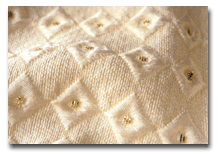
A fabric from Mantero-Seta’s Autumn/Winter 2003-04 collection. In the wool sector, Scottish weaver Johnstons of Elgin showed rustic, textured coatings that reverse from tweed to check. The look is harsh and raspy, and the touch is ultra-soft, woven of 100-percent cashmere. There are cashmere/Lycra® blends and cashmere that resembles denim in this line. With the price of cashmere down, double cloths are selling well for unlined jackets.John Gillespie, design director, Johnstons of Elgin, said authentic estate tweeds originally created for the hunt in the mid-19th century are back in fashion. They are colored to blend with the terrain and camouflage the wearer. Woven of 100-percent pure new wool, these tightly constructed fabrics weigh in at 700 grams per meter and provide protection from rain, cold and wind or an occasional tangle with a gorse bush.At Robert Noble, part of the Yorklyde Group, designer Gil Cable said a lot of its traditional tweeds have been Teflon®-coated and backed for use in handbags and luggage. Coach Leather is a name she mentioned. There are honeycombs with high/low surfaces, coatings woven using color-mixed plied yarns, and sophisticated brushed classics dyed in animal hair colors.CalzeatandCo. Ltd., another Scottish weaver, has traditional checks and tartans with jacquard overlays. There are Prince of Wales checks with floral patterns woven using bouclarns, big checks with mini-houndstooth overlays and tartans with twining leaves and flowers. Techno Wools From ItalyItalian wool weavers have diversified. Several have opened new divisions for a broader market reach. At the top, Loro Piana S.p.A., specialists in cashmere and merino wool fabrics, has a techno range for sportswear. There are waterproof, breathable cashmere coatings with a thin membrane adhered to the fabric. One new fabric, a blend of 70-percent merino wool and 30-percent nylon, has the touch of nylon taffeta. It has been selected by Team New Zealand for the 2003 Americas Cup races.At Picchi S.p.A., a new division called Filopuro has fine, stretch worsteds for the suit and casual sportswear markets. Jacquard and novelty brocades are other best-sellers. Double cloths with a rustic look, reversing from flannel to sherpa, also were pointed out.Franco Miliotti of Milior S.p.A. said anything with a luxury look and warm finish is selling. Winter stretch cottons, cotton/wool and cotton/wool/Lycra cavalry twills and ribs with heavenly, brushed surfaces are among the favorites. Special finishes to give a vintage look, delavand transfer prints are other novelties. Corduroy is emerging as another best-seller of the season. Luxury French WoolsFrench wool weavers are into luxury classics that are heavily brushed, reversible and stretch. At De Cathalo S.A., Thomas Brochier, head of the New York office, said cashmere is selling extremely well in the United States, and wool/silk coatings are coming back. There are crinkled surfaces, soft brushed surfaces and shiny aspects in blends of wool/nylon.Carreman is selling stretch denim in a blend of polyester/wool/cotton/Lycra. There are rustic weaves in cotton/wool, easy-care wool blends and a lot of stretch in this line.Isoule Textile has a group of worsted wool/silk blends that look like tussah silk and have a dry silk touch. There are thick, lightweight boiled tweed-look wools woven with twisted yarns; and Chanel-type tweeds in multi-fiber blends.Novelty tweeds are a specialty of AJM France. Irregular, thick, multi-colored yarns have been loosely woven into supple twills and box-weave tweeds. Some fabrics have been brushed and flattened. There are subtle metallic touches, boucl#44; slubs and pigtails.Master of fantasy Malhia is the originator of tweeds for Chanel. For Fall, they are knitted or woven using thick, lightweight, shaggy yarns. There are open patterns with touches of metal, hairy fringes, ropy textures and sequins. Intricate KnitsThe Italian knit company Marioboselli Jersey has two collections of knitted fabrics: Top, which specializes in luxury and natural fibers; and Two, a younger line that is competitively priced. Cashmere is used alone or blended with cotton or silk in the Top line. Some fabrics contain Lycra. There are jacquards, burn-outs, lacy looks, double-faced cloques and hand-painted velours.
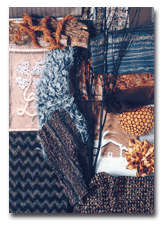
Fall/Winter 2003-04 fabric selectionfrom United Kingdom-based mills.Two of the best-selling fabrics at Italian knitter Mabu Jersey contain cotton. One is a ribbed jacket-weight fabric finished to have a warm hand. The other is a double-faced fabric with cotton piqueversing to micro Tactel® flannel. There are wool/cashmere blends, double cloths of wool/silk, micro jacquards knitted using wool/nylon/Lurex, cloques of micromodal/Lycra, and silky/matte fabrics knitted using double mercerized yarns.French knitter Billon Frs is showing sueded knits that are pigment-printed, heat-transfer printed or embossed. One pattern of note is a patchwork of faded mosaics. Another is a mottled leaf design, and a third is a distressed jeans look. At Welbeck Fabrics Ltd., now part of the Farago Group, England, a lot of the fabrics that have been designed for intimate apparel are going into outerwear. Airpak®, a three-layered fabric with a cushion center, and Aphrodite, a knit that simulates the look of bonded fabric, are selling for molded bra cups, robes and sport jackets. Innovations For SportswearTreatments and techniques with denim continue to hold center stage. French technical fabric producer Griffine Enduction is showing polyurethane-coated denim that can support stone washing. Another fabric is double-faced, with fleece reversing to a crinkled leather look.At Nappel, Spain, there are washed denims that have been polyurethane-coated and bonded to fleece. Some look like vintage denim. Other fabrics resemble aged leather. Moleskin/fleece reversibles and heavily brushed twills with a velvet look in cotton/Lycra are best-sellers.Along with denim, corduroy sales are on the rise. Germany-based CordandVelveton GmbH sells stretch and non-stretch corduroy, both greige and finished. Currently the womenswear market is buying baby cord weft stretch. Childrenswear is into ribless and wide wales. Six wale is selling to menswear.The Swiss firm Schoeller Textil AG continues to develop high-tech outerwear fabrics for rugged sports and industrial end-uses. Popular this season are two-layered fabrics that stretch, breathe and are water-resistant. There are ultra-light and strong transparent fabrics in a blend of 75-percent nylon/25-percent elastane.The Spanish firm AGB Textil S.A. has a diverse line of fabrics for casualwear. There is Tencel®/cotton/Lycra corduroy that is cross-dyed and has a washed look. Ultra-lightweight shirting fabrics in cotton/Lycra have a crushed finish. There are Tencel/cotton moleskin, wool blends with four-way stretch, jacquards with a vintage look, and a lot of surface interest through laser cutouts, eyelet patterns and crinkling.At Milag S.A. of France, denim is stone-washed, coated, printed, double-faced, stretch and sanded. Some denim is touched with metallic, puff-printed, or coated to resemble sequins. Printed FabricsFrank Iovino, head of the Miroglio office in New York, said corduroy printed with old-fashioned florals is starting to sell. Velvet and sueded fabrics are of note. Monotones, fractured designs with a blurred or worn look, misted paisleys, veined leaves, Missoni-type stripes, animal skin patterns and romantic florals are among the popular themes.The Spanish firm La Industrial Sedera S.A. has fractured patterns on top of glen checks, mixes of paisleys with animal skins, patchworks and burn-outs. There are double-faced jacquards, cotton stretch and metallics in this line. Best-selling colors are brown, black and eggplant.At the French firm Chaine et Trame, a lot of sales to the United States are going to private label manufacturers and retail design departments. Best-selling base fabrics are nylon, lace, spun rayon crepe with a dry hand, etamine, georgette, sheer knits and pannelvet. Mosaic patterns are of special interest. The Silk SectorFantasy is selling, said Frans Damide, who heads the US divisions of two French companies, Solstiss and Bucol. At Solstiss, a new division called Embeliss has fabrics designed in New York and made abroad. Adornments and embellishments are applied to silk taffeta and burn-out velvet along with lace. There are sequins of all sizes, beads, loops, dangles and crystal drops used together.At Bucol, there are influences from the 1930s, with tarnished gold jacquards and feather fringe stripes in zig-zag patterns. There are disco flowers and twining vines, small leaf designs and warp-printed paisleys.French silk weaver Bianchini Fer showed iridescent mousseline in faded colors, large blurred abstract prints and wavy designs. When the fabrics move, the colors change.There is a lot of novelty and fantasy in Weisbrod-Zuerrers Fall line. Each fabric is woven and embellished with a lot of different techniques. There are pleated stretch jacquards; puckered tweeds with fleece stripes; Lurex in tartan patterns applied over paisley and flower designs; plissthat are pressed with metallic; laser cutouts on double-woven crushed taffeta; patchwork tweeds embroidered with buttons, sequins or raffia; and a lot more.Donatella Ratti of the family-owned Italian silk weaver Ratti pointed out three directions that are especially popular. One is soft and inspired by nature, with traditional flowers printed on cotton velvet and silk satin. Another has an ethnic theme with large, stylized floral designs. The third is called Modern Kimono, with optic and graphic patterns combined with chrysanthemums. The look of denim has been printed and sometimes overprinted with flowers. Another Italian silk producer, Mantero Seta S.p.A., is showing one line developed for haute couture and another that is more competitively priced. The Stile line has jacquards and tweeds with a vintage look. They are woven with silk and wool.First-time exhibitor Kimura Senko Co. Ltd. of Japan showed a diverse line. Printed silk jersey is appliquwith rice paper. Scratched denim with a frayed look is glued to nylon stretch tulle. One fabric, called Shooted Denim, looks as if it has been randomly hit with buckshot. Boiled, felted wool with pressed-in patterns is bulky and extremely lightweight. The next Premiere Vision will be held in Paris, February 12-15, 2003. European Preview will take place in New York City, January 23-24, 2003.December 2002
Tajima Machines Receive Safety Approval
Tajima Machines Receive Safety ApprovalFranklin Lakes, N.J.-based Tajima America Corp.’s TFHX series of 2-, 4-, 6- and 8-head bridge-type embroidery machines, assembled by Tajima U.S.A., has earned ETL approval from Underwriters Laboratories Inc., Northbrook, Ill. The embroidery machines, which meet the standards of UL 1;~94 and CSA 68, now are able to bear ETL markings.According to Tajima, the TFHX series is the only ETL-approved embroidery machine on the market. The company plans eventually to have all of its machines ETL-approved. December 2002



