Weaving At ShanghaiTex


W
ith sales in Asia growing, many weaving companies are reaching out to China and
establishing divisions or distribution points in various regions of the country. In addition,
attendance at local exhibitions is more important than ever before. At the recent 10th
International Exhibition On Textile Industry, or ShanghaiTex as it is more commonly known, many
weaving machine companies displayed their latest-generation machines to the Asian market.

Some held openings for new divisions, including the ITEMA Group – parent company of
Italy-based Promatech S.p.A. and Switzerland-based Sultex Ltd. – which recently established ITEMA
(Shanghai) Textile Machinery Co. Ltd.
(See ”
ITEMA
Opens Shanghai Operation
,”
TW, January, 2004)
.

This new ITEMA facility will become the center of Promatech and Sultex sales and after-sales
activities in the region. The company made an initial investment of 10 million euros and will
produce 2,000 looms per year. The new site allows for expansion in both office and production space
when warranted.

sulzer_Copy
Sultex Ltd. demonstrated a 3.9-meter-wide P7300 projectile weaving machine at
ShanghaiTex.


Dornier Opens Shanghai Operations


Cheers erupted when Peter D. Dornier, managing director of Germany-based Lindauer Dornier
GmbH, handed a meticulously decorated cow bell – a reference to Dornier’s proximity to the Alps –
to Franz Miesbauer, sales manager of the newly opened Dornier Machinery (Shanghai) Co. Ltd. The
crowd, which included Dornier executives and representatives from the company’s clients and
vendors, as well as members of the press, gathered to celebrate the opening of Dornier’s new
subsidiary in China, located on the outskirts of Shanghai at the Wai Gao Qiao Tax Free Zone.

With China generating almost 18 percent of Dornier’s global business, the new Chinese
operation will play a key role in bringing the company closer to one of its fastest-growing
customer bases. The new facility will house, under one roof, a spare-parts warehouse, training
facilities, a 760-square-meter test weaving shop, and distribution and service facilities for
specialized machine construction.

“With the new facility, we can provide really good service to customers in the Chinese and
East Asian markets,” said Egon Wirth, marketing communication manager. “The test weaving room for
rapier and air-jet machines makes decision-making easier for our customers.”

The office in Shanghai, which replaces the company’s facility in Beijing, has 15 employees
now engaged in both sales and technical capacities. However, Wirth expects the number to grow very
soon. “First, we want to see how it goes, but we expect the number of technical people to
increase,” he said. Wirth also noted that the local employees will be training with their European
peers to ensure that the service the company provides is the same everywhere around the world.
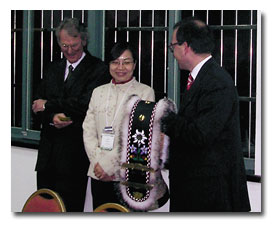
dornierbell
Left to right: Egon Wirth, marketing communication manager, Lindauer Dornier; Linda H. M.
Lai, general manager, Dornier Machinery (Shanghai) Co. Ltd.; and Peter D. Dornier, managing
director, Lindauer Dornier, celebrate the opening of Dornier’s new subsidiary in China.


Tsudakoma Unveils New Concept Loom


Japan-based Tsudakoma Corp.’s big presence at ShanghaiTex was matched by the constant crowd
gathered around its three main attractions: the ZW408 water-jet loom, the ZAX-N (Navi) air-jet loom
and the yet-to-be-named air-jet concept model.

The ZW408 is the company’s widest water-jet loom to date. With three nozzles, it is capable
of weaving a wide range of fabrics, from general apparel fabrics to thick, value-added fabrics to
double fabrics. The unit at the show was set up to weave curtain fabrics. The machine runs at 800
revolutions per minute (rpm).

Originally scheduled to make its first appearance during ITMA 2003, Tsudakoma’s newest model
– the ZAX-N air-jet loom equipped with the Weave Navigation System – had its first public showing
at ShanghaiTex. Takeshi Kokura, deputy general manager of the sales department, said the loom is
designed for denim and runs at a speed of 1,000 picks per minute (ppm). The Weave Navigation System
has a new algorithm that automates settings and monitors looms in operation for the best weaving
conditions. Other new features of the ZAX-N include completely new electrical components, as well
as a land-area network for networking with a host computer.

The concept air-jet loom, shipped directly from the company lab to the show floor,
represents Tsudakoma’s next-generation products. Features of the loom include high productivity
(1,900 ppm), low energy consumption and versatility. “We want people to see what point we are
aiming at and toward what direction we are developing [our products],” Kokura said.
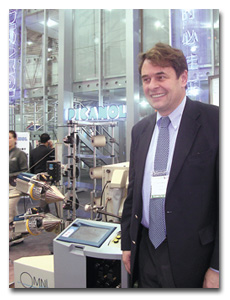
picanolguy
Patrick Steverlynck, chairman of Picanol’s Board of Directors, poses with the
OMNIplus-2-P280 air-jet weaving machine on display at ShanghaiTex.


Picanol Group Continues Growth In Asia


Belgium-based Picanol NV is no stranger to the Asian market’s demand for advanced weaving
technology. With the recent announcement of a memorandum of understanding with the Vietnam-based 8
March Textile Co. for 150 weaving machines, last summer’s celebration of the manufacture of the
10,000th OMNIplus air-jet weaving machine – sold to Chinese customer Jiangxi – and the sale of 126
rapier weaving machines last December to Vietnam-based Vinatex, Picanol continues to expand its
presence in that marketplace.

“We are looking to the Chinese market to understand its needs,” said Patrick Steverlynck,
chairman. “An emerging-style machine for an emerging market. China is estimated to have 200 rapier
loom manufacturers with approximately 30 high-technology (300-400 ppm) [manufacturers], and an
additional five water-jet and five air-jet [manufacturers] of reasonably high-technology [looms].”

But Picanol’s interest goes beyond sales analysis. It established Picanol of China, which
has offices in Beijing and Guangzhou, in 1992, and a technical service station in Shanghai.
Additionally, Picanol has established Picanol Korea and Picanol Turkey to grow and support the
region.

“China and Asia are growing,” said Steverlynck, “but we at Picanol believe in a world
market, and the whole situation will develop a commercial balance over time. This is the middle of
a growing process. The machinery today reflects the execution of today’s technology – as
intellectual property protection improves, more technology will follow, and more companies will
invest in new ideas.”

Picanol adheres to a strategy based on the three pillars of systems, services and
technology. Picanol has some 80,000 individual weaving machines in 2,600 weaving mills worldwide.


ShanghaiTex A

Resounding Success For Sultex


Sultex sold a number of projectile and rapier weaving machines at the show. According to R.
Feucht, sales division manager for Asia and the Pacific region, from its beginnings as a regional
show, ShanghaiTex has become an international show. Sultex had the opportunity to make contact with
key decision makers in China and other Asian regions and expects future business in that area of
the world.

Sultex displayed its Sulzer Textil P7300 projectile weaving machine weaving a dense cotton
twill fabric at a weft insertion rate of 1,250 meters per minute. The company says the machine is
flexible and capable of weaving a wide variety of fabric types.

The company also presented its G6200E rapier machine, which is geared towards technical and
industrial fabrics including air bags. The machine, also suitable for producing apparel and
decorative fabrics, was shown weaving a fine menswear worsted fabric at a speed of 600 rpm.

(Editor In Chief Jim Borneman, Senior Editor Carmen Pang and Managing Editor Rachael Dunn
contributed to this feature.)

March 2004

DAK Introduces DelCron HydroPur

Combining the benefits of its antimicrobial SteriPur® AM fiber with its moisture-management
Delcron® Hydrotec fiber, Charlotte-based DAK Americas LLC has created Delcron HydroPur, a new
antimicrobial, moisture-management staple polyester fiber.

“Combining moisture-management and antimicrobial properties creates endless opportunities to
improve the existing products, as well as to create new and exciting offerings,” said Jim Netzel,
marketing director, DAK Fibers.

Spartanburg-based Milliken & Companys AlphaSan®, a silver-containing zirconium
phosphate-based ion exchange resin, provides antimicrobial properties to DAK’s Delcron HydroPur.

DAK claims both the antimicrobial and moisture-management properties are durable and will
perform safely for the life of the product.

March 2004

Sun Chemical Upgrades BPM Solution

Fort Lee, N.J.-based Sun Chemical Corp. recently upgraded its business performance management (BPM)
solution to the Cartesis Magnitude BPM solution supplied by Paris-based Cartesis. The printing inks
and coatings manufacturer decided to implement the updated version to better streamline and
automate its financial reporting, consolidation and planning processes.

“Cartesis Magnitude allows Sun Chemical to collect, consolidate and deliver more data
faster,” according to Jim Kelly, manager, financial reporting and analysis, Sun Chemical. Kelly
added that the new solution uses automated control features to validate data before Sun Chemical
receives it, and then stores it in a single repository.

March 2004

US Signs Trade Pact With The Dominican Republic

A US/ Dominican Republic free trade agreement signed March 15 has been met by a mixed reaction from
textile and apparel importers and domestic manufacturers. US Trade Representative Robert B.
Zoellick praised the pact as a historic and comprehensive free trade agreement. He said it phases
out tariffs and strips away non-tariff barriers, and is expected to open new markets for a variety
of products when it is incorporated into the recently negotiated Central American Free Trade
Agreement (CAFTA) with Costa Rica, El Salvador, Guatemala, Honduras and Nicaragua. Zoellick said,
We are enhancing a cutting edge, modern free trade agreement between the United States and Central
America by expanding the circle of friends and neighbors who have agreed to tear down the tariff
walls that block trade.

Kevin M. Burke, president and CEO of the American Apparel and Footwear Association,
enthusiastically endorsed the agreement, saying the combined agreement, once approved by Congress,
will help US apparel and footwear companies strengthen their ties in this hemisphere and diversify
their sourcing strategies. He said US textile manufacturers will benefit from the pact because it
involved countries that predominately use US fabric and yarn. He said this will help them compete
against Asian nations.

US textile manufacturers, however, were not so excited by the agreement, and they are likely
to oppose it as they are opposed to CAFTA. While the Dominican Republic agreement and CAFTA have a
yarn forward rule of origin, it also permits what trade officials call cumulation that allows
Mexican and Canadian inputs, as well as those from Caribbean nations. US manufacturers would like
inputs to be confined to the direct participants in agreements.

Congressional approval of CAFTA and any other free trade agreements certainly is problematic,
as trade-related job losses become an increasingly contentious issue in this election year.

 
March 2004

Tri-Tex Opens North Carolina Facility

Montreal-based Tri-Tex Co. Inc., a producer of chemicals, dyes and pigments for the textile, paper,
leather, plastic, coatings, graphic arts and flooring industries, has expanded its North American
operations with the recent opening of Tri-Tex USA Inc. in Monroe, N.C. The company also has
locations in Los Angeles and Puebla, Mexico.

“Our investment in North Carolina is part of our growth strategy in the USA,” said Naim
Laham, CEO. “We have an excellent basis in North America and our aim now is to expand our
leadership.”

March 2004

FIT Licenses Cargill Dow’s INGEO™ Technology

Johnson City, Tenn.-based Fiber Innovation Technology (F.I.T.) Inc. has signed a master license
agreement with Cargill Dow LLC, Minnetonka, Minn., which gives F.I.T. permission to produce and
market Cargill Dow’s INGEO fiber in the United States and parts of Asia.

Front row (left to right): Snehal Desai, Cargill Dow; and Frank Harris, Cha Technologies

Back row (left to right): Vann Brown, Cargill Dow; Brad Willingham, F.I.T.; and Jeff Dugan,
F.I.T.

F.I.T., a Cha Technologies company, becomes the first manufacturer in North America to sign
such an agreement with Cargill Dow. “We value our role as a leader in delivering specialty fibers
that hold great value for current and future applications,” said Frank Harris, CEO and president,
Cha Technologies. “We believe that Ingeo fibers hold great promise with their unique combination of
synthetic properties and natural origin.

March 2004

Increasing Hemisphere-Based Trade


I
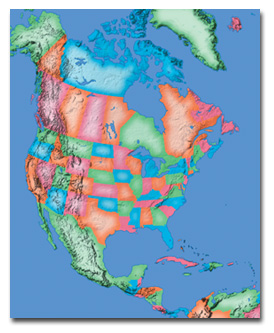
n late December 2003, the Bush administration concluded talks on the Central American
Free Trade Agreement (CAFTA) with Honduras, El Salvador, Nicaragua and Guatemala. The on-line
newspaper Honduras This Week (12/22/03) reported: “[A]t the last minute, Costa Rica withdrew from
the negotiations, meaning the [Costa Ricans] will have to negotiate on their own next year. … The
event is considered by Washington [to be] a step towards the creation of a free trade zone in the
Americas. … It is foreseen that the presidents of the region will sign the agreement in April and
that the White House [will send it] to Congress for [approval] before July, to avoid the process
[being] politicized by the upcoming November 2004 elections.”

northamerica

Congress granted the president trade promotion authority (TPA), commonly known as fast track
authority, in August 2002. TPA permits the executive to negotiate trade agreements with nations and
submit them to Congress only for an up or down vote; i.e., as is, no changes. Long denied to
President Clinton, TPA has encouraged the current administration to pursue a free trade agenda in
the Western Hemisphere, creating North American Free Trade Agreement (NAFTA)-like preferences with
all Western Hemisphere countries. On Aug. 1, 2002, President Bush announced: “With TPA, we will
open markets to create high-paying jobs and provide new opportunities for America’s farmers and
workers. I thank the House and Senate for passing TPA so that we can work together to advance
America’s free trade agenda [and] promote prosperity in the United States, progress in our
hemisphere and freedom throughout the world.” With the authority in hand, the administration has
focused on opening Central and South American markets, leading to a Free Trade Area of the Americas
(FTAA). Like it or not, the current administration is bent on increased trade. It is combining the
theories that the rising tide lifts all boats and, that manufacturing, in order to be competitive,
needs to chase lowest-wage-cost economies. In so doing, the administration appears determined to
trade manufacturing jobs for increased opportunities for US companies to export technology and
knowledge. “Fair” probably is not in the lexicon; “free” is, and one at a time, jobs in low-wage
industries will be outsourced to countries with lower-labor-cost competitive/advantaged economies.

The steel industry recently learned a harsh lesson. Granted protective tariffs in early
2002, steel promised to upgrade to a world-class industry. The promise probably was hollow
-designed to allow steel producers to dress up poor income statements, balance sheets and stock
prices. The threat of European Union sanctions under World Trade Organization (WTO) rules likely
sandbagged the duties from day one. The results  were protective tariffs on steel, and the
elimination of a number of steel industry jobs sacrificed on the political altar of trade.
Objectors to FTAA likely will face the same results.

Given that the political climate favors free trade, and the Senate is expected to endorse
CAFTA, it’s time to look at the region that now is receiving recognition. In order to understand
it, a number of questions need to be answered: How big is it? How big is the textile portion? What
opportunities exist for current North American fiber and fabric manufacturers? Is there a
possibility for fiber expansion as the region “grows,” based on more open trade with the United
States? What is the fiber business in South America? Are labor rates world-competitive? And what
kind of market are we now asked to service and participate in?


The Economies


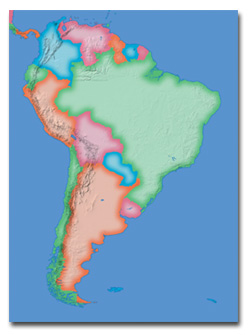
Just as the United States is not a single, massive economy, South America is not a monolith.
The continent is characterized by both developed and underdeveloped nations, with significant
differences between the areas. Historically, Brazil, Argentina and Chile have been regarded as the
most-developed economies, with conditions in the remaining countries ranging from abject poverty to
verging on developing. It is reported that poverty affects less than 5 percent of the populations
in Chile, Brazil and Argentina, while most of the remaining South American countries face poverty
levels in the 15+ percent arena. This seems to suggest no lack of available labor. Trained and
educated labor is another issue, but it probably is fair to say that with local government
assistance, “trainable in time” is applicable.

Investor confidence in Latin America was dealt a blow by Argentina’s recent economic crisis.
According to worldinformation.com, net external capital flight totaled 18 percent of Argentina’s
gross domestic product. This represented 50 percent of the region’s net capital outflow and had a
disastrous effect on the overall economic performance of the continent. Argentina’s relationships
with Uruguay, Brazil and Chile were injured through common membership in the regional Mercusor
trade bloc. Brazil and Venezuela suffered political unrest – the former through election of a
left-wing president and government, according to worldinformation.com. The latter, Venezuela,
experienced continuing confrontations between the government and opposition forces, which led to
severe cuts in oil output and a lengthy 2002 year-ending general strike.

It is clear that political and currency risks abound in South America. However, are textiles
better off by hunkering down in the United States to be eroded gradually by expanding trade
policies, or should the industry undertake harsher measures, including changes in traditional
business methods? Alliances/ownerships/development consortia are needed. If US firms do not open
South American markets, it is likely that European competitors will lock up the distribution
through NAFTA-like arrangements, most of which will not favor US interests.

southamerica


Fiber Consumption


As noted previously in

Textile World
, fiber consumption in the mills of South America totaled slightly more than 5.3 billion
pounds in 2001
(See ”
Fiber’s
Fast Track
,”
TW, September 2002)
. Economic distress in several nations drove down 2002
consumption to approximately 5.1 billion pounds, as political unrest and a hangover from 2000-01
continued to take a toll. Of 2002’s total consumption, approximately 52 percent was cotton, 46
percent was man-made fibers and 2 percent was wool. Since 1993, cotton usage has been level at
approximately 2.6 billion pounds, while man-made fibers enjoyed all the area’s consumption growth,
expanding 37 percent to 2.3 billion pounds in 2002. Per capita use dropped to slightly under 15
pounds for the year as total consumption fell. Considering that US per capita consumption remains
in the 80-pound range, opportunities for growth seem extraordinary. A 20-percent increase in
consumption from 15 to 18 pounds per capita would mean increased continental consumption of almost
1 billion pounds.

Regional fiber consumption mirrors politics. The historical participants – Chile, Venezuela
and Colombia – still are active, but now they are shadowed by major fabric-forming investments in
Argentina and Brazil. Peru, Ecuador and Uruguay bring up the rear with small textile industries.
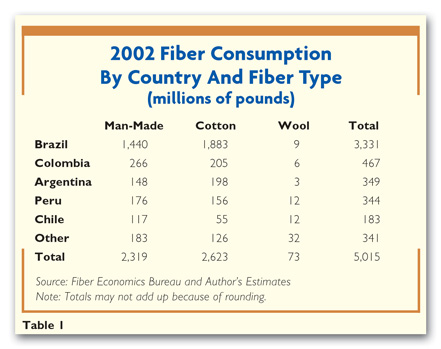
Virtually all of the fiber consumption decrease in 2002  fell at the lap of Argentina, whose
usage fell 6 percent from 2001 levels – which represented a 33-percent drop in the decade
(See Table 1).

Obviously, Brazil is the 800-pound gorilla in South American fiber consumption. The
importance of cotton is apparent, and the growth potential for man-mades is unstated. The focus is
on apparel to utilize the relatively inexpensive labor available in many South American nations.
However, the future of South American expansion relies heavily upon foreign investment. Despite
defining themselves as industrialized, Argentina, Chile and Brazil do not generate sufficient
investment capital to develop their neighboring states. For example, according to
worldinformation.com, in 2002, “Capital flight and poor external markets combined with increased
political risk [dragged down] the region’s prospects. The GDP of [the area] contracted by 0.5
percent … inflation rose to 12 percent, double that of 2001. … Real wages fell 1.5 percent
while unemployment increased to 9.1 percent. … Non-oil economies were hit further by high oil
prices, leading to a severe deterioration in the region’s … trade. … At the same time, capital
flight saw nearly $40 billion drained out of the regional econom[ies] … leaving [highly
vulnerable economies] little room to manoeuvre [trade] policy.”

fiberchart


The Answer


What are America’s strengths? Investment, ideas and a willingness to take risks. What are
manufacturing America’s weaknesses? High wages vis-à-vis the levels in developing economies,
increasing social costs for employees and the environment, and a government obviously intent on
finalizing the conversion of the economy from a manufacturing base to a knowledge base. Long-term,
these goals likely would result anyway from natural long-term economic forces. NAFTA, the WTO and
CAFTA merely are accelerating the natural trend of industrialized economies to push services and
knowledge at the expense of manufacturing.

Given that public policy is pushing away manufacturing, what is the textile industry to do?
Arguably, NAFTA has been successful in helping Mexico develop a consuming middle class. It appears
that the increasing tide of trade did raise many, if not all, boats. It can be argued that much of
the last five years of restructuring in the US fiber industry was facilitated by Mexican
involvement. If Mexico, with 100 million people, can impact NAFTA that much, imagine what a
consortium of South American textile and fiber manufacturers can do under FTAA, fueled by US
technology and access to capital, as well as access to the US market with garments and made-up
articles assembled by relatively low-wage, currently poverty-stricken workers in the South American
continent.

It is doubtful that CAFTA will pass the Senate with ease. The current political silly season
virtually guarantees a battle over CAFTA. Based on the chastising received from the WTO on steel,
however, it is doubtful the administration will fold. Its stance on trade is too strong, and the
Bush dream of FTAA verges on a legacy accomplishment. Can textiles find partners below the equator?
The US textile industry has a risk-laden history. Can it – will it – investigate spreading the risk
further south to begin the industry’s transformation into a truly global enterprise?

Carly Fiorina, CEO of Hewlett Packard, recently talked of jobs: “There is no job that is
America’s given right. We have to compete for jobs.” Is the textile industry competing for jobs? It
is clear no textile job is a given right; can the odds be improved by investing time and
intellectual and investment capital in a region that is likely to become the next NAFTA-like
incarnation?


March 2004

Honeywell Increases DSP Production

Honeywell International, Morris Township, N.J., has announced a plant expansion at its Kaiping,
China, facility to double production of its dimensionally stable polyester (DSP®). The expansion is
scheduled to be completed later this year.

DSP yarns and fibers produced at the plant are used in tire reinforcement, as well as in
other industrial and consumer applications.

“As the only polyester fiber supplier with manufacturing facilities in Asia, Europe and North
America, we continue to make investments in technology to meet the needs of our customers, wherever
they are located,” said Greg Rogowski, general manager, performance fibers.

March 2004

Interpolymer Offers Low-pH Agents For Carpet Cleaning

Interpolymer Corp., a Canton, Mass.-based specialty polymers producer, has developed Syntran® 4022,
a low-molecular-weight sodium acrylate solution polymer, and Syntran 4020, a high-molecular-weight
emulsion polymer, for use in carpet-cleaning products containing peroxide. Syntran 4022 is a low-pH
soil-suspension agent that helps loosen and remove dirt particles. Syntran 4020 is a low-pH
embrittling agent that helps remove dirt during vacuuming of a carpet following shampooing and
drying.

March 2004

Picanol Garners Orders From Companies In Russia

Belgium-based Picanol NV recently secured orders from three companies in Russia for a total of 155
weaving machines. The Russian Textiles Alliance has ordered 100 OMNIplus and 10 TERRYplus weaving
machines. Shujskie Sitsy Cotton Mills has ordered 40 OMNIplus weaving machines, and Promtextile has
ordered five GamMax weaving machines.

According to Picanol, the order from the Russian Textiles Alliance represents the
largest-single Russian contract with a Western weaving machine company since Perestroika was
implemented. The first 45 weaving machines were shipped in February, with the remainder to be
delivered by September. The alliance will use the Picanol machines at several mills located in the
Russian Federation and Kazakhstan.

March 2004

Sponsors