Saint-Gobain, Hongfa Form Joint Venture

The Reinforcements Division of France-based Saint-Gobain has entered into an 80/20 agreement with
HongFa Co., China, for the creation of Saint-Gobain Technical Fabrics HongFa (Changzhou). The joint
company will provide technical fabrics at competitive prices to the Asian market. According to
Saint-Gobain, HongFa’s composite and geotextile products sales and marketing abilities and its
knowledge of the Chinese market made the company a good fit with Saint-Gobain’s technical
capabilities and global reach.

April 2004

Democrats Urge Bush To Break Down Trade Barriers

The top leadership of the US House of Representatives has urged president Bush to take immediate
action to address overseas trade barriers standing in the way of a wide range of US exports
including textiles and apparel. A sharply worded letter signed by all 10 leaders of the Democrats
in the House says:”It is not enough simply to sign a trade agreement and move on to negotiating the
next one. To restore credibility to the trading system, agreements have to be enforced.”

The letter was a response to release of the annual National Trade Estimates report on trade
barriers to US exports of goods and services, investments and intellectual property rights. The
letter says the US Trade Representative (UStr) has carefully documented problems, but has taken no
action to redress or eliminate them.

Each year the report documents a variety of tariff and non-tariff barriers used by other
countries to protect their markets. Those where textiles and apparel are affected include China,
India, Bangladesh, Pakistan, South Korea, Taiwan among others.

“After the loss of almost 3 million manufacturing jobs since January 2001, and the growing
problem of outsourcing the services sector, it is time to stop taking inventory and time to start
producing results for American workers, farmers and businesses,” the letter says. “In the three
years that the Bush administration has been in office, the USTR has brought an average of fewer
that three cases per year to the World Trade Organization (WTO), while the Clinton Administration
brought approximately 10 cases per year.”

The letter comes down hard on China, charging that its trading rights and distribution rights
effectively bar imports that compete with Chinese goods, and it urges the administration to take
immediate action under the WTO’s dispute system to ensure that China complies with its WTO
commitments. The Democratic leadership also singles out India because of its $9 billion textile and
apparel trade surplus with the United States. They charge that India is one of the most protected
markets in the world, that Indias barriers to textile trade have been identified for three years
running, and that no action has been taken.

The congressional leaders said they plan to introduce legislation to revive a key tool of the
US law used in the past that would require the UStr to prioritize dealing with overseas trade
barriers.


April 2004

National Spinning Opens Sweater Facility In El Salvador

Leveraging the yarn-forward rules of the Caribbean Basin Trade Partnership Act, Washington,
N.C.-based National Spinning Co. has opened a new sweater manufacturing operation in the Miramar
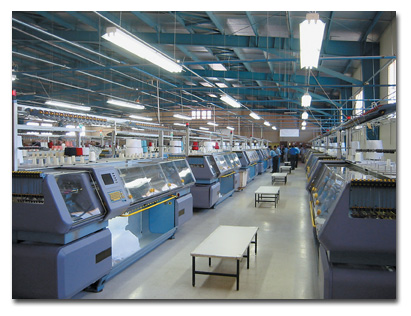
Free Zone in El Salvador. Fuenta de Ropa de las Americas (FRASA) will utilize a new installation of
H.Stoll GmbH & Co. flat-bed knitting machines and Jumberca circular knitting machines to
provide sweater packages to a variety of customers in the United States. James W. Chesnutt,
National Spinning president and CEO, stated the objectives of the new company are to provide a knit
product at the quality, price and timeliness demanded by the company’s sweater jobber and ladies
apparel customers.

“We began this process by meeting with 14 sweater jobber clients and four ladies apparel
suppliers,” he said. They had a growing dissatisfaction with imported garments and were seeking
alternate supply. This operation will allow us to not only use our acrylic yarn spun and dyed in
the United States, but also will enable us to source other US yarn, including cotton yarns.”

nationalspinning
H. Stoll flat-bed knitting machines have been installed at National Spinning’s new sweater
facility in El Salvador.


Photograph courtesy of Mike Todaro, American Apparel Producers Network

Regarding the new operation, Chesnutt spoke highly of Bill Wilson, vice president, apparel
marketing and sales, FRASA. Wilson brings his past experience in El Salvador, as well as in
logistics, quality and production management to FRASA.

“I can’t say enough about the folks at PROESA [El Salvadors investment promotion agency] as
well. Patricia Figueroa [executive director] and her team really helped with the decision to locate
in El Salvador,” Chesnutt said. We are talking about making 300,000 to 500,000 sweaters out of US
yarn that previously were made in China. That is good for the United States and good for the
hemisphere.”

The apparel division operates under Matt Rauschenbach, president, who brings 20 years of
experience to the position. He is based out of National Spinning’s headquarters. Stuart Mays,
formerly with Beldoch Industries, manages the El Salvador facility.

April 2004

Cerberus To Acquire Guilford Mills

An affiliate of New York City-based Cerberus Capital Management LP has made a cash tender offer
valued at $107 million to acquire Guilford Mills Inc., Greensboro, N.C., an engineered automotive,
technical and apparel fabrics producer. According to terms of an agreement approved by Guilford’s
Board of Directors, Cerberus has offered to pay $19 per share for all outstanding Guilford shares.
The deal is expected to be completed by the end of this quarter.

Guilford emerged from bankruptcy in late 2002. Last fall, the company retained Goldman Sachs
& Co., New York City, to help it explore strategies, including possible sale of the company, to
maximize shareholder value.

Following the acquisition, the Cerberus affiliate will merge with Guilford Mills, and
Guilford’s current management will continue.


Guilford Mills’s product offerings include automotive fabrics.

“I’m very excited to see Guilford placed in the hands of people who share our vision for
building this company,” said John A. Emrich, president and CEO. “They believe in this company and
our operations, and they fully support our plans for growth.

April 2004

Donaldson, PGI Cooperate On Filter Bag Media

The Donaldson Co. Inc., Minneapolis, has teamed up with North Charleston, S.C.-based Polymer Group
Inc. (PGI) for the production of industrial filter bag media.

PGI’s Durapex nonwoven fabric, made using PGI’s APEX® process, will be used by Donaldson
Torit® in its line of first fit and replacement baghouses.

Durapex was designed to meet the Environmental Protection Agencys Air Quality Standard, which
specifies a 2.5-micrometer particulate matter limit.

“Teaming up with PGI enables us to deliver industrial air filtration solutions that offer
superior value to our customers,” said Steve Groves, global product director, Donaldson Torit.

April 2004

UCO-LDC Establishes UCO Performance Fabrics

Belgium-based UCO-LDC NV has established a new business unit, UCO Performance Fabrics, to handle
its industrial fabrics products. UCO-LDC, part of the UCO-Textiles Group, produces man-made fashion
fabrics and industrial fabrics. However, the success of its industrial product lines and the need
for a clear product identity led the company to create the new industrial fabrics business unit.
According to the company, UCO Performance Fabrics still will benefit from UCO’s experience,
investment and research capabilities, but will be able to offer improved customer service and
fabrics engineered for customers specific requirements. Products manufactured by UCO Performance
Fabrics include flame-retardant, medical, industrial and outdoor application fabrics.

April 2004

Fifield Celebrates 80 Years

Fifield Inc., Hingham, Mass., recently celebrated its 80th anniversary. The company was founded in
1924 by Charles W. Fifield in Gloucester, Mass., as a manufacturer of protective flannel for the
silver industry. Today, it produces flannel, simulated velvet, linen, suede and leather fabrics for
display and packaging.

Fifield and later his son, Richard, ran the company until it was purchased in the 1970s by
then-vice president Randall Martin. Martin’s son, Edwin, is current president. Today, Fifield is an
international company with locations also in Hong Kong, Mexico City and Italy.

April 2004

One-Stop Shopping For Technology


T
extiles and Turkey are interwoven in history. The Silk Road, which Marco Polo so famously
traversed, cuts through parts of the country, which has a long history in textile production.
Today, textiles contribute to about 33 percent of Turkey’s total exports – generating about $10.3
billion in 2001, according to the Export Promotion Center of Turkey’s Undersecretariat of the Prime
Ministry for Foreign Trade (IGEME).

With the availability of good-quality cotton, cotton yarn and fabric production are among the
most important textile activities in modern-day Turkey. According to IGEME, estimated 2001 cotton
yarn production in the country was 893,000 tons, and estimated cotton fabric production was 1,590
million meters. The value of cotton, cotton yarn and cotton fabric exports added up to more than
$840 million that year.
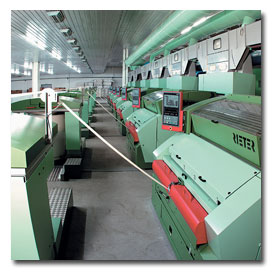
c60
Yumak Iplik’s iPOND spinning complex houses seven Rieter C 60 cards.


A Brand-New Plant


In March 2003, installation of a brand-new spinning plant began in a 15,000-square-meter
covered area in Tekirdag, a city not far from Corlu, one of Turkey’s largest textile centers west
of Istanbul. Yarn production began three months later. Today, the plant employs approximately 80
people and churns out an average of 18 tons of cotton and rayon yarns every day.

The spinning complex, named iPOND, is part of Yumak Iplik Tekstil Sanayi ve Ticaret A.S., a
textile manufacturer headquartered in Istanbul. Yumak Iplik was founded in 2002 by two families
that have been in the textile business for more than 20 years.

iPOND also is the trademark under which the company markets its yarns, which range from Ne 16
to Ne 30 in yarn count. According to the company, the majority of its yarns are sold to Turkish
export knitters. In addition, some of the yarns are used by Yumak Iplik’s new knitting plant, which
was completed in December 2003. The company also plans to add a ring-spinning line to its
operation.


Technology Investments


iPOND may not be the largest spinning mill in Turkey, but it easily is one of the most
advanced in technology installation.

The plant is equipped with an open-end (OE) spinning system made by Switzerland-based Rieter
Machine Works Ltd. According to Melih Günugur Hasircilar, one of Yumak Iplik’s owners, a decision
was made early on to install machinery supplied by one source. “At the time when one first goes
into production, the responsibilities must be clear. A solution with various suppliers would have
meant that we had to find out ourselves which machine had what influence on a production error,”
Hasircilar said. “Thanks to the ‘everything from one source’ solution, we have gained additional
security.”

owner
“A solution with various suppliers would have meant that we had to find out ourselves which
machine had what influence on a production error.”

— Melih Günugur Hasircilar, owner, iPOND


Fiber Preparation


iPOND’s blowroom line includes a Rieter A 11 bale opener, a Rieter B 11 pre-cleaner, two
Rieter B 70 mixing units and two Rieter B 60 fine cleaners with A 20 condensers. In addition, there
are seven Rieter C 60 cards set up in a modular construction to reduce resetting time to a minimum.

According to Rieter, benefits of the C 60 include high production rates and improved quality
and flexibility.

For the drawing process, iPOND decided to use two drawing passages – a Rieter RSB-D 35 draw
frame and a Rieter RSB-D 15 draw frame. According to Rieter, the additional dust removal the RSB-D
provides leads to higher efficiency during spinning. Moreover, the improved parallel alignment of
the fibers results in improved yarn quality and characteristics.


Rotor Spinning


Ten Rieter R 40 OE spinning machines are set up to manufacture yarn packages with diameters
of up to 340 millimeters and weights of up to 5 kilograms. Rotor speeds can reach 150,000
revolutions per minute.

The R 40 uses Rieter’s SC-R spin box, which integrates piecing and package change in a robot
assembly. According to Rieter, an optimized take-off angle facilitates reduction in yarn twist,
while maintaining spinning stability and increasing delivery speed by 5 percent.

All yarns then are conditioned using a Condimat conditioning machine made by Germany-based
Ph. Welker GmbH. A final phase of quality control is conducted under ultraviolet light to detect
foreign fibers.

iPOND also has integrated Rieter’s SPIDERweb mill monitoring system into its production lines
to provide plant personnel with instant access to production and quality data.


Knitting Line


Yumak Iplik recently added a new knitting operation to the iPOND complex. The knitting
operation features VXC-3S circular knitting machines from Monarch Knitting Machinery Corp.

Because the knitting facility is so new, Hasircilar said the company has yet to set any
production capacity or goals for the plant. “It also depends on the economic consumption in Turkey
and in Europe,” he said.

March 2004

Adhesives Research Opens Singapore Technical Center

Adhesives Research Inc., Glen Rock,
Pa., a manufacturer of pressure-sensitive adhesive tapes and specialty coatings, films and laminate
products, has opened a technical center in Singapore to provide support services to its Asian
customers. The new facility is located in the same complex as the company’s Asian sales operation,
Adhesives Research Pte. Ltd.


March 2004

Ciba, Milliken Products Achieve Oeko-Tex Standard

Ciba® Flovan® CGN, Pyrovatex® CP and Pyrovatex CP-LF flame retardant finishes from Ciba Specialty
Chemicals, Switzerland, and textiles treated with them, have qualified for Oeko-Tex Standard 100.
The finishes have been added to Oeko-Texs active chemical substances list.

Designed for cotton and used in protective clothing applications, Pyrovatex CP and CP-LF
finishes are compatible with a variety of other treatments, such as oil- and water-repellent
finishes, and are washfast. Garments made using these finishes can be multifunctional, and they
shrink very little when exposed to heat and flame.

Flovan CGN, designed for wool, cellulose, polyester, polypropylene and polyethylene fibers
and blends used in automotive and decorative fabrics, also is compatible with numerous other
treatments.

The odor-control technology used in Milliken & Company’s VISAEndurance fabric suitable
for activewear, among other applications recently achieved Oeko-Tex Standard 100
certification.

The silver-based inorganic odor-control technology used in Spartanburg-based Milliken &
Company’s VISAEndurance fabric is the first of its kind to achieve Oeko-Tex Standard 100
certification as an accepted active ingredient. The fabric features perspiration-activated
odor-control properties, as well as VISA soil-release and moisture-management properties that are
durable for the life of the end-product. Applications include activewear and medical wound
dressings, among others.

March 2004

Sponsors