SML Group Acquires KalPak

Hong Kong-based SML Group, a global
manufacturer of woven and printed fabric labels and hangtags, has acquired KalPak International,
Hillside, N.J. The acquisition expands SML Group’s presence in Central and South America, the
Caribbean region and the United States.

KalPak operations now are known as SML/KalPak. Rob Kaliner, president of KalPak, now leads
SML/KalPak’s sales and marketing operations within the Americas. SML Group also plans to open
additional offices in four new countries within the next year.


June 2004

Barco Supplies Optitwist Systems To Shaw Facility

Dalton, Ga.-based Shaw Industries
Inc. has selected Belgium-based Barco NV’s Optitwist system for installation in all 32 twisters at
Plant 67 in La Fayette, Ga. The plant manufactures carpet yarn for the Shaw Commercial business
unit.

Optitwist enables increased production and improved yarn quality, according to Barco. The
system uses an optical sensor to monitor ends down and spindle speed at each position on the
twister, and immediately alerts the operator when a problem must be corrected. Performance and
efficiency data are stored in the Optitwist machine terminal, and can be downloaded to a
centralized system.

The installation will include Barco’s newest data collection terminal, which features a
touchscreen interface and standard OLE for process control (OPC) communication protocol.


June 2004

WestPoint Stevens To Open Shanghai Office, Receives Filing Extension

West Point, Ga.-based home fashion textiles manufacturer WestPoint Stevens Inc. has announced plans
to open its first overseas office in Shanghai on July 1, 2004.

“We have spent the last several years building our direct offshore sourcing operations,” said
M.L. Chip Fontenot, president and CEO. “We have now reached a point of critical mass, currently
running at over $400 million of our revenues, such that a direct presence overseas is warranted. We
have chosen China initially because of its strategic importance in the globalization of the home
fashions industry.”

The company has promoted William T. Walker to managing director and president, Asian
Operations. Walker, formerly senior vice president, sourcing, will manage the Shanghai office and
open additional offices overseas. He also will continue to develop, coordinate and oversee
vendor/country relationships in Asia.

The Shanghai office initially will employ a staff of three, but that number will eventually
grow to 12. Shanghai native Mingzi Ye will serve as sourcing coordinator in that office.

In other news, the US Bankruptcy Court has extended through July 29, 2004, WestPoint Stevens’
exclusive right to file a reorganization plan in accordance with its June 1, 2003, filing for
protection under Chapter 11 of the US Bankruptcy Code.

“While we are sensitive to the desire to exit bankruptcy as quickly as possible, it is more
important to conclude this process with a sound strategic vision that will ensure WestPoint
Stevens’ long-term competitive position in a rapidly changing global market,” Fontenot said.
“WestPoint Stevens remains committed to its high level of customer service and product innovation,
and continues to enjoy ample financial flexibility.

June 2004

Quality Fabric Of The Month: Textile Sensitivity

Interactive textiles are taking their place in the array of cutting-edge products available in today’s marketplace. Some incorporate various electronic sensors and control devices aimed at improving safety and comfort, providing communication and entertainment, and allowing
users to interact with the world in countless other ways.

England-based SOFTswitch Ltd.’s electronic fabric technology can turn conventional textile products into interactive ones, while also allowing them to maintain their flexibility and hand. Dianne C. Jones, Ph.D., general manager, said SOFTswitch™ products — which include keypads; single or multiphase switches; lighting systems; pressure sensors and mapping systems; and power, signal and audio data-bus cables — replace conventional hard devices. They can be used in wireless
applications, or they can interface directly with an electronic circuit. Jones said they are durable and washable, and the electronic components can withstand extreme conditions.

qfom_Copy_12

Frederica, Del.-based ILC Dover’s I-Suit, developed for planetary surface operations, uses
SOFT
switch™ components to control helmet-mounted lights and robotic rover assistants.


The technology involves combining lightweight conductive textile materials with a quantum tunneling composite that has pressure-sensitive switching properties. Jones said the fabrics normally act as insulators, but when pressure is applied, the resistance decreases, and the fabric becomes conductive in proportion to the amount of pressure applied. This property makes the fabric suitable for applications such as adjustable lighting or sound, as well as on/off functions. A switch incorporated into a sofa, chair, carpet or wallcovering allows the user to turn on and adjust a lighting or stereo system, or to control a climate or security system.

The proportional pressure response also lends the fabrics to pressure-mapping uses such as in automobile seating to sense the presence and size of a body in order to deploy an air bag during a collision, or in hospital bedding or bandages to monitor a patient’s condition.

Interactive outerwear and backpacks offered by Burton Snowboards, Burlington, Vt.; Nike Inc., Beaverton, Ore.; and The North Face Inc., San Leandro, Calif., incorporate audio, communications or heating systems with SOFTswitch keypad controls on the sleeve or strap. A snowboarding jacket from O’Neill Inc., Santa Cruz, Calif., uses SOFTswitch controls and an imbedded MP3 chip from Germany-based Infineon Technologies AG to enable the wearer to record songs and download them into a computer.

Other flexible interface possibilities include soft keyboards for personal digital
assistants and mobile phones, and computer mice and other computing controls.

Jones said SOFTswitch offers a complete textile solution, noting the technology can be used with any type of fabric; is not bound by shape, size or design; and can be integrated seamlessly into a product. The fabric’s sensitivity can be customized to detect any degree of pressure. In addition, end-products can be made using standard manufacturing techniques.


For more information about SOFTswitch™, contact Dianne C. Jones, Ph.D., 44 1943
603888;
diane.jones@softswitch.co.uk.


June 2004


President Signs Central American Free Trade Agreement

President Bush has signed a Central American Free Trade Agreement (CAFTA) granting trade
preferences to Costa Rica, El Salvador, Guatemala, Honduras, and Nicaragua the Dominion Republic is
expected to be added later this month. The pact, which must be approved by Congress, is strongly
opposed by the US textile industry, but it enjoys equally strong support from the importing
community. In view of its controversial nature, the agreement is not likely to be considered by
Congress until next year.

Describing signing of the agreement as a momentous occasion, Kevin Burke, president of the
American Apparel and Footwear Association, said CAFTA is the only opportunity available to support
US exports of textiles and fabrics to the region and retain, as well as possibly bolster, demand in
the region for US textile inputs. While expressing disappointment that CAFTA does not go far enough
in liberalizing trade, Laura E. Jones, executive director of the United States Association of
Importers of Textiles and Apparel, said the agreement will preserve textile jobs in the Western
Hemisphere. While the world is changing dramatically on January 1, when quotas are finally phased
out, the partnerships and commercial alliances created because of CAFTA will encourage textile and
apparel manufacturing operations to remain in Central America and in the United States.US textile
manufacturers remain opposed to CAFTA because of the way it will permit use of some yarn and fabric
from non-participating countries.

June 2004

Study Shows Import Surge Of Quota-Free Products

The National Council of Textile Organizations (NCTO) has issued a report designed to demonstrate
that China will dominate textile and apparel trade in a quota-free world. The analysis focuses on
25 textile and apparel product categories released from quotas 28 months ago where Chinese imports
have grown from 9 percent of the US market to 65 percent. At the same time, according to the
analysis, all major suppliers except India have shown major declines. India’s market share remained
at a static 3 percent.

NCTO claims that China cut its prices for the decontrolled products by 48 percent and this
correlates with their increases in market share in the past 28 months. The textile lobbying group
sees the analysis as an important tool to predict Chinas behavior when the remaining quotas are
removed next January 1.


June 2004

Associations Seek Review Of Textile Trade Policies

Textile and apparel trade associations representing manufacturers in 47 countries have agreed to
seek their governments help in getting the World Trade Organization (WTO) to conduct a review of
trade policies that would include a continuation of extension of textile and apparel quotas until
2008. They also are calling for implementation of automatic safeguard mechanisms that permit
imposition of quotas on products that are disrupting markets and expedited and effective remedies
to address unfair trade practices.

At a summit meeting of 25 of the organizations who are members of the Global Alliance for
Fair Textile Trade, Allen Gant, chairman of the National Council of Textile Organizations, said
“Clearly it is time for governments to act.”

Summit attendees and other members of the alliance are urging governments whose textile and
clothing manufacturing industries are at risk to petition the WTO for an emergency meeting to
discuss the textile and clothing trade crisis.

The organizations and their governments have three possible approaches to getting the WTO to
act. They can ask the Council For Trade In Goods, which has jurisdiction over textile issues, to
call a meeting. They can seek a meeting at the ministerial level or the WTO Director General can
call a meeting. In addition, alliance members will urge their respective governments to use their
own trade laws to remedy trade problems.

While the US government is opposed to extending textile and apparel quotas, trade
associations in this country are mounting a major political effort to change that stance. In
addition, they are putting increasing emphasis on the use of the safeguard mechanism in the
US-China bilateral trade agreement. Last year, the US government used the safeguard mechanism to
impose quotas on three categories of imports, but industry lobbyists are seeking a more
comprehensive approach. They say the government has the power to impose quotas if there is a threat
of market disruption, and it does not have to wait until actual market disruption is demonstrated.
US importers of textiles and apparel are opposed to that, and in fact, they contend that market
disruption was not demonstrated in the case of the three categories last year.US textile
manufacturers have turned to Congress for help. They have secured letters to the White House from
99 House members and 29 senators urging President Bush to endorse an emergency meeting of the WTO
to reconsider the wisdom of allowing world-wide quotas on textiles and apparel to expire next
January 1.

June 2004

Nanotube Composite Research Shows Progress

Researchers from the Atlanta-based Georgia Institute of Technology (Georgia Tech); Rice University
and Carbon Nanotechnologies Inc., both based in Houston; and the US Air Force presented findings
from their research on incorporating carbon nanotubes into fibers and films at the national meeting
of the Washington-based American Chemical Society, held recently in Anaheim, Calif.

Fibers created with carbon nanotubes and polyacrylonitrile

According to Satish Kumar, a professor at Georgia Tech’s School of Polymer, Textile and Fiber
Engineering, carbon nanotubes can provide thermal and electrical conductivity to textile fibers
while allowing them to maintain the touch and feel of typical textiles. Moreover, the addition of
carbon nanotubes to traditional fibers can double the fibers stiffness, reduce shrinkage by 50
percent, raise the temperature at which the material softens by 40°C, and improve solvent
resistance.

Kumar’s research team, in collaboration with Richard Smalley, a Rice professor and Nobel
Prize-winning scientist, has developed a technique to produce composite fibers containing up to
10-percent carbon nanotubes. Produced by Rice University and Carbon Nanotechnologies, single-walled
nanotubes exist in bundles 30 nanometers in diameter and containing more than 100 tubes. To produce
composite fibers, the bundles first are dispersed in an organic solvent, acid or water containing
surfactants. Polymer materials then are dissolved with the dispersed nanotubes, and fibers are
produced using standard textile manufacturing methods and equipment.

To advance nanotube composite research further, Kumar hopes to form a Carbon Nanotube-Enabled
Materials Consortium at Georgia Tech to conduct basic and applied research.

June 2004

Ioline Celebrates 20th Anniversary

Woodinville, Wash.-based Ioline Corp. celebrates its 20th anniversary this year. Founded in 1984,
the company originally manufactured open-architecture plotters for the architectural and graphic
arts industries. It expanded its product line just a few years later to include appliqué 
cutting systems, sign cutters and apparel plotters. Current president and CEO Frank Schimicci
bought the company in 1991.

“For 20 years we have been singularly focused on helping our customers maximize
profitability,” Schimicci said. “We look forward to doing the same for the next 20 years.

June 2004

Miami Beach: Apparel Focus


T
he seamless integration of three events – Material World, SPESA Expo 2004 and Technology
Solutions – was a hit recently in Miami Beach, Fla., as the Arlington, Va.-based American Apparel
& Footwear Association (AAFA) and the Sewn Products Equipment and Suppliers of the Americas
(SPESA™), Raleigh, N.C., co-hosted the first edition of the co-located triennial event. According
to the organizers, the event attracted more than 10,600 members of the apparel industry, ranging
from mills and contractors to designers, branded apparel companies, private-label retailers and
others. More than 600 companies exhibited.

Material World, an annual and official event of AAFA, is owned and managed by Atlanta-based
Urban Expositions. SPESA Expo, owned and produced by SPESA, is a triennial event focused on sewn
products technology. Technology Solutions, jointly produced by SPESA, AAFA and Urban Expositions,
focuses on information technology as it relates to the sewn products industry.

“SPESA and Urban Expositions decided to co-locate for 2004 in direct response to the
dramatic changes the sewn products industry has experienced over the past few years, as well as to
additional challenges anticipated for 2005 and beyond,” said Tim von Gal, executive vice president,
Urban Expositions.

“We received tremendous feedback from exhibitors and attendees – many pointing out that this
event had the same feel and energy of shows from the early ’90s,” said Benton Gardner, executive
vice president, SPESA.

materialworldexecs
Executives gathered at the ribbon-cutting ceremony for Material World, SPESA Expo and
Technology Solutions, co-located at the Miami Beach Convention Center.


Broad Range Of Exhibitors


With a full range of exhibitors present, the event represented both the complexity and
integration of the supply chain. Cotton Incorporated, Cary, N.C., participated in several areas,
most notably with traditional textile manufacturers in the Cotton Pavilion, which featured US mills
partnering with Cotton Incorporated to display their products.

SPESA Expo featured notable exhibitors such as Gerber Technology, Lectra, Juki Union Special
and Pegasus Corp. of America. Melvyn Blore, vice president, sales, Pegasus, said: “The general
impression that we picked up on was that apparel manufacturers, especially in Central America, have
realized there are several factors – close proximity to the US market, quick response with 45-day
lead times, and the ability to take on short production runs – that will keep them competitive with
Asian counterparts after quotas are lifted in 2005. From the number and type of inquiries received
during the show, it’s clear customers have the confidence to invest in new plants and equipment.”

trio
Left to right: Marshall Gordon, industry executive, Retail, Apparel & Footwear, SAP
America; Mahesh D. Amalean, chairman, MAS Holdings (Pvt.) Ltd.; and Vajira De Silva, CEO, Rapier
Consulting (Pvt.) Ltd. at a Technology Solutions presentation


Technology Solutions


The Technology Solutions section of the show floor included such firms as Jomar Softcorp
International, Sunrise Technologies, Porini, New Generation Computing, eWarna and SAP America.
Marshall Gordon, industry executive, Retail, Apparel & Footwear, SAP America, said: “Our
industry has always agreed that servicing the consumer requires a synchronized effort between
design, manufacturing, sourcing and technology. This year, we finally pulled all the vendors, and –
more importantly – the sourcing executives, alongside their CIOs, into a single venue where the
ever-increasing opportunity to leverage technology to reduce cycle times and improve margins
through responsive sourcing was a discussion that I expect will resonate into many companies when
those executives return home.”

Gordon continued: “For the first time ever, we had textile firms stopping by to ask how they
might use SAP to integrate with the apparel-retail supply chains they service. Perhaps the mindset
has shifted and the make-to-order and consumer-centric model is taking hold. This signals to me
that textile vendors are realizing they are servicing a pull-based supply chain, and technology can
help them collaborate and better support their customers. I think many firms resisted this
integrated supply chain model for years. The success of the model in Asia has taught us it can be
equally successful in this hemisphere.”


Looking Ahead


“It is rewarding to be aligned with an event that brings such a depth of business,
networking and educational opportunities to our industry,” said Kevin M. Burke, president and CEO,
AAFA. “We look forward to continued growth and success.”

The new, all-inclusive “Three Great Events,” occurring every three years in the spring, will
return May 8-10, 2007. Material World and Technology Solutions will continue annually with the 2005
edition scheduled for March 16-18.


AAPN: Forging Links


The American Apparel Producers’ Network’s (AAPN’s) continued presence at Material World gave
members the opportunity to meet and work the show floor with full support of the AAPN staff – Sue

C. Strickland, executive director, and Mike Todaro, managing director.

The AAPN Sourcing Executive Reception, this year in its fourth incarnation, continues to
grow in popularity as a casual networking event for AAPN members and leading sourcing executives.
The pre-Material World event, sponsored by Asheboro Elastics Corp., Lion Brothers Co. Inc., Eagle
Global Logistics, American & Efird Inc., Paxar Corp. and Seaboard Marine, attracted more than
270 guests to the Ritz Plaza reception.
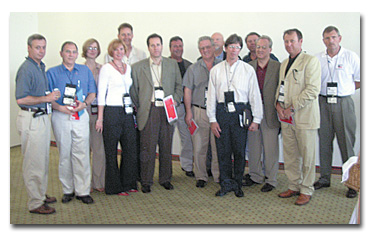
aapnexecs
AAPN honored sourcing executives at its fourth sourcing executive reception.

Prior to the gathering, AAPN hosted a sourcing executives-only roundtable to discuss the
concerns sourcing managers face in today’s marketplace. “We created this party to honor our
customers, the sourcing executives for brands, retailers and manufacturers,” said Todaro, who –
along with AAPN Vice President Kim Krummel, Timberland – facilitated the meeting. “We were pleased
to be able to hear the views of nearly 50 sourcing professionals. The only complaint we received
from sourcing execs was that our roundtable should have been eight hours long instead of two. So,
in Cancun in October, we’ll give them eight hours.”

todaro
AAPN’s Managing Director Mike Todaro (standing) helped facilitate the sourcing
executives-only roundtable.

AAPN, an international, non-profit association focused on networking in the textile and
apparel supply chain, has been a Material World sponsor since it was inaugurated in 2000. This
year, more than 70 of the association’s 220 members participated in the show.

“This is a great environment to really support our members in making new business
relationships,” Todaro said. “With our recent meetings in Guatemala, and gearing up for our meeting
in Cancun, this has been a forum to bring people together and demonstrate the power of networking
in textiles and apparel – something where [AAPN] really excels.”

The AAPN 2004 Fall Meeting is scheduled for Oct. 13-15 at the Fiesta Americana Grand Coral
Beach, Cancun, Mexico. For more information, contact AAPN through its website,
www.USAWear.org.


June 2004

Sponsors