ASTM Signs MOU With China’s SAC

ASTM International, West Conshohocken, Pa., and the Standardization Administration of the Peoples
Republic of China (SAC) have signed a memorandum of understanding (MOU) under which they will
explore cooperative standards development opportunities in areas of mutual interest, promote
communication and knowledge sharing, and promote increased Chinese participation in ASTM’s
standards development process.

ASTM says the MOU will facilitate development of Chinese national health, safety and
environmental standards; and enable the two organizations to better support the needs of the
Chinese people.

October 2004

Malden Mills Wins Military Contracts

Malden Mills Industries Inc., Lawrence, Mass., has received contracts worth $21 million to provide
Polartec® garments to the US Armed Forces. The funding, awarded under the 2005 Defense
Appropriations bill, includes $1.5 million for continued research and development of electronic
textiles to be used in the Army’s Combat Casualty Care program. Such textiles will enable remote
monitoring of the vital signs and location of soldiers in combat by medics responsible for their
care.

Polartec programs include the Army Extended Cold Weather Clothing System, the Marine Corps
Mountain Cold Weather Clothing and Equipment Program, and the Navy Air Warfare Centers
Multi-Climate Protection System.

In addition to the programs funded by Congress, a US Army Rapid Fielding Initiative approved
by the US Department of Defense specifies 400,000 sets of silkweight shirts and pants made with
Polartec Power Dry® fabrics for use as a base layer by the Special Operations Forces and the Army.
The quick-drying bicomponent fabric wicks perspiration away from the body, is highly breathable and
has a soft surface on the side worn next to the skin for added comfort.

October 2004

USM Knife Cutting Tables Provide Dieless Cutting

The Hudson Machinery Division of USM Corp., Haverhill, Mass., says its Atom FlashCut Knife Cutting
Tables offer a high-speed, low-operating-cost alternative to die cutting. The system is suitable
for cutting materials up to three-fourths-inch thick in low to medium production runs. It is
available in a variety of multi-zone vacuum table sizes and with a choice of cutting heads. Options
include a material roll feeder for handling roll goods, and a camera and projector to ensure
optimal material utilization when cutting from irregularly shaped materials.

October 2004

Fong’s Acquires Then Assets

Fong’s Industries Co. Ltd., a Hong Kong-based manufacturer of textile dyeing and finishing
machines, has invested 10 million euros to acquire the assets, production facilities, real property
and intellectual property rights of Then Maschinen und Apparatebau GmbH and Scholl-Then GmbH. The
companies, both based in Germany, had faced bankruptcy proceedings. Fong’s has renamed the
consolidated company Then Maschinen GmbH. The new company will maintain its current distribution
network and will continue to supply beam dyeing machines, piece dyeing and yarn dyeing equipment,
chemicals and dyestuff dosing systems, and control units and central control systems. Seventy-five
percent of the former staff will continue with the new company working under the leadership of
previous Then and Scholl-Then Managing Director Werner Hubsch.

October 2004

Integra Invests $2 Million In Expansion Effort

Myrtle Beach, S.C.-based Integra International Inc. recently invested $2 million to expand its
headquarters to the Loris Commerce Center in nearby Loris, S.C. Integra –  a hospitality
textile converting company specializing in the heat-transfer of printed fabrics for use in such
applications as bedding, drapery and upholstery – plans to employ 40 people.

“When existing industries expand their operations in the area, it exemplifies the fact that
Horry County has the business environment necessary for companies to flourish,” said Joe Woodle,
president and CEO of Conway, S.C.-based PARTNERS Economic Development Corp., which assisted Integra
with the expansion. “This is an excellent example of the state, county and city all working
together to bring a project to fruition.

October 2004

Quality Fabric Of The Month: Signal Approach

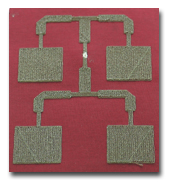
Applied Radar Inc. — North Kingstown, R.I., a research and development firm that designs and produces prototypes of sensing, communication and navigation systems using microwave or radio frequency technology — has introduced a line of electronic textile (e-textile) antennas. Michael A. Deaett, antenna sales manager, says the antennas can provide higher performance and lower cost to original equipment manufacturers’ wireless and radar products.

“E-textile antennas are simply antennas constructed from fabrics using the techniques of the textile industry,” Deaett said. “We have built and tested antennas operating at frequencies from 400 megahertz (MHz) to 2.5 gigahertz (GHz), and we are now moving to 10 GHz.”

qfom_Copy_15

E-textile antennas can replace traditional printed circuit antennas in conventional
applications, as well as enable new possibilities.

The antennas are an early product of research funded by the Defense Advanced Research Project Agency (DARPA) of the US Department of Defense under a Phase I Small Business Innovative Research program. “DARPA has been trying to put together a project to use textile industry
techniques to make e-textiles. Applied Radar is the first company to make textile microwave antennas,” Deaett said. One possible application is low-cost, lightweight antennas for very large aperture applications such as space-based antennas.


“While not appropriate for all electronic applications, the textile approach is very cost-effective if the features are accurate enough for the specifications,” he said, noting most printed circuit boards include fabric-based substrates. “The idea is to use textile fabrics and methods to produce low-cost, high-performance antennas that can be integrated in a seamless, nonintrusive way into our living spaces.”

Deaett said the company has developed two antenna types. “The first type consists of lightweight, flexible free-form textile antennas that perform like a conventional laminated antenna at less than 20 percent of the cost. A second consists of resin-infused textile antennas that can be incorporated into a composite airframe.”

The free-form model ET 100 antenna is used in woven or knitted textiles (typically nylon or polyester) that are stitched together with metallic conductive threads; while the composite encapsulated antenna is suitable for aircraft, automotive and shipbuilding applications.

The company expects the ET 100 will not only replace traditional printed circuit antenna technology in conventional applications, but also open up new possibilities including fashion apparel and home wireless systems applications.

In the commercial area, Applied Radar is selling 8-inch by 10-inch planar antennas to go into wireless networks. In wearable applications, Deaett said, “they can be stitched into a garment after that garment is made, or they can be incorporated into the fabric as that fabric is made and then utilized after the fabric has been incorporated into a garment.”

As part of the DARPA project, the company has made a wearable antenna that operates at 430 MHz for military applications. “We just tested it, and it works very well,” Deaett said.


For more information about Applied Radar e-textile antennas, contact Michael A. Deaett (401)
295-0062, Ext. 107; miked@ appliedradar.com.


October 2004


Tag-It Pacific Extends Deal With Levi Strauss

Woodland Hills, Calif.-based Tag-It Pacific Inc., a provider of apparel component products and
services, has extended its two-year agreement with Levi Strauss & Co., San Francisco, for the
use of its TekFit stretch waistband technology in Levis’ line of Dockers® pants. The extension runs
through November 2006 and is expected to generate $35 million to $40 million in profits.

October 2004

Atlas Upgrades HVFAA Flammability Test Chamger

Atlas Material Testing Technology LLC, Chicago, now offers its HVFAA Horizontal Vertical Flame
Chamber with expanded capabilities for performing Federal Aviation Administration (FAA)-approved
flammability tests on aircraft cabin and cargo materials including seat fabrics and carpeting.

The HVFAA is a large-volume, draft-free bench-top test chamber featuring a tilting burner
mount, sliding tempered glass viewing window, remote-control digital timers, hand-access ports for
burner positioning, precision flowmeter, and gas pressure regulator and gauge. Interchangeable
specimen holders and a flame confirmation kit are available.

October 2004

Future Cottons


A
quiet revolution has been taking place in America’s cotton fields. With the launch of
Bollgard in 1996, Roundup Ready in ’97, and Bollgard and Roundup Ready (BG/RR) in ’98,
biotechnology has produced tools that are very advantageous to the farmer.

These advances increased cotton yields by reducing damage from insects and competition from
weeds. More recently, cotton seed breeders like Delta and Pine Land Co. (D&PL), Scott, Miss.,
have begun focusing on improved fiber quality.

“If we can maintain the yield and still give the end-user — the mill — a better strength
cotton with a better length and premium micronaire, it’s a plus/plus for everybody,” said a cotton
farmer who is planting the new varieties.


The New Cottons

One example of these new cotton varieties is DP 444 BG/RR. In 534 trials, this cotton had an
average staple length of 35.8/32, micronaire of 3.96, strength of 29.7 grams per tex and a
uniformity ratio of 83.0. This year, D&PL says it sold enough DP 444 BG/RR seed to plant 1
million acres, and it expects to sell enough to plant twice that area next year.

Next year, the company will field DP 488 BG/RR. Based on 134 trials, it has an average staple
length of 37.3, micronaire of 4.27, strength of 31.5 and a uniformity ratio of 82.8.

“The emphases in breeding programs over the last 10 years have been yield, micronaire and
length,” said Tom Kerby, Ph.D., vice president, technical services, D&PL. “Strength is coming.
We’re focusing on uniformity now more than anything else. We have some experimental varieties with
exceptionally high uniformity, and the mills have been very interested in them.”


Spinners’ Wish List

Spinners would like to see less trash, increased staple length and micronaire a little lower —
say 4.2 to 4.4. They seem fairly happy with strength, which has been on the upswing over the last
few years. Short fiber content also is very much on spinners’ minds.

“First on my radar screen right now is short fiber content, which is something that we don’t
even get a measurement on from USDA,” said one spinner. “There is a lot of controversy over that. I
would like to see a short fiber measurement, and I would like to see that improve [less short
fiber]. And I think short-fiber content is the problem in cotton from Georgia.”

While seed breeders and cotton farmers are working each year to improve the crop, it’s an
imperfect world and an imperfect cotton marketing system. At least for now, there is a limit to how
much fiber quality can be improved without reducing yield.

“Mills are interested in having micronaire a little lower, but I don’t think that is going to
happen,” said another spinner. “Higher micronaire is associated with higher yields, and if you sit
down and look at the marketing system for cotton, I don’t think mills can pay enough for a cotton
farmer to bring his yields down. If I was a farmer, I’d be doing exactly what they’re doing and
producing a higher micronaire.”


Georgia On Our Minds

Speaking of Georgia, much has been written recently in the cotton press about quality problems
with the cotton crop there. Last month, a spinner reported problems with Georgia cotton, and this
month another spinner said he will not buy Georgia cotton this time around, due to high short-fiber
content.

Theories abound about possible causes and fixes for cotton quality problems in Georgia, but
there appears to be no clear consensus on either just yet. To their credit, Georgia farmers are
working to keep mills in the loop on this issue.

“I know that they [Georgia cotton farmers] are interested in improving, and I think it is
just a matter of time before we identify the problem and find the answer,” said a mill executive.

One spinner said he didn’t truly value the total package that US cotton delivers until he had
an experience with foreign cotton several years ago. Some of the bales had metal wraps, which
caused a fire hazard during transportation. Other bales appeared to be wrapped in trash bags. There
were issues with contamination. It was a mess.

“It taught me to appreciate what we have here at home,” he said. “While there can and should
be improvements, US cotton farmers do it better than anyone in the world.”


October 2004

Dilo Installs Spunlace Equipment For Jacob Holm

Dilo System Group, Germany, has installed a new fiber opening and cross-laying line for Jacob Holm
Industries, which has operations in Germany, France and the United States.The line, which was
developed in cooperation with Jacob Holm, is equipped with Spinnbau HSP cards in large working
widths. According to Dilo, the new line was designed to satisfy increasing demand for spunlace
products in North American markets.

October 2004

Sponsors