Lectra Unveils ProSpinTechTexST Cutting Solution

Paris-based Lectra has introduced the
ProSpinTechTexST cutting table for industrial fabric applications. According to the company, the
new table allows users to cut pattern pieces from several cut lengths simultaneously or from roll
fabrics; and handles a range of flexible materials including polyvinyl chloride, composites and
foam.

Minimal training is required for the ProSpinTechTexST, which is available in cutting widths
of 72 inches or 100 inches and cutting lengths ranging from 9 to 55.5 feet. The table comes
equipped with a vibrating blade, punch and pen; and features a compartment air-feed device and a
material optimization program that allows on-the-spot, automatic marking. Marker and cutting
parameters can be stored for future use.

ProSpinPilot TechTex software is included to allow visual monitoring and real-time tracking
of cutting processes, and definition of multiple work areas. The software offers a cutting path
optimization system with in-line tool change and automatic marker-making for pieces in one model.
It also enables material files to be selected according to model and fabric, size or variant to be
used.

Options include mosaic software for processing of stripes, plaids or prints that need to be
matched; a digital camera for detection of motif position to enable repositioning of pieces; and a
barcode reader to read barcoded cutting instructions.


June 6, 2006

Schoeller’s NanoSphere® Earns Hohenstein Nanotechnology Quality Label

Switzerland-based Schoeller Textil AG’s NanoSphere® finishing technology has earned the
Germany-based Hohenstein Institutes’ Nanotechnology Quality Label.


The Hohenstein Institutes, an
independent research and service organization with agencies located around the world, focuses on
research, testing, consultation and certification related to technologies used in textile and
associated applications. In October 2005, the organization began to offer testing and certification
for nanotextiles and their suitability for daily use. Certification of the textiles is based on
their adherence to a strict definition of nanotechnology developed in conjunction with NanoMat, a
Germany-based nanomaterials network; and also on successful performance according to various
criteria including abrasion; water, oil and soil repellency; durability to washing; and skin
tolerance.

“There is considerable disquiet among retailers and consumers because according to the
advertising claims of manufacturers, ‘everything is somehow nano,’ and we had reason to believe
that this was not the case,” said Jan Beringer, Ph.D., head of the Intelligent Textiles Competence
Center of the Textile Services & Innovations Department, Hohenstein Institutes, and who is
responsible for the new quality label. “Our institute has been in existence for 60 years, and we
were among the founders of the Oeko-Tex Standard — a quality assurance system for toxin-tested
textiles …. With the nano quality label, in turn, we are taking a step into the future.”

Beringer said NanoSphere is the first nanotechnology to meet all the test requirements for
the Nanotechnology Quality Label. NanoSphere fabric samples retained their micro and nano
structures after 5,000 cycles in the abrasion test; and were highly hydrophobic, and had very good
oil and water repellency and oleophobia, even after 50 washing and drying cycles and reactivation
by brief ironing. The treated fabric also tested positively in regard to skin tolerance.


June 6, 2006

Shuford Mills To Form Separate Yarn Company

Shuford Mills LLC, Hickory, N.C., has
announced it plans to spin off its yarn operations by establishing Shuford Yarns LLC to take over
its yarn business, which produces and distributes coarse-count cotton and polyester yarns for
home-furnishing and industrial applications. Shuford Mills will own a 25-percent share, and members
of a new management team that includes Shuford Mills President Allen Barwick will own a 75-percent
share in the new company, which expects to purchase Shuford Mills’ two yarn plants in Dudley
Shoals, N.C., and Longview, N.C., on June 30, 2006.

Shuford’s weaving operations will retain the Shuford Mills name and will continue to operate
a plant in Hudson, N.C., which manufactures Outdura® outdoor fabrics as well as other fabrics for
industrial applications.

“All Shuford Mills stakeholders — most significantly, our vendors and customers — will
benefit greatly from this transaction,” said Pope Shuford, chairman, STM Industries Inc., parent
company of Shuford Mills. “Our experience has taught us that focus and discipline drive the
efficiencies that are required to remain competitive in the textile business. Establishing separate
yarn and weaving operations ensures that each company will maintain a keen focus on its unique
manufacturing processes and market opportunities.”

Barwick will serve as president of Shuford Yarns, which also will be headquartered in
Hickory. Shuford will serve as a member of the new company’s Board of Directors.


June 6, 2007

A Fairly Good Second Quarter


D
omestic textile activity is holding up tolerably well. True, overall mill production is
down, but only fractionally. Other encouraging signs would have to include fairly firm prices and
Chinese import gains that are now increasingly offset by smaller incoming shipments from other
overseas suppliers.

Looking at domestic mill activity first; preliminary April-June returns show production
running only a small 2 to 2.5 percent under year-ago levels. That’s really quite a feat given last
year’s dire predictions following the junking of global quotas. And preliminary forecasts for the
rest of the year and into early 2007 point to pretty much the same pattern.

In any event, declines over the past year have been well under those racked up in 2001, 2002
and 2003 when domestic textile output slipped 10 percent, 4.1 percent and 7.6 percent,
respectively. The bottom line is industry shrinkage seems to be becoming much more manageable than
feared, as increasingly savvy domestic mills take more innovative steps to keep themselves afloat
in today’s increasingly competitive one-world marketplace.

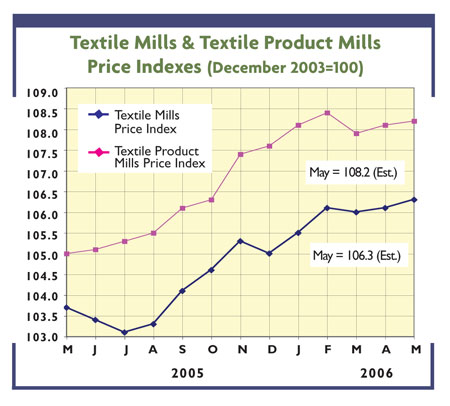
Turning next to prices: Earlier predictions calling for major easing just have not materialized.
Uncle Sam’s widely monitored price index for basic textile products has actually inched up 1
percent since the end of last year. And a similar picture is shaping up for more highly fabricated
textile products, where the average quote is up 0.5 percent over late 2005 readings.

One basic factor behind this relatively strong price performance is improving demand both
here and abroad. Virtually all major countries are now anticipating solid economic growth for the
current year — and this, in turn, is strengthening global demand for textile and apparel products.

Significant increases in mill production costs may also be playing a role in keeping most
prices relatively firm. And this may be doubly true for our major competitor — China. Indeed,
Chinese labor costs in some instances are now reportedly advancing as much as 10 percent per year.
Add in higher raw material costs — aggravated by an undervalued yuan — and it’s easy to see why
that nation’s producers need strong prices if their profits and margin levels are to be
maintained.

BFchartJune_Copy


The Chinese Response

Not surprisingly, those Far Eastern producers are beginning to rethink their overall production
and marketing strategies. For one, they’re resisting pressure on the part of major American buyers
for further price reductions – and in a few cases have actually managed to nudge tags up a
bit.

Equally important, many of these mills are also beginning to put a lot more effort into
upgrading their product lines. Reports, for example, suggest more and more Chinese companies that
produce shirts, pants, skirts and other apparel products are now investing in better, more
efficient sewing and cutting equipment. Their goal is substantially improved quality and products
that will allow a production shift over to higher-profit, value-added apparel. If successful, they
hope to attract new relatively upscale American customers like Gap and Liz Claiborne – thereby
ending their reliance on selling most of their product mix to basically bottom-of-the-line stores
like Wal-Mart and Target.


More Yuan Questions

In the meantime, Washington’s decision not to formally accuse Beijing of manipulating its
currency could also have significant implications. One thing is certain: This recent move would
seem to deprive Congress of a weapon it could use to justify economic retaliation. Other things
being equal, for example, the current bill pending in Congress calling for new tariffs on Chinese
incoming shipments will almost certainly be facing even stiffer legislative hurdles. On the other
hand, the absence of any punitive US measures could give the Chinese an opening to slowly nudge up
the value of the yuan — something that Beijing would have found politically impossible had
Washington decided to really flex its muscles.

The big question, however, remains: Just how much yuan appreciation vis-à-vis the US dollar
is possible? The consensus among economists now is that some upward movement is coming — but that
it will be slow and gradual, given Beijing’s own internal economic pressures. Their best bet for
the yuan is an appreciation of somewhere between 3 and 5 percent by year-end or early next year.
Unfortunately, that won’t be nearly enough to correct the current Sino/US trade imbalance — one
that in 2006 seems almost certain again to approach the $200 billion mark.


June 5, 2006

Mill Consolidations Continue


T
he hottest topic from the yarn mills is the merger between Frontier Spinning Mills and
Cheraw Yarn Mills.

At a glance, it looks like a good fit for both parties. Cheraw produces more specialty items
and serves quite a few niche markets. Frontier is a major player in terms of volume and has strong
Central American business. Word is the Cheraw workers will get to keep their jobs.

The industry has seen significant recent mill shutdowns. Alice Manufacturing Co. will close
its Elljean plant in Easley, S.C., and eliminate 260 employees. Fruit of the Loom has announced the
closure of its Rabun Gap, Ga., plant, cutting 930 workers. Springs Global will close plants in
Hartwell, Ga., idling 340 associates. These closings will take considerable open-end (OE) and
air-jet capacity out of the yarn market.


Mapping The Market

Spinners’ descriptions of current running conditions and market outlooks vary somewhat this
month. The consensus is that OE remains soft, and at least one observer sees some weakness in ring
spinning.

“Demand has softened a bit for both open-end and ring-spun,” said one spinner. “It’s more
noticeable in the ring. For a while, it seemed like there was no ring-spun yarn available at any
price in the United States. That’s changed in the last week or so.”

“On the open-end side, there is availability out there,” said a multisystem spinner. “On the
ring-spun side, it appears to be quite tight or at least tight. Pricing is down on open-end.
Ring-spun pricing is still in good shape.”


Heather Yarn Demand On The Rise

“Ring-spun and open-end heather yarns, especially the ones that use bale-dyed cottons, seem to
be in good shape,” said one mill executive. “Vendors are quoting out two to three weeks or more.”

The depressed OE market seems to have picked up somewhat, at least for one mill. OE yarn
prices remain lackluster.

“Business is real good now; we’re running seven days,” said one OE spinner. “Our customers
say that their outlook is pretty good right now.”

One spinner suggested slow patches in the fourth and first quarters of 2005 and 2006,
respectively, were the result of retailers still further reducing inventory. He felt since they
have finished “making the pipeline leaner,” business for the second half of 2006 and the beginning
of 2007 should be stronger.

Further good news for the yarn mills is that business with Central America is finally on the
rebound. At the same time, spinners expressed impatience with the slow country-by-country adoption
of Central America-Dominican Republic Free Trade Agreement (CAFTA-DR).

“We still don’t have a CAFTA agreement signed by all the countries down there,” said one
spinner. “That needs to stabilize so retailers will feel comfortable sourcing from that
region.”


US Cotton Acreage On Upswing

US cotton plantings for 2006 are expected to total 14.6 million acres, 3 percent above last
year, according to the US Department of Agriculture (USDA).

Upland acreage is expected to total 14.3 million, also up 3 percent. Growers intend to
increase acreage in all the cotton-producing states except Alabama and South Carolina, where
expected acreage is down 1.8 percent and 4.1 percent, respectively. California producers expect to
plant 290,000 acres, up 26 percent from last year.

US Pima cotton growers intend to increase their plantings 24 percent from 2005, to a record
high of 334,000 acres, according to the USDA. The largest increases are projected for Arizona and
California, up 70.7 percent and 26.1 percent, respectively, according to the National Cotton
Council of America (NCC).

The latest USDA figures are higher than the NCC’s annual early-season planting intentions
survey released in February, which estimated US cotton producers intended to plant 14.4 million
acres of cotton, up 1.7 percent, and 312,000 acres of extra-long-staple cotton, up 15.2 percent.

For the 2006–07 crop year, USDA projects a US crop of 21 million bales. Mill use is set at
5.6 million bales, while exports are reported to reach 17 million bales. The estimated total
offtake stands at 22.6 million bales, resulting in ending stocks of 4.9 million bales.


May/June 2006



CARE Receives Milliken CO2 Credits, Releases Annual Report, Honors Recyclers

Dalton, Ga.-based Carpet America
Recovery EffortSM (CARE) recently received a donation of carbon dioxide (CO2) credits from
Spartanburg-based Milliken & Company to offset the environmental impacts of CARE’s Fourth
Annual Conference, held recently at Southern Pine Conference Center at Callaway Gardens, Ga.

CARE is a voluntary initiative supported by US carpet manufacturers and related businesses
to reduce carpet waste sent to landfills. Milliken, whose Milliken Floor Covering division has sent
no carpet manufacturing waste to landfills since 1999, maintains forests and small hydroelectric
plants that absorb and reduce CO2 emissions totaling approximately 900 million pounds per year.

“Our managed forests sequester much more carbon dioxide than our factories produce,” said
Russell Grizzle, global president, Milliken Floor Covering. “Donating credits to reduce the
industry’s impact on landfills fits with our philosophy of respect to the Earth.”

At the conference, CARE released its Fourth Annual Report and announced that respondents to
its annual survey reported diverting 224.6 million pounds of carpet from landfills in 2005,
including 194.3 million pounds that were recycled — 97 percent more than were recycled in 2004.
Since 2002, when CARE began collecting statistics, 483.7 million pounds of carpet have been
diverted from landfills, based on survey results.

“Aside from the known amount we have reported in 2005, we now see a path to demand in 2007
that adds an additional need for more than 400 million pounds of old carpet,” said Robert Peoples,
Ph.D., executive director, CARE. “I am forecasting another increase of greater than 100 percent for
2006, which would reinforce our belief that this new industry of carpet landfill diversion is well
on its way to meet our overall goals.”

CARE also honored Winchester, Ky.-based Champion Polymer Recycling, a division of Old
Saybrook, Conn.-based Infiltrator Systems Inc., as Recycler of the Year; and Ronald Greitzer,
president of Vernon, Calif.-based Los Angeles Fiber Co., as Person of the Year.

Champion has implemented a polypropylene carpet recovery system to provide raw materials for
Infiltrator Systems’ leachfield chamber systems.

Greitzer has been an active recycler since 1983, when he and Stan Greitzer founded Los
Angeles Fiber for the recycling of carpet and textile materials. The company, which was named CARE’s
Recycler of the Year in 2003, is the world’s largest recycler of post-consumer carpet, according
to CARE.


May 30, 2006

Mohawk Industries Honored As Recipient Of Textile World 2006 Innovation Award

Atlanta, GA — Mohawk Industries, Inc.
has been named the recipient of the 2006 Innovation Award from

Textile World
, the leading trade magazine for the US textile industry.

Mohawk Industries was selected as the recipient of the award based on the company’s
long-standing commitment to innovation in the textile industry and its business prowess in the
floorcovering industry, according to James M. Borneman, publisher of

Textile World
. Mohawk Industries is the largest floorcovering manufacturer and distributor in the
world, with 2006 sales approaching $7 billion.

“Mohawk is a very special company — one with a rich history, strong leadership that
understands today’s challenging business environment, and one that is one the move strategically
expanding its product and marketing capabilities,” said Borneman.

“Recognition from within one’s industry is always noteworthy and particularly satisfying,”
said Jeff Lorberbaum, Chairman and CEO of Mohawk Industries. “We are honored to be selected for
this honor from

Textile World
, and I think that it represents the continuous effort of employees throughout Mohawk
Industries to improve, renew, and redefine how our company works.”

The

Textile World
Innovation Award is presented annually by

Textile World
magazine in recognition of outstanding efforts and accomplishments in the textile
industry. The July/August 2006 issue of

Textile World
will feature the full Mohawk Industries story. Visit

Textile World
on the web at
www.textileworld.com.


Textile World
has covered the North American textile industry for more than 130 years and is a member
of the Textile Industries Media Group, a division of Atlanta-based Billian Publishing, Inc.

Nominations for future awards may be made by contacting the editorial staff at

Textile World
, 2100 Powers Ferry Road, Atlanta, GA 30339; (770) 955-5656.

For More Information, contact:

James Borneman

770-955-5656

jborneman@textileworld.com


May 25, 2006


Congressmen Seek Support For Textile Agenda

Leaders of the Congressional Textile
Caucus are circulating a letter to their colleagues seeking support for the textile industry’s
agenda. Their goal is to get enough signatures to put pressure on administration trade officials to
act favorably on key issues.

A letter to US Trade Representative Rob Portman underscores the economic importance of the
industry and expresses concern over what is being reported about the Doha Round of trade
liberalization talks and the accession of Vietnam to the World Trade Organization (WTO). The letter
says: “We believe that unless the US government takes specific steps, these talks will likely cause
large job losses in the US textile and apparel sector. We are committed to working with you to
ensure that the concerns of this industry, which contributes $75 billion through textile production
and $2.7 billion through apparel to our GNP [gross national product], and is the third largest
exporter of textile products in the world, are addressed at this critical juncture.”

The letter calls for sectoral textile negotiations in the Doha Round and “substantially
equivalent” concessions that would ensure fairer and more open opportunities for both the United
States and its trading partners. It expresses concern the current talks are framed in a fashion
that will produce an “uneven outcome.” The letter says sharp cuts in US textile tariffs will “
almost certainly dismantle our various preferential trading programs that are dependent on
zero-duty arrangements.”

With respect to Vietnam, the letter says: “Like China, Vietnam has a large and subsidized
textile sector that utilizes anti-free market principles to under-price producers here in the
United States and elsewhere. Just as with China, the United States must insist on a textile
safeguard system or an extension of the current quotas until these unfair subsidies are removed.”

The congressmen warn “failure to address these concerns will substantially impact our view
of the administration’s legislative trade agenda from this point forward.”

Although a tentative agreement has been reached between the United States and Vietnam,
domestic manufacturers believe they have opportunities to modify any final agreement. They are
seeking congressional support to get the agreement changed before it is finalized on a bilateral
basis, and it will be subject to multilateral negotiations in the WTO. This is likely to remain a
highly contentious issue for some time.


May 23, 2006

Maya Apparel Buys, Renovates Honduran Plant

City of Commerce, Calif.-based Maya
Apparel Group Inc., which acquired knitwear designer and apparel sourcer Indosheen’s assets last
year and now does business under the Indosheen name, has bought and begun renovating a
170,000-square-foot manufacturing facility in Honduras.

Calabasas, Calif.-based Buxbaum Group, which has a controlling interest in Maya Apparel,
expects the facility to produce 300,000 to 700,000 units a month once it is completely on-line.
Maya will contract additional volume to other Honduran plants. The renovation will add special
services, incentive programs, and amenities such as air conditioning and an on-site medical
facility for the plant’s 400 employees. A group of local professionals will oversee quality control
at Maya’s facility and the contract plants, and will coordinate international shipping as well as
potential changes resulting from international commerce laws.

“Ownership of this facility will allow us to gain a greater degree of control over
production in order to ensure on-time delivery, as well as provide a level of quality that will
meet the most stringent criteria, including those of major retailers like Target, Wal-Mart and
Federated Department Stores,” said David Gren, president, Maya Apparel.

Additionally, the plant purchase and renovation are part of Buxbaum Group’s planned
turnaround of Indosheen, which previously had a structure that was not capable of handling the
manufacturer’s rapid growth, according to Gren.

“To take the company to the next level, we infused Maya with capital, hired additional
customer service personnel, and dramatically changed the operations and production procedures of
the business,” said Paul Buxbaum, chairman and CEO, Buxbaum Group.

“Until Indosheen’s infrastructure can be built, annual sales volume will be capped at
approximately $25 million,” Gren added. “After that, growth will proceed at a measured pace, with
sales expected to reach the $50 million to $60 million range in about three years.”


May 23, 2006

Dow Hikes Polyglycols, Surfactants Prices

Effective June 1 or as contracts
allow, The Dow Chemical Co., Midland, Mich., will increase North American list and off-list prices
on certain specialty chemicals polyglycols and surfactants products by 2 to 15 cents per pound.
According to the company, the increase is due to higher energy and hydrocarbon costs, as well as
competition for raw material and delivery costs.


May 23, 2006

Sponsors