Sun Capital Subsidiary Acquires Kellwood

Cardinal Integrated LLC, a wholly owned subsidiary of Sun Capital Securities Group LLC, has
successfully completed a $21-per-share cash tender offer for approximately 2.5 million outstanding
shares of St. Louis-based branded apparel and soft goods marketer Kellwood Co. Added to Sun
Capital’s existing 11.4-percent holding of Kellwood shares, Cardinal Integrated will hold
approximately 93.7 percent of Kellwood outstanding shares.

Shares not acquired through the tender offer or otherwise owned by Cardinal Integrated or one
of its affiliates will be converted into the right to receive cash payments of $21 per share,
subject to appraisal rights. The transaction is valued at $762 million including net debt, upon
completion of the acquisition, which is expected very soon, according to a Sun Capital
spokesperson.

Once the merger is complete, Kellwood will become wholly owned, privately held subsidiary of
Cardinal Integrated.

“As a strong, private company, Kellwood will continue to execute on its strategic priorities
to position the company as a brand-focused marketing enterprise,” said Robert C. Skinner Jr.,
chairman, president and CEO, Kellwood.

February 19, 2008

Printos Introduces High Flow Printing/Coating Head Suitable For Carpet Applications

The Netherlands-based Printos — a manufacturer of drop-on-demand, digital, solenoid valve-jet
printing/coating heads, business unit of Wood Dale, Ill.-based Videojet Technologies Inc. and
partner of Wools of New Zealand — introduced the P16, a new digital printing solution for wool
carpets at Domotex, the international trade fair for the carpet and floor coverings industry, held
recently in Hannover, Germany.

According to Printos, the P16 multichannel printing/coating heads are suitable for applying
various fluids onto a range of substrates, but the heads’ high flow capabilities make them
particularly suitable for penetrating high-pile wool and nylon carpets. The company reports the
technology offers high-speed operation, repeatable fluid dispensing and precision drop placement,
in addition to full process control and monitoring and full-color image preparation.

New software, specialty inks, electronics and data path add to the flexibility of the P16
technology. Made mainly from stainless steel, the printing head is easy to maintain, according to
the company.

At Domotex, Printos demonstrated the P16 on a T4 sample printer. The company has also
developed the H8 head, which features eight P16 heads, for high-output coating and printing.

February 19, 20008

Glen Raven Distribution Group Offers Hurricane Protective Panels Made With Spectra®

Glen Raven Distribution Group, Glen Raven, N.C., now offers Storm-A-Rest™ window and door panels to
protect homes from hurricane damage. Manufactured by Spring Hope, N.C.-based armor and
high-performance fabric specialists JHRG LLC, the panels are made with Supreme Protector® fabric
with Spectra® ultra-high-molecular-weight polyethylene fiber from Morristown, N.J.-based Honeywell
Specialty Materials. The Supreme Protector fabric has been certified under Florida Building Code
FL8442 to meet or exceed large-missile-impact D and 155+-mile-per-hour wind specifications for Wind
Zone 4 — comprising the area within one mile of Florida’s coastline, where an estimated 7.3 million
homes are located.

“Florida has adopted some of the country’s toughest building codes following [Category 5]
Hurricane Andrew in 1992,” said Joe Gelo, business director, Advanced Fibers and Composites,
Honeywell. “This application demonstrates yet another example of how Spectra fiber’s strength can
help end-use products perform in harsh environments.”

In addition to having a strength-to-weight ratio 15 times greater than that of steel, the
lightweight panels allow 76 percent of daylight to pass through — an advantage over competitive
products in the event of power outages — and also prevent wind-driven rain from passing through.
According to Glen Raven, the made-to-order panels are easy to install using standard tools and
Tapcon or Sammy fasteners in brick, concrete or wood; and are easily removed for storage during
fair-weather months. They also are trimmed with a choice of Glen Raven Technical Fabrics LLC’s
Sunbrella® fabrics.

February 19, 2008

Lenzing To Expand Lenzing FR Production To Supply Fiber For Military Uniforms

Austria-based fiber manufacturer Lenzing Group plans to expand capacity at its Lenzing, Austria,
manufacturing facility for the production of Lenzing FR® flame-resistant fiber. The expansion will
enable the company to supply increased volumes of the fiber to Union City, Ga.-based TenCate
Protective Fabrics for use in its Defender™M Lenzing FR/para-aramid-blend fabrics to be used for US
armed forces military combat uniforms
(See “
Quality
Fabric Of the Month: Saving Our Troops
,”
Textile World, September/October 2007)
.

A special amendment to the US National Defense Authorization Act for Fiscal Year 2008, signed
into law recently by President George W. Bush, exempts FR rayon fiber for five years from
requirements that it be manufactured in the United States in order to be used in garments supplied
to the US armed forces. Lenzing FR is produced only at the Lenzing facility, which devotes about 50
percent of its capacity to the production of specialty fibers.

TenCate’s Defender M fabric offers inherent FR properties in addition to moisture management
and breathability. The Lenzing FR/para-aramid blend also can increase the fabric’s thermal
protection properties. The fabric has been specified by the US Army and Marine Corps to replace the
nylon/cotton uniform fabric used currently.

According to Lenzing, increased manufacturing flexibility and capacity at the Lenzing site
will enable it to focus on Lenzing FR production for the Defender M application. The ensuing
increased production of Defender M also will enable TenCate to supply the fabric to the armed
forces of other countries, which now are conducting wear trials and tests of the fabric, Lenzing
and TenCate report.

February 19, 2008

Huntsman To Raise Prices Of Textile Effects Products

Effective March 1, or as contracts allow, Switzerland-based Huntsman Textile Effects will raise
prices of a range of products by up to 15 percent. The company cited continued labor, raw material,
transportation and utility costs as reasons for the increase.

February 19, 2008

The Rupp Report: More Good News

Last week, we asked for more good news from the industry.

Successful Year For Dornier

The year 2007 was again successful for Lindauer Dornier GmbH, the well-known Germany-based
air-jet and rapier weaving and finishing machines as well as special machinery manufacturer. In
2007, Lindauer Dornier increased its turnover to 221 million euros (US$322 million), compared to
212 million euros (US$309 million) in 2006. Dipl. Ing. (FH) Peter Dornier, shareholder of Dornier
Holding and CEO of Lindauer Dornier GmbH, expects a positive company result at about the same level
as for the previous year.

ITMA 07 And K07 Perfect Platforms

Dornier reports that “the leading international trade fairs ‘ITMA’ in Munich (textile
machinery) and ‘K07’ in Düsseldorf (plastics machines) served as perfect platforms to demonstrate
the high engineering level of Dornier machines and production plants to customers and other
interested persons.”

The production capacity of the Special Machinery Division is already covered by firm orders
extending into the year 2009, whereas the Weaving Machine Division expects the year 2008 to end
with a similar output as in 2007. Considerable investments, financed by the company’s own
resources, are planned for 2008 and involve new buildings and new machinery at the three German
production facilities in Lindau, Esseratsweiler and Pfronten. Today, 1,240 people are working in
those facilities.

New Business Unit Organization

In order to effectively meet the challenges and changes imposed by the increasingly global
market, the areas of responsibility within the management have been reorganized:

CEO, Dipl. Ing. (FH) Peter D. Dornier is also a shareholder of Lindauer Dornier GmbH. The
responsible people for the new business unit organization are: Dipl. Ing. (FH) Michael Ebeling for
the Weaving Machinery Division, Dr. Ing. Andreas Rutz for the Special Machinery Division, and Dipl.
Oec. Hans-Jürgen Schmidt for the commercial sector as well as the subsidiaries in the United
States, China, India and Turkey.


New Subsidiary In Turkey


The new subsidiary Dornier Makina Ltd. Sti., established in Istanbul, started operation on
Jan. 1, 2008, and serves the important Turkish weaving machinery market with sales, spare parts and
customer service.

With this package of measures, and thanks to its solid capital base and 100-percent
family-owned shareholder structure, Lindauer Dornier said that it is well-prepared for the upcoming
tasks in the future.

Send news to:
jrupp@textileworld.com

February 12, 2008

Omniflex Adds Natural Elements™ Antibacterial Technology To Transport® Bedding Films

Omniflex LLC, a Greenfield, Mass.-based manufacturer of flexible films and composites, has added
Natural Elements™ odor- and infection-control technology to its Transport® line of waterproof,
breathable films for bedding applications.

The combination enables a single film-to-fabric lamination to provide all of the benefits of
each technology to such products as the top fabric layers of mattresses for consumer as well as
institutional markets. The single lamination provides the advantage of reduced weight and mass in
the finished textile composite.

When specified, fire resistance properties also can be incorporated into the Transport film,
which is made from copolyester, ether-amide and polyurethane polymers, and can be laminated to
fabrics using any available commercial lamination technique for two- to three-layer fabrics. The
copolyester versions of the film are recyclable.

The patent-pending Natural Elements technology — developed by joint-venture partner Etcetera
LLC, Northampton, Mass., and available exclusively on Omniflex products — uses various
antimicrobial additives including silver, copper, blends of each or proprietary non-metallic
additives according to the requirements of the targeted application. The formulation of the film,
available in thicknesses ranging from 0.2 to 2.0 mils, can be customized to provide a range of
activation and duration rates within the same layer.

February 12, 2008

The Weakening Business Climate


G
rowing concern about the 2008 general business picture is raising some new questions and
fears as to how our textile and apparel industries will fare over the next few quarters. It’s
pretty clear, for example, that most consumers are beginning to tighten their purse strings –
reflecting the negative effects of both the subprime mortgage meltdown and today’s $3-per-gallon
and higher gasoline prices.

If nothing else, buyer confidence has taken a hit. Nevertheless,

Textile World
continues to remain cautiously optimistic that a full-blown business correction can be
avoided. The Fed, for example, has already taken steps to brake any slide by continuing to lower
interest rates. Washington lawmakers, fretting about the impact of a business slowdown on the
upcoming November elections, also are taking action, in the form of new fiscal simulae, to
jump-start our shaky economy. That’s not to say, of course, that these current problems won’t
result in somewhat lower-than-hoped-for first- and second-quarter textile shipments. But despite
this,

TW
still sees only a modest overall decline in mill activity for the year as a whole – something
only in the 4-5 percent range, and actually a bit less than the slippage noted over the past year.
Also on a reassuring note: While overall retail clothing sales slipped during the latest reported
month, December, they still managed to stay some 2-percent ahead of year-earlier levels.
Implication: Big-ticket consumer items – rather than apparel – are bearing the brunt of the current
consumer slowdown.
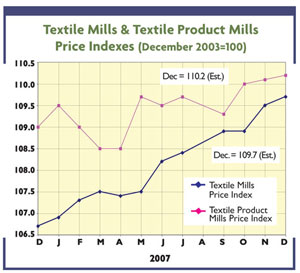
Feb08texpriceindexes


Changing Import Trends

Still another potentially positive sign: decelerating textile and apparel import gains.
Indeed, the latest monthly government report shows incoming totals on a square-meter-equivalents
basis actually running fractionally under year-earlier levels. If nothing else, it represents a
refreshing change from the steady tattoo of increases recorded over the past few years. To be sure,
one month doesn’t make a trend. And

TW
certainly does not expect negative numbers to become the norm. On the other hand, it does
seem to suggest that 2008 incoming textile and apparel shipments may not turn out to be all that
much above last year’s total. Part of this import deceleration reflects the fact that overseas
producers have already captured the lion’s share of these industries’ vulnerable commodity markets
– making further import penetration considerably more difficult. Another part of the import
slowdown can be attributed to the growing success of domestic mills and manufacturers in
establishing niche markets that are a lot less sensitive to cutthroat overseas competition.
Finally, today’s somewhat smaller import gains may also be a reflection of an improving
international exchange rate situation – one where a generally weaker dollar is making it somewhat
more expensive for Americans to buy overseas textile and apparel items. Indeed, there is already
some evidence of this kind of price effect – with Uncle Sam’s import price index for basic textile
products now running some 4 percent above year-ago levels.


A Closer Look At Exchange Rates

The fact that currency rate swings have tended to show significant country-by-country
differences can’t be ignored either. Indeed, in many cases, such changes are forcing major shifts
in global procurement strategies. One case in point: India, whose currency – the rupee – has jumped
11 percent vis-à-vis the dollar over the past year. This rupee runup, by driving up the cost of
Indian apparel, has been forcing US buyers to shift procurement over to neighboring countries like
Pakistan, Bangladesh and Sri Lanka – nations whose currencies are now a lot cheaper.

One JCPenney buyer perhaps best sums it all up: “If we don’t get the right price in India,
we will move elsewhere.” Nor is India the only glaring example of sizable exchange rate swings –
shifts that are making for significant changes in buying patterns. Thus, the better-than 10-percent
and 7-percent appreciations of the euro and the yuan, respectively, over the past year are having
some impact on trade flows from these countries as well.

Perhaps the most important change may now be occurring in China – the United States’ major
source of textile and apparel imports. Note, for example, that Beijing’s currency jumped a
surprisingly large 2.3 percent during the final two months of 2007. Add that onto earlier 2007
gains, and the yuan’s value has advanced some 7 percent in just one year. Moreover, go back to July
2005, when the yuan was first unpegged from the dollar, and the yuan is up a sizeable 13 percent.
All this may already be having some impact on imports from that nation. Incoming Chinese textile
and apparel shipment gains are now running well below the double-digit levels of the previous few
years.


Karl Mayer New Protechna Sales Agency

Germany-based Protechna Herbst GmbH & Co. KG has selected Karl Mayer North America as the new
sales agency for its weaving and warp preparation equipment. Greensboro, N.C.-based Karl Mayer has
successfully represented Protechna’s knitting products for some time.

Karl Mayer will handle sales, service and spare parts sales for Protechna’s Laserstop,
Procam, Warpstop, Camscan and Tensoscan knitting, weaving and yarn preparation equipment. Scott
Hartzell will handle sales for knitting related equipment, while Ken Overly will handle sales of
weaving and yarn preparation equipment.

February 12, 2008

Lubrizol Adds Estane Capacity At Ohio Plant

Cleveland-based Lubrizol Advanced Materials Inc. — a subsidiary of The Lubrizol Corp, Wickliffe,
Ohio — has completed the installation of a new production line at its Avon Lake, Ohio,
manufacturing facility increasing capacity for Lubrizol’s Estane® thermoplastic polyurethane (TPU)
products by approximately 30 percent.

“A key part of the global growth strategy for Estane TPU is to ensure that our manufacturing
facility at Avon Lake, as well as our global facilities in Oevel, Belgium, and Songjiang, Shanghai,
have the capacity to supply our customer base well into the future,” said Mike Vaughn, vice
president and general manager, Estane Engineered Polymers.

“Business throughout the Americas is growing. We have already sold material produced on the
new line, and we expect that the added capacity will complement all of the product development
efforts underway,” added Dale Willis, business director – Americas, Estane Engineered Polymers.

February 12, 2008

Sponsors