Lenzing Expands Tencel® Production

Austria-based cellulosic fiber manufacturer Lenzing AG has expanded capacity at its Heiligenkreuz,
Austria, facility for the production of Tencel® fibers from raw pulp materials. The company
invested 25 million euros to increase production capacity from 10,000 tons to almost 50,000 tons of
Tencel annually and to improve infrastructure at the plant. The site’s second production line now
includes two new spinning lines.

November/December 2008

Going Green: Beyond Marketing Hype


T
he increasing focus on the well-being of planet Earth has engendered concerns about what
effects many products might have on the health of consumers and the planet alike, as well as new
expectations with regard to what goes into the making of those products. Consumers are making it
known that they want products that do not have deleterious effects on the environment, in their
making or their use or their disposal. Partly in response to these expectations, partly out of
their own sense of responsibility, and partly out of a realization that it is economically
beneficial to do so, certain manufacturers are taking steps to reduce the environmental impacts of
their products; and they want to make sure consumers know about their efforts. Other manufacturers
are looking for aspects of their products that they can market with any sort of environmentally
friendly association – whether there is a clear connection or not – in a “greenwashing” effort to
leverage the current eco-sensitivity to their advantage.

As a result, the consumer is receiving messages left and right touting products’
environmental integrity. Marketing materials are full of words such as “green,” “eco-friendly,”
“sustainable,” “renewable,” “recyclable,” “organic” and a host of other related terms. The claims
may not always provide a clear picture of the product’s true environmental impact because the terms
may be used in such a general way as to have no certifiable meaning but rather convey simply an
idea of environmental responsibility; or they may relate to one aspect of a product – for example,
a 100-percent organic cotton garment – while another is clearly not environmentally friendly – that
garment has been dyed using toxic dyes in a process that pollutes the river into which the plant
releases its effluent. If marketing claims cannot be substantiated or are not qualified, or if they
are shown to be deceptive or misleading, that greenwashing has the potential to cause consumers to
become skeptical or, worse, tune out the message altogether when valid claims are made for other
products.

climber
Outdoor apparel marketer Patagonia’s Common Threads Recycling Program takes back worn out
Capilene® base layers and other used clothing to recycle into new garments.

Photo courtesy of Patagonia Inc.


FTC Green Guides

In a move to address green marketing issues, the Federal Trade Commission (FTC) developed
its “Guides for the Use of Environmental Marketing Claims,” also known as the Green Guides, to
provide a framework for voluntary compliance with FTC regulations related to environmental
marketing and advertising practices. First published in 1992, the guides were last reviewed in
1998. With the recent onslaught of green marketing claims, particularly with regard to textiles and
building, the FTC is now considering further revisions, and over the past year has held a series of
workshops to educate the public about the various issues surrounding such claims and receive input
to help it in making the revisions.

The general principles set out in the original Green Guides apply to all green marketing
claims and stipulate that these claims, whether specific or implied, must be substantiated or
qualified in a way that consumers can understand. The guides also provide examples of general and
specific claims to illustrate comparative degrees of clarity or accuracy.

The textile-related portion of the FTC’s workshop titled “Eco in the Market – Green Building
and Textiles,” held in July of this year, brought together representatives of Organic Exchange,
Cotton Incorporated, North Carolina State University, US Customs and Border Protection, the Organic
Trade Association (OTA), outdoor apparel marketer Patagonia® Inc., The Good Housekeeping Research
Institute and Consumer Reports to share their knowledge and ideas about what is and isn’t green and
propose parameters for FTC guidance regarding marketing and labeling of green textiles.


Degrees Of Green

As was pointed out at the FTC workshop, there are varying degrees of green in different
textile products. In some, the materials used may be green, but the manufacturing process may not
be, or vice versa; and marketers need to be clear as to which aspect of a product a green claim
applies. For example, the National Organic Program stipulates that a textile containing a blend of
organic cotton and another material, such as spandex or nylon, must state all of the components and
not just the cotton content.

As another example, one also must be careful when making claims for a product that contains
a blend of organic, biodegradable cotton and recycled polyester in a single textile article. While
each fiber may be sustainable on its own, another issue crops up when they are combined either in a
single yarn or as separate yarns woven into one fabric: It can’t completely biodegrade because of
the polyester content, and it can’t be recycled in a cradle-to-cradle polymerization process
because of the cotton content. It could be cut into strips and used in another textile, say, a rag
rug, or repurposed in some other way, but it still will eventually enter a noncompostable waste
stream. In such a case, the green credentials of the materials can be touted, but biodegradability
or recyclability claims could not be made for the end product unless the two materials can be
separated to go into the relevant downstream processes.

As another, not entirely unrelated, issue, can the same performance claims be made for a
regenerated cellulosic fiber as for the raw fiber from which it is derived? This question has come
up in the case of bamboo, a renewable, fast-growing resource that needs little water and no
pesticides for its cultivation. The raw fiber has antimicrobial and moisture-transport performance
properties, and these properties are claimed for many of the apparel products currently offered on
the market. But, according to workshop presenter Dr. Peter Hauser, NCSU, while these properties are
retained in bamboo that has been processed mechanically similarly to the processing of flax into
linen, it is unclear that they are retained in the more commonly used regenerated solvent-spun
fiber, which is essentially either a rayon fiber – whose chemical-laden processing raises
environmental issues – or a lyocell fiber – which is made using a recoverable and reusable solvent
in a sustainable closed-loop process. Hauser stressed the need for scientific peer-reviewed
documentation of any claims regarding fiber performance. His call was backed up by presenters
Kathleen Huddy, The Good Housekeeping Research Institute, and Pat Slaven, Consumer Reports.


Third-Party Certification

Companies may have their textile products and processes evaluated and certified for their
environmental integrity by a third-party agency such as MBDC; Switzerland-based International
Oeko-Tex Association; Switzerland-based bluesign technologies ag; the International Working Group
of Global Organic Textile Standard (GOTS), a group comprised of OTA and three other associations
promoting the use of organic raw materials; and other agencies. Such certifications serve to assure
consumers that green marketing claims made for those products are valid.

The Oeko-Tex® Standard 100 certifies that textiles from raw materials through end product
comply with prohibitions and regulations regarding the presence of harmful substances, as well as
with criteria related to substances known to be harmful to human health but not yet regulated, and
with other parameters related to colorfastness and pH value. Oeko-Tex also offers a Standard 1000
to certify compliance by manufacturing plant operations with environmentally responsible production
parameters.

MBDC’s Cradle to Cradle Design Protocol and the bluesign® standard encompass, each in one
certification, the entire supply chain and all manufacturing processes that go into a product. All
materials going into a product – fibers, yarns, dyes, chemicals and other components – plus
manufacturing parameters – energy and resource usage, wastewater management, plant emissions,
employee health and safety, and other parameters – are evaluated, and products are certified at set
levels based on the degree of optimization. Both organizations work with clients to help them
design out of their products substances and practices that are harmful to the environment and human
health, and incorporate the most environmentally beneficial alternatives and solutions possible.

GOTS encompasses the production, processing, manufacturing, packaging, labeling and
logistics-related aspects of organic textiles from fiber through end product. Certified products
may be labeled in one of two ways: “organic” or “organic – in conversion,” for products containing
at least 95-percent certified organic or in-conversion fibers; and “made with x-percent organic
materials” or “made with x-percent organic – in conversion materials,” for products containing 70-
to 95-percent or more certified organic or in-conversion fibers.


Transparency Is Key

Ventura, Calif.-based Patagonia has long been committed to environmentalism, from its
sensitivity to the impact of its products on the environment and its commitment to foster the
well-being of the people producing them as well as its direct employees; to building its own solar
collection system to help power its headquarters and implementing other earth-friendly measures in
Ventura and at its LEED-certified distribution center in Reno, Nevada; establishing a
garment-recycling program to take back worn garments for reprocessing into new ones; and giving
back a percentage of its profits to environmental causes; among other measures. The company’s
website offers extensive information about its environmental commitment, including analyses of the
environmental footprints of a number of its products.

In order to promote its eco-textile program, Patagonia labels products with a green E when
they contain at least one-third by weight of what it considers environmentally friendly fibers. The
company also includes additional information about the labeling in its stores and catalogs. 
The fibers that qualify for this designation include organic cotton, hemp, chlorine-free wool,
recycled polyester, recycled nylon and Tencel®.

In 2007, Patagonia became the first brand globally to become a member of the bluesign
standard. As a brand member, it has committed to promote implementation of the bluesign standard
throughout its supply chain.

Rob BonDurant, Patagonia’s vice president of marketing, speaks to the need for transparency
in green marketing: “If green marketing is a first step for a company, we believe it’s a good first
step in the right direction. Eventually, customers are going to want to know the specifics behind a
company’s green marketing claims – and companies will be either inspired or literally driven
towards making changes in the way they do business. At Patagonia, we believe that transparency is
key. Corporate honesty begets customer loyalty. When a customer knows they can come to you to learn
about where your product came from, who made it and what it’s made of – everybody wins.”


What Is Green?

Green connotes the general idea that a product or a process is beneficial to, or at least
has minimal impact on, the environment with regard to energy, resource and raw material usage;
greenhouse gas and toxic emissions; and/or waste generation. It often is interchangeable with
environmentally friendly, eco-friendly and other general terms.

Sustainable is a broader term that encompasses not only the environment, but also economic
and social equity considerations. A sustainable product has minimal impact on the environment in
that harvesting or resource usage does not deplete or permanently damage the resource; plus, it can
be produced in an economically viable way and it is produced with consideration for the welfare of
employees and others impacted by the production.

Cradle-to-cradle refers to a regenerative life cycle in which no material making up a
product becomes waste because noncompatible materials in the product can be separated and all can
be recycled and reused for the same purpose as the original virgin material. This is in contrast to
a cradle-to-grave product that cannot be recycled and ends up in a landfill at the end of its
useful life, or a cradle-to-gate product whose environmental footprint has been calculated from raw
material acquisition through the manufacturing process.

The term “cradle to cradle” was coined by Charlottesville, Va.-based McDonough Braungart
Design Chemistry LLC (MBDC), a design consultancy that advises companies in the area of what it
calls eco-effective product design, taking into account all aspects of production and material use.
MBDC also is a third-party certifier, using its Cradle to Cradle Design Protocol to assess
materials and processes according to environmental and human health criteria.

As noted elsewhere, there are numerous other terms as well that are used in describing a
product’s and process’s environmental integrity or function.


The Greening Of The Cotton Supply Chain

A video produced by Cotton Incorporated examines new processing technologies that are
significantly improving the sustainability of the entire supply chain for cotton products. While
cotton cultivation practices have improved vastly in recent years, including the development of
varieties that have increased yields and require far less chemical and water input, new dyeing and
finishing technologies also require fewer chemicals and consume less energy and water while also
releasing cleaner effluent. Process technologies highlighted include new enzymes and ozone
technologies that replace harsh chemicals in fabric finishing, very low-moisture foam dyeing
technologies, waste- and solvent-eliminating digital printing technologies, low-salt reactive dyes,
bleaching processes that drastically reduce water and energy use, and technologies that combine
dyeing and finishing in one step, among other technologies. The video also presents the point of
view of respected retailers who expect

manufacturers to implement these new green technologies as a prerequisite to a continuing
business relationship.

The video, “Textiles: The Sustainability Revolution,” can be viewed at
www.textileworld.com/video/cotton.html


November/December 2008

Orders Becoming Smaller


T
he current economic uncertainty has made already nervous retailers even more
inventory-conscious and has resulted in a significant decrease in the volume of orders for
spinners.

“Orders here are becoming very erratic and short,” said one Georgia specialty spinner. “They
will be quick delivery only. Retailers don’t seem to be interested in filling their stores right
now; they are buying as little as they can.”

Added another: “We’re still running flat out. But our orders are much smaller. Everything we
get is small and quick-turn.”

A North Carolina spinner said: “Uncertainty is something we’re all going to have to deal
with. No doubt, we see much uncertainty in retail. Our customers tell us that retailers are waiting
until absolutely the last minute to place orders. And when they are replenishing, if they sell 10,
they replace five. They have become very careful about managing their inventories – no one wants
anything going forward.

“Frankly, we’re having to take some risks in the credit market we would prefer not to take,
but in order to help keep our customers in business, we don’t have any choice but to do that,” he
added. “Many of our customers are not as strong right now as we would like for them to be. Some of
our customers that have been somewhat marginal have found it very difficult to get their bankers to
work with them. They are not giving any leeway.”

Several spinners expect an upturn in orders shortly after the holidays. Said one: “This year,
especially, I think you are going to see retailers drop their prices to the minimum to clear their
shelves. I anticipate that will result in a sharp increase in orders. But it is likely to be very
short-term.”


Infrastructure Question

One major spinner is increasingly concerned about the vanishing textile infrastructure in the
United States. “Our knitters are gone, our weavers are gone, the apparel manufacturers are gone,
particularly the cut-and-sew. For the few that are left here, they’re doing OK. But I’m hearing
from a lot of companies that were doing business in China who are no longer enamored with that way

of doing business. They might like to source a little closer to home, but they have capacity
concerns.”

Relating to China, one spinner in the upholstery market said he is hearing positive news
about the potential return of substantial upholstery fabric business to the Western Hemisphere. “We
hear over and over that some of the furniture people that have tried to buy fabric and kits in
China are not as happy with it now as they once were.”


Package-Dyed Yarns

It has been no secret that the US package-dyed yarns business has suffered for some time as a
result of overcapacity in the marketplace. “At some point, there had to be some rationalization of
capacity, and that has now happened,” noted one spinner, referring to the recent closings of
Spectrum Yarns, Burke Mills and Grover Industries. “While unfortunate, this may present some
opportunities for those of us who are still in business.”


Election Impact

Several spinners believe the US general election has added to the recent slowing of orders.
“Many companies have been taking a watch and wait approach to business in election years,” said one
spinner. “I believe, regardless of outcome, that there will be some confidence-building going on as
far as consumers are concerned, and they will go out and buy some things.”


Odds And Ends

Following are quotes from spinners in various industry segments:

“The knit outerwear trade has been extremely weak.”

“Our hosiery business continues to hold up fairly well, but a reason for that is that we
don’t deal in commodity socks. We target a price range that’s a little higher.”

“The industrial markets, for industrial upholstery, workstations, office furniture and the
like have been very soft.”

“Most of our orders have been in light counts. We’ve seen very little in heavy counts.”

“Fiber prices are not coming down as quickly as we think they should, especially on acrylic.
It looks to us like the chemical companies have kept the supply tight to keep their margins up.
That’s caused a lot of people to move out of acrylic into polyesters.”


November/December 2008

A Disappointing Year


G
eneral economic woes and uncertainties are combining to take their toll on textile
activity. Year-to-date shipments of basic textiles at latest report were lagging behind comparable
2007 levels by more than 6 percent. And in the case of more highly fabricated products, the
year-to-year decline was an even more disturbing 9 percent. Retail sales of apparel products also
have recently dipped into negative territory. More important, the upcoming holiday season isn’t
very likely to provide any turnaround. To be sure, the National Retail Federation (NRF) recently
predicted that Christmas sales would rise 2.2 percent this year. But that’s only about half the
10-year average. Also, the fact that retail apparel prices have edged up in some instances over the
past 12 months would seem to suggest that the NRF-forecast gain in real terms would be fractional
at best. Moreover, since this projection was made before the big Wall Street meltdown, the final
pushers may be hard-put to even equal, much less top, last year’s level. Still another telltale
sign of buyer pullback: Consumer credit has started contracting for the first time in a decade.
Given all these developments,

Textile World
editors are again revising their overall 2008 textile prediction. Right now,

TW
sees shipments of combined basic and more highly fabricated textile products falling as much
as 9 to 10 percent — well above the 5-percent and 8-percent declines of 2006 and 2007. It’s also a
big difference from as recently as six months ago, when little more than 5- to 6-percent slippage
was anticipated.

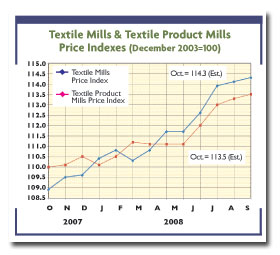
bftextileindices


Early 2009 Outlook

The really big question these days, however, is not about 2008, but rather how the new year
will fare. The answer: Not well, but perhaps not as badly as some purveyors of doom and gloom would
have us believe. To be sure, we’re still not out of the woods, and clearly, the general economic
picture leaves a lot to be desired. But

TW
believes any additional gross national product (GDP) declines over the next few quarters will
be manageable, thanks to a combination of factors — including the recent spate of bold US
fiscal and financial moves, lessening inflationary pressures, and the quick inventory response to
less-than-hoped-for demand.

On the inflation front, for example, crude oil and gasoline tags continue to decline, thus
leaving more money for other purchases. And there has been little inventory buildup, both overall
and in the case of textiles, where days’ supply is pretty much where it was a year ago. Upshot: the
big inventory corrections that traditionally have accompanied economic downturns will be relatively
mild this time around. Factoring in all the above into their forecast equations, economists
responding to a recent Wall Street Journal survey confirm

TW
’s feeling that near-term GDP declines will be relatively modest.

The same is likely for textiles and apparel — especially since a big portion of today’s
spending cutbacks seem to be centered in big-ticket durable goods items like cars — thus
leaving  a bit more cash available for clothing and home furnishings. 


Thoughts On Imports

The US trade situation will also require some close monitoring over the next few months.
True, incoming shipments of textiles and apparel on a square-meters- equivalent-basis have not
proved to be that much of a problem this year. Indeed,  figures covering the first 8 months of
the year show a decline of nearly 6.5 percent when compared to a year earlier. Even incoming
shipments from China are down about 3 percent, but this slowdown is not guaranteed to continue
because current safeguards on many categories of American textile and apparel imports from the
nation are scheduled to end in January.

The big fear is that this could result in another huge surge such as the one following the
January 2005 discontinuation of quotas. At that time, Chinese textile and apparel shipments to the
United States soared by more than 1,000 percent in some product lines. Hopefully, this huge jump
won’t be repeated this time around. In any event, Washington lawmakers are pressuring for new
safeguards aimed at establishing new monitoring procedures, including the possible implementation
of new quotas and/or tariffs, that could go into effect almost immediately. Because chances for
some action seem fairly good,

TW
  remains optimistic that further big import gains won’t be a major industry problem.
Indeed,

TW
is hopeful that Chinese imports in 2009 can be held close to current levels.

Tall Orders For New Administration And Congress


U
S textile manufacturers will be pressing the new Congress and administration taking over
in January to act on what they feel is a good deal of unfinished business left behind by the Bush
administration and the 110th Congress. While it will take some time to get administration trade
officials nominated and confirmed, textile and other manufacturers are looking to the government to
stem the flow of imports and their impact on manufacturing jobs. They, along with retailers and
other importers, look for a busy year on the trade front.


Free Trade Agreements

The Bush administration negotiated some 25 free trade agreements (FTAs). Textile
manufacturers generally supported those agreements when they provided a yarn-forward rule of origin
and limited amounts of inputs from non-participating countries if it appeared that the
participating countries presented market opportunities for US yarn and fabric in apparel
manufactured in those areas. The broader-based American Manufacturing Trade Action Coalition, which
includes textile manufacturers, has been less than excited about the FTAs, as it has felt that many
of the countries involved do not provide anywhere near the overseas market opportunities for US
goods that they do for increased imports. US importers of textiles and apparel do not like the
yarn-forward requirements and limits on products from non-participating countries, as they believe
they restrict sourcing opportunities.

There is not much likelihood that new free trade agreements on the scale and scope of the
Bush administration will be negotiated, at least not very soon. There is increasing congressional
concern about reciprocity and other considerations such as human rights, working conditions and
environmental protection. It will be virtually impossible to negotiate new agreements until
Congress renews the president’s Trade Promotion Authority, which says Congress can only approve or
reject an agreement without any amendments. That authority expired last year, but there is
considerable sentiment to renew it.


China Trade

While there is widespread concern about the trade deficit in manufactured goods, more than
half of which is accounted for by China, there continues to be considerable reluctance to get tough
with China. This is due in large measure to the facts that retailers rely heavily on Chinese
imports and multinational corporations have major involvements in China, and no one wants to pick a
fight.

In order to stem an increasing flow of imports from China, US textile manufacturers and
organized labor are banking on an import-monitoring system that could lead to the imposition of new
import quotas and/or other trade sanctions. Two avenues are being pursued. One would be a
monitoring program by the Department of Commerce that could lead to imposing anti-dumping  or
countervailing duty tariffs on goods if it is determined that Chinese goods are being unfairly
subsidized and dumped in the US market. A second approach being taken by the House Ways and Means
Committee would direct the International Trade Commission to monitor trade and its impact on the US
economy. If there is sufficient indication that Chinese imports are disrupting the US market or
threatening to do so, import quotas or tariffs, or both, could be imposed. In both cases, the
monitoring efforts would have to have the support of the president. While a monitoring program
would be confined to the US

market, the effort has been joined by textile and apparel trade associations from 16 other
countries that believe a surge in Chinese exports into the US market would eat into their share of
the market.

Textile officials both here and abroad are concerned about what they say is China’s
manipulation of its currency in order to gain an unfair advantage in trade. Congress has taken some
tentative steps to address the currency issue, but nothing has come of it. One bill, sponsored by
Reps. Duncan Hunter, R-Calif., and Tim Ryan, D-Ohio, would declare currency manipulation an unfair
trade practice and give injured parties the right to seek compensation under US countervailing duty
laws. Another measure, sponsored by Sens. Charles Schumer, D-N.Y., and Lindsey Graham, R-S.C.,
would impose a 27.5-percent punitive tariff on Chinese goods in order to offset the advantage of
what is viewed as unfair subsidy. Importers of textiles and apparel are strongly opposed to these
measures, charging that they would increase the costs of consumer goods and limit their choices.
They say that similar efforts in the past have failed to protect US manufacturing jobs.


Trade Enforcement

Reps. Charles B. Rangel, D-N.Y., chairman of the House Ways and Means Committee, and Trade
Subcommittee Chairman Sander Levin, D-Mich., will most likely retain their leadership positions in
the next Congress and can be expected to reintroduce their Trade Enforcement Act of 2008, which is
designed to help the United States enforce its international trade rights and attack non-tariff
barriers to trade. The legislation would create a Director of Intellectual Property Rights
enforcement and an advisory committee to address property rights issues. It would increase staffing
and add better training for expanded Customs and immigration enforcement. It would require the US
Trade Representative (USTR) to identify and annually report on foreign government trade barriers
and take action to eliminate them. It also would create a Congressional Trade Enforcer to
investigate trade barriers, and calls on the USTR to file cases and make great use of US trade
remedies such as countervailing duties to combat unfairly subsidized imports from non-market
economies, such as China.


Job Loss Assistance

While there is considerable congressional interest in renewing and upgrading trade
adjustment assistance (TAA) for workers who lose their jobs as a result of import competition,
bills that would do that were held hostage in view of other trade legislation in the waning hours
of the 110th Congress. The proposals, which likely will be reintroduced in the new Congress in one
form or another, would expand TAA eligibility, reduce the requirements for receiving aid, shorten
the time frame for processing applications and provide increased funding for retraining.


Copyright Protection

The Bush administration was successful up to a point in putting pressure on China to do a
better job of policing intellectual property rights violations, and US textile manufacturers would
like to see more of that. One specific area of concern is the so-called “Orphan Works,” for which
it is difficult or impossible to contact the copyright holder of a design. US manufacturers often
have a comparative advantage with their ability to produce copyright and patented designs, but that
advantage is lost when their designs are knocked off by overseas manufacturers. Legislation to
address this problem was introduced in the last Congress, but it was not enacted. Rep. Howard
Berman, D-Calif., chairman of the House Judiciary’s Subcommittee on Courts, the Internet and
Intellectual Property, is the main sponsor of the bill, and textile manufacturers would like him to
give it another shot in the new Congress.


Changes Sought In Government Procurement Of Textiles

Textile and apparel manufacturers are seeking ways to improve and expand government
procurement of textile products. Although it is a long shot, they are supporting legislation that
would extend the Buy American principles currently required for textile and apparel purchases by
the Department of Defense to the Department of Homeland Security (DHS). Legislation introduced but
not enacted in the 110th Congress would have prohibited the DHS from purchasing certain items,
including clothing, fabrics and sewn products from overseas, if the products are available from
domestic sources. Textile manufacturers will be asking their supporters in Congress to try again.
In addition, two coalitions, comprised of major US textile and apparel trade associations, are
involved in stepped-up efforts to streamline and improve military procurement practices in an
effort to make it easier and more practical for domestic manufacturers to do business with the
military.

November/December 2008

AF&Y Shuts Down Operations

Chapel Hill, N.C.-based American Fibers & Yarns Co. (AF&Y) has discontinued operations and
closed its two plants in Bainbridge, Ga., and Afton, Va., and plans to liquidate its assets under
Chapter 11 bankruptcy protection. Including manufacturing and corporate employees, approximately
330 people have lost their jobs.

The company was a major supplier of solution-dyed polypropylene filament yarns for
residential and contract furnishings fabrics as well as a supplier of product for industrial,
automotive and apparel applications. Its Marquesa® and Innova® yarns offered earth-friendly,
inherent performance attributes, and AF&Y had initiated a program for recycling fabrics made
with its yarns.

AF&Y cited increased offshore residential upholstery fabrics sourcing, high polypropylene
resin prices, competition from polyester producers, price pressure from lower-cost imported
textiles and the current economic decline as factors leading to the shutdown. The company also had
been unable to secure additional financing or sell portions of the business.

RAS Management Advisors LLC, Newport, R.I., is assisting AF&Y in its efforts to wind down
the business and settle its affairs.

Remarking on the cost increases for polypropylene resin and competition from polyester-based
products, Timothy Boates, president, RAS, said: “For a long time, there was a real value
differential that AF&Y benefited from, where its products were cheaper than polyester-based
products, but the price of raw materials has gone up so sharply over the last couple of years that
that price advantage has turned the other way around. Right now, there’s a substantial negative
price variance between our product and polyester-based product.”

November/December 2008

Milliken Floor Covering Named Sustainability Mentor Of The Year

Spartanburg-based textile and chemical manufacturer Milliken & Company has received Mentor of
the Year awards from the Partnership for a Sustainable Georgia for Milliken Floor Covering’s Live
Oak Complex and Hillside Plant in LaGrange, Ga. Each year, the Partnership for a Sustainable
Georgia presents the award to an organization that is helping the state become more sustainable by
educating other companies on the benefits of environmental improvements such as pollution
reduction.

“Milliken & Company’s Live Oak Complex and Hillside Plant worked together to mentor local
medical facilities, municipalities, businesses and organizations on the importance of pollution
reduction,” said Suzanne Burnes, assistant director of Georgia’s Pollution Prevention Assistance
Division (P2AD) and manager of the Partnership for a Sustainable Georgia.  “We look to see
other organizations in Georgia follow their lead.”

The Live Oak Complex and Hillside Plant carpet manufacturing facilities joined the
Partnership in 2006 as a Gold Level partner, the highest achievement level. Gold Level
organizations can retain membership for life, as long as they continue to demonstrate improvement.
Milliken Floor Covering, whose carpet products have been certified carbon-neutral, employs
alternative energy in its operation and since 1999 has sent no waste to landfills.

P2AD, a non-regulatory division of the Georgia Department of Natural Resources, created the
Partnership for a Sustainable Georgia to promote environmental leadership and acknowledge
excellence in environmental performance. Membership in the partnership is free of charge and open
to any organization or business that operates in Georgia.

November/December 2008

South Carolina Textiles Summit Focuses On Industry’s Future

Three studies released at a textile industry summit held last week in Spartanburg indicate the
industry still has much to contribute to South Carolina’s economy, even as it is changing to
reflect a new dynamic.

“The Future of Textiles in S.C.” was organized by New Carolina™, South Carolina’s Council on
Competitiveness, a public-private partnership established to help increase per capita income and
promote a competitive business climate in South Carolina.  The summit brought together 100
textile industry and economic development leaders to talk about the industry’s future and find new
competitive avenues in the state. The program included a presentation of findings from three
studies commissioned by New Carolina: “The Contribution of the Textile and Apparel Cluster to the
South Carolina Economy,” and “South Carolina’s Textile and Apparel Industries: An analysis of
Trends in Traditional and Emerging Sectors,” both conducted by Clemson University researchers; and
” Improving the Global Market Competitiveness of the Textile Industry Cluster in S.C.,” conducted
by North Carolina State University researchers. New Carolina also launched
www.SCTextileConnect.com, an Internet resource
for the South Carolina textile industry.

The summit is part of a larger effort to build a cluster of textile-related companies that
can collaborate to develop and expand their offerings and thereby attract jobs and investment to

bolster the state’s economy.

“By building the textiles cluster in South Carolina, we can increase productivity of existing
companies in the state, drive innovation, stimulate the formation of new businesses within the
cluster, and recruit new companies to the state,” said George Fletcher, executive director, New
Carolina. “Contrary to a widely held belief, textiles are not dead in South Carolina. In reality,
the industry is reinventing itself, becoming more high-tech and high-skill. South Carolina is in an
ideal position to capitalize on the high-paying jobs that will come from this re-emerging
industry.”

November/December 2008

Cone Denim Cuts Operations At White Oak Plant

Greensboro, N.C.-based Cone Denim, a division of International Textile Group Inc. (ITG), has
announced it will shut down the yarn operation and reduce some weave capacity at its White Oak
Plant. The action, which is expected to be completed by the beginning of December, will impact some
150 employees.

“Our operation at White Oak remains the primary platform for servicing and growing the
premium jeans market in the US and Europe,” said Delores Sides, director, corporate communications
and human resources, ITG. “The premium segment has also been impacted by the slowing economy, and
we are making changes at the plant to better align our operations with current demand and global
cost pressures.”

Sides said going forward, the plant will purchase yarn externally for its weaving operation.


November/December 2008

Palmetto Synthetics To Expand Plant

Kingstree, S.C.-based Palmetto Synthetics LLC — a manufacturer of polyester, nylon, and other
specialty man-made staple fibers — plans to invest $3 million to expand its 100,000-square-foot
manufacturing facility. The project, the first of a two-part expansion, will add 30,000 square feet
of space, a new production line and 25 new employees at the plant. The expansion is scheduled to be
finished and the new line to begin operations by February 2009.

“Palmetto Synthetics produces high-quality specialty polyester fibers used in a range of
applications, from apparel to automotive products,” said Joe Taylor, South Carolina’s secretary of
commerce. “The company’s decision to expand its facility in South Carolina speaks favorably to the
state’s business-friendly climate and skilled workforce. Thanks to the efforts of state and local
officials, Williamsburg County will benefit from this investment.”

November/December 2008

Sponsors