The Rupp Report: Farmer Or Hunter?

If future generations are looking back in history books, they will probably see 2008 described as
an historic year. They also will notice that mankind didn’t learn anything but to forget. And,
therefore, some scientists maybe will recognize that the human brain is still the same as it was
when homo sapiens started its evolution: hunter or farmer. But one after the other …

Farming

In the early days of modern mankind, human beings hunted for their daily food. Over time,
they started to recognize that hunting only wouldn’t be enough to survive. Thanks to farming, which
means seeding and then harvesting, mankind’s situation improved over the millennia. When they
became farmers, humans settled down and modern life started to develop. First seeding and then
harvesting. Hunting only was not the solution to survival. Before earning something, you’ve got to
do something. So far, so good.

Since that time, this system has applied to almost every manufactured product at all levels.
Everyone tried to produce something, and then swapped it for something else. Of course, over time,
there were always hunters who tried to harvest without seeding. Around 400 B.C., Sun Tzu said in
his book “The Art of War” that interminable war will bring no profit to a country whatsoever.


Hunting


Later money was invented. Then in 1817, some traders rented a hall in Wall Street Building
No. 40, and money trading began. This was the beginning of the New York Stock and Exchange Board,
as it was known at that time. The rest is history: Trading and selling became commonplace around
the world. However, on Tuesday, Sept. 3, 1929, the first big erosion started in the afternoon when
shares of US Steel dropped in value. Within a few weeks, the situation accelerated into “Black
Friday” Oct. 25, 1929. It was obvious some people became rich with virtual money, and some became
poor with true debts. And was a lesson learned? Not at all.

Over the years, Black Friday was forgotten, and the hunters were on the road again. The
textile industry began to change its traditional face, too: Markets moved to the East from the
Western Hemisphere. And, even worse, the old entrepreneurs and patrons died off. The younger
generation was and is not a kind of farmer, but more of a hunter. While old-style patrons showed
responsibility for their people, the younger generation didn’t. Modern market theories
indoctrinated students to forget about personal responsibility, and to have a look at the
shareholder value.


Ups And Downs


The latest upswing culminated in 2007, which was one of the best years for the global
textile industry in recent decades. Money was available to invest, and manufacturers around the
world bought a lot of modern equipment. Order books were full, and delivery times were up to 10
months. The music was playing mainly in China and India, and the result was ITMA Asia + CITME,
which took place in Shanghai in 2008.

However, back in 2007, some wise people mentioned that this rally couldn’t go on forever. It
was mentioned in a past Rupp Report that gambling shouldn’t be done with borrowed money. Parallel
to the soaring stock markets, energy costs increased drastically, and, of course, raw material
prices too. A barrel of oil cost more than $140 — some people said that these prices were mainly a
matter of speculation. Stock markets went mad and everybody was hunting for money. And the same
story happened again. With more borrowed money, so-called “structured products” handed over the
responsibility in a snowball system and collapsed. And now the same people are weeping for help.
And who’s helping the world textile industry to invest with cheap loans?

There is no need to sum it up again: The downward trend has been heavier than ever over the
last six to seven decades, thanks to virtual prosperity and now, true debts. It’s common sense —
the textile and textile machinery industries are used to ups and downs. However, it’s quite amazing
to see that in these hard times, companies with patrons remaining are not losing their will and
confidence — the farmers are back on stage.

Do you know some entrepreneurs? Tell us their story at
jrupp@textileworld.com

December 9, 2008
Heimtextil 2009 Speakers, Bedding Certificate Training Course Announced

The upcoming edition of Heimtextil Frankfurt — the international trade fair for home and contract
textiles, presented by Frankfurt-based Messe Frankfurt Exhibition GmbH — will feature a variety of
leading speakers during the four-day series, “Let’s Talk About It,” to be held Jan. 14-17, 2009.

The “Let’s Talk About It” lecture series is an opportunity for manufacturers, dealers and
designers to exchange information about the latest developments in the bedding sector. The first
subject area, “Eco Luxury — Green Business — Innovation” will cover sustainability in textiles. The
speakers will include experts from organizations such as Switzerland-based Schoeller Technologies
AG, Germany-based Hohenstein Institutes and the Advisory Committee of the Government of the United
Arab Emirates, among others.

On January 16 and 17, dealers and retailers will have the opportunity to obtain the
Heimtextil Bedding Certificate by participating in lectures and workshops. The Heimtextil Bedding
Certificate is a supplementary qualification supported by Germany-based LDT Nagold – Specialist
Academy for Textiles and Shoes, the Federation of German Textile Retail Trade, the Association of
the German Down and Feather Industry, and the Germany-based Chemical Fibre Industrial Association.

December 9, 2008

Huntsman To Downsize As Part Of Restructuring

The Woodlands, Texas-based chemical manufacturer Huntsman Corp. has announced it plans to make
significant job cuts as part of the company’s move to adopt a new structure for its Textile Effects
business and to help cut annual costs by $60 million
(See “
Huntsman
Textile Effects Business Adopts New Structure
,
www.textileworld.com, Dec. 2, 2008.)
Huntsman globally has redesigned its
overall organization to move from a product-centric model to a consumer-facing organization. The
cost cuts apply to all nine segments of the Textile Effects business, which now comprises Apparel
& Home Textiles and Specialty Textiles. Though the consolidation is global, there is a higher
impact in Europe.

Huntsman will eliminate approximately 470 jobs in its Dyes and Textile Chemicals business —
approximately 12 percent of that unit’s current workforce of 3,700. The company already has trimmed
production in Langweid, Germany, as a result of a drop in volumes, eliminating 150 employees at the
site. According to Huntsman Director of Global Communications Guy Wolff, the company also intends
to halve the number of sales offices and laboratories globally as well as drop unprofitable
products.

The Specialty Textiles business will remain centered in Europe and the United States, and the
Apparel & Home Textiles business will remain centered in Asia.

December 9, 2008

Rieter Announces Lower 2008 Sales And Profits Than Forecast, Unveils New Website

Switzerland-based Rieter Holding Ltd. announced sales and profits for the Rieter Group will be
lower than any forecasts for the year. The company cites the current global economic downturn,
which has negatively impacted both textile machinery and automobile markets.

The Textile Systems Division reports received orders are expected to decline 65 percent in
2008 when compared to 2007 figures, and sales will decline some 30 percent. Operating profits
before special charges also will not meet forecast figures.

Decreased demand for automobiles worldwide also has affected sales for Rieter’s Automotive
Systems Division.

After reporting reduced profits in the first half of 2008 and anticipating lower sales for
the rest of the year, Rieter launched an extensive restructuring program
(See ”
Rieter
Reports Substanstial Downturn In Machinery Demand
,” Aug. 19, 2008,
www.TextileWorld.com)
. The program included the transfer of manufacturing
operations and capacity adjustments in addition to a hiring freeze, termination of temporary
employees, overtime reductions and early retirements.

In addition to the measures previously implemented, Rieter is reducing capital expenditures
and is working to lower working capital. The company also continues to implement part-time work
schedules for employees in North America and Europe, as well as layoffs of both temporary and
permanent personnel. The restructuring will cost the company some 250 million Swiss francs, and
impairment charges on goodwill amounting to 100 million Swiss francs will have to be recognized.

Rieter expects consolidated sales in 2008 to be more than 20 percent lower than in 2007.

In light of the current unsettling financial picture, Rieter said it will not make any
financial forecasts for 2009 at this time.

In other company news, Rieter Group has launched its new website, which offers a more clearly
structured, user-friendly navigation so visitors can quickly locate group and division contacts and
information. The site, located at
www.rieter.com, features an Open Source Content Management
System, enabling the company to frequently update, expand and optimize the content. The Rieter
Textile Systems section is now available in Chinese and Turkish as well as in English and German.


December 9, 2008

BASF To Use Imports To Secure Formic Acid, Methylformate Supply

BASF Corp., the Florham Park, N.J.-based North American affiliate of Germany-based BASF SE, is
increasing its imports of both formic acid and methylformate, a precursor of formic acid, into the
United States so it can continue supplying customer demand.

Dallas-based Celanese Corp., which currently produces most of the formic acid sold by BASF in
the United States at its Pampa, Texas, plant, will shutter that facility in early 2009. 

“BASF has set up a supply chain and a new logistics infrastructure to ensure that customers
will have a reliable supply,” said Teressa Szelest, group vice president, BASF Intermediates
business in North America.

BASF — the world’s largest supplier of formic acid, with a worldwide capacity of 255,000 tons
per year — has formic acid and methylformate production operations in Germany and at its joint
venture plant in China.

December 9, 2008

Operations Remain Strong, But Orders And Backlog Down


T
he US government has finally confirmed what many in the textile industry have known for
some time – that the economy has been in a recession since December 2007. And yarn spinners are
beginning to feel the effects, as retailers have begun to dramatically slash inventories and
curtail new orders.


“We’re still running a full schedule,” said one North Carolina spinner. “But our backlog is
shrinking fast. We should be fine through the holidays, but I expect the first half of the new year
to be very difficult.”


Said another: “Our operations are still steady and full, but we’ve started to see orders
dwindle. That doesn’t really surprise us this time of year. It’s business as usual. The real test
is going to be whether they pick up again after the holidays. We’re not concerned yet. But, come
January, we will start having some concerns if we don’t start seeing some business come our way.”


Spinners seem to be of different mindsets about business prospects in the first quarter. “I
don’t think you are going to see retailers order anything they don’t think they can move in a
hurry,” said one spinner. “They will maintain low inventories and stock only what they need. If all
the forecasts  I’ve seen are correct, I don’t know that we will see any real positive moves in
the market until June, maybe later.”


However, another spinner said reduced retailer confidence may work in favor of spinners,
particularly those in the Western Hemisphere. “With the poor environment at retail, we know a lot
of retailers are cancelling current orders and diverting shipments already on the water – they’re
not taking any inventory – and there won’t be anything left on the shelves post-holiday. After the
holidays, the retailers are going to need product, and it’s going to benefit spinners in this
hemisphere, just from a quick supply standpoint. So I believe there will be opportunities the first
half of the year, especially for those spinners that can be nimble in their response.”


Pricing Pressures


The price of cotton has been on a roller coaster ride this year, spiking to near 80 cents per
pound in midyear. Many spinners, after struggling mightily with the issue, were finally able to
pass some of those increased raw material costs along to customers. Since June, however, the price
of cotton has plummeted – all the way to 43 cents per pound in early December. As a result, many
customers are now looking for across-the-board cuts in yarn prices.


“There’s a lot of pressure on pricing right now,” said a specialty spinner, “because
everybody has become a cotton expert. It seems customers think yarn  prices should be
specifically congruent with raw material costs. It’s funny, though, that they didn’t see it that
way when prices were going in the other direction. We have not instituted rate cuts, but consider
each order individually.”


Supply Chain Integration


One spinner noted that business often is lost as a result of not keeping up with changes in
the supply chain. “US manufacturers are challenged in dealing with the constantly shifting supply
chain structure in the Western Hemisphere,” he said. “With all of the consolidations, plant
closures and relocation of plants to Central America, it’s difficult for US manufacturers to stay
involved in that supply chain. For example, if we are involved with a US garment manufacturer and
they make a decision to close US production and source in Central America, the customer may rely
upon the Central American vendor to do the full package, including sourcing the yarn.


“We want to be very much involved in that yarn sourcing, so we have to constantly watch the
market and make sure we integrate ourselves into our customer’s sourcing strategy.”


December 9, 2008

Another Negative Quarter


T
he year is ending on a rather dismal note. To be sure, consumers are still buying apparel
and other holiday gifts. But, by and large, the number of purchases are fewer and generally cost
considerably less than previously anticipated. In any event, it’s shaping up as the weakest
Christmas season in decades. The result: more downward revisions in our November/December
big-picture business forecast — from the very modest overall retail gain predicted a month or two
ago to perhaps a sizable decline. Some recently released surveys would seem to confirm this
basically downbeat outlook. A few weeks ago, for example, the Hay Group, a big consulting firm,
queried the 40 largest retailers, and the results were pretty sobering: Three out of five said they
expected November/December sales to be no better than flat, with many of the remaining respondents
anticipating declines as high as 15 percent. It’s all in sharp contrast to a similar September
survey, when the majority of retailers were talking in terms of a 5- to 10-percent jump in holiday
sales. The story is much the same when viewed from the consumer perspective. The NPD Group, for
example, finds 25 percent of queried families planning to spend less this Christmas — more than
double the number feeling they’d be spending more. And as might be expected, declines cover all
goods, including many domestic textile and apparel products. As such, mill shipments — already down
8 percent over the first nine months — could be off by as much as 10 percent by year end. That
would be the industry’s worst performance in nearly a decade.

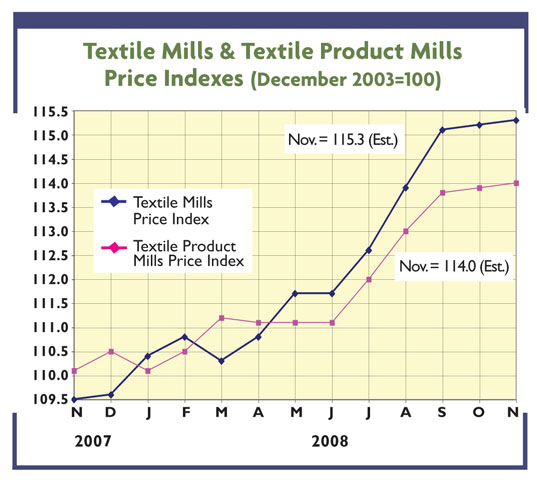
BFDec08graph


A Look At Early 2009


Nor is it likely that the next few quarters will see any appreciable textile turnaround.
True, all the fiscal and financial aid being funneled into the economy by Washington should have
some positive effect. But it will all take time, especially with consumer confidence still near an
all-time low. While making any pinpoint predictions under these conditions is risky,

Textile World
editors feel that general business activity will continue to decline, though hopefully at a
less precipitous pace. And again, this will be having a negative effect on textile and apparel.

TW
’s best bet: another 3- to 5-percent slippage in textile production and shipments through
next June. After that, if all goes well, a more significant industry bottoming-out could be in the
cards. But to achieve this, US officials will also have to keep a sharp eye on imports — especially
from China, where fears of a similar-to-US downturn has halted an further upward revaluation of the
nation’s currency — the yuan — and resulted in increased Beijing rebates on taxes charged to their
textile, apparel and other exporters. More importantly, Washington’s top priority has to be put on
effecting extensions on still-existing Chinese export curbs — caps that are targeted to expire at
the end of the current year. One hopeful sign: The incoming Obama administration has been hinting
it might be somewhat more willing to protect US industries. So has the new Congress, many members
of which were selected on the promise to further level the still badly distorted international
trade playing field.


A Few Other Positives


There’s also a modicum of additional good news to balance out all of today’s gloom and doom.
For one, despite all the recent declines, the US textile and apparel industries are still managing
to turn a profit. True, earnings and margins are down when compared to last year — but not any more
than many other key US industries. Indeed, our mills seem to be faring a lot better than some other
hard-hit sectors like autos and big-ticket appliance lines. Credit here has to go to increasingly
savvy textile/apparel management personnel. They’ve helped avoid a major crisis by forging new
global alliances, coming up with continuing new and improved products, reacting quickly to changes
in consumer tastes, and last, but not least, cutting costs. This improving cost performance has
also been aided by the recent tumble in cotton prices — from a peak of near 80 cents per pound
earlier this year to only around 40 cents per pound at latest report. Much of this fiber drop can
be traced to the worldwide economic crisis. But basic supply/demand forces are also playing a role.
More to the point: Global consumption this year, according to Cotton Incorporated estimates, could
actually show a fractional decline — enough to keep overall supplies, as measured by the stock/use
ratio, at relatively high levels. And there’s even some hope for lower costs in the other major
fiber sector — man-mades. True, quotes here are still running considerably above a year ago. But
this, too, should change on a combination of slower demand, excess capacity, and sharply reduced
petroleum-based feedstock costs engendered by the recent huge declines in crude oil tags.

December 9, 2008

Livermore Study Shows Decontamination Wipe Developed At TTU Outperforms Others

Fibertect™, a nonwoven decontamination wipe developed by researchers at The Institute of
Environmental and Human Health (TIEHH) at Lubbock, Texas-based Texas Tech University (TTU) has been
shown to perform better than 30 other decontamination materials for wiping up toxic chemicals and
chemical warfare agents.

The materials, including some used currently by the US military, were tested using mustard
gas and other toxic chemicals as part of a study conducted at Livermore, Calif.-based Lawrence
Livermore National Laboratory. The results of the study, “Next Generation Non-particulate Dry
Nonwoven Pad for Chemical Warfare Agent Decontamination,” have been published in the American
Chemical Society’s journal, “Industrial & Engineering Chemistry Research.”

Fibertect is a needlepunched fabric comprising two absorbent nonwoven layers covering an
activated carbon core. The wipe was developed by Dr. Seshadri Ramkumar, supervisor of TTU’s
Nonwovens and Advanced Materials Laboratory, and a team of scientists with the Admiral Elmo R.
Zumwalt Jr. National Program for Countermeasures to Biological and Chemical Threats, funded by the
US Department of Defense. The outer layers of the Fibertect wipes that were evaluated in the
Livermore study contained polyester and viscose.

“Needlepunch nonwoven technology has been used to develop this flexible, absorbent and
adsorbent material that can be used not only as a decontamination wipe, but also as the liner of
protective suits, filters and masks,” Ramkumar said. “The material is flexible, doesn’t contain
loose particles and is capable of cleaning intricate parts of everything from the human body to the
control panel of a fighter jet.”

TTU’s Office of Technology Commercialization has licensed the technology to Hobbs Bonded
Fibers, Waco, Texas, and the product is now in production.

December 9, 2008

December 2008

President George W. Bush has presented
Dr. Claire C. Gordon, senior research scientist, US Army Natick Soldier Research,
Development and Engineering Center (NSRDEC), with a 2008 Presidential Rank Award for Meritorious
Senior Professionals.

gordon
Gordon

London-based
Ernst & Young has named
Dr. Geoffrey Scott, CEO, Switzerland-based Uster Technologies AG, a winner of its
Entrepreneur of the Year® award.

State College, Pa.-based
NanoHorizons Inc. has appointed
Timothy Skedzuhn vice president, Textile Business Unit.

Bushman Equipment Inc., Butler, Wis., has named
Paul Karrels Application Engineer.

karrels
Karrels

Finland-based
Ahlstrom Corp.‘s Corporate Executive Team (CET) has appointed
Tommi Björnman senior vice president, Filtration business;
Laura Raitio senior vice president, Glass and Industrial Nonwovens business; and
Paul Marold, senior vice president, Advanced Nonwovens business, and a member of
the CET.

Charlotte-based
DAK Americas LLC has appointed the following individuals to its Nonwovens team:
Paul “Wayne” Proctor, senior manager, sales and marketing;
Jesse “Bob” Fletcher and
Keith Jaillette, technical marketing representatives; and
John Saxon, quality manager, Fibers.

New York City-based
Yunique Solutions has named
Rodney Harrelson western region sales manager.

The Roseville, Minn.-based
Industrial Fabrics Association International (IFAI) has presented Fontana,
Calif.-based A&R Tarpaulins Inc. Co-Owner and Vice President
Bud Weisbart with an honorary life membership.

The Netherlands-based
International Apparel Federation (IAF)‘s Executive Committee has named
Hasan Arat, Turkish Clothing Manufacturers’ Association, treasurer. The IAF’s
Board of Directors has appointed the following as members of the Board:
Rahul Mehta, Clothing Manufacturers’ Association of India (CMAI);
Fazlul Hoque, Bangladesh Knitwear Manufacturers & Exporters Association
(BKMEA);
Steve Jesseph, Worldwide Responsible Accredited Production (WRAP); and
Raymond Wu, Taiwan Textile Federation (TTF).

Dalton, Ga.-based
Tandus has promoted
Tanya Koenen-Ogden to director of marketing communications.

Government Seeks Comments On Textile Tariffs

The office of the US Trade Representative (USTR) is seeking public comments on possible
modifications to the list of European products subject to 100-percent tariffs as a result of a
World Trade Organization (WTO) dispute settlement regarding beef hormones. Included on the list are
two categories of textile products, viscose rayon staple not combed or carded or otherwise
processed (tariff classification HTS 5504.10.00) and single yarn containing 85-percent or more by
weight of artificial staple fibers (tariff classifications 5510.11.00). The single yarns currently
are on the list for retaliation against products from France and Germany, and the USTR is proposing
adding the viscose rayon staple fiber

The action dates back to a dispute settlement over a ban in 1996 on certain beef imports by
members of the European Union (EU). After it was determined that there was not sufficient
scientific evidence to support the ban, the United States successfully challenged the ban in the
WTO, and as a result was authorized to suspend concessions and impose stiff tariffs on EU products.

In seeking information, the USTR said it is particularly interested in comments addressed to
the effects of the higher tariffs on US small and medium-size businesses or on consumers. An
interagency committee of trade experts and economists will review the public comments and make
recommendations. The USTR intends to complete the process and announce any modifications to the
existing tariffs by the end of the year.

The USTR announcement is in the Nov. 6, 2008, Federal Register, Volume 73, pages 66066 to
66074. The deadline for submitting comments by Fax or e-mail is December 6.

December 2, 2008

Sponsors