
Effective June 1, or as contracts allow, Florham Park, N.J.-based BASF Corp. will implement a price
increase of 4 cents per dry pound for all Styrofan™ carboxylated styrene-butadiene polymers sold to
the carpet industry in the United States and Canada.
May 12, 2009
BASF Announces Price Increase For Styrofan™ Latex
J+J/Invision Backing Systems Receive NSF/ANSI Standard 140-2007 Certification
Dalton, Ga.-based J&J Industries — a manufacturer of carpet for commercial applications
including corporate interiors, healthcare, retail and educational facilities — has announced three
carpet backing systems in its J+J/Invision product line have been certified by Ann Arbor,
Mich.-based third-party certification organization NSF International to be compliant with the
NSF/ANSI Standard 140-2007 Sustainable Carpet Assessment standard.
J+J/Invision’s eKo® modular carpet backing system has received platinum certification; and
its PremierBac™ Plus and TitanBac® Plus broadloom carpet backing systems have received gold
certification. NSF/ANSI 140-2007 rates sustainable carpet on three performance levels — silver,
gold and platinum — using established criteria for sustainable manufacturing processes; reclamation
and end-of-life management; energy usage and efficiency; use of bio-based, recycled or
environmentally preferable materials; and efforts to minimize adverse impacts on public health, the
environment and the community.
Eko modular carpet backing contains less material, making it 33-percent lighter-weight than
traditional polyvinyl chloride backing; and it also is recyclable in a closed-loop system.
PremierBac Plus and TitanBac Plus broadloom carpet backings feature lifetime warranties for tuft
bind strength and delamination protection. TitanBac Plus also features a system that keeps moisture
from penetrating into the subfloor. Eko, PremierBac Plus and TitanBac Plus are all part of EnAct®,
J&J Industries’ company-wide focus on sustainability.
May 12, 2009
Springtime In Paris
D
espite the lagging economy, sample orders for many recent Paris apparel textile trade
show exhibitors were ahead of last year. Business is coming back to Europe. The trend is to order
less, buy more frequently and demand faster deliveries – something not available from Asian mills.
And buyers looking for innovation and creativity found a lot of it at the shows.
Fiber producers, yarn spinners, weavers, knitters and finishers all offered new developments
and treatments that buyers wanted. Generally, fluid, sheer, supple, silky-touch fabrics are
favorites for Spring/Summer 2010. Some have crinkled surfaces; others, a papery touch. Open-work
comes via knit stitch, loose weave or laser cut. Luster, shine and metallic decoration are
abundant.
Performance fabrics transport and evaporate moisture, are antibacterial and
ultraviolet-protective, and provide thermal comfort. Eco-friendliness is a given, with cotton,
linen and silk reported to be fibers of choice, along with recycled polyester and a bio-based nylon
as activewear favorites. Natural dyestuffs and low-impact finishing treatments are on the rise.
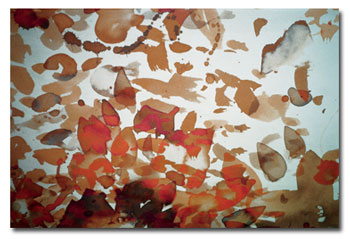
Fabric from Bucol, shown at Première Vision
Fibers
Cary, N.C.-based Cotton Incorporated, an exhibitor at Première Vision and Texworld, showed
development techniques and fabrics, along with Fall/Winter 2010-11 color direction. Fabrics shown
included knits with a dry, crisp hand; fluid 36-gauge single knits, hairless, singed, plied yarns;
and piece-dyed, discharge-printed denim.
Supima, Phoenix, showed fabrics and apparel brands, and garments created by young, emerging
designers. Of note was a wedding dress created in Supima® cotton shirting fabrics by Cotonificio
Albini S.p.A., Italy.
Lenzing Fibers, Austria, focused on new fiber variant ProModal®, Tencel® in denim and the
environment. Lenzing is working with DyStar Textilfarben GmbH & Co. Deutschland KG, Germany, to
develop eco-friendly ways to use and reuse dyestuff.
At Première Vision, Masters of Linen, Paris, showed a collection of innovative fabrics called
Linen Dream Lab. Fabric samples were executed by European knitters and weavers. Libeco Lagae S.A.,
Belgium, showed a linen/paper-blend dense and loose check. Also seen were a micro textured jacquard
with a dry hand and fluid drape from Crespi, Italy; camouflage-patterned devoré of linen/silk that
has mechanical softening by Achille Pinto, Italy; soft, ultrafine double voile by Coltex Retail
Group, the Netherlands; broken geometric damask by Linea Tessile Italiana, Italy; and a 3-D
prism-like knit in yarns from Linificio E Canapificio, Italy.
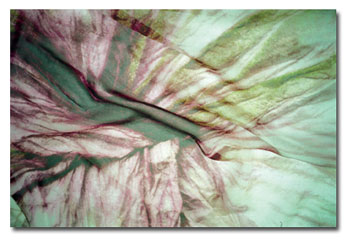
Fabric from Mantero Seta S.p.A., shown at Première Vision
Expofil
Exhibitors at Expofil, the yarn segment of Première Vision Pluriel, presented a lot of
newness. Much of the focus was on yarns for Fall/Winter 2010/11 and future developments.
Sofila, France, introduced its greenfil® yarn, made of Rilsan® nylon produced from oil
extracted from castor beans. Sofila is using natural dyes produced by Rubia Pigmenta Naturalia, the
Netherlands. Hosiery, lace, swimwear and medical products makers have shown interest.
France-based Safilin introduced ultrafine-count linen yarns. A lot are going to knitters,
including Bel Maille and Bugis, both based in France, and Silanco S.p.A, Italy. Bel Maille reported
excellent reaction to its linen single jersey and a linen/cotton piqué. Bugis is blending linen
with cotton or Tencel. Fabrics include piqué stitches, ribs and jersey with a slight nub.
Techno yarns at Tearfil, Portugal, are low-pill and antibacterial. A new yarn spun of
Trevira® is being used in double cloths for the next-to-skin inner layer. For Winter 2010, Tearfil
has new cashmere/silk yarns.
Hermann Bühler, Switzerland, reported special interest in TransDRY™ and Rainbow yarns.
Recently, it introduced an extensive range of ultrafine organic Supima cotton yarns. Another new
product is Royal Spun, a MicroModal® yarn with improved anti-pilling.
New at Kurabo Industries Ltd., Japan, is Qwon yarn irradiated to bind deodorizing agents,
producing a long-lasting effect. The yarn absorbs moisture inside clothing to generate heat and
warm the body. Mitsubishi, Japan, showed superfine acrylic yarns with antistatic, anti-pilling and
heat-generating properties. Other yarns resemble fur.
ProModal spinner Karsu Tekstil, Turkey, is showing cellulosic yarns as well as cashmere and
wool blends. There are fine-count and anti-pill yarns. Sampaio, Portugal, has ultralight
ProModal/spandex piqué and single knits.
One of the most crowded stands was Rubia, whose current spectrum of naturally dyed colors
ranges from pale pinks and oranges to deep reds and browns. Rubia’s dyes are powder extracts from
Rubia tinctorum roots grown on its own farm. Soon to be introduced are yellows and blues. Crespi
and Italy-based Marioboselli Group are using Rubia dyes.
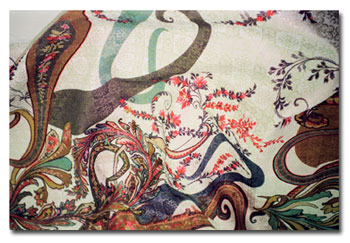
Fabric from Ratti S.p.A., shown at Première Vision
Première Vision Best Sellers
At Crespi, linens have a paper touch, are gold-foil-coated or have pearly finishes.
Marioboselli has linen/Lycra® knits and heavy jacket weights for menswear.
Libeco Lagae is selling naturally dyed linen. Popular are glazed linens washed to give
them a soft hand, linen gauze and summer tweeds.
Prints tend to be large and bold, blurred and romantic, abstract, outlined or graphic.
Continuing are skins, small shirting florals, dots and paisleys. Print bases at Josef Otten GmbH
& Co., Austria, are heavy cotton/silk blends, seersucker, polyester sateen, heavy linens, silk
chiffon and viscose crepe. There are blurred florals, abstracts and mono-colored flowers outlined
in white.
Miroglio Group, Italy, has spectacular dramatic flowers, sunburst stripes, animals in their
natural habitat and enormous borders. Italian printer Friulprint’s line, created by five young
British-schooled designers, ranges from colorful abstract florals to architectural designs.
Silk producer Ratti S.p.A., Italy, has sophisticated fabrics with dimensional effects,
transparent foil coatings, prints with a faded look, bleeding watery florals and new paisleys. Best
seller at R. Allegri & Filli S.r.l., Italy, is a color-reverse, crinkled-surface taffeta.
Bucol, France, showed an elegant line with prints that are splattered, melting, blurred or
paintbrush-stroked. Colors are subtle.
Jacquard weaver Stephen Walters & Sons Ltd., England, showed handwoven effects,
understated textures and patterns, touches of luster or metal and soft mélange colors.
Fantasy knits at Jackytex S.p.A., Italy, are light and liquid, and include fringe, chenille,
shiny printed laminates and double gauzes. Knits at Texdam, Spain, are crinkled, puckered or open;
and include eyelet embroideries, diagonal stripes and placed patterns.
Techno specialist Mectex S.p.A. produces all of its fabrics in Italy. Nylon stretch cloqué
and ultra-sheer taffeta with a soft or crisp hand were pointed out. Performance features include
bistretch, moisture transport/absorbency, antibacterial function, and flame retardation.
Komatsu Seiren Co. Ltd., Japan, showed a 7-denier, 11-grams-per-square-meter transparent
woven polyester fabric with reflective luster.
At Texworld, Rieter Machine Works, Switzerland, presented possibilities available using its
textile machinery. Fabrics and garments on display were created using yarns spun on new ComforJet®
equipment.
Many Texworld exhibitors are vertical manufacturers. Many are also garment manufacturers.
Nishat Mills Ltd., Pakistan, sells stretch denim woven with Invista T400® elastic fiber. There are
soft sugar finishes.
Techno finishes at Alok Industries, India, offer soil-release, antibacterial and
insect-repellent properties on cotton/silk knits, fine yarn-dyed dobbies and herringbone shirtings
that have been gas-finished. Some fabrics are knitted or woven of organic cotton.
At Bordo Tekstil, Turkey, organic and Pima cottons, linen and bamboo are fibers of choice.
Fabrics include silky-touch twills; jacquard interlocks; and jersey for T-shirts, dresses and
intimates.
Hangzhou Zhongsang, China, a dyer and finisher of casual and outerwear fabrics, is selling
ottomans, twills and poplins. China-based Jiangsu Textile Industry (Group) Import & Export Co.
Ltd. showed jacquards, piqués, interlocks, fleeces and basket textures knitted with cotton/spandex,
Modal, Tencel, bamboo viscose and polyester.
May/June 2009
Kornit Offers New Dark Polyester Printing
Kornit Digital Ltd. – an Israel-based developer, manufacturer and marketer of digital printing
solutions for the apparel industry – has introduced a method of using its existing ink technology
and automatic wetting solution process to print on 100-percent dark polyester and dark polyester
performance fabrics. According to Kornit, the application allows for high-quality dark polyester
prints including variable data prints for sportswear, collegewear and other applications.
Kornit will present Dark Polyester Printing for the first time at Fespa Digital 2009, to be
held May 12-14 in Amsterdam. The Dark Polyester Software Application will be available May 15.
May/June 2009
TIEHH Unveils New Nonwovens And Advanced Materials Lab
The Institute of Environmental and Human Health (TIEHH) at Lubbock, Texas-based Texas Tech
University has opened a 4,000-square-foot fabric laboratory to house research and development of
nonwovens-based products for military and civilian use. Launched on April 6, the Nonwovens and
Advanced Materials Laboratory features an air-conditioning and humidification system, contoured
needlezone needlepunching technology and thermalbonding capabilities.
“We are exclusive in the way we’re set up here with the unique needlepunch nonwoven
technology and access to cotton,” said TIEHH Director Ron Kendall. “This technology has been used
successfully to develop products such as our nonwoven decontamination wipe, Fibertect™. The need
for decontamination wipes, such as the kind we’ve created here at TIEHH, were a top priority for
the Department of Defense. Years ago, we began the research, developed a product and met a top
national security issue. Now we’re going to continue that research with this laboratory.”
Fibertect technology, developed by TIEHH associate professor and lab manager Seshadri
Ramkumar, can be used to create products using a range of fibers to suit various requirements and
uses. In a recent evaluation of several decontamination products, the Lawrence Livermore National
Laboratory tested a Fibertect wipe featuring an activated carbon core sandwiched between a layer of
absorbent polyester and one of absorbent cellulose. When tested with mustard gas and other toxic
chemicals, results revealed Fibertect out-performed 30 other decontamination products, including
those materials currently used in military kits.
“One of the main focuses of this lab will be used to develop new products from cotton and
wool, such as thermal and acoustic insulation pads, and automotive and defense textiles,” Ramkumar
said. “Our aim is to find value-added applications for products made of cotton grown on the High
Plains.”
May/June 2009
Report Shows Continuing Problems With Intellectual Property Rights Protection
The US government’s annual special report on the adequacy and effectiveness of intellectual
property rights protection (IPR) shows some improvements among US trading partners, but for the
first time Canada is on the Priority Watch List, and problems continue with China, Russia and a
number of other countries.
The report reviewed trade with 77 nations, with 46 being placed on the Priority Watch List or
a lower-level monitoring list. The US Trade Representative (USTR) said 12 countries on the Priority
Watch List will be “the subject of particularly intense engagement through bilateral discussions
during the coming year.”
Underscoring the importance of the report, USTR Ron Kirk said: “As US rights holders,
businesses and workers suffer losses from international piracy, counterfeiting and other forms of
IPR theft, the Special 301 Report provides a critical policy tool for focusing on urgent
problems that undermine one of America’s great strengths in the global economy – our
innovation and creativity. In this time of economic uncertainty, we need to redouble our
efforts to work with all of our trading partners – even our closest allies and neighbors such as
Canada – to enhance protection and enforcement of intellectual property rights in the context of a
rules-based trading system.”
For the first time, Canada was added to the priority list, reflecting increasing concern
about the need for copyright reform as well as border protection.
While noting that China and Russia have shown “some evidence of improvement,” Kirk said, “I
am particularly troubled by reports that Chinese officials are urging more lenient enforcement of
IPR laws, motivated by the financial crisis and the need to maintain jobs.” He added that China
needs to strengthen its approach to IPR protection and enforcement, not weaken it. With respect to
Russia, Kirk said the United States is committed to ensuring that Russia fulfills its promises to
improve its IPR protection and enforcement regimes as part of a bilateral agreement with the United
States.
Algeria and Indonesia were added to the Priority Watch List, reflecting growing concerns
about IPR protection in those countries, but South Korea was removed from the Watch List in view of
what the USTR said were “significant improvements” made during the past year. This marks the first
time that Korea has not been on the Watch List or the Priority Watch List.
In addition to Canada, Russia, China, Algeria and Indonesia, other countries on the Priority
Watch List are Argentina, Chile, India, Israel, Pakistan, Thailand, and Venezuela.
In a filing with the USTR, the American Apparel and Footwear Association (AAFA) said footwear
and apparel amounted to 38 percent and 9 percent, respectively, of the total value of counterfeit
products seized by US Customs officials last year. The association said last year Chinese
counterfeit products accounted for 81 percent of the total value of all goods seized by Customs.
AAFA President and CEO Kevin Burke said: “IPR infringements in China run the gamut in the
apparel and footwear industry with copyright and trademark infringement as two leading areas of
concern.” He also cited counterfeit labels and packaging, manufacturing of counterfeit products and
retail counterfeit trade as problems. He called for criminal and civil justice reform and better
customs training.
May 5, 2009
TIEHH’s Decontamination Wipe Creation Process Receives Patent
The Institute of Environmental and Human Health (TIEHH) at Lubbock, Texas-based Texas Tech
University (TTU) has received a US patent for its process used to create nonwoven toxic chemical
decontamination wipes such as Fibertect™. The technology was invented by Seshadri Ramkumar –
an associate professor in TIEHH’s Nonwovens and Advanced Materials Laboratory – and a team of
scientists.
“This is an important milestone in the commercial development of the product and will aid
our partner, Hobbs Bonded Fiber, in its marketing and sales efforts,” said David Miller, vice
chancellor of TTU’s Office of Technology Commercialization, which licensed the technology to Waco,
Texas-based Hobbs.
“The process for which the patent has been issued focuses on a multilayered wipe with a
unique fabric structure, which can wipe liquid and vapor toxins,” Ramkumar said. “Also, it lends
itself to the use of cotton and other fibers, depending on the need. The wipe can be used on human
skin and military equipment.”
May 5, 2009
Nilit Acquires Nylstar
Israel-based Nilit Ltd. – a global manufacturer of nylon 6,6 fibers – has acquired Nylstar Inc., a
nylon manufacturer owned by JP Morgan Chase. Nilit will acquire Nylstar’s US operations and its
nylon 6,6 plant in Martinsville, Va., which will become part of Nilit’s global production facility
network, making the company one of the largest nylon 6,6 producers worldwide. Last year, Nilit
opened a state-of-the-art nylon production facility in Suzhou, China
(See ”
Nilit
Opens New Nylon Facility In Suzhou China,” May 27, 2008).
“Nylstar is a respected manufacturer that shares Nilit’s commitment to innovation and
quality,” said Arie Gottlieb, general manager, Nilit. “Having the Martinsville facility as part of
the Nilit network will expand our ability to service our growing North American customer base, our
US partners and as well as other customers around the world.”
Nilit has named former Nylstar President Basil B. “Sonny” Walker president of Nilit US.
“Sonny’s knowledge of the North American market will help us drive Nilit’s growth on the
continent,” Gottlieb said. “In addition, Sonny’s leadership will ensure a smooth integration and
uninterrupted service for both our existing and new customers.”
“The union of Nilit and Nylstar here in the US will be extremely beneficial for our
customers,” Walker said. “Not only will this new partnership ensure ready supply but we expect even
higher levels of innovation and quality to result from this collaboration.”
Nylstar’s product line includes fully-, partially- and low-oriented yarns in a variety of
filament counts, lusters and cross-section types. Nylstar’s line will complement Nilit’s portfolio
of branded performance yarns for intimate apparel, bodywear, legwear and activewear.
May 5, 2009
DAK, Shaw Form PET Recycling JV
Polyester staple fiber producer DAK Americas LLC, Charlotte, and carpet manufacturer Shaw
Industries Group Inc., Dalton, Ga., have formed a joint venture (JV) company, Clear Path Recycling
LLC, to produce Recycle PET (RPET) from post-consumer polyethylene terephthalate (PET) bottles.
Clear Path Recycling plans to build a facility at DAK’s Cedar Creek PET resin manufacturing
site in Fayetteville, N.C., and annually will recycle more than 280 million pounds of PET – equal
to around 5 billion bottles. The operation will reduce energy use by some 2.5 trillion British
thermal units compared to virgin polyester production.
DAK and Shaw will use the RPET material primarily in-house, with the balance to be sold
through merchant sales. Operations are expected to begin by first-quarter 2010 and provide
approximately 100 new jobs.
May/June 2009
CARE Announces Award Winners, Annual Report Indicates Decreased Recycling
The Carpet America Recovery Effort™ (CARE) – a voluntary, joint industry and government group that
promotes carpet recycling and re-use – announced winners of the Environmental Protection Agency
(EPA)/CARE Innovations in Recycling award, the CARE Recycler of the Year award and the CARE Person
of the Year award at its Seventh Annual Conference, held recently in Lansdowne, Va.
The EPA/CARE award – which recognizes innovative products containing post-consumer carpet
content or a process that diverts large amounts of post-consumer carpet from landfills – was given
to Dalton, Ga.-based Shaw Industries Group Inc.’s Evergreen Nylon Recycling Facility, and the Los
Angeles Fiber Co. and its president, Ronald Greitzer. Since Shaw acquired the Evergreen plant in
2007, the company has recycled more than 220 million pounds of post-consumer nylon 6 carpet and
more than 36 million pounds of post-consumer carpet filler, and has reduced fossil fuel usage
through the plant’s waste-to-energy processing. Los Angeles Fiber and Greitzer have recycled more
than 464 million pounds of post-consumer carpet since 2000, which is more than 40 percent of the
accumulated poundage of recycled carpet CARE has reported since it began collecting data in 2002.
CARE named Calhoun, Ga.-based Mohawk Industries Inc. Recycler of the Year, recognizing the
company for its GreenWorks Post-Consumer Recycling Center in Chatsworth, Ga., which converts
post-consumer carpet into engineered resins that can be used in a variety of products. In 2008, the
GreenWorks Center collected 15 million pounds of post-consumer carpet for processing into
thermoplastic nylons and other materials.
Brendan McSheehy, director of research and development for Universal Fiber Systems, was
named Person of the Year for his exemplary leadership on the CARE Board and for serving as chairman
on various CARE committees. McSheehy holds a patent for a method of cleaning and separating
post-consumer carpet face yarn, and he was instrumental in the development of Universal Fiber’s
ReFresh Fiber, which contains post-consumer content from recycled nylon 6,6 carpet.
In other group news, CARE has released figures from its 2008 annual report indicating a
decrease in the recycling and diversion of post-consumer carpet compared to 2007 levels. The report
revealed that in 2008, 243.4 million pounds of post-consumer carpet were recycled and 292.4 million
pounds were diverted from landfills – an 11.4-percent decrease in recycling and a 0.8-percent
decrease in diversion compared to 2007.
According to CARE Board Chairman Frank Hurd, the reduction was less than expected,
considering the current economic downturn and the negative business results reported by other
industries in 2008. On a positive note, new data collected for the first time in CARE’s 2008 member
survey revealed 1,100 industry employees are directly involved in carpet recycling, which
translates into an additional 2,200 indirect jobs created in local communities.
May 5, 2009



