The Rupp Report: More Investment For The Future

In mid-July 2010, Groz-Beckert officially opened its new Technology and Development Center (TEZ) in
Albstadt, Germany. The TEZ will serve as a platform for research and development, strengthening
systematic thinking, innovation, and synergies in close cooperation with machine producers, machine
users and partners. An important role also is played by training and further education.

Facts And Figures

The planning started in the spring of 2005. In October 2006, the renowned Munich
architectural office of Henn GmbH was awarded the contract. The construction work, realized by
various local contractors, proceeded according to plan. This was also thanks to the commitment
shown by the relevant authorities and the people involved in the project within the company itself.

The TEZ is Groz-Beckert’s biggest-ever construction project, and the facts are impressive:
27,000 cubic meters (m3) of concrete, 3,200 metric tons of steel and 700 metric tons of steel
girders were used, while almost 8,000 square meters (m2) of flat and sloping roofs had to be
covered. The interior space amounts to 136,000 m3. The floor space covers an area of 5,000 m2, and
the total area covered by the TEZ amounts to 25,000 m2, including 14,000 m2 of usable space.

Big Investment

With regard to sustainability, the TEZ surpasses in several respects the strict energy-saving
requirements already in place. Structural materials were selected with conscious regard to
environmental compatibility and durability. Emulsion-based materials were largely eliminated and
the steel roofs were powder-coated, to prevent any rainwater contamination by heavy metals. The
building is said to be the proof of the manner in which Groz-Beckert assumes economic, ecological
and social responsibility.

The investment in the TEZ amounts to roughly 70 million euros. In choosing Albstadt as its
location, Groz-Beckert says it has made a commitment in favor of its headquarters and the
surrounding region. All the company’s core competencies — including development, design, process
technology and lab technology — are centered here, and especially at the TEZ. The center will
thrive on the know-how transfer from production in Albstadt and from instant access to all
services. Moreover, the site features a qualified education infrastructure and, as ever, a profound
level of textile expertise.

The Services

Research and development, applications consulting, sound education and further training, a
comprehensive interchange of ideas — all these aspects and more are taken into consideration at
the center, Groz-Beckert states. A main focus is on five technical centers for the most diverse
textile production methods, including knitting, weaving, felting, tufting and sewing.

The company notes that machines and installations close to production are fixed components of
these technical centers, adding that they enable application technology experiments as well as
short batch runs and production of special series as a service for partners. It also is possible to
test Groz-Beckert products under actual production conditions. In addition, customers and partners
can work together at the centers to develop products, and processes can be optimized.

A further, central area of the TEZ is the Groz-Beckert Laboratory. Apart from lab services
for the most diverse sectors, the lab provides a special section devoted to the new “Textile
Product Technology — Technical Textiles” study course. The TEZ also includes an apprentice
workshop, various meeting and conference rooms, developer offices, and a 275-seat auditorium.

Objectives

System solutions and services augment Groz-Beckert’s diversified range of products. The
company is also opening a card clothing service for nonwovens and a consulting service for
sewing-machine needles, and expects the TEZ will provide additional synergies and momentum.

Systems Thinking

The TEZ has as its main goals not only a greater emphasis on thinking in systems, but also
the encouragement of research and development, innovation, synergies, and the integration of
training and further education, Groz-Beckert reports. In its effort to bring qualified new
employees on board just in Albstadt, the company continually provides training for 30 commercial
and 145 technical apprentices, and achieves a training quota higher than 9 percent.

August 17, 2010
Hanesbrands To Acquire Gear For Sports

Winston-Salem, N.C.-based apparel manufacturer Hanesbrands Inc. has agreed to acquire Lenexa,
Kan.-based GearCo. Inc., also known as Gear For Sports — a seller of embellished licensed logo
apparel to college bookstores under several brand names including Hanesbrands’ Champion label —
for $55 million. The purchase is expected to be completed in the fourth quarter of 2010.

“This acquisition will create great value and immediately add to our growth momentum,” said
Richard A. Noll, chairman and CEO, Hanesbrands. “We have significant growth synergies in both the
collegiate bookstore channel and our existing retail channels and can take advantage of our
low-cost global supply chain. This acquisition is an excellent way to leverage the growth platform
we have just built and create value for our shareholders.”

The acquisition is part of Hanesbrands’ strategy to create stronger branded businesses in its
Outerwear Segment. Following its purchase of Gear For Sports, 20 to 25 percent of the company’s
Outerwear Segment sales will be graphic apparel.

“Gear For Sports is a graphic apparel powerhouse with a phenomenal team,” said William J.
Nitakis, president and COO, Hanesbrands. “Together we have tremendous opportunities to expand,
drive growth and take market share.”

Gear For Sports’ senior management will continue to run the company, and the administrative,
operational, production and sales structure will remain the same, with the business continuing to
operate out of its Lenexa office.

August 17, 2010

Haiti Apparel Center Opens To Train Workers For Country’s Garment Industry

The Haiti Apparel Center (HAC) officially opened last week in the SONAPI industrial park in
Port-au-Prince, Haiti, to provide professional training for workers in the country’s garment
industry. The center, funded by the U.S. Agency for International Development (USAID), is located
in a 6,000-square-meter facility made available by the Government of Haiti and refurbished and
operated by Silver Spring, Md.-based international development organization CHF International, and
has implemented a six-week training program developed by Cary, N.C.-based Textile/Clothing
Technology Corp. ([TC]
2).

HAC will train more than 2,000 workers annually for positions ranging from sewing machine
operators to mechanics to quality-control supervisors, providing skilled workers to an industry
that had been shrinking even prior to the January 2010 earthquake that devastated the country. In
addition, senior managers, factory owners and business leaders may attend executive seminars
offered by the center. According to [TC]
2, the professional training program was initiated in the summer of 2009 for the
training of sewing machine operators. USAID reports that more than 50 operators and 13 operator
trainers have completed the program to date.

According to USAID, the center will help Haiti take full advantage of the Haitian Economic
Lift Program (HELP) Act, under which the country’s exports, including apparel, have expanded access
to U.S. markets. HELP also provides support for the rebuilding of Haiti’s apparel industry —
including building renovations, machinery replacement and professional training — which will cost
an estimated $38 million, according to a Congressional Research Service report.

“The apparel center promotes economic recovery and long-term growth and helps Haiti tap into
the tremendous potential of the garment industry,” said Paul Weisenfeld, coordinator of USAID’s
Haiti Task Team. “It will provide opportunities to improve the lives of thousands by increasing job
skills and enabling Haitians to earn more. In the last 30 years, the number of skilled garment
workers in Haiti has dramatically declined, but we hope to reverse that trend.”

August 17, 2010

Naturally Advanced Technologies Subleases Kingstree Facility For Flax Fiber Scale-Up

Portland, Ore.- and Vancouver, B.C., Canada-based Naturally Advanced Technologies Inc. (NAT) — a
developer of technology to process bast fibers including industrial hemp for use in a range of
applications — has signed a 10-month sublease of a Kingstree, S.C., facility that it will use as a
pilot scale-up flax fiber facility to perform decortication of CRAiLAR® Organic Fibers. The
40,000-square-foot facility — originally set up to process flax fiber under a U.S. Department of
Agriculture initiative — is located near 300 acres of land dedicated to fiber-flax cultivation,
where NAT will conduct fiber-flax-growing trials starting in October.

“Having a facility in the USA that we operate and manage for the dry process or decortication
of our Crailar Organic Fibers brings the entire patented Crailar process together under NAT
control, enabling us to manage our process entirely,” said Ken Barker, CEO, NAT. “As well, the
opportunity to conduct full scale flax trials furthers our vision of utilizing a variety of bast
fibers as the foundation for Crailar and its multiple principal uses.”

August 17, 2010

New ASTM Textiles Standard Provides Comprehensive Guide To Fibers

WEST CONSHOHOCKEN, PA — August 2010 — After completing an update of ASTM D123, Terminology
Relating to Textiles, members of ASTM Subcommittee D13.92 on Terminology decided that the
information contained in the annexes was sufficiently important to merit being in a separate
standard. The new standard, ASTM D7641, Guide for Textile Fibers, has now been published, and it
provides a comprehensive guide to a large variety of fibers used to manufacture many textile
products. Subcommittee D13.92 on Terminology is under the jurisdiction of ASTM International
Committee D13 on Textiles.

“ASTM D7641 is intended to be a useful resource for designers, buyers, test laboratories,
educators, students and regulators,” says Vincent Diaz, Atlantic Thread and Supply Co., and a D13
member. Diaz notes the following information is typical of what can be found in ASTM D7641:

–  Bear grass is a hard leaf fiber grown in the southwest United States and Mexico.

–  Pineapple fiber is a fine leaf fiber grown in the Philippines.

–  Fox hair can be used to make soft brushes.

–  PLA is a manufactured fiber that is derived from naturally occurring sugars.

“This new standard is a valuable reference that can help readers improve their understanding
about the relationship between commercial names, fiber identification and the geographical regions
of fiber origins,” says Diaz.

To purchase ASTM standards, visit
www.astm.org and search by the standard designation number, or
contact ASTM Customer Relations (phone: 610-832-9585;
service@astm.org).  ASTM International welcomes and
encourages participation in the development of its standards. For more information on becoming an
ASTM member, visit
www.astm.org/JOIN.

Posted on August 17, 2010

Press Release Courtesy of ASTM International

TMC Goes The Extra Mile

NEW SOUTH Wales, Australia — August 13, 2010 — The unique Sheep to Shelf ® (S2S) traceability
programme offered by The Merino Company (TMC) since 2006, provides complete transparency and
traceability and guarantees the integrity of the fibre throughout the entire supply chain.

Working directly with its Wool Pool Participants, and closely monitoring and managing each
step in the supply chain, TMC provides its global customers with fully certified, transparent and
traceable, quality merino yarn, fabric or garment solutions from Sheep to Shelf ® – traceable right
back to the very farms where the fibre is grown.

Phoebe Croyle, Marketing Manager of TMC said “Whether our customers require certified ceased
or non-mulesed wool, EU Eco-label compliant wool, wool that has been produced on a property which
has implemented a Farm Management Plan or Environmental Management System, or something different
altogether, we can provide complete traceability and certification for each movement of the wool;
from the fibre source, through each manufacturing step, right through to the finished product”.

“Our commitment to maintaining integrity throughout the supply chain, provides our customers
with quality assurance, and provides reassurance to our wool growers that their efforts to
differentiate their wool are recognised and valued right to the end consumer. Such high levels of
transparency and traceability are only possible through the TMC Pools system and our unique
relationships with our wool growers”, continued Ms Croyle.

Details of TMC’s wool growers are recorded, together with their on-farm practices,
certifications, and any additional information required about their properties. TMC then works with
quality driven supply chain partners across the globe including topmakers, spinners, and fabric and
garment manufacturers to provide customers with differentiated natural fibre, textile and apparel
solutions from Sheep to Shelf. Each supply chain partner provides complete transparency and the
necessary certifications which are input into the TMC traceability process.

Taking traceability one step further, TMC can also provide customers with customised web
based traceability programmes, tracing products from Sheep to Shelf. Depending on a customer’s
needs, TMC can engineer a programme designed to their style and specification and once complete,
the programme is then integrated into their website.

One of TMC’s first customers to adopt the Sheep to Shelf® traceability programme was INSTYLE,
a leading Sydney interiors textile designer and manufacturer.

Tracy Mak, INSTYLE’s Environmental Manager, said “INSTYLE works closely with TMC, who manage
the early stages of our supply chain. TMC ensure that our EthEco® wool comes from
holistically-managed farms that have ceased mulesing and that the fibre, yarn and final products
meet our LIFE Textiles® specifications. Working with TMC provides assurance for us, as the whole
system is traceable, and also provides our customer’s assurance through our ‘FARM TO FABRIC’ web
based traceability programme”.

Posted on August 17, 2010

Press Release Courtesy of The Merino Company

Little Near-Term Import Relief


I
t’s now been nearly two months since China announced its new yuan policy — one that
promised some gradual upward currency revision. But so far, there’s little to suggest it will make
for any big difference in incoming textile and apparel shipments from that nation — certainly not
over the next few quarters. For one, the upward revaluation since the announcement in June has been
negligible. And judging from latest Beijing standards, any changes will continue to be quite small.
True, some American officials are still talking in terms of a 5-percent-or-so rise in yuan value
over the next few quarters. But this seems like wishful thinking, with most analysts seeing a much
more modest near-term advance — not nearly sufficient to even start leveling the international
playing field. Indeed, if there’s any doubt about how the huge still-existing yuan-dollar imbalance
is continuing to spark imports, take a look at recent trade trends. Thus, despite only a very small
pickup in U.S. domestic demand so far this year, U.S. year-to-date textile and apparel imports from
China have jumped a hefty 22.5 percent. Result: With this new advance, China now accounts for some
40 percent of all U.S. textile and apparel imports. Also on the disturbing side: Imports from all
other overseas suppliers have also been increasing — with year-to-date incoming shipments up by 10
percent. To be sure, that’s small than the Chinese gain, but again, hardly anything to cheer about.

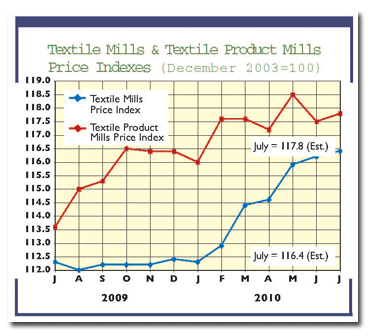
textilepriceindexes810


Imports Beyond 2010


On a rosier note, however, this new import surge should slow down over the longer pull. For
one, the anticipated creep-up in Beijing’s yuan — while far under the 25- to 40-percent
appreciation most analysts feel is needed to correct the current imbalance — will over time add up
to a meaningful number. Note, for example, that a similar Chinese currency policy from 2005 to 2008
resulted in a sizeable 21-percent gain in the yuan vis-à-vis the dollar. There are also other
factors at work that might slow down our demand for Chinese products — the most notable of which
is that nation’s accelerating increase in wage rates. Pay levels there are already running anywhere
from 5 to 15 percent above beginning-of-year levels. Zero in on the coastal province of Guangdong,
a hub for apparel manufacturing, and wage gains are now near 20 percent. Further add in rising
costs of raw materials, transportation and pollution control — and Chinese apparel tags may rise
as much as 5- to 10-percent over the next 12 months. That should be enough to make U.S. companies
take another look at their overall sourcing strategies. But don’t expect any miracles — certainly
nothing that would result in any actual import shrinkage. That’s because rather than shifting back
to domestic production, virtually all major American firms are now considering shifting some of
their sourcing to other low-cost suppliers like Vietnam, Indonesia, Pakistan, India and Bangladesh.
The CFO of one of the nation’s largest retailers sums it up, noting that his company is already
busy working with its top 15 suppliers to find cheaper foreign sources. Other firms tell pretty
much the same story — suggesting some major changes in industry sourcing over the next few years
are virtually inevitable.


Gauging The Macro Impact


The strength of underlying domestic demand is another problem that industry executives
continue to wrestle with these days. The basic unknowns: How fast will the economy grow, and how
will it all impact textile and apparel activity? As of now, the prognosis is basically positive.
Newly revised International Monetary Fund forecasts, for example, now see the U.S. economy
advancing 3.3 percent this year — actually a bit faster than its earlier 2.7-percent projection.
And while some leveling off to 2.9 percent is anticipated for next year, that, too, would still be
a respectable gain. Several factors are behind this cautious optimism. They include:
higher-than-a-year-ago household net worth; falling consumer debt — the amount owed by average
credit card holders is now running 10-percent under a year ago; the modest amount of government
economic stimulus still in the pipeline; strong growth in Asia — something that could help bolster
our exports; and the huge amount of cash in corporate coffers — money that could stimulate
additional business spending. All the above would seem to guarantee at least a 3-percent rise in
real consumer spending this year. More important, retail apparel sales seem to be doing even better
than that. Latest monthly totals, for example, are running close to 6 percent ahead of a year ago.

August 2010

Demand Strong, Capacity Available


T
he momentum that is carrying many yarn spinners forward to what could be their best year
in recent memory continued through the first two weeks of August. Spinners from multiple sectors
report strong orders and are cautiously optimistic that business will remain good through the rest
of the year.

However, the pressure on capacity that was so much of an issue a few months ago seems to be
easing somewhat. “It seems that most of the panic buying is over,” said one spinner. “This
desperate attempt to refill pipelines that had gotten so empty seems to be over. Everybody rushed
in to restock their shelves earlier in the year, and that put a lot of pressure on being able to
fill orders on time. We’re still running strong, but we have room for new orders.”

An executive from a major Carolinas spinner agreed: “Our business continues to run at a
level that we’re satisfied with. A few months ago, we couldn’t take any new orders. Now, we have
some capacity available, but not anything to be overly concerned about. The biggest thing going
forward is that the depth of the business is not as much as I would like it to be, but we’ve been
living with those kinds of issues for a couple of years now. There are few times that we see
long-term contracts.”

Depth is an issue for other spinners, as well. “We have some business in-house that goes out
a few months,” said a specialty spinner, “but most of our orders are short, and our customers still
expect quick turnaround.”

Depth of business is impacted by the high rate of unemployment in the United States, one
spinner noted. Retailers are understandably hesitant to overstock in light of uncertain future
purchasing power. “You have to be concerned with the high rate of unemployment in this country and,
especially, those who have given up looking for jobs,” he said. “They don’t have jobs, their
benefits are running out, and they don’t have credit availability. At some point, these folks are
going to just quit buying at retail. We are certainly concerned about how this will impact business
down the road.”

Orders for natural yarns seem to be strongest at the moment, said one Southeastern spinner,
while demand for package-dyed yarns is still relatively weak. “I’ve talked with a number of other
package dyers over the past few weeks, and they all say they have excess capacity,” he said.


Pricing, Credit, Materials Still An Issue


Even with the relative lack of spinning capacity, customers are still putting pressure on
spinners to hold the line on yarn prices. “Despite the increases in prices from China as a result
of higher-cost labor, fiber increases and the overall cost of doing business in the Far East, we
still see retailers just fight, fight, fight for cheap prices,” said one spinner.

Another spinner said: “We’re still finding credit availability to be an issue for some of
our customers. It’s hard to borrow money if you are not golden. Banks have not substantially
loosened their requirements, despite the appearance of an economic recovery. Going forward, this
could be an issue that has tremendous impact on business.”

“The cost of raw materials continues to be an issue,” noted one spinner, “although we’ve
seen some slight decreases in the past several weeks. But, with the pressure from our customers to
maintain prices, material cost has the potential to have a big impact on the bottom line.

“Overall, though, we’re doing well,” he continued.  “I believe the opportunity is there
for spinners in this country — those of us that are left — to do okay going forward.”

August 2010

August 2010

Sweden-based
Atlas Copco AG‘s Oil-free Air Division has published a technical white paper,
available at
www.efficiencyblowers.com, explaining the
differences between screw technology and traditional Roots type lobe technology.

Brentwood, Tenn.-based
OHL, a supplier of logistics solutions to industries including apparel and retail,
has signed a membership agreement with
CargoNet, a cargo theft solutions provider.

Neenah, Wisc.-based
Appleton Mfg. Division now offers performance tuning and maintenance checkups for
its core cutting equipment.

Outlast Technologies Inc., Boulder, Colo., has added an interactive,
multi-lingual, comprehensive training program on its website,
www.outlast.com, to educate manufacturers and retailers about
Outlast® technology.

ASTM International, West Conshohocken, Pa., has revised the ASTM E2149, Test
Method for Determining the Antimicrobial Activity of Immobilized Antimicrobial Agents Under Dynamic
Contact Conditions.

Pantone LLC, Carlstadt, N.J., has launched TONES,
www.pantone.com/tones, a free quarterly e-newsletter
highlighting the latest color and trend information in design, fashion and furnishings as well as
influences in art, culture and nature.

Designtex, New York City, has converted its entire upholstery collection sampling
from fabric to a 100-percent digital format.

The
Théophile Legrand Foundation – Institut de France is accepting applications for
the Théophile Legrand International Award for Textile Innovation, which honors textile innovation,
research and creativity. The international competition is open to all researchers, and doctoral or
master of science students, who may submit applications in French or English by Sept. 10, 2010 to
theophile-legrand@hotmail.fr.

Dalton, Ga.-based
Shaw Industries Group Inc.‘s Shaw Floors business has launched Shaw Web Studio, a
suite of web products for flooring retailers. The Shaw Contract Group business has received the
Best of NeoCon Silver and Best of NeoCon People’s Choice Gold design awards for its 18×36
rectangular modular carpet collection.

Ahlstrom Corp., Finland, has implemented a global price increase on all of its
wiping fabrics.

Messe Frankfurt GmbH, Frankfurt, has been accepted into the United Nations Global
Compact initiative, a network comprising companies committed to sustainability.

Bethesda, Md.-based
Lockheed Martin‘s wholly owned subsidiary
Savi Technology has relocated its headquarters from Mountain View, Calif., to
Alexandria, Va.

Fort Smith, Ark.-based
Baldor Electric Co. now offers an 18-page brochure detailing Baldor’s
energy-saving products. A free copy is available at
www.baldor.com/support/literature_request.asp.

energybrochure
Baldor’s energy-saving products brochure

The
Hohenstein Institute, Germany, has established a contact office in Minsk, Belarus,
located at Prityckogo Str. 112-70, 220017; 375-33-664-15-97;
belarus@hohenstein.org.

Erie, Pa.-based
Eriez Manufacturing Co.‘s Eriez® 5-Star Service Group has opened a Service Center
near the company’s headquarters. The Center has machining, fabricating and welding capabilities to
repair or re-manufacture equipment, as well as service technicians who can perform on-site audits,
repairs, equipment checks and in-plant certifications.

eriez
Eriez’s 5-Star Service Center in Erie, Pa.

R.G. Barry Corp., Pickerington, Ohio, has given an exclusive license for its
Dearfoams® brands for sleepwear and apparel to Mira Loma, Calif.-based
Olivet International.

Agoura Hills, Calif.-based
Buxbaum Group has relocated its headquarters to 28632 Roadside Dr., Suite 200. The
main telephone number remains the same.

Jackson, N.J.-based
Newson Gale Inc. has released a white paper titled “The Critical Role of Clamps
& Cables in Static Electricity Control.”

Glen Raven, N.C.-based
Glen Raven Inc.‘s Dickson Coatings division’s EverGreen fabrics have been
certified to the International Organization for Standardization’s 14040 to 14044 standards.

Rock Hill, S.C.-based
Atlas Copco Compressors LLC has released the seventh edition of the “Compressed
Air Manual.” Free copies are available at
www.atlascopco.us/usus/Aboutus/sales/compressors_generators/Comp_manual.asp.

atlascopco
Atlas Copco Compressors’ Compressed Air Manual

High Point, N.C.-based
Allied International Inc. has launched a full e-commerce website at
www.alliedi.com.

alliedweb
Allied International’s new e-commerce website

The
Association of the Nonwoven Fabrics Industry (INDA), Cary, N.C., is accepting
nominations through September 1 for the 2011 Visionary Award, to be presented at the Vision 2011
Consumer Products Conference in San Diego in January. To nominate a product, e-mail a product
explanation to Visionary Awards Coordinator Michael Jacobsen at
mjacobsen@inda.org, or visit
www.inda.org.events/vision11/nominate.html
for an online submission form. For more information, contact 201-396-7005.

The Roseville, Minn.-based
Truck Cover & Tarp Association, a division of
Industrial Fabrics Association International, has been renamed the
Tarp Association.

The
Synthetic Yarn and Fiber Association (SYFA), Gastonia, N.C., has added a Standards
section to its website, located at
www.thesyfa.org.

Spain-based Valentin
Rius Clapers S.A. now offers YouTube videos of its machinery models via its
website,
www.rius-comatex.com.

New York City-based
FildiUSA’s Ecotec® recycled cotton-blend yarns have been certified to the
Netherlands-based Control Union Certifications’ Global Recycle Standard.

Aurora, Ill.-based
Aurora Specialty Textiles Group Inc. has launched a new website to present its
Northern Lights Printable Textiles™ line of printable fabrics and canvas. The website is located at
www.auroranorthernlights.com.

Germany-based
Messe Frankfurt Exhibition GmbH is accepting nominations for the Young Contract
Creations Award: Upholstery, to be presented at Heimtextil, the International Trade Fair for Home
and Contract Textiles to be held in Frankfurt Jan. 12-15, 2011. Applications may be submitted at
www.heimtextil.messefrankfurt.com by October
17.

DyStar Textilfarben GmbH, Germany, has opened a Color Solutions International
Studio at its facilities in Rabale, Navi Mumbai, India.

Harrisonburg, Va.-based
AirDye Solutions/Colorep Inc. has launched a new website, located at
www.AirDyeSolutions.com.

Ashland, Ore.-based
Massif Mountain Gear Co. has selected Bozeman, Mont.-based
TEXbase‘s material-lifecycle-management software.

Houston-based
Solvay Chemicals Inc. has increased off-list prices for all commodity grades of
hydrogen peroxide by 4 cents per pound in the United States and 93 cents per metric ton in Canada.

Customs Reform Legislation Introduced In The Senate

Legislation giving U.S. Customs and Border Protection expanded authority and funding to combat
textile import fraud has been introduced in the Senate. It is a companion measure to the Textile
Enforcement and Security Act that is pending in the House with 25 co-sponsors.

As the bill was introduced by Sens. Kay Hagan, D-N.C., and Lindsey Graham, R-S.C., David
Hastings, chairman of the National Council of Textile Organizations, said the measure “will send a
clear message that the U.S. government will not allow fraudulent activity on imported textile and
apparel goods to continue.”

The House and Senate bills include provisions that would establish an electronic verification
system for textile and apparel imports; allow the Department of Homeland Security to use fines and
penalties to help pay for investigations and training, increase the staff at high-volume ports for
textiles and apparel, and establish a program to ensure that resident agents are held accountable
for products imported under their name.

U.S. Customs and Border Protection currently collects more than $25 billion in duties
annually, and more than 42 percent of the duties are collected on textile and apparel imports. In
spite of this, textile manufacturers contend that many imports are entering this country
undervalued for customs purposes, and there continues to be a problem with illegal transshipments,
particularly through countries with which the United States has preferential trade agreements.

August 10, 2010

Sponsors