
2010 ITMF Annual Conference: Brazil And Its Textile Industry


T
he Brazilian textile and apparel industry comprises more than 30,000 companies in the
textile and apparel sectors, generating some 14 million to 15 million jobs, both direct and
indirect. Brazil is among the top 10 textile industry markets worldwide and among the top five as
an apparel producer.

The Federative Republic of Brazil is the largest country in South America, and one of the
richest countries in terms of natural resources, environment and wildlife. The Federation is formed
by the union of the Federal District and 26 states.


Bright Future


Today, the Brazilian economy is the world’s eighth-largest by nominal gross domestic product
(GDP) and the 10th-largest by purchasing power. The country is one of the largest domestic markets
in the world and one of the fastest-growing economies today. That’s why it is a member of the G20,
but also a member of the United Nations and the Southern Common Market (MERCOSUR).

In the first half of 2010, more than 1.5 million jobs were created, a record high. During
the same period in 2009, the Brazilian economy generated only 299,000 jobs owing to the
international financial crisis. The government believes the Brazilian economy will create a total
of 2.5 million jobs in 2010.

The Organization for Economic Cooperation and Development (OECD) predicts an economic growth
rate of 6.5 percent in 2010 for Brazil – higher than the previous estimate of 4.8 percent. For
2011, the economy is expected to grow 4.5 percent. The effects of the international financial
crisis caused the economy to contract by 0.2 percent in 2009.

The OECD is not the only institution to predict a high growth rate for Brazil in 2010. In
the most recent Focus market survey, the Brazilian financial sector projected 6.46-percent growth
for this year. The Brazilian government’s most recent estimate is 5.5-percent growth. According to
the OECD, Russia, India and China – the other countries in the BRIC group – are undergoing a solid
expansion as well, and will register positive figures this year.
Brazilmap


Big Cotton And Textile Producer


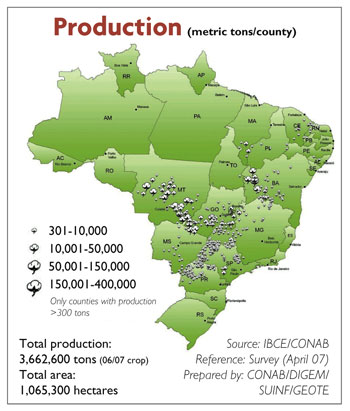
Brazil is the fifth-largest producer of cotton, after China, India, the United States and
Pakistan (See Table 1). The yield per hectare of cotton is rather high in Brazil, especially in the
state of Mato Grosso.

The Brazilian textile industry is constantly growing owing to the acquisition of modern
equipment and technical development applied to production, and also the promotion of its
professionals through training programs and increasing productivity. This development program has
already invested more than $8 billion. Its objective is to strengthen Brazil’s textile industry in
the globalized and competitive market.

Brazil has around 4 million ring spindles and 330,000 rotors in operation. It produces and
consumes 5 percent of the world’s total cotton crop. Producing approximately 1.2 million metric
tons of cotton annually, Brazil exports almost 400,000 metric tons to Indonesia, Pakistan, Japan
and Argentina.


ABIT


The Brazilian Textile and Apparel Industry Association (ABIT) represents the integration of
the Brazilian textile chain. Founded in the early 1960s, ABIT sponsors companies in every segment
in the textile industry, including cotton growing, synthetic raw materials, textile fibers,
spinning, weaving, knitwear, dyeing, printing and apparel. ABIT participates actively in the
evolution of the textile sector. A pioneer in the industrialization of Brazil, the textile sector
stands out within the domestic economy. ABIT also coordinates relevant initiatives in the social
and environmental arenas, besides sponsoring the sustainable growth of the industry.


TexBrasil


Created in 2001, the Brazilian Textile Chain Strategic Program (TexBrasil) – developed by
ABIT in partnership with Apex-Brasil, the country’s export promotion agency – states its mission is
to support and prepare sector companies to present, in an organized way, Brazilian products in
international markets. Using various tools and actions, it aims to increase the platform of
Brazilian export companies, encouraging their inclusion in the global market.

In 2009, the total turnover for the textile sector was $47 billion, and exports exceeded
$1.8 billion. During the same year, the sector generated a deficit of $1.5 billion and created more
than 66,000 job openings. In terms of consumption, Brazil holds fifth place after China, India,
Pakistan and Turkey.


Ambitious Targets


Intensely investing in the excellence of domestic production, the textile sector intends to
expand its operations. The domestic Brazilian market comprises 190 million consumers. In addition,
the textile sector aims to recover its 1-percent share of the world market, which is equivalent to
increasing the volume of exports to $4 billion per year. For 2010, the Brazilian textile industry
expects to grow beyond the GDP and predicts an increase in consumption of textiles in the order of
12 percent.

These are ambitious targets, but by paving the way with adequate planning, such goals are
surely compatible with the Brazilian reality. To achieve such aims, new investments in technology
will be essential. Moreover, the country relies on the required managerial maturity as well as the
creativity of its professionals. Within such a context, it is essential for the textile sector to
join efforts and multiply convergences and know-how. ABIT supports such missions and offers the
Brazilian textile market all the necessary support to meet the above-mentioned goals.


Fashionable Brazil


But Brazil plays a growing role not only with regard to cotton and apparel. To produce more
value-added products, many Brazilian apparel producers are heading toward more fashionable fabrics
and products. To support these activities, the second Première Brasil, a major Latin American
textile industry event, took place in July 2010 at the Transámerica Expo Center in São Paulo. The
show presented Fall/Winter 2011 collections of fabrics, yarns, fibers and accessories. It was
supported by TexBrasil, the Brazilian Association of Fashion Designers (ABEST) and Sinditêxtil-SP.
The event is a joint venture between Paris-based Première Vision S.A. and Brazil-based Fagga
Events.

The second edition gathered 67 exhibitors from eight countries, including Brazil, France,
Spain, Italy, Turkey, England, Germany and Uruguay. Compared to the first edition, there was a
49-percent increase in the number of exhibitors.

Jacques Brunel, managing director, Première Vision S.A., Paris, said the event provided to
Latin American countries an alignment with the international fashion calendar, presenting one year
in advance the range of colors and fabrics for future collections. He also said the first Brazilian
edition of the event helped reinforce the perception of strengthening the Latin American market and
textile sector, pointing to Brazil as a starting point for expansion.

September/October 2010

Georgia Carpet Producer, Nonwovens Manufacturer Invest In Aztec Machinery

Ivyland, Pa.-based Aztec Machinery Co. — a producer of dryers and ovens for nonwovens, technical
textiles and carpets — reports a north Georgia-based major manufacturer of nonwoven and tufted
carpets has purchased a thru-air drum dryer to dry and thermally bond needlepunched nonwovens. The
machine is a 4.6-meter-wide single-drum omega design with drum diameter exceeding 3 meters.

The company also reports it recently commissioned a thru-air drum dryer for a major tier-one
manufacturer of needlepunched automotive nonwovens. The dryer will be used in a thermal bonding
application.

The two machines are believed to be among the largest sold to U.S. nonwovens manufacturers,
according to Burnsville, N.C.-based Ford, Trimble & Associates Inc., sales and marketing agent
for Aztec Machinery.


September 7, 2010


Hyosung Debuts Creora® Highclo™, Mipan® Micro-Denier Nylon

South Korea-based Hyosung Corp., manufacturer of creora® spandex, has launched creora® highclo™
super-chlorine-resistant spandex/elastane for swimwear. According to the company, highclo offers
excellent compression and shaping qualities and retains its fit and shape after extended chlorine
exposure. Hyosung also reports it provides high quality, consistency, uniformity, knitting
efficiency and value. Partner mills producing creora highclo include Sofileta, France; Cherry Body,
Hong Kong; Hyunjin, Korea; Hungyen, Vietnam; and Huiyi, China.

Hyosung also has launched Mipan® microfine 20/34 and 30/68 micro-denier nylon suitable for
fine-gauge, super-lightweight, warp and circular knit intimate apparel fabrics.

September 7, 2010

Virginia Governor Bob McDonnell Applauds Universal Fibers For New Hires, Sustainable Technology

BRISTOL, Va., September 7, 2010 — Universal Fibers, Inc welcomed Virginia Governor Bob McDonnell
to its Washington County, Virginia headquarters for a plant tour this afternoon. Governor McDonnell
got a first hand look at the improvements, innovations and growing number of employees that have
helped ensure the company’s success.  To service increased customer demand, Universal Fibers
has expanded production capacity and hired more than 200 new employees.

In his remarks the Governor called Universal Fibers a Virginia success story. “I just wanted
to come by and say thanks for what you are doing here,” said Governor McDonnell. The Governor
continued, “A top priority for me is jobs and to foster economic development. You’ve got a good
model of how to do that and it’s something that needs to be duplicated.”

The company is undergoing a $13M expansion that is partly funded by a $150,000 grant from the
Governor’s Opportunity Fund.


Universal Fibers is a leading producer of solution-dyed fibers for the commercial flooring,
transportation, industrial fiber, and textile markets, and has been located in Washington County,
Virginia for forty years. The company also has operations in Thailand and China.

“We like to say we export products, not jobs,” remarked Universal Fibers CEO Marc Ammen.
“We’ve welcomed 200 new families here this year and we’ve done it by creating a sustainable product
that is in demand in markets around the world.

Universal Fibers is a pioneer in sustainable efforts in the fiber industry and was the first
in the industry to produce post-consumer solution-dyed nylon fiber in a broad color line.  The
Universal brand is called refresh fiber®, which is made from a sophisticated multi-step process
that takes post-consumer carpet fiber and turns it back into usable nylon fiber, maximizing the use
of an abundant resource that would otherwise end up in a landfill.  refresh fiber® has won
several environmental awards including the inaugural Bloom Award given by the American Society of
Interior Designers (ASID) in partnership with Interiors & Sources magazine.

Joining Governor McDonnell on the tour was Virginia Delegate Joe Johnson, Dulcie Mumpower,
the chair of the Washington County, Virginia Board of Supervisors, Russell Owens, the Chair of the
Industrial Development Authority of Washington County and Christy Parker, the Assistant County
Administrator.

About Universal: Universal Fibers® is headquartered in Virginia, USA with manufacturing
operations in Thailand and China. Universal Fibers® a multi-platform producer of solution-dyed
synthetic yarns for the commercial, residential, transportation and textile market and is ISO 14001
certified.  For more information, please call customer service at 800-457-4759 or visit our
website at www.universalfibers.com.

Posted on September 7, 2010

Press release courtesy of Universal Fibers Inc.

TenCate Introduces MiraSpec Design Solutions Software To Assist In Flexible Pavement Designs

PENDERGRASS, Ga., September 7, 2010 — TenCate Geosynthetics North America introduces internet
based MiraSpec Design Solutions Software, an easy to use software program that will assist
engineers in flexible pavement design while demonstrating the many benefits of using TenCate
Mirafi® RS580i woven reinforcement  stabilization geotextile in roadway structures. 

The new software program, MiraSpec Design Solutions Software, will allow pavement designers
to perform AASHTO (American Association of State Highway and Transportation Officials) flexible
pavement Structural Number (SN) design calculations, either with or without geosynthetics. In
addition, the designer will be able to calculate the cost savings and green savings the use of
TenCate Mirafi® RS580i will provide in the design.

About TenCate Geosynthetics North America, Royal Ten Cate

TenCate Geosynthetics develops and produces synthetics fabrics, nonwovens, wovens and
geogrids, and creates design solutions and systems for infrastructure and civil engineering.
TenCate Geosynthetics has plants in Europe, North America and Asia.

Royal Ten Cate (TenCate) is a multinational company which combines textile technology with
related chemical processes and material technology in the development and production of functional
materials with distinctive characteristics. Products of TenCate are sold worldwide.

Systems and materials from TenCate come under four areas of application: safety 
protection, space  aerospace, infrastructure  the environment, and sport 
recreation. TenCate occupies leading positions in protective fabrics, composites for space and
aerospace, antiballistics, geosynthetics and synthetic turf. TenCate is listed on the NYSE Euronext
(AMX).

Posted on September 7, 2010

Press release courtesy of TenCate Geosynthetics North America

The Rupp Report: Organic Production Yes, But …

There is no doubt about it: the world’s climate is changing. And at the same time, the world’s
population is growing, too. So, on the one hand, the consciousness about natural resources is
rising, and on the other hand, the world’s population needs food. This vicious circle occupies many
international organizations as well as nongovernmental organizations (NGOs) all over the world.

Another issue in the focus of people’s attention around the world is rural poverty. This
focus, along with increased awareness of climate change and sustainability, has led to a
proliferation of projects to improve agricultural practices as well as raise the level of social
and environmental responsibility. In the near future it might be impossible to sell products that
are produced not only under ecological standards, but also according to social standards.


Global Organic Textile Standard


As the Rupp Report has already reported, in the spot of monitoring are all chemical inputs
such as dyestuffs and auxiliaries, which must comply with certain environmental and toxicological
criteria, and the choice of accessory materials also is restricted. In this context, the Global
Organic Textile Standard (GOTS) is recognized worldwide as one of the top processing standards for
organic fiber-based textiles.

Currently, there are more than 2,000 companies around the world working according to GOTS
standards. The standard includes not only fiber production but also criteria related to dyeing and
finishing.


Finishing In The Center Of Attention …


For obvious reasons, the finishing sector especially demands to be certifed according to
GOTS. An increasing aspect is ecology and toxicology, on which basis dyestuffs and auxiliaries are
evaluated and approved. Desizing can cause problems if the applied enzymes are genetically
modified. Mercerizing is allowed only without the use of ammonia. Optical brighteners are very
problematic: They cause a lot of problems in wastewater treatment because of their poor
biodegradability and high toxicity levels, and they also can influence the human hormone system
through estrogen receptor cells. Fabrics finished with antibacterial treatments can affect the
natural behavior of human skin as well.

… But Social Standards Also Are Important

But not only environmental issues are part of the standard. GOTS also includes current
minimum social standards: no forced labor or child labor, a safe working environment, no
discrimination and the guarantee of payment that secures a living for the working people. This is
quite important. More and more Western companies are emphasizing social standards. Just a few weeks
ago, one of the world’s top retail chains had a public relations nightmare: The company was on the
front page of daily newspapers around the globe because some NGOs found out that in spite of
existing labor contracts and guaranteed minimum payments, the workers were underpaid.


Too Many Labels On The Market


As with every trend, many companies are jumping on the bandwagon. As a producer, retailer or
consumer, one must be careful to have all the certificates and the right papers sent along with the
goods so that the products can be traced back in a clear system. There are a lot of institutes that
have a “Bio” label on their letterhead. One of the most popular trends at the moment is certainly
to bear the Öko-Tex® 100 label. Without being cynical, one could say it may be somewhat
questionable when this label appears on a shirt with a value of just a few dollars.

If you would like to share your experience with these kinds of labels, write to
jrupp@textileworld.com.


August 31, 2010

Nordson Introduces PS Metering Station

Nordson Corp. – a Westlake, Ohio-based producer of precision dispensing equipment, and a
manufacturer of electronic equipment used for testing and inspecting electronic components and
technology-based systems for curing and surface treatment processes – has introduced the Nordson®
PS metering station, a system designed to add adhesive streams to existing melter systems or to act
as a booster pump to compensate for high pressure/volume losses. According to the company, the
station maintains consistent pressure with high-viscosity materials such as butyls and when feeding
several adhesive streams concurrently.

The PS metering station has a compact layout that enables adhesive supply to be set as close
to the point of application as possible. It also offers an optional circulation port with
recirculating applicators for accurate intermittent applications, eliminating hammerheads and
inconsistent beads. A variety of adhesives can be applied at processing temperatures up to 250ºC or
pressure up to 250 bar.

Nordson offers the PS metering station in two layout versions with one to four pumps,
depending on output capacity. It may be integrated into a Nordson engineered system or retrofitted
into existing production lines. The system is suitable for product assembly applications including
textile production, filter, automotive and solar manufacturing.

August 31, 2010

Clariant Unveils Pad/Sizing-Ox For Advanced Denim Dyeing

Switzerland-based specialty chemicals manufacturer Clariant International Ltd. has introduced
Pad/Sizing-Ox, an eco-efficient dyeing procedure that is the latest technology in the company’s
Advanced Denim water-saving dyeing concept. According to the company, Pad/Sizing-Ox delivers the
same effects, colors and shades as Advanced Denim in a one-step sizing and dyeing process that
reduces water consumption by up to 92 percent, produces almost no wastewater, and offers 30-percent
greater energy savings and 63-percent less waste cotton than conventional dyeing procedures. The
Pad/Sizing-Ox dyeing process is based on Clariant’s recently patented Arkofil® DEN-FIX sizing agent
innovation and is particularly well-suited for dyeing of small and varied denim batches.

“Helping the denim industry to achieve maximum results with minimum resources is fundamental
to Clariant’s Advanced Denim concept,” said Miguel Sanchez, head of Global PL Dyes for Cellulose,
Clariant’s Textile Chemicals business unit. “Our extensive research and development to bring
innovation through new products and technologies is creating new possibilities in fashion effects
as well as addressing the need and demand for ever-more sustainable, efficient production by the
textile industry.”

The Advanced Denim process enables eco-bleaching wash-down with ozone and peroxide instead of
harmful chemicals such as hypochlorite or permanganate. When used in combination with Clariant’s
full range of Diresul® RDT sulfur dyes – including the non-indigo-based Indicolors dyes – the
process offers unique effects, improved color depth and fastness and tone and shade reproduction,
and an easy application process, the company reports.

August 31, 2010

Oerlikon Barmag Introduces New Spin Pack For Industrial Yarn

REMSCHEID, Germany — August 25th, 2010 — Space-saving solutions are gaining in importance, and
the Industrial Yarn area is no exception. This is a factor that the new 6LA spin pack by Oerlikon
Barmag – premiered at this year’s ITMA Asia from 22 through 26 June – takes into account. An
industrial yarn plant fitted with the 6LA spin pack is around 25% more compact and has a filter
surface that is more than three times larger than for conventional metal powder filtration.

All this is made possible thanks to tighter position spacing. With the innovative inner melt
feed, the 6LA spin pack allows for production of two threads per spin pack, with constantly high
yarn quality. At the same time, though, the 6LA spin pack provides for greater product variety:
with no change in throughput, for instance, yarn with half the titer can be produced with twice the
number of ends.

Thanks to the use of reusable filter cartridges, the successful concept behind the 3LA spin
pack reduces maintenance costs and waste rates.

About Oerlikon

Oerlikon (SIX: OERL) is a leading high-tech industrial group specializing in machine and
plant engineering. The Company is a provider of innovative industrial solutions and cutting-edge
technologies for textile manufacturing, thin-film coating, drive, vacuum, solar energy systems and
advanced nanotechnology. A Swiss company with a tradition going back 150 years, Oerlikon is a
global player with around 16,000 employees at 157 locations in 36 countries and sales of CHF 2.9
billion in 2009. The Company invests more than CHF 200 million annually in R&D, with over 1 200
specialists working on future products and services. The operative businesses rank either first or
second in their respective global markets.

About Oerlikon Barmag

Oerlikon Barmag is the world market leader for spinning systems and equipment for manmade
fibers and texturing machines and – as a service provider – offers engineering solutions for the
entire textile value added chain. As a future oriented company Oerlikon Barmag’s research and
development is driven by energy-efficiency and sustainable technologies. With the expansion of the
product range to include polycondensation systems and their key components, the company now caters
to the entire process – from the monomer all the way through to the textured yarn. The primary
Oerlikon Barmag markets are in Asia. Correspondingly, the company – with its approximately 1,500
employees – has a worldwide presence in 120 countries as part of the Oerlikon Textile network of
production, sales and distribution and service organizations. At the Oerlikon Barmag R&D Center
– the largest of its kind in the world – within the company’s headquarters in Remscheid,
highly-qualified engineers and technicians develop innovative and technologically-leading products
for tomorrow’s world.

Posted on August 31, 2010

Press Release Courtesy of Oerlikon Barmag

Kellwood Finalizes Acquisition Of ADAM

ST. LOUIS, August 26, 2010 — Kellwood Company announced its acquisition of ADAM, effective today,
according to Michael Kramer, Chief Executive Officer and President of Kellwood. This acquisition is
the first in a series of aggressive expansion plans for Kellwood.

ADAM, founded by Creative Director and Chief Executive Officer Adam Lippes, is a full
contemporary sportswear collection for men and women available at ADAM retail stores, ShopADAM.com
and luxury retailers, such as Bergdorf Goodman, Neiman Marcus, and Harrod’s. Lippes, who began his
fashion career in 1995 at Polo Ralph Lauren before moving to Oscar de la Renta, was one of the
youngest designers to hold the position of Global Creative Director in the luxury fashion world.
Determined to pursue his dream of designing his own collection, he launched a line of cotton basics
under the label adampluseve, which evolved into what is now known simply as ADAM.

“We’re thrilled to add ADAM to Kellwood’s growing portfolio of brands. ADAM has great
potential for expansion across major product categories and international markets to be one of the
next luxury lifestyle brands. Combining Adam Lippes’ extraordinary vision with Kellwood’s
operational excellence and best-in-class infrastructure, will take this brand to the next level,”
added Kramer.

“Partnering with Kellwood will enable us to build ADAM into a global lifestyle brand.
Kellwood clearly understands our vision and has the means to support our growth on a scale large
enough to be competitive in the marketplace. Kellwood’s size and reputation speaks for itself, and
we look forward to building ADAM with them,” stated Lippes.

ABOUT KELLWOOD

Kellwood designs, manufactures, and markets a growing collection of premier fashion brands
across a broad range of consumer lifestyles including Vince, Baby Phat, Phat Farm, Sag Harbor,
Briggs NY, Jolt, and My Michelle as well as licensed brands XOXO and David Meister. Kellwood also
operates Vince retail stores and Sag Harbor outlet stores across the U.S. Kellwood brands are a
perfect combination of fashion and quality.

Kellwood is an affiliated portfolio company of Sun Capital Partners, Inc., a leading private
investment firm specializing in leveraged buyouts and investments in market-leading companies. For
additional information, visit
Kellwood.com.

ABOUT ADAM

ADAM collection is available at ADAM retail stores, ADAM’s e-commerce site,
www.shopADAM.com, and over 250 stores in 10 countries around
the world.

Posted on August 31, 2010

Press Release Courtesy of Kellwood Co.

Sponsors


