The Rupp Report: Global Rise In Yarn And Fabric Production

The global textile industry is enjoying a strong recovery, in both yarn and fabric production.
Soaring cotton prices give an additional kick to the international market situation. In the last
few months, the Rupp Report has received a lot of positive feedback for its information about the
latest news from the cotton front; and it will continue to publish all kinds of news – most
preferably, good news.

During the last three weeks, many European textile machinery suppliers also confirmed in
face-to-face interviews that they are enjoying a much better order income than in the previous
year. With a twinkle in their eyes, some of them announced that ITMA Europe 2011 is still very
important. In other words, this means the global textile industry can expect some new machinery
developments in Barcelona, Spain.

Another Confirmation

The latest statistical confirmation for good news, that is, the upswing of the global textile
industry, comes from the International Textile Manufacturers Federation (ITMF), Switzerland. In its
most recent state of trade report, for the second quarter of 2010, ITMF reports:

“The strong global recovery in yarn and fabric production since their recent lows in the 1st
quarter of 2009 continued also into the 2nd quarter of 2010. Both global yarn and fabric production
rose significantly compared to the 1st quarter of 2010 as well as to last year’s 2nd quarter.
Output increases of yarns and fabrics could be observed in all regions. Asia’s increases in the 2nd
quarter are influenced especially by China’s increases which are somewhat overstated since
production in China in the 1st quarter is traditionally lower compared to the other ones as a
result of fewer working days due to Chinese New Year. Global yarn and fabric stocks were slightly
up in the 2nd quarter of 2010 as compared to the previous quarter. As compared to the 2nd quarter
of 2009 yarn stocks worldwide fell slightly as a result of lower stocks in Asia and Europe while
global inventories of fabrics jumped strongly mainly due to higher inventories in South America and
Asia that offset drops in Europe and North America. Yarn and fabric orders increased both in Europe
and South America in comparison to both the previous quarter and last year. On the other hand yarn
and fabric orders in Brazil fell significantly compared to the previous quarter. In comparison to
last year’s 2nd quarter, yarn orders in Brazil were down while fabric orders were up.

“World yarn production jumped by +18.6% in the 2nd quarter in comparison to the 1st quarter
of 2010. To this significant increase all regions contributed, especially Asia (+19.8%), South
America (+10.1%), Europe (+5.3%) and North America (+4.7%). In comparison to last year’s quarter
all regions still recorded higher output levels. With a jump of +21.9%, especially South America’s
yarn production surged impressively. But also Europe (+20.3%), Asia (+11.1%) and North America
(+4.7%) experienced higher output levels.

“Worldwide fabric production in the 2nd quarter of 2010 also jumped by +16.2%. All regions
recorded higher output levels, especially Asia (+17.5%), South America (+11.2%) but also Europe
(+7.1%) and North America (+6.9%). Global fabric production increased year-on-year by +10.4%. Only
North America’s fabric production declined during this period by -4.4%, whereas the other regions
recorded higher output levels. Fabric production in Europe was up by +24.4%, South America’s by
+14.5% and Asia’s by +9.3%.

“World yarn inventories rose slightly in the 2nd quarter of 2010 by +1.4%. In South America
they soared by +40.0% and remained almost unchanged in Europe (+0.3%) but fell slightly in Asia
(-0.8%). On an annual basis world yarn stocks were down by -0.3% as inventories dropped in Europe
and Asia by -4.0% and -0.7%, respectively. South America’s yarn inventories were up by +13.4%.

“Fabric stocks were up by +1.5% globally in the 2nd quarter of 2010 with Asia, North America
and Europe recording increases of +2.4%, +0.8% and +0.7%, respectively. Only in South America
fabric stocks fell slightly by -0.5%. In comparison to last year’s 2nd quarter global fabric
inventories skyrocketed in South America and Asia by +45.2% and +19.8%, respectively, while fabric
stocks in North America and Europe dropped by -9.9% and -0.2%, respectively.

“In the 2nd quarter of 2010 yarn and fabric orders in Europe rose slightly by +0.6% and
+1.0%, respectively. On the other hand, yarn and fabric orders in Brazil dropped by -13.4% and
-4.4%, respectively. On an annual basis yarn and fabric orders in Europe were up by +8.6% and
+11.4%, respectively. In Brazil yarn orders fell by -3.1%, but fabric orders were up by +5.4%.”

December 7, 2010
Negotiators Reach Agreement On KORUS Trade Pact; Textile Groups Express Concerns

On Friday, December 3, United States Trade Representative (USTR) Ron Kirk and South Korean Minister
for Trade Kim Jong-hoon concluded negotiations on the U.S.-Korea Free Trade Agreement (KORUS), with
Kirk stating: “We’ve made substantial progress in our discussions. It’s time now for the leaders to
review this progress before we move forward.”

According to the Obama administration, the agreement is expected to boost U.S. exports by
$10 billion to $11 billion and support 70,000 U.S. jobs. While U.S. auto makers have been singled
out among the beneficiaries of the pact, the manufacturing sector as a whole stands to benefit from
the elimination of tariffs on more than 95 percent of industrial and consumer products within five
years of ratification of the agreement. Customs enforcement and rules of origin — points that have
been of major concern to the U.S. textile industry — are also addressed, according to USTR
spokesperson Carol J. Guthrie.

“Under the agreement, many textile tariffs are eliminated immediately in the US and in
Korea. There is a 10-year timetable for phaseout of duties for U.S. imports of some sensitive
textile products,” Guthrie stated, noting that the schedule is in line with timetables for other
manufactured goods. “In addition, the agreement contains a special textile safeguard allowing the
United States to re-impose tariffs on certain goods should Korean textile import surges damage/harm
domestic producers. The agreement also contains strict customs enforcement provisions. U.S. and
Korean customs authorities are authorized to undertake a variety of enforcement actions where
textile exporters are breaking the rules — up to and including denying entry for suspect goods.
Finally, the agreement contains stringent rules of origin,” she concluded without providing details
of those rules.

However, the protections described by the Office of the USTR are relatively general in
nature, and organizations representing the U.S. textile industry are concerned that certain
specific provisions they had requested for inclusion may not be included in the agreement that will
be presented to Congress. With regards to duty phase-outs for sensitive textile products, these
groups charge that 60 percent of these products will become duty-free immediately and only 10
percent of these products are scheduled for a 10-year tariff phase-out period. There also are
concerns that the customs enforcement language will not adequately protect the U.S. textile
industry from fraudulent activity, particularly activities such as transshipments of Chinese goods
through South Korea.

The final text of the agreement that is posted on USTR’s website dates from 2007, when the
original agreement was written, and there was no clarification from USTR about the inclusion of the
specific provisions requested by these groups as of the publication deadline for

Textile World
‘s e-newsletter for December 7.

In a statement provided by the American Manufacturing Trade Action Coalition (AMTAC), the
organization said that based on the information that is currently available, including reports that
only the automotive provisions of KORUS have been modified, it would have to oppose agreement.

“AMTAC will obviously study the final text, but, if the flaws that industry identified in
the agreement were not fixed, then this deal could offshore tens of thousands of additional U.S.
manufacturing jobs,” said Auggie Tantillo, AMTAC’s executive director.

National Council of Textile Organizations (NCTO) President Cass Johnson also expressed
concerns about the strength of the provisions related to textiles. He noted that there is a general
lack of support and manpower to adequately enforce U.S. Customs regulations, and said rules of
origin — which he said are generally in compliance with textile industry requests — still must be
enforced by Customs. He also mentioned that KORUS is the first agreement negotiated by USTR that
provides for immediate duty phase-outs of the majority of sensitive products, and pointed out that
higher tariffs generally for textiles and apparel compared with most manufactured products make the
called-for immediate phase-outs “a much bigger hit, particularly when the product is sensitive.”

December 7, 2010

Sattler AG To Acquire Outdura From Shuford Mills

Sattler AG, an Austria-based, family-owned performance textile manufacturer, has announced plans to
acquire the Outdura
® brand from Hickory, N.C.-based Shuford Mills LLC for an undisclosed price, with
completion of the transaction expected Dec. 31, 2010. Included in the deal are Shuford Mills’
manufacturing operation and distribution center, both located in Hudson, N.C.

Sattler plans to invest $4.56 million in the operation, which will be renamed Outdura Corp.,
and will retain Shuford Mills’ current 60 employees while expanding the operation’s facility and
manufacturing systems, and adding 12 or more positions over the next three years.

Shuford Mills was established in 1880 by Abel Shuford and has remained a family-owned
enterprise through five generations. Outdura, the company’s sole product line, comprises a line of
solution-dyed acrylic canvas fabrics for outdoor furniture, marine and awning applications.

“We feel this planned acquisition will support the growth of two great brands — Sattler and
Outdura,” said Herbert Pfeilstecher, CEO, Sattler. “We are extremely excited about the growth
potential of Sattler and Outdura across the US and worldwide. Outdura complements our portfolio
perfectly: We increase market shares with regards to outdoor casual furniture and boat-covers and
it will enable us to advance sales of our Austrian manufactured awning fabrics. North America will,
therefore, become one of the most important markets in this area.”

“We are moving from one great family (the Shufords) to another (Sattler),” said C.P. Davis,
CEO, Outdura. “Our core values align and we share strong and unmatched passion for serving our
customers with high quality fabrics. Like Shuford Mills, Sattler is a multi-generation family
company with a commitment to its employees and to the communities in which it operates.”

The Sattler Group, established in 1875 by August Sattler, currently has approximately 540
employees globally and annually produces more than 20 million square meters of fabric including
membrane solutions for roofing and other architectural applications, biogas storage, stench traps
and other industrial applications; sun-protective fabrics for tents and awnings, boat covers,
anti-glare and other applications; and technical textiles for truck tarpaulins, large-scale
advertising, tents, and hall and booth applications. Its headquarters and two other manufacturing
operations are located in Austria; and another, for its Ceno Tec textile architecture subsidiary,
is in Germany.

December 7, 2010

Naturally Advanced Technologies, Hanesbrands Sign CRAiLAR® Supply Agreement

Portland, Ore.- and Vancouver, B.C., Canada-based Naturally Advanced Technologies Inc. (NAT) — a
developer of technology to process bast fibers including industrial hemp for use in a range of
applications — has signed a short-term supply agreement with Winston-Salem, N.C.-based apparel
manufacturer Hanesbrands Inc. to allow Hanesbrands to pre-purchase up to $375,000 of CRAiLAR
® Organic Fibers between Dec. 1, 2010, and early 2011 for additional product testing.
NAT recently completed spinning trials using Crailar flax fibers and has been working with
Hanesbrands to develop apparel products containing Crailar/cotton blends.

Crailar technology, developed by NAT in collaboration with the National Research Council of
Canada, involves processing bast fibers such as hemp and flax using a proprietary enzyme wash to
give them an organic cotton-like texture while allowing them to retain their durability and
strength.

“We are excited to move to this next level in our commercialization plans,” said Ken Barker,
CEO, NAT. “Our partnership with Hanesbrands has proven to be a truly collaborative effort. We
believe this next step is a significant validation of our technology and we look forward to
bringing Crailar Flax fiber to consumers in 2011.”

“We are encouraged by our spinning tests with Crailar Flax fiber and believe that our
continued investment in this process will accelerate development of the commercialization process,”
said Mike Faircloth, senior vice president of supply chain, Hanesbrands.


December 7, 2010

Dow Water & Process Solutions Engineers Low-Energy Reverse Osmosis Element

Minneapolis-based Dow Water & Process Solutions has introduced the Dow FILMTEC™ HRLE-440i
high-rejection, low-energy element with advanced membrane chemistry. The new reverse osmosis (RO)
membrane, available as a dry element for easy storage and improved shelf life, delivers 99.5
percent sodium chloride rejection at 150 pounds per square inch. According to the company, the
element effectively rejects silica, boron, nitrate and ammonium while meeting ANSI/NSF 61
certification requirements for drinking water system components.

“This advance in membrane chemistry allows new RO equipment to be designed around lower
pressure membranes, meeting permeate quality with up to 30 percent less energy than conventional
brackish water membranes,” said Chris Sacksteder, strategic market manager for industrial water,
Dow Water & Process Solutions. “In addition to energy efficiency, with 440 square feet of
active area, the Dow Filmtec HRLE-440i membrane allows fewer elements to be used in a system
design. This shrinks the overall system footprint, related to enery use and operational costs.”

December 7, 2010

Growth In Global Cotton Mill Use Hampered By Limited Supplies And High Prices

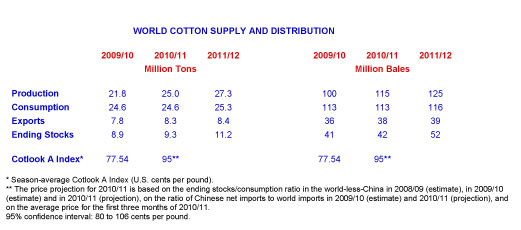
Despite the strong projected global economic growth, cotton mill use is expected to remain stable
at 24.6 million tons in 2010/11 due to limited available supplies and high prices. Global cotton
stocks fell by 25% in 2009/10 to 8.9 million tons, the smallest in seven seasons. Ending stocks are
projected to increase to 9.3 million tons in 2010/11. However, this hides disparate geographic
trends: stocks are expected to decline in most countries of the Northern Hemisphere and to increase
in the Southern Hemisphere due to an expected bumper crop. The global stocks-to-use ratio could
increase from 36% in 2009/10 to 38% in 2010/11, still well below the ten-year average (48%).

International cotton prices have risen steeply since the beginning of this season. The
average Cotlook A Index over the first four months of the season is 120 cents per pound, almost
twice as high as the average over the same period last year. It is also well above the current ICAC
2010/11 season-average projection of 95 cents per pound. The ICAC Secretariat encourages an
awareness of the confidence interval around each forecast, rather than an exclusive focus on the
point estimate. It also acknowledges that in the current environment of volatility, the ICAC price
model may be less relevant than in other seasons.

Cotton prices rose much faster than polyester prices over the last few months. This has
already resulted in some shifts in fiber blends at the spinning level, to the benefit of polyester.
The share of cotton in global fiber use, estimated at 36.5% in 2009, will likely continue to
decline in 2010 and 2011.

PR-DECEMBER-10

Posted December 7, 2010

Source: ICAC

Lenzing Group Third Quarter 2010 Best Quarter In Company History

LENZING, Austria — November 16, 2010 — The Lenzing Group extended its strong upward development of
the first half year into the third quarter of 2010. EBIT of EUR 60.8 mill. (third quarter 2009: EUR
37.3 mill.) generated the best quarterly result in the company’s history. Nine-months sales in 2010
grew by 45.2% from EUR 885.0 mill. (2009 reference period) to EUR 1.285.5 mill. EBIT reached a new
nine-month record high of EUR 168.8 mill. and more than tripled EBIT of the 2009 reference period
(EUR 54.3 mill.).

The reason for the strong growth of sales and results lies in the significantly improved
business development of cellulose fibers which turned out to be far better than expected still at
mid year. Higher shipments as a result of increased production capacity, a fiber price level
improved over last year’s and the full consolidation of the Paskov pulp factory from May 2010 on
yielded correspondingly positive results. Sales excluding acquisition effects grew by 37.7%.

Peter Untersperger, chairman of the Lenzing management board comments on the development of
the business: “We are facing a growing and sustainable excess in demand in all important fiber
markets”. In addition, the floods in Pakistan and India recently caused the global textile fiber
market to expect a significant physical shortage of cotton and triggered a distinct increase in
cotton prices.

Peter Untersperger: “The calamitous weather situation in Pakistan and India has led to
rethinking. Cotton will in the future be viewed with ever increasing doubt concerning the crop’s
pricing and availability. Market analysts therefore expect a structural change of the global fiber
market which should strongly benefit cellulose man-made fibers, such as viscose, modal and TENCEL
® in the medium and long term.”

All fiber production sites of the Lenzing Group were fully utilized and partly achieved new
records in production and shipment. The increase in raw material prices was largely, but not fully
passed on to the market. The ongoing capacity expansion programs at almost all fiber production
sites will relieve the demand-driven pressure on production in the course of 2011/12 to a certain
extent.

Outlook

The fourth quarter, too, is expected to show a continuation of the dynamic market
development and excellent results in its core business fibers. Lenzing’s fourth-quarter fiber
capacity has been largely sold already. Lenzing will continue its long-term and fair pricing policy
of the recent months and years, even under the given positive framework conditions. A product mix
further improved by favoring special fibers with attractive margins, increased fiber and pulp
production capacity and a very good internal cost structure allow the expectation that business
year 2010, despite the currently tight raw material price situation, will provide a new record
result for the Lenzing Group.

Posted on December 7, 2010

Source: Lenzing Group

Freudenberg Nonwovens To Increase Global Prices For Polyester Spunlaids

KAISERSLAUTEM, Germany, DURHAM, N.C., TAYUAN TAO-YUAN, Taiwan, — December 1, 2010 — Facing increase
in raw material prices Freudenberg Nonwovens will adjust global prices for polyester spunlaids
between 6 percent and 10 percent valid from January 1st, 2011. “We are a global company with
regional market focus, therefore we cope with the price increase on a regional level”, commented
Lin Gowming, General Manager at Freudenberg Far Eastern Spunweb, Taiwan.

The regional Sales & Marketing Departments in Asia, Europe and US are in the process of
informing customers individually per region.

“This increase is necessary to secure our position as a long term, reliable partner and
supplier of polyester spunlaid materials”, added John McNabb – General Manager in North America.

For Europe price increase will be in the range of 6 percent to 8 percent, affected are
polyester spunlaids for carpet and automotive industry but also numerous special applications. “
Unfortunately, in view of this development in raw materials we need to pass on at least some of
this increase to the market,” said Dr. Marc Schmidt, Director Marketing & Sales.

Posted on December 7, 2010

Source: Freudenberg Nonwovens

The Rupp Report: Old Spinning Machines: And The Winner Is …

The
Rupp Report of September 28, 2010
, reported about the outstanding idea of Switzerland-based
Rieter Textile Systems, which was searching for the oldest Rieter textile machine still operating.
And it was quite worthwhile to participate in this somewhat funny competition with a serious
background:

The Proof Of Endurance

And indeed, Rieter received entries from around the world, from which some 20 had the chance
to win the first prize. Last week, the lucky winners were announced during a ceremony led by Peter
R. Gnägi, CEO of Rieter Textile Systems. The Rupp Report had an exclusive invitation to take part
in the event. In his lively and entertaining speech, Gnägi mentioned the age of Rieter, which is
215 years, and explained the idea behind this competition. Rieter machinery is known around the
world for its reliability and durability. The company wanted to know how long old spinning
machinery equipment can be in use and still be productive.

Gnägi thanked all participants for their entries and their long-standing loyalty and, of
course, for their outstanding maintenance achievements and taking care of the machinery. Some of
the machines have been in use for generations. He didn’t forget to mention that Rieter’s sales
force will visit all participating companies to convince them to buy new machinery.

The Winner Takes Almost All

Later, the award winner with the oldest machine in the contest was presented — Flawa AG from
Flawil, Switzerland, a producer of dressings and wadding. The oldest machine still in production
dates from 1940 and is a so-called bale breaker — better known today as a bale opener, which
explains the function of the machine. Gnägi presented the first prize, a trip to ITMA 2011 in
Barcelona, including the flight and a two-night stay. Gnägi declared the old machine officially to
“be the oldest existing Rieter machine still in a production line.”

It seems that Rieter already had given this machine some credit in advance to win the
competition. In the earlier Rupp Report, the machine had already been mentioned. Peter Bruelisauer,
Flawa’s general manager, explained in his address that ¨the machine is producing a semi-finished
product, a fiber batt, which is used to produce very special maternity pads.” The delicate
maintenance of the machine, which is equipped with special card clothing, has been executed for 19
years by the same operator, who also attended the ceremony. Of course, said the winner, these pads
are only 0.5 percent of the company’s turnover. At first, he said, he hesitated to take part in the
contest. However, it’s nice to win this global competition, which proves that serious and permanent
maintenance is worthwhile.


Lucky Draw


Next, Gnägi started to announce the second- and third-place winners. In a lucky draw, the
second and third prizes were won by two Indian companies, still producing with Rieter machinery
assembled in the mid-1950s. Both companies will receive high-quality Swiss watches, which will be
presented by the local representatives.

Gnägi said some customers possibly were hesitating to take part in the competition. Some
companies with old machines were reluctant to offer possible entries due to the age of the
machines. “But,” Gnägi said, “this competition is the confirmation that Rieter is producing
reliable machinery, which is able to be productive for decades. And this reminiscence of the past
is a promise for the future to supply top-class machines.”

These words concluded an exceptional idea, born in the crisis of the past 18 months. Gnägi
also reported that Rieter is very much on the way to getting back to its old strength thanks to
soaring sales, mainly in Asia. And there is more to come at ITMA 2011 in Barcelona.

More information on the competition can be found at
www.rieter.com/oldestmachine.

Protex International Introduces Prote® Spring 930 Elastic Finishing Agent

Protex S.a.s., the textile subsidiary of France-based chemicals manufacturer Protex International,
reports its new Prote
® Spring 930 finishing agent provides permanent elasticity to cellulosic fabrics such as
cotton, linen and viscose. The company is targeting the new agent primarily to women’s knitwear
markets.

According to the company, the new elastomer — which complies with Oeko-Tex
® Standard 100, Class  I to IV — substantially improves a fabric’s elasticity;
provides rapid recovery after the fabric is stretched; offers a soft, supple hand; is non-yellowing
during drying and heat-setting; is easy to use, exhibiting good stability for padding applications,
even under alkaline pH conditions; and is durable to repeated launderings. Prote Spring 930 also
can be applied to nylon or polyester knits, either with or without spandex.


November 30, 2010


Sponsors