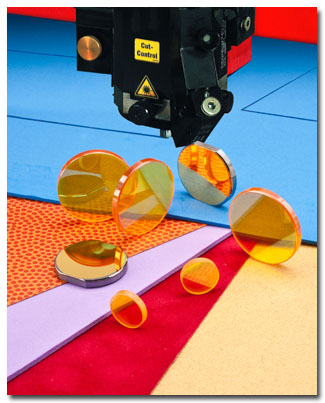
C02 Laser Optics For Cutting Clothing And Textiles

PROVIDENCE, R.I. — November 15, 2011 — A line of field replacement CO2 optics for most popular low
power lasers used for laser cutting fabrics, filter mats, canvas, and other synthetics is available
from Laser Research Optics of Providence, Rhode Island.

Laser Research CO2 Optics meet OEM and ISO-10110 specifications and are field replacements
that fit most popular lasers used for cutting clothing, textiles, and other synthetics. 
Offered in 1/2″ to 1-1/2″ dia. sizes, with 1″ to 25″ focal lengths in 1/2″ increments, they are
available from stock and shipped within 24-hours to minimize laser production downtime.

laserresearchoptics

Laser Research Optics’ CO2 Optics

Optimized for use at 10.6 µm, Laser Research CO2 Optics are suitable for Amada®, Bystronic®,
Cincinnati®, Mazak®, Mitsubishi®, Prime®, Strippit®, and Trumpf® lasers.  Mirrors and
reflectors made from silicon, molybdenum, and copper from 2mm to 10mm thick are available in 1/2″
to 3″ dia. sizes.

Laser Research CO2 Optics are priced according to type, configuration, and quantity with
delivery from stock within 24-hours.

Posted on December 21, 2011

Source: Laser Research Optics/Venmark International

The Rupp Report: Latest News From The Cotton Front

It was some two months ago that the Rupp Report last informed its readers about the latest news
from the cotton front. Quite a lot has happened with the downturn of the prices and the stocks. Now
it is time to give an update. As ever, the report is based mostly on the most appreciated
information from United Kingdom-based Plexus Cotton Ltd.

In mid-November, Plexus reported the New York December futures closed unchanged at 99.50
cents, while March dropped 240 points to 96.48 cents. “US export sales of Upland and Pima cotton
amounted to 646,800 running bales net, of which China took 630,200 running bales net. In addition
to that there were 528,000 bales sold to China under ‘optional origin.’ Total sales for the season
now amount to 9.5 million statistical bales and there are another 1.3 million statistical bales in
the ‘optional’ category.” As of the mid-November report, only 1.5 million bales had been exported,
and the backlog of outstanding commitments totaled some 8.0 million bales.

Record-high Crop

“According to the latest USDA figures, the rest of the world (excluding the US) will produce
a record crop of 107.6 million bales this season, surpassing the previous mark set in 2006/07 by no
less than 7.0 million bales,” the company continued. On the other hand, “mill demand in the rest of
the world is expected to remain stagnant at 110.5 million bales, due to slow economic growth and
man-made fiber substitution. As a result the seasonal production gap is expected to drop to just
2.8 million bales, which compares to much larger deficits of 13.3 million bales last season and
26.1 million bales two years ago.


Fierce Competition Outside The United States


“Considering that the rest of the world is nearly self-sufficient, the US has done extremely
well by filling its order books to the tune of 9.5 million bales, thanks to the fierce pace of
sales earlier in the year, when mills were still fearful that the world would run out of cotton. As
a result the US has entered this marketing year with a record 7.5 million bales in carry-in sales.
… This situation is likely to lead to fierce competition among non-US growths, as they try to
capture their fair share of this anemic market. Fortunately China has been acting as a stabilizing
force by aggressively procuring some of the excess supply, both in the domestic and international
markets, otherwise prices would already have come under a lot more pressure. The Chinese Reserve
has so far lifted 2.7 million statistical bales in the Chinese market and probably a similar amount
overseas. … As crops are moving in and unsold supplies keep building in non-US origins, we expect
to see some additional hedge selling by the trade.”

Lower prices

On December 1, the New York futures dropped considerably lower, with March down 518 points to
close at 91.30 cents from 96.48 cents two weeks earlier. This momentum in recent weeks became
strong enough to break through the Chinese level of support, taking prices to new 14-month lows,
Plexus considered, adding, “The move was all the more impressive since it happened in the face of
very strong US export sales, totaling more than 2.5 million statistical bales over a 3-week period.


Cancelled Contracts

“The US export sales report reflected a more routine course of business …, with
Upland and Pima sales increasing by just 84,100 running bales net for the current marketing year,
while another 19,000 bales were sold for 2012/13. Although net sales are still growing thanks to
China, it is troubling to see that another 35,900 running bales were cancelled in eight different
markets, led by Pakistan, Turkey and South Korea. The pace of shipments is also a negative, as just
163,400 running bales were exported last week, bringing the total for the season to 1.85 million
statistical bales so far, the slowest pace since 2000. The backlog of outstanding orders now
amounts to over 8.6 million statistical bales.


China As A Price Balance …


“Fortunately, there is the Chinese Reserve, who [took] a huge load off exporters’ and
domestic suppliers’ shoulders over the last six weeks and who is expected to continue to buy a lot
more in the months ahead. As of today the Chinese Reserve has procured over 5.0 million statistical
bales in the domestic market and probably at least 4.0 million bales in the international market.
By absorbing the world’s production surplus into its stocks, the Chinese Reserve is acting as a
counterforce to the extreme volatility in the cotton market since the summer of 2010.”

… While The Prices Collapsed

There is a big difference between the price swings in the Chinese and the international
market. As Plexus noted, “While the CC Index in China has dropped some 80 cents from its high of
215 cents earlier this year to its current price of 135 cents, the A-index has collapsed from a
high of 243.65 cents to a current quote of 98.15 cents, a swing of over 145 cents or nearly twice
as much as the CC Index. The futures market is not far behind the A-index, with a difference of
around 136 cents.”

One week later, on December 8, the company reported: “NY futures moved sideways in very dull
trading this week, as March added 75 points to close at 92.05 cents. … Through its domestic
auction program the Chinese Reserve has added another 1.1 million statistical bales to its
stockpile this week, which means that it has already accumulated around 6.1 million bales since the
middle of October, which equates to roughly 18 percent of China’s crop this season. The maximum
daily auction target is currently at 577,000 statistical bales and the fact that less cotton was
taken up this week, combined with an ever so slight rise in domestic prices, seems to indicate that
the support mechanism is working.


Struggling With High Price Contracts


“Against this backdrop of Chinese support, which has kept the CC-index at a relatively
elevated level of around 136 cents when compared to the current A-index of 98.70 cents, mills
around the globe have been getting some breathing room lately and are now in many cases able to
turn a profit against current replacement cost. However, a lot of mills are still struggling to
digest the many high price contracts they have engaged in earlier this year and it is going to take
a while until this overhang of expensive cotton has finally been worked through the system.”

So what’s next? Again, time will tell.

December 20, 2011

Aquafil, Carvico Form JV To Relaunch XLA Stretch Fiber

Two Italy-based companies — Aquafil S.p.A., a producer of nylon 6 for carpet applications and a
producer of nylon, microfiber and polypropylene yarns for apparel applications; and Gruppo Carvico,
a manufacturer of warp-knitted stretch fabrics for swim-, sports- and underwear — have formed a
50/50 joint venture (JV) under the name XLAnce Fibre Italia to acquire assets related to XLA
polyolefin-based soft-stretch fiber from Midland, Mich.-based The Dow Chemical Company and its
affiliates and to restart production of the fiber.

Dow introduced its DOW XLA™ fiber technology in 2002, and apparel featuring the fiber
appeared at retail in 2004. XLA was touted for its ability to withstand extreme chemicals and
temperatures up to 220°C, among other processing conditions; but Dow made a strategic decision to
focus on other businesses in its portfolio and ceased investing in the technology. The company
announced in 2010 that it would stop production of XLA and shutter its manufacturing plant in
Tarragona, Spain, upon fulfillment of all outstanding orders (See ”
Dow To Shut Down XLA
Production
,” www.
TextileWorld.com, May 25, 2010
). XLAnce Fibre Italia has acquired the
trademarks associated with XLA fiber; an exclusive license to use the technology; and the XLA fiber
production lines, machinery and equipment located in the Tarragona plant. The company will move the
equipment to a site in Italy and expects to begin production in the third quarter of 2012.

“As a leading stretch fabric company our interest into the possibility to resume XLA
production was natural, since XLA has been one of the very few significant new fibers in our
business in recent years, and our partnership with Aquafil, whose fiber technology knowledge is a
key requirement, made this project possible,” said Laura Colnaghi Calissoni, chairman, Carvico. “We
will work to ensure that the new company, which will have the full freedom to operate independently
on the market, can offer innovative solutions in many applications where the use of fiber XLA can
add value.”

“Aquafil’s consolidated knowledge within the polyamide fibers segment, in particular with the
innovative Econyl recycled yarn, and within the microfiber and polypropylene segment with the
Dryarn hi-tech fiber, will be essential to revive this promising elastomer with undoubted
synergies,” said Giulio Bonazzi, chairman, Gruppo Aquafil. “The transfer of the production to Italy
will also bring the added value of the closeness to what is still renown as the Textile innovation
and creativity world center, both for fashion and sportswear brands.”

December 20, 2011

Kingwhale Reports Success Of Low Impact Technology™

Taiwan-based Kingwhale — a bluesign®- and Oeko-Tex®-compliant vertically integrated manufacturer of
performance apparel fabrics and finished products — reports that utilizing Low Impact Technology™
(L.I.T.™) in its manufacturing and dyeing processes has led to significantly reduced use of energy,
water and dyestuffs.

L.I.T. is designed to conserve energy and raw materials from the start of manufacturing and
includes a process to modify the polyester molecules during fiber manufacturing to enable the yarn
to take up the dye more quickly than conventional polyester yarn, thereby requiring less dyestuff
to be used and cutting the amount of process energy and water needed as well. According to the
company, the dyeing technology uses 22-percent less electricity for coloring and heating,
50-percent less thermal energy for steam creation, 60-percent less water and 15-percent less
dyestuffs than traditional dyeing processes to achieve comparable results.

Kingwhale’s fleece products were the first to be dyed using the L.I.T. process, and the
company now also dyes baselayer fabrics using L.I.T.

“Depending on the amount of fiber in a fabric, … the overall water and energy savings
[using L.I.T.] can be very substantial,” said James Huang, president, Kingwhale. “An average fleece
fabric can save over 8 gallons of water per garment. Each L.I.T. fleece dye lot can save 1150
[kilowatt hours] of energy — enough to power a typical U.S. household for over a month.”

December 20, 2011

RollMover™ From Appleton Mfg. Division Increases Productivity And Safety

NEENAH, Wis. — December 16, 2011 — Appleton Mfg. Division’s battery-powered RollMover™ is perfect
for increasing productivity and ensuring worker safety whenever heavy loads need to be moved. The
material handler is ideal for moving large master rolls of: paper, fabric, tissue, towel,
other paper, nonwovens, or fiberglass mat, as well as large trucks or chassis. With the power
to move loads ranging from 100 lbs to over 50,000 lbs, the RollMover™ increases productivity by
preventing the need to wait for special tow trucks or moving machinery. Although featuring a
durable steel frame, the RollMover™ is lightweight and compact, easy to use and simple to store.
This versatile material handler prevents on-site injuries caused by pushing heavy loads, thus
reducing risk and liability. The RollMover™ also increases productivity and safety by removing the
need for air hoses, which have length limitations and can be a trip hazard on the work floor.

The RollMover™ comes in three different models designed to cover all needs and scenarios. The
Standard Duty (SD) RollMover™ can safely move loads up to 6,500 pounds, while the Heavy Duty (HD)
model can manage larger loads reaching 50,000 pounds plus. The HD Large Roller model offers all the
power and durability of the HD model along with a large, contoured drive wheel designed for
damage-free moving of soft material rolls, including tissue and nonwovens.

Posted on December 19, 2011

Source: Appleton Mfg. Division

Engineered Floors Acquires Dream Weaver Carpet Industries

Engineered Floors LLC, Dalton, Ga. — a manufacturer of carpet primarily for multi-family housing
and producer of PureColor solution-dyed stain- and soil-resistant polyester fiber for residential
replacement and multi-family housing carpet — has acquired Chatsworth, Ga.-based residential carpet
manufacturer Dream Weaver Carpet Industries Inc. for an undisclosed price.

Engineered Floors was established in 2009 by Chairman and CEO Robert E. Shaw, who returned to
the industry after retiring in 2006 as CEO of Dalton-based floor-covering manufacturer Shaw
Industries Inc. The new company built a fiber and carpet manufacturing plant in Calhoun, Ga. — the
first greenfield carpet plant built in North Georgia in the last 25 years, according to James
Lesslie, assistant to the chairman. The plant, which is equipped with new machinery, has undergone
two expansions, and now measures 510,000 square feet (ft2) and employs a workforce of some 500
people. A new 210,000-ft2 manufacturing plant under construction in Dalton is scheduled to open in
the first quarter of 2012. By the end of 2012, the company expects to employ approximately 800
people including those at Dream Weaver Carpets.

Dream Weaver Carpets was founded in 1992 and uses PureColor fiber in its carpet products. As
a division of Engineered Floors, the company will continue its operations in Chatsworth and offer
its carpets under the Dream Weaver Carpets brand.

“We are excited to have Dream Weaver Carpets become part of the Engineered Floors
organization,” Shaw said. “Melvin Silvers (founder of Dream Weaver Carpets) has built a solid
company and features a great collection of carpets using our PureColor fiber. By combining
resources, we can accelerate their growth and help maximize our production efficiencies.”

Lesslie noted that the acquisition of Dream Weaver Carpets gives Engineered Floors an entry
into retail distribution channels. “We are excited about getting into the full-service side of the
carpet industry,” he said.


December 13, 2011

The Rupp Report: ITMA Flash V

This week, the Rupp Report takes a look at one of the major German suppliers of tenters and other
finishing equipment – A. Monforts Textilmaschinen GmbH & Co. KG. The company is located in
Monchengladbach and some months ago, it became a member company of the Possehl Group. The Rupp
Report spoke to Klaus A. Heinrichs, vice president marketing for Monforts. Heinrichs expressed that
his company was very happy with the results of ITMA 2011 in Barcelona, Spain.

Too Many ITMAs …

As always, the first question was about the concept of ITMA, with an ITMA Europe every four
years and the Asian ITMA every two years. His answer was quite different from the other interviewed
people: “If we consider ITMA to be an innovative show, one in Europe and one in Asia every three
years would be enough. I’m sure with this concept the Asian ITMA would be valued much more highly.
With the current situation, we have quite an inflation of Asian textile machinery exhibitions, and
not only the ones in China.”

… But Very Good Response

The questions about the origin of the visitors were congruent with answers from
other interviewed exhibitors: Most people came from India, Pakistan and Turkey. South America was
very strong with many Brazilian visitors; followed by Germany and Spain.”

The visitor frequency was very good indeed for us,” Heinrichs said, “and the quality of the
people was absolutely outstanding. We welcomed only decision makers, and by September 27, we
already had 20-percent more visitors than in Munich four years ago. Indeed, we are very happy with
this event and are looking forward to the following months.”

With the increasing importance of industrial fabrics, the European market is still important
for Monforts: “Yes, in spite of the fact that today, technical textiles are also produced in
low-wage countries, the concept and decision-making still takes place in Europe,” Heinrichs added.
“But of course, the Asian market today is much more important in terms of bigger volumes. However,
I believe that Europe is still important for high-tech machinery and products.”

The current economic situation is not that much distorting the business of Monforts. “The
only difference we see today is the fact that the investments are a bit smaller than last year,”
Heinrichs commented.

New Products

The response to the exhibits is somewhat the most important criterion for a
successful show: “The response to our two main new exhibits was great,” Heinrichs said. There is,
on the one hand, the Montex 8000 tenter. Monforts reports the new tenter includes a number of new
features and options that are particularly suitable for knitted fabrics, nonwovens and other
industrial fabrics applications. The European-built tenter features a new heat recovery module
incorporating a fully automatic system for its integrated heat recovery system; a reduced distance
at the infeed for knitted fabrics; a new heavy-duty vertical chain; new rotating disc type
“fluff-sieves” and a vacuum system for efficient cleaning. Furthermore, it features an improved
visualization for the company’s Teleservice remote control facility; as well as two parallel
integrated exhaust ducts in each chamber. A new heat recovery module Eco booster HRC with a fully
automatic cleaning system was also presented, replacing earlier modules. The new one provides
availability on a constant level, a reduced downtime and no reduction in the tenters performance
due to contaminated filters.

On the other hand, the Matex Eco-applicator was a tremendous success too, Heinrichs
mentioned. According to Monforts, a new, improved soft coating solution provides a significant
energy savings with reduced drying times. In addition to that, it also can eliminate the need for a
conventional wet-on-wet padder. The new process uses trough and roller techniques and applies just
the required amount of liquid/coating to the fabric via contact with the roller.

“The whole industry is in search of sustainable production, whatever that may be. The main
issue is to save time and energy, and reduce wastewater,” Heinrichs added. “So the success of these
exhibits is just the outcome and consequence of a strong market need.”

Positive And Confirmed Situation

How does Monforts interpret the current market situation? “Well,” said Heinrichs,
“we feel not that much influence from the stock markets. We are optimistic, having great
opportunities in Latin America for our systems working in traditional markets, but also for
technical textiles in Europe — mainly in Germany, Austria and Switzerland.”

Last week, the Rupp Report had the chance to see Heinrichs again and ask him if he can
confirm the positive statements he made at ITMA. “By all means,” he said, “the impressions from
ITMA were confirmed. Virtually all discussions with customers at ITMA are becoming serious
projects. Our products are absolutely fulfilling the market demands. These positive feedbacks
require much more customer testing on the new machinery in our laboratory to prove that these new
machines produce the same finish results on an industrial 1:1 scale. But this is no problem at all.

“On the other hand, we also see a higher demand for upgrade packages of existing machines. We
prepared different upgrade kits for older machines, and with these tools, the customers have the
possibility to get a much higher production with less investment,” Heinrichs said.

Outlook

“Our portfolio is pinpointed to today’s requirements regarding sustainable production in
general; and reduced energy, time and wastewater in particular. The current positive trend for our
machines is reflecting this argument. For 2012, we expect a similar positive year,” Heinrichs
mentioned.

Yes, of course, he added, Monforts will be in Shanghai next June for ITMA Asia + CITME 2012,
and probably in Milan for ITMA 2015.

December 13, 2011

Teijin, GM To Jointly Develop Advanced Carbon Fiber Composite Technologies

Tokyo-based Teijin Ltd. and Detroit-based General Motors Co. (GM) have signed an agreement to
jointly develop advanced carbon fiber composite technologies that could be used worldwide in GM’s
high-volume cars, trucks and crossover vehicles.

The agreement involves using Teijin’s proprietary carbon fiber reinforced thermoplastic
(CFRTP) technology — a method of producing carbon fiber composites more quickly and efficiently
than traditional methods that use thermosetting resins and require much longer molding times, which
until now has limited the use of carbon fiber in high-volume vehicles. The technology enables mass
production of CFRTP components with cycle times of less than one minute, Teijin reports.

“Teijin’s innovative CFRTP technology, which promises to realize revolutionarily lighter
automotive body structures, will play an important role in GM’s initiative to bring carbon fiber
components into mainstream vehicles,” said Norio Kamei, senior managing director, Teijin. “We
believe our visionary relationship with GM will lead the way in increased usage of green composites
in the automotive industry.”

“Our relationship with Teijin provides the opportunity to revolutionize the way carbon fiber
is used in the automotive industry,” said Steve Girsky, vice chairman, GM. “This technology holds
the potential to be an industry game changer and demonstrates GM’s long-standing commitment to
innovation.”

Teijin will set up the Teijin Composites Application Center in the northern part of the
United States in early 2012 to work more closely with GM. The agreement could make way for Teijin
to expand its portfolio beyond specialty and high-end automotive carbon fiber applications.

December 13, 2011

Albany International To Close Plant In Menasha, Wis.

Albany International Corp., a Rochester, N.H.-based advanced textiles and materials processing
company, has announced plans to cease manufacturing at its forming fabric facility in Menasha,
Wis., in January 2012, eliminating 48 jobs. The company reports the closure is necessary in order
to align its paper machine clothing manufacturing capacity in North America with expected long-term
demand. Production will be relocated by July 2012 to Albany’s other forming fabric manufacturing
plants in North America.

Forty-four employees involved in research and development (R&D), product management,
quality systems, customer service, technical and design and administration will remain at the
Menasha facility, which going forward will operate as a R&D center and as a center of
excellence in forming technology.

Albany International will have 24 plants remaining globally after the closure, five of which
manufacture forming fabrics. Six of the 24 plants are part of Albany Door Systems, which the
company is selling to New Haven, Conn.-based Assa Abloy Door Security Solutions. Albany also
recently announced plans to cease manufacturing at its corrugator fabrics plant in Menands, N.Y. (See ”
Albany
International To Close Plant In Menands, N.Y.
,” www.
TextileWorld.com, Oct. 18, 2011
).

December 13, 2011

Huntsman Textile Effects, Ramatex Form Strategic Partnership

Singapore-based dye and chemical provider Huntsman Textile Effects and Singapore-based textile
manufacturer Ramatex Group have formed a strategic partnership with the goal of becoming the first
textile company globally that is committed to helping major brands fulfill commitments in the Joint
Roadmap: Toward Zero Discharge of Hazardous Chemicals — an initiative recently issued by brands and
marketers including Adidas Group, C&A, H&M, Li Ning, Nike Inc. and Puma to lead the apparel
and footwear industry toward eliminating hazardous materials discharge in the supply chain by 2020.

The initiative is a direct response to Amsterdam-based advocacy group Greenpeace
International’s Detox challenge to global sportswear and fashion brands following its Dirty Laundry
reports, which found hazardous chemicals released by textile facilities in China and disclosed that
samples of clothing and footwear from 15 brands tested positive for toxic chemicals.

“As a member of the Sustainable Apparel Coalition, Huntsman Textile Effects is proud to be a
part of this major initiative in driving sustainability throughout the whole textile value chain,”
said Paul Hulme, president, Huntsman Textile Effects. “This partnership [with Ramatex] will
leverage our combined capabilities to deliver not only the challenges of the roadmap but indeed
create a model for real, sustainable change within the textile industry.”

Ramatex was established in 1976 and became vertically integrated in 1990, allowing it to
control the entire apparel manufacturing process from spinning, knitting, dyeing and printing to
exporting. The company operates three fabric mills and 13 apparel factories in Singapore, Malaysia,
Cambodia and China.

“Ramatex has always been committed to meeting the needs of the brands and responsible to the
consumers we supply,” said Ma Wong Ching, chairman, Ramatex. “It is clear that the Joint Roadmap is
challenging and ambitious but represents an important first step in reducing the environmental
impacts of the textile industry. I am proud to say that with our solid foundation and the strong
support of our partner, Huntsman we are well placed to meet the challenge.”


December 13, 2011

Sponsors