ITMF’s Cotton Contamination Survey 2011

ZURICH, Switzerland — January 2012 — “After some improvements in the recent past foreign matter,
stickiness and seed-coat fragments in raw cotton pose serious challenges to the cotton spinning
industry worldwide.” This is the general conclusion to be drawn from the “Cotton Contamination
Survey 2011” which has just been released by the International Textile Manufacturers Federation
(ITMF). The survey is carried out every other year, the 2011 edition being the twelfth in the
series since the changeover to a new methodology in 1989. In the 2011 report, 119 spinning mills
located in 24 countries evaluated 71 different cotton growths.

Contamination — slight increase

The level of cottons modestly or seriously contaminated as perceived by the spinning mills
from around the world rose slightly from 22% to 23% compared to the last survey in 2009. A closer
look at the extent of the contamination shows that 7% (2009: 6%) of all cotton evaluated were
seriously contaminated by some sort of foreign matter whereas 16% (2009: 15%) were only moderately
contaminated. As the summary data are arithmetic averages of the different contaminants, the extent
of contamination is fully illustrated only by the results for the individual contaminants. They
range from 5% for “tar” (2009: 4%) to 51% of all cottons processed being moderately or seriously
contaminated by “organic matter”, i.e. leaves, feathers, paper, leather, etc. (2009: 42%). Other
serious contaminants are “inorganic matter” (31%), “fabrics made of cotton” (30%), “strings made of
woven plastic” (29%) as well as “fabrics made of woven plastic” and “strings made of plastic film”
(28% each). The most contaminated cotton descriptions considered for the survey originated in
India, Nigeria, Zimbabwe, China and Turkey. In contrast, very clean raw cottons were produced in
the USA, (Texas High Plains, Arizona, Pima, USA-Others, Memphis and California), Syria, Benin,
Brazil, Spain, Argentina, Greece and Australia).


Stickiness — significant rise


The presence of sticky cotton as perceived by the spinning mills increased in 2011
significantly from the record low of 16% in 2009 to 20%. While this level is still lower than the
long-term average, the level of stickiness is still considerable high and remains a major challenge
to the global cotton spinning industry. Descriptions that were affected most by stickiness were
those from India (DCH, MCU-5, India-Others), Syria, USA (California, Pima), Spain, Mali and
Uzbekistan (Medium-Staples. On the other end of the range, cottons from Argentina, Turkey (Izmir),
USA (Arizona), Egypt (Giza), India (J-34) and USA (Texas High Plaines) were not or hardly affected
by stickiness.


Seed-coat fragments — noticeable jump


With regard to seed-coat fragments the Cotton Contamination Survey 2011 shows that their
appearance in cotton growths remains an issue for spinners around the world. 38% of cotton spinners
(2009: 31%) claim that they have encountered seed-coat fragments in the cotton growths consumed.
This is a jump of 7 percentage points, up from only 31% in 2009, the lowest level since including
measuring the level of seed-coat fragments in the survey in 1991. The origins affected most by
seed-coat fragments are those from Nigeria, India (India-Others, MCU-5, Shankar-4/6, J-34) USA
(South Eastern, California), Ivory Coast and Turkey (Turkey-Others). Cotton descriptions for which
the existence of seed-coat fragments was negligible (prevalence of less than 20%) included those
from Australia, Benin, India (Others), Pakistan (Others), and the US (California, Texas High
Plains).

A free download of the complete survey can be found on the ITMF website. Please use the
following link: http://www.itmf.org/cms/pages/publications/free-downloads.php

Posted on February 27, 2012

Source: ITMF
Smoothing Out The Differences

Roadways and other paved surfaces can be subject to the damaging effects of sub-surface moisture-
and temperature-induced swelling and shrinking, and traditional geosynthetic materials haven’t been
especially effective in stabilizing the moisture content in the ground that underlies the pavement.
Especially in environments such as the Alaskan tundra — which is subject to frost heaves owing to
varying rates of expansion and contraction of the freezing and thawing water held in the soil — or
parts of Texas, Georgia and other warmer-climate states that have expansive soils — which are
stable enough when wet but which may dry up and crack in the heat of a severe summer drought — the
movement of the water in the soil affects the pavement as well and can cause it to buckle or crack
in response to that movement. What is needed is a way to equalize the moisture content throughout
the roadbed, which will help eliminate the threat of weather-induced damage to the pavement.

TenCate Geosynthetics North America, Pendergrass, Ga., part of the Netherlands-based Royal
Ten Cate NV’s TenCate Geosynthetics division, has developed a woven geosynthetic that is designed
to provide roadway stabilization in the face of extreme weather and environmental situations.
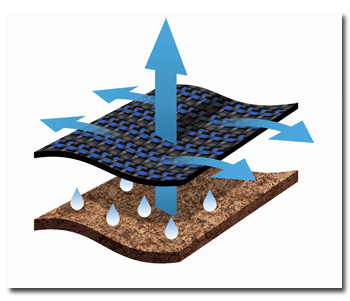
TenCate Mirafi® H2Ri is a double-layered fabric made with high-tenacity polypropylene filaments to
provide reinforcement and soil retention, and a yarn comprising patented hygroscopic, hydrophilic
4DG (deep groove) multi-channel nylon fibers that wick water out of the roadbed and move it
laterally through the fabric and thus mitigate the effect of frost heaves, or, alternately, the
uneven drying out of expansive soil.

QFOMgraph


The wicking yarns in TenCate Mirafi® H2Ri wick water out of the roadbed and move it laterally
through the fabric, thus mitigating the effects of differential settlement.

The development of Mirafi H2Ri came about following a meeting between representatives of
TenCate and the Alaska Department of Transportation (DOT), which was struggling with frost heave
problems on roadways in Alaska, according to Brett Odgers, market manager, roadway reinforcement,
TenCate Geosynthetics North America. “We turned the problem over to our product development people,
and they came up with a wicking yarn to help mitigate the DOT’s issues.”

Wicking yarns are used a lot in performance apparel, but they had not previously been used in
a geosynthetic stabilization application. Instead, Odgers said, road builders traditionally have
put down six to 12 inches of sand or aggregate that the water could move through, or they have
installed some sort of drainage net. “The problem with that is that if there are changes in the
grade, the water can’t move uphill and will pocket at the lower level. The benefit of H2Ri is that
water will move uphill as it is transported through the fabric.” This movement will help solve
problems caused by differential settlement because the moisture content is equalized throughout the
roadbed.

QFOM

TenCate Mirafi® H2Ri is placed directly on the prepared site in an overlapped or seamed
arrangement, depending on subgrade strength, and then covered with fill.


According to TenCate, H2Ri has higher tensile modulus properties than traditional
stabilization products, and the double-layer construction with uniform openingsenhances the
separation, filtration and drainage functions.

“We developed the weave structure for some reinforcement products we came out with last
year,” Odgers said. “It allows us to use both the nylon and reinforcement yarns together, and it
gives a better flow through the fabric so it won’t trap water.”

This solution applies to environments other than the Alaskan tundra as well. “We’re doing
research now with the University of Texas, Austin, on using H2Ri for expansive soil applications,
and the preliminary work is pretty positive,” Odgers said. “Any time you need to reinforce and move
water out of the system, this will be useful, but these two applications — frost heave and
expansive soil — are particularly challenging.” He added that the same product would be used in
both applications.


For more information about TenCate Mirafi® H2Ri, contact Brett Odgers +913-909-7150,
b.odgers@tencate.com.


February 2012

The Rupp Report: Confirmed Yarn And Fabric Production Trends

As the Rupp Report has reported during the past weeks, mainly from ITMA 2011 in Barcelona, Spain,
the international textile community is enjoying a positive time. Reports with opinion and market
leaders show some solid positive trends for the year to come — and for the past six months. The
Rupp Report recently received the latest news from the Switzerland-based International Textile
Manufacturers Federation (ITMF) regarding yarn and fabric production for the third and fourth
quarters of 2011. These figures illustrate an optimistic trend toward ongoing confidence in the
business.


Increased Yarn Production


The report states: “In comparison with the previous quarter, world yarn production increased
in the 3rd quarter of 2011 by +2.5 percent. South America and Asia recorded increases of +9.2
percent and +2.7 percent, respectively.” On the other hand, “North America and Europe recorded
decreases of -4.9 percent and -4.8 percent, respectively. Year-on-year global yarn production rose
slightly by +1.1 percent due to higher output in Asia by +1.6 percent, and despite lower output
levels in North America (-8.5 percent), South America (-7.5 percent) and Europe (-2.6 percent).”


Increased Fabric Production


The same comment is given for global fabric production: “Compared with the previous quarter
global fabric production increased in the 3rd quarter of 2011 by +5.9 percent. Fabric production
rose by +7.5 percent in Asia and by +3.1 percent in South America, but fell in Europe by -8.7
percent. In comparison to last year’s 3rd quarter global fabric production was down by -2.3
percent. Looking at the various regions only South America recorded an increase (+4.6 percent),
while in Europe, Asia and North America fabric production was reduced by -4.9 percent, -2.6 percent
and -2.4 percent, respectively.”

Decreased Yarn Stocks

In contrast, ITMF reports: “Global yarn stocks dropped in the 3rd quarter of 2011 compared
with the previous one which was especially due to lower stocks in South America and Asia, while
stocks in Europe and North America remained practically unchanged.” This fact was certainly an
effect of the volatile cotton prices. The Rupp Report has informed its readers in the past months
about the ups and downs of the cotton prices.

Higher Yarn …

However, “Year-on-year global yarn inventories increased as a result of higher stocks in Asia
and in spite [of] a drop in South America. … Yarn inventories dropped worldwide by -11.4 percent in
the 3rd quarter of 2011 compared to the previous one. In South America and Asia they fell by -20.6
percent and -14.8 percent, respectively, but remained almost unchanged in Europe and North America.
On an annual basis global yarn stocks were up by +2.0 percent. In South America yarn inventories
fell by -9.5 percent, but rose in Asia and Europe by +4.8 percent and +0.3 percent, respectively.”

… And Fabric Inventories

“Global fabric inventories rose in the 3rd quarter of 2011 by +4.4 percent as compared to the
previous one. In South America they jumped by +14.9 percent and also increased in North America by
+4.0 percent, in Asia by +0.6 percent and in Europe by +0.5 percent. In comparison to last year’s
3rd quarter, the global fabric inventories increased by +15.7 percent. In South America they soared
by +64.0 percent and also rose by +12.3 percent in North America, by +4.1 percent in Asia and by
+0.7 percent in Europe.”


Lower Order Income


The report adds: “Yarn and fabric orders fell in Europe both compared to the previous and
last year’s quarter. … [The] orders in Europe were slightly down by -0.4 percent and -1.5 percent,
respectively, in the 3rd quarter of 2011 compared to the previous one. Year-on-year yarn and fabric
orders in Europe decreased slightly by -0.1 percent and -1.5 percent, respectively. In Brazil yarn
and fabric orders jumped compared to the previous quarter by +23.5 percent and +15.7 percent,
respectively. On an annual basis yarn and fabric orders were down in Brazil by -19.9 percent and
-10.0 percent, respectively.”


Different Expectations For The Future


The ITMF report comments that “The estimates for yarn and fabric production in the 4th
quarter of 2011 in most countries are mixed. While the majority of producers in Asia are expecting
increases, those in Europe (with the exception of Turkey), North and South America are more
sceptical expecting lower output levels.”

Well, after all, the response over the last few weeks from machinery suppliers wasn’t that
pessimistic about this coming year. Many of them expressed their feelings that they are expecting a
prosperous 2012 that should be at least as good as 2011.

February 21, 2012

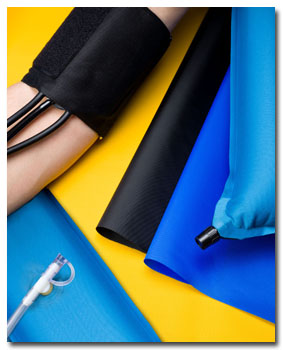
Eastex Products Introduces Tek Air Medical Fabrics

Holbrook, Mass.-based Eastex Products Inc. — a supplier of textile products and solutions for
healthcare and other markets — has introduced a line of air- and water-holding thermoplastic
polyurethane (TPU)-coated nylon fabrics that are suitable for manufacturing inflatable medical
products such as blood pressure cuffs, circulation leg wraps, cold-water circulating therapy wraps,
hold or cold gel packs, hospital air mattresses and seat cushions.

Eastex


Examples of products made with Eastex Tek Air Medical Fabrics

Eastex Tek Air Medical Fabrics are soft and non-stretch; offer properties including flame
retardancy, fluid and stain resistance, antibacterial and antifungal performance; and are easy to
clean. The fabrics may be manufactured using radio frequency welding and heat and sonic sealing
techniques as opposed to traditional sewing of seams. “The ability to seal these fabrics is what
makes them unique,” said Eastex Vice President of Marketing John Kimball. “By sealing as opposed to
sewing, the manufacturer can create air holding bladders and such. In medical applications, sealing
as opposed to sewing also helps keep the seam cleaner and not as prone to collecting bacteria and
microbes.”

February 21, 2012

Burlington Technologies To Add Cut And Sew Operation, Create 110 Jobs

Burlington Technologies Inc., Burlington, N.C., plans to expand its manufacturing operation in
Burlington, investing $725,000 to add cut and sew capabilities and creating 110 jobs. The company
has received a $120,000 grant from the One North Carolina Fund along with other incentives from
state and local entities to support the project.

Burlington Technologies currently operates two core businesses including Burlington
Manufacturing Services (BMS) — a package-yarn dyeing operation serving the home furnishings,
apparel and industrial textile markets — and Se7en LLC — a manufacturer of woven decorative fabrics
for home furnishings, hospitality and contract applications. The company also has two business
affiliates including VitaFlex LLC — a manufacturer of elastic nonwoven products for various markets
— and Diagnostic Chips LLC — a developer of diagnostic testing technologies for medical
applications. The plans for the cut and sew operation are contingent upon the company receiving a
contract from the U.S. military to produce military dress pants using wool-based fabrics already
supplied to the military by Greensboro, N.C.-based International Textile Group.

“This would be a new capability for our company,” said Mike Durham, president and CEO,
Burlington Technologies. “The system would be very automated, very process-oriented and efficient,
and ideally suited to a contract with the military. Once we get this up and running, it appears we
could have a niche that would serve other customers and markets as well.”

February 21, 2012

Huntsman Textile Effects, Madura Fashion And Lifestyle Form Innovation Council

Singapore-based dye and chemical provider Huntsman Textile Effects and Madura Fashion &
Lifestyle — an apparel manufacturer whose brands include Louis Philippe, Van Heusen, Allen Solly,
Peter England and People; and a division of India-based Aditya Birla Nuvo Ltd. — have formed a
joint Innovation Council in an effort to produce innovative and high-quality products.

“Consumers in the Indian market are increasingly affluent and look to companies like Madura
to provide the high quality, innovative products they demand,” said Rohit Aggarwal, global vice
president, strategic marketing and planning, Huntsman Textile Effects. “Huntsman is proud to
partner with Madura to drive innovation and quality to an even higher level in the future.”

“As one of the leaders in fashion and lifestyle within the Indian market, it is essential to
continuously drive innovation,” said Naresh Tyagi, Ph.D., head and vice president, product
development and quality assurance, Madura. “Working with strong partners like Huntsman Textile
Effects is an important aspect of maintaining our leadership position.”

February 21, 2012

Sawgrass Technologies Debuts M-XTR™ Pigment Inks

The Industrial Division of Sawgrass Technologies Inc. — a Charleston, S.C.-based developer of
digital printing technologies — has introduced M-XTR™ pigment-based inks formulated specifically
for high-speed digital textile printing systems.

M-XTR inks feature the company’s patented Rheological Modified Ink (RMI™) Technology — a
unique cylindrical jetting characteristic that creates a more consistent ink drop shape, thereby
producing sharper images with greater color accuracy than prior technologies. According to
Sawgrass, RMI Technology uses up to 40-percent less glycols than other ink products on the market,
enabling higher pigment concentrations for richer, higher-density colors and faster drying times.

M-XTR inks also feature a binderless formula that generates good color vibrancy, good
runability and maximum uptime, even with uncoated fabrics, Sawgrass reports. The company notes,
however, that the inks work best with matched-component fabrics and M-coatings. The inks also
eliminate the need for costly steam and wash steps; pass American Association of Textile Chemists
and Colorists (AATCC) crock and wash tests; and provide three-year outdoor durability based on
AATCC/International Organization for Standardization tests.

February 21, 2012

Five Specialty Fabrics Industry Student Scholarships Available Through IFF

ROSEVILLE, Minn. — January 30, 2012 — The Industrial Fabrics Foundation (IFF) today announced that
it is offering five scholarships to specialty fabrics/technical textile industry students.

But these are only for students with dreams as wide as a fabric structure sports stadium,
high as a cover on a NASA missile about to blast into space; deep as a dam embankment fortified
with geosynthetics, tiny as a fabric patch in a heart valve, cool as a sustainable design shade
structure, hot as a temperature controlled climate suit for arctic workers, strong as a fabric
reinforced ski worn by an Olympic athlete.

The importance of college and vocational training has been the core of IFF’s mission, and a
hot button news story this past week in President Obama’s State of the Union address and in his
speech Friday at the University of Michigan. The country’s new goal: Getting people the education
and training they need so they’re ready to take on the jobs of today and tomorrow.

Technical training is a critical part of the specialty fabrics/technical textiles industry
for everyone from the chemist conducting R&D to the factory worker operating million-dollar
high-tech machinery.

The specialty fabrics industry is made up of a wide spectrum of companies. Small, medium and
large suppliers make fabrics, machinery, components and accessories.

End product manufacturers make high-performance textile  products for a variety of uses
by the aerospace industry, the military, first responders/hazmat, fabric structures, biomedical
applications, high performance sports apparel, geosynthetics in agriculture and waste containment;
automotive interiors; and in futuristic applications in nanotechnology.

The world market for these high-performance fabrics was estimated at $126 billion in 2011 —
$29 billion of that in the U.S. In fact, this is one segment of the domestic textile manufacturing
base which now thrives thanks to continuous technical innovation.

IFF was established in 1994, and it awards several scholarships each year to students
enrolled in accredited colleges, universities or technical schools. The foundation was set up by
the board of directors of the Industrial Fabrics Association International (IFAI), a trade
group with over 1,800 member companies which has represented the U.S. specialty fabrics industry
for 100 years.

Students interested in applying for the scholarships can visit IFF’s website — the submission
deadline is in May — and the scholarship applies to the following school year, paid directly to the
students’ schools for fall semester tuition.

The IFF Board of Directors holds responsibility for application review and scholarship
awards. Announcement to the industry of the scholarship recipients takes place during IFAI Expo
Americas 2012, which will be held Nov. 7-9 at the Boston Convention Center. 

The scholarships offered are as follows: 

Don Williams IFF Student Scholarship — $3,000 each (up to three available) — This
scholarship is named in honor of the IFF board director who was instrumental in developing the
foundation scholarship program. IFF pays for tuition expenses at an accredited college, university,
or technical school textile or textile-related program. Applicants must be enrolled in a textile or
textile-related program of study. Recipients are selected on the basis of academic achievement,
community service, and interest in a future career in the specialty fabrics industry.  


IFAI Member Scholarship
— $3,000 each (up to two available) — This scholarship award
pays for tuition expenses at an accredited college, university or technical school. Recipients are
selected on the basis of academic achievement, community service, and interest in a future career
in the specialty fabrics industry.To qualify for the IFAI Member Scholarship award, applicants must
be employed by or related to an employee of an IFAI member company. 

In addition to these IFF-funded scholarships, several market segment scholarships are made
available through IFF by IFAI Divisions:  


Architect Student Scholarship
— $3,000 (one available) — This scholarship award pays
for tuition expenses at an accredited college or university architect program.The scholarship
recipient  will be selected on the basis of academic achievement, community service, and
interest in a future career in the specialty fabrics industry. To qualify for the scholarship,
applicants must be enrolled in a college or university architect program. This scholarship is
funded by a donation from the Fabric Structures Association (FSA), a division of IFAI.


Fabric Graphics Association (FGA) Member Scholarship
— $2,000 (one available) — This
scholarship award provides tuition expenses at an accredited college, university or technical
school. The scholarship recipient will be selected on the basis of academic achievement, community
service, and interest in a future career in the fabric graphics industry.T o qualify for the FGA
Member Scholarship award, applicants must be employed by or related to an employee of a FGA member
company. This scholarship is funded by a donation from the Fabric Graphics Association (FGA), a
division of IFAI.


Marine Fabricators Association (MFA) Member Scholarship
— $2,000 (one available) —
This scholarship award provides tuition expenses at an accredited college, university or technical
school.The scholarship recipient will be selected on the basis of academic achievement, community
service, and interest in a future career in the specialty fabrics industry. To qualify for the MFA
Member Scholarship award, applicants must be employed by or related to an employee of an MFA member
company. This scholarship is funded by a donation from the Marine Fabricators Association (MFA), a
division of IFAI.

Additional scholarships will be announced in February and March, 2012. For more information
visit www.ifai.com/resources/iff or contact Ruth Stephens, IFF Managing Director, at +1 651
225 6545, rastephens@ifai.com.  

Posted on February 21, 2012

Source: IFAI

AAFA Applauds Leadership On FPI Reform

ARLINGTON, Va. — February 16, 2012 — The American Apparel & Footwear Association (AAFA) today
applauded members of Congress actively working to reform detrimental procurement practices of the
U.S. government in order to provide more opportunities for job creation in America’s domestic
manufacturing sectors in lieu of federal program that gives these manufacturing jobs to
federally-incarcerated inmates. In a press conference hosted by Representative Bill Huizenga
(R-MI), the lead sponsor of the Federal Prison Industries Competition in Contracting Act (H.R.
3634), the congressman pledged to move this important legislation as soon as possible to bring
these jobs back to law-abiding American citizens.  Representative Huizenga was joined by
Representatives Carolyn Maloney (D-NY), Jim Sensenbrenner (R-WI), Walter Jones (R-NC), Don Manzullo
(R-IL), and Howard Coble (R-NC).

Jones is the lead sponsor on similar legislation known as the Department of Defense (DOD)
Textile and Apparel Procurement Fairness Act (H.R. 2312), also supported by AAFA, that would
further level the playing field for government contractors who outfit American servicemen and women
by limiting the government contracting preference currently enjoyed by federally-incarcerated
inmates.

“The bipartisan coalition of representatives who continue to oppose the idea that the U.S.
government should put inmates to work over taxpayers are to be commended for their dedication to
American manufacturing jobs,” said AAFA President and CEO Kevin M. Burke.  “I would like to
thank Representative Huizenga for his leadership to reform the unfair advantage federal inmates
have over hardworking Americans.  I would also like to thank Representatives Maloney,
Sensenbrenner, Jones, Manzullo, and Coble for their continued support.”

“Our industry’s market share is declining because a significant portion of the Department of
Defense contracts are given to Federal Prison Industries. This means that companies like ours can
no longer compete for those opportunities,” said Jonathan Long, Program Manager, Military Systems
for Propper International and who served as an industry voice during today’s press conference.
“While we support the intent of the FPI program and need to find ways to rehabilitate prisoners
serving their terms, we don’t believe that taking scarce jobs away from law abiding and taxpaying
citizens is the way to proceed.”

In 2010, the U.S. military spent more than $2 billion on uniforms, camouflage, training gear,
and combat footwear for U.S. servicemen and women.  Nearly $140 million of that business went
to convicted felons in 24 federal prisons around the country under the auspices of Federal Prison
Industries (FPI), a federally-operated program that puts inmates to work while in prison.

AAFA supports reform through two legislative vehicles, including the DOD Textile and Apparel
Procurement Fairness Act (H.R. 2312) introduced on June 23, 2011, by Representative Walter Jones
(R-NC) and Representative Larry Kissell (D-NC) and the Federal Prison Industries Competition in
Contracting Act (H.R. 3634) introduced by Representative Bill Huizenga (R-MI) on December 12,
2011.  Both pieces of legislation aim to bring equity back to the procurement process by
providing private industry with more opportunities to bid on government contracts.

The DOD Textile and Apparel Procurement Fairness Act (H.R. 2312) would:

  • Limit FPI to five percent of any one clothing and textile-based product made for the DOD.
  • Require DOD to report to Congress annually on all market research that led to the award of
    contracts to FPI.
  • Require DOD to report to Congress on the disbursement of funds to FPI and the effect of their
    preference on the private sector.
  • Direct DOD to reduce FPI at the same percentage as industry when DOD reduces quantities in
    delivery orders.
  • Prohibit FPI from taking any small business set-aside contracts.
  • Prohibit FPI from obtaining contracts only to subcontract that work out to another entity.

The Federal Prison Industries Competition in Contracting Act (H.R. 3634) would:

  • Require FPI to compete for government contracts, minimizing unfair competition with the private
    sector firms and their non-inmate workers.
  • Prohibit FPI from taking any small business set-aside contracts.
  • Require FPI to submit a detailed analysis of the probable impact on the private sector with
    proposals that would expand sales of new products or services.
  • Require agencies to research private sector products based on price, quality, and time of
    delivery before making a purchase from FPI to best meet agency needs.
  • Require purchasing agencies to negotiate terms and conditions of contracts and price paid with
    FPI, cannot exceed fair and reasonable price determined by the Federal Acquisition Regulation.

Without the passage of these two important pieces of legislation, FPI will continue to enjoy
utilize its mandatory source preference which enables the program to unfairly claim federal
contracts that outfit U.S. troops, including a preference over businesses that employ blind and
disabled workers.  As a result, domestic manufacturers, and the hardworking taxpayers they
employ, lose valuable market share — and jobs — to federally-incarcerated inmates.  Last year,
FPI posted a $36 million profit in their apparel and textile business alone.

Small apparel and textile manufacturers continue to lose contracts to FPI because of FPI’s
ability to unilaterally take almost any contract it chooses.  These situations have led to
layoffs, job losses and, in some cases, the closure of whole “Made in America” factories. 
Moreover, FPI also represents millions of dollars of lost opportunities, as U.S. manufacturers are
not even afforded the chance to bid on contracts that could have led to the retention and creation
of U.S. jobs.  Domestic apparel and footwear manufacturing for the U.S. military accounts for
more than 100,000 U.S. jobs.

From a national security perspective, the Berry Amendment — which requires the clothing and
footwear worn by our troops to be entirely made in the U.S.A. — is one of the most commonsense
regulations on the books. Because of the Berry Amendment, domestic manufacturers are able to
produce top-of-the-line uniforms and footwear for U.S. troops while protecting the proprietary
nature of our war fighters’ first line of defense when on the battlefield.

Keeping the Berry Amendment strong is vital for the safety of U.S. servicemen and women, as
well as the overall health of the U.S. apparel and footwear industry.  Congress must move to
quickly pass the DOD Textile and Apparel Procurement Fairness Act and the Federal Prison Industries
Competition in Contracting Act to limit FPI’s market share and level the playing field for U.S.
manufacturers and hard-working taxpayers.

AAFA recently launched a new issue-focused Web site at www.wewearreform.org and posted a
petition urging support for reform at www.whitehouse.gov.  In addition to these grassroots
efforts to raise issue awareness, AAFA also recently held an advocacy day on Capitol Hill today
with AAFA government contract members.


Posted on February 21, 2012

Source: AAFA

Cotlook Releases Initial Supply And Demand Forecasts For 2012/2013 (August/July) Season

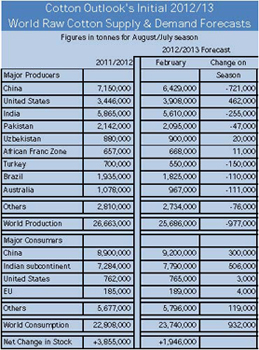
BIRKENHEAD, United Kingdom — February 16, 2012 — Cotton Outlook’s initial world production forecast
for the 2012/13 season foresees a decline in cotton area of 3.3 percent (area expanded by 11
percent and around 7.0 percent, respectively, during each of the last two seasons) and a similar
percentage reduction in output (versus growth of 13.6 and almost 7.4 percent, respectively). The
area projection is 34,618,000 hectares, and the production forecast is 25,686,000 tonnes.

Global cotton consumption is forecast to increase by 4.1 percent, to 23,740,000 tonnes.

However, despite the setback to production and the partial recovery of consumption (estimates
of which have decreased by an aggregate 9 percent over the two preceding seasons), the statistics
indicate a substantial net surplus, approaching two million tonnes, during next season.

Cotlook

Full details of Cotlook’s figures for this season and next are published in this week’s
edition of the weekly Cotton Outlook magazine. For details of how to subscribe please visit
www.cotlook.com, or email subscriptions@cotlook.com.

Posted on February 21, 2012

Source: Cotlook

Sponsors