Huntsman Unveils Phobotex® Fluorine-Free Rain- And Stain-Management Finishes

Singapore-based dye and chemical provider Huntsman Textile Effects (HTE) has introduced the
Phobotex® range of fluorine-free rain-repellent and stain-management textile finishes designed for
a variety of end-use applications including rainwear, activewear, pants, careerwear, awnings,
tarpaulins, boat covers, outdoor furnishings and shower curtains.

The Phobotex range — designed to complement HTE’s Phobol® CP short-chain C6 fluorocarbons
sold under the Teflon® trademark — are hydro polymer finishes that offer a soft hand and durable
water-based rain repellency and stain-management effects that last for up to 30 washes at 40°C and
higher, according to the company. Some products in the range also provide a stain-release effect
after washing as well as moisture-wicking and quick-drying properties.

Phobotex finishes are compatible with other textile finishes, according to Huntsman, and
comply with Oeko-Tex® and bluesign® standards; align with the Zero Discharge of Hazardous Chemicals
joint roadmap; and are free of chemicals on the American Apparel & Footwear Association’s
Restricted Substances Lists.

March 26, 2013

Southern Weaving Receives 2013 Silver Crescent Award For Manufacturing Excellence

Southern Weaving Co. — a Greenville-based manufacturer of high-tensile-strength narrow fabrics
including webbing, rope, protective sleeves and coatings for cargo restraint, safety protection,
lifting and other specialty applications — has received a 2013 Silver Crescent Award for
Manufacturing Excellence in the Midsized Manufacturer category.

The Silver Crescent Awards are given by the Silver Crescent Foundation to recognize small,
midsized and large manufacturers in South Carolina and to promote the importance of manufacturing
to the state’s standard of living and quality of life.

Founded in 1904, Southern Weaving has increased its workforce by more than 25 percent over
the past two years and now employs 212 people at its locations in Greenville, Anderson, S.C., and
Collingwood, Canada. The company was recognized for its creative partnerships with community
organizations including Greenville Technical College, Furman University, SC Works, ReadySC, SCMEP
and Personal Pathways to Success.

The awards were presented at the 17th annual Salute to Manufacturing Awards Luncheon, held
last week at the TD Convention Center in Greenville.

Dalton, Ga.-based Shaw Industries Inc.’s Plant 8T in Greenville was among the eleven Silver
Crescent Award finalists.

March 26, 2013


Monterey Mills Receives National Award For Paint Roller

Monterey Mills — a Janesville, Wis.-based high-pile knitting manufacturer and paint roller fabric
supplier — has received the American Brush Manufacturers Association’s William Cordes Innovation
Award in recognition of its seamless, collapsible paint roller.

According to the company, the paint roller offers advantages over traditional paint rollers
including improved pickup and release characteristics, reduced shedding, economical manufacturing,
and easy storage.

“The economic slow down of the past few years led us to look inward to reassess our resources
and opportunities,” said Dan Sinykin, president, Monterey Mills. “As the leading supplier of fabric
to the paint roller industry in the U.S., Monterey Mills set out to accomplish innovation in the
sector we know best. Now, with an economic recovery in sight, Monterey Mills is well positioned to
introduce an innovative process and fabric alternative to our long-term customers, whose expertise
in paint roller manufacturing will bring our product to the next level and ultimately to the
consumer.”


March 26, 2013


Picanol Of America Celebrates New U.S. Headquarters

Picanol of America Inc. — a wholly owned subsidiary of Picanol Group, Belgium — recently opened its
new headquarters at 65 Kitty Hawk Road in Greenville. More than 150 customers and guests attended
the official inauguration ceremony and also celebrated Picanol’s more than 50 years, presence in
America.

The opening of the new headquarters in Greenville represents yet another milestone in
Picanol’s long history in the United States. The company is focused on sales of Picanol weaving
machines and original Picanol spare parts and accessories, as well as machine repair and training
services; and reports that there are more than 20,000 Picanol weaving machines installed in the
United States.

The opening offered several presentations including Picanol’s position in the global weaving
machine marketplace, a review of available technologies, a focus presentation on technical fabrics,
and tours and demonstrations in the new facility.

“In recent decades, both thanks to and in tandem with our American customers, we have
constantly pushed our limits with regard to the performance and versatility of our weaving
machines. And it was also due to the confidence and belief of our American customers that Picanol
has been able to grow into the world leader that we are today,” said Picanol Group Managing
Director Luc Tack. “Furthermore, the successes achieved by Picanol in the United States over the
past decades have undoubtedly paved the way for our expansion throughout the rest of the world.
With our new headquarters in Greenville, we will make sure that we continue to deliver the very
best weaving machines and the highest levels of service to our valued U.S. customers.”

Following the sale of its Steel Heddle Division in September 2011, Picanol had to establish
a new site in Greenville. In June 2012, Picanol of America acquired 18,500 square feet of space at
the South Carolina Technology & Aviation Center (SC-TAC) to accommodate expanded sales, machine
repair and spare parts operation that will serve its U.S. markets.

Picanol of America currently employs 19 people.

1Picanolnew

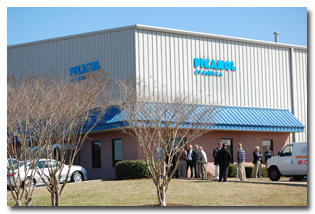
Picanol of America has moved into an 18,500-square-foot facility at the South Carolina
Technology & Aviation Center (SC-TAC).

2tent

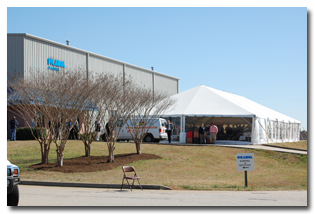
More than 150 customers and guests were welcomed at the new facility’s inaugural
ceremony.

3Cyrilopening

“We are excited to expand our operations and move to our new facility,” said Picanol of
America President Cyril Guérin. “The opening of our new headquarters represents another milestone
in our long history in the U.S. It is further proof that Picanol of America now more than ever is
committed to providing outstanding customer service, the exceptional levels of quality that Picanol
is renowned for, and high added value to meet the needs of our U.S. customers.”

3AGuerin

Picanol of America President Cyril Guérin directed the day’s activities.

4Crowd

Industry executives gathered for presentations, demonstrations and tours of the new Picanol
facility.

5Verstraete

Picanol Group Vice President of Marketing, Sales & Service Johan Verstraete presented
“Picanol in the World.”

6PicanolRibbonCutting

Left to right: Picanol Group Board of Directors Chairman Stefaan Haspeslagh, Picanol Group
Managing Director Luc Tack and Picanol of America President Cyril Guérin cut the ribbon on the new
facility.

 
8crowd

Tours and demonstrations were offered to all attendees.

9technicians

Picanol’s technical staff kept the weaving machines at peak performance during the opening
celebration.

10Lieven

Picanol Marketing & Product Manager Lieven Beke presented information on air-jet and
rapier weaving machine developments as well as a summary of technical wovens.

11SteveBrown

Picanol of America Sales Manager Steve Brown introduced the staff of the new facility and
discussed spare parts, workshop, training, technical assistance and Burckle reeds available at the
new facility.


March 26, 2013

French Technical Textiles Industry: Futurotextiles 3: Nexus Of Technology And Art

In conjunction with the opening of the European Centre for Innovative Textiles (CETI) in Roubaix,
France, in October 2012, and with 2012 lille3000 celebrations in Lille, France, the third edition
of Futurotextiles was installed at CETI to present current, state-of-the-art textile technology not
only as used in technical textile applications, but also as used by artists and designers to create
beautiful and imaginative articles that often include high-tech function as part of the concept.

In the exhibition catalog introduction, it is stated: “Midway between technology and
culture, the exhibition rests on three foundations: education, since it explains the origins and
diversity of textiles and shows how textile innovations change our relationship to the world;
science, by highlighting the technical characteristics of the textiles of the future; art, finally,
because the new fibres, with their innumerable properties, inspire the imagination of designers
more than ever.”

The exhibition covers a full textile spectrum including fibers and yarns, composite and
nonwoven materials and finished products. Unusual fibers presented include spider silk; biopolymer
fibers such as milk; mineral fibers such as basalt; stainless-steel fiber; piezoelectric and optic
fibers; and flax; among others. The diverse range of end-use applications includes protective,
apparel, smart, sport, health, transportation, home, construction and architecture, geotextiles,
and wellbeing. There also are artworks that incorporate highly functional technical textile
materials in objects that, while some may exhibit functional characteristics, are primarily
aesthetic concepts.

Shown here are a few examples of the textiles shown at or in conjunction with Futurotextiles
3:

LotusDome


Lotus Dome — created by Studio Roosegaarde, the Netherlands, commissioned by lille3000 and
installed at Sainte Marie Madeleine Church in Lille — is an interactive, organic construction made
using ultralight aluminum “smart foils” that react individually to changes in temperature triggered
by a breath of air, a light source or other such influences. Photograph courtesy of Studio
Roosegaarde


Litracon

LiTraCon™, light-transmitting concrete invented by Hungarian architect Áron Losonczi, Litracon
Kft, and distributed by Byzance Design, France, is made using a combination of 96-percent concrete
and 4-percent glass fiber. Exterior light is channeled by the glass fibers and filtered through
concrete blocks into interior spaces. Photograph courtesy of LiTraCon


Perles

Perle de Pluie, created by Paris-based designer Tzuri Gueta and Tony Jouanneau, is a chandelier
made with silk lace tubes filled with translucent silicon “pearls,” and lit using a light-emitting
diode (LED) light source. Photograph courtesy of Tzuri Gueta


Eightpart


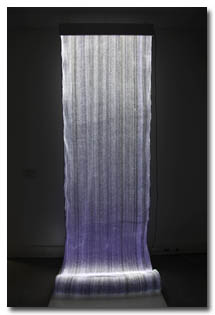
Eight-part Fugue, single panel detail — designed by Clémentine Chambon and Françoise Mamert,
Design Percept, Paris; and developed by Brochier Technologies, France — is a light-diffusing
curtain woven using silk and optic fibers and powered using five LEDs. Photograph courtesy of
Maxime Dufour



Scube

SCUBE® C1 Flax is an electric tricycle made using a recyclable composite flax material
developed by Flax Technic, Groupe Dehondt, France. Photograph courtesy of Maxime Dufour

Brochier

Lightex phototherapy pad for treatment of neonatal jaundice, developed by Brochier
Technologies, is a textile pad made using polymer optic fibers and LED modules. Photograph courtesy
of Brochier Technologies.
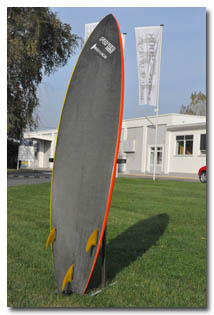
Libecosurf

Windsurf board, developed by Libeco-Lagae NV, Belgium, is made using a composite containing
carbon and flax fibers. Photograph courtesy of Libeco-Lagae & Lineo
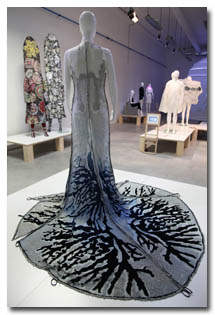
Storey

Herself Dress, photocatalytic dress designed by British fashion designer Helen Storey, is made
with 70-percent polyester/30-percent silk fabric, finished using sand and cement, and coated with
titanium dioxide (TIO2). The coating is said to repel harmful molecules in the air and purify and
deodorize the air around the wearer. Photograph courtesy of Maxime Dufour

Neidlinger

Mood Sweater, designed by San Francisco-based future concepts designer Kristin Neidlinger,
founder of Sensoree, is a cotton/LYCRA® dress that reveals the mood of the wearer via colored LEDs
in a collar made using recycled plastics along with sensors and conductor fabric. Photograph
courtesy of Roger Dyckmans

Bodysens

Active Protection Hood, developed by Bodysens SAS, France, for firefighters, is made using a
99-percent flame-retardant treated aramid fabric and allows hands-free communication by the wearer
with colleagues involved in the operation. The hood features a digital radio to transmit movements
and position up to a distance of 1 kilometer; sensors in the lining that measure vital signs such
as heart rate, oxygen levels and skin temperature; and a wireless micro audio network that enables
the wearer to communicate verbally with colleagues in a “natural” conversation despite physical
obstacles. Photograph courtesy of Bodysens


After closing at CETI at the end of 2013, the exhibition moved to Paris and is currently on
view at the Cité des Sciences & de l’Industrie until July 14, 2013.

March/April 2013

Texprocess 2013 Exhibitor Preview: RSG Automation Technics GbmH & Co. KG

BIETIGHEIM-BISSINGEN — April 2013 — Since the foundation of the innovative textile machine
manufacturer RSG, located in Bietigheim-Bissingen near Stuttgart, the 30th year is characterized by
automated processing, manufacturing and presentation of narrow fabrics, such as webbings, belts and
straps.

From long years of experience RSG was able to accumulate a vast treasure of experiences in
the field of automated production of vehicle seat belts. Many of these ideas can now be transferred
also to other narrow textiles.

Among the highlights of the new “Narrow-Matic” machine generation are other fully automated
assembly lines for round-slings, element belts, as well as lifting and lashing strap systems.

These unique facility concepts combine the most diverse work steps and thereby offer the user
tremendous time and cost savings, and markedly increase production capacity and product quality.


All production steps such as unrolling, cutting, feeding, folding, sewing, sealing, wrapping,
and packaging are taken over by the facility.

Additionally labels, ratchets or hooks can be processed, or supplementary facility components
for textile inscribing or marking can be integrated.

The complete production process including sewing, is entirely monitored by technology (to a
large part patented), so that mistakes in the final product can be excluded.

RSG presents the new “Narrow-Matic” facility generation for the first time at the trade fair
TexProcess 2013, which will take place from June 10-13, 2013 in Frankfurt, at the same time as
Techtextil, in hall 5.1, booth C10.

Posted on March 26, 2013

Source: RSG Automation Technics GbmH & Co. KG

U.S. Protective Gear Manufacturer PGI Simplifies IT With Visual End2End

NEW YORK CITY — March 22, 2013 — Visual 2000 International Inc. announces that Green Lake,
Wisconsin-based PGI, Inc. has begun implementation of its Visual End2End™ enterprise solution. The
manufacturer of Cobra™ Flame Resistant Hoods, FireLine® Wildland Clothing, Sawbuck™ Chainsaw Chaps,
and other firefighting and protective gear brands is replacing multiple software systems with the
integrated, industry-focused solution across its product development, production, warehousing,
financial management, and other key operations. PGI expects the move to a unified IT platform to
eliminate redundancies and related errors, streamline critical processes, and increase overall
business efficiency.

According to PGI Corporate Secretary Renee Ristau, “We chose the Visual End2End solution
because it will enable us to manage our entire operation with a single, out-of-the-box system. This
will help us to eliminate the visibility and functional gaps of the past. Instead of struggling to
patch together information from a variety of sources, we will have a single, reliable source for
all the information we need to make faster and better informed business decisions.”

Visual End2End incorporates Product Lifecycle Management (PLM), Enterprise Resource Planning
(ERP), Supply Chain Management (SCM), Warehouse Management (WMS), Financial Management (FMS), and
other traditionally independent software capabilities into a fully integrated solution designed
specifically to manage the unique requirements of fashion, sewn products, and other softgoods
companies.

PGI expects to go-live on the new system in the third quarter of 2013 at the company
headquarters and peripheral office locations.

“We welcome the opportunity to work with PGI,” noted Farhat Awan, Visual 2000 USA Sales
Director. “Like many other growing companies, they will benefit greatly from the flexibility and
power of this uniquely comprehensive system. We look forward to helping PGI accomplish their goals
and take their business to the next level.”


Posted on March 26, 2013

Source: PR.com

Nominations Now Open For 2013 World Of Wipes Innovation Award™

CARY, N.C. — March 26, 2013 — Nominations are open for the 2013 World of Wipes Innovation Award.
The World of Wipes Innovation Award will recognize and reward innovation within the entire wipes
value chain that utilizes nonwoven fabrics in a way that expands the usage of nonwovens.

Nominated products should demonstrate advancements in one or more of the following
categories:

    * Creativity (Was there imaginative skill used to create a solution to a
known problem?)

    * Novelty of approach (Is the method or thought process used to create the
product new?)

    * Uniqueness (Is this the only product of its type in the marketplace?)

    * Technical sophistication (Does the product/process use nonwoven
technology in an intellectually elegant manner?)

Nominees could come from industries such as raw materials, roll goods, machinery, converting,
packaging, lotions, active ingredients, binders, additives and end products. Finalists will present
their innovation to the industry at WOW 2013, June 19.

Voting shall be weighted equally across three voting bodies: the Technical Advisory Board
(TAB), the WOW Conference Committee and the WOW conference attendees.  Each group shall vote
separately and be given equal weight in the final determination of the award winner. Once the
weighted votes have been tabulated onsite, the winner will be announced during the scheduled
conference hours.

The deadline for nominations is April 29.

Organized by INDA, Association of the Nonwoven Fabrics Industry, the annual World of Wipes
(WOW) International Conference, will be held June 17-20, 2013 at the Hotel InterContinental
Buckhead in Atlanta, Georgia, and will focus exclusively on the business, technology and regional
trends of wipes – from raw materials to substrates to converting and end-use applications – during
three days of presentations and business.

Anyone may nominate a wipes-related product for consideration for the 2013 Award. To nominate
a product, send a short abstract describing the innovation along with a product sample to Helena
Lee, Suite 115, 1100 Crescent Green, Cary, NC 27518; hlee@inda.org.

To download a nomination form, go to:

www.bit.ly/wowaward13

For more information on the World of Wipes (WOW) International Conference, set for June
17-20, 2013 at the Hotel InterContinental in Atlanta, Georgia USA; http://bit.ly/WorldofWipes2013.


Posted on March 26, 2013

Source: INDA

Fair Currency Coalition Praises Reintroduction Of House Currency Bill

WASHINGTON — March 20, 2013 — The Fair Currency Coalition thanked Congressmen Sander Levin (D-MI),
Tim Murphy (R-PA), Tim Ryan (D-OH), and Mo Brooks (R-AL) for reintroducing the Currency Reform for
Fair Trade Act of 2013 in the U.S. House of Representatives.  The bipartisan bill is expected
to be introduced later today with at least 37 original sponsors (13 R, 24 D).  

The Fair Currency Coalition urges the U.S. House of Representatives to act quickly on this
pro-jobs measure.  The proposed legislation would deter foreign countries from illegally
undervaluing their currencies by making prolonged undervaluation actionable under U.S.
countervailing duty (CVD) law.

The newly introduced bill:

  • Is the same as H.R. 639, the Currency Reform for Fair Trade Act of 2011, bipartisan legislation
    from the 112th Congress that  garnered 234 cosponsors.
  • Is virtually identical to H.R. 2378, the Currency Reform for Fair Trade Act of 2009, bipartisan
    legislation passed by the U.S. House of Representatives by a 348 to 79 vote in the 111th
    Congress;  and,
  • Has a countervailing duty remedy similar to that contained in S. 1619, currency legislation
    passed by the U.S. Senate by a 63-35 vote the 112th Congress.

The need for action on currency has never been more acute.  Every day of delay means
more American jobs lost and more new American job creation denied.  Illegally undervalued
foreign currencies like China’s renminbi (RMB) and Japan’s yen are unfair export subsidies and
trade barriers that discourage new investment needed in America.  This lack of investment is
evidenced by the fact that although the United States has recovered more than 5.7 million nonfarm
jobs since employment bottomed out three years ago, it still has 2.9 million fewer jobs than it did
five years ago.  Job creation is needed more than ever to help the unemployed as well as to
accommodate new entrants into the U.S. workforce.

Looking at China’s prolonged illegal currency undervaluation more closely, it also aggravates
a perpetual current account deficit that destroys middle-class jobs and plunges America ever deeper
into foreign indebtedness.  The U.S. bilateral current account deficit with China was $333.4
billion for 2012 and $2.6 trillion for the last decade.  Heavily contributing to the record
bilateral current account deficit in 2012 was America’s $315 billion trade deficit in goods with
China, an increase of almost $20 billion from 2011.

Since September 2010, when the U.S. House of Representatives last passed a bipartisan
currency bill, China’s foreign currency reserves have grown by an estimated $500 billion and now
total a staggering $3.3 trillion by the most conservative measures.  Moreover, in nominal
terms, the RMB has barely increased in value compared to the U.S. dollar, rising by a little more
than 5 percent in the past two years.  

Despite the continuous engagement and best good-faith efforts of the current and previous
administrations, bilateral and multilateral diplomatic talks show no sign of resolving the issue
satisfactorily.  China’s previous leadership ignored every entreaty to meaningfully address
the problem, whether in state visits, G-20 talks, or bilateral U.S.-China Strategic and Economic
Dialogue discussions.   Congressional passage of currency legislation would send a strong
signal to China’s new leadership that America is serious about fixing currency undervaluation.

The FCC is an alliance of business, agriculture, and labor interests that supports passage of
legislation to make prolonged foreign currency undervaluation actionable under U.S. countervailing
duty law.  

Visit the FCC’s website at www.faircurrency.org to see a list of the coalition’s supporters
and to learn more about the currency issue. 

Posted on March 26, 2013

Source: Fair Currency Coalition

Under Secretary Francisco Sánchez Featured To Speak At NCTO Annual Meeting In April

WASHINGTON — March 22, 2013 — NCTO is working to put together an informative and thought-provoking
program for its annual meeting at the Grand Hyatt Washington April 15-17, 2013.  Following are
the speakers who have confirmed or have been invited to address attendees during the meeting.

Featured Dinner Speaker

Honorable Francisco Sánchez, Under Secretary of Commerce for International Trade, U.S.
Department of Commerce, a strong supporter of the textile industry and of increased trade between
the United States and its Western Hemisphere partners, will address the group regarding textile
issues and the Trans-Pacific Partnership.

Export-Import Finance Seminar

Export-Import Bank officials
Walter Kosciow, Vice President, Short-Term Trade Finance and
Jim Newton, Credit Portfolio Management – Small Business Group, will discuss the evolution
of Bank financing policy and how recently implemented legislation has caused the Bank to
specifically look at new and innovative ways to finance textile shipments.  This session will
begin at 4:30 on Monday afternoon and will include time for Q&A.

Fiber Session

Alasdair Carmichael, President (Americas) of PCI Fibres, will present at the fiber session
on Monday afternoon beginning at 3:00 p.m.  Alasdair has over 35 years experience in the
Synthetic Fibers industry, having lived in Europe, Asia and the U.S. in this time and been involved
in the fibers industry in all the major markets of the world.  Schedule your travel to arrive
early enough to participate in this informative session. 

Defense Logistics Agency

Warfighter Director
Craig Rettie of the Defense Logistics Agency (DLA) has been invited to address the attendees
on the effects of sequestration during the general session on Tuesday afternoon.

Administration

Administration Representatives
Kim Glas, U.S. Department of Commerce, and
Gail Strickler, Assistant U.S. Trade Representative, will update members on the TPP
negotiations during the members only session on Tuesday afternoon. 

Members of Congress

U.S. Senator Tim Scott (R-SC) will address the group during the general session on Tuesday
afternoon.

The Following Congressional Representatives have been invited to Speak to NCTO: 
U.S. Senator Johnny Isakson (R-GA), Ways and Means Trade Subcommittee Chairman
Devin Nunes (R-CA), and Ways and Means Committee Member and Textile Caucus Co-Chair
Bill Pascrell (D-NJ).

Members of Congress Participating in Tuesday Morning Breakfast Buffet include
Representative Richard Hudson (R-NC), Representative
Robert Pittenger (R-NC), Representative
Mark Meadows (R-NC), and Representative
George Holding (R-NC).

Invited: Representative Doug Collins (R-GA)

Posted on March 26, 2013

Source: NCTO

Sponsors