Commercial Partnership Pays Dividends For New Zealand

New Zealand — March 12, 2013 — An AgResearch-developed wool dyeing technology that bridges the gap
between high performance and haute couture is set to shine on a global stage thanks to a worldwide
licensing deal.


The revolutionary textile dyeing process is now being commercialised by BGI
Development.  It enables wool to be dyed two colours at the same time, and graphics and images
to be dyed into the fabric. There is no loss of the quality feel of the fabric and the images won’t
deteriorate over time.

The technology enables designers to use high performance merino in creative ways never before
possible, making merino an excellent choice for fashion active wear.

BGI director Robyn George-Neich says that since signing the commercialisation agreement BGI
has been working to identify the right company to bring this innovation to the global market.

American company Global Merino has now signed an exclusive worldwide license to produce
active wear using the techniques pioneered here.

“Global Merino was the obvious choice as they work with all of the big brands in the active
wear market. It is also seen on the world stage as an innovator, and is a company that can make a
real impact,” says Robyn.

“For the past year we have been working with Global Merino through their commercial trials at
their Melbourne facility.  The investment of resources in this process was significant but
will pay dividends for everyone involved now that it is commercially-proven technology.  It is
a big step to take innovation from the lab to commercial production.”

BGI Director Brent Gregory says, “This is an exciting time as the market is introduced to
something revolutionary that will change the way designers work with merino and increase the
expectations of consumers. 

“It will enable companies to create garments in a premium quality fabric, and with exciting
graphics that look and continue to feel just as good as they did the day you brought them.”

Global Merino Director Jose Fernandez says that the company has been introducing buyers to
the technology at recent American outdoor trade shows, where the response has been overwhelmingly
positive.

“This definitely has the wow factor and people genuinely think it is cool technology,” he
says.

“There’s an established and growing market for natural fibres and this process allows more
creative dyeing than ever before, merging fashion with function.”

The technology was developed within the Textiles team at AgResearch. Science team leader
Stewart Collie says that this illustrates the skills and experience of the organisation.

“Technologies such as these are great for getting consumers excited about wool and opening up
new markets for it,” he says.

“We can also build on our knowledge and experience in working with wool and use it to help
create new applications and products.”

BGI is now looking for other sectors of the market where this new technology can be
applied.  The scientists at AgResearch are currently trialling applications on wool in its
various forms.

“What is great about this deal is the way all the parties involved have decided to
collaborate, each recognising that alone they will not be able to achieve anywhere near the level
of success as they can by working together,” says Robyn.

Posted April 2, 2013

Source: AgResearch
Teijin To Accelerate Business Incubation Through Technology Alliances

TOKYO — April 1, 2013 — Teijin Limited announced today that it will establish a specialized
department to accelerate materials business incubation through technology acquisitions and
alliances from April 1.

The new Technology Alliance Development Department, established under Teijin’s New Business
Development Group, will strategically grow materials-related businesses by identifying promising
partners and M&A opportunities. Alliances are envisioned for undertakings ranging from R&D
to business model creation.

To enhance its capabilities to provide optimal solutions to customers, Teijin strives to
strengthen its downstream technologies and leverage alliances in line with the group’s medium- to
long-term management vision.Downstream technologies include value-added processing technologies
such as the proprietary film-coating technologies that Teijin used to develop Lielsort, innovative
separators that enhance the performance of lithium-ion secondary batteries.

Teijin has both broadened and deepened the polyester technologies that it originally acquired
from ICI of the U.K. in 1956, enabling the company to create diverse solutions incorporating
fibers, films and resins.

“We are pursuing technology alliances particularly in the fields of environment, energy and
electronics, where new demands are emerging, and in healthcare, where we are applying our materials
technologies,” said Kazuo Imose, Teijin Group Corporate Officer and General Manager of the New
Business Development Group. “We will continue to create new value by providing needed solutions and
by rapidly creating new businesses that benefit society.”

Posted on April 2, 2013

Source: Teijin Ltd.

The PCI Fibres Conference 2013

EAST SUSSEX, United Kingdom — March 27, 2013 — Reflecting the coverage of our monthly consulting
services, our conference will feature papers on a number of fibres including those in acrylics,
carbon, nylon, polyester, polypropylene, spandex and viscose as well as the raw materials for
these.  There will also be coverage of wool from a leading industry expert and of cotton from
the PCI Group’s own specialist, as well as a strategic view from one of Hong Kong’s leading
commentators.  In addition, this year we have two new items in the programme.  There is a
panel discussion on feedstock supply and also a workshop on the fibres and textiles supplies being
generated in China. 

Speakers and papers


Fibres review

Peter Driscoll

PCI Consulting Group

The technical yarn market

D Pulikeshi

SRF Ltd

The new century consumer market

Allan Wang

Australian Wool Innovation     

The cellulosic gap: viscose staple in Asia

Lenzing

Economics and strategic review

Paul Krake

View from the Peak

Nylon fibres: global segment opportunities

David Hart

Opus Business Consultants

New developments for carbon fibre in automotives

Scott Carlton

SGL Carbon

Australian wool from commodity to luxury

Allan Wang

Australian Wool Innovation

Polyester staple markets in the Americas

Mark Ruday

DAK Americas

Consequences of China’s cotton policy on manmade fibres

Bruna Angel, PCI Fibres

The imbalance between paraxylene and PTA

Steve Jenkins

PCI Consulting Group

The prospects for caprolactam

Crystal Chiang

PCI Consulting Group

Issues of MEG supply

Doug Rightler

PCI Consulting Group

Panel discussion

The supply chain from feedstock to fibre

Douglas Hsu (Far Eastern), Richard Brice and Robin McDonald (PCI Consulting Group)

Workshop

Resolving the surplus in fibres capacity

Bruna Angel, Richard Brice, Alasdair Carmichael, Janice Chen, Peter Driscoll, Carlos
Gonzalez, David Hart

PCI Consulting Group

Further details, including speakers’ biographies and conference leaflet, are available from
us direct on sdeacon@pcifibres.com and jbrooks@pcifibres.com .

Posted on April 2, 2013

Source: PCI Fibres

QuestaWeb Partners With AduanaSoft For United States-Mexico Trade Solution

CLARK, N.J. — April 3, 2013 — QuestaWeb, Inc., a premier provider of Web-based, integrated Global
Trade Management (GTM) solutions, announced today that it has entered into an alliance partnership
with Chihuahua, Mexico-based AduanaSoft, Inc., a leading provider of IT solutions that automate
Mexican Customs clearance, and assure import and export compliance. Under the terms of the
alliance, QuestaWeb and AduanaSoft have integrated their software to offer a seamless solution for
U.S. companies manufacturing in Mexico’s maquiladora industry and thus conducting trade on both
sides of the border. The single system allows companies to benefit from the IMMEX Program, while
generating all required documentation in full compliance with all the regulations of both
governments. Further, this alliance, in conjunction with a soon-to-be-released solution for Canada,
positions the integrated system as a global trade compliance solution for all of North America.

QuestaWeb has long recognized Mexico’s status as a premier sourcing locale and growing
manufacturing base. However, U.S. firms seeking to leverage the market advantages arising from
favorable trade agreements and geographic proximity often had to resort to separate solutions for
each side of the border. Unfortunately, efforts to comply with Mexican regulations frequently
created bottlenecks because the documentation produced by piecemeal solutions was inaccurate or
incomplete, overlooked regulatory changes or miscalculated tariffs. 

QuestaWeb thus sought a highly qualified partner to bring to market a single solution that
could deliver the same reliable services and assured compliance as QuestaWeb’s U.S. solutions do.
In AduanaSoft, QuestaWeb found a leader in Web-native software with a 17-year history of excellence
in serving over 350 customers. Notably, the two companies found they already shared customers in
common that would welcome the efficiencies and economies made possible by only having to enter
information once.

Eduardo Ramos, CEO of AduanaSoft, said, “Manufacturing in Mexico is all about cost savings
and speed to market for U.S. companies. Firms want to move raw materials/parts/components in and
finished goods out as quickly as possible. Unfortunately, navigating the supply chain can create
bottlenecks, especially when attempting to comply with Mexican regulations. In entering into this
alliance, our two companies will optimize trade between the United States and Mexico assuring
compliance, reducing costs and eliminating holdups.” 

Leon Turetsky, CEO of QuestaWeb, said, “In AduanaSoft, we found a company that operated using
a similar business model and shared our penchant for excellence and customer service. Our system
designs are highly complementary, thus facilitating seamless integration. AduanaSoft, like
QuestaWeb, offers modular, Internet-based products; provides real-time database updates; allows
electronic payment of pedimentos; and enables users to customize both the system and reports to
meet their specific needs. It is an ideal match that will help promote the economies of both
countries by simplifying cross-border transactions.” 

QuestaWeb is exhibiting at the 39th Annual Conference of the National Customs Brokers &
Freight Forwarders Association of America (NCBFFAA) in Rancho Mirage, Calif. from April 7-10. Both
companies will be represented at Booth #412, and interested parties are invited to stop by and
learn more about this alliance and this exciting new trade solution.

Posted on April 2, 2013

Source: QuestaWeb Inc.

Invista Acquires Ashburn Hill, TECGEN® FR Apparel Brands

Wichita, Kan.-based polymer and fiber producer Invista has acquired Greenville-based Ashburn Hill
Corp. including its TECGEN® brands of flame-resistant (FR) apparel and its Angleton, Texas-based
manufacturing operation.

“Invista has an aggressive growth strategy that includes identifying new business
opportunities to allow us to continue building a product portfolio that delivers value to
customers,” said Jeff Brown, executive vice president, Invista Performance Materials. “The TECGEN®
flame resistant brands have quickly gained trust in the marketplace, and by coupling that expertise
with Invista’s existing global workwear capabilities, we have high expectations for the specialized
garment segment.”

Tecgen fiber is produced using a patented carbon technology process that offers advanced
protection against heat and flame. Blends of Tecgen with other inherently FR fibers can be used to
make lightweight, breathable garments that provide a high level of both flame protection and
comfort, according to Invista. The Tecgen brands include: Tecgen Select®, an arc-rated, flame- and
flash-fire-resistant line of garments for manufacturing, transportation, mining, oil and gas, and
energy utility applications; and Tecgen Xtreme®, a National Fire Protection Association
(NFPA)/UL-certified line of lightweight, moisture-repellent clothing for firefighters involved in
wildland and technical rescue operations.

The Tecgen brands will join Invista brands such as CORDURA® in the company’s Performance
Materials business segment, which will provide global resources to enable the brands to expand
their offerings.

Ashburn Hill was incorporated in 2006, and Invista first took an interest in the company in
2008, when Jon Heard left Invista to become its CEO. In the following years, Invista made
investments in Ashburn Hill to help it scale up production.

Heard will continue to head the business under Invista ownership, and Ashburn Hill’s 20
employees at the Greenville administration office and the Angleton manufacturing facility have now
transitioned into Invista.

March 26, 2013

The Rupp Report: FILO: The European Art Of Surviving In Spinning

Spinning was most probably the impetus for the first Industrial Revolution in the 18th century. And
most probably, there is no other sector in the whole textile production chain that underwent such
drastic changes over the centuries and decades.

From humble beginnings in Great Britain, the spinning sector started conquering the European
continent in the 20th century. Until the early 1960s, for staple yarn spinning, there was mainly
one technology: ring spinning. Then, new technologies came into the market: open-end or rotor
spinning; then, compact spinning; and also, air-jet spinning. Today, virtually all of these
technologies have their space and markets.

The Two Sides Of The Coin

However, where are these markets today? The answer to this question is quite simple: almost
everywhere. But where are the production sites for these yarns? The answer to this question is not
that easy. It depends on the requirements of the various end-uses. Over the last four decades, yarn
production moved eastward and arrived — no surprise — largely in China. On the one hand, the
textile machinery industry sold millions and millions of spindles to Asian markets, bringing the
Western spinning industry deep troubles. On the other hand, the quality of Asian yarns increased
considerably. However, some fine-count cotton yarns were still produced in Western countries,
although not for a very long time. The prices of these yarns were and are so competitive that many
spinning mills in the Western world closed down. That was the very end of the commodity market for
Western spinners.

For quite a long time, China has been seen as an antagonist for virtually every
textile-producing country in the world. China is today competing in all sectors of the textile
industry, including machinery. The saying goes that Chinese manufacturers, and mainly yarn and
fabric producers, have no competition. Is this the undisputed truth? China is also facing the
well-known problems of today.

The Art Of Fashion

So, one should talk about quantities, and about delivery times — this is about fashion, and
so, it’s about colors, and above all, quality. In every market, and definitely in the apparel
market, there are and always have been a low-end and a high-end or niche market. And niche markets
are not willing to buy the quantities that are needed today to be considered as a customer for
Asian spinners.

In a nutshell, one should talk about the art of fine yarn and fabric production and not about
prices. There must be some remaining spinners that have the will and are capable of producing yarns
for a very defined market segment. You think, dear reader, this a fairy tale? To check whether it’s
true or not, the Rupp Report went to Milan — sorry, French people — the center of design and
fashion.

The Art Of The — Mostly — Italian Way

As the Rupp Report mentioned some weeks ago, the yarn exhibition FILO took place in Milan
last week. And, to an observer from a neighboring country, it is always fascinating to see how the
Italians live and organize their lives and survive with an attitude that is second to none. Is
there maybe a secret behind all this? An explanation is quite difficult. The official opening of
the show demonstrated in a way how the Italians conduct their way of life. Words like non mollare,
grinta and amore were used in different speeches.

Non mollare means, essentially, “we never give up.” Grinta means something like “the will to
do it, to get it done,” or just “hang on to it.” Amore is obvious — it means “love.” But here, it
refers to the admiration, the commitment and the love for the job, for the work to do. The summary
of all this could be named Italianità, meaning “the Italian character.”

The Art Of Being Different

Well, most of the interviewed exhibitors have been attending FILO for a long time. However,
there are always newcomers like Camenzind & Co. AG, which produces 100-percent silk yarns Made
in Switzerland. Managing Director Nicole Camenzind said that her company is selling a lot of silk
to Italian customers, and she was told that FILO provides a good opportunity to present the
products. Yet, the first contacts were quite promising.

Roberto Belloli and his company, Antonio Aspesi S.r.l., are doing something very different:
this Italian company is selling tailor-made filament warps. “Our customers are weaving special
products, so they need special warps, customized to their needs. And that is what we are doing.”

One well-known yarn producer is Switzerland-based Hermann Bühler AG, which has a big
subsidiary in the United States — Buhler Quality Yarns Corp. in Jefferson, Ga.: The company is an
established producer of fine-count yarns made of extra-long-staple cotton and MicroModal® and
blends. Renata Franz, business development and marketing manager, said that the company is still
going to Expofil; however, it seems that the Swiss are not very happy with the Paris exhibition. On
the other hand, she said, “we are here at FILO for the second time and have already booked for
October.”

Botto Poala S.p.A. is an Italian producer of fine yarns made of wool, cashmere and silk, all
Made in Italy. The company is a part of Italy-based Zegna Baruffa Lane Borgosesia S.p.A., and
Nicoletta Meriglio of Botto Poala mentioned that FILO is the most important yarn show for weavers;
however, many companies presented yarns for knitting, too.

Another Italy-based exhibitor with excellent products is Filatura Pettinata “Luisa 1966”
S.r.l. The company is exclusively producing fine and finest yarns made of 100-percent Merino wool.
Laura Mauri presented a range of yarns to the Rupp Report, which, with all due respect to other
exhibitors, it found to be just mind-blowing. To this old horse from spinning and weaving, these
yarns were so unique that he will need another report to describe them. More information about this
spring’s FILO is to come in the near future.

All this reporting covers just a fraction of the impressions that the exhibitors — that is,
their excellent products — provoked in this reporter. All of them are playing in the top league of
yarn and fabric production. The customers are mainly specialized weavers and knitters in Europe —
including Italy, France, Germany and Great Britain — and also customers from Japan, the United
States and Canada.

The Art Of Perfect Customer Service

When asked how they persist in today’s harsh market, all of the interviewed exhibitors said
they are not competing with Asian products. “Only experienced people with perseverance, passion and
the love for their job can do this,” one of them said. The issue is not the price; it is the unique
products and the possibility to buy small lots, even 25 kilograms. “Textiles are emotion,”
mentioned Franz, of Bühler. And at the end of the conversation with Antonio Aspesi’s Belloli, while
discussing customer needs, he said: “We are not selling yarn, we are selling service.” And that
seems and must be the essence of the art of survival for European manufacturers.

The 40th edition of FILO will be held October 9-10, 2013.

March 26, 2013

Litzler To Supply Hot Melt Prepreg Machine To South Korea

Cleveland-based composites machinery supplier C.A. Litzler Co. Inc. has sold a Hot Melt Prepreg
machine to South Korea-based composites manufacturer Hankuk Carbon, which will use the wide-width
machine, designed for high-speed and high-quality applications, to expand its prepreg business.

“We are very excited to have chosen the Litzler Hot Melt Prepreg machine,” said Hankuk Carbon
President Cho. “The technical and management team of Litzler answered all the needs for our
expansion in composites and with their long-time presence in Asia, my team is very excited about
our decision for Litzler.”

In other company news, Litzler is celebrating 60 years of business this year.

March 26, 2013

BASF To Reorganize Leather And Textile Chemicals Business

BASF SE, Germany, has announced plans to reorganize its Leather and Textile Chemicals business unit
(BU) to concentrate on the Asia-Pacific region and on high-value-adding applications.

Leather Chemicals will focus on core technologies for the automotive industry and premium
leather segment, and Textile Chemicals will focus on value-adding steps such as printing and
finishing and solutions for manufacturing premium textile items.

BASF will establish a global innovation center for its Leather and Textile Chemicals BU in
China, which is its main growth market. The center will be located within the BASF Innovation
Campus in Shanghai and will be part of the R&D Innovation Verbund.

In addition, the company will eliminate 65 positions globally — including 29 in Ludwigshafen,
Germany — to adjust to the BU’s new setup. However, BASF reports it will create approximately 23
positions to support the anticipated growth in China, India and Turkey.

“BASF strives to remain the preferred partner of the leather and textile industries for
reliable and innovative chemical solutions,” said François Desné, senior vice president, Leather
and Textile Chemicals global business unit, BASF. “We are reshaping our business setup to
strengthen our long-term ability to compete in a rapidly changing market environment.”

The reorganization is expected to be completed by the end of 2014.

March 26, 2013

Stork Prints Debuts NovaScreen® For Textile Printing

The Netherlands-based textile and graphics printing equipment supplier Stork Prints BV has
developed a new hybrid screen for the textile printing market. The new NovaScreen® 195-19% is a
combination of the existing open area NovaScreen 165 (mesh) screen and the high-resolution
NovaScreen 195 (mesh) screen. The hybrid screen offers printers that require voluminous paste
supply a high-resolution option with improved paste flow and printability.

Stork reports primary benefits of the new screen include: high screen volume and high
printing resolution; improved surface printing; and benefits in geometric printing.

A unique electroforming process allows Stork to control nickel growth during screen
production and push the ratio between hole size, mesh count and thickness of the screen beyond
conventional boundaries. By keeping the nickel growth mostly toward the top of the screen, the dam
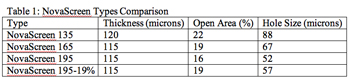
shape stays thin and streamlined. A comparison of thickness, open area and hole size for the 4
NovaScreen types are shown in Table 1.

StorkTable

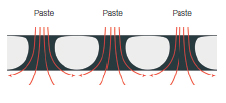
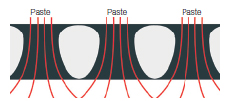
Stork reports that a smaller, more streamlined dam shape increases the chance of paste
flowing beneath the dam with lower squeegee pressure, thus creating a more even spread of paste on
the textile substrate. This even paste flow makes the screen suitable for pigment printing and
penetrative printing; the look and straightness of geometric and engraved prints is improved; and
improved rasterisations with dot definition generate quality halftone impressions.

conventionalscreen

Figure 1: Paste transfer through a conventional screen

Novascreen


Figure 2: Paste transfer through NovaScreen®


March 26, 2013

CCI To Promote U.S. Cotton At Upcoming Central American Shows

Cotton Council International (CCI) — the Washington-based export promotion arm of The National
Cotton Council, Memphis, Tenn. — has announced it will promote U.S. cotton and cotton textiles
through its Cotton USA Sourcing Program at two upcoming trade shows in Central America.

CCI will host the Cotton USA Western Hemisphere Sourcing Fair 2013, to be held April 29-May 1
in Panama City, Panama. The fair will gather U.S. mills and retailers, European and Latin American
retailers, and apparel manufacturing companies from Colombia, the Dominican Republic, El Salvador,
Guatemala, Honduras, Mexico and Peru, for a trade show, seminar and networking opportunities.
Representatives from Cary, N.C.-based Cotton Incorporated will be on hand to answer questions about
cotton product developments.

CCI also will host a pavilion at the Apparel Sourcing Show, to be held May 21-23 in Guatemala
City, Guatemala. The annual show, which is considered to be the most important textile and apparel
fair produced in the Central American, Caribbean and U.S. region, will attract textile executives
from the United States, Guatemala, El Salvador, Honduras, Nicaragua, Costa Rica, and Mexico. U.S.
mills participating in the Cotton USA Sourcing program will display high-quality cotton yarns and
knit and woven fabrics at the pavilion and will be invited to a private event at the pavilion
organized by CCI. 

March 26, 2013

Sponsors