ShriVallabh Pittie To Build Spinning Plant In Georgia, Create 250 Jobs

ShriVallabh Pittie Group — an India-based industrial group with textile, finance, real estate,
retail and jewelry businesses — is investing $70 million to build a yarn manufacturing plant near
Sylvania, Ga., and hire 250 employees.

The facility, located at the Screven County Industrial Park, will employ state-of-the-art
machinery to manufacture carded cotton yarn in a variety of counts. The company reports that
production will be flexible to meet market demand.

“We are very excited about this project, which is the biggest single investment in the U.S.
cotton yarn sector in decades,” said Vinod Pittie, chairman, ShriVallabh Pittie Group. “We believe
there is a significant market opportunity for yarn manufacturing in Georgia due to a skilled local
workforce, proximity to high-quality cotton fiber, the economical supply and reliability of power
and world-class infrastructure to international markets. We are proud to generate 250 new U.S. jobs
and to bring a positive economic effect on the local area and its rich cotton textile heritage.”

ShriVallabh Pittie Group was established in 1898, and started its textile business, which
operates under the name Platinum Textiles Ltd., in 2003. Platinum Textiles mainly manufactures
cotton, polyester and blended yarn, and has a considerable presence in India’s textile sector, with
13 manufacturing facilities and 140,000 spindles in operation. The company also recently announced
plans to expand capacity with the addition of 60,000 spindles at its facility in Ramnad, India.

October 22, 2013

Kraig Biocraft, Warwick Mills To Codevelop Spider-silk-based Textiles

Kraig Biocraft Laboratories Inc., Lansing, Mich. — developer of Monster Silk™ recombinant spider
silk technology — and New Ipswich, N.H.-based advanced technical textiles and protective materials
developer and manufacturer Warwick Mills Inc. have signed a collaborative development agreement
under which the two companies will codevelop and commercialize Monster Silk-based advanced textile
products.

The initial focus of the partnership will be to weave and test Monster Silk-based textiles
for near-term applications. Kraig and Warwick will jointly own any product-related intellectual
property that results from the collaboration.

“This collaborative undertaking represents a huge step forward in our commercialization
efforts,” said Kim Thompson, CEO and founder, Kraig Biocraft. “The pairing of Kraig’s spider silk
technology with Warwick’s world-class technical textiles applications engineering and weaving
abilities is a bold move, which we believe will enhance and accelerate the penetration of spider
silk into technical textile markets.”

Monster Silk is produced by transgenic silkworms whose genetic makeup includes a combination
of certain spider silk proteins with silkworm proteins. The silk produced by these silkworms
contains only a small percentage of spider silk protein, but it exhibits significantly increased
strength and elasticity when compared to conventional silk.

Kraig has set up a pilot spider silk production operation overseas in a country that offers a
trained workforce for the production of silk. “We’ve reached the point where we’re ready to ramp up
to commercial-scale production,” Thompson said. “Now, we’re raising the silkworms primarily to
multiply instead of harvesting them. Each pair of silkworms produces 300 to 500 eggs. We get a new
generation roughly every 50 days, so we can go from 100,000 to many millions of silkworms in just a
few months and have the capacity to begin pumping material to Warwick and ultimately to other
partners.”

Thompson said that in addition to its technical expertise to work with advanced materials,
Warwick’s capability to use small quantities of material in its product development efforts has
enabled Kraig to enter now into a binding agreement without the need to provide the relatively
large material quantities required by many other potential partners to initiate development.
“Warwick presents a more immediate opportunity for us,” he noted. “We aren’t interested in just
knitting or weaving something to be producing something. We’re interested in working with someone
who could take the material and engineer something beautiful, and that’s where we are with
Warwick.”

Warwick is known for its production of ballistic, puncture-resistant and high-tensile
materials for defense, aerospace, safety and law enforcement applications. “The collaboration will
look at those applications, but we are hopeful it will also open up other opportunities beyond
protective materials,” Thompson said.

“The future of textiles will continue to be driven by innovation and we believe that our
textile engineering capabilities and Kraig’s fibers can change the game in some important
applications,” said Warwick President Charles Howland. “These technologies could potentially result
in higher performance textiles, which would enable very advanced safety and military equipment.
This collaborative agreement is a big step forward in the development of exciting new textiles with
potential applications for the technical textiles and protective textiles marketplace.”

Kraig also has signed a memorandum of understanding with Spring City, Tenn.-based SSM
Industries Inc. — a knitter and weaver of personal protection fabrics — and ultimately expects to
move forward with some development initiatives with SSM as well.

October 22, 2013

Vapor Apparel Offers SubliSocks™ Customizable Socks

Vapor Apparel — a Charleston, S.C.-based provider of apparel designed for sublimation printing —
has added sublimation-friendly socks to its imprintable apparel line.

Designed both for apparel decorators with small-format presses and for large-scale customers,
SubliSocks™ feature a black toe and heel segment to prevent creasing marks during the sublimation
process. The socks are offered in two leg lengths: the 7-inch Crew version and the 3.5-inch Short
version.

“We see strong consumer demand for this product, and view it as a great margin-opportunity
for our decorating customers,” said Christopher Bernat, chief revenue officer, Vapor Apparel.
“Customization in the apparel industry shows no sign of slowing down, and the trend is now
expanding to things outside traditional t-shirts and performance tops.”

Vapor Apparel also is offering the SubliSock kit, which allows digital decorators to expand
the sock during pressing to prevent grin-thru of white fabric when the socks are stretched over the
calf when worn.

October 22, 2013

Stylish Launch For Wool Yorkshire Campaign

LEEDS, United Kingdom — October 16, 2013 — A campaign to promote Yorkshire’s global reputation as a
manufacturer of luxury cloth and fibre launched at Victoria Quarter in Leeds on Monday with the
opening of a week-long exhibition.


A pen of live sheep in Briggate helped to pull in the crowds and reinforce the connection
between the textile industry and the farmers and small businesses it supports.


The Wool Yorkshire initiative, which was launched to coincide with Campaign for Wool’s
annual Wool Week, was organised by Bradford-based SIL Holdings Ltd, one of the largest speciality
fiber manufacturers and merchants in the world.


Jennifer Nickson of SIL’s contract furnishing and interiors manufacturer Abbotsford, and her
colleague Sara Duxbury of sister company Luxury Fabrics, joined forces with students from Leeds
College of Art to create an exhibition that would showcase the evolution of the textile and fashion
industry from its traditional roots to its contemporary role in the world of high end designer
tailoring and fashion.


More than 150 guests gathered in Victoria Quarter for a celebration in conjunction with
Harvey Nichols to mark the opening of the exhibition and the launch of Wool Yorkshire. Among them
was Deputy Lord Lieutenant for Yorkshire Stanley Hardy who delivered a personal message from
Campaign for Wool patron HRH The Prince of Wales.


Speaking after the event Andrew Seal, managing director of SIL Holdings, said: “Our aim was
to get the message out that Yorkshire has a thriving textile sector that operates on a global
scale. Thanks to the hard work of our own staff and the talent of the students the public this
exciting exhibition truly gets the message out there that our mills are at the heart of luxury
fabric manufacturing.”


The exhibition at Victoria Quarter runs until October 20.

Posted October 22, 2013

Source: Wool Yorkshire


H&V Announces European Investment In NanoWave Production

EAST WALPOLE, Mass. — October 16, 2013 — Hollingsworth & Vose announces plans to add NanoWave®
Filtration Media production capability in its plant in Hatzfeld, Germany, to support the rapid
growth in demand for high performance filter media. NanoWave, which won the IDEA13 Achievement
Award for rolled gods, achieves higher levels of filtration efficiency at reduced pressure drops.
The Hatzfeld production line is expected to start operations by mid 2015 and will serve European
customers. H&V currently manufactures NanoWave media in the United States in Floyd, Virginia.

“In addition to the European capacity expansion, further performance improvements and next
generation production developments will result in increased service levels for our European
customers,” comments Jochem Hofstetter, vice president & managing director, EMEA.

Posted October 22, 2013

Source: Hollingsworth & Vose

Klopman Bases New Sungrazer 180 Fabric For PPE Clothing On Fortron® PPS Fibers From Celanese

SULZBACH, Germany, Florence, Ky., and Shanghai, PR China — October 16, 2013 — Fibers made with
Fortron® polyphenylene sulfide (PPS) from Celanese Corporation (NYSE: CE), the global technology
and specialty materials company, are woven into Klopman International’s newest fire resistant
textile technology — the Sungrazer 180 lightweight fabric that provides reliable protection for the
Personal Protection Equipment (PPE) clothing industry.

The new Sungrazer 180, a light weight option (185 g/m²) to the mid-weight Sungrazer version
(260 g/m²), is part of the innovative Klopman fabric line that first incorporated Fortron PPS
fibers in 2010. Fortron PPS from Celanese is combined with a high content of PROBAN® flame
resistant (FR) treated cotton, to maximize the inherently flame retardant property benefits of the
polyphenylene sulfide.

High-temperature Fortron PPS fiber spinning grades excel in protective clothing applications.
Fortron PPS provides a very high continuous service temperature — up to 192 degrees Celsius (377.6
degrees Fahrenheit) and up to 240 degrees Celsius (464 degrees Fahrenheit) for incidental exposure.
High-temperature stability, combined with outstanding chemical and solvent resistance, means
Fortron PPS fiber spinning grades are an ideal choice in various industries, including chemical,
pharmaceutical, automotive, consumer and household goods.

Sungrazer 180 fabric, based on a balanced blend of 41 percent Fortron PPS and 58 percent
flame retardant-treated cotton and 0.5 percent anti-static material, provides excellent tear
strength with a natural degree of elasticity, extremely high shape retention good durability based
on excellent abrasion resistance. The result: A high degree of comfort, even after repeated
industrial laundering.

Synthetic fibers have revolutionized the clothing industry. Today, synthetic fibers for
specialty leisure, sport and work clothing provide distinguishing properties — from elasticity and
durability to low weight and high comfort and even protection against specific substances and
extreme temperatures. Fortron PPS is positioned for use in extreme cases and with good reason.The
ideal combination of protection and flexibility is the most important requirement for workwear in
some jobs. Workers in contact with heat or fire, chemicals, oils or similar substances need special
workwear protection that still allows them to move freely.

Sungrazer — Fabric For Multifunctional Protection

Klopman International, one of the major European producers of polyester/cotton blended
fabrics for work and protective wear, developed its first Fotron PPS high performance
multifunctional fabric with Celanese in 2010. The original Sungrazer 260g/m2 high-performance
fabric uses a blend of 40 percent Fortron PPS, 59 percent flame-retardant-treated cotton and 0.5
percent anti-static material.

Protective clothing made with the lighter the new Sungrazer 180 is more comfortable to wear,
especially in high-temperature surroundings, and provides improved breathability — all without
losing any of its excellent chemical properties. Shrinkage properties remain very good.

Certified for heat, flame and anti-static protection, it can be combined in a single fabric
and used at high temperatures. This fabric is certified with:

  • European Norm (EN) International Organization For Standardization (ISO) 11612 Clothing for
    protection against heat and flame
  • EN 1149-5 Protective clothing — electrostatic properties

Excellent Starting Product – Reliable Final Product

Proven in harsh environments, Fortron PPS is chemical and temperature resistant and are
inherently flame retardant. Staple and multifilament fibers, as well as non-woven fabrics of superb
quality, are manufactured with the Celanese line of Fortron PPS spinning grades designed for a wide
variety of demanding uses. In addition to protective and safety textiles, these applications
include filtration, electrical and high-temperature insulation, composites and rubber
reinforcement, and fire barriers.

Posted October 22, 2013

Source: Celanese

MonoSol LLC, A Kuraray Company, Announces Expansion Of Hartlebury, UK, Facility

Merrillville, Ind. — October 14, 2013 — MonoSol LLC, a Kuraray Company, the world leader in
environmentally friendly, water-soluble delivery systems, is pleased to announce the expansion of
its Hartlebury, UK production facility.

This production facility manufactures many MonoSol products such as MonoDose™ water-soluble
films used by top brand leaders and Aquafilm® water-soluble laundry bags.

MonoSol has expanded the capacity of their UK facility located at Hartlebury, Worcestershire
by 40 percent to meet the increasing demand for its MonoDose water-soluble delivery systems for the
European market.

MonoSol’s President and CEO, Mr. P. Scott Bening arrived at the Hartlebury facility on
October 14, 2013 for an official tour of the factory with its newly installed, state-of-the-art
production equipment. “Consistent with our global growth plans, we continue to invest in increasing
our capacity to meet rising market demand, including European manufacturing and distribution
capabilities,” said Mr. Bening. “We are very proud of this accomplishment and applaud the
excellence displayed by our Hartlebury team.”

Posted October 22, 2013

Source: MonoSol LLC

SGIA Expo 2013 Exhibitor Preview: Bordeaux Digital Printink

ORLANDO, Fla. — October 22, 2013 — Bordeaux Digital Printink, an industry leader in developing,
manufacturing and distributing high quality inks, coatings and solutions for a wide variety of
inkjet technologies and applications, announced today a special give-away offer to printers that
convert to Bordeaux ink from any 3rd party or OEM ink.  The campaign will be branded the Grand
Prix Conversion Race and will start in SGIA Orlando, Florida, 23-25 October, Booth 1814. 

Bordeaux plans on giving away a free ink set to printers that convert to Bordeaux inks. In
addition, converters to Bordeaux ink are automatically eligible to enter in the Grand Prix
Conversion Race and a chance to win three exciting prizes.

The first prize will go to the 25th ink conversion which will receive a year of Bordeaux ink,
the 2nd prize will go to the 50th ink conversion which will win a 9 month supply of Bordeaux ink
and the final winner, the 75th converter, will receive the third prize, a 6 month supply of
Bordeaux ink

Visitors to Bordeaux’s booth can receive more information about the race and witness
demonstrations of the company’s new environmentally friendly water-based EDEN Dye Sub ink, the
Smart Cartridge Solution and Mix & Match FUZE ECO SC ink for Epson® SureColor S® series
printers and FUZE ECO NR5 ink with reduced VOCs, increased alcohol resistance and extended shelf
life. 

Bordeaux will also highlight its PLASMA UV & UV Curable LED ink include rigid, flexible
and super-flexible versions for diverse UV applications and its CLEAR product line which includes
adhesive promoters, Liquid Laminates and Coatings for vehicle and Fleet, Sign & Banner and UV
Curable Liquid Coatings for digital press and document finishing.

Visit Bordeaux booth 1814 at SGIA 2013 for more information, rules and limitations.

To schedule a meeting & demo, contact Bordeaux at: info@c-m-y-k.com

Posted October 22, 2013

Source: Bordeaux Digital Printink

SGIA Expo 2013 Exhibitor Preview: Stork Prints

CHARLOTTE, N.C. — Are you new to digital textile printing?  Are you wondering what brand of
inks to use? The answer can be found in a country where digital printing is flourishing:
Italy!  Major textile printers in Italy and around the globe choose Stork Prints inks
only.  And we see the same happening in the Americas now as well.

Are you experienced with digital printing, but somehow have never used Stork Prints inks? If
so, then your solution is easy.  What you are looking for is a reliable ink at a good price,
run-ability and extended color gamut.  At Stork Prints these qualities are not an option but a
standard feature with our inks. Unattended printing is now a dream that will come true!  Fewer
nozzle blockages or print head failures provide great quality and we have very competitive prices.
Why spend time, energy and money on testing and selecting when you can start making money
immediately?

Stork Prints, the inventors of digital textile printing, will prove to you why they are still
recognized as number one in textile printing, whether it is in rotary screen or digital!

VISIT US AT BOOTH # 977 FOR MORE DETAILS

SEE YOU SOON

Stork Prints America, Inc.  3201 Rotary Drive, Charlotte, NC 28269   Tel:(704)
921-5260 (spgprints.com) <http://www.spgprints.com/> 

Posted October 22, 2013

Source: Stork Prints

The Rupp Report: German Textile Machinery In Good Shape

Among the member associations of the European Committee of Textile Machinery Manufacturers
(CEMATEX), the German Engineering Federation (VDMA) Textile Machinery Association is by far the
biggest.

Around 120 of the most important manufacturers of textile machinery and accessories from all
sectors of the trade are affiliated within VDMA. The largest portion of the companies comprises
medium-sized companies, which represent approximately 90 percent of the entire sector volume. In
2012, the branch exported textile machinery worth about 3.1 billion euros. It seems that 2013 will
be an even better year for the German manufacturers.

Different Success Rates For Different Sectors

Exports, as everywhere in Europe, are playing a major role for the success of a textile
machinery association. VDMA is running representative offices in Brazil, China and India, to be
close to the customers in major South American and Asian markets. The offices serve as hubs between
German and Brazilian, Chinese and Indian companies and associations as well as authorities.

During a recent visit to Frankfurt, the Rupp Report had the opportunity to talk to Nicolai
Strauch, public relations officer for VDMA’s Textile Machinery Association, about facts and figures
pertaining to its members. He gave detailed information for the period of January through July
2013:

RuppReporttable

For spinning machines, compared to an export volume of 781.359 million euros in the same
period of 2012, the current period in 2013 netted 821.575 million euros. A slightly negative
development is shown with weaving machines: here, last year’s volume was 123.500 million euros, and
for 2013, it dropped to 116.721 million euros from January through July.

However, for knitting machines, VDMA reports a slight increase: compared to 452.610 million
euros in 2012, the first seven months in 2013 record a volume of 471.371 million euros. The
finishing machinery sector recorded the sharpest drop in volume: from 473.174 million euros in 2012
to 406.735 million euros in the same period in 2013.

Sharp Slowdown In China

The somewhat negative picture — which, in fact, is a positive — is mainly caused by the
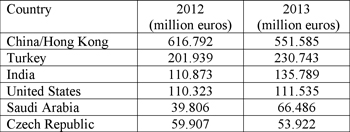
declining business in China. The following interesting table shows the development of German
textile machinery exports to the most important countries over a period from January to July for
2012 and 2013:

Turkey, India, the United States and Saudi Arabia show higher export volumes, with an overall
big jump in 2013. From January through July 2013, German textile machinery and accessories worth
1.8 billion euros have been exported.

Taking a closer look at the major destinations shows that China weakened in the first half of
this year. Shipping of German textile machinery and accessories to China decreased by 11 percent
year-on-year and reached approximately 552 million Euros. The exports to Turkey, a market that
already performed very well in 2012, increased again — by 14 percent to approximately 231 million
euros.

India Is Back

But also the Indian textile industry strikes back: After two weak years, the sector invested
much more during the first half of 2013, which resulted in German deliveries worth 136 million
euros — an increase of nearly 23 percent. And a former established textile nation is celebrating a
kind of comeback: the United States. The Rupp Report has already informed its readers about the
comeback of the U.S. textile industry some months ago
(See ”
The
Rupp Report: Astonishing Investment Climate In The U.S.
,”
TextileWorld.com, May 14, 2013)
. While the overall German textile machinery
exports to the U.S. — worth more than 111 million euros in the 2013 period — is just a small
increase, the shipping of spinning machinery nearly doubled year-on-year.

Positive Outlook

Strauch added that the latest incoming orders figures for the German textile machinery
industry increased by an encouraging 18 percent between January and August 2013 compared to the
respective period in 2012. “The high expectations of the VDMA member companies towards the export
performance indicate good business for the next months,” he said. And to end an interesting meeting
positively, he commented, “Regarding the good performance in this year, the VDMA sales forecast of
an increase of some 5 percent for 2013 proved to be realistic.” That is a promise for the future.

October 15, 2013

Sponsors