Interface Announces Expansion Of Credit Facility, Planned Bond Redemption, Share Repurchase Program And Preliminary Third Quarter Results

ATLANTA — October 7, 2014 — Interface, Inc. a worldwide carpet tile company and global leader in sustainability, today announced the consummation of an amendment of its existing syndicated facility agreement, effective October 3, 2014.  The amendment expands the aggregate borrowing availability for revolving loans under the credit facility from $200 million to $250 million, and provides new borrowing availability for a $200 million Term Loan A which may be used to repurchase or redeem, before December 31, 2014, the Company’s existing 7.625% Senior Notes due 2018 (the “Notes”).  The amendment also extends the maturity of the facility until October 3, 2019.  All other terms of the facility, including covenants, interest rates and fees, remain substantially unchanged from the existing facility agreement.

Planned Bond Redemption
The Company also announced its intention to redeem the currently outstanding $247.5 million aggregate principal amount of the Notes.  While the Company has not yet commenced the redemption, it expects to do so shortly and complete the redemption before the end of 2014.  The planned redemption is expected to require $266 million to $268 million, depending on the date of redemption, and to be funded through a combination of Term Loan A and revolving borrowings under the expanded credit facility, and cash on hand. It is estimated that the redemption would result in $12 million to $13 million in annualized interest savings, based on current interest rates.

Share Repurchase Plan
In furtherance of its capital allocation strategy, the Company also announced that its Board of Directors has authorized a program to repurchase up to 500,000 shares of common stock per fiscal year, commencing with the 2014 fiscal year.  It is anticipated that the share repurchase program will be funded through the Company’s cash on hand.  Purchases made pursuant to the program will be made in either the open market or in privately negotiated transactions from time to time as permitted by federal securities laws and other legal requirements. The timing, manner, price and amount of any repurchases will be determined by the Company in its discretion and will be subject to economic and market conditions, stock price, applicable legal requirements and other factors. The program does not require the Company to repurchase any specific number or amount of shares and may be amended, suspended or discontinued at any time in the Company’s discretion and without notice.

Preliminary Third Quarter Results
The Company also announced preliminary results for the third quarter ended September 28, 2014.  Based on preliminary data, the Company expects third quarter revenue to be in the range of $250 million to $255 million, compared with $255 million in the third quarter last year.  In addition, the previously announced pre-tax restructuring charge in the third quarter of 2014 has been increased to an aggregate amount of $12.5 million.  The charge is now comprised of approximately $9.5 million of cash expenditures, primarily for severance expenses, and approximately $3.0 million of non-cash charges for the write-down of the carrying value of impaired assets.  This restructuring plan is anticipated to be substantially completed by the end of 2014, and is expected to yield annual cost savings of approximately $14 million beginning in fiscal year 2015.  Excluding the restructuring and asset impairment charge, third quarter net income is expected to be between $8 million and $9 million, or $0.12 to $0.14 per diluted share.  In the third quarter last year, net income was $15.0 million, or $0.23 per diluted share.  Including the restructuring and asset impairment charge, the third quarter of 2014 bottom line result is expected to be between a net loss of $0.7 million and net income of $0.3 million, or $(0.01) to $0.01 per diluted share.  Orders received during the third quarter of 2014 were $262 million, compared with $255 million in the third quarter last year, and backlog at the end of the third quarter was up $33 million (or 33%) compared with the beginning of the year.

“We’re pleased with the amendment to our syndicated credit agreement, which gives us the opportunity to refinance our existing debt at a substantially lower interest rate,” said Daniel T. Hendrix, Chairman and Chief Executive Officer of the Company.  “These arrangements also will allow us to improve our capital structure by repurchasing shares of our common stock and thereby enhancing our earnings per share.”

Mr. Hendrix continued, “Unfortunately, our preliminary results in the third quarter have not shaped up to our expectations, starting with lighter than expected revenues primarily due to customer deferrals of order delivery dates, disruptions in yarn supply and lower order intake levels at the beginning of the quarter.  These factors brought about lower manufacturing throughput and increased margin pressure, prompting us to look for deeper cost cutting as part of our restructuring efforts and resulting in a charge that is larger than our previously announced estimate.  Most of the restructuring activities are within the SG&A line item, and have a payback period of less than a year, so we are currently targeting 2015 SG&A expenses to be in the neighborhood of $250 million.  Our restructuring and refinancing plans, along with our healthy backlog, should put us in a much improved operating and capital structure going forward.”

Third Quarter Conference Call
Interface intends to release its definitive third quarter 2014 results on Wednesday, October 22, 2014, after the close of the market.  Interface will host a conference call the next day, Thursday, October 23, 2014, that will be simultaneously broadcast live over the Internet.  Detailed information regarding the third quarter conference call will be announced by the Company at a later date.

Posted October 7, 2014

Source: Interface
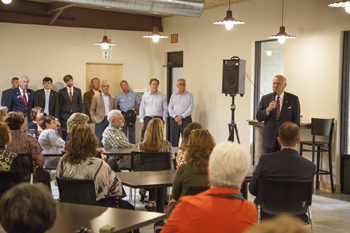
 

Georgia Governor Nathan Deal Visits Mohawk Flooring Center

CALHOUN, Ga. — October 7, 2014 — Earlier this week, Georgia Governor Nathan Deal toured the Mohawk Flooring Center in Calhoun, visited with individuals to learn more about their roles in the business and spoke to a large group of employees about the importance of the flooring industry in the state of Georgia.
 
Gov. Deal began his visit with a discussion with Mohawk Industries CEO Jeff Lorberbaum and members of the Company’s executive team. The governor reiterated his support of the industry and the importance it represents to the state’s economic well-being.
 
Later, Carpet segment president Brian Carson gave the governor a tour of the Flooring Center and then introduced him to a group of Mohawk employees. Carson highlighted Gov. Deal’s longstanding knowledge of the flooring industry and his support of Mohawk Industries.
 
This is not the governor’s first visit to Mohawk. Last year, Gov. Deal spoke at Mohawk facilities in Dalton, Summerville and Rome to highlight the Company’s investments in new manufacturing technologies and the creation of jobs at those locations. Throughout his remarks to the employees who filled the Flooring Center cafeteria, Gov. Deal shared his perspective about his past four years in office. He added that in 2014, the state’s revenues have grown 5.71% over fiscal 2013, the result of an economic rebound that the governor linked to job creation.
 
 “We’ve laid the proper foundation for continued job growth,” he explained. “For the last 12 months, Georgia ranks number 6 in the country in terms of total new jobs, and most of the states ranked ahead of us are twice or three times larger.”
 
Gov. Deal recognized the importance of the flooring industry to Georgia’s economic recovery. “We’ve seen thousands of new jobs that have already come online or have been announced, and Mohawk has been involved in many of those expansions,” he added.
 

Georgia Governor Nathan Deal speaks to employees at the Mohawk Flooring Center in Calhoun, Georgia.

Posted October 8, 2014

Source: Mohawk Flooring
 

NCC Commends Resolution Of Brazil WTO Dispute

MEMPHIS — October 1, 2014 — The National Cotton Council appreciates the U.S. government’s successful efforts to conclude the U.S.-Brazil trade dispute in the World Trade Organization through negotiation, thereby avoiding retaliation.

NCC Chairman Wally Darneille reiterated that the U.S. cotton industry has undertaken extensive efforts to resolve this case. He said the NCC offered comprehensive reform of cotton policy as part of the new farm law.

“The new U.S. farm bill includes several necessary changes to cotton policy and the GSM export credit program,” Darneille said. “When compared to previous programs, cotton policy is more market-oriented with the primary safety net conveyed through insurance products that must be purchased by the producer.”

“Officials from the Office of the U.S. Trade Representative and the Department of Agriculture are to be commended for reaching a comprehensive agreement that brings the dispute to a close,” Darneille stated. “With the conclusion of the case, the U.S. cotton industry can bring a renewed focus to the challenges that lay in front of us.”

Posted October 1, 2014

Source: National Cotton Council
 

AmeriPride Acquires Valley Industrial In Decatur, Alabama

TUSCUMBIA, Ala. — September 30, 2014 — AmeriPride Services Inc., a leading supplier of linen and uniform rental services in North America, today announced the acquisition of Valley Industrial in Decatur, Alabama. AmeriPride began servicing the new customers out of its Tuscumbia branch in mid-September under the leadership of Benjy Crenshaw, General Manager.
 
“We have been serving the local market in the Tuscumbia area for more than 50 years and this strategic acquisition gives us a chance to grow our business in a key market while introducing new products and services to our new customers,” said John Sutherland, SVP of U.S. Operations. “Our Tuscumbia branch has the capacity and resources to take on the additional volume, and I’m confident the operational and service leadership we have in place will facilitate a smooth transition.”
 
AmeriPride is incorporating customers into existing service routes and the company says they are looking forward to building strong business relationships with their new customers.
 
“Innovation, commitment to the customer and personalized service has sustained our family-owned business for 125 years,” said Sutherland. “We have a strong set of values that we live by and our customers appreciate that. This is demonstrated by our industry leading customer retention rate.”
 
AmeriPride helps businesses improve their image while keeping facilities clean and employees safe. Services include laundered linens and uniforms, facility care products and direct sale programs.
 
Posted October 1, 2014

Source: AmeriPride
 

Samson Debuts WarpSpeed® II

FERNDALE, Wash. — October 1, 2014 — Samson, the worldwide leader in performance cordage, introduces WarpSpeed® II today at authorized Samson retailers in the United States and Canada.  It replaces WarpSpeed, Samson’s flagship running rigging line for more than a decade. WarpSpeed II combines the great attributes of WarpSpeed® with added performance features, a trendy new look, and a value that both club and competitive racers appreciate.
 
WarpSpeed II outperforms lines made with standard high performance polyethylene (HMPE) in static applications due to its core, which is made of creep-mitigating Dyneema® SK78 fiber. The 24-strand polyester cover boasts a variegated color design, is flexible, provides good handling, enhanced abrasion resistance, and excellent performance in stoppers and clutches.  The Samthane-coated core is color coded to match the cover and accommodates cover stripping when racers need to save weight.  Racers and cruisers alike will enjoy the higher strength of smaller diameters and greatly reduced weight that takes the work out of trimming.
 
“We’re excited to bring WarpSpeed II to the sailing community,” said David Krupka, Regional Sales Manager.  “It is built on our reputation of high quality and great performance.  And what makes it even more attractive is that we are bringing it to the market at a better price than its predecessor, WarpSpeed.”
 
WarpSpeed II lives up to Samson’s standard for high performance products that can be trusted for safe and secure use around the boat as a halyard, mainsheet, spinnaker sheet/guy, jib/genoa sheet, or control line. It is available in six sizes from 1/4” – 9/16” in diameter and is available in four color options: variegated black, blue, green, or red with matching core.

Posted October 1, 2014

Source: Samson
 

The Dixie Group Retains Bob Kokoszka to Assist In Integration Of Burtco Enterprises, Inc.

CHATTANOOGA, Tenn. — October 1, 2014 — The Dixie Group, Inc. today announced that it has retained the services of former President and Chief Operating Officer of Burtco Enterprises Robert E. Kokoszka to assist Dixie in the integration process of the recently acquired assets of Burtco Enterprises, Inc., a maker of custom-crafted flooring designed for the hospitality industry.

Kokoszka earned a bachelor of science degree in engineering from Widener University in Chester, Pennsylvania, in 1965, and continued with graduate studies in engineering at Penn State University. His career began in 1958 at Aldon Industries in product development and manufacturing capacities. He has been an officer and board member of Regent Mills and Dorsett Carpet Mills. In 1990, he joined Burton Brown as a partner at Burtco Enterprises where he pioneered the utilization of computerized yarn placement (CYP) technologies for manufacturing patterned soft-surface floorcovering. Bob retired from Burtco in 2012.

Posted October 1, 2014

Source: The Dixie Group

United States And Brazil Reach Agreement To End WTO Cotton Dispute

WASHINGTON — October 1, 2014 — Today, U.S. Trade Representative Michael Froman and Secretary of Agriculture Tom Vilsack announced that the United States and Brazil have reached agreement to settle the longstanding Cotton dispute in the World Trade Organization (WTO). Under the terms of the agreement, Brazil will terminate the Cotton case, giving up its rights to countermeasures against U.S. trade or any further proceedings in this dispute. Brazil has also agreed not to bring new WTO actions against U.S. cotton support programs while the current U.S. Farm Bill is in force or against agricultural export credit guarantees under the GSM-102 program as long as the program is operated consistent with the agreed terms. 
 
“I am pleased that the United States and Brazil have found a permanent resolution to the Cotton dispute,” said Ambassador Froman. “Today’s agreement brings to a close a matter which put hundreds of millions of dollars in U.S. exports at risk. The United States and Brazil look forward to building on this significant progress in our bilateral economic relationship.”
 
“Through this negotiated solution, the United States and Brazil can finally put this dispute behind us,” said Secretary Vilsack. “Without this agreement, American businesses, including agricultural businesses and producers, could have faced countermeasures in the way of increased tariffs totaling hundreds of millions of dollars every year. This removes that threat and ensures American cotton farmers will have effective risk management tools.”
 
Background
The Cotton dispute is a decade-long dispute brought by Brazil against the United States at the WTO.  In 2005 and again in 2008, the WTO found that certain U.S. agriculture programs (domestic support to cotton under the marketing loan and countercyclical payment programs, and export credit guarantees under the GSM-102 program) were inconsistent with the United States’ WTO commitments.  In August 2009, WTO arbitrators provided the level of countermeasures that Brazil could impose against U.S. trade.
 
In June 2010, the United States and Brazil signed a Framework Agreement to avert the imposition of countermeasures by Brazil against the United States that at the time would have affected approximately $800 million of U.S. trade, including U.S. intellectual property rights.  The Framework provided specific interim steps and a process for quarterly discussions on the programs at issue.  The United States also made monthly payments to the Brazil Cotton Institute for technical assistance and capacity building activities for the sector under a related Memorandum of Understanding (MOU).  During discussions under the Framework over the past four years, Brazil and the United States worked on the elements of a settlement to the dispute, including changes to the operation of the GSM-102 program and changes to cotton domestic support programs.  The Framework expired on February 7, 2014, when the 2014 Farm Bill was enacted.  The Farm Bill included significant changes to U.S. cotton domestic support programs, along with changes to the GSM-102 program.
 
Over the last several months, the United States and Brazil have held intensified discussions to resolve the dispute.  Today, the two governments have reached an agreement that provides for formal termination of the Cotton case at the WTO Dispute Settlement Body within 21 days.  Brazil will also relinquish all rights to countermeasures against U.S. trade.  Other terms and conditions are contained in a MOU that includes new rules governing the fees and tenor for guarantees under the GSM-102 Program, a final transfer of funds to the Brazil Cotton Institute, and limitations on new disputes against U.S. cotton domestic support programs and the GSM-102 program. 
 
The 2014 MOU provides for additional support for the technical assistance and capacity building activities begun under the 2010 Memorandum of Understanding.  The United States will make a one-time final contribution of $300 million to the Brazil Cotton Institute, or IBA.  The 2014 MOU also provides for additional uses for the funds, such as research in conjunction with U.S. institutions.

Posted October 1, 2014

Source: USTR
 

Tencate Advanced Composites Plan For Growth And Expansion With UK Centre Of Excellence

NOTTINGHAM, United Kingdom — October 1, 2014 — TenCate Advanced Composites, a leading global composite materials company, announce plans for the growth and expansion of equipment and facilities at their manufacturing facility in Langley Mill (Nottingham), United Kingdom, as part of their growth strategy. The UK plant will be a centre of excellence for thermoset chemistry systems serving the EMEA region. The substantial investment will bring additional capability and capacity for fabric and UD based products, which are ideally suited to serving existing markets like Formula 1 motorsport, automotive and industrial markets. 
 
Additionally, the upgrade will emphasise TenCate customer commitment to support markets such as space, satellites, radomes and select aerospace high temperature end-user applications. Following the acquisition of Amber Composites in January 2013, the company has set out the strategies and plans that will support growth within its target markets and build on a strong portfolio of legacy products with proven capability. This includes the heritage TenCate AmberTool® HX-series of tooling prepregs and pre-impregnated materials for the high performance automobile markets. The UK facility of TenCate Advanced Composites and the additional increase of both capacity and capability is scheduled to be ready mid 2015.
 
Centre of Excellence
Nick Tiffin, Sales and Marketing Director of TenCate Advanced Composites EMEA says: ‘This is very exciting time for the Langley Mill business which has been producing composite materials for over 25 years. Our strategy and plans to grow the business clearly demonstrate our long term commitment to the market and we look forward to being able to service existing and new customers with both prepreg and honeycomb products in the coming years. We clearly see the need for investment in Europe and balancing our manufacturing technology capability and capacity with the North American activities of TenCate, which has itself seen significant growth in previous years’.
 
Posted October 1, 2014
 
Source: TenCate Advanced Composites Europe 


The Rupp Report: The Other Way Round

Usually every element in the whole production chain tries to put the responsibility and stock on the shoulders of “the next one.” For decades, and not only in the textile industry, just-in-time is the magic phrase, and nobody wants to play the bank for any customer, keeping a big stock to be ready for quick deliveries. Many so-called experts claim that only with less as much bounded money a company can survive. In the global textile industry, these are mostly the case for consumer goods, and only to certain extend for tailor-made products. But how does one define his company policy if he’s producing some consumer goods, but also tailor-made products?
 
The Rupp Report recently visited Kuny AG in Kuttigen, Switzerland, which is celebrating 100 years in business. This ribbon manufacturer and narrow weaver goes exactly the opposite way: Serving the customer, even for small lots; and “be ready for any request” is the credo of the company. Central points of success include its extensive range of finished products and stock availability. Particularly important, is the fact that the company is a fully integrated producer. Some 100 people are employed by Kuny, and many employees have worked for the company for 20 years or longer. Back in 1945, the enterprise built a welfare institution for the employees. But first some background …
 
A Bit Of History
In the summer of 1914, Hans Kuny-Thommen laid the foundation for today’s Kuny. Things began with a few looms, and the company struggled through difficulties caused by World War I. Initially, cotton tapes and ribbons for slippers were produced. In the mid-1930s, the first products were exported to Belgium and Holland. Despite World War II, the company continued to prosper. Kuny produced 140-centimeter-wide plush fabrics for linings, upholstery and seat covers. However, this division closed in 1964, and production was then focused on narrow fabrics and ribbons.
 
Over the following decades, the company grew specializing in high-class ribbon manufacturing. Since the mid-1960s, up to 90 percent of total sales have been exported — 55 percent in the European Economic Community countries (forerunner of the European Union), 20 percent in the European Free Trade Association States and the remaining 25 percent overseas. In 1964, the year the company celebrated its 50th anniversary. During that period in the 1960s, Kuny produced some 8 million meters of ribbons every year.
 
Company-Owned Dye House
Another important step to success, was adding velvet ribbon production for the fashion industry. For this purpose and for the first time in the history of the company, a separate continuous ribbon dyeing line was established in 1965. Today, more than 90 percent of all ribbons are dyed using the continuous process.
 
In 1978, thanks to its ongoing success, Kuny enlarged its premises with a new weaving hall and a new office building. With the increased importance of polyester, a dyehouse for polyester products was built in 1982, followed by a new warehouse in 1987. These products have formed an important cornerstone of the company’s success for many decades. Fashion demands in the 1990s, led printed ribbons to become more and more important. Seeing a new market opportunity, Kuny set up its own printing shop.
 
 
Hook-And-Loop Fasteners
In the mid-1970s, international patents for hook-and loop fasteners, commonly known by the brand name “Velcro,” had expired. At the beginning of the 1970s, Gottfried Kuny-Scherrer, the father of Hans Georg Kuny, developed the so-called “mushroom tape”, a product that became quickly a top seller for Kuny. In terms of adhesion, mushroom tapes have advantages compared to traditional hook-and-loop fasteners. In many application areas, the ribbons sold like hotcakes — which is still the case today.
 
A Growing Group
With the acquisition of Germany-based silk ribbon manufacturer Seidenbandweberei Säckingen GmbH in 1975, the company took an important step into the European market. Another step towards the European market was made in 1992, with the acquisition of United Kingdom-based ribbon manufacturer Berisfords Ltd. These acquisitions were followed in 2002, by the takeover of a very traditional Switzerland-based company, Bally Band AG. During those years, Kuny had an export share of more than 90 percent.
 
To secure a supply of quality yarns for its products, Kuny acquired Bäumlin & Ernst AG, one of the top yarn and twist producers in Switzerland. With its sister company Berisfords, the group now had a second fully integrated production facility.
 
The Key To Success
At a press conference prior to the jubilee event with handpicked customers and suppliers, Kuny CEO René Lenzin and Chairman of the Board Hans Georg Kuny mentioned that the company generally is working with sales representatives all over the world. Thanks to an extensive global clientele in countries from Europe to the United States to Japan and even Australia, current sales decreases in Europe were absorbed mostly by these overseas markets. The Rupp Report spoke with customers from Europe and Japan at the event and they all said that Kuny with its excellent service and quality cannot be compared to any other ribbon manufacturer in Europe, or even the world. One customer mentioned if he orders before lunchtime, the delivery is made the same day.
 
Kuny’s product range is characterized by a variety of articles and colors. The four main ribbon types are velvet, satin, grosgrain and printed. In satin ribbons, approximately 100 colors are available from stock in 9 different widths. At the press conference, the Rupp Report asked about minimum quantities. Lenzin said the minimum run for special products is 500 meters. “However,” he said with a smile, “we can also produce 500,000 meters.”
 
Fully Integrated Value Chain
The Kuny Group is well positioned for today and into the future. With its various companies, it has a fully integrated value chain, which is linked ideally in terms of technical level and market handling. In order to further improve internal logistics and to optimize production processes, the company replaced some old sheds over the past 12 months. The new building was completed just in time for the anniversary celebration. “With this new building structure on the one hand, it was possible to improve and streamline operating procedures,” said Lenzin. “And on the other hand, thanks to cutting-edge insulation, we can save as much as 28,000 liters of fuel oil per year.”
 
Overcoming Hard Times
The financial crisis of 2008 represented an enormous challenge, reported Hans Georg Kuny. The year 2009 was decisive for a safe future of the company: At that time, Kuny AG, with its group of companies was brought into a holding company. For the Kuny Group, continuity of the company was always a top priority. That’s why the Kuny family has realigned ownership in the same year. Current shareholders are René Lenzin, Dr. Niklaus Honauer and Hans Georg Kuny.
 
Bright Future
Over the past fiver years, a lot of money was invested in a modern computer science solutions. These substantial expenditures on infrastructure help to ensure smooth and problem-free order processing.
 
In the industry of narrow fabrics, the Kuny Group is recognized as a reliable international problem solver. And this will continue, according to company representatives Lenzin and Kuny: “We want to consolidate our top position in the market with moderate and safe growth and guarantee absolute delivery reliability. Therefore, we constantly optimize our machinery. To respond flexible to market and customer needs, throughput times and work management are permanently reduced and customer services further perfected.” And the end of the press conference, Kuny said: “Other suppliers outsourced their production by accepting a lower quality. We did the contrary — we invested in better machinery and personnel, resulting in better quality and customer reliability. That’s why we look very positive heading into the future.”

September 30, 2014


Ahlstrom Introduces Ahlstrom VaporCool™, Dynamic SMS Fabric For Single-Use Scrubs

HELSINKI, Finland — September 30, 2014 — Ahlstrom, a global high performance fiber-based materials company, introduces Ahlstrom VaporCool a soft SMS (Spunbond-Meltblown-Spunbond) fabric treated with adaptive technology to create a smart fabric designed for conversion into single-use surgical scrub suits.
 
Ahlstrom VaporCool is a soft, textile-like, dynamic fabric that offers outstanding comfort. Worn in direct contact with the skin, the fabric works as an extension of the wearers’ body helping to regulate their body temperature. When hot, the fabric boosts evaporation providing a cooling effect. When cool, the fabric holds in moisture acting as an insulating layer.
 
The first fabric of its kind, VaporCool uses moisture management to offer enhanced comfort to surgical professionals. Working under bright lights and dressed in high-barrier surgical apparel, surgeons operate under intense pressure for hours. These conditions cause their body temperature to rise, increasing the production of sweat. Discomfort caused by feeling hot and sticky can quickly shake concentration and impair cognitive abilities. Ahlstrom VaporCool works with the body to relieve discomfort and improve concentration.

Posted September 30, 2014

Source: Ahlstrom
 

Sponsors